

Not all multivitamins are vegan. Standard formulations may contain hidden animal-derived ingredients such as gelatin, lanolin-based vitamin D3, and beeswax, so parents need to check the full label and look for clear vegan certification rather than assuming a vitamin is plant-based.
You're standing in the pharmacy aisle with your child, comparing colourful bottles and chewy gummies. The front label says “multivitamin”, perhaps with pictures of fruit and smiling children, but the ingredient panel uses unfamiliar terms that don't immediately reveal where each ingredient came from.
That confusion is understandable. “Multivitamin” describes the nutritional purpose of a product, not its ethical or animal-free status. A supplement can contain several vitamins and minerals, be legally supplied in Australia, and still use animal-derived ingredients in its capsule, coating, colour, flavour system, or nutrient source.
Table of Contents
- The Reality of Vegan Multivitamins for Kids
- Hidden Animal Ingredients in Standard Supplements
- Decoding TGA Labels and Australian Regulations
- Comparing Gummies, Capsules, and Tablets
- Nutritional Safety Nets for Plant-Based Diets
- How to Audit and Choose Verified Vegan Products
- Building a Consistent and Positive Daily Routine
The Reality of Vegan Multivitamins for Kids
A parent might reasonably expect a children's multivitamin to be vegan if it contains nutrients associated with plants. The product may include vitamin C, beta-carotene, mineral salts, or fruit flavours, yet the complete formulation can still include a non-vegan excipient. Excipients are the supporting ingredients that give a product its shape, texture, colour, stability, or taste.
That means the answer to “are multivitamins vegan?” is no, not automatically. Some are vegan by formulation, while others rely on animal-derived materials that don't appear prominently on the front of the pack.
Why the front label can mislead
“Plant-based”, “natural”, and “vegetarian-friendly” aren't interchangeable with vegan. A vegetarian product might exclude meat but still contain gelatin, dairy-derived ingredients, beeswax, or other animal inputs. Even a product marketed as a children's health supplement may need a closer inspection if the brand doesn't explain the origin of every active and inactive ingredient.
Consider two products with the same delivery format. Both might be orange-flavoured gummies containing vitamin C and zinc. One could use pectin for its chewy structure, while the other uses gelatin. The nutritional panel may look similar, but the products aren't equivalent for a vegan household.
Practical rule: Treat vegan status as a formulation claim that needs verification, not as a characteristic of the word “multivitamin”.
Australian families have a genuine reason to seek clearer plant-based choices. In a survey of 997 vegan, vegetarian, and flexitarian shoppers from Australia and New Zealand, nearly 40% said they bought vegan healthcare products such as vitamin supplements “always” or “often”, while over half wanted more vegan products in supermarkets and restaurants. The findings, reported by The Vegan Society, show meaningful interest, but they don't mean every supplement on a shelf is vegan.
The safest starting point is simple. Turn the bottle around, read the active and inactive ingredients, and check the manufacturer's explanation of the formulation. If the source of a nutrient or processing aid isn't clear, contact the brand or ask a pharmacist before giving it to your child.
Hidden Animal Ingredients in Standard Supplements
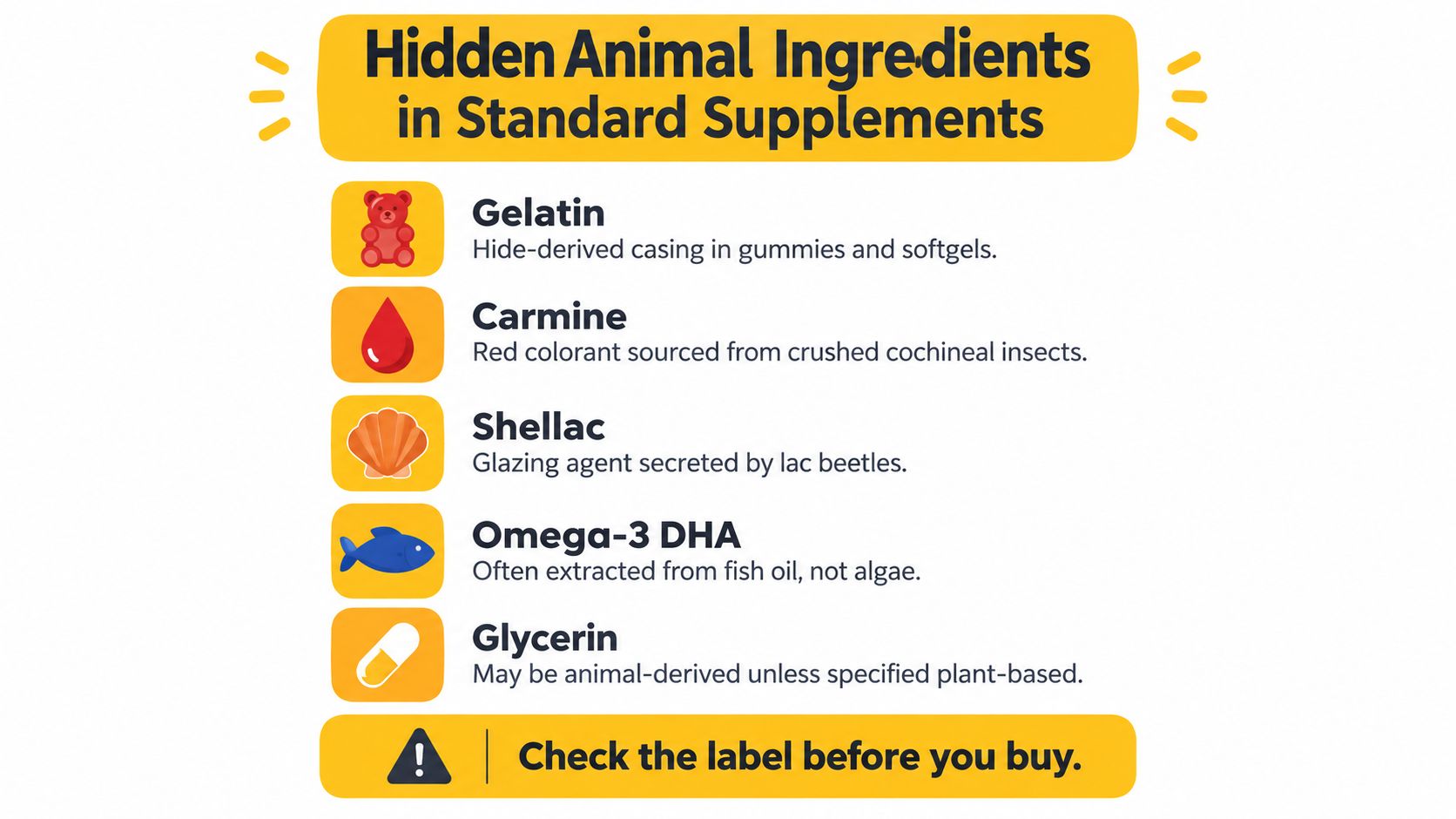
Animal-derived ingredients often have practical manufacturing roles. Gelatin can create a springy gummy texture or form a soft capsule shell. Shellac can create a smooth, glossy coating. Beeswax may help bind or polish a product. These ingredients can be functional without being obvious from the product name.
The same principle applies to active nutrients. Vitamin D3 is commonly made from lanolin, a substance derived from sheep's wool grease. A vegan formulation may instead use a plant-associated source such as lichen-derived D3, but the label needs to say so clearly. “Vitamin D3” alone doesn't identify the source.
Ingredients parents should recognise
Gelatin is one of the most common concerns in children's supplements. It's made from animal collagen and may appear in gummy bases, softgels, or capsule shells. If a label lists gelatin without a plant-based alternative, the product isn't vegan.
Carmine, also called cochineal or carminic acid in some ingredient systems, is a red colourant made from insects. A bright red or pink gummy isn't necessarily non-vegan, but parents should verify the colour source rather than infer it from appearance.
Shellac is a resin associated with lac insects and is used as a glazing or coating agent. It can make tablets or chewables look polished and help protect the surface. The term may sit among the excipients rather than beside the vitamin names.
Beeswax can be used in coatings, binders, or manufacturing processes. It comes from bees, so it doesn't fit a strict vegan formulation even though it isn't a dairy or meat ingredient.
Glycerin needs clarification. It may be made from vegetable oils or animal fats, and the label may not always identify the origin. Ask whether the glycerin is plant-based if the manufacturer hasn't stated this.
Omega-3 products also deserve scrutiny. DHA may come from fish oil, while algae-derived DHA provides a vegan alternative. Don't assume that a product is vegan because its multivitamin component is plant-based. Every active ingredient and excipient needs to fit the same standard.
For a product example, Brave is described by its manufacturer as a vegan-friendly children's multivitamin gummy with kid-friendly flavours and textures, no artificial colours or flavours, and essential vitamins for general wellbeing. Even with a clear product claim, parents should still read the current package and ingredient information because formulations can change.
Decoding TGA Labels and Australian Regulations
Australian supplement labels add another layer of information that parents need to understand. The Therapeutic Goods Administration, or TGA, regulates vitamins as therapeutic goods. The TGA explains that most vitamins are listed medicines, rather than products assessed before market entry for every therapeutic claim.
A listed medicine must use pre-approved ingredients and approved low-level indications. Its label should display an AUST L, AUST R, or AUST L(A) number. The number matters because medicines without the required approval number may not be legally supplied in Australia, as explained in the TGA's guide to how vitamins are regulated in Australia.
That regulatory number answers a compliance question. It doesn't answer the vegan question.
A practical label check
Use the label in this order:
- Find the Australian approval number. Look for AUST L, AUST R, or AUST L(A). If the required number isn't present, stop and ask a pharmacist or the TGA for clarification before buying.
- Read the active ingredients. Check vitamin D3, omega-3 DHA, vitamin B12, and any other nutrient where the source can vary. “D3” doesn't automatically mean lichen, and “DHA” doesn't automatically mean algae.
- Read the excipients. Look for gelatin, shellac, beeswax, carmine, and unspecified glycerin. These ingredients may determine whether the entire product is vegan.
- Compare the brand's vegan statement with the ingredient list. A front-of-pack claim is useful, but transparent brands should explain the formulation and identify plant-based sources where they matter.
- Check the product, not just the brand. One product line may be vegan while another uses a different capsule, gummy base, colourant, or nutrient source.
The Australian Register of Therapeutic Goods entry for a vegan-labeled multivitamin illustrates how a formulation can use plant-based actives such as beta-carotene and cyanocobalamin, mineral salts, and cellulose-based tablet materials instead of gelatin. The ARTG also records a product explicitly named “Vegan Vitamin D” entered on 8 May 2023, showing that vegan-labelled vitamin medicines exist as a distinct category, not as the default meaning of “multivitamin”.
Parents considering B12 can also use this guide to vitamin B12 supplements in Australia, then discuss a child's diet and supplement needs with a GP or accredited practising dietitian. Registration and vegan status are separate checks, and nutritional suitability is a third.
Comparing Gummies, Capsules, and Tablets
The delivery format can reveal potential vegan issues before you've studied every nutrient. It can also create a practical difference for children, because a supplement only helps if a child can take it consistently and safely.
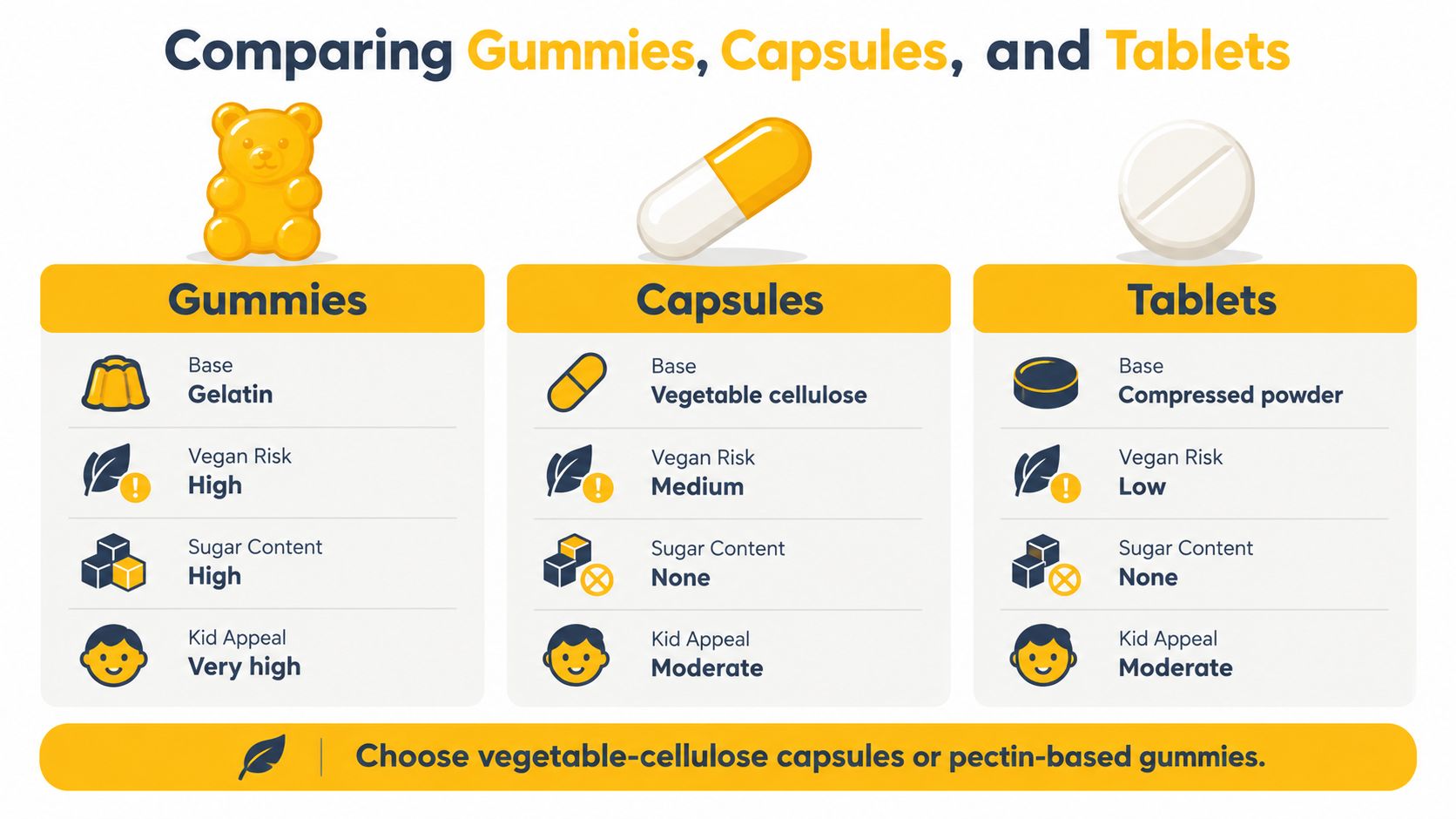
Gummies often have the strongest child appeal because they're soft, chewy, and flavoured. Their texture may come from pectin, tapioca starch, or gelatin. They can also include glazing agents, colours, flavour carriers, and sweeteners that require their own checks. A fruit flavour or natural colour doesn't confirm vegan status.
Capsules may use a hard shell made from vegetable cellulose, but many traditional capsules use bovine or porcine gelatin. The active powder inside can be entirely plant- or mineral-derived while the outer shell remains non-vegan. Softgels deserve particular care because their flexible shell and carrier oils may use animal-derived materials.
Tablets are compressed powders, but that doesn't make them automatically vegan. Manufacturers may use stearic acid, coating agents, colourants, or polishing materials whose source varies. A plain-looking tablet still needs a full excipient check.
Format and label questions
| Format | What to check | Why it matters |
|---|---|---|
| Gummies | Pectin or gelatin, glazing agents, colours, flavour carriers | The gummy matrix can contain non-vegan ingredients even when the vitamins are plant-based |
| Capsules | Vegetable cellulose versus gelatin, capsule lubricants, carrier oils | The shell and delivery materials are part of the product |
| Tablets | Stearic acid, shellac, coatings, binders, colourants | Compressed formats can still use animal-derived processing aids |
Gummies also need a nutrition check. Some contain sugar or sweeteners, and the base may be designed for taste rather than a simple daily routine. Parents who want to compare texture, ingredients, dosing directions, and child suitability can read this guide to multivitamin gummies for kids.
The most reliable format is the one that satisfies three conditions: the full formulation is verified vegan, the nutrient profile suits the child, and the child can take it as directed. A vegetable-cellulose capsule isn't automatically better than a pectin gummy, and a gummy isn't automatically healthier than a tablet. The format should serve the child, not replace label checking.
Here's a closer look at the practical difference between these forms:
Nutritional Safety Nets for Plant-Based Diets
A parent may find a vegan-labelled multivitamin, then wonder whether the child needs it every day. Vegan describes the product's ingredients and processing, not its place in the child's care plan. That plan depends on the child's usual diet, growth, health history, fortified foods, and advice from a qualified health professional.
A product registered with Australia's TGA is not automatically vegan. Registration concerns the medicine's quality, safety, and permitted claims. Parents still need to check the active ingredients, excipients, and processing aids. A registered product can meet regulatory requirements while containing an animal-derived ingredient, so regulatory status and vegan status answer different questions.
Vitamin B12 deserves particular attention. Healthdirect advises people following a strict vegan diet to take a B12 supplement and identifies B12 as the nutrient that diet cannot reliably provide without supplementation. A vegan multivitamin can act as a convenient safety net, provided its B12 form and amount suit the child's age and circumstances.
Australian evidence shows why this deserves a practical conversation rather than vague reassurance. In a New South Wales study of 14 to 17-year-olds, 8.2% of vegetarians had serum B12 below 148 pmol/L, compared with 0.9% of non-vegetarians, while 22.4% of vegetarians, compared with 9.4% of non-vegetarians, fell into the 148 to 222 pmol/L range, according to the Australian children's vegan nutrition resource summarising this research.
Nutrients that need a deliberate plan
B12 is only one part of the assessment. Food choices and variety may also make these nutrients worth discussing:
- Iodine, particularly if the family does not use iodised salt or suitable fortified foods.
- Iron, especially when meals contain few iron-rich plant foods or absorption-supporting combinations.
- Zinc, which may be harder to plan when food variety is limited.
- Vitamin D, where dietary intake, sun exposure, health status, and the product's source all matter.
Use a multivitamin to support a varied diet, not to cover a very restricted menu without professional guidance. Check for duplication with other supplements and fortified foods.
A 2022 study of Australian vegan women of reproductive age found that 23% used a multi-nutrient supplement as their only supplemental source of vitamin B12, as reported in the same Australian children's vegan nutrition resource summarising this research. Children have different requirements, so follow the label's age directions and seek individual advice from a clinician.
How to Audit and Choose Verified Vegan Products
A good audit doesn't depend on recognising every chemical name. It uses several checks that support one another. Start with the current bottle in your cupboard, because an old purchase may have a different formulation from the product now shown on the manufacturer's website.
A repeatable cabinet audit
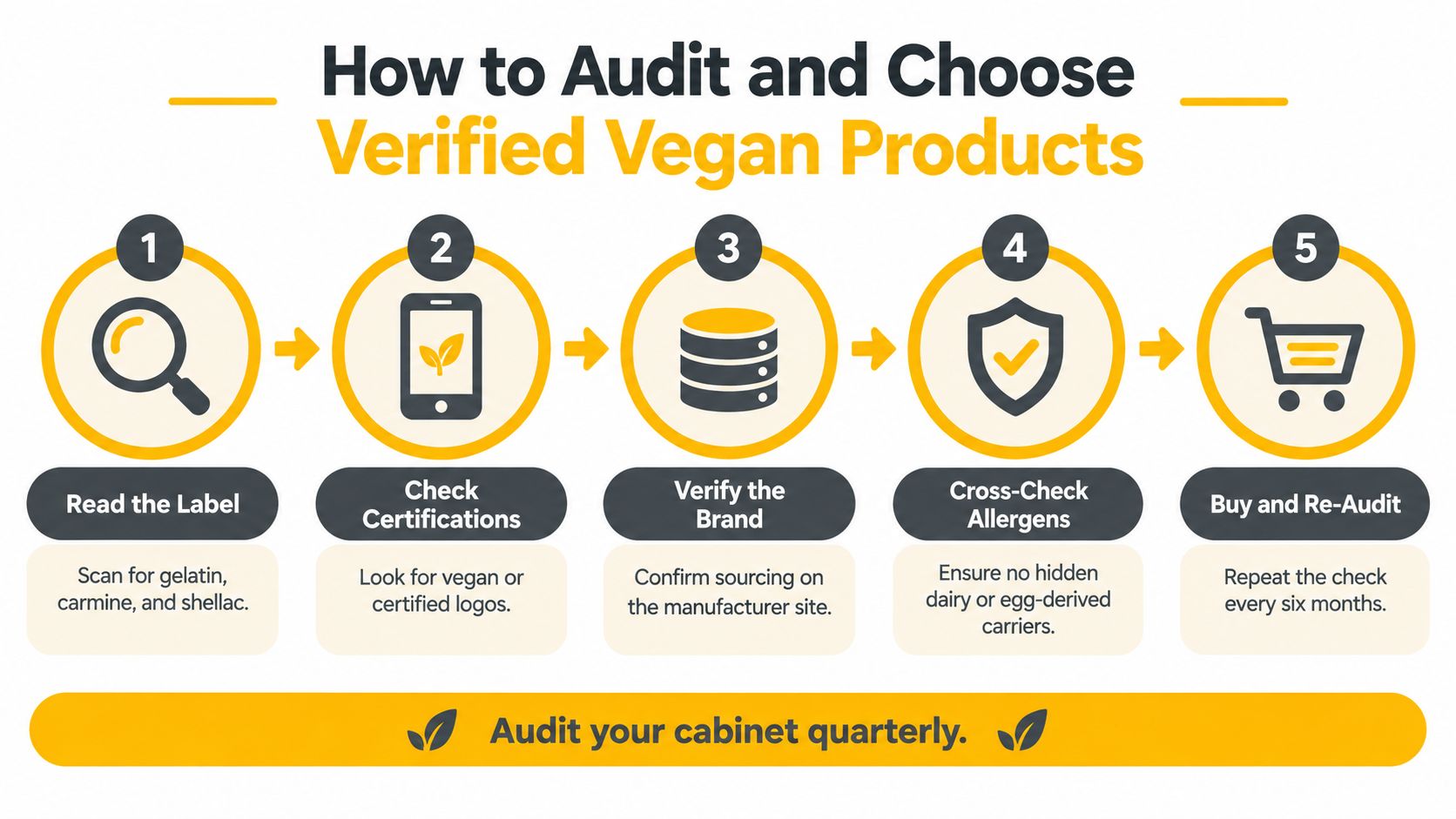
Step 1, read the full label. Scan the active ingredients and excipients. Search specifically for gelatin, shellac, carmine, beeswax, lanolin, and unspecified glycerin.
Step 2, look for meaningful verification. A recognised vegan certification or a clear manufacturer statement is stronger than a vague image of leaves or fruit. Check whether the claim applies to the exact product and format.
Step 3, verify variable nutrient sources. Ask where vitamin D3 comes from. If the product contains DHA, confirm whether it comes from algae or fish oil. Don't accept an unexplained “plant-based” statement as proof for every nutrient.
Step 4, check the child's nutritional context. Compare the product with other supplements, fortified foods, and the child's usual diet. If your child follows a strict vegan diet, grows slowly, has digestive symptoms, or has a known deficiency, speak with a GP or accredited practising dietitian.
Step 5, assess daily usability. Look at texture, flavour, age directions, storage, and whether your child can take the product without pressure. A perfectly formulated supplement is not useful if it consistently stays untouched.
A brand that publishes full ingredient and dosing information makes this process easier. Parents should still review the package each time they repurchase, particularly if the product name, flavour, format, or manufacturer has changed.
The difference between vegan and merely plant-themed marketing often appears in the small print. For a plain-language explanation of what multivitamins are intended to do and how families can think about them, see what a multivitamin is.
Label-reading habit: Save a photograph of the current ingredient panel on your phone. If the packaging changes, compare the new panel rather than relying on memory.
Building a Consistent and Positive Daily Routine
The right vegan multivitamin should fit into family life without turning nutrition into a daily argument. Children are more likely to cooperate when parents offer a predictable time, explain the purpose in simple terms, and allow an age-appropriate choice, such as taking the supplement before breakfast or after brushing teeth.
Taste and texture matter, but they aren't the whole decision. Parents should balance child acceptance with the ingredient list, nutrient profile, age guidance, approval information, and advice from a health professional. A soft gummy may suit a child who refuses chalky tablets, while another child may prefer a small capsule that doesn't taste sweet.
A positive routine also avoids exaggerated promises. A multivitamin can support nutrient intake where it's needed, but it won't replace varied meals, adequate sleep, medical care, or a dietitian's plan for a confirmed deficiency. Keep the language practical: “This helps us look after your body,” rather than suggesting the supplement will create confidence, concentration, or health on its own.
Parents can make the routine child-led without making the supplement optional every day:
- Keep it in a consistent, adult-supervised place.
- Follow the label's directions rather than improvising the serving.
- Don't describe gummies as lollies.
- Review the product if your child's diet, health, or medications change.
- Ask for professional advice if you're unsure whether a multivitamin is necessary.
The main lesson is straightforward. A vegan multivitamin must be vegan in its entire formulation, not just in its vitamin sources. Check the Australian approval number, inspect the excipients, verify D3 and DHA sources, and choose a product your child can use consistently.
Daily Powers offers Australian children's gummy supplements designed around everyday routines, including the vegan Brave daily multivitamin gummy for general wellbeing. Visit Daily Powers to review current ingredient lists, dosing guidance, and the range of vegan formulations before choosing a product for your family.