

Everyone says to buy the best magnesium supplement brand Australia can offer by starting with the salt form. That advice is backward. For a child, the key question is not whether a label says glycinate, citrate, or oxide, it's whether the product shows elemental magnesium clearly, fits the child's age, and stays within Australian supplement limits without turning bedtime into a battle.
| Quick comparison point | What matters most |
|---|---|
| Age fit | The dose must match the child's age band, not an adult routine. |
| Elemental magnesium | This is the number that counts, not the weight of the compound. |
| Upper limit | Younger children need a tighter ceiling than older children. |
| Routine fit | A product only works if your child will actually take it every day. |
| Label transparency | Clear dosing, warnings, and serving instructions matter more than hype. |
For Australian families, the smartest filter is blunt: ignore the marketing noise, read the elemental dose, and judge the product against your child's actual daily intake. The Australian Bureau of Statistics reported that in 2023, 31.3% of Australians aged 2 years and over had an inadequate magnesium intake from food and beverages, but among children aged 2 to 11 years, inadequacy was below 5.0% (ABS usual nutrient intakes). That does not mean magnesium never helps a child, it means you should use it selectively, not automatically.
Table of Contents
- Magnesium Intake in Australian Children: What the Data Shows
- Decoding Labels and Elemental Magnesium Limits
- Essential Criteria for Evaluating Kids Supplements
- Comparing Formulations and Daily Adherence
- Building a Consistent Evening Wind Down Ritual
- Navigating Subscriptions and Household Logistics
- Final Recommendations and Common Parent Questions
Magnesium Intake in Australian Children: What the Data Shows
Parents are sold magnesium as a catch-all fix. That framing is too broad for children. The stronger case starts with intake patterns, not marketing claims.
National magnesium inadequacy fell from 34.9% in 2011–12 to 31.3% in 2023, and the drop was notable for adolescent boys and girls alike (ABS usual nutrient intakes). That change matters because it shows the national picture is improving, even before you focus on a child's individual diet. It also keeps the conversation honest, since a supplement should answer a real need, not a vague fear.
For younger children, the same ABS release points to a different pattern. Among children aged 2 to 11 years, inadequacy was below 5.0%, which is far lower than the headline figure many supplement ads want parents to remember. I treat that as a warning against routine, one-size-fits-all use. If a brand talks as if every child is depleted, it is selling pressure, not a sensible nutrition message.
Practical rule: use magnesium for a clear reason, not because a label suggests every child needs extra support.
What the ABS data shows
The useful takeaway is simple. Children are not a single magnesium-deficient group, and the national figures do not support blanket supplementation. A child with a reasonably varied diet is a different case from a child with a narrow food pattern, poor intake, or a household routine that makes food changes hard to sustain.
That is why food-first stays the right default. Magnesium can still make sense when a child's eating pattern is limited or when parents need a measured option they can give consistently. The point is to match the product to the child, not the other way around.
Who benefits from a supplement
A supplement has the most value when daily food intake is weak, repetitive, or hard to improve quickly. That often includes picky eaters, children who cycle through the same few foods, and families building a calmer evening routine after busy days. It can also help when parents need a simple dose that fits into bedtime without turning the whole night into a negotiation.
The standard should stay strict. Magnesium is not a reward, and it is not a sleep shortcut. It is a nutrient, so the dose has to fit the child's age and the family's routine.
If you are checking whether a product makes sense, start with the child's diet, then compare the label against age-appropriate dosing guidance in the paediatric dosing guidance. If food already covers the basics, keep supplementation conservative.
Decoding Labels and Elemental Magnesium Limits
The label trick that confuses most parents is simple. A brand can print a big number for the compound weight, while the child receives far less elemental magnesium. If you don't separate those two figures, you can't compare products properly.
Read the active amount, not the compound weight
Elemental magnesium is the number you should compare across brands. That's the usable magnesium content, not the total weight of magnesium glycinate, citrate, oxide, or any other bound form. A supplement can sound generous on paper and still deliver a modest amount of the mineral itself.
That distinction matters because Australian guidance is age-specific. The Australian Nutrient Reference Values set supplement upper limits of 65 mg/day for children aged 1–3, 110 mg/day for children aged 4–8, and 350 mg/day from age 9 onward (magnesium nutrient reference values). For younger children, the 110 mg/day ceiling is the tighter benchmark, so that's the number I'd treat as the hard stop when comparing kids' products.
| Australian Supplemental Magnesium Upper Limits by Age | ||
|---|---|---|
| Age Group | Upper Limit (mg/day) | Key Considerations |
| Children 1–3 | 65 | Keep supplemental exposure low and deliberate. |
| Children 4–8 | 110 | This is the tighter benchmark for younger kids. |
| Age 9 and older | 350 | Higher ceiling, but total intake still matters. |
Why the label structure matters more than the salt name
Parents often get distracted by the salt name. That's a mistake. Saying “magnesium glycinate” or “magnesium citrate” tells you the form, but it does not tell you whether the dose is appropriate for your child's age, diet, and other supplements. A well-designed label should put the elemental magnesium figure where you can see it fast, then give clear serving instructions.
I'd also want the label to explain the maximum daily servings and whether the product is meant for younger children, older children, or adults. That is the practical safety check. If a product doesn't make the dose easy to compare with the age limit, it's not parent-friendly, and it's not transparent enough for a child's routine.
The Australian government's nutrient guidance also shows why food still matters. Everyday foods can contribute meaningful magnesium, and a child's supplement should be viewed beside the rest of the diet rather than in isolation. If you want a rule that keeps you out of trouble, use this one: elemental magnesium first, age limit second, compound name last. For a routine-focused use case, see the magnesium and sleep guide.
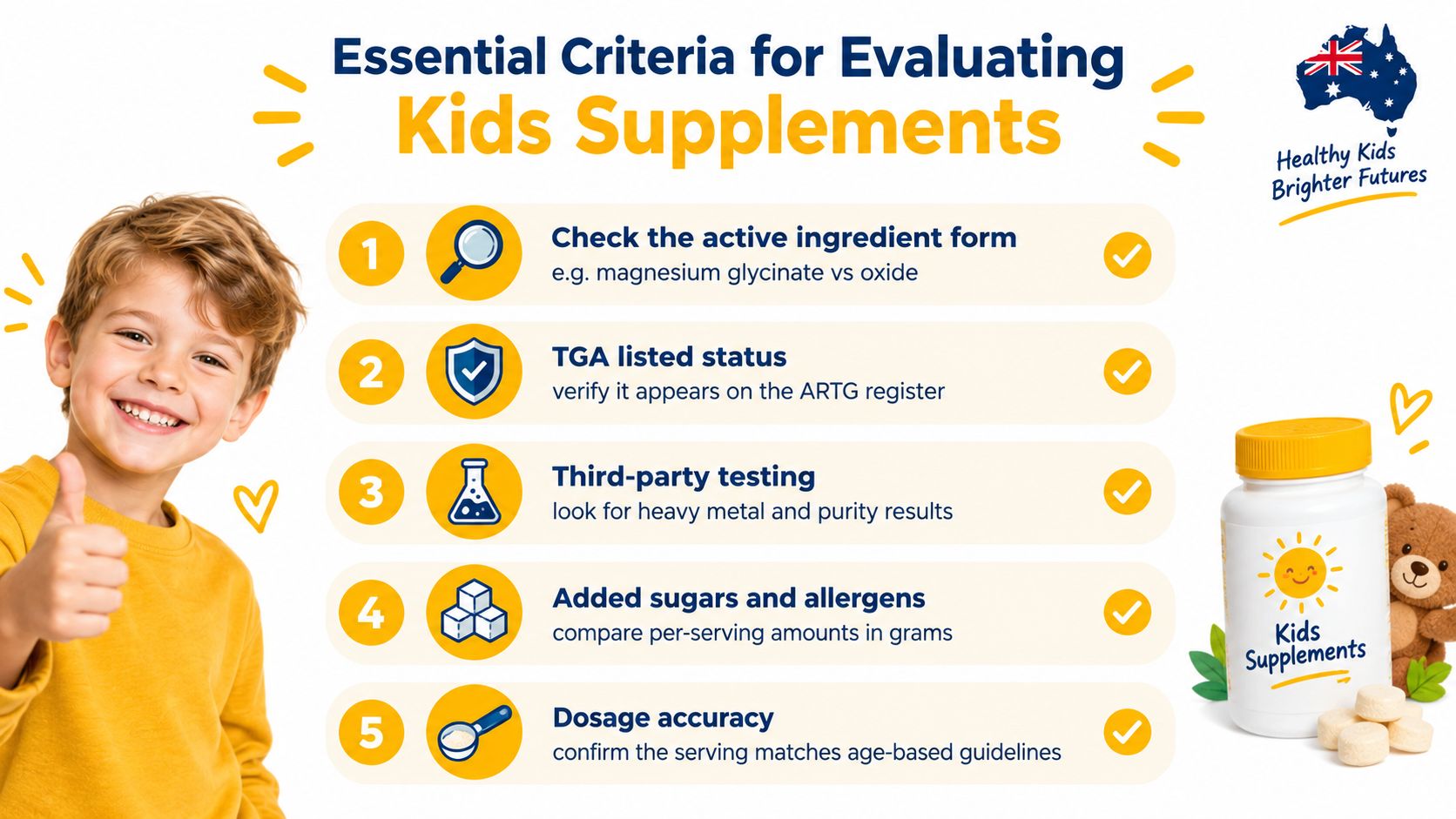
Essential Criteria for Evaluating Kids Supplements
Don't buy a children's supplement because the front label looks calming. Buy it because the product is regulated, the dose is clear, and the formula doesn't sabotage your evening routine with junk.
Start with regulatory status
In Australia, vitamin and mineral products are commonly regulated as listed medicines when they meet the relevant requirements, and they generally must be entered in the Australian Register of Therapeutic Goods before legal supply (TGA listed medicines). That doesn't mean the TGA individually assesses every listed product before release, so parents still need to read the label closely. It does mean the brand should be operating inside a real regulatory framework, not free-styling on social media.
Then check what's inside the gummy, tablet, or powder
A clean children's formula should be easy to inspect. Look at the ingredient list, the sweeteners, and the allergen statements before you get attached to the flavour. A supplement that works on paper but becomes a fight at the dinner table is a bad product for family life.
Rule to keep in mind: if the label is hard to decode, the product is asking you to trust too much.
For magnesium specifically, I want three things in a kids' product. First, the dose must be legible. Second, the serving must line up with the intended age range. Third, the inactive ingredients shouldn't create another problem, especially for families trying to keep evenings calm and predictable. The form of delivery matters because children don't live in theory, they live in routines.
Use a fast pre-purchase checklist
- Check the active amount: Confirm the label shows elemental magnesium per serving, not only the compound weight.
- Match the age band: Make sure the serving suits the child's age and doesn't drift into adult territory.
- Review the additives: Avoid formulas loaded with unnecessary sweeteners, colours, or fillers.
- Inspect the label language: Look for plain serving directions, warnings, and practical use guidance.
- Confirm the routine fit: Choose a format your child can take consistently without resistance.
The best product is the one that stays usable after the novelty wears off. That's why packaging clarity and ingredient simplicity matter. If the dose is appropriate but the delivery format creates drama every night, the product fails in everyday use.
Comparing Formulations and Daily Adherence
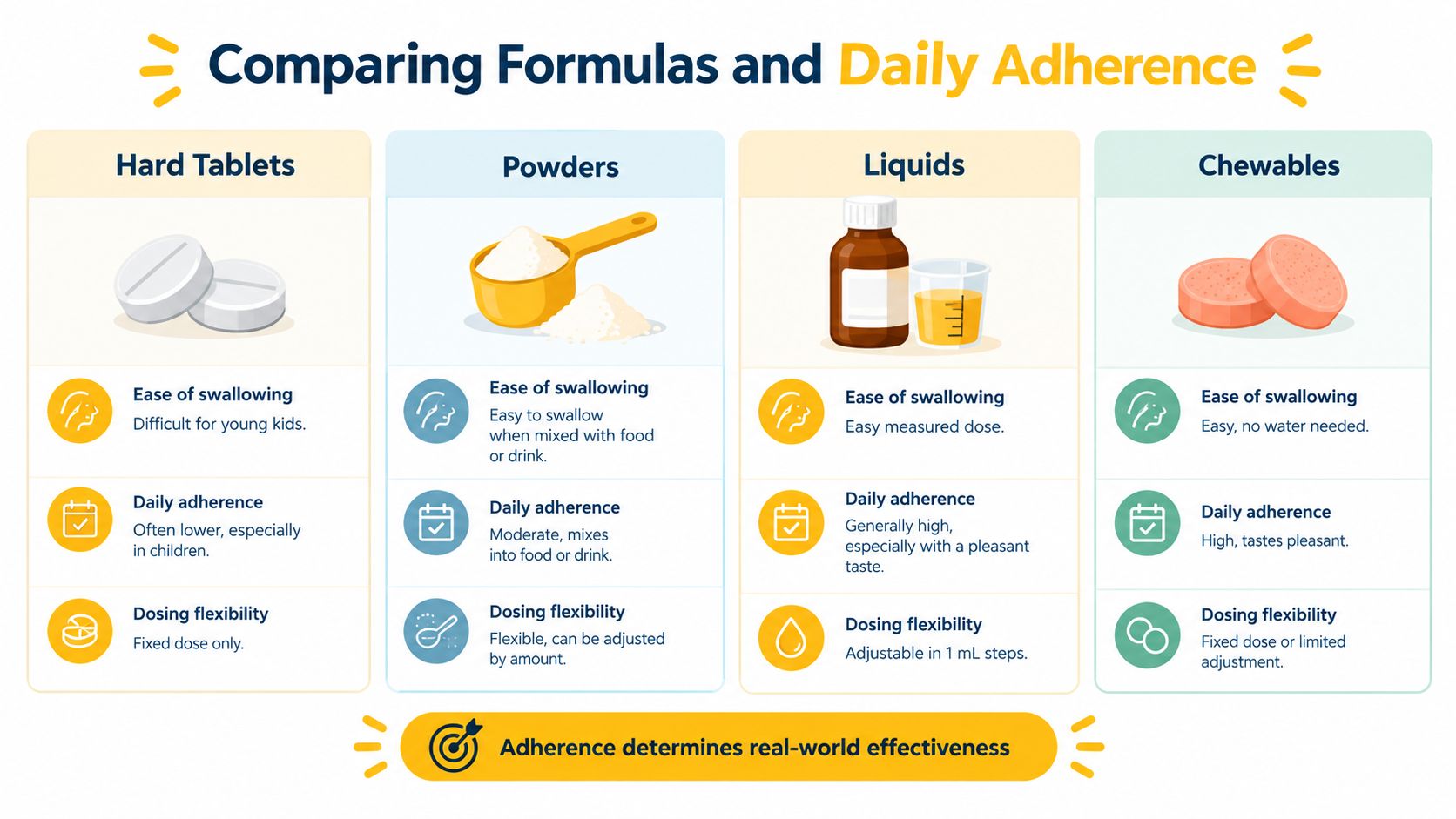
A supplement doesn't help if it stays in the cupboard. That's why format matters just as much as the ingredient itself. For children, the winner is usually the product that causes the least friction and gets taken without negotiation.
Hard tablets and powders aren't automatically wrong
Hard tablets suit some older children, especially if they already swallow tablets well. They're often straightforward from a dosing perspective, but they can be a poor fit for younger children or any child who resists pills. Powders can be useful if you want to mix a dose into food or a drink, but the trade-off is that you need a habit strong enough to handle preparation every day.
Liquids can look convenient, but they only help if the taste, measuring, and clean-up stay manageable. If a parent has to measure carefully every night and then negotiate around the flavour, the product becomes a chore. Consistency beats novelty every time.
Chewables make the daily job easier
Chewables and gummies are often the most realistic option for children who dislike swallowing tablets. The advantage is obvious, the child can take them quickly, and the routine feels less medical. That matters because daily adherence is what turns a supplement from a purchase into a habit.
A good chewable still has to be judged properly. I'd rather see a sugar-free, clearly dosed gummy than a prettier product that hides its active amount or leans on sugary syrup behaviour. Daily compliance depends on whether the child accepts the format without protest, not on how impressive the bottle looks on a pharmacy shelf.
A child's supplement routine should feel boring in the best possible way. Fast, clear, repeatable.
That is why a soft, zero-sugar chewable can outperform a technically respectable tablet. The format reduces resistance, and that matters when the household is tired, rushed, or already dealing with school stress. If you need a practical example of a routine-friendly kids' magnesium product, Daily Powers Calm is a magnesium-based grape gummy with a sugar-free, vegan format designed for wind-down use.
Building a Consistent Evening Wind Down Ritual
The right magnesium product should support a routine, not sit beside one. I've seen enough family evenings to know the problem usually isn't knowledge, it's friction. A child who's overstimulated at 6.30 pm won't thank you for a capsule that feels clinical and inconvenient.
A routine works better than a one-off dose
A parent needs a cue the child recognises. That cue can be the same flavour, the same time, the same place at the kitchen bench, or the same sequence of steps before brushing teeth. The supplement becomes part of the ritual, not the whole ritual.
The child's mood matters here. If the product tastes pleasant and is easy to chew, it stops feeling like a correction and starts feeling like a normal part of the evening. That lowers resistance, which is often the primary barrier to consistency.
Here's the part parents should be honest about: magnesium won't compensate for a chaotic night. Dim the lights, reduce the noise, put away the screens, and then use the supplement as one predictable cue inside a broader wind-down pattern. The calmer the routine, the easier it is for the child to repeat it.
Keep the product and the routine aligned
If your child hates tablets, don't buy tablets because they look more serious. If they reject syrup, don't force a liquid because it seems “stronger”. The best format is the one your child will accept calmly without a nightly argument.
The phrase “daily habit” sounds soft, but it's the whole game. Once the child associates a specific flavour and texture with bedtime, the product becomes easier to deliver and easier to remember. That's how a supplement earns its place in family life.
If you want a product type that fits that logic, a gummy can be the simplest way to keep the evening smooth, especially for children who prefer a sweet, familiar cue over a tablet. The more ordinary the routine feels, the more likely it is to stick.
Navigating Subscriptions and Household Logistics
Most supplement routines fail because parents run out, forget, or lose momentum. That's a household problem, not a nutrition problem. The easiest way to fix it is to choose a buying model that supports the routine instead of depending on memory.
A subscription is the cleaner option for families who know they'll use the product regularly. It removes the gap between finishing one pack and getting the next one, which is exactly where habits unravel. The subscription guidance is worth reading if you want to compare the logistics before committing.
Why automatic replenishment helps
A child's supplement only works if it's available on the night you need it. Automated deliveries reduce the chance that a parent forgets to reorder after a busy week or a school holiday disruption. That matters more than many parents admit, because consistency is what gives the routine any chance of becoming normal.
Subscriptions also suit picky eaters better than one-off purchases. If the child rejects the texture or flavour, a flexible pause or skip option gives you room to adjust without turning the trial into waste. That's a practical, low-drama way to test fit in daily life.
Trial the routine without overcommitting
A satisfaction guarantee changes the risk profile. It lets parents try a new formulation with less anxiety about buying a full bottle that no one wants to finish. For a kids' product, that's not a gimmick, it's sensible product design.
I'd treat subscriptions as the default if the brand offers flexible management and clear household controls. Use one-off purchases only when you are not sure or need to confirm that the child accepts the flavour. If the routine is already proving itself, automatic delivery makes more sense than repeated last-minute pharmacy trips.
The main point is simple. You're not just buying magnesium, you're buying a system that helps the family remember, repeat, and finish what it started. The easier that system is to manage, the more likely the supplement becomes part of the household rhythm.
Final Recommendations and Common Parent Questions
If you want the best magnesium supplement brand Australia can offer for a child, ignore the loudest claims and focus on the simplest proof. The right product shows elemental magnesium per serving, fits the child's age, stays within the appropriate upper limit, and is easy enough to give every day without a fight. That's the shortlist, and anything outside it is noise.
My decision rule for parents
- Choose age-first dosing: The product should suit the child's age band before it suits your preferences.
- Check elemental magnesium: This is the only number that tells you what the child receives.
- Prefer plain labelling: If the label is vague, I'd pass.
- Demand routine fit: The format should be something your child will take.
- Avoid overbuilt formulas: More ingredients doesn't mean more usefulness.
The TGA's tolerability information also gives parents a useful safety lens. It notes that about 250 mg/day of elemental magnesium was well tolerated in human studies, while diarrhoea became more evident at around 360 mg/day or higher, and it identifies 110 mg/day as the supplement upper limit for children aged 4–8 and 350 mg/day for people aged 9 and older (TGA consultation on permissible ingredients). For children, especially younger ones, that makes careful dosing essential.
If a child gets loose stools, the dose is probably too high for that child's routine or age band.
Parents also ask how long magnesium takes to “work”. That depends on what they're expecting. If the goal is better routine compliance, you'll notice that first. If the goal is a calmer evening, the routine around the product matters as much as the product itself. Magnesium is not a magic switch, and I wouldn't treat it like one.
Another common question is whether it can sit alongside a multivitamin or medicines. Sometimes it can, sometimes it shouldn't, especially if the child already takes multiple supplements or has gastrointestinal symptoms. Kidney disease changes the conversation too, so that's a case for professional advice rather than guesswork. When in doubt, ask a pharmacist or clinician before layering products.
For Australian families who want a clear, routine-friendly option with transparent guidance, Daily Powers focuses on child-appropriate gummy supplements that fit into everyday habits. If you're ready to compare a magnesium-based kids' product with a subscription-friendly routine, visit Daily Powers and read the label as carefully as you'd read the dosage on any children's health product.