

The breakfast decision can feel deceptively complicated. Should you serve yoghurt, choose a fortified cereal, pour a plant-based milk, or reach for a children's multivitamin because your child's bones are growing so quickly? The useful answer isn't to treat calcium and vitamin D3 as competing choices. They work as a partnership, with calcium supplying the structural material and vitamin D3 helping the body absorb and use it.
For most families, strong bone habits start with ordinary meals, a varied diet, and attention to a child's individual risk factors. Supplements can have a place, especially when a clinician identifies a gap or a child belongs to a higher-risk group, but suspected deficiency calls for professional assessment rather than high-dose self-treatment. This guide applies an Australian lens to the relationship between calcium and vitamin D3, changing calcium needs through childhood, food-first routines, and safer supplement decisions.
Table of Contents
- Why Bone Health Takes a Nutrient Partnership
- How Calcium and Vitamin D3 Work Together
- Calcium Needs Across Childhood
- Food Sources and Supplement Options
- Building a Food-First Family Routine
- Understanding Deficiency Risks in Australian Children
- How Caregivers Can Choose and Use Supplements Safely
- Key Takeaways for Strong Bones
Why Bone Health Takes a Nutrient Partnership
At breakfast, a parent might choose yoghurt for calcium, fortified cereal that may provide vitamin D, or a multivitamin for broader coverage. The child experiences one meal. Their body depends on a steady supply of nutrients that work together over time.
Calcium is the mineral framework in bones and teeth. Vitamin D3 helps the body absorb calcium from food and make it available for its needs. Calcium supplies the material, while vitamin D3 helps the body handle that material. A routine that overlooks either part may leave bone support incomplete.
Bones are living tissue. They are continually built, maintained, and remodelled. Childhood and adolescence provide an important opportunity to establish helpful habits, because the skeleton has substantial mineral demands while the body grows.
Australian clinical guidance states that vitamin D helps the body absorb calcium and phosphate from food. Very low vitamin D can contribute to rickets, low calcium, and severe symptoms such as seizures in young children. The Royal Children's Hospital vitamin D deficiency guidance identifies a serum 25(OH)D level below 27.5 nmol/L as consistent with deficiency in infants, neonates, and young children.
Practical perspective: A nourishing routine comes from repeated meals, not one perfect breakfast or a single supplement choice.
This partnership also changes how caregivers assess everyday decisions. Calcium needs vary with age, food choices can make both nutrients easier or harder to provide, and a supplement may address a confirmed gap rather than replace a varied diet. A child who misses one serve does not usually need an emergency response. Suspected deficiency, higher risk, or concerning symptoms call for medical advice, testing where appropriate, and supervised treatment instead of high-dose self-treatment.
How Calcium and Vitamin D3 Work Together
How do calcium and vitamin D3 work together in a child's body? Calcium supplies the mineral material used in the skeleton, while vitamin D3 helps the body absorb and regulate that material. Strong bone support depends on both roles working together.
Calcium is stored mainly in bones. As children grow, the body continually builds, maintains, and remodels bone tissue. Milk, yoghurt, cheese, calcium-fortified alternatives, tofu, some fish with edible bones, nuts, seeds, and selected vegetables can all contribute calcium. The amount absorbed differs between foods, so a calcium value on a label does not show the full amount the body will use.
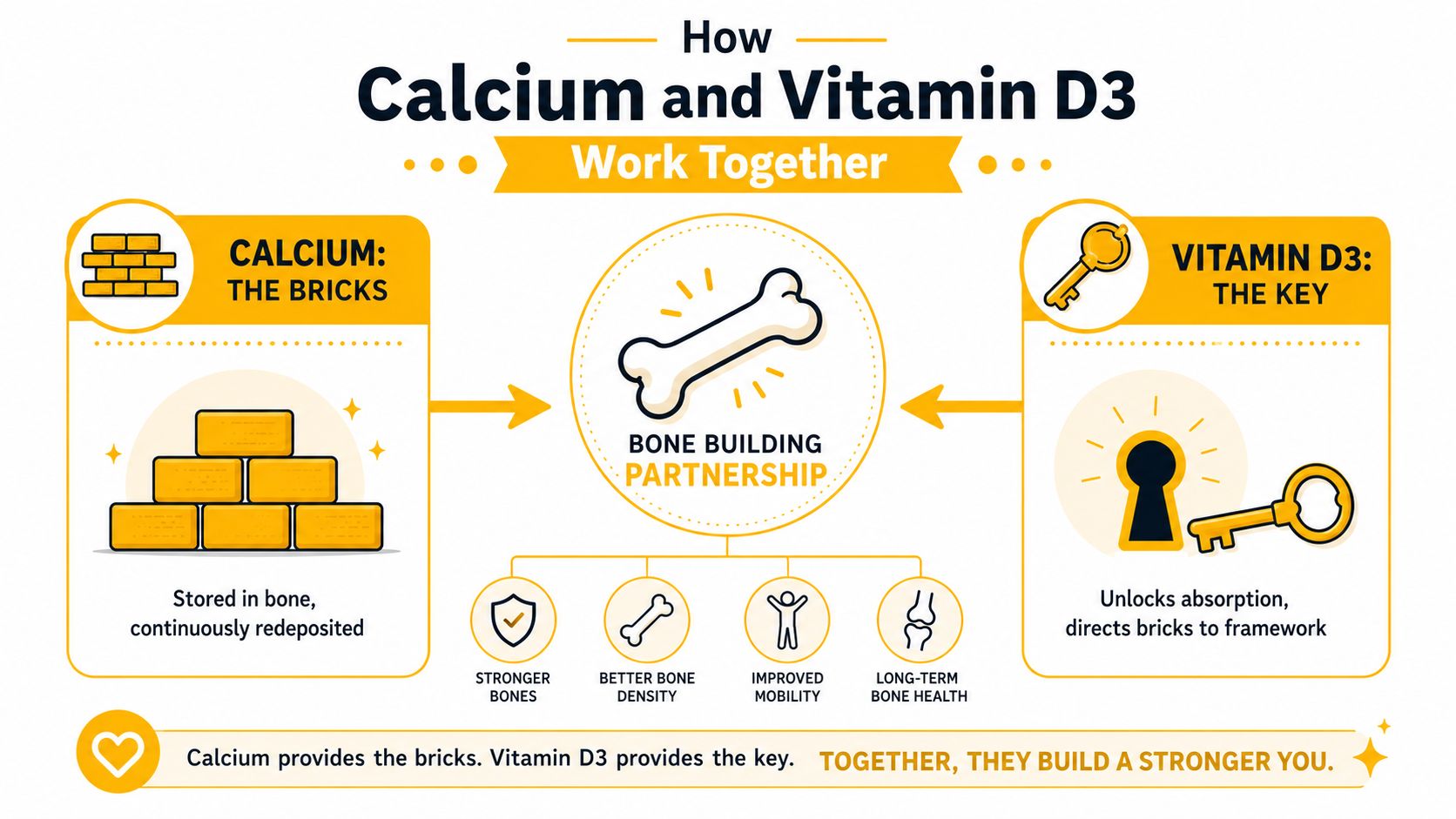
Vitamin D3, also called cholecalciferol, supports the process that moves calcium from food into the body. It is converted into active forms that help regulate calcium and phosphate. In practical terms, calcium is the building material, and vitamin D3 helps the body make that material available for use.
Step one, provide calcium
A child may drink a calcium-fortified beverage yet eat very little variety overall. Another child may have dairy foods regularly while still having factors that make vitamin D status a concern. Reviewing both nutrients gives caregivers a clearer picture than counting calcium alone.
Step two, support absorption
Australian clinical guidance explains that vitamin D helps the body absorb calcium and phosphate from food. Very low vitamin D can also be associated with low calcium and serious symptoms, including muscle cramps or seizures in severe cases. As noted earlier, suspected deficiency should be assessed with medical guidance rather than treated through high-dose self-supplementation.
Step three, match support to the child
Extra calcium cannot correct poor vitamin D status, and vitamin D3 cannot supply calcium when the diet provides too little. The partnership works best when children receive regular calcium-containing foods and vitamin D intake or supplementation suited to their age and individual risk.
A supplement is not automatically needed because one meal lacks calcium or a child spends less time outdoors on a particular day. Caregivers should consider the overall food pattern, growth, sun exposure, medical history, and advice from a healthcare professional. Everyday nutrition can usually begin with a varied, food-first routine, while suspected deficiency or higher risk calls for professional assessment.
Calcium Needs Across Childhood
Calcium needs rise as children grow, with the steepest demands appearing during school-age years and adolescence. The Australian and New Zealand Nutrient Reference Values, summarised in the NHMRC nutrient reference intakes document, provide age-based reference points for planning nutrition.
| Life Stage | Age Range | Adequate Intake (mg/day) | Practical Family Meaning |
|---|---|---|---|
| Early infancy | 0–6 months | 200 mg/day | Calcium needs are met through the infant's usual milk feeding pattern, with individual feeding advice where needed. |
| Later infancy | 7–12 months | 270 mg/day | Continue age-appropriate milk feeds while introducing varied complementary foods. |
| Early childhood | 1–3 years | 360 mg/day | Offer calcium-containing foods regularly across meals and snacks rather than relying on one large serve. |
| School-age childhood | 4–8 years | 520 mg/day | Build a dependable pattern around dairy or fortified alternatives and varied meals. |
| Later primary years | 9–11 years | 800 mg/day | Growth and activity make regular calcium-rich choices increasingly important. |
| Adolescence | 12–18 years | 1,000 mg/day | The reference intake rises sharply during a period of rapid skeletal growth. |
| Adolescent recommended dietary intake | 12–18 years | 1,300 mg/day | This higher recommended dietary intake reflects the mineral demands of growth and bone formation. |
The figures are population reference values, not automatic supplement prescriptions. A child's individual intake may vary from day to day, and a single low-calcium day doesn't define their nutritional status. A weekly pattern is more useful: look for regular opportunities to include calcium at breakfast, in snacks, and at main meals.
Infancy also needs careful interpretation. The reference values above describe calcium intake, while vitamin D3 has its own age-based prevention guidance. Australian policy recommends vitamin D supplementation for all infants from birth to 12 months at 400 IU/day, and for at-risk people over 12 months at 600 IU/day, according to the Australian Medical Journal guidance on vitamin D deficiency. Those recommendations aren't interchangeable with calcium targets.
The rapid rise through adolescence explains why a teenager who previously managed a limited diet may need a closer look at food variety. Growth rate, dietary restrictions, absorption, and sun exposure all affect the practical picture. Caregivers don't need to calculate every meal perfectly, but they should take persistent gaps seriously, particularly during a growth spurt.
Food Sources and Supplement Options
Food is usually the simplest starting point because it can provide calcium alongside protein and other nutrients. Dairy staples such as milk, yoghurt, and cheese are practical choices, while calcium-fortified plant-based milks and some breakfast cereals can help families managing dairy-free diets. Tofu, leafy vegetables, nuts, seeds, and canned fish with edible bones can contribute too, although the calcium in some oxalate-rich greens is less absorbable than calcium from dairy or fortified products.
Vitamin D3 is harder to obtain consistently from food alone. Fatty fish, egg yolks, and fortified milk or spreads may contribute, but natural food sources are limited. Sun exposure also varies with season, location, skin type, clothing, and time spent outdoors, so a child's risk can't be judged from a general assumption that they play outside.
| Nutrient | Common Food Sources | Typical Serving Provides | Supplement Format Options |
|---|---|---|---|
| Calcium | Milk, yoghurt, cheese, fortified alternatives, tofu, fish with edible bones, nuts, seeds, selected vegetables | Varies by food and product label | Chewables, liquids, combined children's formulations, or standalone calcium products |
| Vitamin D3 | Fatty fish, egg yolks, fortified milk, fortified spreads | Usually limited and dependent on fortification | Drops, liquids, chewables, gummies, standalone D3, or combined multivitamins |
“Typical serving provides” can't be reduced to one universal figure because products differ. Check the nutrition panel for calcium content and the supplement panel for vitamin D3 per serve. For calcium products, look for elemental calcium, which describes the actual calcium supplied rather than only the weight of the compound used.
A broad children's multivitamin may contain a modest amount of vitamin D3 alongside other nutrients. A standalone vitamin D3 product offers more targeted use when a clinician or a clearly identified dietary gap calls for it. Calcium supplements should also be age-appropriate, especially because large doses can be unnecessary when food already supplies enough.
Calm is a magnesium gummy rather than a calcium or vitamin D3 supplement. Its listed ingredients include magnesium citrate, vitamin B6, zinc, and prebiotics, so it shouldn't be treated as a replacement for a calcium-rich food or a vitamin D3 product.

For broader context on choosing children's formulations, caregivers can read this guide to the best vitamins for kids. The key is to match the product to the nutritional question, not to buy several overlapping products because each has a different label.
Building a Food-First Family Routine
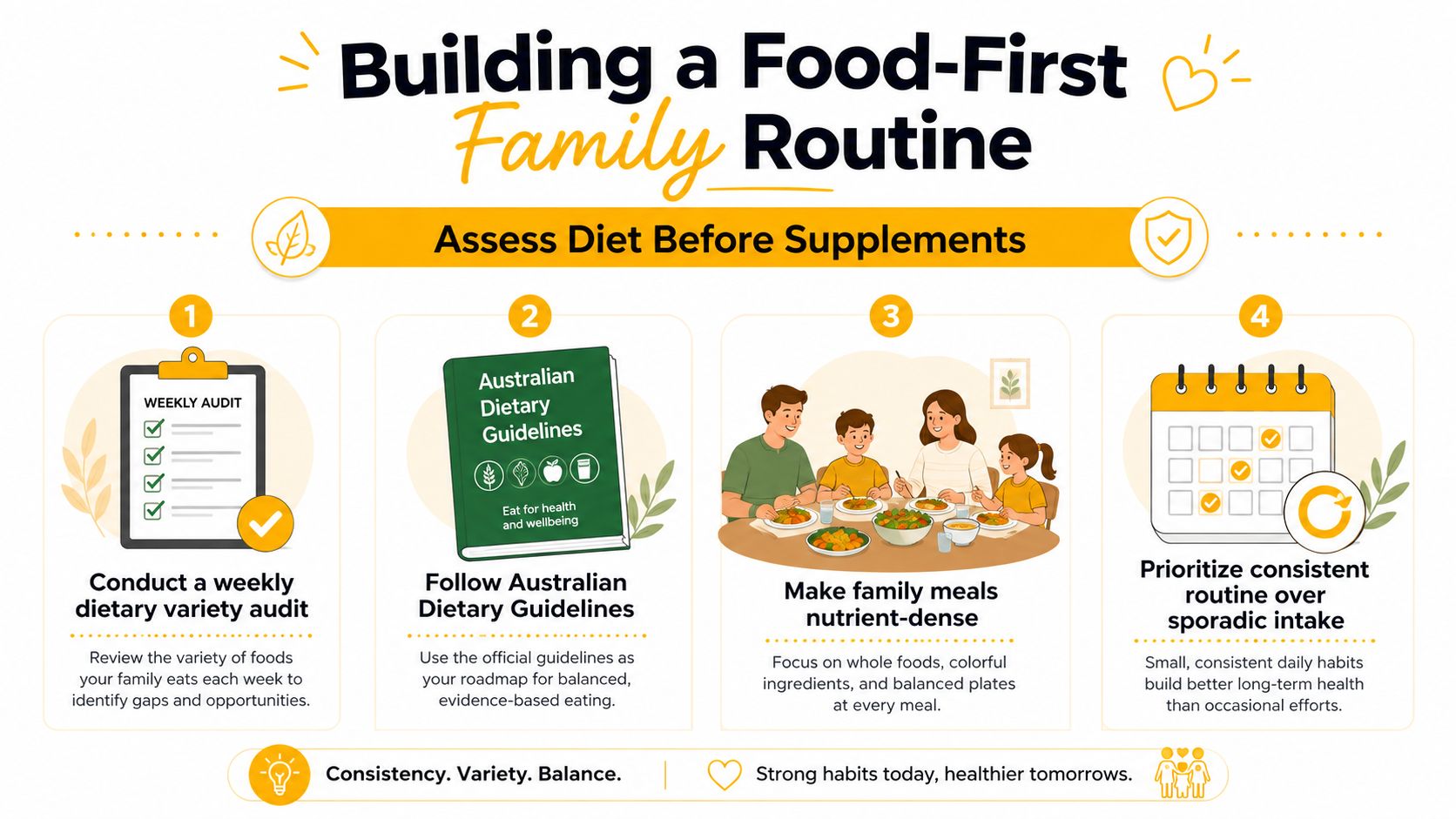
A food-first routine doesn't mean every meal must be optimised. It means caregivers check the child's usual pattern before adding supplements as nutritional insurance.
Start with a simple weekly audit. Was there a calcium-containing option at breakfast? Did snacks include yoghurt, cheese, fortified foods, or another suitable choice? Did main meals contain varied protein and plant foods? This approach helps identify a repeated gap without making children responsible for calculating nutrients.
Try a few low-pressure systems:
- Rotate familiar breakfasts: Keep three reliable options in circulation, such as yoghurt with fruit, fortified cereal with milk, or calcium-fortified toast toppings where suitable.
- Prepare one easy snack: A ready-to-eat calcium source in the fridge can make the better choice the easier choice.
- Audit labels together: Check whether a plant-based milk or cereal is calcium-fortified and whether vitamin D3 has been added.
- Use meals, not megadoses: A supplement doesn't compensate for a narrow diet, and doubling a children's product doesn't double its value.
Sunshine deserves the same measured approach. Outdoor time can be healthy, but it doesn't guarantee adequate vitamin D3 status for every child. Australian guidance uses a targeted prevention model rather than routine vitamin D screening for asymptomatic children, with supplementation directed towards infants and people at higher risk, as described in the Australian Medical Journal policy discussion cited earlier.
Families building a broader supplement routine can also review practical guidance on kids' vitamin gummies. The decision should still begin with diet, age, risk factors, and professional advice where appropriate.
Understanding Deficiency Risks in Australian Children
A child can spend time outdoors and still have nutrition or health factors that affect vitamin D3 status. Vitamin D deficiency rickets is uncommon in Australia, but it does occur. The estimated national incidence among children aged 15 years or younger is 4.9 per 100,000 per year. Higher-risk groups include exclusively breastfed infants beyond six months, children with dark skin, refugees, and children with extensive clothing coverage, according to the Australian Medical Journal report on vitamin D deficiency rickets.
Calcium risk often develops through a different route. Multiple food allergies, highly selective eating, or a dairy-free diet can remove several familiar calcium sources at once. Adolescents also need closer attention during rapid growth, when their calcium reference values rise substantially. Calcium supplies the building material for bones, while vitamin D3 helps the body absorb and use it. A gap in either part can weaken the partnership.
Risk factors deserve individual review
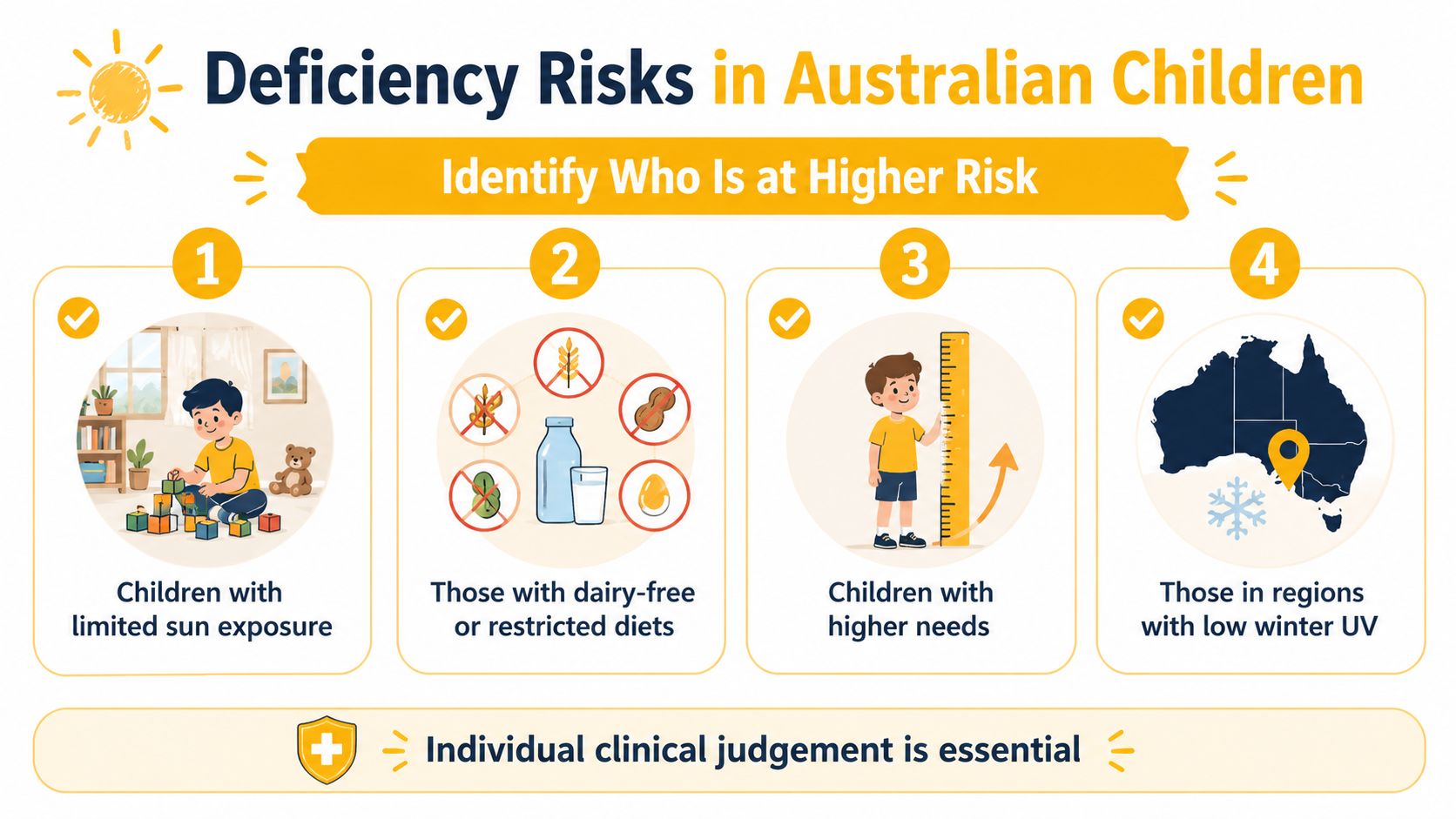
Professional advice is appropriate if a child has:
- Limited sun exposure: Extensive clothing coverage, indoor living, or seasonal patterns may reduce vitamin D3 production, particularly where winter UV is lower.
- A restricted diet: Dairy exclusion, multiple allergies, vegan eating, or severe selective eating may reduce calcium or vitamin D sources.
- Higher nutritional demands: Fast growth, delayed growth, or an adolescent growth spurt can change the balance between intake and need.
- Possible skeletal or muscle symptoms: Frequent fractures, persistent muscle pain, cramps, weakness, or delayed growth need assessment rather than a household supplement experiment.
Routine blood testing is not recommended for every child without symptoms. As noted earlier, Royal Children's Hospital guidance provides a biochemical benchmark for deficiency. A GP or paediatrician should decide whether testing is appropriate and interpret results alongside the child's history.
A suspected dietary shortfall is different from confirmed deficiency. A clinician may recommend blood tests, structured dosing, and follow-up for deficiency. A dietitian can help a child with restricted eating develop a sustainable calcium plan. Very high doses can be harmful, so caregivers should not copy another child's treatment schedule or use adult products without advice.
How Caregivers Can Choose and Use Supplements Safely
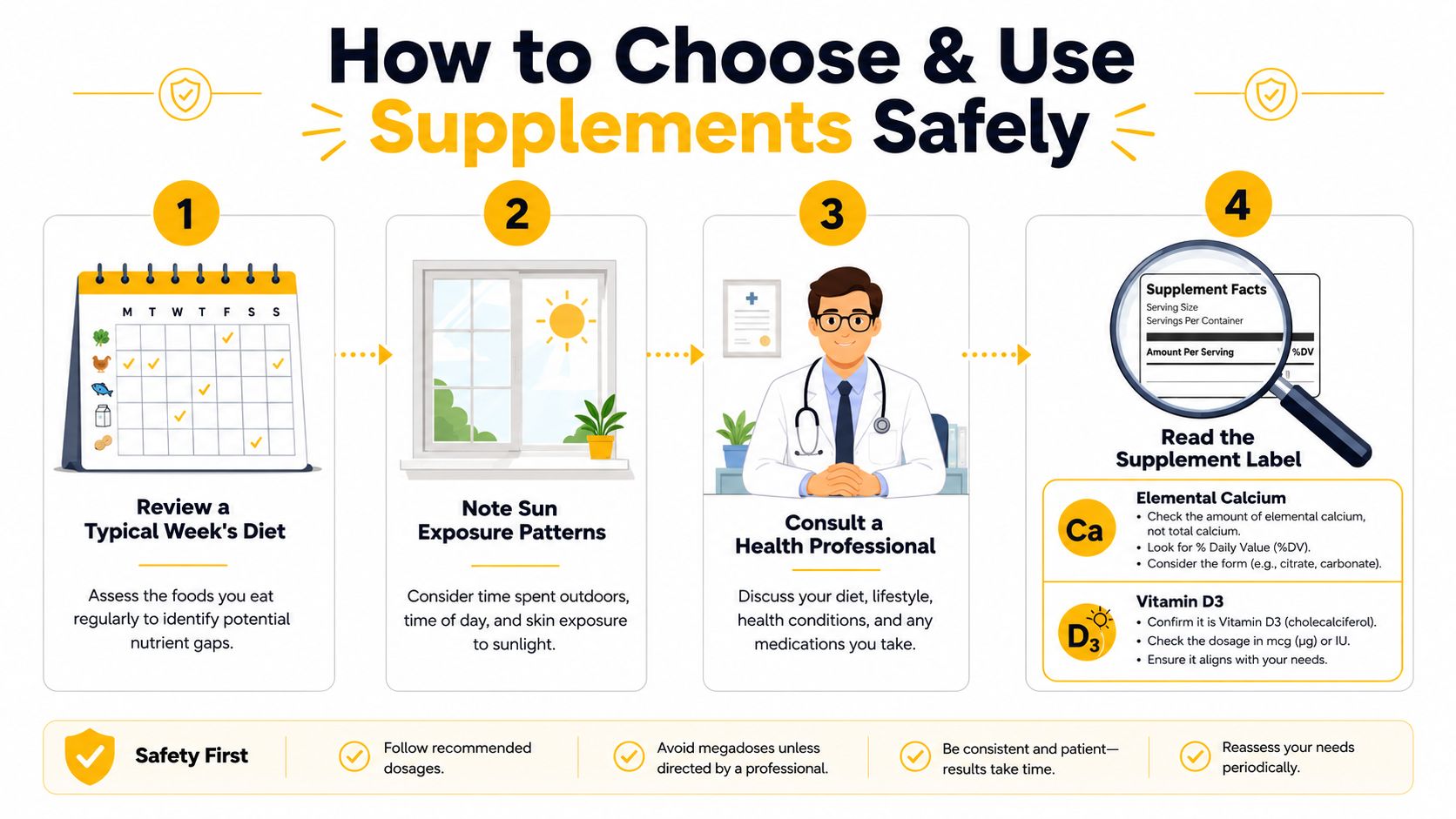
A sensible supplement decision follows a sequence rather than a shopping impulse.
- Review a typical week. Note calcium-rich foods, fortified products, milk feeds where relevant, and dietary exclusions. Look for a repeated gap rather than one missed meal.
- Record sun exposure patterns. Consider whether the child regularly spends time outdoors, has extensive skin coverage, has dark skin, or lives in circumstances associated with limited UV exposure.
- Ask a health professional when risk is present. A GP, paediatrician, or dietitian can decide whether dietary changes are enough, whether testing is appropriate, or whether treatment is needed.
- Read the label carefully. Check the amount per serving, age suitability, serving instructions, and whether the vitamin D is D3, cholecalciferol, or D2, ergocalciferol. For calcium, identify the elemental calcium amount.
Drops or liquids may suit younger children, while chewables or gummies may be easier for children who resist tablets. Combined multivitamins offer convenience, but they may provide less targeted dosing than a standalone product. Don't combine several products without checking for overlapping vitamin D3 or calcium.
Avoid mega-dose products, adult formulations repackaged for children, and brands with unclear ingredient or dosing information. Store every supplement out of reach, and keep the original packaging so a healthcare professional can review exactly what the child has taken.
Caregivers considering a targeted vitamin D product can read more about vitamin D3 gummies for children. Any decision to start, increase, or stop supplementation for suspected deficiency should be made with professional guidance, especially when symptoms, chronic illness, or medicines that affect absorption are involved.
Key Takeaways for Strong Bones
Calcium and vitamin D3 aren't interchangeable. Calcium supplies the mineral material, while vitamin D3 helps the body absorb and use it. The partnership works best when caregivers support both through a varied food pattern and an age-appropriate plan.
For everyday nutrition support:
- Start with food: Use dairy, fortified alternatives, tofu, fish with edible bones, leafy vegetables, nuts, and seeds where suitable.
- Check the pattern: Review a typical week instead of judging one imperfect day.
- Match the product: Choose supplements according to age, diet, risk factors, and professional advice.
- Separate routine from treatment: Confirmed deficiency may require blood testing, structured dosing, and follow-up. Don't self-prescribe high doses.
- Ask about warning signs: Persistent pain, frequent fractures, cramps, weakness, or delayed growth deserve clinical assessment.
The aim isn't to create a supplement-heavy household. It's to build a consistent, food-first routine and use calcium or vitamin D3 supplements thoughtfully when a genuine need exists.
Daily Powers offers children's gummy formulations designed around simple daily routines, including products focused on general wellbeing, concentration, and relaxation rather than calcium or vitamin D3 replacement. Visit Daily Powers to review the ingredient lists and dosing guidance, then discuss any supplement choice with your child's healthcare professional when dietary gaps or deficiency risks are present.