

Yes, vitamins expire. In Australia, the printed date is a technical quality boundary backed by mandatory stability testing, and Australian guidance uses a default 12-month shelf life below 25°C for solid vitamins.
You find the bottle while clearing out the bathroom cupboard. It's a children's gummy supplement, still sealed, but nobody in the family can remember when it was bought. The label raises two immediate questions: will it still work, and is it safe for a child?
The calm answer is that an expired vitamin is usually more concerning because it may no longer deliver its declared strength than because it suddenly becomes poisonous. However, the date still matters. It tells you how long the manufacturer has evidence that the product should meet its quality specifications under the stated storage conditions. The safest household routine is to check the date, consider how the bottle was stored, and replace anything that's expired or visibly changed.
Table of Contents
- Introduction to Supplement Expiry
- What the Expiry Date Actually Means
- How Potency and Safety Change Over Time
- The Impact of Heat, Humidity, and Light
- Signs Your Supplements May Be Compromised
- Safe Disposal and Household Management
- Building Consistent and Safe Vitamin Habits
Introduction to Supplement Expiry
The phrase “can vitamins expire” often makes expiry sound like a switch. One day the supplement is good, and the next day it becomes dangerous. In reality, vitamins and other supplements can gradually lose quality as their ingredients react with air, light, heat or moisture. The label date marks the end of the period in which the product is expected to meet its tested quality requirements.
That distinction helps parents make a sensible decision. If a bottle is slightly past its date, stored properly and unchanged in appearance, the main concern is likely to be reduced potency. But a child's supplement routine should be reliable, not based on guesswork. There's little benefit in continuing with a product that may no longer contain the strength shown on the label.
Practical rule: Treat the expiry date as a quality guarantee, not as a prediction that the contents will suddenly become unsafe at midnight.
Storage can alter the decision. A sealed bottle kept in a cool, dry cupboard has had a different history from an opened bottle left in a steamy bathroom, a warm kitchen or a car. Australian families also need to think about stockpiling. Subscription deliveries and multi-pack purchases can leave several bottles waiting in the cupboard, so buying less, rotating older stock first and checking dates at reorder time can prevent waste.
The rest of the label matters too. Look for the expiry date, storage directions, serving instructions and any warnings for children. If you're uncertain about a product your child has taken, or your child has symptoms after taking it, speak with a pharmacist or medical professional rather than relying on the date alone.
What the Expiry Date Actually Means
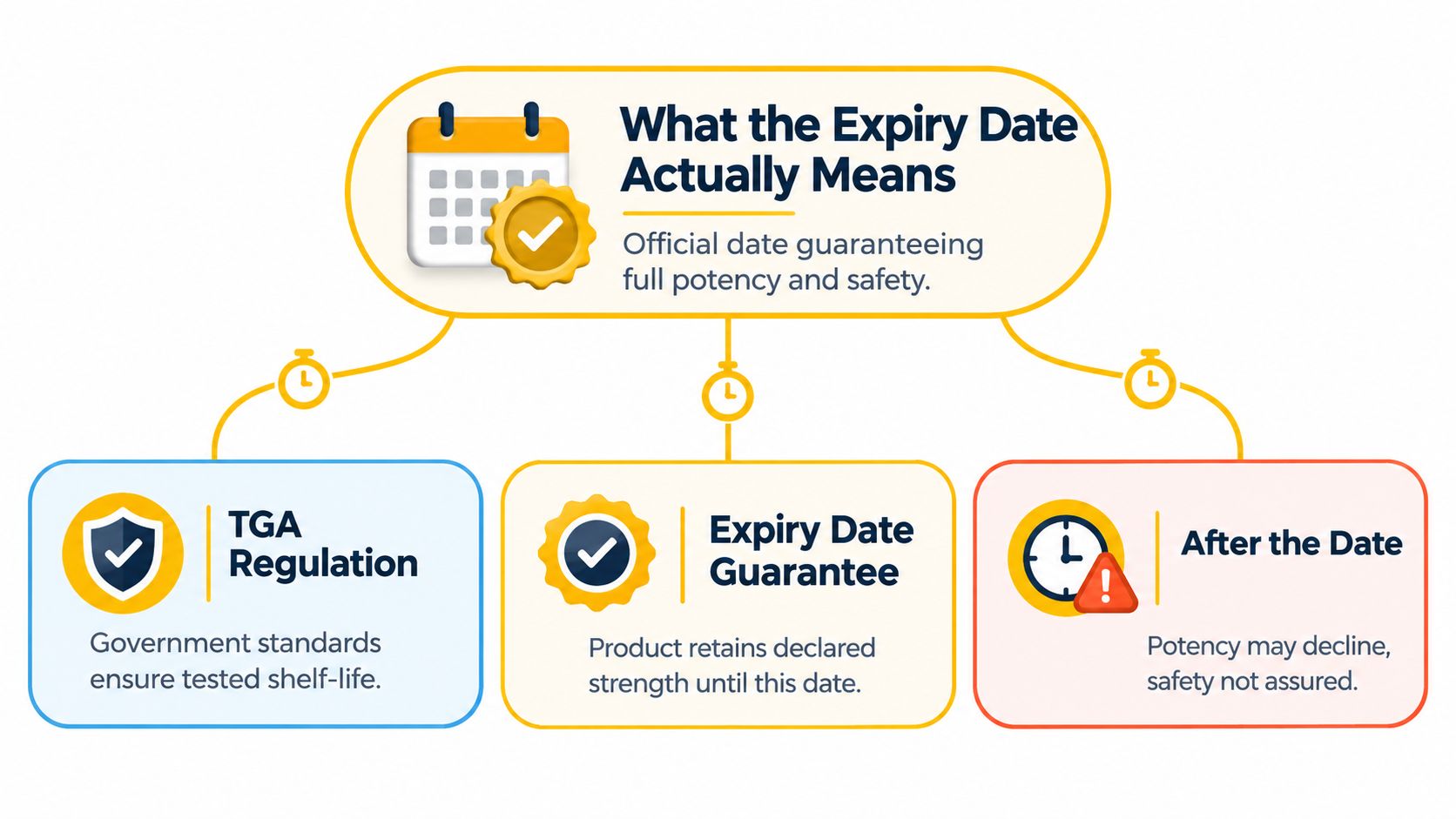
For vitamins supplied as listed medicines in Australia, the expiry date has a regulatory purpose. The Therapeutic Goods Administration's quality requirements for listed medicines require the finished product to satisfy its expiry specifications or end-of-shelf-life specifications for the entire shelf life. The date therefore isn't merely a marketing suggestion.
A manufacturer needs stability evidence to support that claim. The TGA states that ongoing stability testing for listed and complementary medicines is mandatory, and that testing must take place in real time under the storage conditions shown on the label. This connects the printed date with the product's formulation, packaging and expected environment.
What the guarantee covers
Think of the date as a boundary around a tested quality promise:
- Declared strength: The product should continue to meet its labelled quality specifications up to the date when stored as directed.
- Shelf-life evidence: Stability testing examines how the finished product behaves over time, rather than relying only on the age of an ingredient.
- Storage assumptions: The guarantee depends on the conditions stated on the label. A product kept well outside those conditions may deteriorate sooner.
- After the date: The product may still look normal, but its declared potency is no longer assured in the same way.
This is why an expired vitamin isn't automatically equivalent to a toxic substance. Degradation commonly means that an active ingredient has broken down or become less available. The practical problem is that you may give your child a serving without knowing how much of the stated nutrient remains.
A product can also be compromised before its printed date if it has been exposed to damaging conditions. Heat, humidity and light are the main variables that can accelerate potency loss. The date is reliable only within the stability assumptions behind it.
Brave, for example, is described by its product information as a daily multivitamin gummy for kids, with essential vitamins, kid-friendly flavours and textures, and a vegan formulation without artificial colours or flavours. Whatever the product, parents should still follow its own date and storage directions rather than treating all gummies as interchangeable.
How Potency and Safety Change Over Time
A vitamin doesn't age in exactly the same way as every other vitamin. Formulation matters. A dry tablet, a capsule, a liquid and a soft, oil-based product can respond differently to air, moisture, heat and light.
Australian regulatory and technical guidance illustrates this difference. The APVMA's Australian-climate shelf-life tables use a default 12-month shelf life below 25°C for solid vitamins and vitamins/minerals. A TGA laboratory report also notes that vitamin D3 is sensitive to air, heat and light. These are formulation and ingredient examples, not a universal expiry rule for every product.
Read the label in order
Use this short process when you find an old bottle:
- Find the actual date. Check the cap, base, side panel or seal. Don't confuse a batch number or manufacturing date with an expiry date.
- Check the product form. A dry tablet or capsule may have different stability characteristics from a liquid, gummy or oil-based softgel.
- Read the storage instruction. Note whether the label requires a cool, dry place, protection from light or another specific condition.
- Consider the storage history. Ask whether the bottle was opened, left in humidity, exposed to sunlight or carried in a hot car.
- Inspect the contents. Changes in smell, colour, texture or packaging can justify replacement even when the date hasn't passed.
- Choose reliability for children. If the product is expired or its storage history is unclear, replacing it avoids relying on uncertain potency.
A children's gummy routine also needs age-appropriate serving guidance. The guide to chewable multivitamins for kids can help parents think about format and routine, but it doesn't replace the instructions on a particular product.
Focus is described as a blueberry-flavoured gummy containing Mushroom Polysaccharides, vitamin D3, zinc, elderberry fruit powder and prebiotics. Those listed ingredients don't change the basic rule: check the product's own label, store it as directed and don't assume that a familiar format has an identical shelf life to another supplement.
The Impact of Heat, Humidity, and Light
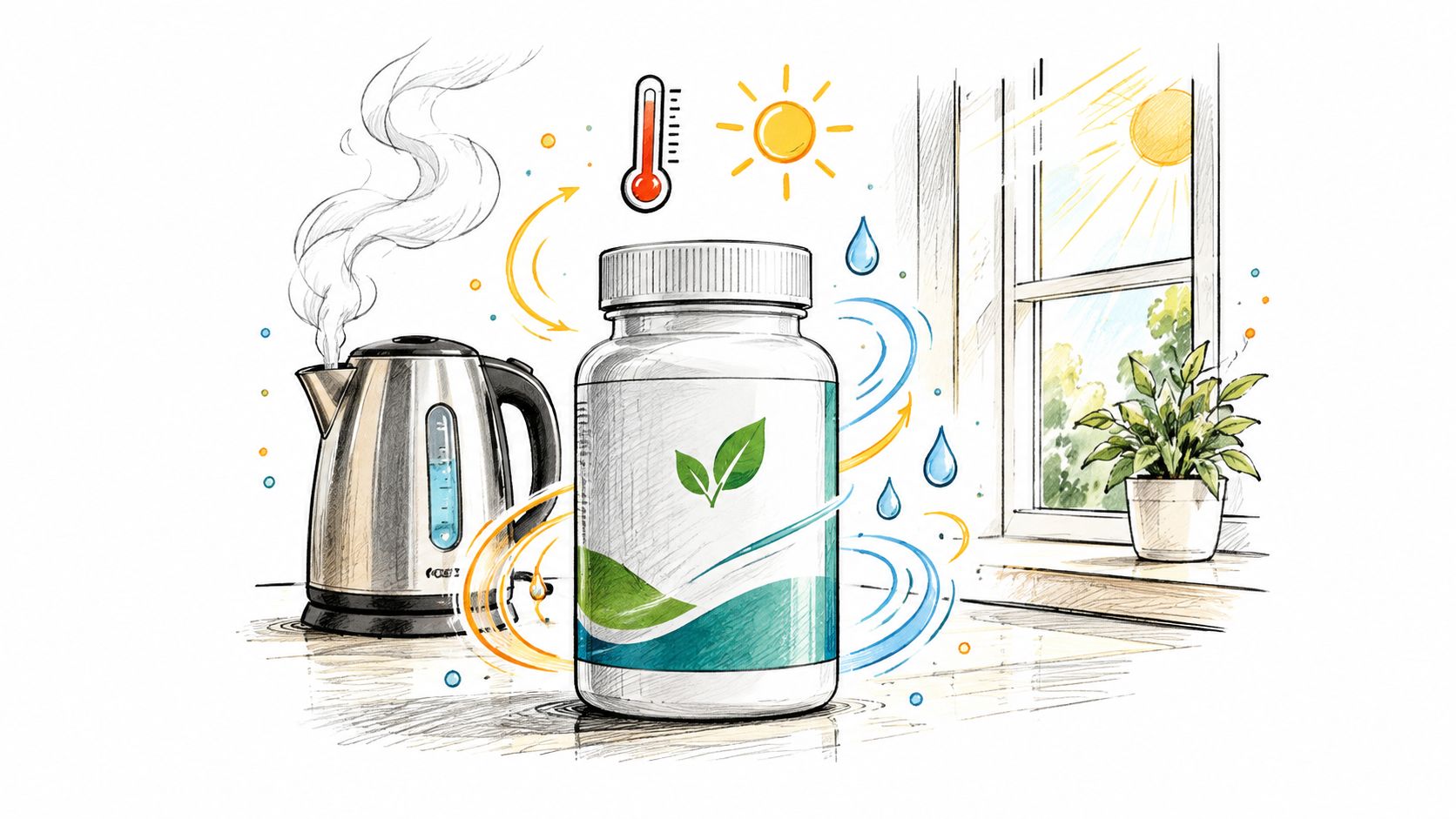
The cupboard beside the shower may seem convenient, but it's a poor place for many supplements. Warm, humid air can enter when the container is opened, while repeated moisture exposure can affect gummies, capsules, powders and tablets. A kitchen shelf beside the kettle or oven has a different problem, with heat and temperature changes. A car can become particularly harsh during an Australian summer.
The Australian guidance on storing medicines reinforces the practical link between a product's expiry date and its storage conditions. The label date assumes the product has been kept in the environment used for its stability assessment. When a bottle spends time in heat, humidity or direct light, that assumption becomes less dependable.
Match the product to the cupboard
A useful household approach is simple:
- Dry tablets and capsules: Keep them sealed in a cool, dry, shaded cupboard. Don't transfer them into an unlabelled container.
- Gummies: Close the lid promptly and keep them away from steam, sunlight and heat. Sticky, melted or unusually soft pieces deserve caution.
- Liquids and oil-based products: Follow the specific label instructions closely. These formats can be more vulnerable to environmental changes than dry products.
- Opened containers: Limit the time the contents spend exposed to air. Use clean, dry hands and close the package after every use.
- Subscription stock: Keep only a practical amount at home, check the dates when a new delivery arrives and use the oldest acceptable pack first.
Storage check: Cool, dry and dark is a better default than bathroom, windowsill or car.
Calm is described in its product information as a berry-flavoured magnesium gummy containing magnesium citrate, vitamin B6, zinc and prebiotics. Its format makes the storage instruction important, just as it would be for any other gummy. A product's flavour or texture may make a routine easier, but it doesn't remove the need to protect the contents from moisture and heat.
For a visual reminder of how these conditions can affect a bottle, watch the following video.
Signs Your Supplements May Be Compromised
The printed date is only part of the check. A bottle can be within date yet have been exposed to conditions that changed its contents, while an expired bottle may show no obvious physical difference. You can't confirm potency by sight alone, so visible or sensory changes should be treated as warning signs rather than proof of a precise chemical change.
Use the decision table below before giving a questionable product to a child.
| Sign | Meaning | Action |
|---|---|---|
| The date has passed | The product is outside its stated quality period | Don't use it as part of a child's routine. Replace it. |
| Gummies are sticky, melted or fused together | Heat or moisture may have affected the texture and stability | Set the product aside and replace it. |
| Tablets are crumbling or unusually soft | Moisture or physical deterioration may have affected the product | Don't give it to your child. Seek a fresh product. |
| Powder is clumped | Moisture may have entered the container | Follow the label or pharmacist's advice, and replace it if the condition is unusual. |
| Colour has changed | The contents may have degraded or been affected by light or air | Don't rely on appearance as proof of safety. Replace it. |
| The smell is noticeably unusual | The ingredients or oils may have changed | Don't taste-test it. Dispose of it safely. |
| The seal, lid or container is damaged | The contents may no longer have been protected as intended | Treat the product as compromised. |
Do not ask your child to taste a supplement to see whether it's still acceptable. If the product looks, smells or feels different from when it was purchased, replacement is the sensible option, particularly when the bottle has been stored in a warm or damp place.
When the label is intact, the date is current and the product has been kept according to its instructions, there's no need to create anxiety over normal variation in shape or colour. Follow the product information, and ask a pharmacist if the change is difficult to interpret.
Safe Disposal and Household Management
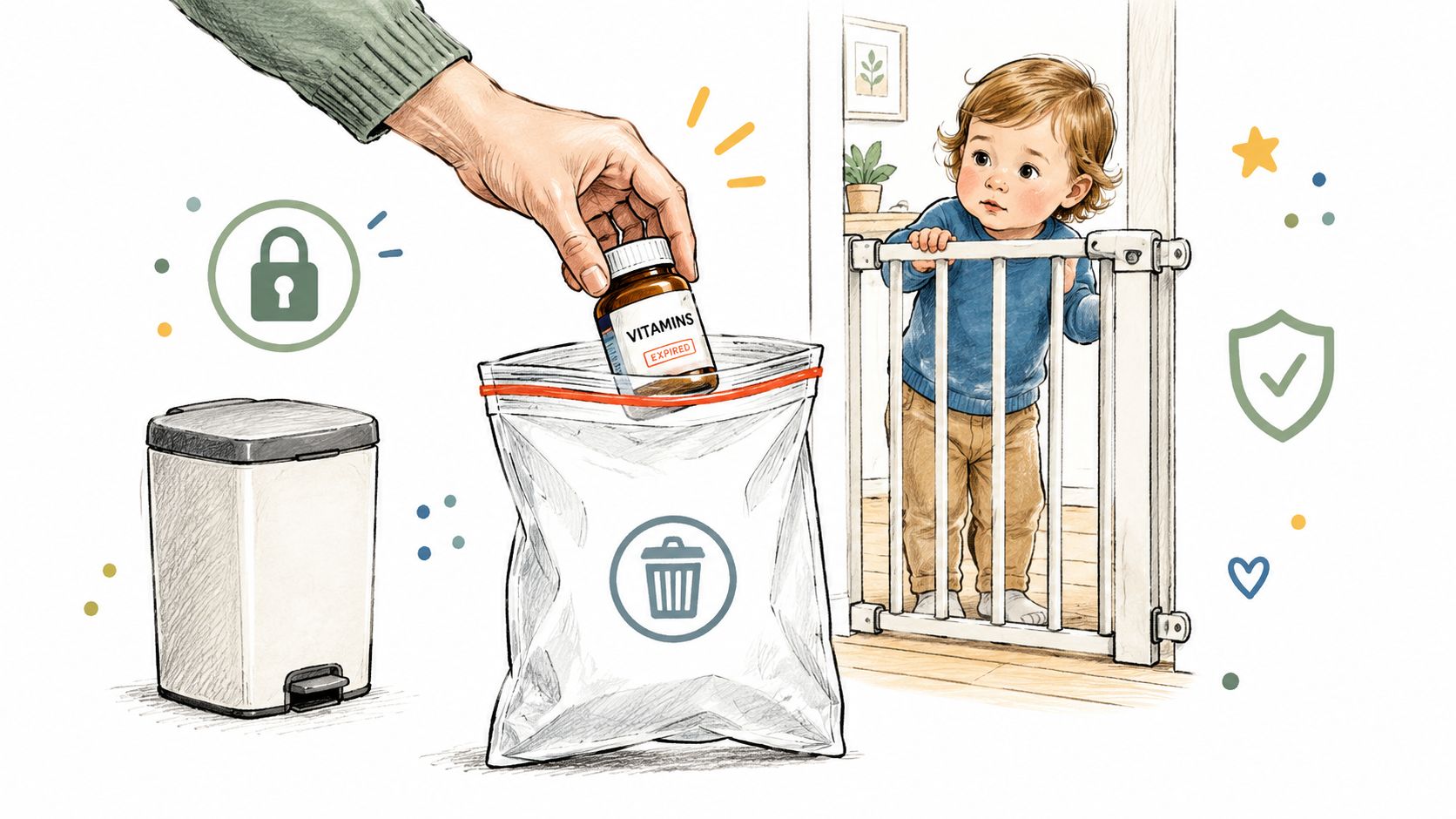
An old supplement shouldn't remain within easy reach of children just because you haven't decided what to do with it. Place questionable products somewhere inaccessible while you check the label and arrange disposal. Don't leave loose gummies or tablets in a drawer, handbag or bedside table.
Start with the product label and local advice. A community pharmacy may be able to explain whether it accepts unwanted medicines or supplements, and your local council can advise on household disposal requirements. If no return option is available, follow the packaging instructions and local waste guidance. Don't flush a product unless an authorised instruction specifically tells you to do so.
A simple household rotation system
- Create one storage location. Keep supplements in a cool, dry place away from children, rather than distributing bottles across the bathroom, kitchen and car.
- Record the date of opening. A small note on the container can help you remember which pack is in use.
- Put older acceptable stock in front. Use the earliest expiry first, provided the product has been stored correctly and remains unchanged.
- Review deliveries immediately. If you use subscription buying, check the new date before adding the bottle to the cupboard. Pause or adjust deliveries if stock is accumulating faster than your household uses it.
- Remove compromised products promptly. Separate expired, damaged or unusual items from supplements that are still suitable for use.
- Secure the waste. Keep products contained during disposal so curious children and pets can't retrieve them.
The guide to kids' vitamin gummies can support broader conversations about choosing a format and establishing a routine, but it doesn't override expiry or storage instructions. Parents should also avoid combining several products without checking their ingredients and serving directions, especially when more than one caregiver gives supplements.
A short monthly cupboard check is often enough to prevent forgotten bottles becoming a problem. The aim isn't to inspect every supplement obsessively. It's to make date checking, rotation and secure storage ordinary household habits.
Building Consistent and Safe Vitamin Habits
A dependable supplement routine starts before the first serving. Choose a product appropriate for your child, read the directions, check the expiry date and store it where heat and moisture won't undermine the label's quality guarantee. These steps are small, but they remove much of the uncertainty that makes an old bottle worrying.
Consistency also means knowing when not to continue. An expired product, a bottle with a damaged seal or gummies that have changed in smell or texture doesn't belong in the daily routine. Replace it rather than trying to estimate how much potency remains.
A good routine is not only taking a supplement regularly. It's taking the right product, at the labelled serving, while it remains within its tested quality period.
Keep serving decisions separate from expiry decisions. The paediatric dosing guidelines can help caregivers think carefully about children's directions, but a pharmacist or healthcare professional should advise on individual circumstances, interactions or concerns about a child's health.
The most useful household system is uncomplicated: buy a manageable amount, rotate stock, keep containers sealed, store them cool and dry, and inspect anything that seems different. That approach respects the Australian regulatory reality without turning expiry into a source of panic.
Daily Powers offers children's gummy supplements framed around bravery, focus and calm, with product information designed to support repeatable family routines. Visit Daily Powers to review the range, ingredient lists and usage guidance, then choose a routine that fits your household's storage and date-checking habits.