

The lunchboxes are open, one shoe is missing, and your child is already saying the breakfast toast “looks weird”. Then you look at the vitamin shelf and hit a very familiar question. Do they need a chewable multivitamin, or do you just need something they'll reliably take without a daily argument?
That's where many families land. Not in a tidy nutrition textbook situation, but in ordinary family life where routines matter as much as nutrients.
Chewable multivitamins for kids are often treated like a fix for poor eating. In real life, they're usually more useful as a habit tool. The chewable format exists because plenty of children won't swallow tablets, dislike chalky textures, or need a predictable cue that fits the school-morning rush. The most important difference between products often isn't the front-label promise. It's whether the texture, flavour, sugar content, and daily routine make safe, steady use realistic in your house.
That matters in Australia. Supplement use is established, but it doesn't automatically mean widespread vitamin deficiency. The better question is often less dramatic and more practical. Is this product a sensible support for a child with uneven intake, or has it become a stand-in for a food issue that needs a different response?
Table of Contents
- Introduction to Chewable Multivitamins for Everyday Family Life
- What Chewable Multivitamins Are and How They Work
- Benefits and Risks for Children Aged 4 to 12
- Inside the Label Key Ingredients and What They Do
- Choosing the Right Formulation for Your Child and Household
- Making It Stick Dosing Guidance Adherence and Safety Checks
- Your Next Step to Confident Everyday Nutrition Habits
Introduction to Chewable Multivitamins for Everyday Family Life
A lot of parents meet chewable vitamins at the exact same moment. A child refuses a tablet, wrinkles their nose at a liquid, and happily accepts anything that feels more like a small treat than “medicine”.
That reaction isn't trivial. It tells you why chewables exist.
For many children in the primary-school years, the challenge isn't only what's in the bottle. It's whether the format fits their stage, their sensory preferences, and the pace of your household. A child who can't swallow tablets yet may do well with a firmer chewable. Another may accept only a softer gummy texture. A third may like the routine for a week, then lose interest unless the cue is built into breakfast or school-bag time.
Why families reach for chewables
Parents often think first about picky eating, and that makes sense. If dinner feels repetitive and vegetables are a battle, a chewable multivitamin can feel like a safety net.
Australian parents have been using that safety net for a long time. The Royal Children's Hospital Australian Child Health Poll reported in 2016 that 42% of children and teenagers were taking vitamins or supplements, with children aged 6 to 12 the most frequently reported group at 50%, and the poll estimated family spending at about $74 million per year, with later reporting suggesting it could be as high as $98 million a year. Parents most often said they used these products to boost immunity (76%) or supplement diet (47%) in the Royal Children's Hospital summary of the poll.
So if chewables are already part of family life in many homes, the useful question isn't “Would any normal parent ever use these?” Clearly, many do. The more useful question is whether you're using one with clear expectations.
Chewables can support a routine. They can't do the job of regular meals, variety, and a calm plan for feeding.
The frame that helps most
Think of chewable multivitamins for kids as a small daily support, not a nutritional rescue package. They may suit children roughly in the 4 to 12 age range because that's the stage where many still resist swallow tablets but can handle a chew safely when supervised and used as directed.
That frame lowers pressure. You're not trying to solve every food worry with one product. You're choosing whether a child-friendly format helps your family stay organised, consistent, and safe.
What Chewable Multivitamins Are and How They Work
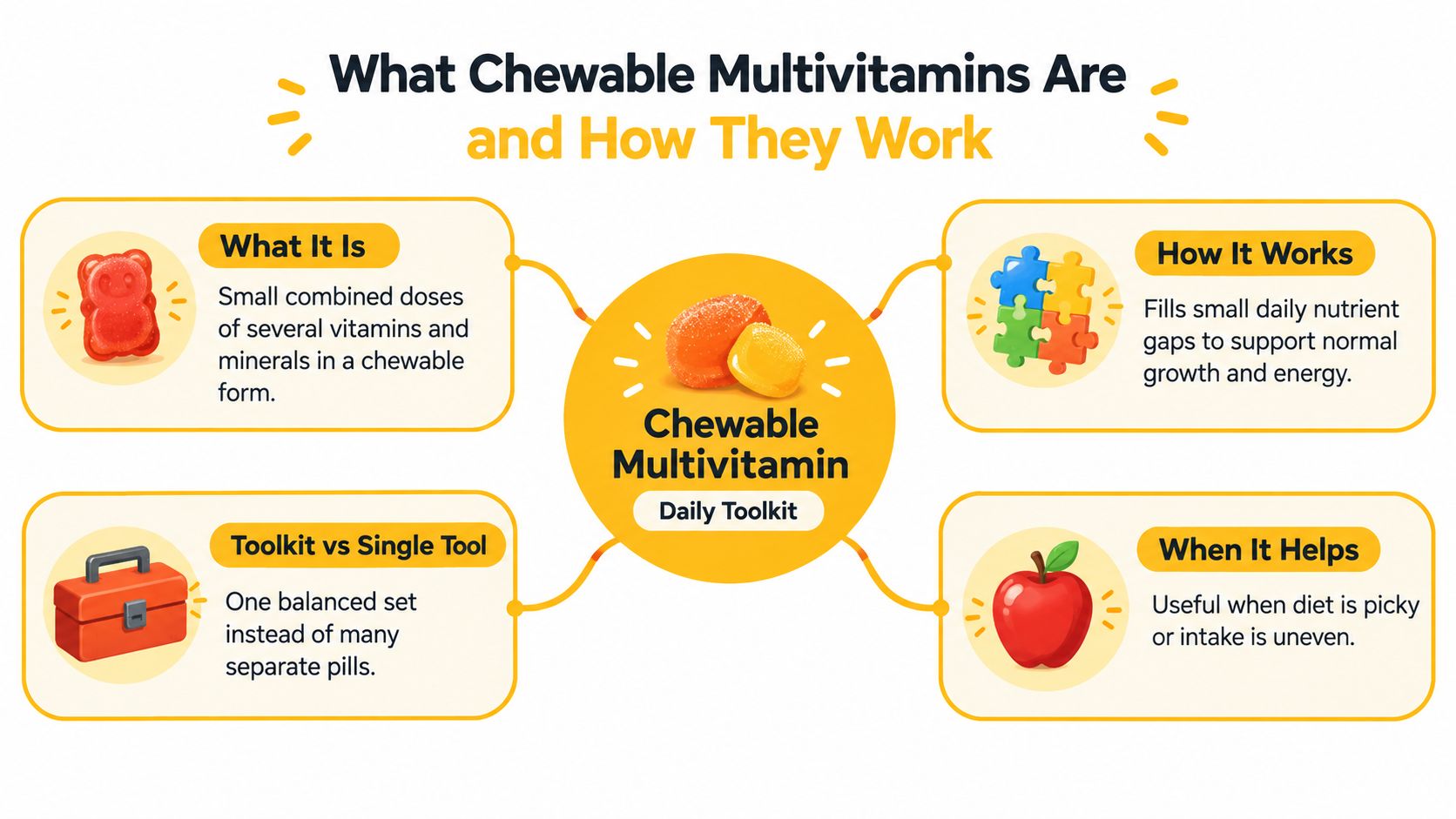
A chewable multivitamin is easiest to understand if you stop thinking of it as a magic fix and start thinking of it as a daily toolkit.
A single-nutrient supplement is like one screwdriver. It has a specific job. A multivitamin is more like a small toolbox. It brings together several vitamins and sometimes minerals in modest amounts, so you're covering more than one everyday nutritional gap at once.
The format matters as much as the formula
Children experience the form before they benefit from the ingredients. That's why chewables come in different styles.
- Firmer chewable tablets often feel more like a tablet you bite. Some children manage these well, especially if they don't mind a more solid texture.
- Soft gummies are usually easier to accept for children who dislike chalkiness or dryness.
- Swallow tablets may suit older children, but they're often a poor fit for younger ones who still gag, hesitate, or refuse.
If your child won't take the product consistently, the nutrient list stops mattering. Adherence starts with mouthfeel, flavour, and how predictable the routine feels.
What they do, and what they don't
Chewable multivitamins are meant to complement food, not replace it. They sit beside breakfast, lunchboxes, and after-school snacks. They don't stand in for dairy foods, fruit, vegetables, proteins, or grains.
That distinction is especially important in Australia. The Australian Bureau of Statistics reported that 20.3% of children aged 5 to 11 took a dietary supplement in 2023, up from 16.0% in 2011–12, and that 10.1% of boys and 9.2% of girls aged 2 to 17 took a multivitamin or multimineral supplement in 2023. The same ABS release found that children aged 2 to 11 generally had adequate intakes of most vitamins and minerals from food and beverages, except calcium, and inadequacy for most vitamins remained below 10% in under-12s, according to the ABS usual nutrient intakes release.
That changes the conversation. For many children, chewables aren't correcting a broad deficiency pattern. They're part of an everyday routine, often chosen for convenience and consistency.
What Australian approval cues tell you
In Australia, gummies and chewable multivitamins supplied as medicines are treated as therapeutic goods. A product should carry an AUST L number and comply with TGA requirements for quality, safety, efficacy, and advertising.
That doesn't mean every listed product is right for every child. It means the label gives you a regulatory checkpoint to start from.
One example of a routine-focused product is Brave, described as a daily multivitamin gummy for kids with a simple routine focus, kid-friendly flavours and textures, and a vegan-friendly formulation without artificial colours or flavours. That kind of description shows how many modern products are designed around acceptance and repeatability, not just vitamin counts.
Benefits and Risks for Children Aged 4 to 12
Most parents want a straight answer here. Are chewable multivitamins useful or overhyped?
The honest answer is both simpler and less flashy. They can be useful for some children, but the benefit often comes from steady routine support, not from dramatic transformation.
Where chewables can help
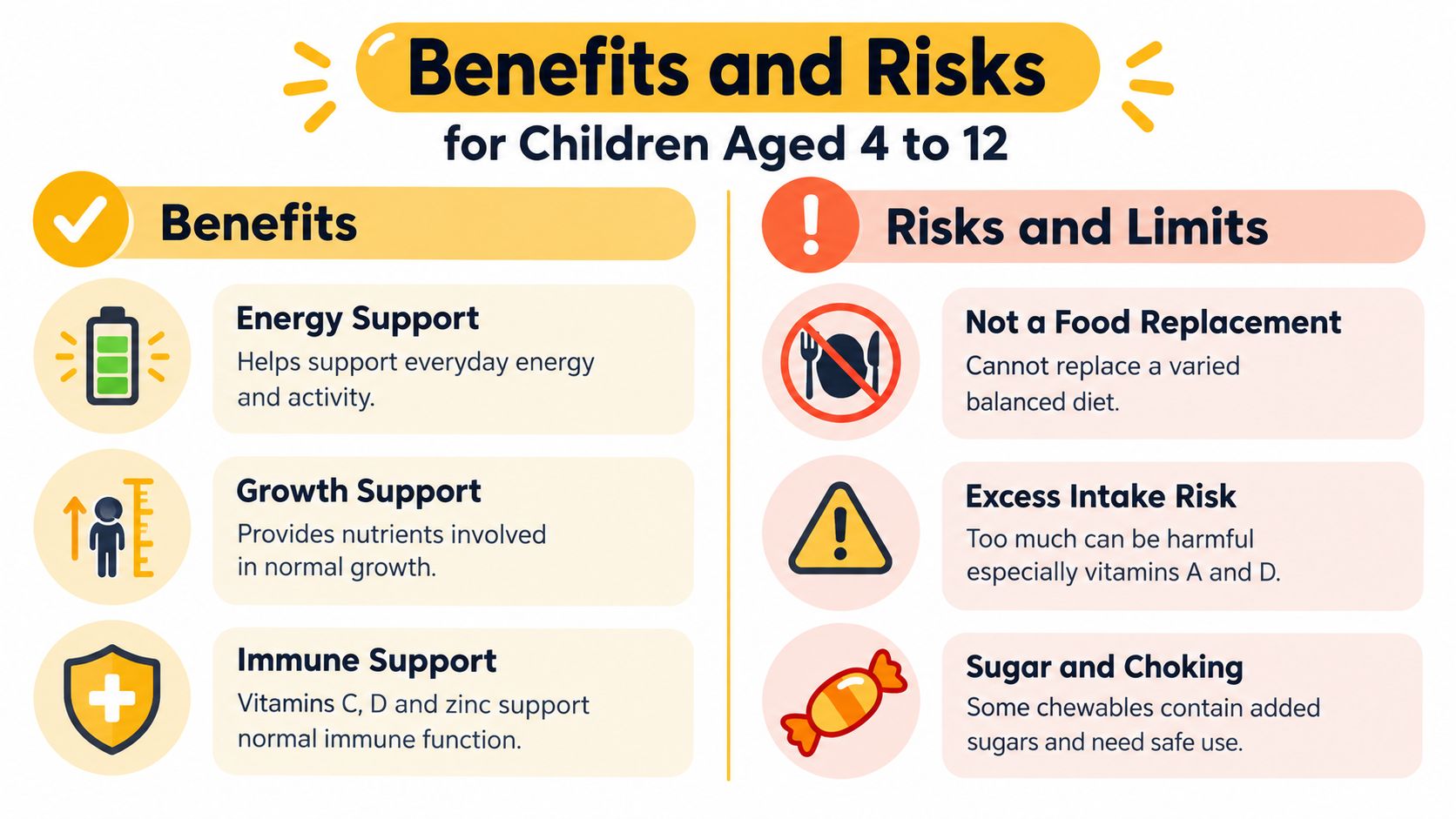
For a child aged 4 to 12, the biggest practical advantage is often that a chewable gets taken at all. That may sound obvious, but it's the whole point of the category.
A child with a narrow food range, frequent appetite swings, or a strong dislike of swallow tablets may do better with a product that feels easy and familiar. In that sense, the chewable format reduces friction. Less friction often means fewer skipped days and fewer battles before school.
Parents also like the simplicity of “one daily thing” rather than managing multiple separate products. That can be especially helpful in shared care, busy workweeks, or households where grandparents help with the morning routine.
Where expectations need tightening
The main limit is this. A chewable multivitamin can make a parent feel reassured even when the underlying food pattern still needs attention.
If a child rarely eats calcium-rich foods, for example, the broader issue may be food acceptance, meal structure, or a targeted discussion with a health professional. A general multivitamin doesn't automatically solve that.
The Australian nutrition picture supports a more measured approach. National data suggest children aged 2 to 11 generally had adequate intakes of most vitamins and minerals, with calcium as the main exception, according to the ABS national nutrition and physical activity release. That means a broad “health boost” story can miss the mark. Sometimes the right next step is food-first support. Sometimes it's a more targeted nutrient conversation.
Practical rule: If the question is broad and vague, such as “Will this make my child healthier overall?”, the answer is usually less useful than asking what problem you're actually trying to solve.
The real risks parents should think about
Chewables are easier to take, and that's exactly why they need more care.
Australian commentary has pointed to a genuine formulation trade-off. The flavour and palatability that help children stick with a product may come with acids, sweeteners, and dental concerns. Independent Australian authors have argued that gummy vitamins marketed to children can be high in sugar, and Australian health commentary has noted that even sugar-free versions may still cause gastrointestinal effects depending on the sweeteners used, as discussed in the UNSW commentary on kids' vitamin gummies.
There's also the risk of overuse. If a child sees the product as a lolly, they may want extra.
That's one reason product choice shouldn't start with the most exciting label claim. It should start with the question, “Will this format help my child take it properly, and will it help me keep it clearly separate from treats?”
Inside the Label Key Ingredients and What They Do
The label on a kids' multivitamin can look crowded fast. Long ingredient lists, tiny print, and nutrient names that sound more chemical than helpful.
A simpler way to read it is to sort the label into two groups. First, what's there to support the body. Second, what's there to make the product chewable, stable, and acceptable to children.
The common nutrients on the front half of the label
Here's the plain-English version of what parents usually see.
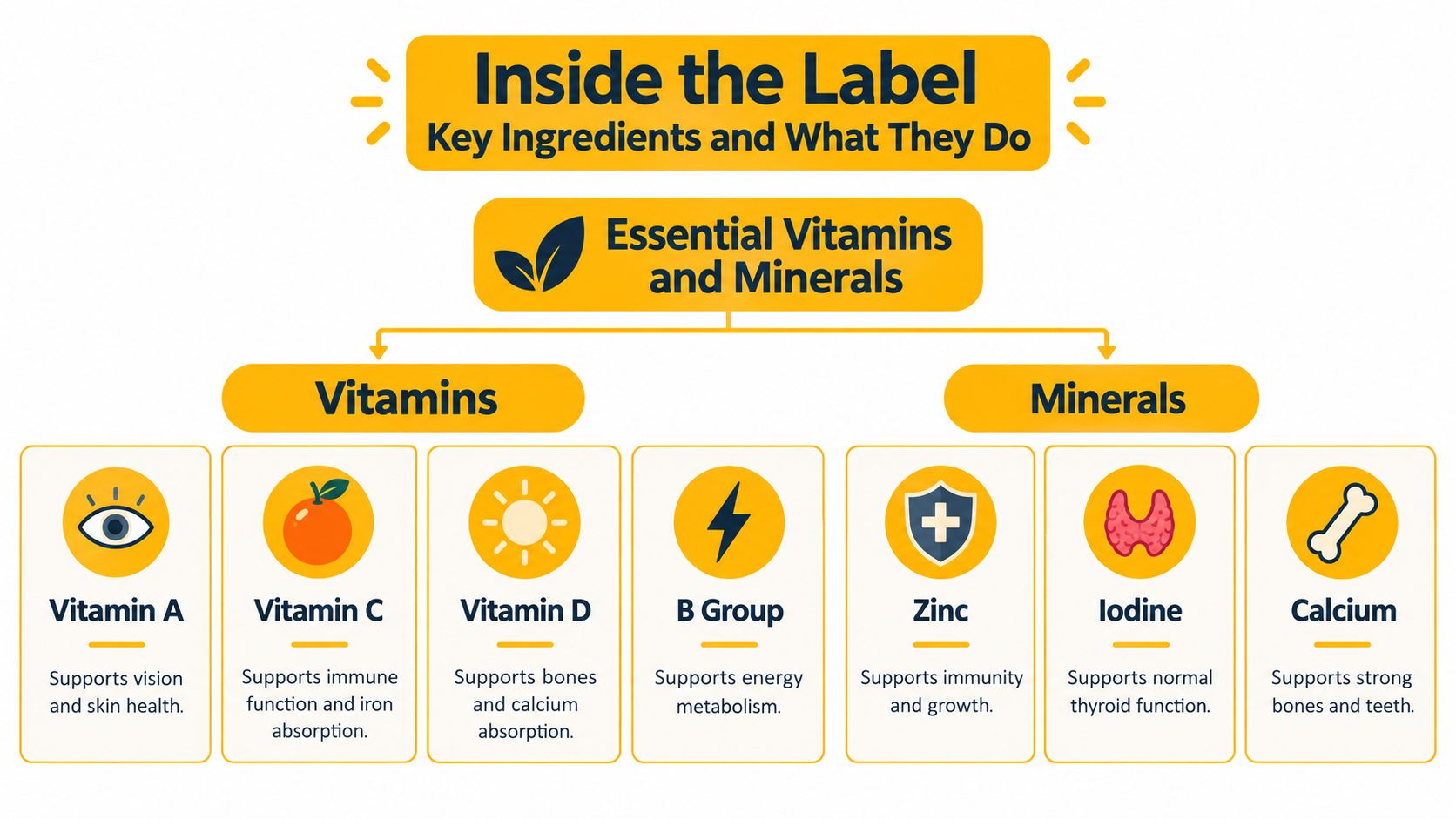
- Vitamin A supports normal vision and skin.
- Vitamin C is commonly included because it supports normal immune function and helps with iron absorption from food.
- Vitamin D matters for bone health because it supports calcium absorption.
- B group vitamins help with energy metabolism. In simple terms, they help the body use food as fuel.
- Zinc is often included for growth and immune function.
- Iodine supports normal thyroid function.
- Calcium may appear, though not every multivitamin includes much of it.
The amounts in children's chewables are often modest. That's usually deliberate. These products are designed as broad support, not as high-dose treatment.
A targeted product can sometimes make more sense than a broad multivitamin. If your concern is mainly bone nutrition, a more focused discussion around calcium and vitamin D is often more useful than assuming a general chewable covers it all. This guide on calcium and vitamin D for kids is a good example of that narrower lens.
The part of the label parents often skip
This section matters just as much as the vitamin panel:
- Serving size and directions tell you how much counts as one daily dose.
- Iron inclusion deserves extra attention. Some families need to know whether it's there. Others may be trying to avoid it unless specifically advised.
- Sweeteners matter for both taste and tolerability.
- Colours and flavours can matter for families who prefer simpler formulations.
- Allergen statements should always be checked, even if the front of pack looks reassuring.
- Vegan claims tell you something about ingredients such as gelatin, not about whether the product is automatically suitable for every child.
A quick explainer can help if labels still feel abstract.
A simple label-reading order
When you pick up a product, read it in this order:
- Check the age guidance first. Don't start with flavour.
- Find the dose per serve. One chew? Two gummies? Something else?
- Scan the nutrient panel. Look for the nutrients relevant to your concern.
- Read the non-active ingredients. Sweeteners, textures, and flavouring choices show up.
- Check storage and safety wording. If it reads like something that needs careful handling, treat it that way at home.
If you can't explain to another caregiver how many to give, when to give them, and what's in them after reading the label, keep looking.
Choosing the Right Formulation for Your Child and Household
Standing in front of several kids' chewables can feel strangely similar to buying shoes online. They may all look fine at first glance, but question is fit.
The right formulation is the one your child will accept, your household can use consistently, and you can manage safely without confusion. That's why I'd put format fit ahead of a long list of nutrient claims.
Start with your child's real-world pattern
One child loves a soft gummy and rejects anything chalky. Another dislikes strong fruit flavours. Another needs a product that fits a vegan household. Parents often get stuck comparing nutrition panels when the deal-breaker is really sensory.
A sugar-free option may appeal if you're thinking about teeth or trying to avoid adding one more sweet item to the day. A more detailed discussion of that trade-off appears in this article on a sugar-free multivitamin for children.
Texture also matters more than many people expect. Soft gummies can improve acceptance, but they can also blur the line between supplement and treat if the routine isn't clear. Firmer chewables may feel more “medicine-like”, which some families dislike and others prefer because it sets a cleaner boundary.
Formulation Choices at a Glance
| Feature | What It Means for Kids | Consider For Your Family If |
|---|---|---|
| Sugar-free | May better suit families thinking about dental exposure and everyday sugar load | Your child already has several sweet foods or you want the routine to feel less like a lolly |
| Sweetened formulation | Can improve taste acceptance for some children | Your child rejects bitter or dry products and you're weighing acceptance against dental and tolerance considerations |
| Vegan | Usually avoids gelatin and may align with household values | Your family follows a vegan or vegetarian pattern, or you prefer plant-based formulations |
| Softer gummy texture | Often easier for reluctant users to accept | Your child refuses chalky or hard chewables |
| Firmer chewable tablet | Can create a clearer “supplement” feel | You want less treat-like appeal and your child tolerates a denser texture |
| Natural colours and flavours | May suit families wanting a simpler ingredient style | You're comparing labels beyond the active vitamins and minerals |
| Subscription delivery | Can support routine by preventing run-outs | Your household does better when reorder timing is automatic, but you'll still review use regularly |
Match the product to the household, not just the child
A good fit also depends on who gives the supplement.
If two homes share care, simple instructions matter. If grandparents help with school mornings, you want a product with clear dosing and low confusion. If your weeks are hectic, regular delivery can reduce missed days caused by an empty bottle.
A routine-focused range can fit naturally. Daily Powers, for example, offers Brave as an orange-flavoured vegan sugar-free multivitamin gummy and Focus as a blueberry-flavoured vegan sugar-free option with a different formulation aim. Those details aren't about hype. They're useful because they show how flavour, texture, and naming cues can shape whether a child participates in the routine.
Making It Stick Dosing Guidance Adherence and Safety Checks
A well-chosen product still won't help much if the routine is messy. Most problems with chewables happen after purchase. The bottle gets left on the bench, two adults both give a dose, or the child starts treating it like a reward snack.
That's why the home system matters as much as the formula.
Build a routine your child can recognise
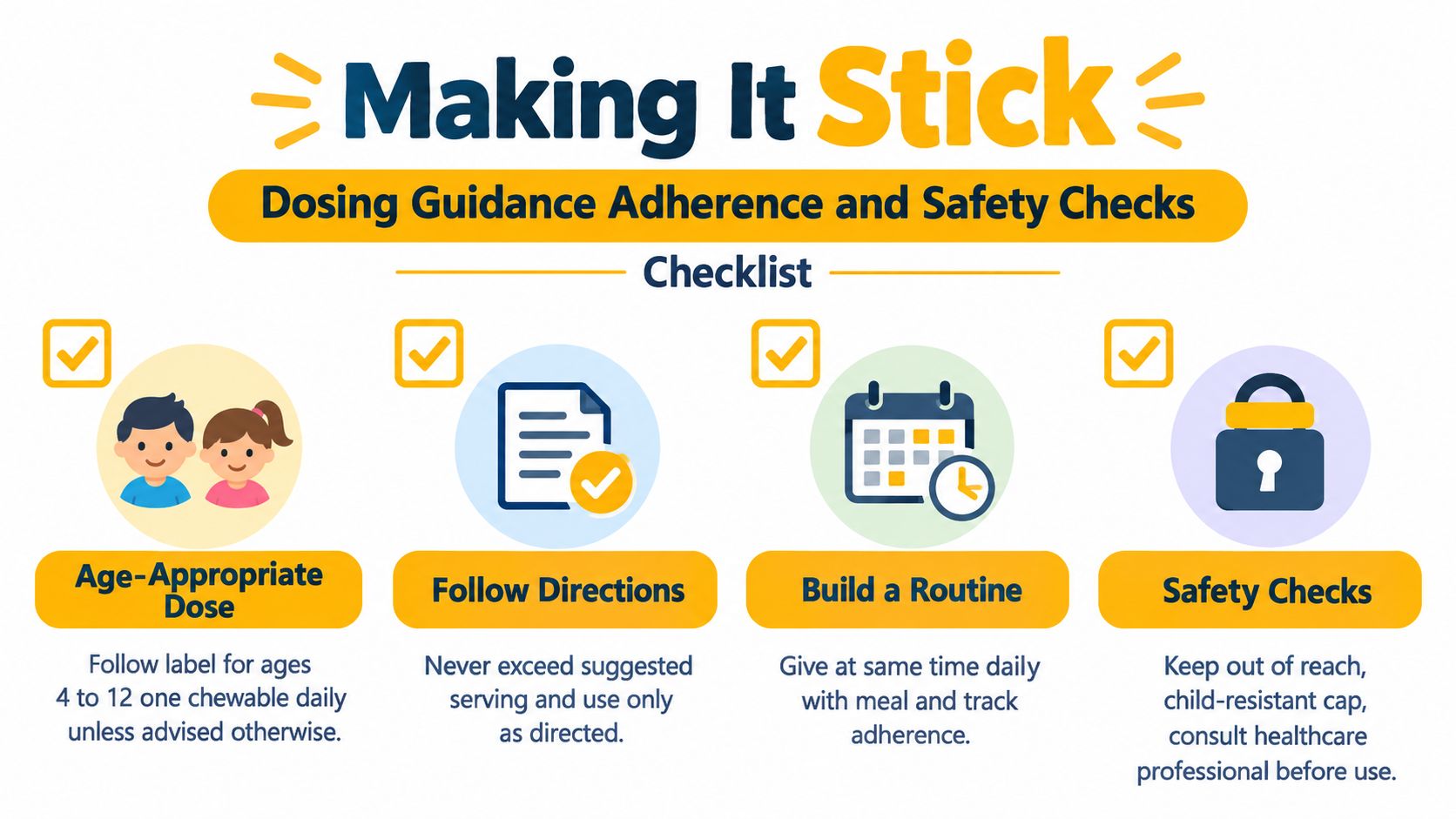
Children do best with cues they can predict. That might mean giving the chewable with breakfast, after teeth are brushed in the morning, or when the lunchbox goes into the bag. Pick one anchor and keep it boringly consistent.
A simple routine works better than a motivational speech.
- Use one daily cue such as the same meal or same spot at the bench.
- Keep one decision-maker visible so your child knows who gives it.
- Use a check system if multiple adults are involved. A note on the fridge or a shared phone reminder is often enough.
- Review the fit after a few weeks. If every morning becomes a negotiation, the formulation may be wrong for your child.
For age-specific questions, product labels should be your first stop, followed by professional advice where needed. If you want a general overview of how families think through age and serving guidance, this page on paediatric dosing guidelines can help frame the questions to ask.
Safety needs to be deliberate
Australia has seen real concern about accidental overuse of appealing supplement formats. Public-health reporting discussed by Complementary Medicines Australia noted a Queensland report of 180 calls in 2023 related to toddlers ingesting multivitamins with iron, a higher-risk ingredient for toxicity if taken in excess, in this Australian overview of vitamin gummy safety and regulation.
That's exactly why chewables should never be stored like snacks.
Keep the bottle out of reach, use the child-resistant closure properly, and speak about it as a supplement every single time. Children learn the category from the language you use.
Watch for three common routine traps
-
Double-dosing in busy households
This often happens when one caregiver gives the morning dose and another doesn't realise. -
Treat confusion
If the product tastes like confectionery, some children will ask for more. Calm language and firm repetition help. “This is your vitamin. One for today.” -
Auto-pilot reordering
Subscription convenience can be helpful, but it shouldn't turn into endless repeat use without review. Pause occasionally and ask whether the product still matches your child's eating pattern and needs.
Your Next Step to Confident Everyday Nutrition Habits
The calmest way to choose chewable multivitamins for kids is to stop asking whether they're a miracle and start asking whether they're a good fit.
A good fit has four parts. There's a real reason for using it. The formulation suits your child's mouth and preferences. The label is clear enough that any caregiver can follow it. The storage and dosing routine are organised enough that it won't drift into guesswork.
That's why I'd treat the chewable itself as only one part of the decision. The deeper question is whether it helps your family run a steadier, safer daily rhythm.
If you're deciding this week, keep it simple:
- Name the problem clearly. Is it picky eating, inconsistent routines, tablet refusal, or a specific nutrient concern?
- Choose by formulation first. Texture, flavour, sugar-free status, and ingredient style affect whether the plan will last.
- Read the whole label. Don't stop at the front-of-pack claims.
- Set the routine before the first dose. Decide who gives it, when it's given, and where it's stored.
- Get help when the question is more specific. If you're worried about a targeted deficiency, growth, restricted diets, or ongoing feeding difficulty, food advice or clinical assessment may be more useful than a broad multivitamin.
That's the quiet strength of a good supplement routine. It doesn't need to feel dramatic. It just needs to be clear, consistent, and safe enough to support everyday family life.
If you're looking for an Australian option built around daily routines, Daily Powers offers children's gummy supplements with clear ingredient information, age-appropriate guidance, and sugar-free vegan formulations designed for regular use. Their range is set up to support the kind of simple, repeatable habits that make chewable supplements easier to use well at home.