

Your child has a blocked nose, winter seems to bring one cold after another, and a product containing horseradish, garlic and vitamin C promises a natural way to help. The label sounds convincing because each ingredient has a long history in food or traditional remedies. The difficult part is separating a reassuring story from evidence that applies to the finished combination.
The most useful question isn't just, “What are the benefits of horseradish, garlic and vitamin C?” It's, “What does each ingredient do, what has been tested, and does my child need extra vitamin C at all?” For Australian families, that distinction matters. Tradition can guide interest, but it can't substitute for a clinical trial, and a listed medicine isn't automatically a proven cold treatment.
Table of Contents
- Why Parents Keep Reaching for This Trio
- What Horseradish, Garlic and Vitamin C Each Do
- What the Evidence Actually Says
- Why Listed Medicines Aren't the Same as Proven Ones
- Is Your Child Actually Low on Vitamin C
- Practical Ways to Use All Three at Home
- The Takeaway for Australian Families
Why Parents Keep Reaching for This Trio
A parent standing in a pharmacy's cold-and-flu aisle may see a bottle that combines three familiar names. Horseradish suggests clear sinuses. Garlic suggests natural protection. Vitamin C suggests immune support. When a child is coughing through the night or missing school, a product that appears to bring those ideas together can feel like a sensible, gentle choice.
The appeal is understandable. Garlic and horseradish have been used in household remedies for generations, while vitamin C is a recognised nutrient with an important role in normal body function. Packaging often turns those separate histories into one simple promise, such as helping with congestion, hay fever or winter colds. But ingredients with plausible roles aren't the same as ingredients proven to work together.
A familiar ingredient may be useful in food, traditionally valued, or biologically interesting without being a clinically proven treatment.
That doesn't make the trio worthless, and it doesn't mean parents have been unreasonable to consider it. It means the decision needs more detail. A food-based use of garlic is different from a concentrated garlic supplement. A child eating fruit is different from a child with a restricted diet. Vitamin C taken regularly is different from vitamin C started after cold symptoms appear.
This distinction also protects families from a common reasoning error. If vitamin C has some evidence for a small reduction in cold duration, that doesn't prove a product containing vitamin C, horseradish and garlic will clear a blocked nose or prevent illness. The herbs may contribute something, but the combination itself needs direct testing.
The practical path is therefore straightforward: look at horseradish, garlic and vitamin C separately, examine the evidence for the trio, understand what an Australian therapeutic listing does and doesn't mean, and then consider your child's actual eating pattern. That approach gives you useful options without turning a supplement into a promise it can't support.
What Horseradish, Garlic and Vitamin C Each Do
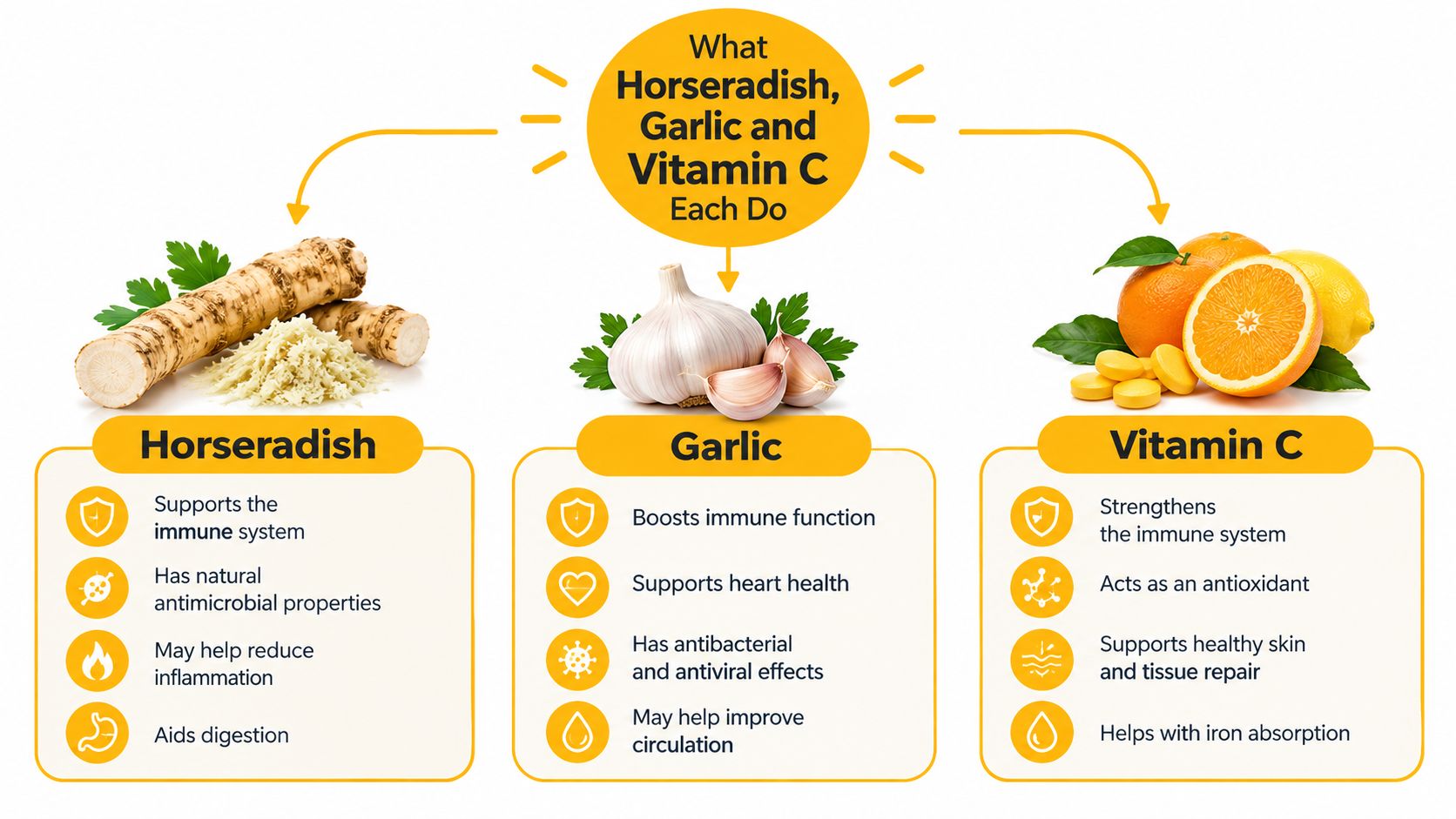
Think of the three ingredients as three different players, not one blended “immune booster”. They may appear on the same label, but their chemistry, traditional uses and evidence are not interchangeable.
Horseradish brings pungency, not proof
Horseradish contains sharp, pungent compounds that create the familiar burning sensation in the nose and mouth. That sensation may make mucus or congestion feel temporarily different, which helps explain its traditional use in sinus and cold remedies. The experience can be strong, but a noticeable sensation isn't evidence that an infection has been shortened or prevented.
Australian reviews have found no clinical trials on horseradish alone and no clinical trials testing the horseradish, garlic and vitamin C combination. That leaves a large gap between traditional use and demonstrated benefit.
Garlic has studied compounds, but mixed clinical evidence
Garlic belongs to the allium family and contains sulphur compounds, including allicin. Crushing garlic changes its chemistry, which is why raw or freshly crushed garlic has attracted scientific interest. In everyday cooking, garlic can add flavour and variety to meals, but that doesn't establish a reliable effect against childhood colds.
Some garlic research has examined cold symptoms, yet the quality and relevance of the evidence matter. A trial involving garlic reported fewer days of cold illness but also more side effects, including rash and body odour. That result doesn't establish that ordinary garlic in food, or a particular combination product, will produce the same outcome.
Vitamin C supports normal body processes
Vitamin C is a nutrient involved in immune function and collagen formation. Australian guidance sets the recommended intake at 45 mg a day for non-pregnant adults and 60 mg a day during pregnancy, as outlined by the Australian Institute of Sport's vitamin C guidance. It can be supplied by foods such as fruit and vegetables, as well as supplements.
Vitamin C status doesn't rise in a perfectly straight line as intake increases. The Medical Journal of Australia article cited in that guidance explains that circulating vitamin C rises non-linearly with intake, so changes in dietary patterns can matter as people approach adequate intake. That is different from saying more vitamin C will prevent every cold.
For a practical overview of how supplements should be judged rather than assumed, Daily Powers' guide to vitamin C supplements can help frame the decision. If you're also considering a routine multivitamin for general wellbeing, Brave is described as a vegan children's gummy with essential vitamins, kid-friendly flavours, no artificial colours or flavours, and a daily habit focus.
What the Evidence Actually Says
The strongest conclusion is also the simplest: the trio hasn't been properly tested as a trio. Australian university and public-facing reviews report no clinical trials on horseradish alone or on the horseradish, garlic and vitamin C combination. Without direct trials, claims about the finished product rely on extrapolation from individual ingredients, traditional use or laboratory reasoning.
Garlic has slightly more clinical attention, but the picture remains limited. Monash reports no clinical trials on horseradish alone or the combination with garlic and vitamin C. UNSW describes one suitable garlic trial that found fewer cold-illness days, alongside side effects such as rash and body odour. A Cochrane review concluded that evidence for garlic in preventing or treating colds was insufficient.
Vitamin C has a clearer evidence base, but its effects are modest. The NHMRC nutrient reference framework states that regular vitamin C intake doesn't prevent colds in the general population. It may reduce the duration of a common cold by only a few hours, while starting it after symptoms begin isn't effective.
Evidence at a glance for each ingredient
| Ingredient | Best available evidence | Bottom line |
|---|---|---|
| Horseradish | No clinical trials on horseradish alone were identified in the Australian reviews. | Traditional congestion use isn't the same as proven cold treatment. |
| Garlic | One suitable trial reported fewer cold-illness days but also side effects, while a Cochrane review found the evidence insufficient. | Interesting, but not strong enough for routine cold prevention or treatment. |
| Vitamin C | Regular intake doesn't prevent colds in the general population. It may shorten a cold by only a few hours, and starting it after symptoms begin isn't effective. | Useful as an essential nutrient, with a limited cold-duration effect. |
| Combination | No clinical trials have established that horseradish, garlic and vitamin C work better together. | Claims for the trio go beyond the direct evidence. |
This is the difference between evidence-informed practice and ingredient storytelling. A useful evidence-informed practice guide encourages you to ask whether the evidence matches the exact product, dose, population and outcome being advertised.
Why Listed Medicines Aren't the Same as Proven Ones
Some Australian parents see a product listed on the Australian Register of Therapeutic Goods, or ARTG, and reasonably assume that listing means the product has proved it can prevent colds or reduce congestion. That assumption is too broad.
An ARTG listing indicates that the product has entered Australia's regulatory system under the relevant pathway. It relates to requirements such as product quality, safety and permitted claims, but a listing doesn't automatically mean strong clinical evidence for every advertised benefit. The level of evidence supporting efficacy can differ between products and claims.
That distinction matters for horseradish, garlic and vitamin C products because their marketing language can sound more specific than the research. “Supports immune health” is broad. “Shortens winter colds” is a treatment-like promise. Neither phrase, by itself, tells you whether the finished combination has been tested against a placebo in children.
Separate the nutrient from the herbs
Most consumer discussion about vitamin C and colds refers to vitamin C alone. It doesn't prove that adding horseradish and garlic improves the result. Likewise, evidence involving a particular garlic preparation can't automatically be applied to a product containing a different extract, dose or combination.
A careful label reader asks four questions:
- Exact product: Has this finished combination been studied, or are claims borrowed from separate ingredients?
- Target outcome: Is the claim about normal immune function, prevention, symptom relief or shorter illness?
- Child relevance: Was the evidence collected in children, adults or another group?
- Dose clarity: Does the label explain the amount of each active ingredient and the intended age range?
Parents often expect a listed medicine to carry stronger proof because the packaging looks official. In reality, the listing and the clinical claim answer different questions. The former concerns regulatory entry and product requirements. The latter asks whether the product produces a meaningful benefit under controlled conditions.
That doesn't make an ARTG-listed product automatically unsafe or useless. It means the listing should be one part of your assessment, not the final word. Look for transparent ingredients, clear dosing, appropriate age guidance and claims that match the evidence.
Is Your Child Actually Low on Vitamin C
Before buying a combination product, start with the child's plate. Australian data show that vitamin C intake remains adequate for the majority of the population, but the national pattern has moved in the wrong direction. The Australian Bureau of Statistics food and nutrients release reports that average daily vitamin C intake fell from 100 mg in 2011–12 to 83 mg in 2023, a 17% decline over about a decade.
The change is particularly relevant for younger families. Among ages 12–17, average intake fell from 104 mg to 91 mg, while among ages 18–29 it fell from 105 mg to 83 mg, according to the same ABS release. These figures describe population averages, not an individual child, but they show why food habits deserve attention.
What the national figures mean at home
Adequacy is still common. The ABS found that 8.2% of Australians aged two years and over had inadequate vitamin C intake from food and beverages in 2023, compared with 2.5% in 2011–12. In other words, most Australians were not inadequate, but the proportion with inadequate intake had increased.
The main sources are familiar foods. In 2023, 46.7% of dietary vitamin C came from fruit and vegetable juices or drinks, while 17.0% came from fruit products and dishes. That doesn't mean juice should replace whole fruit or vegetables. It shows that beverage and fruit choices have a major influence on vitamin C intake.
A simple home check can be more useful than guessing from a supplement advertisement:
- Fruit appears regularly: Does your child eat fruit such as citrus, kiwi fruit or berries across the week?
- Vegetables vary: Are vegetables included in meals, even if the accepted choices are limited?
- Food restrictions are considered: Is a restricted diet making it difficult to include produce?
- Patterns matter: Is the child eating a varied diet, or relying on a narrow group of highly processed foods?
Practical rule: Assess the eating pattern before assuming the child needs a concentrated product.
A child who regularly eats fruit and vegetables may have little reason to add extra vitamin C for cold prevention. A child with a very restricted diet, ongoing feeding difficulties or a health condition deserves individual advice from a GP or dietitian rather than a guess based on a product label.
For families wanting a visual explanation of everyday nutrition habits, this short video can provide an accessible starting point.
Practical Ways to Use All Three at Home
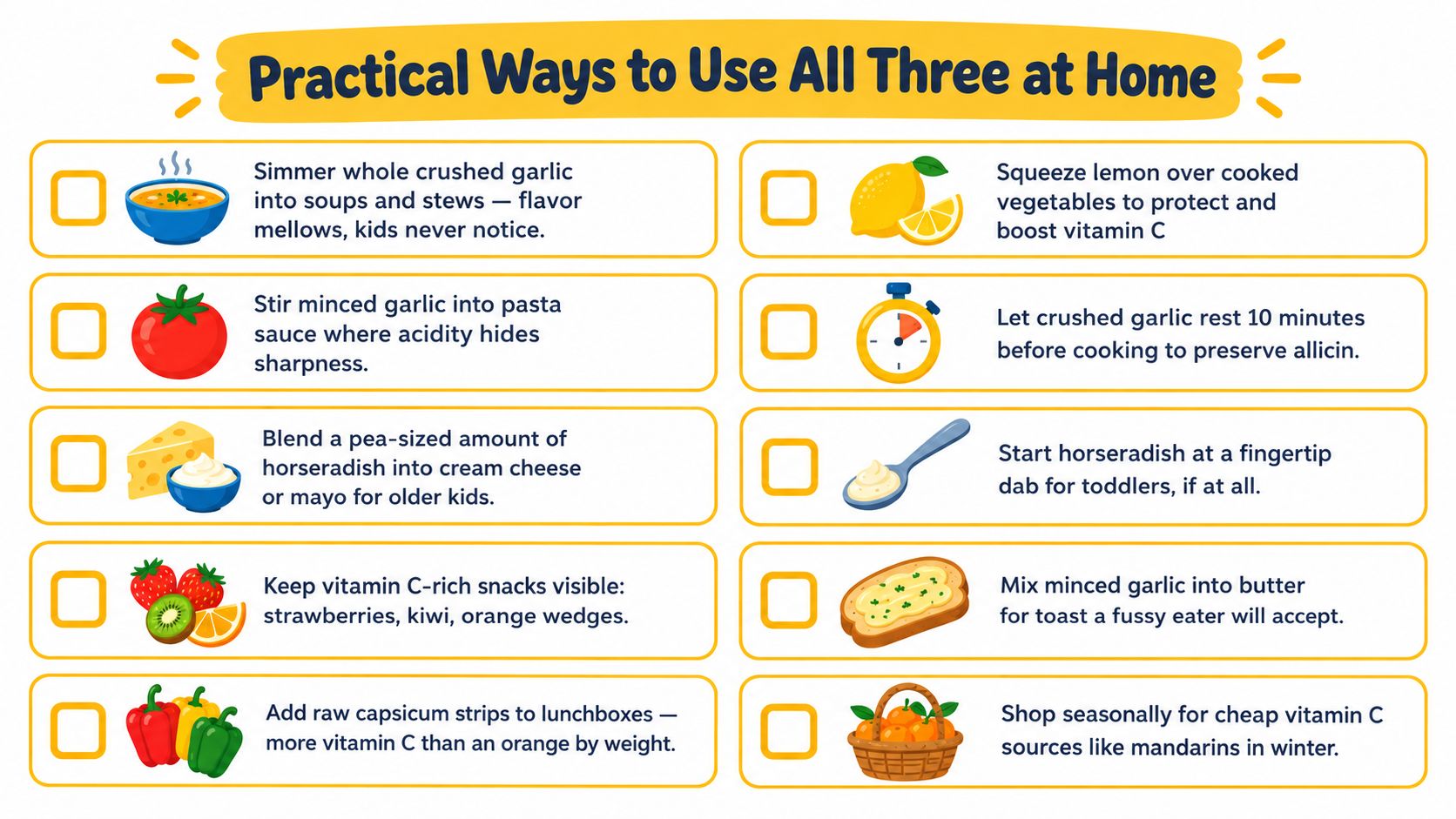
Food is the safest place to begin for most families. Garlic can be mixed into meals in amounts your child already accepts, while vitamin C can come from produce that fits the household routine. Horseradish is different because its strong pungency can irritate the mouth and may be difficult for young children, so it shouldn't be treated as a necessary daily ingredient.
Make the useful parts ordinary
Cook minced garlic into pasta sauce, soups, roasted vegetables or savoury mince. The flavour becomes gentler as it cooks, and the food-first approach avoids assuming that a concentrated extract will work like a household ingredient. If your child dislikes visible pieces, blend the sauce or use a small amount in a familiar dip.
Offer vitamin C foods in forms that require little negotiation. Orange segments, strawberries, kiwi fruit, tomato, broccoli and capsicum can all fit into snacks or lunchboxes, depending on what your child accepts. The Australian Institute of Health and Welfare historical nutrient-supply data, discussed in Australian guidance, show that long-term vitamin C availability was shaped largely by everyday produce such as fresh tomatoes and citrus fruits, not supplements alone.
Horseradish can remain optional. If an older child enjoys a mild spread, a tiny amount mixed through cream cheese or mayonnaise may be more practical than a strong spoonful. Don't force it, and be particularly cautious with toddlers or children who have food allergies, reflux, mouth sensitivity or difficulty swallowing.
Build a repeatable routine
Try a simple household checklist:
- Breakfast: Add fruit to cereal, yoghurt or toast.
- Lunch: Pack one accepted fruit or a few raw vegetable pieces.
- Dinner: Use garlic in a meal the family already eats.
- Shopping: Keep easy-to-serve produce visible and within reach.
- Review: If the diet is very limited, ask a health professional about whether a supplement is appropriate.
The goal isn't to create a “superfood” ritual. It's to make nutritious choices predictable enough that they don't depend on a winter illness or a persuasive label.
Parents should also check the full ingredient list and dosing instructions before giving any supplement to a child. Garlic can cause unpleasant effects and may interact with medicines, while a child who already meets vitamin C needs through food may not gain a meaningful cold-prevention benefit from extra intake. Allergies, medical conditions and age-specific dosing all justify a conversation with a pharmacist or GP.
For families seeking a structured daily routine rather than a horseradish-based cold product, Daily Powers describes children's gummies with sugar-free, vegan formulations, transparent ingredient lists and dosing guidance for ages 4–16. The children's immune support guide offers related context, but no supplement should replace medical advice or a varied diet.
The Takeaway for Australian Families
The phrase horseradish, garlic and vitamin C benefits sounds like it describes one established remedy. The evidence doesn't support that level of certainty. Horseradish has a traditional role in pungent congestion preparations, garlic has biologically interesting compounds and limited clinical research, and vitamin C is an essential nutrient with a modest effect on common-cold duration. The combination itself remains unstudied in the way parents would want before relying on it for children.
A sensible decision framework is practical rather than dramatic:
- Choose food first: If your child eats fruit and vegetables regularly and has no identified deficiency, ordinary food is a reasonable default.
- Investigate restricted diets: Picky eating, feeding difficulties or medical conditions may justify personalised advice.
- Read the claim carefully: “Immune support” doesn't establish prevention, and a listed medicine isn't automatically proven to outperform its individual ingredients.
- Check the label: Look for full ingredient amounts, age-appropriate dosing, allergen information and no added sugar if that matters to your family.
- Don't chase symptoms with certainty: Starting vitamin C after a cold begins isn't supported as an effective treatment, and herbal combinations haven't demonstrated a reliable advantage.
Parents don't need to choose between trusting every natural claim and rejecting every supplement. They can ask whether the evidence matches the product, whether the child needs the nutrient, and whether the expected benefit is large enough to justify the cost, taste or potential side effects.
Small, consistent habits usually offer a more dependable foundation than one seasonal remedy. Keep fruit and vegetables available, make garlic part of enjoyable meals, treat horseradish as optional, and seek professional advice when a child's diet or health needs are complex.
Daily Powers offers children's gummy supplements designed around everyday routines, including the Brave multivitamin format described for general wellbeing, with sugar-free, vegan formulations and transparent ingredient information. If you're comparing options for a child's nutrition routine, visit Daily Powers to review the available products and dosing guidance before making a decision.