

You're standing at the kitchen bench with a bottle of children's gummies in one hand and the lid in the other. The label says one thing in small print, your child is asking for another gummy, and you're left wondering whether one is enough or whether two would be better.
For an Australian child, there isn't one universal answer to how many multivitamin gummies should I take a day. The safe amount depends on the product's nutrient formula, the child's age, sometimes their weight, and everything else they eat or take. The most useful question isn't “how many gummies?” It's “how many nutrients will this serving provide altogether?”
Table of Contents
- Why There Is No Single Answer to This Question
- How to Read an Australian Multivitamin Gummy Label
- Age Appropriate Dosing for Children Aged 4 to 12
- Understanding Recommended Intakes and Upper Limits
- Counting All Sources of Nutrients in a Day
- Multivitamins Versus Targeted Gummies Like Magnesium
- When to Check With a Pharmacist or GP
- A Simple Daily Routine for Confident Dosing
Why There Is No Single Answer to This Question
A gummy is only a delivery format. It isn't a standard nutritional unit. One brand's two-gummy serving may provide a very different amount of vitamin D, iodine, zinc, iron or vitamin A from another brand's serving. Australian nutrient data also distinguishes between tablets, chewable products and other supplement forms, which reinforces that one chew can't be treated as a universal dose. Food Standards Australia New Zealand's AUSNUT supplement data shows materially different nutrient profiles and serving formats across children's multivitamin products.
That's why the printed directions control the decision. Healthdirect Australia advises caregivers to read medicine instructions carefully, recognise that children's products can have different strengths for different age groups, and never give more than the recommended amount. Its guidance also notes that most children who eat a balanced, varied diet don't need routine vitamin or mineral supplements, although supplementation may be considered for children with particular medical conditions, low birth weight or a vegan diet. Healthdirect's guidance on medicines for babies and children provides the relevant safety framework.
The practical rule: Follow the age-specific serving printed on the Australian label. Don't borrow the serving from another brand, and don't increase the dose because the gummies taste pleasant.
Australian vitamins and complementary medicines are therapeutic goods regulated by the Therapeutic Goods Administration. Labels are expected to state the dose and frequency for the relevant age group, rather than leaving parents to guess from the child's size or appetite. The label is therefore more important than a general online answer.
A useful background explanation of the product category is available in what multivitamins are, but the same principle applies whether you're looking at a multivitamin, a chewable tablet or a targeted mineral product. Start with the serving, then examine the nutrient amounts and the child's total intake.
How to Read an Australian Multivitamin Gummy Label
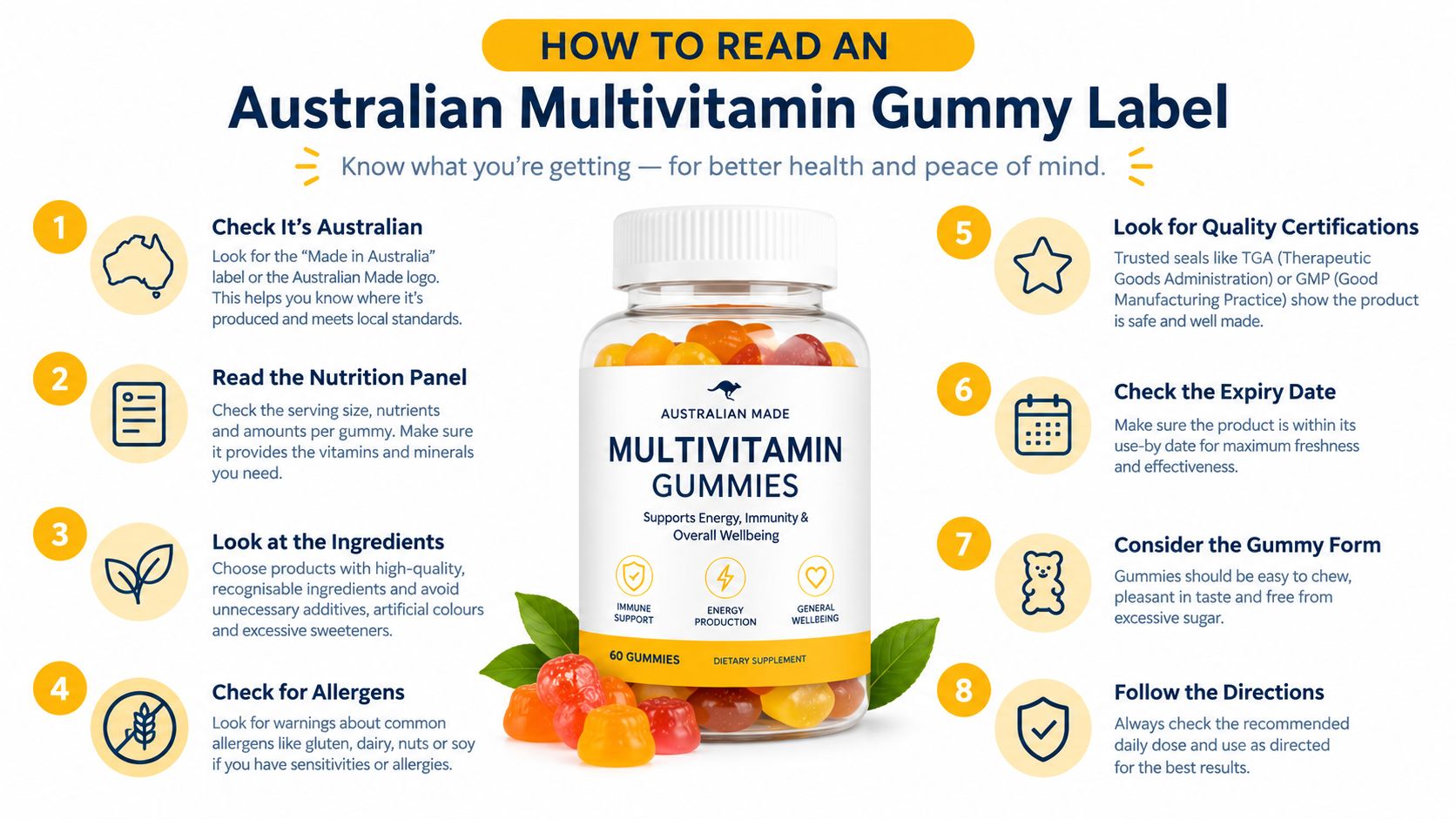
Read the bottle in layers. First, find the directions and the relevant age band. Then find the serving size, which may be expressed as a number of gummies per day. Don't assume that “per serving” means “per gummy”. If the serving is two gummies, the nutrient table may describe the combined amount for both.
Next, examine the active ingredients panel. Write down the amount of each vitamin, mineral and other active ingredient supplied by the stated daily serving. Pay close attention to units. A nutrient listed in micrograms can look numerically small while still making a meaningful contribution to a child's total intake. If a product uses a mineral compound, check whether the label gives the amount of the active or elemental mineral, rather than only the weight of the compound.
AUSNUT records children's multivitamin products with different combinations and amounts of nutrients, including examples with recorded values such as 75 units, 20 units, 180 units, 300 units and 500 units for separate nutrients per recorded serving. Those values belong to a particular database entry, not to every gummy on the market, which is precisely why the label in your hand matters. The AUSNUT supplement profiles are useful for understanding the variation, not for replacing product directions.
The small print deserves equal attention
Check storage instructions, expiry information, sweeteners, allergens and any warnings. A formula may include ingredients beyond the vitamins and minerals you expected, so don't skip the complete ingredient list. If the child has allergies, takes medicines or already uses another supplement, compare the full panels rather than comparing product names.
For example, Brave is described as a daily multivitamin gummy for children, with essential vitamins, kid-friendly flavours and textures, a vegan formulation, and no artificial colours or flavours. Those product characteristics don't tell you the correct dose by themselves. The age-specific directions and complete nutrient panel still determine how it should be used.
Before opening the bottle, run through this quick check:
- Age band: Does the label cover your child's age?
- Daily serving: Is the stated amount per gummy or per serving?
- Active nutrients: What does the full serving provide?
- Duplicate ingredients: Is the child taking another product with the same nutrients?
- Warnings: Are there instructions about medicines, allergies, storage or professional advice?
If any answer is unclear, pause before giving the dose and ask an Australian pharmacist to interpret the label.
Age Appropriate Dosing for Children Aged 4 to 12
A four-year-old and a twelve-year-old can look similar in build, but age still matters when a product sets its serving bands. Nutrient reference values change across childhood, and the same number of gummies can represent a different proportion of a child's daily intake. Healthdirect also advises that children's doses depend on factors such as age and weight, and that caregivers shouldn't exceed the recommended amount. Its medicine-safety advice is a better guide than estimating by body size.
Use the label's age band as the source of truth. If the directions say a particular serving applies to your child's age, use that serving. If the bottle gives separate bands, don't move your child into an older band just because they're tall, active or asking for more.
The table below uses label-dependent wording because there's no safe universal gummy count for each age group.
| Age Band | Typical Gummy Count | Common Nutrient Focus | Key Caution |
|---|---|---|---|
| 4 to 5 | Use the serving printed for this age band | Depends on the product formula | Check the complete panel, especially iron, iodine and vitamin A |
| 6 to 8 | Use the serving printed for this age band | Depends on the product formula | Compare the serving with other supplements and fortified foods |
| 9 to 12 | Use the serving printed for this age band | Depends on the product formula | Older age bands can have different nutrient amounts and directions |
This is also why switching brands mid-cycle requires a fresh label check. A serving that was appropriate for one formula can't automatically be transferred to another. If you're considering a product such as Focus, its listed directions are two gummies daily, and its stated daily serving contains mushroom polysaccharides, vitamin D3, zinc gluconate, elderberry fruit powder and prebiotic fructooligosaccharides. That information applies to that product's stated serving, not to every children's gummy.
Children under four should only receive a gummy supplement when a health professional or the product's appropriate directions specifically support its use. If the child struggles to chew, has a medical condition, or takes prescribed treatment, ask a pharmacist or GP before starting.
Understanding Recommended Intakes and Upper Limits
A parent checks the label and sees two gummies provide several nutrients. The useful question is whether two gummies fit the serving instruction. It is whether the nutrients in that serving fit the child's age, diet and other products.
The Recommended Dietary Intake, or RDI, estimates the daily amount that meets the needs of nearly all healthy people in a particular age group. The Upper Level, or UL, is the highest usual daily intake unlikely to cause adverse effects for almost everyone. The RDI helps assess adequacy. The UL sets a safety boundary. They are not alternative serving sizes.
The figures below use the Australian reference age bands of 4 to 8 and 9 to 13 years, which cover children aged 9 to 12. Vitamin D uses an Adequate Intake rather than an RDI.
| Nutrient | Age 4 to 8 RDI or AI | Age 4 to 8 UL | Age 9 to 12 RDI or AI | Age 9 to 12 UL |
|---|---|---|---|---|
| Vitamin A | 400 micrograms RE | 900 micrograms RE | 600 micrograms RE | 1,700 micrograms RE |
| Vitamin C | 25 milligrams | 650 milligrams | 45 milligrams | 1,200 milligrams |
| Vitamin D | 5 micrograms AI | 80 micrograms | 5 micrograms AI | 80 micrograms |
| Zinc | 4.5 milligrams | 7 milligrams | 6 milligrams | 13 milligrams |
| Iodine | 90 micrograms | 300 micrograms | 120 micrograms | 450 micrograms |
| Iron | 10 milligrams | 40 milligrams | 8 milligrams | 40 milligrams |
These values are reference points, not instructions to add nutrients until the RDI is reached. A child may obtain some nutrients through food, while a gummy may supply a concentrated amount. The UL applies to total daily intake from relevant sources, so an amount below the UL is not automatically a reason to increase the dose.
Iodine illustrates why age matters. The proposed UL is 300 micrograms per day for children aged 4 to under 9, rising to 450 micrograms per day for ages 9 to under 14. NHMRC's nutrition reference information provides the current Australian reference information, including values that may vary by nutrient and age.
Focus lists vitamin D3 and zinc among its active ingredients. Check those amounts against any separate vitamin D, zinc or fortified products before treating the gummy count as meaningful.
For age-related medicine and supplement questions, use these paediatric dosing guidelines. A pharmacist or GP should review products containing iron, high-dose nutrients or several overlapping ingredients.
Counting All Sources of Nutrients in a Day
Start with a blank note on your phone or a piece of paper. Write down the multivitamin's daily serving, then list every other supplement, medicine and fortified food your child has had that day. You're not trying to calculate a perfect dietary record. You're checking whether the same nutrient appears repeatedly.
A useful order is:
- Record the gummy: Note the product name, serving size and nutrients supplied.
- Add other supplements: Include vitamin drops, minerals, probiotics with added nutrients and medicinal products.
- Check fortified foods: Look at breakfast cereals, flavoured milk, plant milks with added vitamins and other fortified products.
- Flag likely overlaps: Pay particular attention to vitamin A, iodine, vitamin D, zinc and iron.
- Pause before adding more: If several products contain the same nutrient, ask a pharmacist to review the combination.
The source of the nutrient can change the significance of the total. For example, vitamin A may come from a supplement as well as foods such as liver or fortified spreads. Iodine may appear in a supplement and in fortified products. Iron deserves extra care when a child is also taking an iron-containing medicine or syrup.
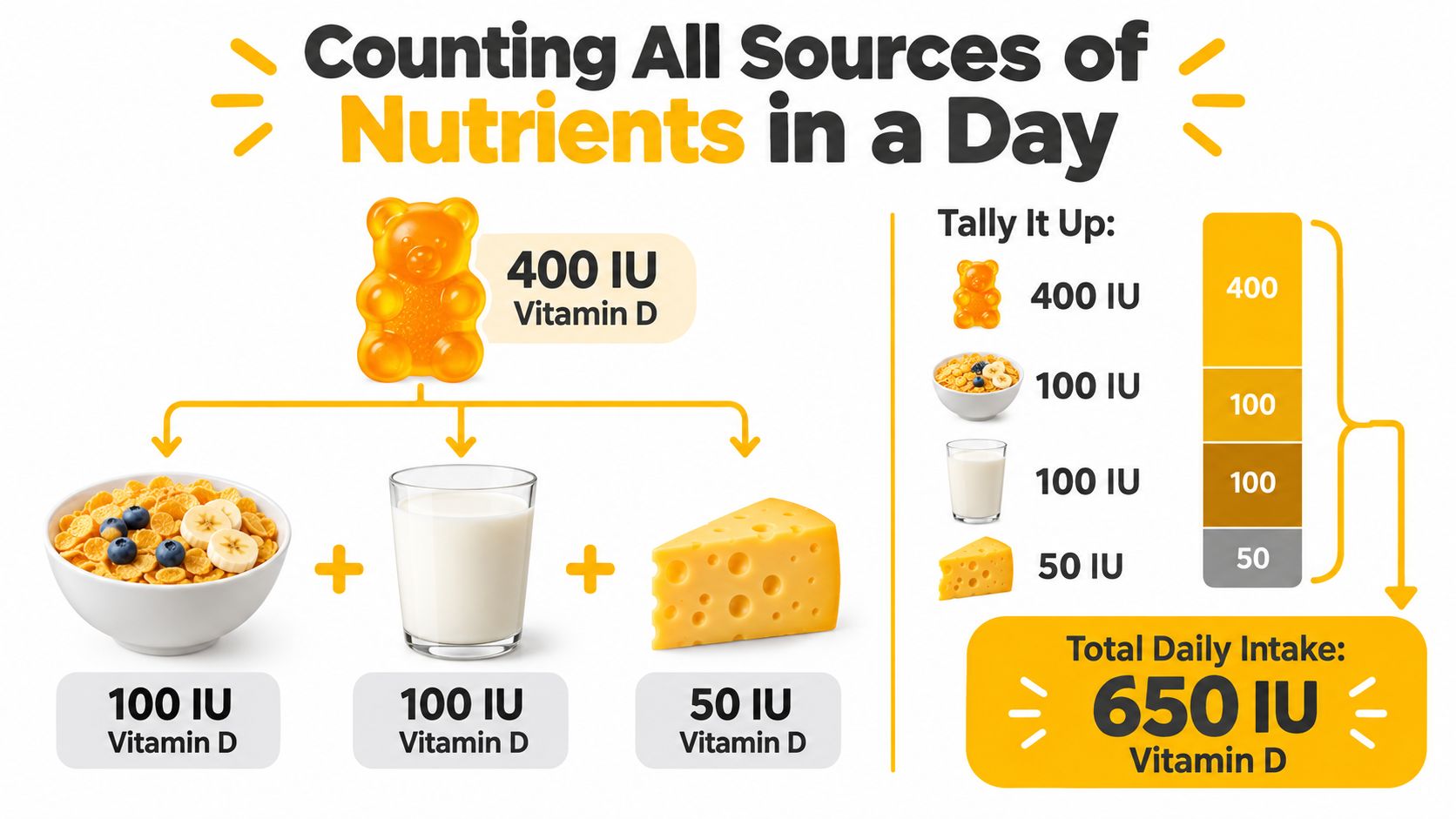
Keep the tally simple:
| Source | Product or food | Nutrients to check | Amount |
|---|---|---|---|
| Supplement | Multivitamin gummy | Vitamin A, D, iodine, zinc, iron | Read the label |
| Supplement or medicine | Separate product | Any overlapping nutrient | Read the label |
| Fortified food | Cereal, milk or plant milk | Nutrients listed on packaging | Read the label |
| Total | Everything used that day | Add repeated nutrients | Ask for help if unclear |
This exercise matters because two gummies instead of one doubles the exposure to every ingredient in that serving. Combining products can also push total intake towards or above a nutrient's Upper Level. Store gummies as supplements, not sweets, and keep the container out of reach once the daily serving has been given.
Multivitamins Versus Targeted Gummies Like Magnesium
The word “gummy” tells you almost nothing about the safety profile. A multivitamin and a magnesium product can both be soft and sweet to chew, yet their active ingredients, dose calculations and warnings can be very different.
A children's multivitamin may combine several vitamins and minerals in one formula. A targeted magnesium gummy concentrates on one mineral, so the relevant question becomes the amount of elemental magnesium supplied by the stated serving. The weight of a magnesium compound printed on packaging isn't necessarily the same as the amount of elemental magnesium available from it.
Australian TGA material lists a magnesium Upper Level of 110 milligrams per day for children aged 4 to 8, and 350 milligrams per day for ages 9 to 13, for supplemental or medicinal magnesium. It also notes that higher doses can cause diarrhoea. The TGA requires a laxative-effect warning when an oral medicine provides 110 milligrams or more of certain inorganic magnesium salts daily for ages 4 to 8, or 350 milligrams or more for people aged 9 and over. These figures concern the relevant supplemental or medicinal magnesium context, not every source of magnesium in food. The TGA material on permissible ingredients and warnings explains why the form and dose matter.
A multivitamin serving and a magnesium serving should never be compared by gummy count alone. Compare the active nutrient and the total daily amount.
If a child takes a multivitamin as well as a calming or magnesium product, check whether the products overlap and whether the magnesium label states elemental magnesium. Persistent diarrhoea or other concerning symptoms warrant stopping the guessing and seeking professional advice.
The guidance in calm magnesium gummies and their benefits should not replace the directions on a specific Australian product. A targeted supplement needs its own age, formulation and interaction check.
When to Check With a Pharmacist or GP
Call a professional when the label no longer matches the child's situation. That includes starting a supplement during the transition from baby foods to a broader diet, changing brands, adding a second product, or giving a supplement to a child with an ongoing medical condition.
A pharmacist is usually the quickest person to contact for label interpretation, duplicate ingredients, medicine interactions and advice after a possible short-term dosing mistake. A child health nurse can help with feeding concerns, routines and general developmental reassurance. A GP is the right person for persistent symptoms, diagnosis, blood tests or concerns about growth and appetite. A dietitian can review the child's overall diet when selective eating or a restricted diet is driving the decision to supplement.
Seek advice rather than self-dosing when:
- The child takes medicines: Ask about interactions and whether a vitamin or mineral could affect the treatment plan.
- You suspect a deficiency: Pallor, unusual tiredness or a marked change in appetite needs assessment, not an extra gummy used as a substitute for diagnosis.
- The product contains iron or high-dose nutrients: Confirm the serving before combining it with another supplement or medicinal product.
- You've switched brands: Recheck the age band, serving size and full ingredient panel from the beginning.
- An accidental extra serving was taken: Keep the bottle nearby and contact a pharmacist, doctor or Australian poisons information service for prompt advice.
The TGA also warns that excess preformed vitamin A can be harmful, with material identifying more than 3,000 micrograms of retinol equivalents as capable of causing birth defects. The TGA complementary medicines guidance is one reason high-dose or overlapping formulas deserve professional review.
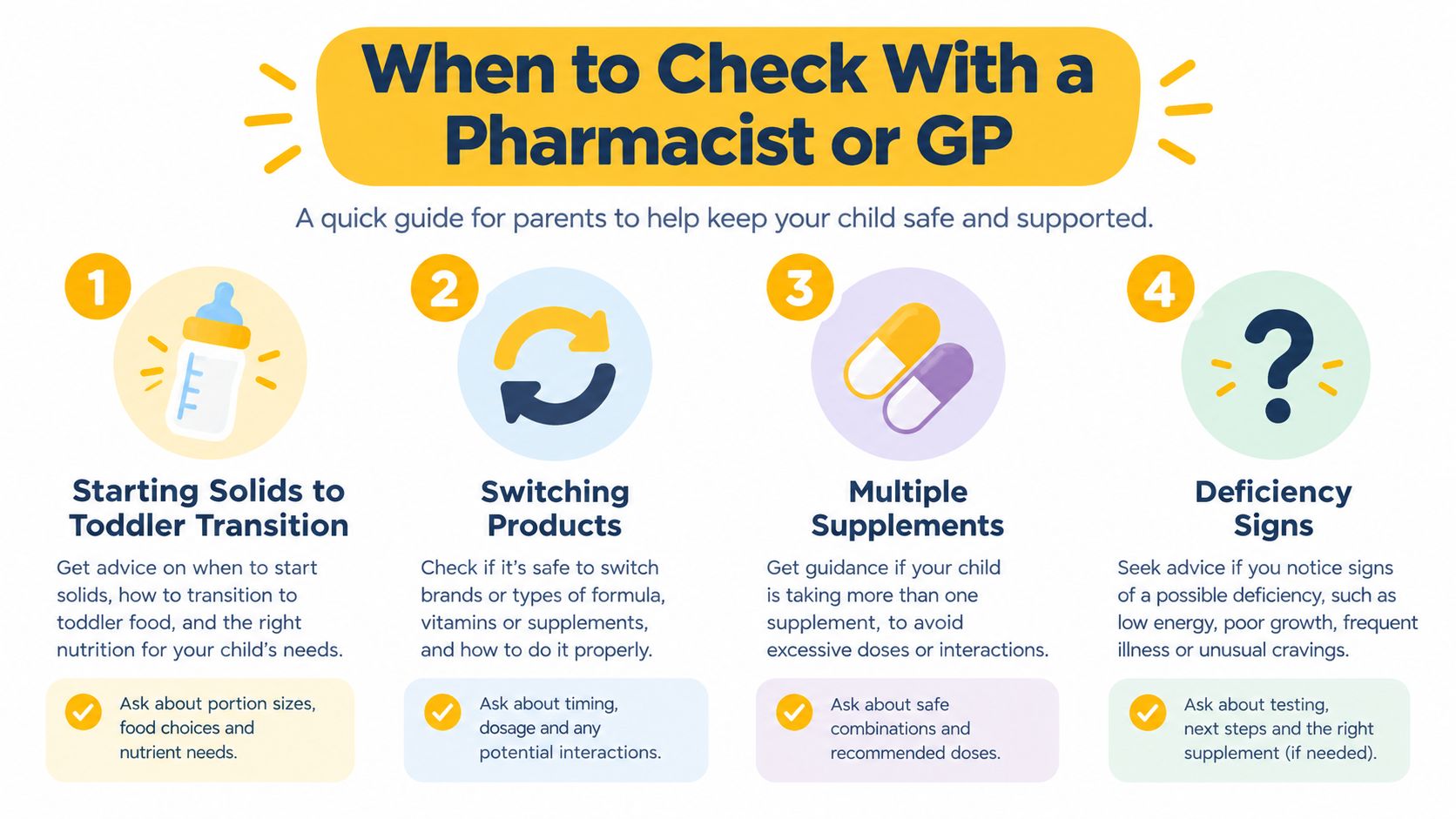
If the situation involves both a visual checklist and a real-time concern, use the image as a prompt, not a diagnosis.
A Simple Daily Routine for Confident Dosing
Make the decision repeatable instead of relying on memory.
- Read before opening: Check the child's age band, serving size and directions on the bottle.
- List the day's intake: Include other supplements, medicines and fortified foods that may contain overlapping nutrients.
- Compare the totals: Pay particular attention to iodine, preformed vitamin A, iron, zinc, vitamin D and magnesium when they appear in more than one product.
- Give the labelled serving: Follow food, timing and storage instructions. Don't add an extra gummy to compensate for a missed dose or a poor meal.
- Record it: Note the time and amount in a phone log, especially when more than one caregiver gives supplements.
If the label is unclear, the child has a medical condition, or you're unsure whether two products overlap, ask a pharmacist before giving the next dose. Confident dosing is a habit built from checking the label, counting the nutrients and knowing when to ask for help.
Daily Powers offers children's gummy products organised around routines such as everyday multivitamin support, focus and calm, with product-specific ingredient lists and directions for caregivers to review. Visit Daily Powers to compare the available formulas and check the labelled serving before choosing a routine for your family.