

Breakfast is going cold, someone needs a signed permission slip, and you're staring at three open gummy bottles wondering which ones your child should take. The labels promise plenty. What they don't answer is whether your child needs any of them.
Kids gummy vitamins should be a targeted tool, not another compulsory morning job. Before you buy, decide what nutritional problem you're trying to solve. Then judge the bottle by its ingredients, dose and suitability for your child, not the reassuring words on the front.
Table of Contents
- The Question Most Parents Skip Before Buying
- Australian Guidance on Whether Supplements Are Needed
- Reading the Label Like a Short Checklist
- Decoding the Buzzwords on the Front of the Box
- Key Nutrients and Age-Banded Dosing for Ages 4-12
- Safety, Dosing and Choking Awareness
- Building a Daily Routine That Actually Sticks
- Subscription Versus One-Off and How to Choose a Quality Product
The Question Most Parents Skip Before Buying
The useful question isn't which gummy tastes nicest. It's what am I trying to fix?
A child who's refused tonight's vegetables isn't automatically a child who needs a multivitamin. Equally, a child with an extremely narrow diet deserves more than a cheerful bottle and crossed fingers. Those situations call for different responses.
Supplement use is common enough to feel normal, but it's still a minority behaviour: among Australian children aged 2–17, 19.2% of males and 18.0% of females reported taking a dietary supplement in the Australian Bureau of Statistics dietary supplements survey. Popularity tells you nothing about whether a particular product belongs in your kitchen.
Give the purchase a clear purpose
I'd put possible reasons for supplementation into these practical categories:
- An identified nutritional gap: You have professional advice about a nutrient your child needs, rather than a general feeling that more vitamins must help.
- A restricted diet: Entire food groups are absent, or the range of accepted foods makes you concerned about nutritional adequacy.
- An individual health or developmental need: A clinician has identified circumstances that change your child's nutritional requirements.
These are reasons to investigate, not instructions to buy whatever multivitamin is on special.
For ordinary mealtime friction, start with the food routine. Look at what your child accepts across the week, not just what they left on tonight's plate. Offer familiar foods alongside opportunities to try something else, and avoid turning dinner into a nutritional performance review.
A gummy should have a job you can name. If its only job is making you feel less guilty about dinner, pause before buying.
Write down your concern before opening another shopping tab. “Avoids dairy foods” gives a dietitian something useful to assess. “Needs a boost” doesn't tell you which ingredient to choose.
Australian Guidance on Whether Supplements Are Needed
The Australian food-first position is reassuring: children aged 2–11 generally had adequate intakes of most vitamins and minerals, with calcium the notable exception, according to the 2023 National Nutrition and Physical Activity Survey. That's population-level context, not a diagnosis for your child, but it challenges the idea that every lunchbox needs a multivitamin alongside it.
Most children eating a balanced diet don't routinely need vitamin or mineral supplements, and caregivers should discuss their use with a healthcare professional, as explained in Healthdirect's dietary supplements guidance. The sensible next step is assessment when there's a concern, not automatic supplementation.
Use this visual as a prompt for the conversation, rather than a substitute for individual advice.
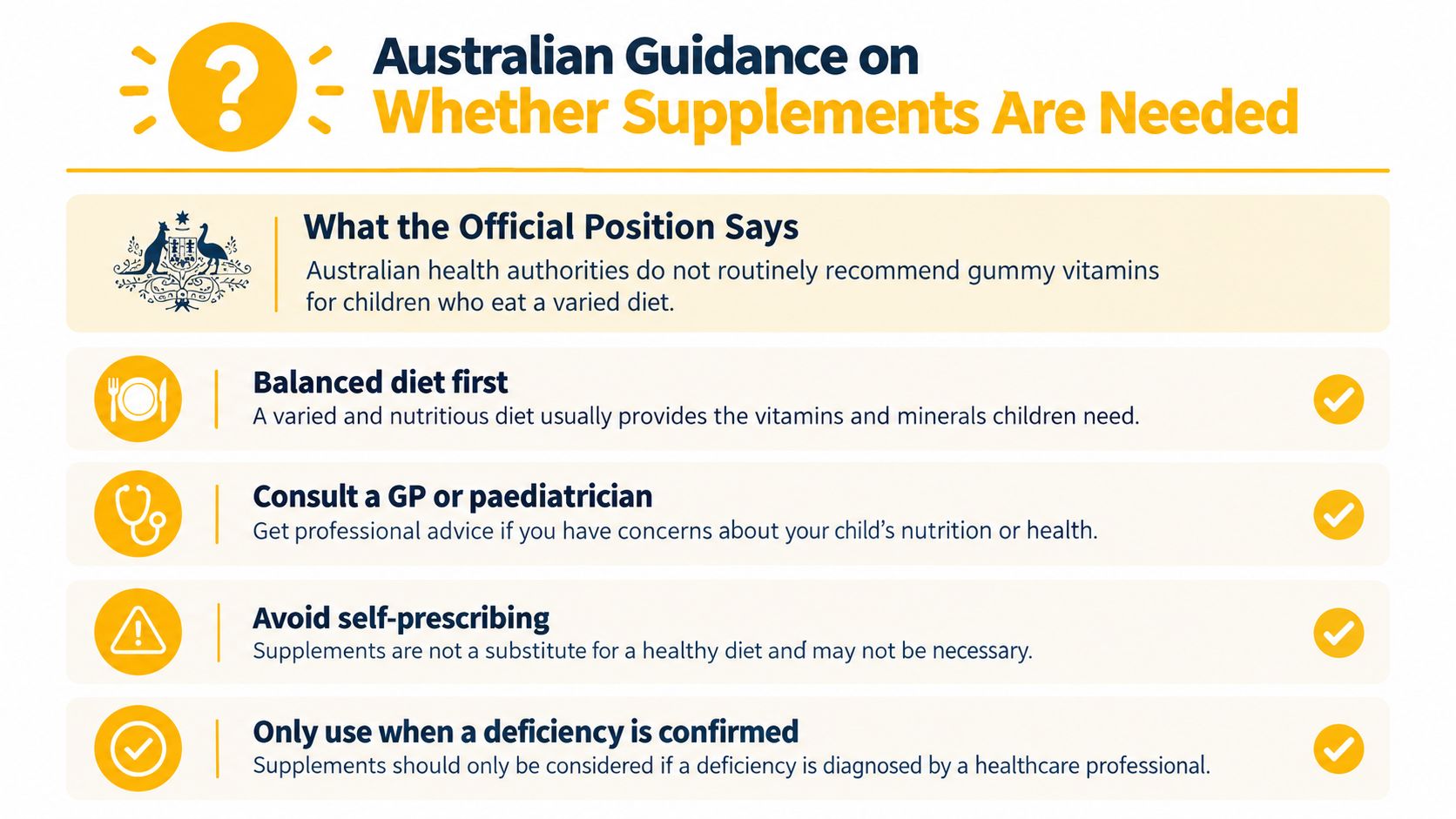
Match the response to the concern
For a child who eats reasonably varied foods and has no specific concern, I'd keep working on meals rather than add a supplement by default. For a child whose diet is persistently limited, I'd arrange a dietary review before guessing which bottle might compensate.
Take something concrete to the appointment:
- Food patterns: Note accepted foods, excluded groups and any recent changes.
- Relevant history: Explain medical conditions, medicines and existing supplements.
- Your actual question: Ask whether food changes, a targeted supplement or further assessment would be most useful.
Don't self-order blood tests or interpret every difficult afternoon as a deficiency. Ask the GP or accredited dietitian whether testing is warranted and what the result would change.
The infographic's confirmed-deficiency checkpoint is a conservative reminder, not an absolute rule. A professional may recommend supplementation for a clear dietary or medical risk without waiting for a laboratory-confirmed deficiency. You need a defensible reason and an appropriate plan, not necessarily a test result for every nutrient.
Reading the Label Like a Short Checklist
Turn the bottle around before you decide whether it belongs in your basket. Front-of-pack promises can wait; serving instructions and ingredient quantities can't.
Keep this checklist beside the product page while you compare options.
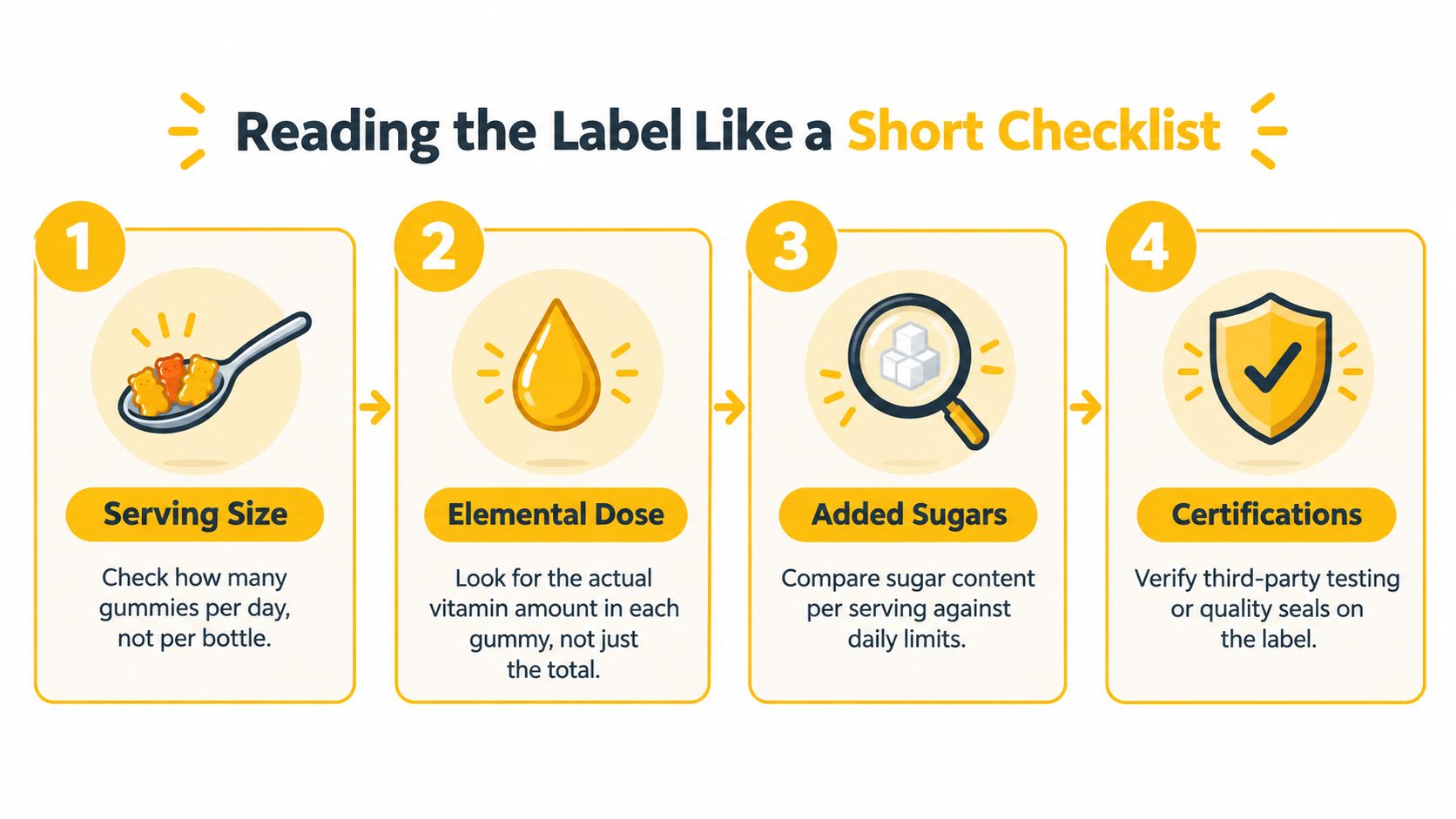
Start with the serving and nutrient amounts
Check the age instructions first. Look for an explicit permitted age range, daily serving and maximum-use instructions. If you can't establish what applies to your child, put the bottle back or ask the pharmacist.
Next, establish whether the nutrient panel describes each gummy or the complete daily serving. Those aren't interchangeable. Don't compare products until you're comparing the same basis.
For minerals, find the actual amount supplied. With magnesium, that means the elemental magnesium amount, not merely the weight of the magnesium-containing compound. If the label gives only an unfamiliar ingredient name and a large-looking quantity, ask for clarification rather than assuming it's the nutritional dose.
Useful label terms to locate include:
- Daily serving: The amount the manufacturer directs your child to take.
- Equivalent nutrient amount: The actual vitamin or mineral supplied by the listed ingredient.
- Warnings and exclusions: Conditions, medicines or circumstances that require advice before use.
Read the rest, not just the active ingredients
Scan the complete ingredient list for sweetening ingredients, colours, flavours and anything relevant to your child's allergies. Don't let an attractive dietary claim distract you from an ingredient you already know your child must avoid.
Keep these terms separate: sugar-free, no added sugar and unsweetened. Don't assume they describe the same formulation. Check the nutrition information, where provided, and the ingredient list rather than deciding from the badge alone.
The video offers another prompt for looking closely at a gummy product.
Finish by checking the regulatory information and asking what any quality seal verifies. The infographic's reference to sugar limits isn't a reason to invent a universal gummy allowance, and a certification badge isn't proof of a child-specific benefit.
My shelf rule is straightforward: if essential dosing information is missing or confusing, don't buy first and investigate later.
Decoding the Buzzwords on the Front of the Box
A preference isn't a therapeutic reason. You can reasonably prefer a vegan or sugar-free gummy, but neither feature establishes that your child needs its nutrients.
Iron-free deserves the same scrutiny. If iron is the nutrient your clinician wants addressed, an iron-free multivitamin doesn't solve that problem. If it isn't, don't chase iron merely because a longer ingredient list looks more complete.
Front-of-pack claims and what they actually certify
Treat the wording below as a claim to check against the label and supporting information, not as independent certification.
| Claim | What it certifies | What it does not certify |
|---|---|---|
| Sugar-free | A declared sugar-related characteristic, subject to applicable labelling requirements | No sweeteners, no carbohydrate, or suitability for every child |
| No artificial colours or flavours | A stated exclusion from the formulation | Nutritional necessity, effectiveness or absence of allergens |
| Vegan | A stated formulation characteristic relevant to avoiding animal-derived ingredients | An appropriate dose or a proven benefit |
| Iron-free | Iron isn't included in the stated formulation | That the product addresses an iron-related need |
| TGA listed or registered | A specific Australian regulatory status that should be verified | A guaranteed outcome for your individual child |
For vegan households, the guide to whether multivitamins are vegan is a useful starting point. Still inspect the exact product, rather than assuming every item from a brand has identical ingredients.
Sugar-free does not mean no added sugar. Don't treat either phrase as shorthand for an otherwise superior supplement. Similarly, “natural” and “no artificial colours” aren't answers to the dosing question.
Treat regulatory language precisely
The TGA explains that vitamins may be listed or registered medicines; listed medicines must use permitted ingredients, meet manufacturing requirements and have evidence supporting their indications, but the assessment pathways differ, as outlined in how vitamins are regulated in Australia. That distinction matters more than a loose “TGA approved” phrase.
Buying rule: Verify the exact product's regulatory status. Don't translate a regulatory badge into a promise about school performance, confidence or bedtime.
Ask for the product's Australian Register of Therapeutic Goods details where applicable. If a seller relies on a badge but won't provide clear product information, choose a more transparent option.
Finally, don't let “soft” or “kid-friendly” wording replace checking the age warning and whether your child can manage the texture.
Key Nutrients and Age-Banded Dosing for Ages 4-12
A nutrient reference value is not a prescription to supply that whole amount in a gummy. Your child's food intake belongs in the assessment, and the recommended intake and supplemental upper limit answer different questions.
For the audience here, the relevant reference bands are 4–8 years and 9–13 years. A child aged twelve belongs in the latter band; that doesn't make every product labelled for older children suitable.
Magnesium shows why the distinction matters
The Australian reference values set magnesium's recommended dietary intake at 130 mg/day for ages 4–8 and 240 mg/day for ages 9–13, while the respective upper levels from supplements are 110 mg/day and 350 mg/day, according to the NHMRC Nutrient Reference Values. These supplemental limits exclude magnesium naturally present in food; exceeding them can increase gastrointestinal adverse effects, particularly diarrhoea.
That younger-age distinction is easy to miss. The recommended total dietary intake is higher than the supplemental upper level because they measure different things. Don't try to “complete” the dietary target using a supplement alone.
For vitamin A, Australian guidance gives recommended daily amounts of 400 micrograms for ages 4–8 and 600 micrograms for ages 9–13, and warns that excessive long-term intake can cause harm because it accumulates in the body; the same Healthdirect vitamin and mineral guidance identifies diagnosed deficiency, certain medical conditions, low birthweight history and vegan diets as circumstances where supplementation may be relevant.
Make a fridge checklist, not a homemade dosing chart
Keep the checklist specific to your child:
- Correct reference band: Match your child's age to the professional assessment and the product directions.
- Relevant nutrient: Identify whether the plan concerns vitamin D, B-group vitamins, magnesium, iron, zinc, iodine or something else.
- Actual daily amount: Record the nutrient supplied by the directed serving.
- Whole-product review: Give the clinician or pharmacist details of other supplements and relevant fortified foods.
Don't rank those nutrients by how often they appear in advertising. Ask which one matters for the identified concern and whether a broad multivitamin or a targeted product is the better fit.
A product image helps identify the bottle, but it can't replace the nutrient panel.
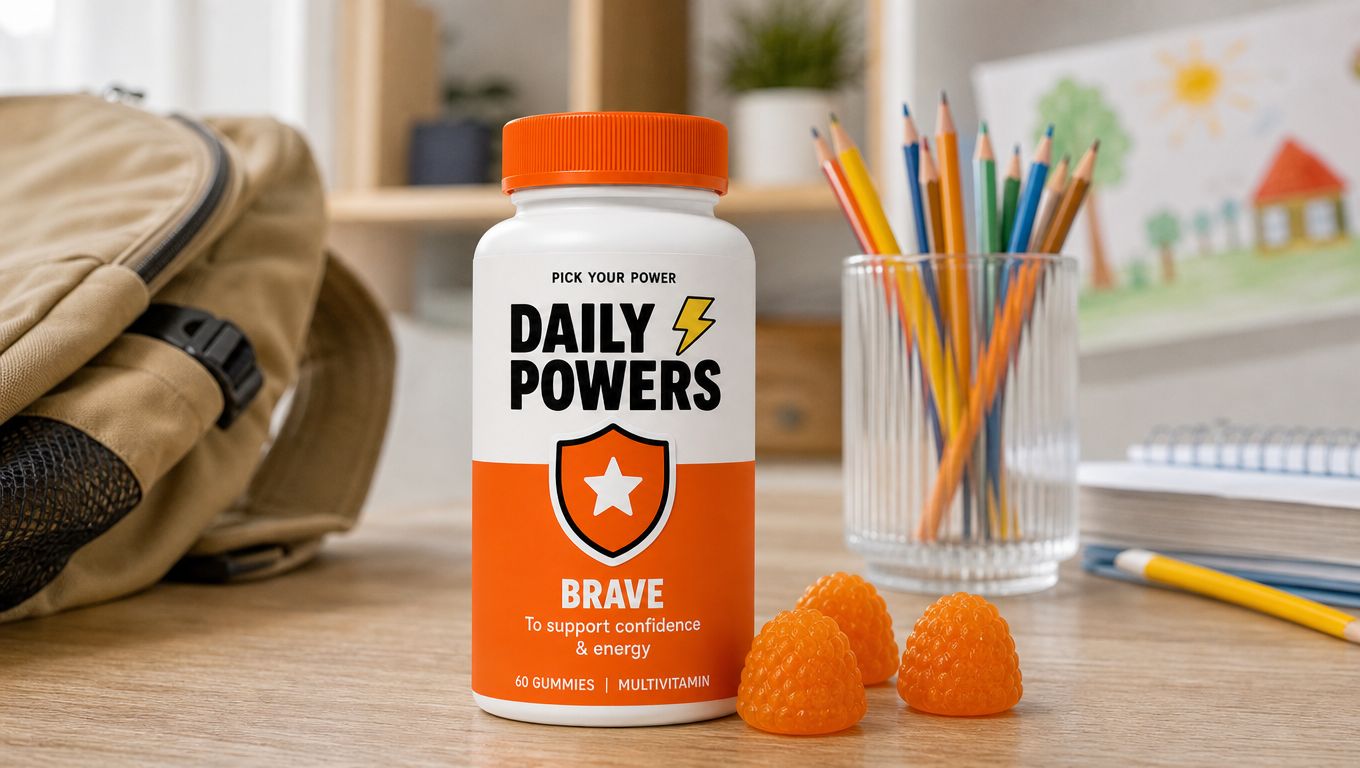
Brave is one daily multivitamin gummy option described as vegan-friendly and free from artificial colours or flavours. Those formulation details are useful, but they don't establish its suitability for an individual child.
Before choosing it or any alternative, obtain the current quantities and age-specific instructions. A name, flavour or wellbeing message can't tell you whether the dose matches the need.
Safety, Dosing and Choking Awareness
The adult should control the bottle, count the serving and put it away. Don't hand over the container and expect a child to distinguish a supplement from a sweet that happens to have rules.
Make the administration routine simple enough that another caregiver can follow it without guessing. The goal is fewer opportunities for an accidental repeat serving.
Use this visual as a household reminder.
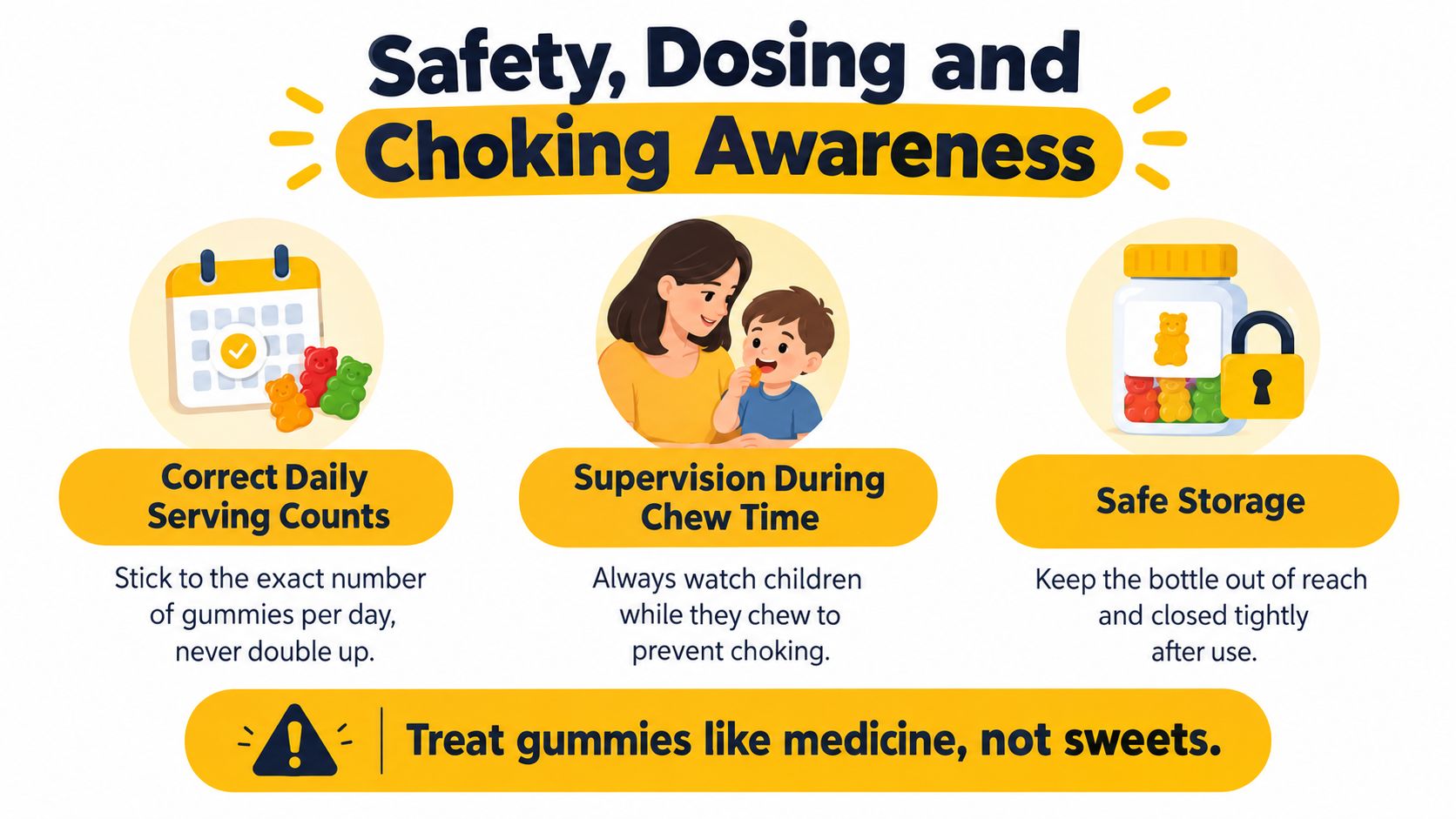
Supervise the actual chewing
Have your child sit down, stay nearby and watch until they've finished. Don't offer a gummy while they're running around, laughing with food in their mouth or rushing out the door.
Treat texture suitability as an individual decision. Soft-gel warnings shouldn't be casually presented as evidence about every gummy, but neither should “easy to chew” marketing persuade you to ignore a child's difficulty managing the product.
If chewing is a problem, ask a pharmacist about an appropriate alternative format. Don't improvise by cutting, melting or mixing the product unless its instructions or a professional support that approach.
Keep everyone on the same plan
- Record administration: Use a shared tick box or note so caregivers know whether the serving has already been given.
- Store deliberately: Close the bottle securely and keep it out of children's reach and sight.
- Avoid overlapping products: Have the complete combination checked rather than adding another bottle independently.
- Plan for mistakes: If your child takes more than directed, seek prompt advice from a pharmacist, clinician or poisons information service with the bottle available.
The paediatric dosing guidelines can help organise your questions before that conversation.
For refusal, try: “You don't have to like this texture. We'll ask about another option.” For a busy evening, check the administration record and follow missed-dose advice rather than doubling up.
Set a review point with the recommending professional. Continuing indefinitely shouldn't be the unspoken default.
Building a Daily Routine That Actually Sticks
Choose the moment when you can reliably supervise, not the moment that looks nicest in a wellness routine. Breakfast suits some households. An after-school snack may work better if mornings are chaotic, provided it fits the product directions.
Keep the cue ordinary: sit down, adult checks the serving, child takes it, adult records it and stores the bottle. You don't need a reward system or a motivational speech every day.
Offer choice inside the boundary
Let your child choose the seat, the cup or whether the reminder happens before or after another suitable activity. Don't let them choose between nutritionally different products unless a professional has specifically approved that plan.
If flavour or texture causes resistance, take that feedback seriously. Buying a large supply before you know your child can manage the product creates an avoidable problem.
Build the habit around the agreed plan, not around persuading your child to consume something they consistently reject.
Weekend disruption calls for a portable reminder, not a second unsupervised bottle. A phone reminder or shared household note can preserve the same administration process when the usual breakfast cue disappears.
Match purchasing to the stage you're at
| Household situation | One-off purchasing | Subscription purchasing |
|---|---|---|
| Trying an unfamiliar product | Keeps the initial commitment limited | May deliver more before you've established suitability |
| Following an ongoing plan | Requires deliberate reordering | Can reduce the need to remember orders |
| Needs are changing | Makes reassessment straightforward | Requires attention to pause or cancellation settings |
| Supply is building up | Lets you wait before buying again | Needs delivery timing adjusted to actual use |
I'd start with a one-off purchase when suitability or acceptance is still uncertain. Consider a subscription only once you know the product fits the plan and your household uses it consistently.
Compare the total ongoing cost, including delivery where applicable, rather than the advertised discount alone. An automated order is convenient only if you need what arrives.
Subscription Versus One-Off and How to Choose a Quality Product
Buying convenience belongs at the end of the decision, after nutritional suitability. A subscription can simplify replenishment, but it shouldn't turn a short-term recommendation into an indefinite commitment.
Before ordering, check the delivery interval, ongoing price and how to pause, skip or cancel. Don't assume flexibility from a prominent subscription button. The supplement subscription comparison guide offers a starting point for comparing those practical terms.
Separate quality evidence from shopping reassurance
Clear disclosure is more useful than a collection of badges. I'd shortlist products that let you answer the following without chasing customer support:
- Dosing transparency: Can you establish the daily nutrient amounts and the instructions for your child?
- Formulation fit: Does the product address the reason supplementation was recommended?
- Relevant dietary details: Can you verify allergens and any sugar-free or vegan claims that matter to your household?
- Regulatory clarity: Is the Australian status explained precisely where applicable?
- Accessible support: Can you obtain clarification before administering the product?
Reviews can tell you what other buyers thought about ordering or taste. They can't establish that your child needs the formulation. A satisfaction guarantee is similarly a purchasing safeguard, not evidence of effectiveness.
Make the decision this week
First, name the concern. Bring a brief food record and your existing supplement list to a GP, pharmacist or accredited dietitian if you need help assessing it.
Next, photograph the candidate label. Ask whether its nutrient amounts, format and directions match the recommended plan before you buy.
Then, choose the smallest sensible commitment. Establish suitability and a workable routine before arranging repeat deliveries, and decide when you'll reassess the need.
You don't need the most elaborate supplement shelf. You need a clear purpose, an appropriate product and a routine the adults can manage safely.
Daily Powers offers children's gummy supplements designed around specific needs and repeatable household routines. Visit Daily Powers to review ingredient lists and age-specific dosing guidance, then take the product details to your pharmacist or dietitian before choosing what belongs in your child's routine.