

The shoes are missing, toast is going cold, a library book has vanished, and someone has decided that today is the day they absolutely can't wear the school uniform. By the time everyone reaches the car or the front gate, the morning has already felt like a negotiation.
A calmer morning routine for kids usually doesn't come from moving faster. It comes from removing decisions, putting tasks in a reliable order, and making the evening carry more of the workload. For Australian families, that also means taking breakfast access, school readiness and sleep seriously, rather than treating them as optional extras.
Table of Contents
- Why Most Morning Routines for Kids Fall Apart
- Night-Before Preparation Hacks That Remove Morning Decisions
- A Sample Morning Schedule for Kids Aged 4 to 12
- Building a Nutritious Breakfast Into the Routine
- The Hidden Bottleneck Is Usually Sleep
- Troubleshooting Common Morning Problems and Building Independence
Why Most Morning Routines for Kids Fall Apart
A typical rushed morning asks children to remember too much while they're still waking up. They need to choose clothes, locate shoes, eat something, brush their teeth, find their bag and respond to repeated reminders, often while a parent is preparing lunches and checking the time.
That isn't a character flaw. It's a systems problem. When every step depends on memory, motivation or a parent's escalating instructions, the routine becomes fragile. One missing item can disrupt everything that follows.
Australian school breakfast data shows why the food step deserves a firm place in the sequence. Foodbank Australia reported that its School Breakfast Program supported 2,104 schools in 2024, distributed more than 2.5 million kilograms of food, and reached an estimated 55,230 students annually. The program served an average of 368,200 meals per week, and 60% of students would miss breakfast without it according to Foodbank Australia's 2024 report. Breakfast is part of many children's school-day infrastructure, not merely a nice addition to a perfect household morning.
Speed isn't the same as structure
Parents often try to solve chaos by setting a later alarm and pushing everyone through the same list more forcefully. That may work for a day, but it doesn't teach the child what happens next. It also increases parent-led task completion, leaving the caregiver responsible for every transition.
A sequenced routine works differently:
Wake up. Fuel up. Brave up. Brush up. Go.
The Daily Powers version uses breakfast as the anchor, then places Brave immediately afterwards. The sequence is Breakfast → Brave → Brush → School. A child doesn't need to remember a separate supplement task because it's attached to something already happening.
Habit stacking lowers the mental load
Habit stacking means placing a new action directly after an established action. In this case, breakfast comes first, the daily gummy follows, and toothbrushing comes next. The order matters because children can learn the flow rather than repeatedly answer, “What do I do now?”
The aim isn't a silent, perfectly timed household. A good routine still allows for tiredness, conversation and unexpected delays. It gives the family a dependable path back to the next step.
The Australian guidance on morning routines for school-age children recommends preparing bags, uniforms, lunches and notes the night before, using a fixed wake time and keeping a short checklist for waking, breakfast, teeth, dressing and leaving. It also suggests getting up 15–30 minutes earlier than you think you need to, because rushing makes routines harder to follow and encourages parents to take over.
Night-Before Preparation Hacks That Remove Morning Decisions
The easiest morning decision is the one nobody has to make at 7 am. Australian family-health guidance recommends shifting as many steps as possible into the previous evening, while keeping the morning sequence short and repeatable.
Five practical evening resets
- Pack the school bag. Check homework, the lunchbox, water bottle, library books, permission notes and anything needed for the next day. Put the finished bag in the launch area, not beside the child's bed where it can be forgotten.
- Lay out clothes and shoes. Place the uniform, socks, underwear and shoes together. If your child is particular about clothing, resolve that conversation in the evening, when nobody is late.
- Prepare breakfast components. Wash fruit, put yoghurt in the fridge, measure oats and place bowls or spoons on the table. The aim is a nutritious breakfast without turning the morning into a cooking project.
- Put the daily gummy where breakfast happens. If your family uses Brave, keep it appropriately stored and visible near the breakfast routine, following the product directions. It should be part of the predictable sequence, not treated as a sleep or concentration aid.
- Start winding down before bed. A calmer final period can include a shower, pyjamas, reading and lights out. Australian family guidance also recommends consistent sleep and wake times and avoiding screens before bed.
These steps remove choices rather than adding chores. A child who sees shoes beside the uniform has fewer opportunities to become stuck. A parent who has already checked the bag doesn't need to conduct a frantic search while breakfast is being eaten.
Use a small time buffer
If mornings routinely collapse at breakfast, try setting the child's alarm 10 minutes earlier, or prepare breakfast the night before. Raising Children Network gives both options as practical ways to reduce rushing in its breakfast guidance. Earlier doesn't mean filling the extra time with more tasks. Use it to let the child wake, open the curtains, visit the toilet and begin without an immediate command.
A useful evening check is simple: “What could stop us tomorrow?” Ask the child to identify one likely problem and solve it before bed. That turns preparation into a shared skill, rather than another list controlled entirely by the parent.
A Sample Morning Schedule for Kids Aged 4 to 12
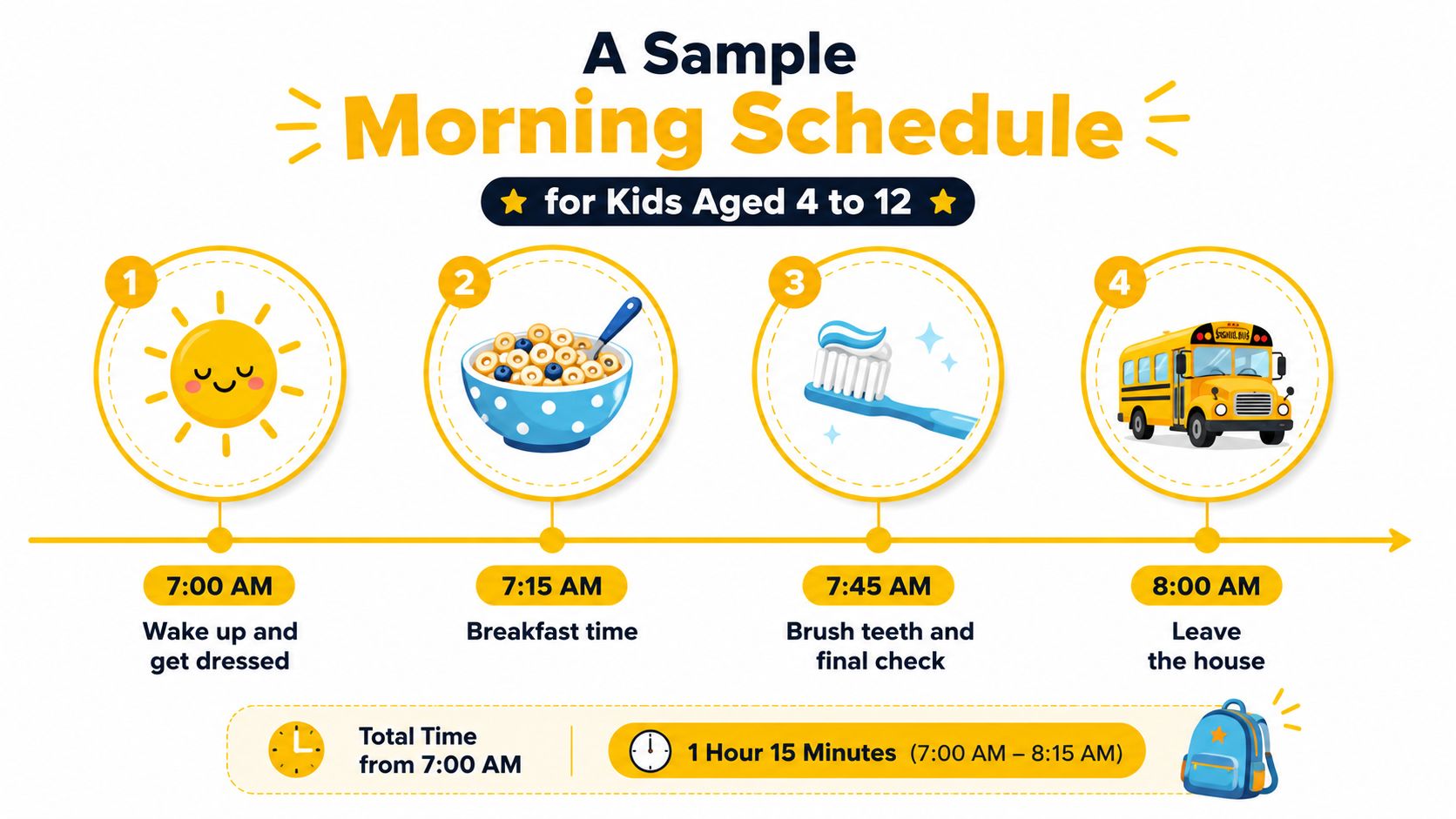
A practical schedule gives children a sequence they can recognise. The times below follow a simple Brave routine, beginning at 7:00 am and finishing with departure between 8:00 and 8:15 am.
The sequence in real time
7:00 am, wake up. Open the curtains, use the toilet and get moving. Avoid starting with a screen, which can pull attention away before the first task has even begun.
7:10 am, breakfast. Keep the meal familiar and manageable. Eggs and toast, yoghurt and fruit, or porridge can provide a dependable anchor without creating extra preparation.
7:25 am, Brave time. The gummy slots in immediately after breakfast. The child follows the sequence, Breakfast → Brave → Brush, instead of waiting for a parent to remember a separate supplement moment.
7:30 am, get ready. Brush teeth, wash the face, get dressed, apply sunscreen and do hair. Younger children may need an adult nearby, while older children can work from a visual checklist.
7:50 am, bag and shoes. Collect the packed lunchbox, water bottle and school bag from the launch area. Shoes should already be together, so the final stage is retrieval rather than searching.
8:00–8:15 am, leave. Use this window for the walk, drive or school drop-off, with the later time acting as a buffer for ordinary delays.
Adapt the responsibility, not just the clock
A four-year-old may need pictures and spoken prompts. A child closer to twelve may be able to manage the checklist, prepare parts of breakfast and notice when the routine is slipping. The clock can stay similar while the adult's role gradually changes from doing, to prompting, to checking.
A printed or hand-drawn kids routine chart can make the order visible. The child can point to or move through each step, which is often more effective than hearing the same verbal reminder repeatedly.
If your child already uses a supplement routine for school-day wellbeing, Focus is another Daily Powers product listed as a daily gummy containing Mushroom Polysaccharides, Vitamin D3, Zinc, Elderberry and Prebiotics. Follow the product directions and speak with a healthcare professional when you're unsure what's appropriate for your child.
Building a Nutritious Breakfast Into the Routine
Breakfast needs to be simple enough to repeat and substantial enough to matter. Australian research shows that breakfast skipping remains common among school-aged children. A 2025 report from The Kids Research Institute Australia found that 57.6% of surveyed South Australian students skipped breakfast sometimes, while 10.1% skipped it every day the report is summarised by The Kids Research Institute Australia.
Earlier national evidence also found breakfast skipping fell between 2000 and 2006, including a change among secondary school females from 27.7% to 18.7% and secondary school males from 19.9% to 12.1% as reported in the same Australian research summary. The lesson is practical: routines can influence behaviour, but the routine must make eating achievable.
Build around three food groups
Nutrition Australia Queensland recommends combining fruit or vegetables, a dairy product or another protein-rich food, and wholegrain bread or a high-fibre breakfast cereal in its Brainy Breakfast Ideas guide.
| Component | Examples | Prep tip |
|---|---|---|
| Fruit or vegetables | Banana, berries, mushrooms, avocado | Wash fruit or slice ingredients the night before |
| Dairy or protein | Yoghurt, milk, eggs, baked beans | Boil eggs ahead or keep yoghurt ready in the fridge |
| Wholegrain or high-fibre carbohydrate | Porridge, wholemeal toast, high-fibre cereal | Measure oats or set out bread and bowls in advance |
Specific combinations include porridge with banana or berries, natural muesli with berries and milk or yoghurt, wholemeal toast with avocado and cooked mushrooms, boiled egg with wholegrain toast, and scrambled eggs on wholemeal toast. These options give children a familiar menu while still allowing variety across the week.
Make breakfast the anchor
The best breakfast is often the one a child will eat without a prolonged argument. Australian Government guidance recommends simple options such as wholegrain cereals, fruit and yoghurt, and advises parents to allow enough time for breakfast, agree on healthy options the child enjoys and model the behaviour by eating breakfast themselves through the Learning Potential school-morning resource.
Avoid making every morning a nutrition test. Offer a small set of acceptable choices, keep portions realistic and reserve more elaborate meals for days when there's time. Once breakfast is predictable, the next habit can follow naturally, whether that's toothbrushing, a daily supplement taken according to its directions, or leaving for school.
Families interested in the role of food and digestion can also read this practical guide to gut health for kids, but breakfast still needs to work first as a reliable morning habit.
The Hidden Bottleneck Is Usually Sleep
A child who struggles at 7 am may be exhausted, not defiant. A well-ordered morning can organise tasks, but it cannot make up for a bedtime that regularly leaves a child short of sleep. The routine needs to begin the night before, with sleep protected before alarms, breakfast and daily supplements enter the sequence.
Australian data found that 42% of children aged 5–17 had a sleep-pattern problem, 21% weren't getting enough sleep, and 45% of children aged 5–12 had sleep issues. The same ABS data set reported average sleep of 9 hours 43 minutes for children aged 5–17 and 11 hours 27 minutes for children aged 2–5 in Australian Bureau of Statistics information on children's physical activity, screen time and sleep.
Treat bedtime as part of the morning plan
For children aged 5–13, Australian guidelines recommend 9–11 hours of sleep, alongside consistent bed and wake times. That gives parents a practical place to investigate: the final part of the previous evening. If getting dressed or starting breakfast is difficult every morning, check whether the child has enough time in bed before adding more prompts.
Use the same wind-down order most nights: shower, pyjamas, teeth, a quiet book and lights out. Remove screens during the final hour where possible, especially when they delay sleep or make the transition harder.
Practical rule: If mornings are consistently miserable, adjust the evening system before adding more alarms, instructions or rewards.
Bedtime will vary with the child, school start and household commitments. Consistency matters more than forcing one universal schedule. Broadly predictable sleep and wake times help children recognise the morning sequence, while constantly changing times make each morning harder to start.
Families dealing with persistent difficulty settling, night waking or marked daytime tiredness can use this guide to helping kids sleep as a starting point. Ongoing concerns deserve discussion with a qualified health professional, particularly when tiredness affects school, mood or daily functioning.
Troubleshooting Common Morning Problems and Building Independence
A routine can be carefully planned and still meet resistance. Find the point where it breaks before adding more reminders. A child who stays in bed may need a better evening setup. Clothing arguments often reflect too much choice. Missing bags, shoes or lunchboxes usually signal that belongings have no fixed home.
Match the tool to the problem
- For younger children, use pictures. A strip showing toilet, breakfast, Brave, brushing, dressing and bag makes the sequence visible and reduces repeated instructions.
- For clothing battles, offer two choices. “Blue shirt or green shirt?” gives the child control within a boundary. Prepare both options the night before.
- For forgotten items, create one launch zone. Keep the school bag, shoes, jacket and lunchbox near the exit, and return them there each evening.
- For the missing-shoe crisis, pair shoes together. Store them beside the uniform or in a basket by the door. A consistent location removes the daily search.
- For supplement reminders, attach Brave to breakfast. Let the child take part in the sequence and, when developmentally appropriate, choose and take it independently according to the label directions. This habit works best when breakfast, supplement, brushing and dressing follow the same order each day.
The adult's role should shrink as the child's skills grow. At four, you may prepare the environment and guide each transition. By twelve, a child can often follow the checklist while you check the school bag, food and weather-appropriate clothing.
Keep one short checklist visible rather than changing the system whenever a morning goes badly. If the child repeatedly stalls at the same step, simplify that step or prepare it earlier. A routine should reduce decisions under pressure, not turn every task into a negotiation.
Success does not require perfect mornings. Look for signs of progress: the child knows what comes next, fewer prompts are needed and responsibility is gradually shifting from parent to child. Consistency over weeks matters more than completing every step perfectly on the first day.
Daily Powers offers child-focused gummy supplements that can fit a predictable household habit, including Brave for a daily multivitamin routine and other products framed around focus and calm. Visit Daily Powers to explore the range and choose a routine that fits your child's breakfast-to-school sequence.