

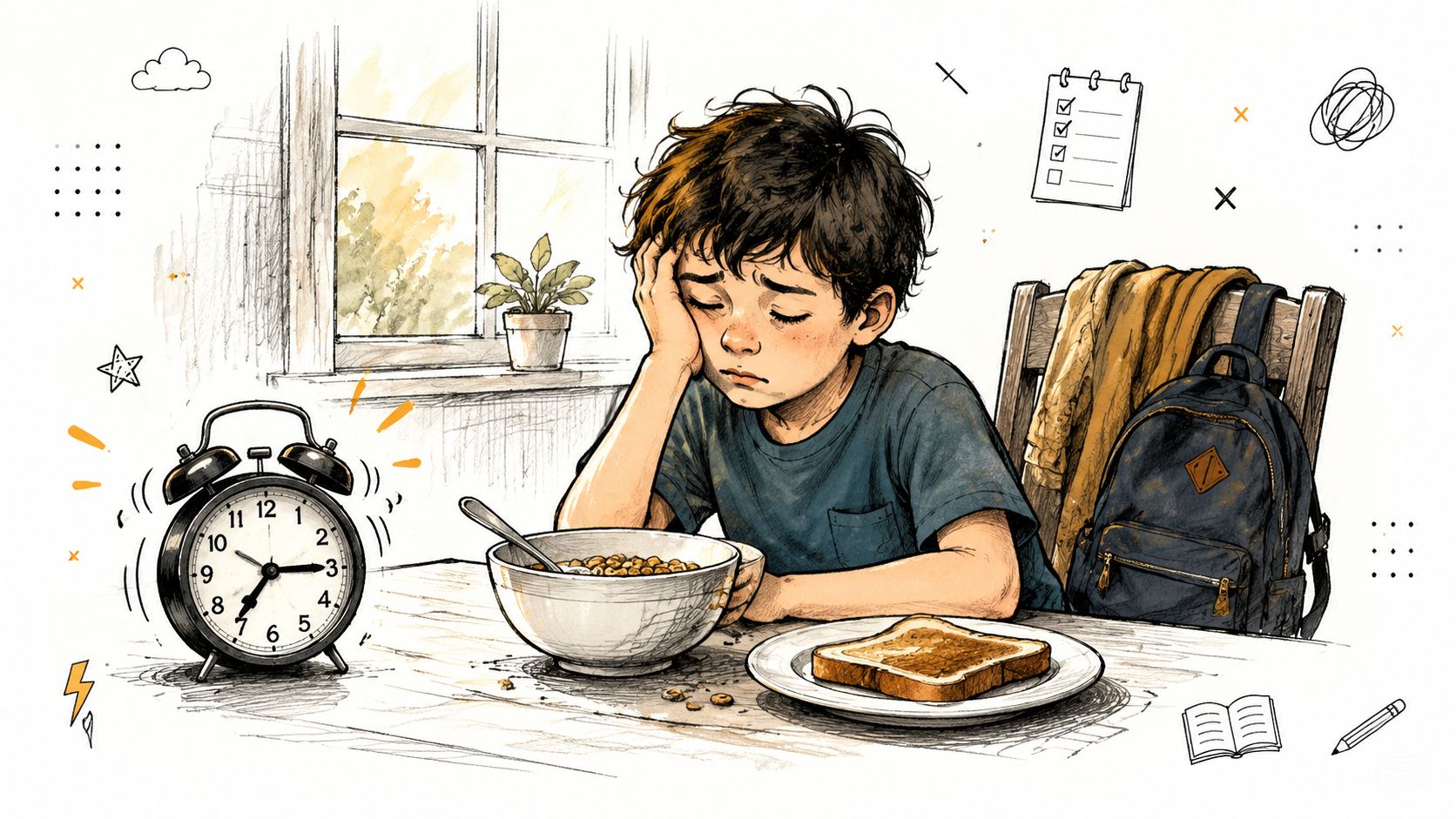
Your child drags themselves to the kitchen, half-awake, and the school-day battle starts before breakfast is finished. You're not overreacting if you wonder whether multi vitamins for energy could help, because tired mornings are frustrating and they can come from very different causes. The tricky part is that supplements, sleep, food routines, and real nutrient gaps can look similar from the outside.
A child who slept badly, skipped protein at breakfast, or had a chaotic evening often looks “low energy” for reasons that have nothing to do with vitamins. A child with an actual micronutrient shortfall is a different situation, and Australian data show that some nutrient gaps do exist, especially around iron, thiamin, and vitamin D in certain age groups and contexts. The goal isn't to turn every groggy morning into a supplement decision, it's to learn when a multivitamin is useful and when the better fix is in the routine around it.
If sleep is the core issue, a simple routine change can matter more than any bottle. This guide on kids' sleep is a sensible place to start when mornings are consistently rough.
Table of Contents
- Why Your Child Might Feel Sluggish Every Morning
- How B-Vitamins and Iron Power a Child's Energy
- When Extra Vitamins Do Not Create an Energy Boost
- Reading a Multivitamin Label Like an Expert
- Choosing the Right Format for Kids Aged 4 to 12
- Building a Daily Routine That Supports Real Energy
- Key Takeaways for Confident Supplement Decisions
Why Your Child Might Feel Sluggish Every Morning
A tired child at the breakfast table is often dealing with sleep, routine, or breakfast quality rather than a vitamin problem. Late nights, broken sleep, rushing out the door, or a meal that is mostly quick carbohydrate can leave a child looking flat even when they are otherwise well.
Normal dips versus genuine fatigue
A normal energy dip usually passes. Your child perks up after eating, moving, or settling into the day. Genuine fatigue tends to stick around, and it may show up as ongoing low motivation, poor concentration, or a child who still seems worn out after a reasonable night.
Parents can get caught out here. Multi Vitamins for Energy are often marketed as if they can fix a morning slump on their own, but they cannot replace sleep, balanced meals, or a predictable routine. Australian evidence also suggests that supplement use is common enough to feel familiar, with 33.6% of Australians taking any dietary supplement and 29.7% using vitamin and/or mineral supplements overall in 2023, while 15.5% took a multivitamin or multimineral supplement (ABS dietary supplement data).
That familiarity matters because familiar does not mean necessary. For many children, the better first question is not “Which multivitamin should I buy?”, it is “What is happening in the morning, and what changed recently?” A child who is slow to wake, irritable, or hungry again soon after breakfast may need better sleep timing, more protein at breakfast, or a calmer start instead of a supplement.
If the tiredness is tied to rushed school mornings, start with sleep and routine. This guide on kids' sleep is a sensible place to begin when mornings are consistently rough.
Practical rule: if your child only seems tired on rushed school mornings, look at sleep and routine before you assume a vitamin gap.
How B-Vitamins and Iron Power a Child's Energy
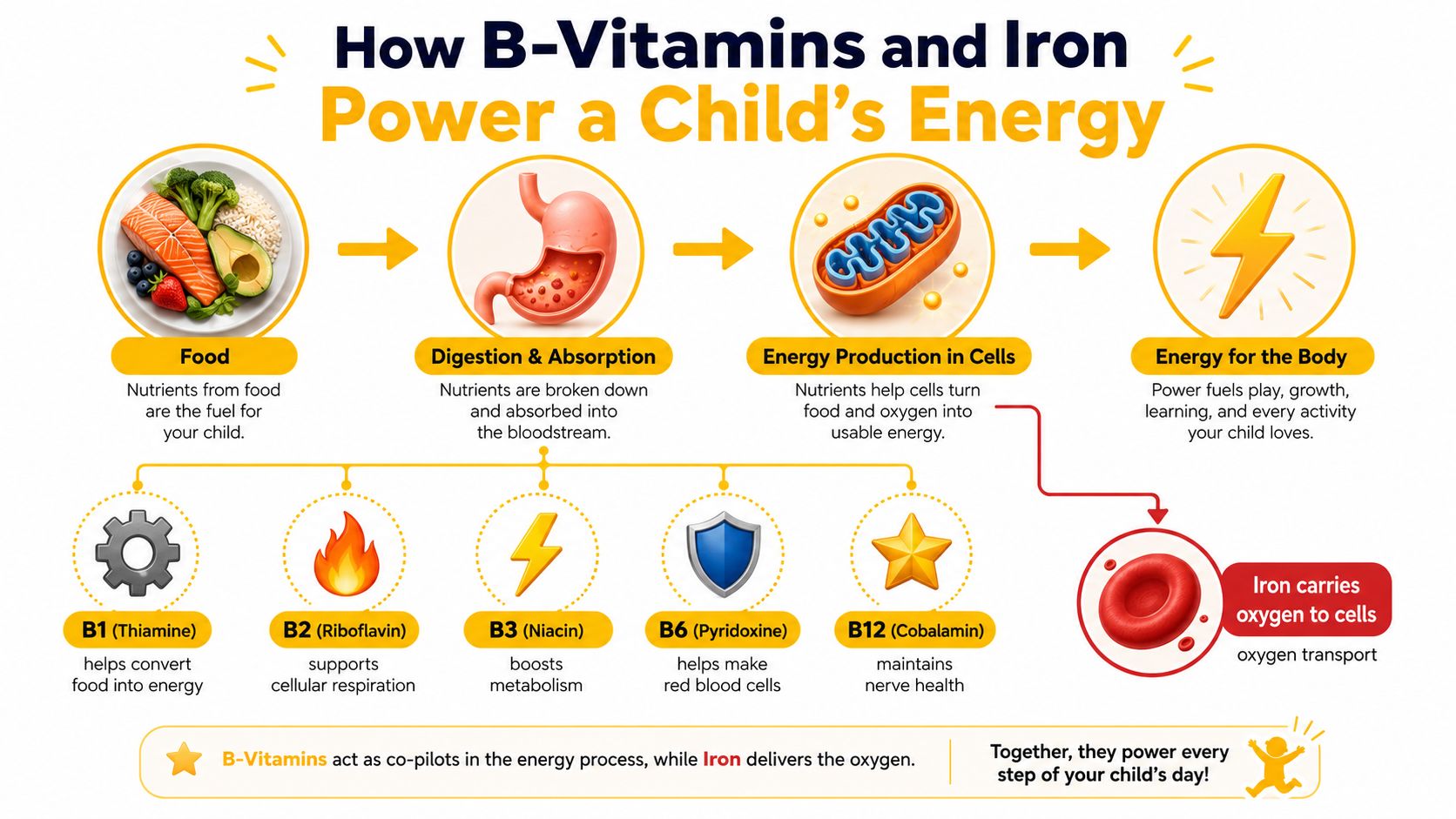
Food does not turn into usable energy by magic. The body has to break nutrients down, move them into cells, and convert them into fuel the brain and muscles can use. B-vitamins and iron matter here, but mainly when intake is too low for a child's needs.
B-vitamins help the body convert food into energy
Thiamin, or vitamin B1, is one of the nutrients tied most directly to energy metabolism. In Australia and New Zealand, the Nutrient Reference Values set thiamin at an RDI of 0.5 mg/day for children aged 1–3 years, 0.6 mg/day for children aged 4–8 years, and 0.9 mg/day for 9–13-year-olds, rising again in older adolescents (NHMRC nutrient reference values). Those age-specific targets matter because energy support is not a vague wellness idea, it depends on real intake.
B-vitamins help enzymes do the work of turning food into energy the body can use. If a child already gets enough, more does not create a better engine. If key nutrients are low, the pathway can run less efficiently and the child may seem tired, flat, or less resilient during the day.
Iron carries oxygen where it needs to go
Iron has a different job. It helps the body make haemoglobin, which carries oxygen through the bloodstream to muscles and the brain. When iron stores are low, fatigue can appear because tissues are not getting the oxygen they need to work well.
Australian evidence keeps pointing back to iron when parents ask about low energy. An Australian Institute of Health and Welfare review noted that iron deficiency can be associated with fatigue, and it cited local prevalence data showing 9.2% of 15-year-old girls were iron deficient in the 1985 National Dietary Survey of Schoolchildren (AIHW review). A later NHMRC summary of Australian research reported that iron supplements improved blood iron levels and stores, but did not improve developmental, behavioural, or growth outcomes in the short or medium term (NHMRC summary).
That is the key distinction. Iron can correct deficiency-related physiology, but it does not act like a general energy booster in a child who already has enough. If you want a broader overview of how formulas combine these nutrients, see this guide to a multivitamin with minerals. If a parent suspects deficiency, the next step is assessment, not automatic supplementation.
When Extra Vitamins Do Not Create an Energy Boost
A parent may start a multi vitamins for energy search after a child seems flat in the mornings. The hard part is telling apart a true nutrient gap from an ordinary dip caused by sleep, meals, or routine. Extra tablets only change energy when the child was low in that nutrient to begin with.
Why “more” usually stops helping
A child who already eats well usually will not feel more alert, run longer at sport, or concentrate better just because the dose goes up. Water-soluble vitamins are not stored in endless amounts, so the body uses what it needs and passes the rest on.
That is why the tablet can seem helpful without creating a real energy lift. Parents often change a few other things at the same time, such as breakfast habits, bedtime, or the morning rush. The supplement gets the credit, even though the bigger shift came from the routine around it.
The table parents need
| Outcome Measure | Deficient Children | Well-Nourished Children |
|---|---|---|
| Energy-related fatigue | May improve if a real deficiency is corrected | Usually doesn't improve from extra vitamins alone |
| Iron-related symptoms | Can improve when iron deficiency is treated | No reliable “boost” if iron status is already adequate |
| Parent perception | May notice a real change when the gap is filled | May notice change from routine shifts, not the supplement itself |
This is the point many parents need most. Supplements are targeted tools, like a key that fits one lock, while healthy children who already have enough vitamins usually will not get a measurable energy boost from adding more.
Children can also seem tired for reasons that have nothing to do with vitamins. Poor sleep, irregular meals, stress, and illness can all look like low energy. Those possibilities deserve attention first, because a bottle cannot fix a short night or a skipped breakfast.
Reading a Multivitamin Label Like an Expert
A child can still seem tired even when the bottle looks impressive. The label is where you separate a formula that fills a real gap from one that mainly sounds helpful. For parents, that matters because energy problems in children often come from sleep, meals, or routine, while true nutrient-related fatigue is more specific.
Start with the active ingredient panel. Look for B1, B2, B3, B6, B12, and iron first, then check the serving size. A label may list amounts per serve or per 100 g, and those are not interchangeable. One can make a product appear generous on the shelf while the daily dose is modest.
Helpful habit: compare the serve size to how often your child would realistically take it, not to the size of the bottle.
Watch for the common red flags
A vague blend that hides individual doses is the first warning sign. So is sugar listed under several names, which can make a sweet gummy look cleaner than it is. The third is a formula that talks about energy but gives only a small share of the nutrients parents think they are buying.
A child's body does not respond to slogans. If the label says “energy support” but the doses are light, the ingredient panel matters more than the front-of-pack promise. A clear formula helps parents see whether the product is meant to fill a gap or mainly to sound reassuring.
A simple checklist helps:
- Check the nutrient list first. Focus on the vitamins and minerals tied to energy, not the front-of-pack claims.
- Confirm the serving size. Make sure the dose suits what your child can take consistently.
- Look for clarity, not noise. If the label is hard to read, the product probably was not designed with parents in mind.
- Keep sugar low. A children's supplement should support routine, not create a daily treat habit.
- Ask whether the doses suit your child's age. A label only helps if the amounts match age needs.
A practical example is Brave, a daily multivitamin gummy for kids that is positioned as part of a routine rather than a quick fix. Whatever product you choose, the label should answer your questions quickly, without making you work for basic information.
Choosing the Right Format for Kids Aged 4 to 12
A child is far more likely to take a supplement that fits the family's morning rhythm. Format matters because the best product is the one your child can take regularly, while still giving you clear ingredient information and a sensible nutrient profile.
Gummies, chewables, and liquids each solve different problems
Gummies are usually easiest for children to accept. That matters, because a supplement left in the cupboard helps no one. The trade-off is that gummies often focus on taste and texture, which can mean less transparency or a weaker mineral profile in some products.
Chewables can feel closer to a standard multivitamin, and they often suit families who want a broader formula. Some children like them, some do not, especially if the texture is chalky or the flavour feels medicinal.
Liquids can help when a child struggles with swallowing or when a parent wants more flexibility with dose adjustments. They can also be harder to keep in a steady routine, because measuring and storing them takes more effort.
Match the format to the child, not the marketing
| Format | Typical Sugar per Serve | Iron Included | Adherence (4–7 yrs) | Adherence (8–12 yrs) | Avg Cost per 30 Days |
|---|---|---|---|---|---|
| Gummy | Varies by product | Often omitted in kid formulas | Usually higher when taste is good | Usually higher when routine is simple | Varies by product |
| Chewable | Varies by product | More likely in a fuller formula | Mixed, depending on taste | Mixed, depending on taste | Varies by product |
| Liquid | Varies by product | Sometimes included | Mixed, depending on ease of use | Mixed, depending on ease of use | Varies by product |
The table shows the basic trade-offs. A gummy may be easier to remember, while a chewable or liquid may suit a child who needs a broader formula or a different dose shape. The right choice depends on the child's age, taste tolerance, and actual nutrient need.
If iron is a concern, check that the product includes it in a form and dose you can discuss with a health professional. If consistency is the bigger challenge, a child-friendly gummy may be more realistic than a tablet that stays untouched. For families who want a daily format that is simple to keep in the routine, Brave is positioned as a multivitamin gummy for kids.
Building a Daily Routine That Supports Real Energy
A child who seems flat every morning is often sending a routine signal, not a vitamin signal. Sleep, food quality, hydration, and predictable mornings shape day-to-day energy for most children far more than a single supplement can. A multivitamin only earns its place when it fits into that wider pattern.
The habits that move the needle first
Sleep comes first. Australian paediatric guidance commonly points school-aged children towards 9 to 11 hours of sleep, and when a child regularly gets less, tired mornings are often linked to schedule, bedtime drift, or an overstimulating evening. Breakfast matters too, because protein and fibre steady energy in a way that a mostly refined-carbohydrate meal does not.
Hydration can be overlooked. Even mild dehydration can make concentration and energy feel worse, so a water bottle near the breakfast table is a simple habit with real value. Movement helps as well, because children who use their bodies early in the day often settle into school more easily.
A morning routine that works
A useful weekday rhythm is straightforward. Wake at the same time, drink water, eat a balanced breakfast, take a multivitamin with food if one is needed, then leave on a predictable schedule. That order gives a child a repeatable start, and repeatability is what helps habits hold.
Useful frame: the supplement fills gaps, but the routine creates the energy pattern.
For parents who want a visual cue, the kids routine chart can help make the morning sequence easier to follow. It works best as a guide for the whole day, not just a reminder to swallow a vitamin.
Daily Powers offers a child-friendly multivitamin gummy format for families who want a simple daily ritual. A product like Brave can fit that role, but it will not make up for missed sleep or a rushed breakfast. The routine has to do the main work, and the supplement can only support what is already there.
Key Takeaways for Confident Supplement Decisions
Multi vitamins for energy only help when a child has a genuine nutrient gap, most often involving B-vitamins or iron. If your child already eats a varied diet and the tiredness is really about sleep, breakfast, hydration, or a hectic routine, a supplement won't fix the problem.
Start with the basics that shape morning energy. Aim for a predictable wake-up time, a protein-rich breakfast, and enough water before school. If you then decide a multivitamin is warranted, choose one with transparent dosing, age-appropriate amounts, and as little sugar as possible.
If fatigue keeps showing up even after the routine improves, talk with a GP or paediatric dietitian. Persistent tiredness deserves a proper check, not guesswork. Most children's energy dips are behavioural or routine-related, and small changes usually beat any promise of a quick fix.
If you're comparing children's supplements, Daily Powers offers simple, routine-friendly options designed for families who want clearer ingredient choices and easier daily habits. Visit Daily Powers to see how a child-friendly multivitamin can fit into a calmer morning and a more consistent routine.