

Multivitamin gummies can help children take a supplement consistently, but they aren't a nutritional necessity for every child. In Australia, 15.5% of people took a multivitamin or multimineral supplement in 2023, including 10.1% of boys and 9.2% of girls aged 2–17.
The practical benefit usually comes from adherence and routine, not from correcting widespread deficiencies in otherwise well-nourished children. A chewy, pleasant-tasting gummy may succeed where a tablet is refused, but it still can't replace meals built around varied whole foods.
A parent might know this situation well. Breakfast is half-finished, school bags are open on the floor, and a child is negotiating over socks when someone remembers the vitamin. The liquid supplement leaves a sticky spoon, the tablet is spat out, and the promise of “later” means it may never happen.
That daily struggle raises a sensible question: do multivitamin gummies offer meaningful benefits beyond convenience, or are they just another product marketed to busy families? The answer is more measured. Taste and texture matter when they determine whether a child takes the labelled dose, but a gummy is useful only when it fits a genuine nutritional need and a safe family routine.
Table of Contents
- The Morning Routine Challenge
- How Multivitamin Gummies Benefits Connect to Child Nutrition
- Gummies vs Whole Foods and Tablets
- Building a Safe and Consistent Routine
- What the Evidence Says About Real Outcomes
- Making the Right Choice for Your Family
The Morning Routine Challenge
A typical Australian morning doesn't leave much room for elaborate health rituals. One child refuses anything chalky, another dislikes liquid medicine, and a caregiver is trying to get everyone fed before the school run. Even a well-chosen supplement has no practical value if it repeatedly stays in the bottle.
That's why format isn't a trivial detail. A child who can chew a familiar fruit-flavoured gummy may be more willing to participate than a child asked to swallow a tablet. The benefit isn't that the gummy has magical nutritional properties. It's that a supplement that gets taken as directed is more useful than one a child rejects.

Making the routine easier
Parents often get better results when they attach the gummy to something that already happens, such as breakfast, packing the lunchbox, or brushing teeth. The morning routine for kids can provide a useful structure, provided the product is kept under adult control rather than left on the table.
A routine should feel boringly predictable. Give the child the age-appropriate serving at the same point in the day, use a simple phrase such as “vitamin time”, and avoid presenting it as a sweet or a reward. That language helps preserve the distinction between a supplement and confectionery.
Practical rule: Choose the format your child will reliably accept, then judge its value by consistency, suitability and safety, not by how appealing the jar looks.
Gummies can reduce arguments, but they don't solve every feeding concern. A child who eats very little, follows a highly restricted diet, has a diagnosed deficiency, or has a medical condition needs individual advice rather than a generic children's multivitamin. For a healthy child with a varied diet, the greater achievement may be continuing to offer nutritious food without turning every meal into a test.
How Multivitamin Gummies Benefits Connect to Child Nutrition
Australian data puts the popularity of children's supplements into perspective. The Australian Bureau of Statistics nutrition survey recorded multivitamin and multimineral use among 15.5% of people in 2023. Among children aged 2–17, use was 10.1% for boys and 9.2% for girls, while uptake among children aged 12–17 was 5.8%.
Those figures show that supplements are already part of many household routines. They don't prove that every child needs one, or that gummies improve health outcomes. They do support a more realistic interpretation of the multivitamin gummies benefits conversation: families may be choosing gummies because they're easier to administer and easier for children to accept.
Where a gummy may help
A gummy can have a practical role when a child's intake is inconsistent or when swallowing tablets creates a daily barrier. It may help provide a repeatable source of labelled nutrients during a period when picky eating limits variety, although parents shouldn't treat it as permission to stop offering vegetables, fruit, legumes, dairy or suitable alternatives.
The ABS also noted that children aged 2–11 generally had adequate intakes of most vitamins and minerals from food, with calcium identified as an exception. That finding points away from a blanket “every child needs a multivitamin” message. In many families, the product's main contribution is making an existing supplement plan workable, rather than repairing a broad nutritional crisis.
A child-friendly routine can also give a child a small sense of participation. For example, Brave is presented as a daily multivitamin gummy with kid-friendly flavours and textures, a vegan formulation, and no artificial colours or flavours. Its “pick your power” framing is a routine concept, not evidence that a gummy creates confidence or changes a child's behaviour by itself.
What a gummy can't promise
A multivitamin isn't a shortcut to better sleep, stronger immunity, more energy, improved concentration or fewer illnesses. Nutrients can contribute to normal body functions when a child needs them, but the presence of vitamins in a product doesn't establish that a healthy child will notice a measurable change.
The useful question is narrower: Is there a likely nutrient gap, and will this format help the child take an appropriate product consistently? If the answer to both is yes, a gummy may be sensible. If the diet is varied and the child already takes no supplement, adding one just because it resembles a lolly is difficult to justify.
Gummies vs Whole Foods and Tablets
Whole foods remain the foundation because they provide a broader eating context than isolated nutrients. Meals and snacks can bring fibre, protein, fats, fluid and naturally occurring plant compounds together, while a gummy supplies only the ingredients listed on its label. No gummy can teach a child to enjoy a new food, replace family meals or compensate for a diet with very little variety.
Tablets have a different advantage. They can offer a compact format and, depending on the product, precise labelled amounts without the texture and flavouring needed to make a gummy appealing. Their weakness is acceptance. A child who struggles to swallow tablets may receive less benefit from a technically suitable product that sits untouched in a cupboard.
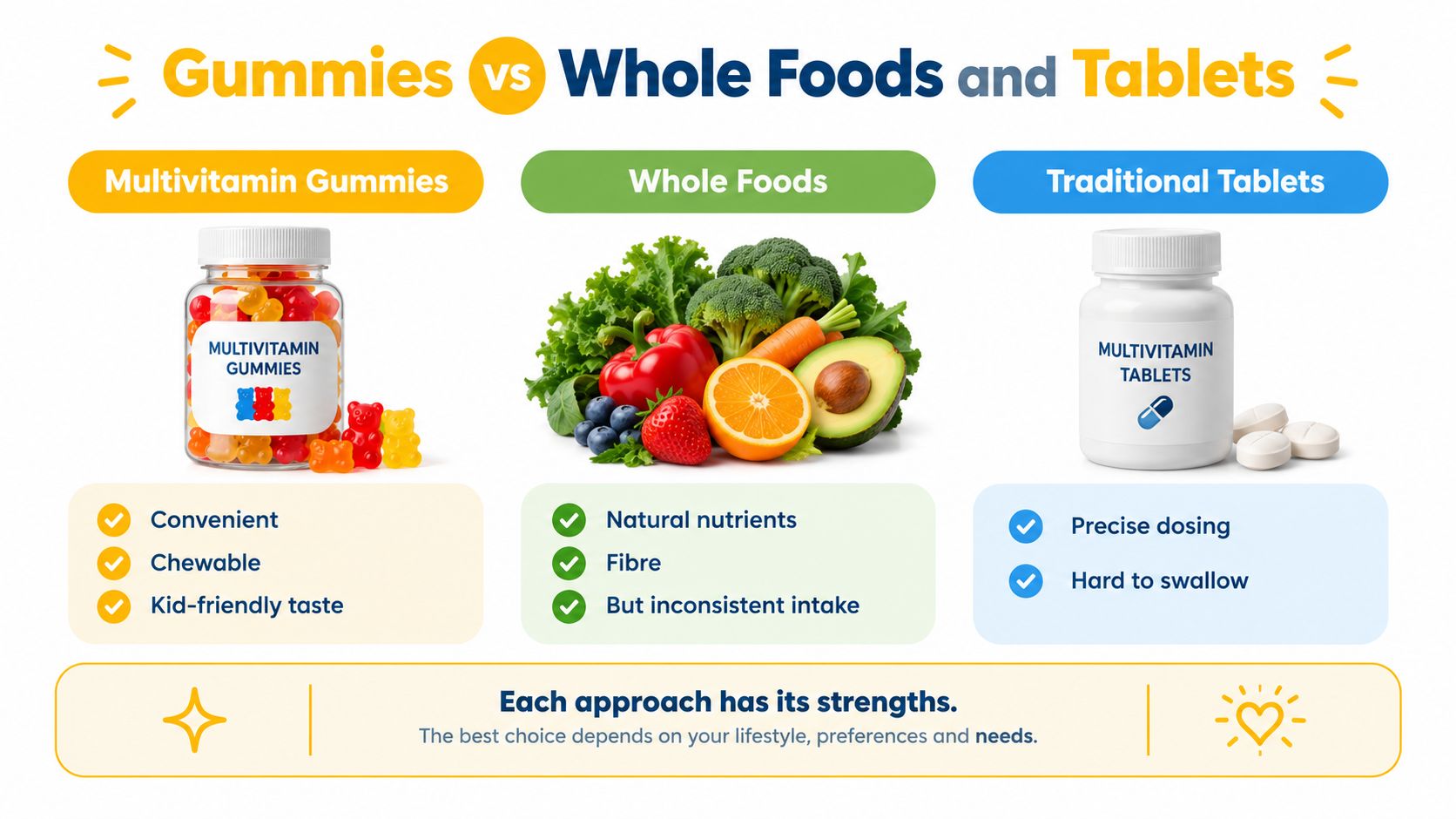
| Approach | Where it works well | Important limitation |
|---|---|---|
| Multivitamin gummies | Chewable, familiar and often easier to include in a daily routine | They can look and taste like confectionery, so storage and dosing matter |
| Whole foods | Provide broad nutrition and help develop eating habits | Intake may vary when appetite, preference or food restriction changes |
| Traditional tablets | Compact and straightforward for children who can swallow them | Many children find them difficult or unpleasant to take |
The trade-off parents should make
Gummies win on acceptance, portability and routine simplicity. Whole foods win on nutritional breadth and the opportunity to build food skills. Tablets may win when a clinician recommends a specific nutrient and the child can take the form comfortably.
The right comparison isn't “Which one is healthiest?” It's “Which option addresses this child's need without displacing better habits?” A gummy can sit alongside regular meals, but it shouldn't become the family's answer to every refused food.
Products aimed at a particular routine also need careful interpretation. Focus is described as a blueberry-flavoured gummy containing mushroom polysaccharides, vitamin D3, zinc, elderberry fruit powder and prebiotics, with directions to take two gummies daily or as directed by a healthcare professional. Those ingredients and directions describe the product, but they don't establish that it will improve a particular child's concentration or school performance.
The same principle applies to any supplement marketed around learning, calm or immunity. A positive ritual may make daily use easier, yet the ritual should support healthy habits, not replace sleep, food, movement, play or professional assessment.
Use the video as an opportunity to discuss what the product contains and what your child needs, rather than treating a familiar format as proof of effectiveness.
Building a Safe and Consistent Routine
The best routine is easy for the caregiver to supervise and uninteresting enough that the child doesn't seek extra servings. Start by checking the label, the intended age range and the serving instructions. Australian guidance says therapeutic goods should carry an AUST L number, which helps parents identify products included within the relevant TGA regulatory framework. The format alone isn't a quality guarantee.
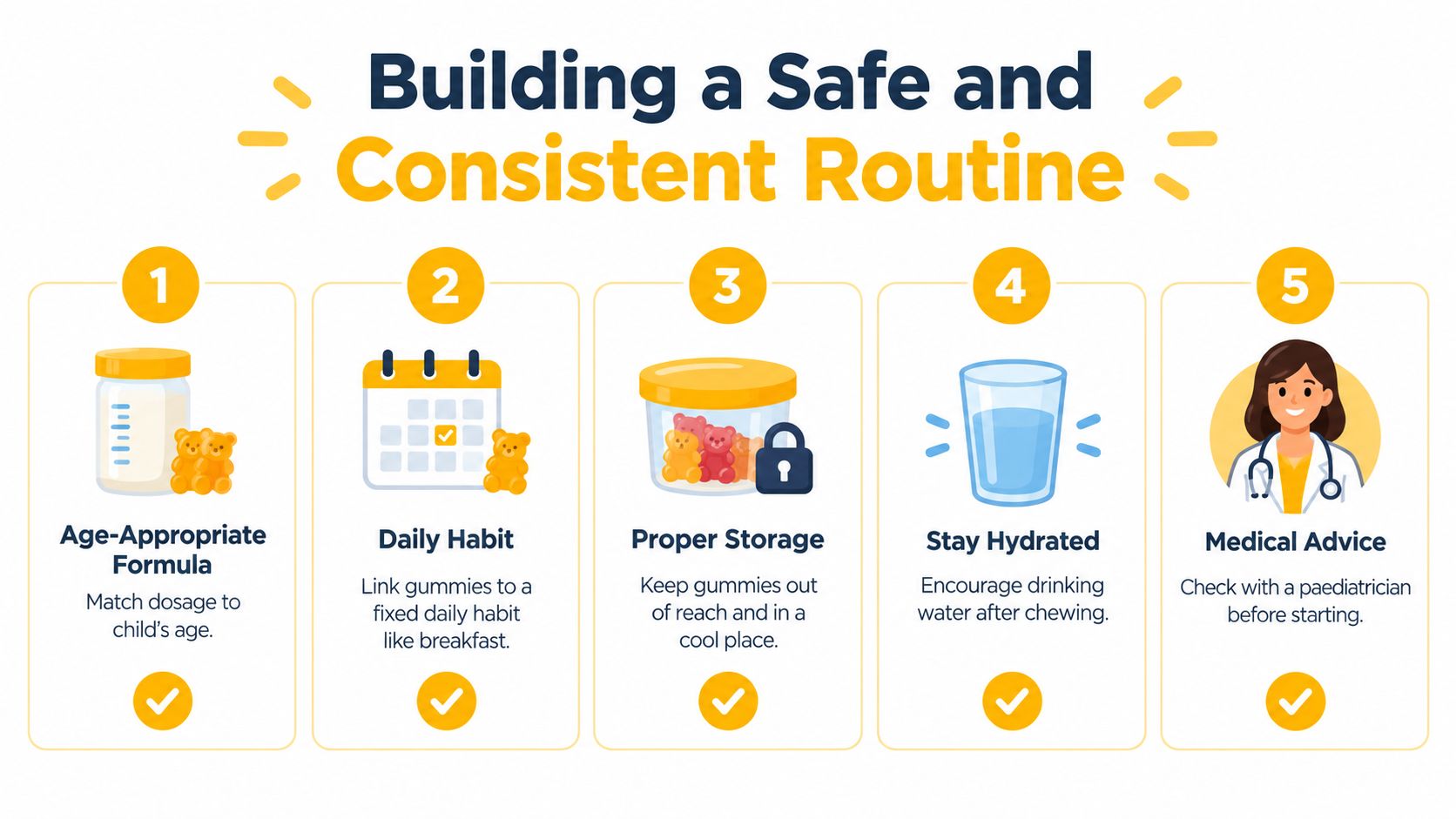
Five habits that reduce mistakes
- Match the serving to the child. Follow the product directions exactly. Don't increase the serving because the child is tired, has eaten poorly, or asks for another one.
- Choose one fixed cue. Breakfast can work, but so can another supervised point in the day. A kids routine chart can help children see the task as part of the day without giving them control of the container.
- Store the jar securely. Keep gummies out of reach and out of sight, ideally in a cool, dry place. A locked or high cupboard is safer than a handbag, bedside table or low pantry shelf.
- Keep the product separate from sweets. Use accurate language and don't offer gummies as a prize. Their appeal is useful for compliance, but their candy-like appearance increases the chance of a child treating them as a snack.
- Ask before starting when there's uncertainty. A paediatrician, pharmacist or dietitian can help when the child has a restricted diet, diagnosed deficiency, medical condition, takes medicines, or needs a specific nutrient rather than a broad multivitamin.
The safety issue deserves particular attention. A peer-reviewed analysis of reports to New South Wales' largest poisons information centre recorded 10,944 vitamin and mineral supplement exposures between 2014–15 and 2018–19, with exposures rising by 9.6% per year across that period. Toddlers aged 1–4 accounted for 41.5% of cases, and more than half of all exposures involved children aged 14 and under, as reported in the published Australian poison-centre analysis.
If a child may have taken more than the labelled amount, don't wait for symptoms before seeking advice. Contact the relevant poisons information service or emergency care and keep the packaging available so health professionals can identify the ingredients and strength.
A magnesium-based product such as Calm is described as containing magnesium citrate, vitamin B6, zinc and prebiotics, with directions for two gummies daily or as directed by a healthcare professional. It should be treated like any other supplement, not as a freely available sweet or an automatic solution for emotional regulation.
What the Evidence Says About Real Outcomes
Australian guidance draws an important boundary that marketing often blurs. Children who eat a varied diet generally don't need supplements, and there is limited evidence that children's vitamin products improve health outcomes or prevent illness in otherwise healthy children. Supplements are more relevant when a child has a diagnosed deficiency, a medical condition, or a highly restricted diet, as outlined by Raising Children Network's guidance on vitamins and minerals.
That doesn't make gummies pointless. It means their strongest practical benefit is usually delivery, not transformation. If a health professional has identified a need and the child refuses tablets, an easy-to-chew format may improve the likelihood that the recommended nutrient is taken regularly. If no need has been identified, better taste alone isn't a strong reason to begin supplementation.
Adherence is not the same as proof
Parents should separate three questions:
- Need: Is there a nutritional or medical reason for supplementation?
- Suitability: Does this product provide the relevant nutrient in an age-appropriate form?
- Adherence: Will the child take it as directed under adult supervision?
A gummy can score well on the third question while failing to answer the first. That distinction is central to evidence-informed practice, which asks caregivers to combine the best available evidence with the child's circumstances and professional judgement.
Claims about focus, calm, immunity or daily energy also need restraint. A product may contain nutrients associated with normal physiological functions, but that doesn't mean it will produce a noticeable outcome in every child. Don't use a supplement to postpone assessment when a child has persistent fatigue, poor growth, significant food restriction, swallowing difficulty or other ongoing symptoms.
Making the Right Choice for Your Family
Start with the diet, not the jar. Consider whether your child eats from a reasonable range of food groups, whether restrictions are temporary or long-standing, and whether a health professional has identified a specific concern. A child with a varied diet may gain more from patient food exposure, regular meals and family modelling than from adding a daily multivitamin.
Then assess the practical problem. If a clinician has recommended supplementation and your child reliably rejects tablets, a gummy may be a sensible delivery choice. If your child already accepts a tablet or liquid, changing format isn't automatically an improvement. Check the ingredient list, serving size, age guidance, AUST L number where applicable, and storage instructions before buying.
Finally, ask whether the product encourages a calm routine or creates a new negotiation. The most useful multivitamin gummies benefits are modest but real: better acceptance, less daily conflict and more consistent use when supplementation is appropriate. The limitations are just as important: gummies don't replace whole foods, don't guarantee better health outcomes, and can be dangerous when children can access them unsupervised.
A good decision is one you can explain in a sentence: “My child has this identified need, this product suits it, and we can use it safely.” If you can't complete that sentence, speak with a paediatrician, pharmacist or dietitian before starting.
Daily Powers offers children's gummy formulations framed around bravery, focus and calm, with ingredient and dosing information provided for caregivers. If you're considering a child-friendly routine and want to review those options alongside your family's nutritional needs, visit Daily Powers.