

Australia's official daily vitamin D target for most children is 5 micrograms (200 IU), with a tolerable upper limit of 80 micrograms for ages 1–18, so a well-formulated multivitamin can cover baseline needs without exceeding the usual safety margin. The right choice depends on your child's age, diet, risk factors and whether a clinician has identified a deficiency.
You're packing lunch, searching for a missing school hat and trying to get breakfast finished before the morning rush. Your child eats selectively, spends much of the day indoors, or refuses anything that looks like a tablet. That's often when the question appears: does a multivitamin with vitamin D make sense, or is it just another product to remember?
For most Australian children, vitamin D supplementation isn't automatically necessary. Australian data suggest deficiency is uncommon overall, although it can be more relevant for children with particular health, lifestyle, geographic or seasonal risk factors. A supplement is best viewed as a practical way to support dietary consistency, not as a replacement for varied food, safe outdoor activity or medical care.
Table of Contents
- Why Vitamin D Is Essential for Growing Children
- Recommended Vitamin D Intake by Age
- Signs Your Child May Have Low Vitamin D
- How Vitamin D Appears in Multivitamins for Kids
- Choosing a Child-Friendly Sugar-Free Vegan Multivitamin
- Building a Reliable Daily Supplementation Routine
Why Vitamin D Is Essential for Growing Children
The school-morning routine can reveal the practical challenge. A child may eat toast, decline the egg, accept only a few bites of fruit and head off to class before anyone has thought about vitamin D. Parents then wonder whether one missed food, one rainy week or a preference for indoor play is enough to create a problem.
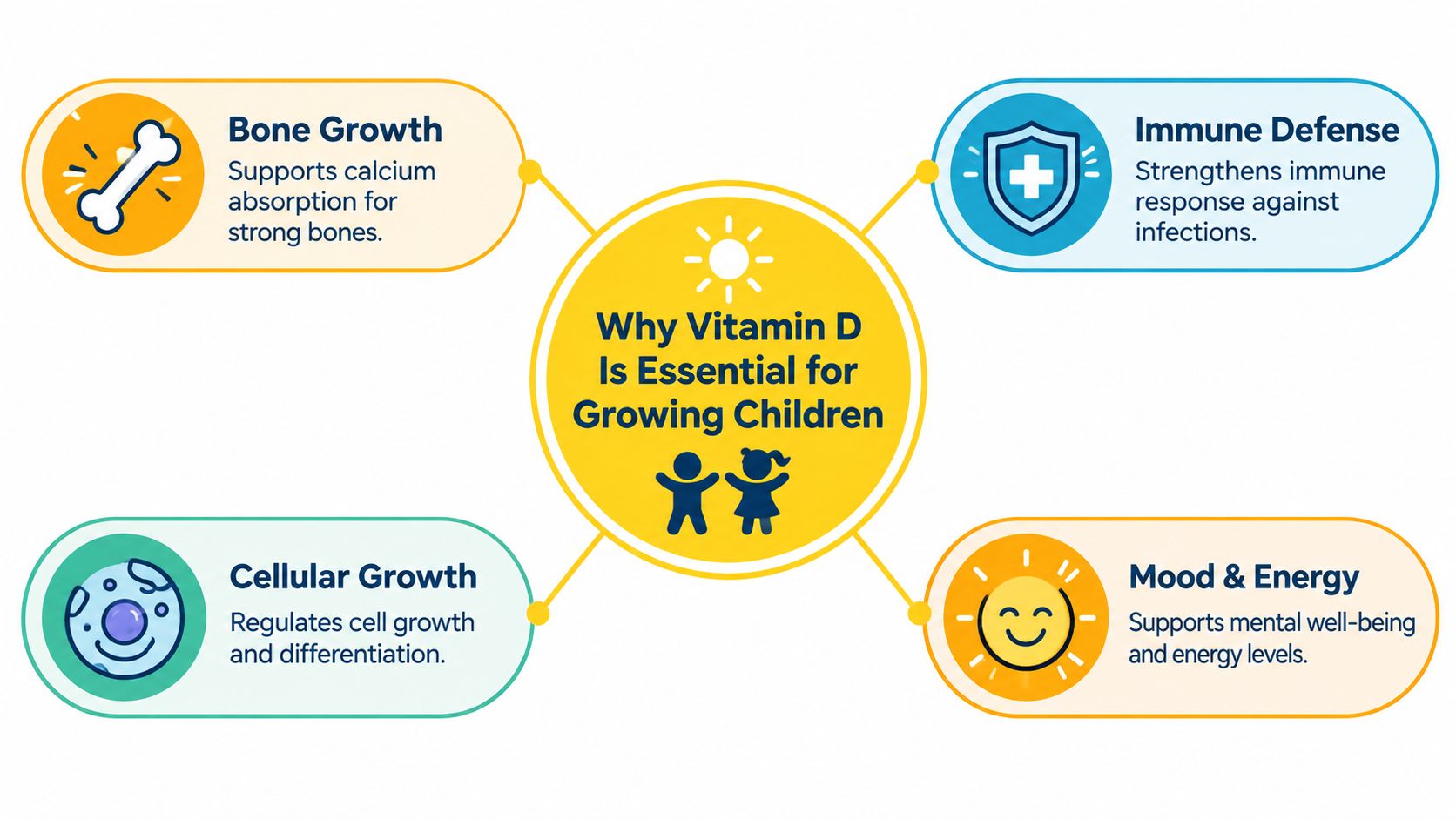
Vitamin D helps the body absorb calcium, which supports the development and maintenance of strong bones and teeth. That role matters during childhood because bones are continually growing and changing. Vitamin D is also involved in immune function, cellular growth and differentiation, so it belongs in the wider picture of healthy development, not just in a conversation about bones.
What parents can reasonably expect
Vitamin D isn't an energy drink, a focus enhancer or a guarantee that a child won't catch ordinary school infections. A child who has adequate vitamin D won't necessarily seem different after taking a supplement. The value is quieter: supporting normal physiological processes while helping families cover a possible nutritional gap.
The relationship between calcium and vitamin D is especially important. Vitamin D supports calcium absorption, while calcium provides a structural mineral for bones. Children still need calcium-containing foods or suitable alternatives, because vitamin D alone can't provide the building material bones require.
Australian evidence also shows why a blanket approach can be misleading. An Australian Paediatric Surveillance Unit study identified 398 children with vitamin D deficiency rickets and estimated an annual rate of 4.9 cases per 100,000 children aged 15 years and under. Rates were higher in Victoria, at 13.0 per 100,000, and Western Australia, at 8.4 per 100,000, than in New South Wales, at 2.6 per 100,000 (Medical Journal of Australia study). Severe deficiency is uncommon at population level, but it's documented, and risk isn't evenly distributed.
Practical rule: Treat vitamin D as one part of a child's nutrition routine, not as a reason to add multiple overlapping supplements.
Recommended Vitamin D Intake by Age
A label on the kitchen bench may show a child's multivitamin contains vitamin D, but the number needs context. Australian guidance lists a recommended daily intake for most children and adolescents of 5 micrograms, equal to 200 IU. For children aged 1–18 years, the tolerable upper intake level is 80 micrograms, or 3,200 IU (NHMRC nutrient reference values).
The upper limit is a safety boundary, not a daily target. Check the amount in one recommended serving, then add vitamin D from any other supplement your child takes. This simple check can prevent overlapping products from pushing the total higher.
A practical label-reading table
| Age Group | Daily Target (mcg) | Upper Safe Limit (mcg) | Notes |
|---|---|---|---|
| Infants and children under 1 year | 5 | No separate upper limit is set in the cited guidance. Ask a health professional before supplementing. | Infant supplementation depends on feeding pattern and individual risk factors. |
| Children aged 1–8 years | 5 | 80 | Routine intake is different from treatment for confirmed deficiency. |
| Children aged 9–18 years | 5 | 80 | Season, region and lifestyle can affect vitamin D status. |
The NHMRC guidance identifies a serum 25-hydroxyvitamin D concentration below 27.5 nmol/L as consistent with deficiency in infants, neonates and young children. This requires a clinical measurement. Parents cannot confirm deficiency from mood, appetite or energy levels alone.
Supplement decisions also depend on purpose. A general multivitamin may provide a modest daily amount for routine nutrition, while a confirmed deficiency needs a clinician's plan. The Royal Children's Hospital recommends 400–600 IU per day for prevention or maintenance in children aged 1–18 years. Mild deficiency may be treated with 1,000–2,000 IU per day for 3 months, under clinical guidance. A standard multivitamin should not replace that plan.
Australian population data show why the same product may not suit every child. The ABS reported vitamin D deficiency in around 15.4% of 12–17-year-olds in 2011–12, with deficiency more common in winter and southern areas (Australian Bureau of Statistics vitamin D overview). The figure does not mean every teenager needs supplementation. It supports checking personal risk factors with a GP or paediatrician before adding a product.
Signs Your Child May Have Low Vitamin D
A child with low vitamin D may not show a clear, recognisable pattern at home. Tiredness, muscle discomfort, frequent illness, mood changes or slower growth can have many explanations, including poor sleep, infection, stress, low iron or an unrelated medical condition. That's why symptoms alone can't confirm deficiency.
Severe deficiency-related bone disease can affect bone strength and development, but it's not sensible to wait for dramatic symptoms before asking for advice if your child has known risk factors. The Australian evidence base has linked vitamin D status with factors such as geography, season and skin coverage, and some children also have health conditions that affect absorption or nutritional intake.

What to watch without jumping to conclusions
Use observations as prompts for a conversation with your GP or paediatrician:
- Persistent fatigue: Ongoing low energy deserves attention, especially if it affects school, play or usual routines.
- Bone or muscle discomfort: Repeated aches, difficulty moving comfortably or reluctance to walk should be assessed rather than explained away as growing pains.
- Growth concerns: A noticeable change in growth or physical development needs professional review.
- Dietary restriction: A very limited diet may increase the chance of nutritional gaps, although it doesn't prove vitamin D deficiency.
- Relevant health or lifestyle factors: Reduced sun exposure, extensive skin coverage, darker skin, malabsorption conditions or living in a region with seasonal risk may change the conversation.
Most children don't need routine vitamin D testing. Healthdirect explains that vitamin D levels and supplementation should be considered in context, and the Royal Children's Hospital advises against treating every child with high-dose supplements (Healthdirect vitamin D guidance).
A blood test may be appropriate when symptoms, medical history or risk factors make deficiency more likely. Don't increase the dose just because a child seems tired, and check the total vitamin D from every product in the cupboard.
Here's a clinician-led explanation of the difference between everyday supplementation and medical management:
If your child has a confirmed low result, follow the prescribed plan and ask when levels should be reviewed. A routine product such as vitamin D3 gummies for children may support maintenance, but it isn't automatically an appropriate repletion dose.
How Vitamin D Appears in Multivitamins for Kids
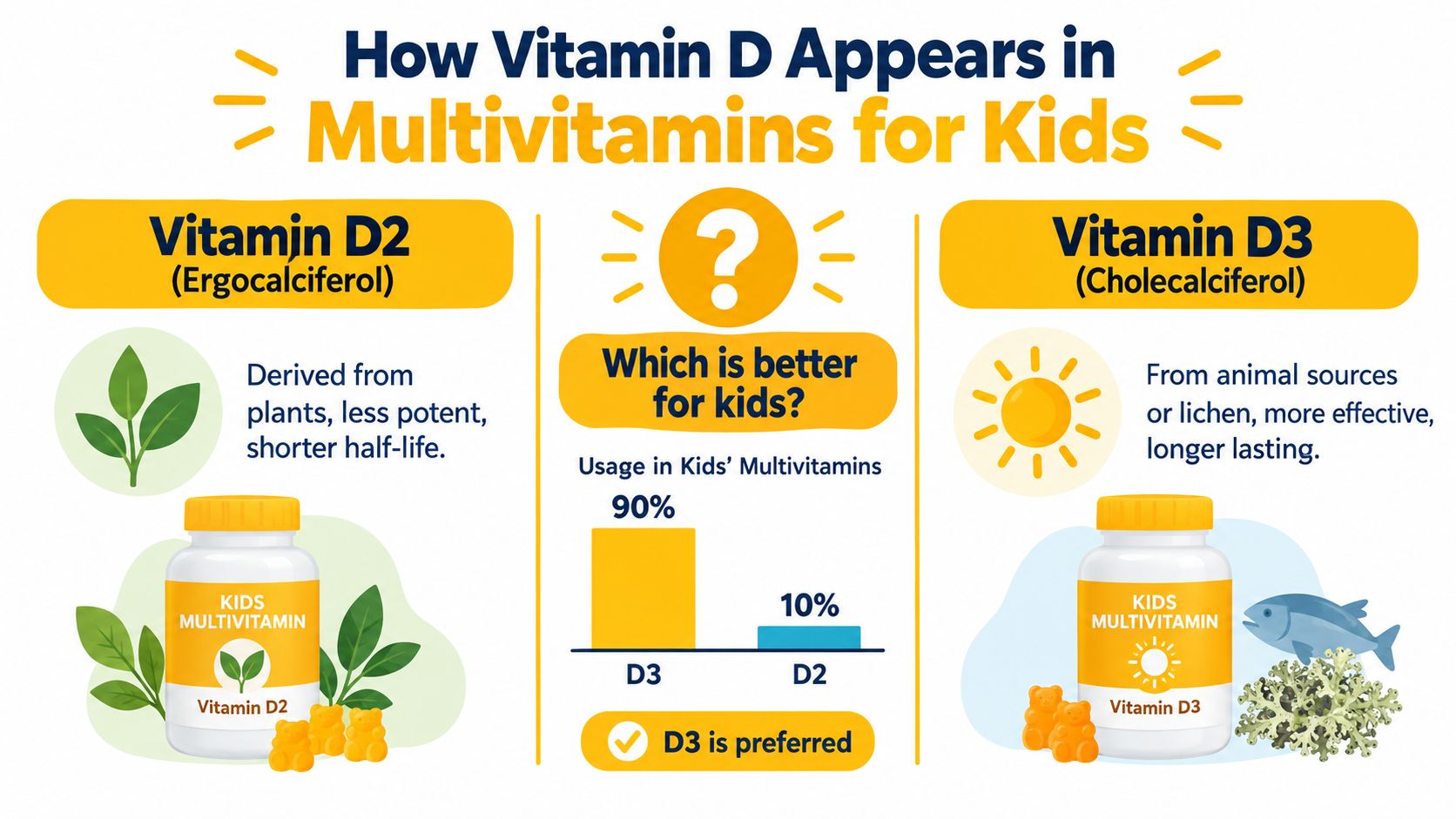
The vitamin D on a children's label usually appears as either vitamin D2, ergocalciferol, or vitamin D3, cholecalciferol. D3 is commonly used in human supplements, while D2 is another recognised form. Parents don't need to turn the ingredient list into a chemistry lesson, but they should know which form is present and how much each serving provides.
The more important question is often dose transparency. A label should state the vitamin D amount in micrograms, identify the serving size and make the recommended age range clear. If the bottle says to take two gummies, check whether the listed amount applies to one gummy or the complete daily serving.
How to assess the formulation
Start with the amount. Australia's general target of 5 micrograms, or 200 IU, per day gives you a useful reference point, but your child's needs may differ if a clinician has identified deficiency or a relevant risk factor. The product's vitamin D should be considered alongside fortified foods, standalone vitamin D products and other multivitamins.
Then check the delivery format. Gummies may be easier for children who reject tablets, but they're still supplements, not lollies. Store them as directed, supervise young children and follow the stated serving size.
Finally, scan the rest of the ingredient list. Look for allergens, sweeteners, colours, flavours and nutrients that may overlap with another product. A product can be sugar-free and vegan while still containing several active ingredients, so “clean” doesn't mean “suitable for every child”.
For example, Focus is described as a blueberry-flavoured, sugar-free vegan gummy containing vitamin D3, zinc, mushroom polysaccharides, elderberry fruit powder and prebiotics. Its stated daily serving contains 4 micrograms of vitamin D3, and the directions say to take two gummies daily or as directed by a healthcare professional. That amount is close to, but not identical to, the general Australian daily target, so parents should assess it within the child's overall intake rather than assume every product is interchangeable.
Read the serving size first, then compare the nutrient amount with everything else your child takes.
Choosing a Child-Friendly Sugar-Free Vegan Multivitamin
A supplement only helps if your child can take it comfortably and your household can use it correctly. A chalky tablet that sits untouched in a drawer has less practical value than a clearly labelled format your child accepts as part of an ordinary routine.
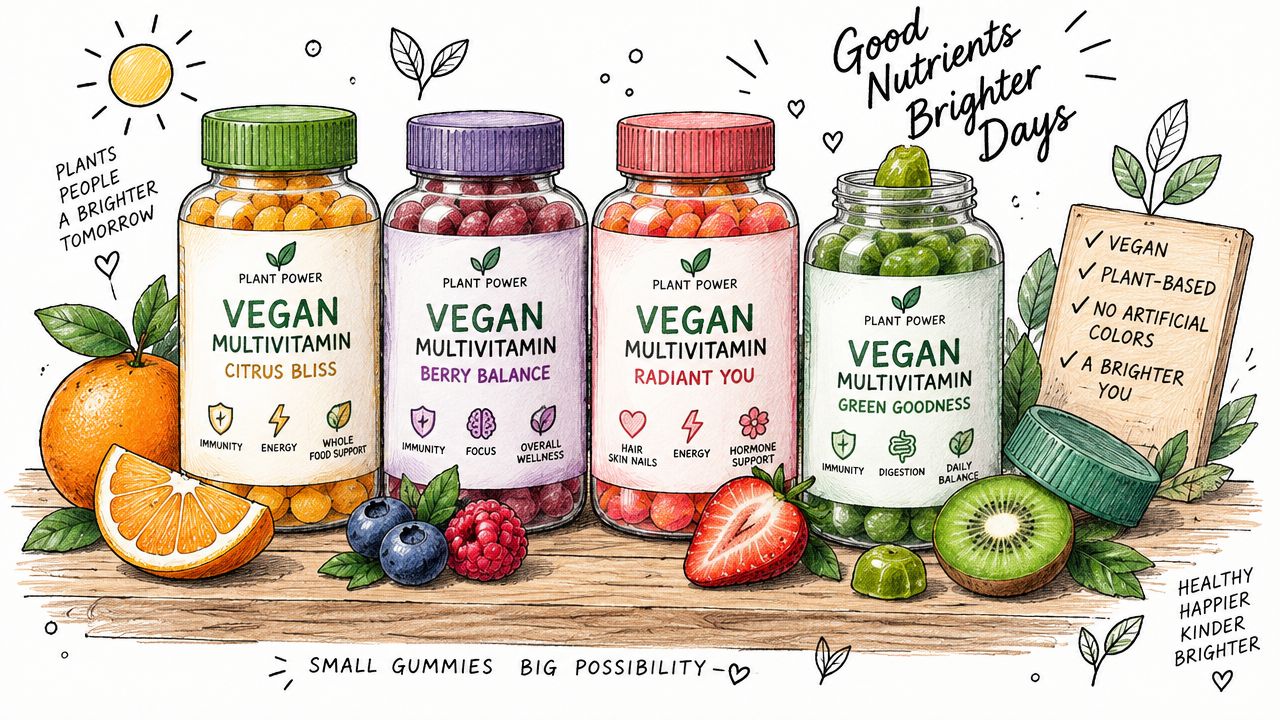
Sugar-free and vegan products may suit families who want to avoid added sugar or animal-derived ingredients, but those labels shouldn't end the assessment. Taste, texture, allergens, dosage and the complete ingredient list still matter. A vegan gummy can be appropriate for one child and unsuitable for another if it contains an ingredient that conflicts with an allergy, medication or dietary plan.
Compare the label with the routine
A useful comparison looks beyond marketing language:
| What to check | Why it matters |
|---|---|
| Vitamin D amount per serving | Shows whether the product contributes meaningfully to daily intake. |
| Serving instructions | Prevents confusion between the amount in one gummy and the full daily serving. |
| Age guidance | Helps keep the product aligned with the child's developmental stage. |
| Other active nutrients | Reduces the chance of accidentally doubling up with another supplement. |
| Allergens and excipients | Supports safer choices for children with sensitivities or dietary restrictions. |
| Storage instructions | Helps preserve product quality and prevents unsupervised access. |
A child-friendly product should also have transparent directions. Parents need to know whether the formula is intended for everyday maintenance, whether it should be taken with food and whether a healthcare professional should be consulted for a particular age or medical condition.
No artificial colours or flavours may be a family priority, especially when parents are trying to simplify ingredient choices. It's still wise to judge the whole product rather than one claim. A short ingredient list, clear nutrient quantities and an age-appropriate serving instruction provide more useful information than a prominent front-label promise.
The guide to vegan kids' multivitamins can help families think through format and ingredient preferences. The final decision should fit the child's needs, the family's dietary choices and advice from a qualified healthcare professional when risk factors exist.
Building a Reliable Daily Supplementation Routine
The best routine is the one your family can repeat without arguments. Pick an existing anchor, such as breakfast, brushing teeth or packing the school bag, and keep the supplement in the same safe, visible place. The aim isn't perfection. It's reducing the number of decisions you need to make during a busy morning.
A few small safeguards prevent common mistakes:
- Choose one daily cue. Attach the supplement to a routine that already happens, rather than relying on memory.
- Use the labelled serving. Don't add extra gummies because one day was missed, and don't combine products without checking their nutrient overlap.
- Keep a simple record. A mark on the calendar or a shared family reminder can help when more than one adult provides care.
- Review the product periodically. Check the age guidance, serving size, expiry date and storage instructions as your child grows.
- Ask before changing dose. A confirmed deficiency, chronic illness, restricted diet or medication may require individual advice.
Seasonal sunlight is also not a precise dosing plan. Sun exposure varies with location, season, clothing, skin type and daily activities, and families need to balance vitamin D considerations with sun-safety advice. A supplement can make a routine more predictable, but it shouldn't encourage unsafe sun exposure.
Resistance often signals a format problem rather than a nutrition problem. If your child dislikes the texture, flavour or swallowing experience, choose a suitable alternative rather than turning each dose into a confrontation. Explain that it's a supplement, keep it out of reach when unsupervised and avoid presenting it as lollies.
For most families, the decision comes down to three questions: does the child have a plausible nutritional gap, does the product provide a transparent age-appropriate amount and can the household use it consistently? If the answer to any of these is unclear, a pharmacist, GP or paediatric dietitian can help.
Daily Powers offers children's gummy supplements designed around everyday routines, including sugar-free, vegan formulas without artificial colours or flavours. Parents can review the range and ingredient information at Daily Powers, then discuss the most suitable option with a healthcare professional if their child has specific health needs.