

You're standing in the kitchen with one eye on the clock, one hand packing a school bag and the other holding a gummy vitamin over your child's cereal bowl. The label promises immunity, focus, healthy growth and “natural” ingredients. Your child has eaten half a banana, rejected the toast and announced that lunch is “disgusting”. Should you open the bottle?
The sensible answer isn't an automatic yes or no. Natural vitamins for kids can be useful when they fill a specific nutritional gap, simplify an inconsistent routine or support a child with an identified risk. They're unnecessary when they're piled onto an already adequate diet because the packaging makes ordinary eating sound inadequate.
Australian children generally aren't short of every vitamin. The Australian Bureau of Statistics reports that vitamin inadequacy remained below 10% for all vitamins among children under 12 in its latest release, while children aged 2–11 generally had adequate intakes of most vitamins and minerals (Australian Bureau of Statistics nutrient intake data). The useful question is narrower: which nutrient matters for this child, what evidence supports it and what does the label provide?
Use this guide at the supermarket shelf, during an online order or in the GP waiting room. Keep food as the foundation, treat supplements as targeted tools and learn to read the label well enough that marketing can't make the decision for you.
Table of Contents
- The Morning Vitamin Question Every Parent Asks
- What Natural Actually Means in a Kids Supplement
- The Nutrients Most Marketed to Parents
- Reading the Label Without Getting Fooled
- Food First or Supplement First
- Questions Worth Asking Your Paediatrician
- Choosing a Format That Fits Real Family Life
- A Simple Rule of Thumb to Take Away
The Morning Vitamin Question Every Parent Asks
A child refuses eggs, the lunchbox returns untouched and a brightly coloured gummy promises an easier morning. In that moment, buying a supplement can feel more practical than solving breakfast.
Start with a nutrition check, not the bottle. Australian guidance says most healthy children can get the vitamins and minerals they need from food, and evidence that supplements improve health outcomes in otherwise healthy children is limited (Raising Children Network guidance on vitamins and minerals). Families spend about A$74 million each year on children's supplements, and 42% of children and teenagers take vitamins or supplements. Those figures show how common the habit is, not that every child needs one.
Start with the child, not the bottle
Before buying, ask:
- Which nutrient could be missing? Check the child's age, usual diet, sun exposure, allergies and medical history.
- What evidence supports supplementation? A nutrient can matter for health without a supplement helping every healthy child.
- What does the product provide? Read the dose, form, ingredients, allergens and directions. The front label is advertising, not a prescription.
A brief fussy phase does not establish a deficiency. Persistent restricted eating, an entirely plant-based diet without a reliable B12 plan, limited sun exposure or a clinician-identified shortfall deserves a more careful response. Do not guess the dose from a child's size or use an adult product. Match the label to the child's age and follow professional advice when a deficiency is suspected.
Morning structure can improve food intake without adding a supplement. Keep a simple morning routine for kids consistent, offer familiar foods beside something new and avoid treating one rejected breakfast as a diagnosis.
Use supplements for a defined gap. Use routines to make ordinary eating easier.
Practical rule: Buy a supplement to address a defined gap, not to soothe anxiety after a difficult breakfast.
What Natural Actually Means in a Kids Supplement
“Natural” usually describes an ingredient's source, not whether it works better. Vitamin C might come from acerola cherry or be made as a purified isolate. If the finished molecule has the same chemical structure, a child's body does not give it extra credit because the label sounds wholesome.
The practical distinction is a whole food versus an isolated nutrient. An orange provides vitamin C with water, fibre and other plant compounds. A fruit-flavoured gummy can provide vitamin C and taste pleasant, but it does not replace the fruit's wider nutritional value.
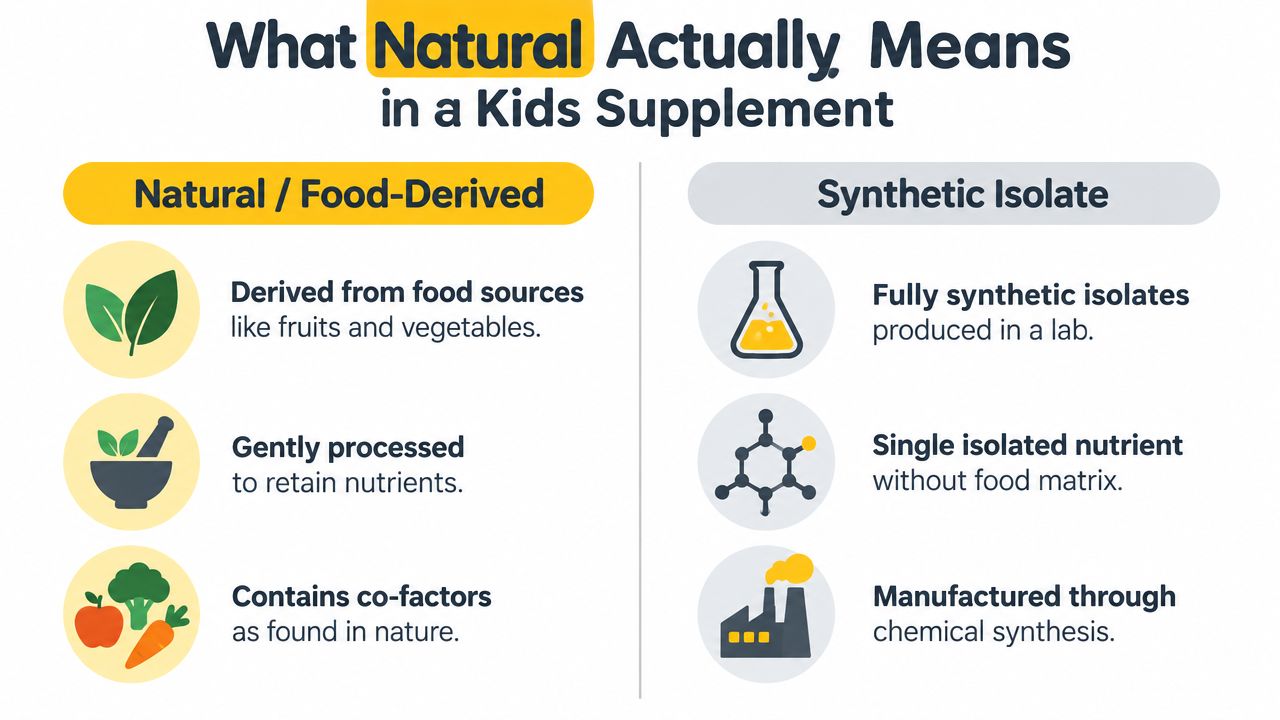
Use “natural” as a sourcing clue
Food-derived ingredients may suit families who prefer fewer highly processed components. The word still tells you little about four things:
- Dose: A natural source can provide too little or too much.
- Safety: Botanical ingredients can trigger allergies or interact with medicines.
- Evidence: A traditional-sounding ingredient may lack strong evidence for the product's advertised outcome.
- Completeness: A supplement does not provide the fibre, protein, fats and meal structure that support a child's diet.
Read “natural” as a starting point for label checking, not a safety guarantee. Look for the actual nutrient amount, ingredient form, allergens, serving directions and any added sweeteners. Parents need this label literacy because a food-derived product can still be poorly matched to a child's needs.
The food-first approach is clear. Offer fruit and vegetables, dairy or fortified alternatives, eggs, fish, legumes, grains and other protein foods in forms your child will eat. A supplement has a narrower job, filling a defined gap when food, medical history or professional advice points to one.
For families seeking a sugar-free, vegan gummy with a stated ingredient list, Focus offers a specific product to assess. Its listed daily serving contains mushroom polysaccharides, vitamin D3, zinc gluconate, elderberry fruit powder and prebiotic fructooligosaccharides. The directions state two gummies daily or as directed by a healthcare professional. Compare those details with the child's diet, age and any other supplements before using it.
The label “natural” is not a clinical recommendation. Judge the nutrient, dose, ingredients and reason for use.
The Nutrients Most Marketed to Parents
A child arrives home tired, skips dinner and asks for a “brain” or “immune” gummy. The label lists familiar nutrients, but the question is not whether each nutrient sounds useful. It is whether that child has a defined gap, and whether the product supplies an age-appropriate amount without duplicating another supplement.
Vitamin C
Vitamin C supports normal body functions. Australian children who regularly eat fruit and vegetables generally do not need it as a routine stand-alone supplement. Consider it for a severely restricted diet or a clinician-identified shortfall. Treat claims that a daily gummy will shield a child from every classroom infection as marketing, not a dosing plan.
Vitamin D
Vitamin D deserves more careful attention than most “immune” blends. An Australian paediatric surveillance study identified 398 children with vitamin D deficiency rickets and estimated an annual incidence of 4.9 cases per 100,000 children aged 15 years and under. The median age was 6.3 years, and 55% were male (Australian vitamin D deficiency rickets study). The condition is uncommon across the population, yet serious enough to assess in children with recognised risk factors.
Risk increases with limited sun exposure, darker skin, cultural clothing practices, winter conditions and low dietary intake. Australian guidance classifies severe deficiency as below 12.5 nmol/L, moderate deficiency as 12.5–29 nmol/L and mild deficiency as 30–49 nmol/L. For children aged 1–18 with mild deficiency, the guidance recommends 1,000–2,000 IU daily for 3–6 months, depending on severity and under clinical direction (Medical Journal of Australia vitamin D guidance).
Do not choose a high-dose vitamin D product from a general wellness claim. Match the dose to the child's age, risk, test results and professional advice.
B vitamins and magnesium
B vitamins matter when a child's eating pattern creates a genuine gap. B12 needs particular attention in vegan households. Iron and other nutrients may also need assessment when a child avoids major food groups. A broad B-complex gummy does not correct an incomplete diet unless the missing nutrient and amount have been identified.
Magnesium is marketed for calm, sleep and muscle function. A well-nourished child without an identified need usually has no clear reason to take it routinely. Its presence in a formula does not establish that it will improve mood, sleep or behaviour.
Prebiotics and probiotics
Prebiotics feed selected gut bacteria, while probiotics provide live microorganisms. Results depend on the ingredient, probiotic strain and outcome being studied. A product intended for one digestive situation does not show that every child needs a generic daily gut-health gummy.
| Nutrient | Realistic benefit for ages 4–12 | Typical evidence-based dose | Marketing gap |
|---|---|---|---|
| Vitamin C | Supports normal nutrition when intake is restricted | Product-specific, clinician-guided | “Immune defence” is often broader than the evidence |
| Vitamin D | Useful when sun exposure, diet or testing indicates risk | Clinician-guided; Australian mild-deficiency guidance uses 1,000–2,000 IU daily | A general gummy isn't a substitute for risk assessment |
| B12 | Important for children avoiding animal foods | Depends on dietary pattern and product | A broad “energy” claim can obscure the specific B12 question |
| Magnesium | Relevant to intake only when a genuine gap exists | Product-specific and clinician-guided | Sleep and calm claims commonly outrun evidence |
| Prebiotics or probiotics | May suit a defined digestive goal | Strain or ingredient-specific | “Gut health” doesn't guarantee a general benefit |
Parents should judge the nutrient, dose, ingredients and reason for use. “Natural” or “immune” does not replace that check.
Reading the Label Without Getting Fooled
Start with the AUST L or AUST R number, then check the active ingredients and directions. A listing with the Australian Therapeutic Goods Administration confirms the product is included in the regulatory system. It does not confirm that the formula suits your child or that its advertising claims are justified.
Check the amount of each active nutrient per tablet, chew or serving. Separate the weight of the compound from the amount of elemental nutrient. “Magnesium citrate” does not automatically tell you how much magnesium it provides. The same applies to “zinc gluconate” and the actual amount of zinc.
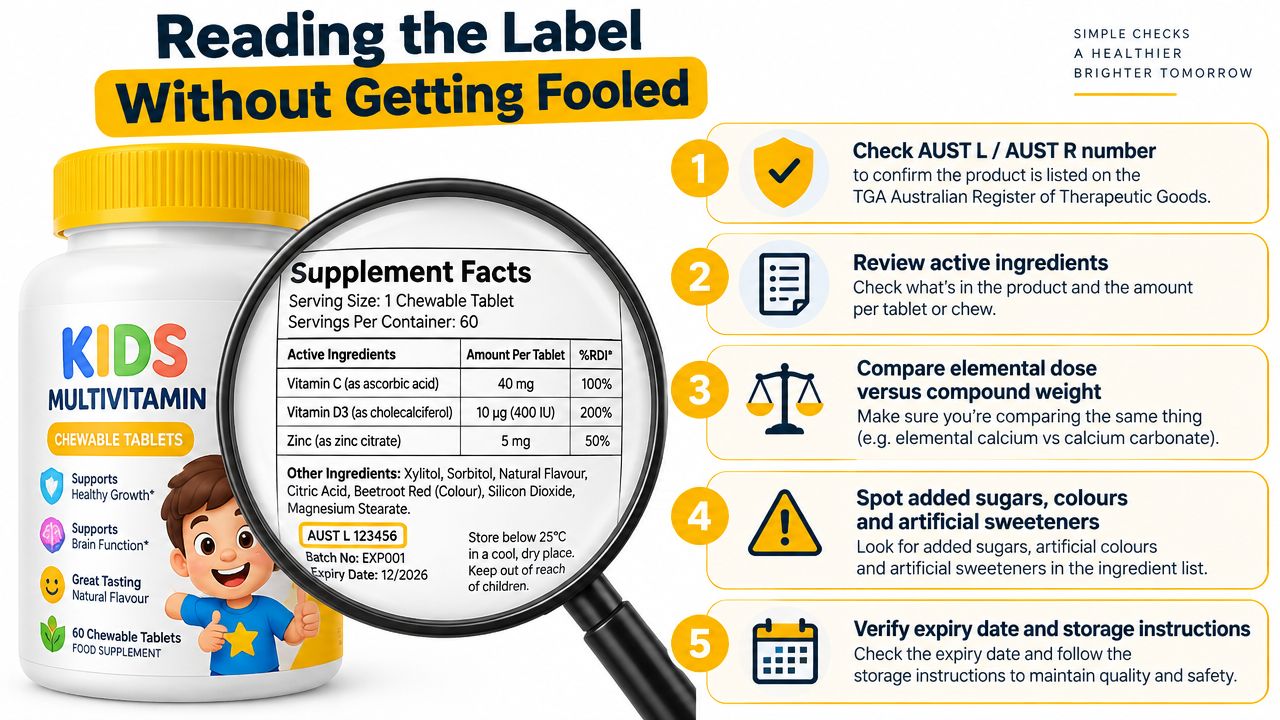
Run the three-minute label check
Look for these traps:
- “No added sugar” wording: Syrups and sugar alcohols can still affect taste, digestion and overall sweetness. Read the complete ingredient list.
- Generic flavour language: “Natural flavours” may not identify allergens clearly. If the label is vague, ask the manufacturer about dairy, gluten, peanut, tree nut and seed ingredients.
- Nutrient overlap: A multivitamin used with vitamin D drops, fortified cereal or another supplement may duplicate ingredients. Add the amounts before combining products.
- Unquantified blends: “Wholefood complex” or a proprietary blend tells you little if individual active ingredients are not listed with their amounts.
- Directions by age: Follow the child's age instructions. Never use an adult serving or assume extra gummies will provide extra benefit.
A clear explanation of what a multivitamin is can help you judge what belongs in a formula. Use it to read the label, not as a reason to buy a product automatically.
Use the 60-second shelf rule: put the product back if you cannot identify the dose, check the allergens or explain why your child needs it. Label literacy is a parent skill, especially when “natural” and “immune” appear more prominently than the actual nutrient information.
A short visual walkthrough can help parents recognise the same details on a real panel:
Food First or Supplement First
A child who eats a varied diet usually needs meals before a multivitamin. Food supplies protein, energy, fibre, and several vitamins and minerals together. A supplement can address a defined gap, but it will not fix a routine built around sweet snacks, skipped meals, or very few accepted foods.
Australian evidence supports targeted use rather than a daily product for every child. Children aged 2–11 generally had adequate intakes of most vitamins and minerals, with vitamin inadequacy below 10% for all vitamins in children under 12, according to the ABS release. Earlier Australian Health Survey data found vitamin A inadequacy affecting about 17% of males and 14% of females (ABS usual nutrient intakes). “Most children” does not mean every child.
When food usually covers the need
| Nutrient | Usually covered by food | Reasonable supplement scenario |
|---|---|---|
| Vitamin C | Fruit and vegetables | Severe dietary restriction or identified deficiency |
| Vitamin A | A mixed diet containing vegetables, eggs and dairy foods | Clinician-identified gap, not casual high-dose use |
| B12 | Animal foods or reliable fortified alternatives | Vegan diet without a dependable B12 source |
| Iron | Meat, legumes, fortified foods and other dietary sources | Suspected deficiency, restricted intake or clinician advice |
| Vitamin D | Dietary sources and sun exposure vary | Higher-risk child, seasonal concern or confirmed deficiency |
Infants need separate assessment. The Australian Feeding Infants and Toddlers Study found iron inadequacy at 75% among infants aged 6–11.9 months and zinc inadequacy at 20% (Australian micronutrient review). These findings do not justify giving an older child an infant formula. They show why age, diet, growth, and risk factors must guide the decision.
Seek professional advice if a child persistently restricts food, avoids several food groups, follows a vegan or medically restricted diet, has limited sun exposure, or has symptoms needing assessment. A supplement can also support an otherwise sensible plan that family routines cannot maintain consistently. Convenience remains a secondary reason, not the main case for routine use.
Do not use magnesium as the default response to poor sleep or emotional storms. Do not use a generic probiotic instead of investigating ongoing digestive symptoms. Match the ingredient to the identified problem, use the age-appropriate dose, and stop when that problem no longer requires supplementation.
Questions Worth Asking Your Paediatrician
A paediatric appointment works better when you arrive with a specific concern. Replace “Should my child take a multivitamin?” with “My child eats no red meat or dairy. How will we cover B12, iron and calcium?” That gives the clinician a diet, a risk pattern and a clear decision to assess.
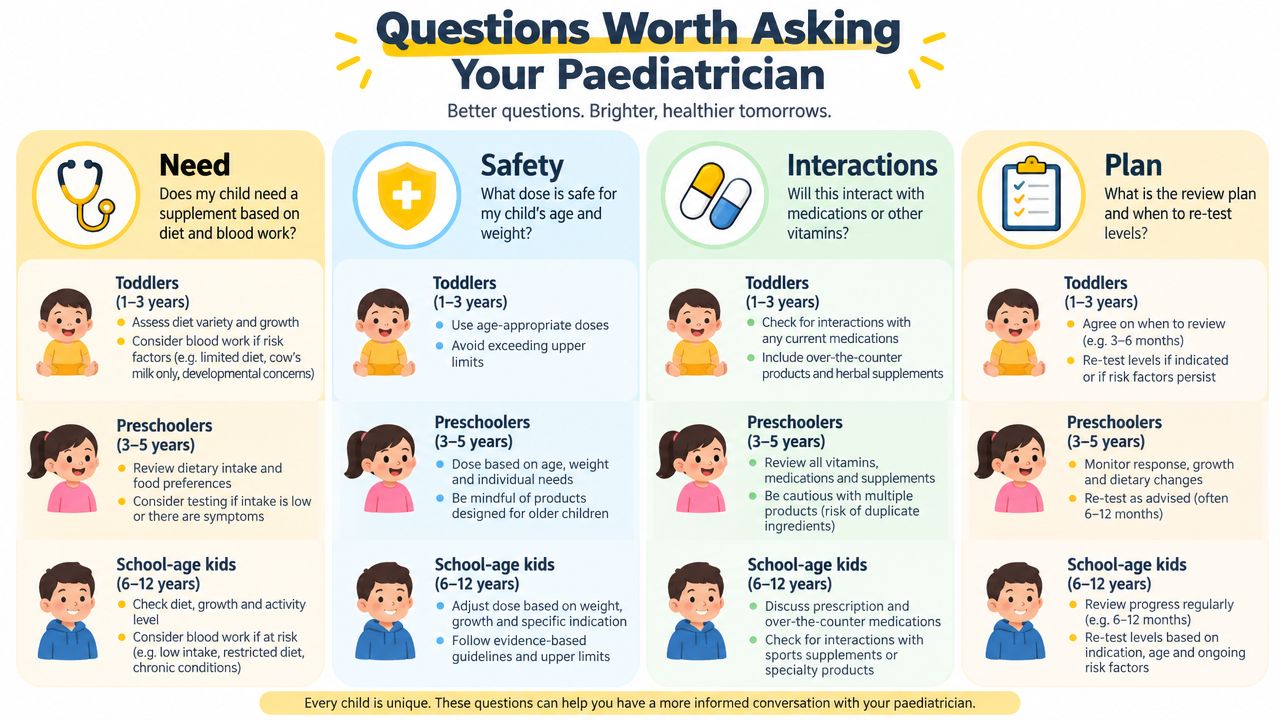
Ask about need
- Toddlers: Do eating patterns, growth and development support supplementation, or would a dietary review change the plan?
- Preschoolers: Which avoided foods create the greatest risk, and would testing clarify the decision?
- School-age children: Do food restrictions, fatigue or frequent illness require assessment instead of a general supplement?
Routine testing does not suit every child. Vitamin D deficiency is uncommon overall, and Australian surveillance found a low population incidence of deficiency rickets. Testing and treatment should follow recognised risk factors, symptoms and clinical judgement rather than worry alone.
Ask about safety and follow-up
Bring the actual bottle or a clear photograph of the complete label. Ask:
- What form and dose match my child's age, diet and identified need?
- Does it duplicate nutrients in fortified cereal, formula, drops or another supplement?
- Could any ingredient interact with a medicine or medical condition?
- What should I do if a sibling eats several gummies?
- When will we review the plan?
- Which signs mean we should stop?
Treat supplement safety as a household rule. Australian exposure reports show why storage and label literacy matter: young children make up a substantial share of accidental vitamin and mineral supplement exposures, and iron-containing products can lead to hospitalisation (Australian supplement exposure analysis).
Ask the clinician to mark the serving size, active ingredients and upper limits on the label. A “natural” ingredient still needs an age-appropriate dose.
Store every product as medicine, not confectionery. If accidental ingestion occurs, contact the Poisons Information Centre promptly and follow its instructions.
Choosing a Format That Fits Real Family Life
Choose the format your child can take at the correct dose and your household can store securely. Acceptance matters because a refused supplement cannot do its job. Taste should come after dose clarity, allergy checks and a short, sensible ingredient list.
Compare the practical trade-offs
Gummies are easy to chew and often accepted quickly. Their lolly-like appearance can encourage children to eat more than directed, while sweeteners and sugar alternatives may add little value. Store them out of reach and explain that they are medicine, not treats. See this guide to kids' vitamin gummies when comparing ingredients, format and routine fit.
Chewable tablets can offer clearer dose control and fewer flavouring ingredients. Choose them only when your child can chew thoroughly and accepts the texture.
Liquid drops suit younger children and allow flexible dosing. They also make measuring mistakes easier, so use the supplied device, follow storage directions and check the expiry date.
Powders may work for children who reject tablets. Check how they mix and taste. Do not stir a dose into a full drink if your child may leave some behind, because you cannot confirm the amount consumed.
Capsules provide precise dosing without a gummy texture, but many younger children cannot swallow them safely.
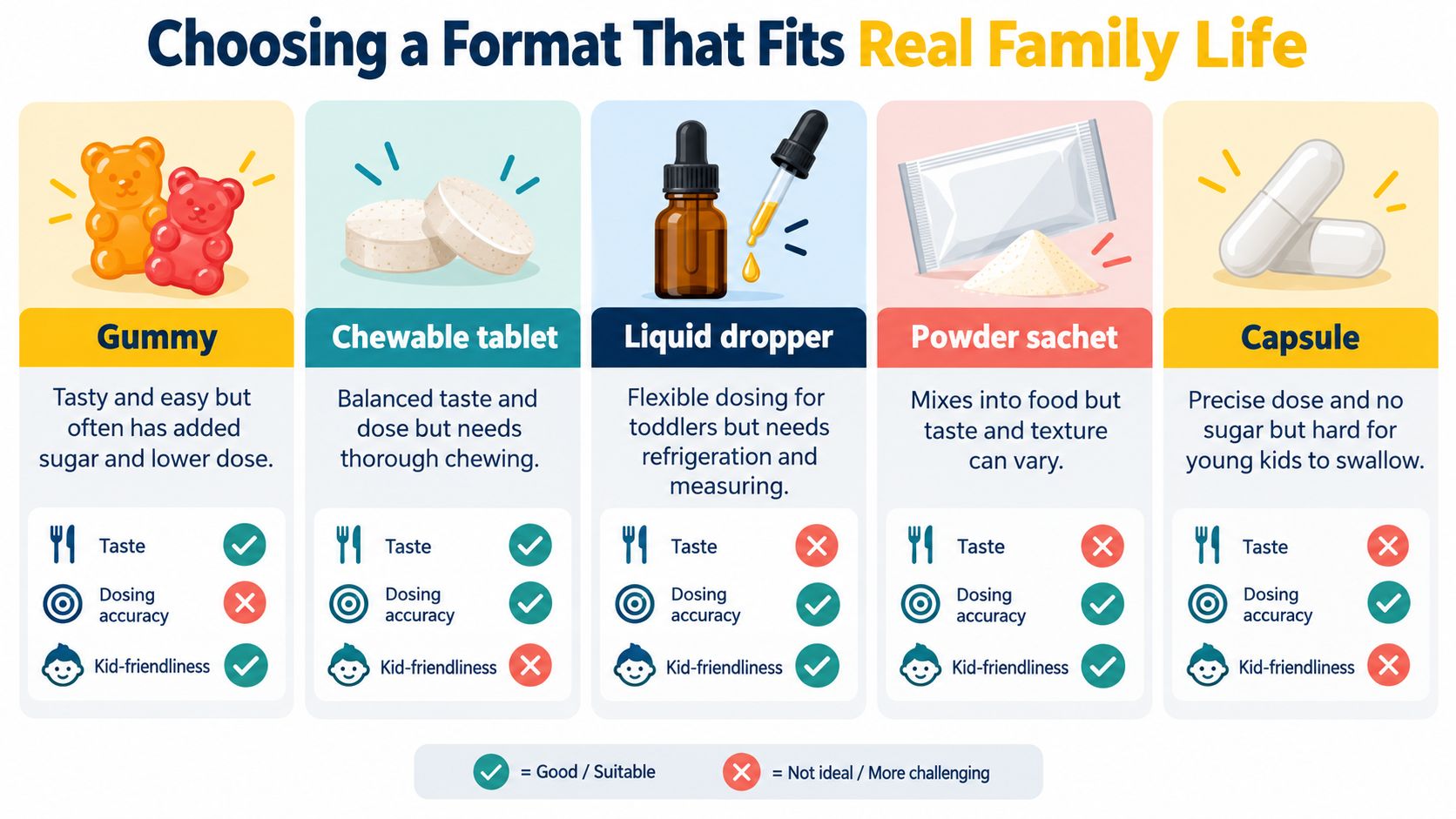
Score the product against your household
Before buying, write down your child's age, dietary restrictions, allergies, usual breakfast and the adult responsible for giving the dose. Then check the label for vegan or vegetarian suitability, relevant allergens, storage requirements, expiry details and the amount of each active nutrient per serve.
A subscription may prevent a busy family from running out, but delivery must never decide whether supplementation continues. Pause it when your child's diet changes, a clinician reviews the plan or another product creates nutrient overlap.
Choose the option that causes the fewest daily arguments while keeping dosing accurate. A child-friendly product that is accessible without supervision is a safety problem, not a successful routine.
A Simple Rule of Thumb to Take Away
Use one rule at the shelf:
Food first. Supplement only for a specific gap. Read every label. Involve a paediatrician when the risk, dose or diagnosis isn't clear.
A varied diet remains the default for a healthy child. A supplement earns its place when intake is consistently restricted, limited sun exposure raises a credible vitamin D concern, a medical condition affects absorption, or a clinician identifies a deficiency. Choose a product that names the nutrient, states its amount clearly and suits the child's age.
Australian evidence shows why blanket advice fails. Many children have adequate usual vitamin intakes, while iron and zinc inadequacy can affect some young children, and vitamin D risk changes with season and individual circumstances. There is no multivitamin for every age, diet or household. ABS nutrient intake release
Evidence is limited for broad promises aimed at healthy children, including sharper focus, calmer behaviour or stronger immunity from a daily blend. No gummy replaces vegetables, fruit, protein foods, dairy or fortified alternatives, sleep and regular outdoor activity.
If you're considering natural vitamins for kids, record what your child eats for several days. Take that record and the product label to your GP or paediatrician. Buy only what fills an identified need.
Daily Powers offers sugar-free, vegan children's gummy formulations without artificial colours or flavours, including everyday multivitamin, focus and calm products. Review the ingredient lists and dosing guidance at Daily Powers, then compare the product with your child's diet and healthcare professional's advice.