

Your child is ready for bed, but the vitamin routine isn't. One chewable has a familiar sweet taste, another says sugar free vitamin C, and both packages leave you wondering about sweeteners, texture, serving size and age guidance. The front label answers the easiest question, not always the most important one.
For Australian families, choosing a children's vitamin C supplement is less about finding a universally “good” or “bad” product. It's about matching the formulation to your child's age, chewing ability, preferences and your concerns about added sugar or other ingredients.
Table of Contents
- Why Sugar Free Vitamin C Matters for Australian Families
- Understanding Vitamin C Needs in Children
- Sugar Free vs Sugared Vitamin C Supplements
- How to Read Children's Supplement Labels Confidently
- Navigating TGA Regulation and Product Safety
- Practical Buying and Routine-Building Advice for Caregivers
Why Sugar Free Vitamin C Matters for Australian Families
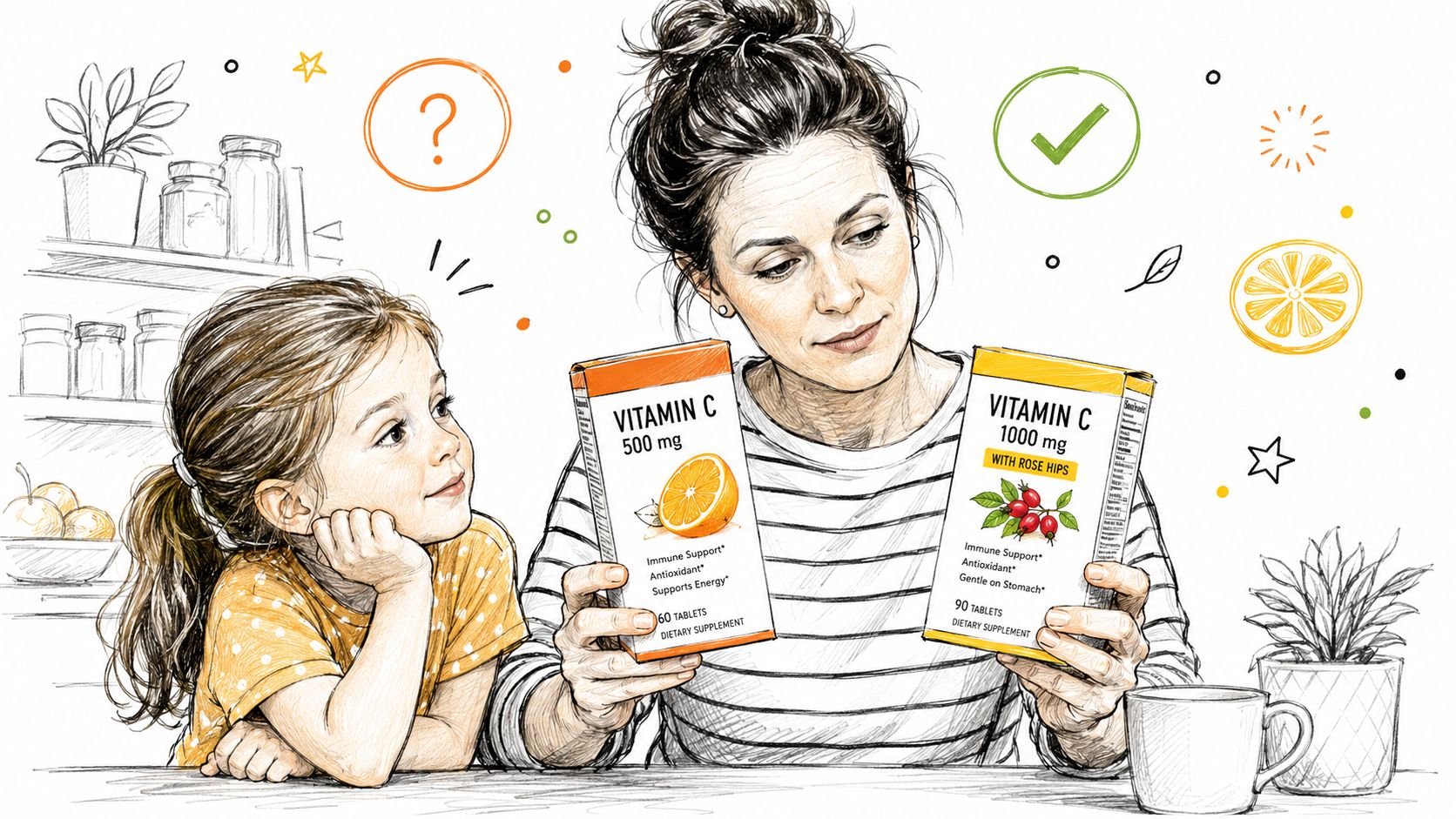
A caregiver comparing two packets at the kitchen table may start with a simple rule: choose the one without sugar. That's a sensible starting point, especially if the supplement is part of a daily routine, but it doesn't finish the decision. Sugar may be absent while sweeteners, acids, flavourings, colours or texture agents still appear in the ingredient list.
The local context helps explain why this category is familiar to Australian households. The Australian Bureau of Statistics nutrition data reports that 33.6% of people in Australia took a dietary supplement in 2023, while vitamin and/or mineral supplements were the most common type at 29.7%. Adult females reported supplement use more often than adult males, 43.7% compared with 30.8%, a pattern that's relevant to household purchasing and routine-setting.
The label claim is only the beginning
Australian market commentary shows that “free from” language, including free from refined sugar, is common in local supplements. That language responds to a real preference: many caregivers want to limit unnecessary added sugar while still choosing a format their child will accept.
A sugar-free chewable can make sense for a child who won't swallow a tablet and needs a pleasant daily format. A liquid may suit a younger child who can't safely manage a chewable. Another child may accept neither if the sweetener leaves an aftertaste or the texture feels sticky.
Practical rule: Treat “sugar free” as one screening question, not a complete quality assessment.
The best choice is the one your child can use safely and consistently, with ingredients you're comfortable offering. That may mean comparing the full formulation, checking the age instruction and asking a pharmacist or healthcare professional when the label doesn't fit your child's needs.
Understanding Vitamin C Needs in Children
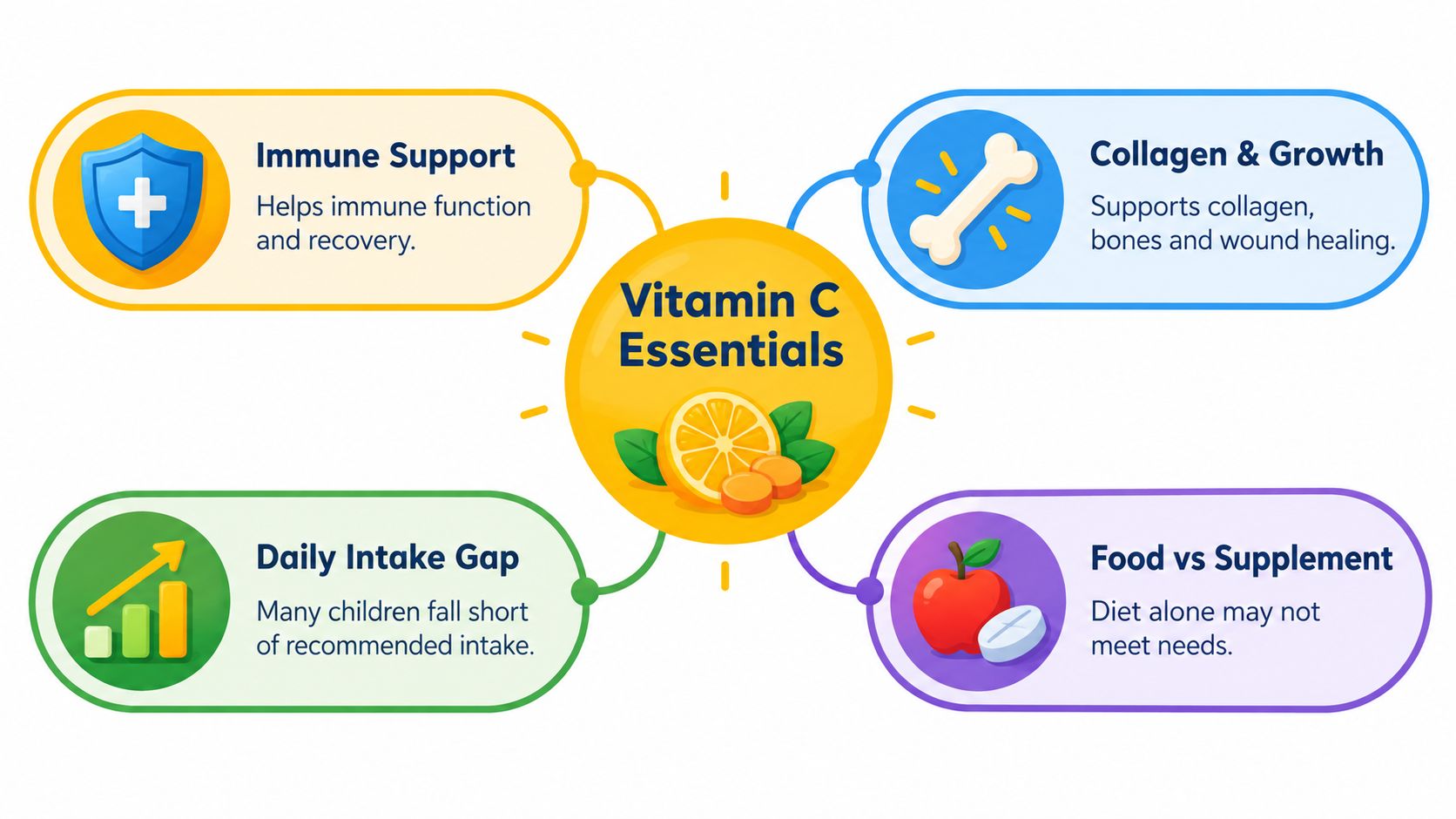
Vitamin C has several everyday roles in a growing child's body. It supports normal immune function, contributes to collagen formation for skin and connective tissue, and helps the body absorb iron from plant foods. Those functions matter in ordinary family life, particularly when a child eats a narrow range of foods or regularly leaves fruit and vegetables untouched.
Australian intake data gives the conversation a local foundation. The ABS reported that average daily vitamin C intake was 83 mg in 2023, down from 100 mg in 2011–12 (ABS food and nutrient data). The figures describe population intake, not an individual child's requirement or diagnosis, but the decline shows why families and clinicians continue to consider where vitamin C comes from.
Food first, with formulation as a practical backup
Fresh fruit and vegetables remain valuable because they provide vitamin C alongside fibre and other nutrients. Yet a child's actual diet can vary from day to day. A selective eater may accept only a small range of foods, while another child may eat fruit at school but refuse it at home. A supplement can fill a practical gap, but it shouldn't turn into permission to replace meals or use high doses without advice.
Caregivers also need to separate nutrient purpose from product format. Vitamin C doesn't become more useful because it is a gummy, liquid or chewable. The format affects whether a child can take it safely and whether the family can follow the directions.
Watch the short video below for a visual explanation of vitamin C's role and the food-versus-supplement decision.
A daily multivitamin gummy such as Brave is designed as a broader routine, rather than as a vitamin C-only product. Its snapshot describes essential vitamins, kid-friendly flavours and textures, a vegan formulation, and no artificial colours or flavours, so caregivers still need to read the product's current label to confirm the ingredients and directions.
The key question is simple: Does your child need a supplement, and can this particular product deliver it in an age-appropriate form? A paediatric dietitian, GP or pharmacist can help when your child has a restricted diet, a diagnosed deficiency, a medical condition or takes other medicines.
Sugar Free vs Sugared Vitamin C Supplements
Sugared and sugar-free vitamin C products solve different formulation problems. Sugar can make a chewable easier to flavour and shape, while a sugar-free product reduces added-sugar exposure. Neither label alone tells you whether the supplement suits your child.
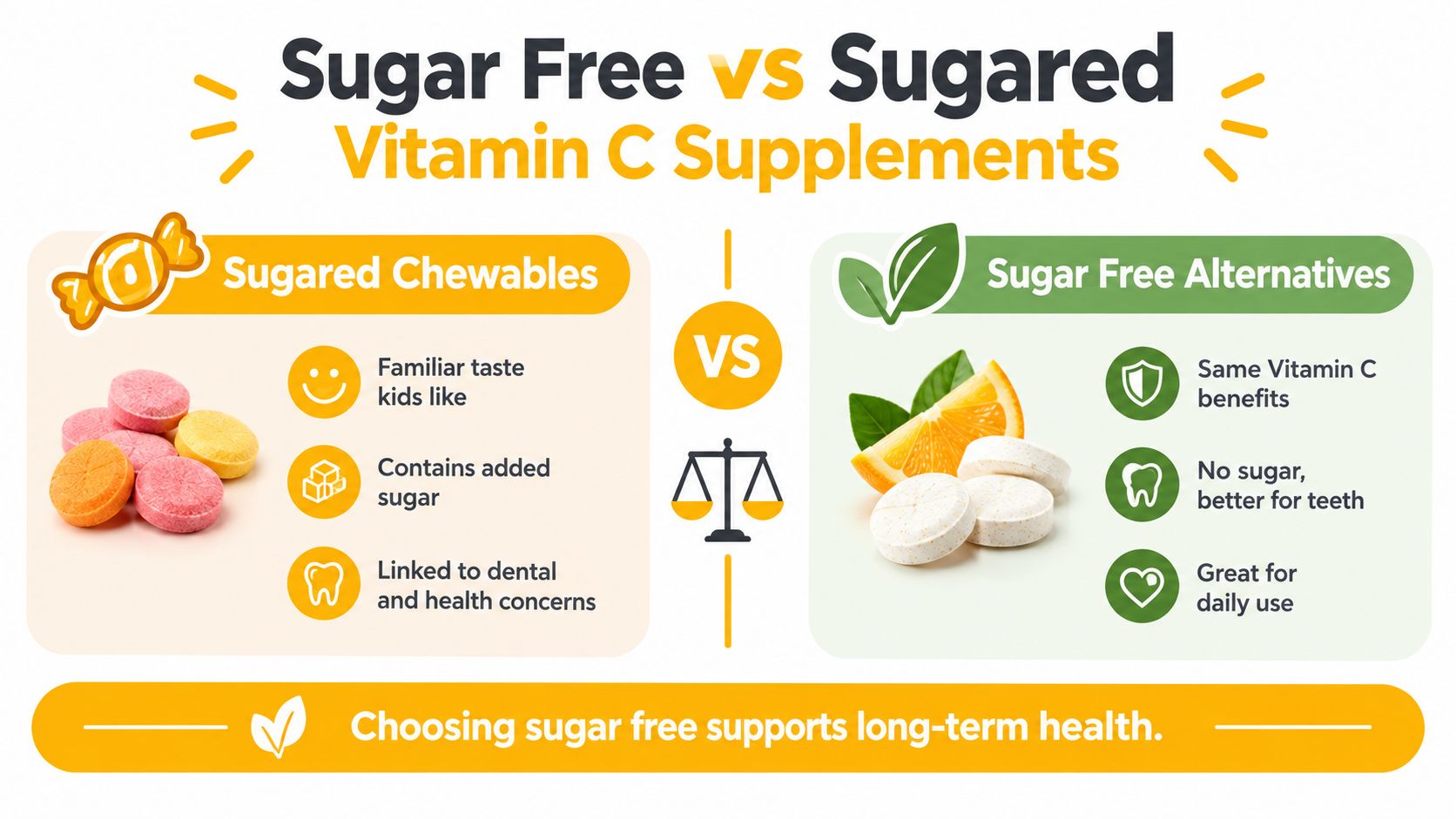
A sugared chewable may be familiar and easy for a child to accept. The trade-off is that the product contributes another sweet item to the daily routine, which can be an avoidable concern for families managing added sugar or dental habits. A sugar-free alternative removes that particular ingredient, but manufacturers still need to create a pleasant taste and stable texture.
What changes when sugar is removed
Sugar-free children's vitamin C products in Australia commonly use alternative sweeteners and other excipients. Market examples include products promoted as 99% sugar free, with age bands such as children over two years, four to eight years, and nine to thirteen years (Cenovis Kids Chewable Vitamin C). These examples show why age guidance and formulation need to be considered together.
| Question | Sugared chewable | Sugar-free alternative |
|---|---|---|
| Taste and texture | Sugar can help create a familiar sweet profile | Alternative sweeteners and flavour systems do the work |
| Added sugar | Present in the formulation | Not present when the label supports the claim |
| Label complexity | May be shorter, but still requires checking | May include several sweeteners or excipients |
| Practical fit | Often accepted by children who prefer candy-like textures | Useful when caregivers want to limit sugar exposure |
| Safety check | Directions and age guidance still matter | Directions, sweetener tolerance and age guidance still matter |
The comparison becomes more important for younger children. Some products are chewables intended for children over two years, while others are liquids for younger ages. Products may also advise adult supervision, because a supplement that looks like confectionery must be handled as a medicine or health product, not as a free-access snack.
Choose the realistic option
Ask whether your child can chew the product thoroughly, tolerate the listed sweeteners and follow the serving instruction. A sugar-free product that causes refusal or stomach discomfort won't support a reliable routine. A sugared option may be easier to administer, but you may prefer to keep added sugar out of a daily supplement.
The useful comparison isn't “sugar versus no sugar”. It's which complete formulation fits your child safely and consistently.
How to Read Children's Supplement Labels Confidently
Front-of-pack language is designed for quick decisions. The ingredient panel and directions contain the details you need for a careful one. Start at the back, then use the front claim as confirmation rather than proof.
A five-point label check
- Confirm the active ingredient. Look for vitamin C and the stated form, such as ascorbic acid, along with the amount provided in the recommended serving. Don't assume that a larger-looking gummy or brighter flavour contains more useful vitamin C.
- Read every sweetener. “Sugar free” doesn't mean unsweetened. Look for the named sweeteners and consider whether your child has reacted poorly to any of them. The Australian market includes products that disclose ingredients such as saccharin and sucralose, as well as other excipients, so the claim needs to be read alongside the full list (Cenovis Sugarless C).
- Scan for excipients and allergens. Excipients help with texture, stability, colour, acidity or flavour. They aren't automatically harmful, but they may matter to a child with sensitivities, allergies or a delicate stomach. Check allergen declarations and contact the manufacturer if an ingredient isn't clear.
- Match the age instruction. An age band isn't a casual suggestion. It reflects the product's intended use, serving design and administration method. Don't split, crush or increase a serving unless a healthcare professional has advised you to do so.
- Look for supervision and storage directions. If the product warns that an adult should supervise use, follow that instruction. Store gummies and chewables out of reach, because a child may mistake them for lollies and take more than directed.
A label can also reveal a swallowing issue that the sugar-free claim distracts from. A child who can't chew safely may need a liquid or professional guidance, while a child who refuses liquids may manage a suitable chewable. The right format depends on development, not just preference.
For a broader look at how sugar-free formulations can differ across children's supplements, see this guide to sugar-free multivitamins. It's useful to compare the complete ingredient list, serving instructions and age suitability rather than choosing by a single badge on the packet.
Label habit: Take a photo of the ingredients and directions before buying. It gives you time to compare products without a tired child waiting beside the pharmacy shelf.
If the wording is confusing, ask a pharmacist to interpret it. Bring the product, your child's age and any relevant allergies or medicines. That small pause can prevent an unsuitable purchase.
Navigating TGA Regulation and Product Safety
Australian vitamin products sit within a regulated complementary-medicine system overseen by the Therapeutic Goods Administration. The framework doesn't mean every product is right for every child, but it does create requirements around ingredients, claims, evidence and manufacturing.
The TGA explains that vitamin products may be regulated as low-risk medicines or listed medicines, depending on factors such as dose and claims (how vitamins are regulated in Australia). Ingredients must come from pre-approved lists, and manufacturers can't describe a product with unlimited therapeutic promises. Claims are restricted to approved minor-condition indications, and sponsors are expected to hold evidence that the product performs as claimed.
What this means at the shelf
For caregivers, regulation appears in practical details:
- Ingredient control: A sugar-free formula still needs acceptable, declared ingredients. Removing sugar doesn't remove the sponsor's responsibility for the complete formulation.
- Claim boundaries: “Supports” wording should be read carefully. It isn't a guarantee that a product prevents illness or treats a child's medical condition.
- Dose accountability: The stated vitamin C amount and intended use must be supported by the product's evidence and directions.
- Manufacturing expectations: Sponsors remain responsible for product quality, regardless of whether the format is a liquid, tablet, chewable or gummy.
Australia's food framework also permits vitamin C as ascorbic acid among the vitamin forms that can be added to foods, while national policy guidance links voluntary fortification with evidence of deficiency or low intake in population groups (Australian food fortification guidance). This helps explain why vitamin C appears in everyday products, but it doesn't replace the need to check a therapeutic product's label.
Parents who want more detail about serving amounts can use these paediatric dosing guidelines as a starting point, then confirm the specific product directions with a healthcare professional. A child's age, diet, health history and other supplements all affect the decision.
Practical Buying and Routine-Building Advice for Caregivers
The most suitable sugar-free vitamin C product is the one that fits your child's real day. A technically attractive formulation won't help if your child can't chew it, dislikes the flavour or needs a serving that clashes with school and childcare routines.
Begin with administration. For a young child, check whether the product is a liquid or a chewable intended for an older age group. For an older child, consider whether they can chew safely and whether the texture creates resistance. Adult supervision remains important for children's chewables and gummies, especially because their appearance can make them seem like ordinary sweets.
Build the decision around four questions
Can my child use the format safely? Choose the form that matches chewing and swallowing ability. Don't use an older child's product for a younger child because the flavour is familiar.
What exactly replaces the sugar? Read the sweetener and excipient list. If you're avoiding artificial sweeteners, particular allergens or ingredients that upset your child's digestion, the full panel matters more than the front claim.
Will we remember it? Attach the routine to an existing event, such as breakfast or brushing teeth, while keeping the product stored safely away. A predictable habit is more useful than an ambitious plan that creates daily arguments.
Can I verify the product information? Look for clear ingredient disclosure, age guidance and directions. If you're buying online, check the current product page rather than relying on an old screenshot or marketplace description.
Some Australian brands frame sugar-free gummies around a repeatable family ritual. Daily Powers, for example, describes its children's range as vegan, free from sugar and artificial colours or flavours, with kid-friendly flavours and textures intended to support daily habits. Those features may be relevant to a family comparing formats, but they don't remove the need to check the individual product label and suitability for your child.
For more help weighing flavour, texture, age suitability and adherence, read this practical guide to kids' vitamin gummies. If your child has a restricted diet, medical condition, swallowing difficulty or ongoing symptoms, ask your GP, paediatric dietitian or pharmacist before starting a supplement.
The aim isn't to find a flawless product or make every ingredient decision perfectly. It's to choose a transparent, age-appropriate formulation that your child can take safely and your household can manage without daily negotiation.
Daily Powers offers sugar-free, vegan children's gummies with no artificial colours or flavours, clear ingredient information and age-appropriate guidance for Australian families. Visit Daily Powers to compare the range and choose a routine that fits your child's needs.