

Packing lunchboxes, finding the missing school hat, answering a last-minute question about library day, then noticing the vitamin jar on the bench. That's often the moment the question pops up. If my child eats vegan, are they getting what they need every day?
For many Australian parents, the worry isn't about whether a vegan diet can work. It's about whether it's being covered well enough in real life, on busy weekdays, with changing appetites, school lunches, and the occasional beige-food phase. A child might happily drink a fortified plant milk one week and refuse it the next. They might love tofu at dinner, then decide they're “off it” by Friday.
That's where a vegan kids multivitamin often enters the conversation. Not as a magic fix, and not as a substitute for food, but as a practical safety net. The useful question isn't “Is this vitamin vegan?” It's “Does this product help cover the nutrient gaps that matter most for vegan children in Australia, and will my child take it consistently?”
Parents also get flooded with label language that sounds reassuring but doesn't always answer the core issue. Vegan. Sugar-free. natural. no artificial colours. gummy. chewable. These claims can matter, but they don't tell you enough on their own. If you want a simple primer on everyday options for children's supplements, this guide on natural vitamins for kids can help frame the bigger picture.
Table of Contents
- Introduction to Vegan Kids Multivitamins for Everyday Family Life
- What Vegan Means in a Kids Multivitamin Formulation
- Key Nutrients Vegan Kids Need and Common Gaps to Watch
- Benefits and Limitations of a Vegan Kids Multivitamin
- How to Evaluate Ingredients Dosing and Label Claims for Ages 4 to 12
- Building a Daily Supplement Routine That Sticks
- Choosing With Confidence and Next Steps for Parents
Introduction to Vegan Kids Multivitamins for Everyday Family Life
A parent of a school-age child usually isn't looking for perfection. They're looking for confidence. They want to know that the breakfast, lunchbox, afternoon snack, and dinner pattern is broadly doing its job, and that any supplement in the routine is filling a genuine gap rather than just adding another product to the cupboard.
That matters even more with vegan eating patterns, because some nutrients are easier to get from plants than others. A child can eat plenty of fruit, vegetables, grains, beans, nuts, and seeds and still need extra thought around a few key nutrients. Many families get stuck. The diet can look healthy on the surface, but the hidden weak spots are easy to miss.
The real decision parents are making
Most product marketing frames the choice as vegan versus non-vegan. That's too shallow. The better way to think about it is like checking a school bag before the day starts. You're not just asking whether the bag looks good. You're checking whether it contains the essentials.
For a vegan kids multivitamin, that means asking:
- Does it target known vegan diet gaps rather than offering a vague “general health” promise?
- Does the label clearly show the nutrients and dose per serve so you can judge what your child is getting?
- Will your child take it daily without pushback, because consistency matters more than good intentions?
- Does the formula match your family's preferences around sugar, sweeteners, colours, flavours, and ingredient transparency?
Practical rule: A supplement only helps if it closes a real gap and becomes a routine your child will actually follow.
Where a multivitamin fits
A multivitamin sits in the support role. Food still does the heavy lifting. Meals provide energy, protein, fibre, and the everyday nutrition that no gummy can replace. But a well-chosen product can make daily coverage more reliable when diet patterns vary.
That's especially useful for time-poor households. If your child eats well some days and narrowly on others, a steady daily habit can reduce the mental load. The goal isn't to control every bite. It's to build a sensible system that works on ordinary days.
What Vegan Means in a Kids Multivitamin Formulation
“Vegan” on a label sounds simple, but in supplements it covers more than one decision. It isn't just about avoiding meat. It can affect the texture of the gummy, the ingredients used to hold it together, the flavour system, and the sweeteners chosen to make it acceptable to children.
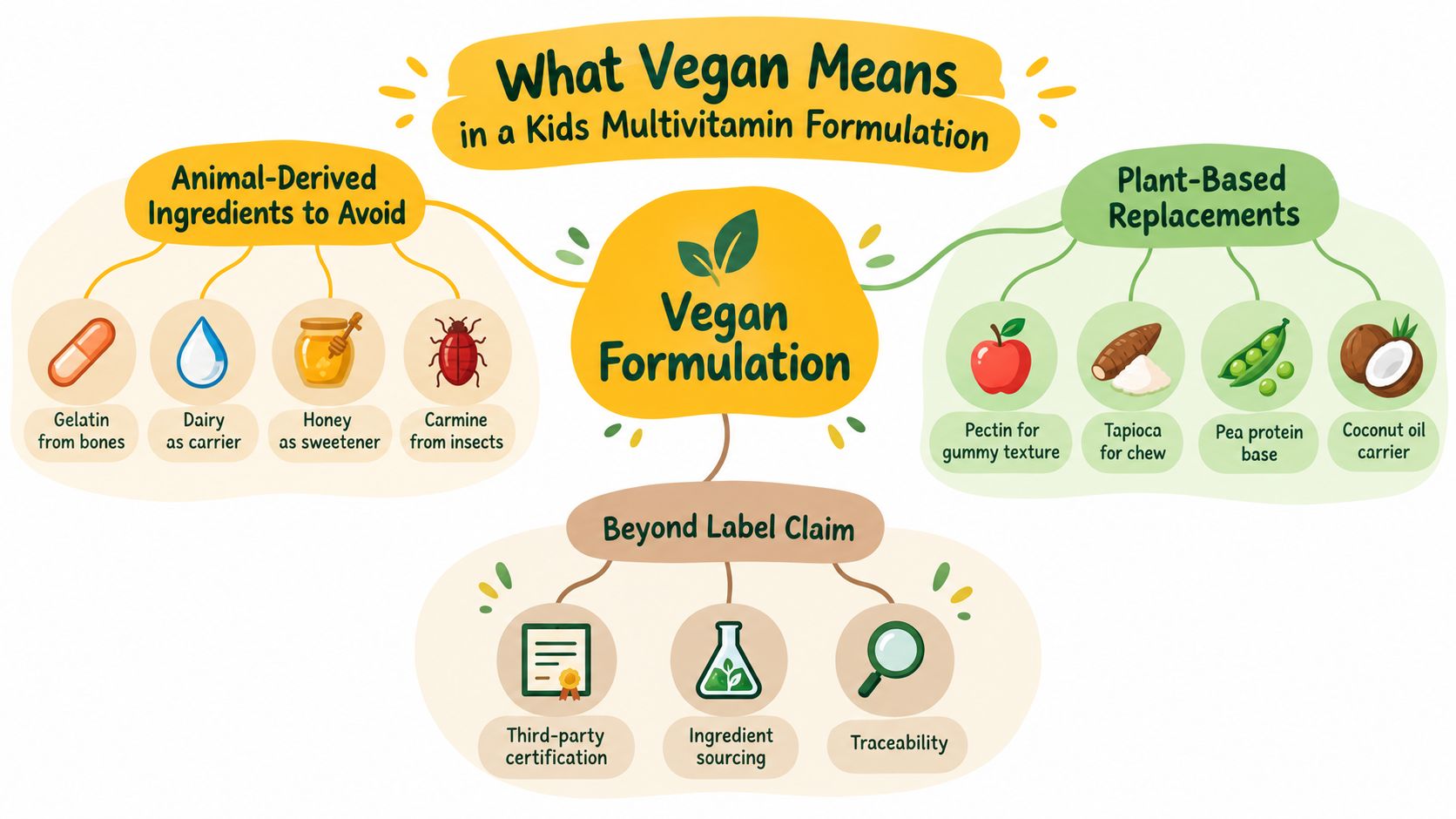
The short version of vegan formulation
Think of a gummy like a small building project. The vitamins are only one part. You also need the structure, the taste, and the finish. In non-vegan products, some of those building blocks can come from animal sources. In vegan products, they need plant-based alternatives instead.
Common things parents often check include:
- Gelling agents such as whether the gummy uses a plant-based option rather than animal-derived gelatin.
- Carriers and flavour components that don't rely on dairy-based ingredients.
- Colours and flavourings that fit the family's preferences for simpler ingredient lists.
- Sweetening system if you're aiming for sugar-free or low-fuss daily use.
A vegan claim is useful, but it shouldn't end the conversation.
Why the “beyond vegan” details matter
Two gummies can both be vegan and still feel very different in a family routine. One might be easy to chew and accepted without complaint. Another might taste odd, have a sticky texture, or include sweeteners a parent would rather avoid. That's why format matters just as much as ideology.
A soft chew texture and familiar flavour aren't just “nice extras”. They're functional. If a child resists taking a product, even the most carefully designed formula doesn't help much. Daily use depends on acceptance.
Some families also look for local transparency and quality signals such as clear ingredient panels, full dosing directions, and TGA-approved status where relevant to the product. Those details don't replace judgement, but they do make it easier to know what you're buying.
One example in this category is Brave, which is described as a daily multivitamin gummy for kids with a vegan-friendly formulation, kid-friendly flavours and textures, and no artificial colours or flavours. The useful takeaway isn't the branding. It's the design principle. A children's supplement has to work nutritionally and behaviourally.
If a gummy is vegan but hard to take every day, the label solves one problem and leaves another.
Sugar-free doesn't automatically mean simple
Parents often assume sugar-free means cleaner. Sometimes it does. Sometimes it means the product uses a different sweetening system. That's why it's worth reading the fine print and checking whether the full ingredient list aligns with what your household is comfortable with.
The label should help you answer basic practical questions quickly: What gives the gummy its texture? What sweetens it? What flavours it? What does each serve contain? If that isn't clear, it's harder to judge whether it belongs in a daily routine.
Key Nutrients Vegan Kids Need and Common Gaps to Watch
When parents hear “multivitamin”, they often picture broad insurance. But vegan children don't need a random scatter of nutrients. They need attention to the few that are predictably harder to obtain from a vegan eating pattern.
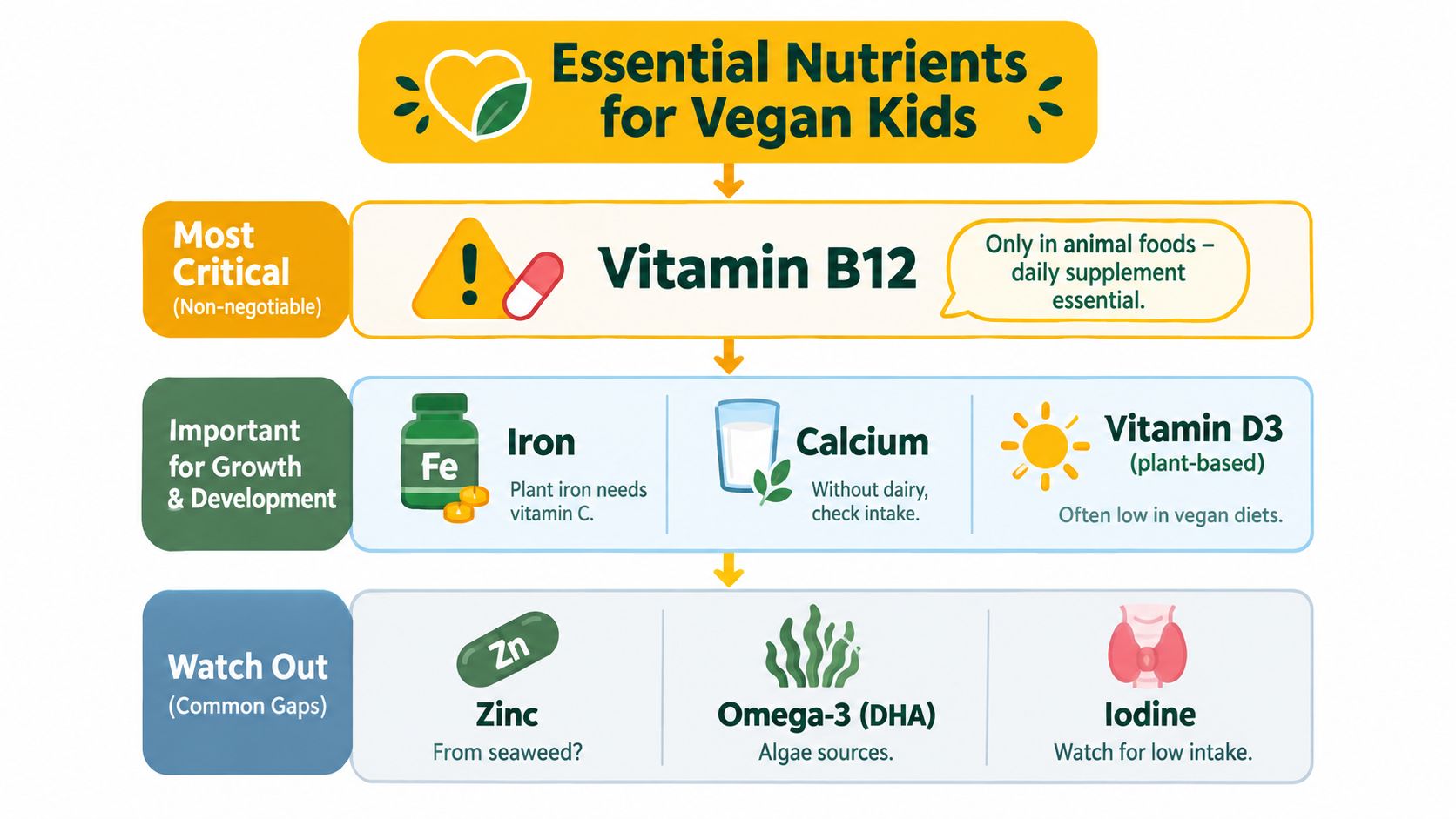
Vitamin B12 is the first thing to check
In Australian guidance, vitamin B12 is the standout nutrient of concern for vegan children. Healthdirect states that strict vegans should take vitamin B12 supplements to avoid deficiency, notes that plant-based diets can be low in several nutrients, and specifically warns that vegan children may not get enough vitamin B12, which is important for brain development, as outlined on Healthdirect's vegetarian and vegan diets guidance.
This is the key point many labels blur. B12 isn't a bonus extra for vegan kids. It's the nutrient you check first.
For children, the Australian and New Zealand nutrient reference values listed by the Medical Journal of Australia set vitamin B12 needs at 0.9 µg/day for ages 1 to 3, with an EAR of 0.7 µg/day, and 1.2 µg/day for ages 4 to 8 within the Healthdirect-linked guidance above. For infants, the adequate intake is 0.4 µg/day at 0 to 6 months and 0.5 µg/day at 7 to 12 months in that same source context. For school-age children, that gives parents a practical benchmark for judging whether a supplement contributes meaningfully.
If your child already gets regular fortified foods, the supplement may play a supporting role. If they don't, it may be doing much more of the lifting.
For extra context on why B12 deserves special attention in a child-friendly format, this explainer on vitamin B12 gummies may be useful.
Other nutrients that often need a closer look
B12 gets most of the attention because it's the most obvious risk. It isn't the only one.
Australian guidance notes that vegan children may also need attention to:
- Vitamin D
- Iron
- Zinc
- Calcium
- Iodine
- Omega-3 fats
Pregnancy Birth and Baby notes that vegan children may particularly struggle to get enough vitamin B12 and may also need attention to iron, zinc, calcium and vitamin D, as discussed in Pregnancy Birth and Baby's children and vitamins guidance.
That list helps parents avoid a common mistake. A long nutrient panel can look impressive, but if a product skips one of the likely vegan gaps, its usefulness may be limited for your child's diet pattern.
Why a long ingredient list can still miss the point
A multivitamin can contain many nutrients and still not be the right tool. The issue isn't how crowded the label looks. The issue is whether it covers the nutrients that are difficult to obtain in the child's actual eating pattern.
A simple way to think about it is this:
| Nutrient focus | Why parents check it |
|---|---|
| B12 | It's the key predictable gap in vegan diets for children |
| Vitamin D | Intake can be inconsistent, and some products leave it out |
| Iron and zinc | These often need closer attention in plant-based eating |
| Calcium and iodine | These may depend heavily on fortified food choices |
| Omega-3 fats | A standard multivitamin may not cover them meaningfully |
Age matters too
Tasmania Health advises offering fortified foods and recommends a B12 supplement for babies or children on vegan diets. It also points to the Australian government NRVs setting the vitamin B12 RDI at 1.2 µg/day for ages 4 to 8 and 1.8 µg/day for ages 9 to 13, as explained in Tasmania Health's vegan eating advice for babies and children.
That matters because a product suitable for a younger child may not cover the same proportion of need for an older child. A parent with a five-year-old and a ten-year-old shouldn't assume one label means the same thing for both.
The best label isn't the one with the most claims. It's the one that helps you see, at a glance, whether it meaningfully supports the nutrients your child is most likely to miss.
Benefits and Limitations of a Vegan Kids Multivitamin
A vegan kids multivitamin can be helpful. It can also be oversold. Parents do better when they hold both truths at once.
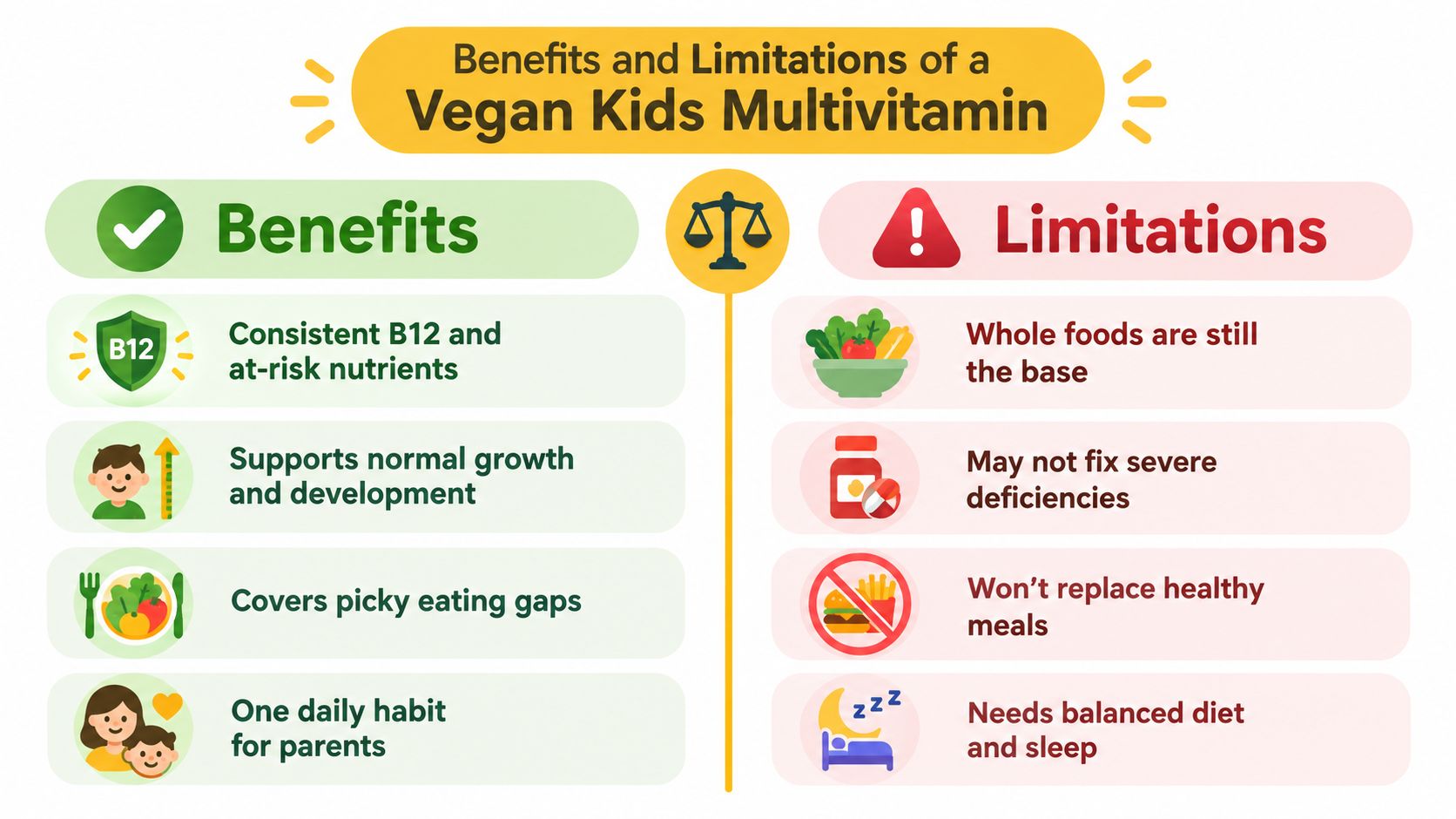
Where a multivitamin helps
The strongest benefit is consistency. If your child's meals vary from day to day, a daily supplement can provide a steadier back-up for nutrients that are easy to underdo on a vegan diet.
It can be especially useful when:
- Fortified foods aren't eaten reliably and intake changes across the week.
- Your child is selective and rotates through a narrow group of preferred foods.
- School-day eating is unpredictable and lunch comes home half-finished.
- You want one repeatable habit rather than making a new nutrition decision every day.
Australian paediatric guidance supports careful planning and often supplementation in vegetarian and vegan diets for children. Western Australia's Child and Adolescent Health Service advises well-planned eating patterns, replacing animal proteins with legumes, tofu, nuts and seeds, and choosing calcium-fortified plant milks with a minimum of 120 mg of calcium per 100 mL where possible. Dietitians Australia also says fortified foods or a vitamin B12 supplement are the only viable ways for someone on a vegan diet to obtain enough B12, and that a B12 supplement will be needed if fortified foods aren't eaten regularly, especially for vegan children, as summarised in the WA Child and Adolescent Health Service nutrition guidance.
Here's a helpful plain-language explanation from a paediatric perspective:
What a multivitamin can't do
It can't turn a limited diet into a balanced one. It can't replace meals, fix poor overall intake, or stand in for adequate calcium-rich foods, protein variety, or family eating patterns.
A gummy also may not cover everything equally well. Some products focus on general wellbeing but don't provide support for all the nutrients a vegan child may need watched more closely. Others may include vitamin D but not enough of other nutrients parents assume are “in there somewhere”.
That's why food, fortified foods, and supplements each have different jobs:
| Option | What it does best | Where it may fall short |
|---|---|---|
| Whole foods | Builds the foundation of daily nutrition | May leave specific vegan gaps if not carefully planned |
| Fortified foods | Add targeted nutrients through everyday eating | Only help if your child eats them consistently |
| Multivitamin | Provides a repeatable safety net | Doesn't replace a varied diet or solve every gap |
A balanced way to use one
Think of a multivitamin like a seatbelt, not the whole car. It improves safety. It doesn't remove the need for the rest of the system.
If your child is growing, eating broadly, and using fortified foods often, a supplement may reinforce coverage. If intake is very restricted, symptoms are concerning, or you suspect a deficiency, that's the point to involve your GP, paediatrician, or dietitian rather than relying on a general product alone.
How to Evaluate Ingredients Dosing and Label Claims for Ages 4 to 12
Once you know what nutrients matter, the next challenge is reading labels without getting lost in marketing language. The easiest approach is to treat the front of pack as an introduction and the back panel as an interview.
Start with the nutrient panel, not the slogan
A product can call itself vegan, kids' health, or daily support and still leave out something important. Check the declared nutrient list first. For school-age children, the clearest age-linked reference point from Australian guidance is vitamin B12.
Tasmania Health notes the vitamin B12 RDI is 1.2 µg/day for ages 4 to 8 and 1.8 µg/day for ages 9 to 13 in its vegan children fact sheet linked earlier. That gives you a practical test. Look at the amount of B12 the product declares per serve, then ask how much of your child's age-band target it helps cover.
Also make sure you know whether the label lists nutrients per gummy or per daily serve. Parents often assume they're the same. They aren't always.
Use a quick comparison method
This simple table works well when you're comparing products side by side.
| Check Item | What to Look For | Why It Matters |
|---|---|---|
| B12 listed clearly | Declared amount per serve and age guidance | B12 is the key predictable vegan gap |
| Vitamin D included | Clear amount shown on label | Vegan diets may need attention here too |
| Serve size | Per gummy versus per daily serve | Prevents accidental underdosing or overestimating |
| Age range | Directions that match your child's age | A product for one age band may not suit another |
| Sugar-free claim | How it's sweetened | “Sugar-free” doesn't tell you the full ingredient story |
| Vegan claim | Full ingredient list supports it | Confirms the formula matches your family's preference |
| Colours and flavours | Whether artificial colours or flavours are used | Important for households trying to keep labels simpler |
| Allergen details | Any relevant warnings or exclusions | Helps with family-specific safety checks |
For broader context on how age-based supplement directions work, parents can compare labels against general paediatric dosing guidelines.
Read sweetener claims carefully
Many families get tripped up. “No sugar” can sound like a complete green light, but it doesn't tell you what has replaced sugar. Some parents are comfortable with alternative sweeteners. Others want to avoid certain ones. Neither approach is automatically right or wrong. The key is knowing what you're agreeing to.
Market listings show that some vegan, sugar-free gummies still use sweeteners or additives parents may want clarified, including ingredients such as sucralose or maltitol syrup, as seen in this Australian product listing example.
That's why “vegan” and “sugar-free” shouldn't end your assessment. They're only part of the picture.
A practical parent checklist
When you pick up a bottle, ask these questions in order:
- Does it contain the nutrients my vegan child is most likely to miss?
- Are those nutrients declared clearly enough for me to judge the serve?
- Does the age guidance match my child?
- What sweeteners, flavours, and additives are used?
- Will my child actually take this every day?
Label shortcut: If the ingredient panel is easy to understand and the dose is easy to follow, you're more likely to use it correctly.
A simple formula used consistently usually beats a complicated one that creates daily negotiation.
Building a Daily Supplement Routine That Sticks
Parents often spend most of their energy choosing the “right” product, then underestimate the harder part. Getting it taken every day without a fuss.
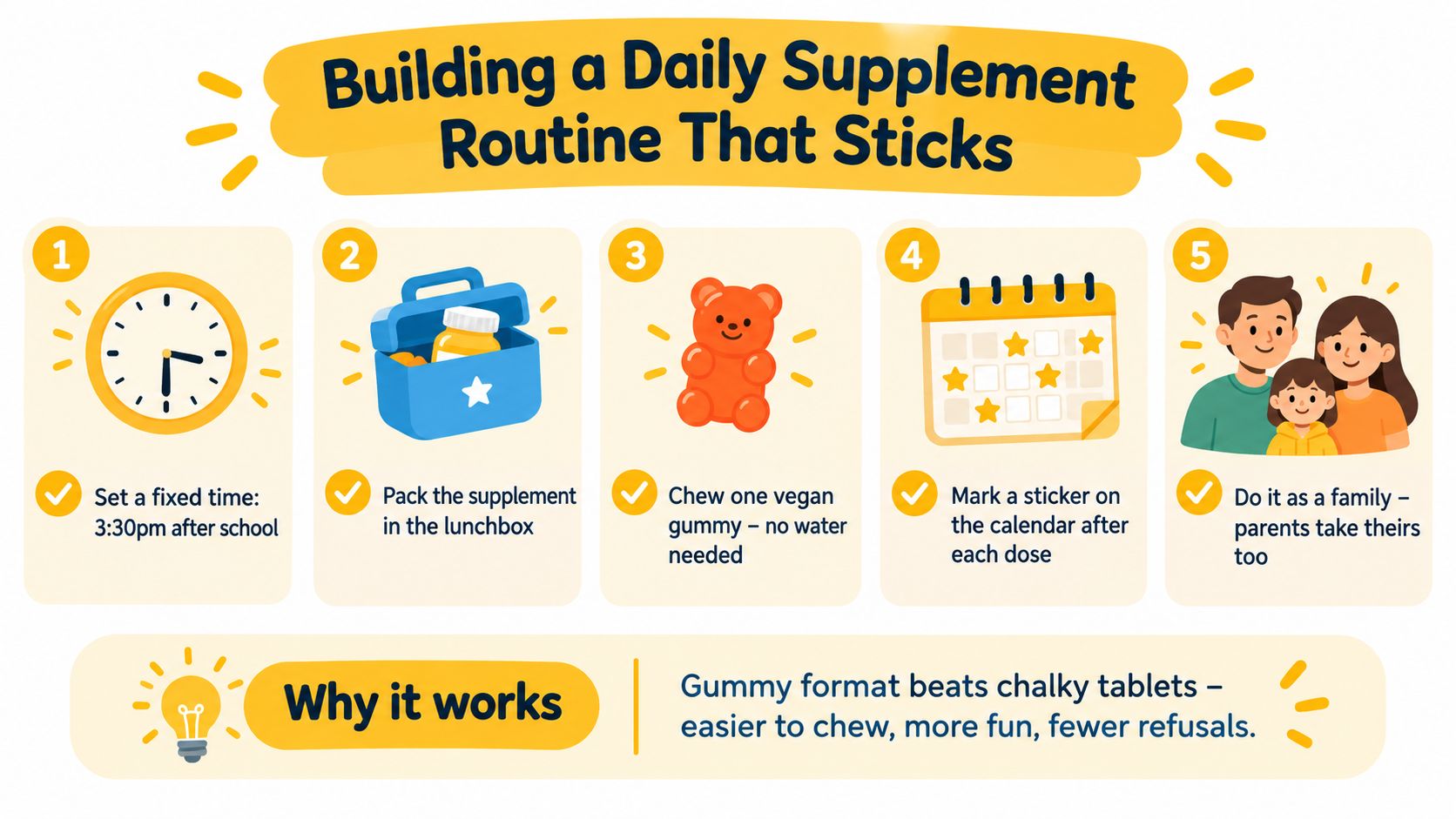
A supplement routine works much like seatbelts, toothbrushes, or school hats. It sticks when it's attached to something the family already does. It usually falls apart when it relies on memory alone.
Make the habit smaller than your intention
The most successful routines are almost boring. Same time. Same place. Same cue. That might mean after breakfast, after school, or during the evening wind-down. Children do well when the step is predictable and low-friction.
Good anchors include:
- Breakfast anchor if mornings are structured and one parent is always present.
- After-school anchor if afternoons are calmer and you can supervise it.
- Toothbrushing anchor if you want the habit tied to an existing routine.
The exact time matters less than repeatability.
Use the child's cooperation, not just your reminders
A routine lasts longer when the child feels part of it. Let them tick off a visual chart, choose whether they take it before or after breakfast, or keep the jar in a familiar family spot that signals “this is part of our day”.
Some children respond well to identity-based language. “This is your after-school routine” can work better than “Don't forget your vitamin.” It changes the tone from nagging to participation.
One example of a habit-friendly format is Focus, a vegan, sugar-free blueberry-flavoured gummy with vitamin D3, zinc, elderberry, prebiotics and mushroom polysaccharides, with directions to take 2 gummies daily. In the same broader range, Brave is described as a vegan daily multivitamin gummy for growing kids in orange flavour with no sugar and no artificial colours or flavours. These examples are useful because they show how some products are built around routine acceptance as much as nutrient delivery.
Protect the routine from the most common failure point
The biggest practical problem is often simple. Families run out.
If a supplement suits your child and you plan to use it daily, automated delivery options, flexible pause or skip controls, and a visible reorder rhythm can reduce gaps. This isn't about buying more than you need. It's about preventing the stop-start pattern where a good habit disappears for a fortnight because nobody reordered in time.
Keep the supplement where the routine happens, not where it gets stored. Daily habits survive in visible places.
What consistency really gives you
Consistency doesn't make a supplement more powerful. It makes your plan more reliable.
A chewable gummy that a child accepts willingly may do more for real-world intake than a theoretically perfect tablet that leads to daily resistance. That's the hidden part of supplement choice many labels never mention. Adherence is part of the nutrition strategy.
Choosing With Confidence and Next Steps for Parents
A useful vegan kids multivitamin does two jobs well. It helps cover the nutrients most likely to be low in a vegan diet, and it fits into family life without becoming another point of friction.
If you're deciding what to buy, keep your checklist short. Check whether your child regularly uses fortified foods. Look for clear B12 coverage first, then see whether the product also addresses other likely watch-points such as vitamin D. Read the sweetener and ingredient list with the same care you give the nutrient panel. Then ask the most practical question of all: will this be taken every day?
A low-stress next step looks like this:
- Choose one product with transparent dosing for your child's age.
- Trial it within a fixed routine for a few weeks.
- Track adherence, not perfection. You're looking for consistency.
- Review the wider diet including fortified plant milks and usual food intake.
- Speak with your GP, paediatrician, or dietitian if your child's diet is very limited, you're unsure about nutrient adequacy, or you're worried about possible deficiency.
If you're comparing brands online, practical cues such as transparent age guidance, visible ingredient lists, customer reviews, Australia-wide shipping, and a satisfaction policy can make a cautious trial feel more manageable.
Daily Powers offers Australian-made children's gummies built around everyday routines, including vegan, sugar-free options with no artificial colours or flavours and clear dosing guidance for ages 4 to 16. If you want to compare habit-friendly gummy formats for focus, calm, or general daily support, visit Daily Powers.