

It's 7:30 on a school morning. Your child has eaten two bites of toast, rejected the fortified cereal and is already asking whether the daily vitamin can be a gummy instead of a tablet. You're wondering whether a vitamin B12 gummy could help, whether the dose is suitable, and whether “energy” on the front of the bottle means it will solve tiredness or concentration problems.
Those are sensible questions. For children aged 4 to 12, the most useful way to think about vitamin B12 gummies isn't as a quick energy fix. They're better understood as a habit and compliance tool, particularly when a child has a restricted diet, struggles with tablets or needs a dependable supplement routine recommended by a healthcare professional.
Australian data gives families useful context. The Australian Bureau of Statistics National Health Measures Survey reported that 9.7% of Australians aged 2 years and over, about 2.4 million people, had an inadequate vitamin B12 intake from food and beverages in 2023. Population-level B12 status is generally adequate, but dietary shortfalls still affect a meaningful minority.
This guide will help you understand what gummies deliver, how cyanocobalamin and mecobalamin differ, why labels can show doses far above a child's daily reference intake, and when a gummy is appropriate for routine support rather than medical treatment. It'll also help you check the label without treating a pleasant-tasting supplement like confectionery.
Table of Contents
- Introduction to Vitamin B12 Gummies for Families
- What Vitamin B12 Gummies Are and How They Work
- Understanding B12 Forms Found in Gummies
- Benefits of Vitamin B12 Gummies for Children
- Appropriate Dosing for Ages 4 to 12 and How to Read the Label
- Vegan Diets Picky Eating and Building a Consistent Routine
- Choosing Safe Quality Gummies and Next Steps for Parents
Introduction to Vitamin B12 Gummies for Families
A B12 gummy is a supplement containing vitamin B12 in a chewable format. The format matters because children often accept a soft, flavoured gummy more readily than a large tablet or a liquid with an unfamiliar taste. If a supplement sits untouched in a cupboard, its carefully chosen ingredients don't help much. A routine your child can follow is more useful than a theoretically perfect product that they refuse.
That doesn't mean gummies are automatically necessary. Children can obtain B12 through foods such as meat, fish, eggs and dairy, while fortified foods and supplements can provide a dependable source for children whose diets exclude or limit those foods. Plant foods don't naturally provide reliable B12, so a child following a vegan diet needs a planned source rather than hope that occasional vegetables will cover the gap.
The important distinction is between supporting intake and treating deficiency. A gummy may make daily supplementation easier, but it can't diagnose why a child is tired, pale, unsteady or struggling with concentration. Those symptoms can have many explanations, and a blood test may be needed when deficiency is suspected. Guidance from the Royal Children's Hospital on vitamin B12 deficiency also distinguishes lower-risk oral treatment from situations where injections are preferred.
Practical rule: Choose a gummy because it improves a reliable routine, not because the word “energy” promises an instant change in behaviour.
You'll also need to look beyond the front label. The B12 form, amount per daily serve, recommended age, other supplements in the household and product storage instructions all affect the decision. By the end, you should be able to ask a more useful question than “Which gummy is strongest?” You'll be asking, “Does this product provide an appropriate, transparent and manageable way to meet my child's needs?”
What Vitamin B12 Gummies Are and How They Work
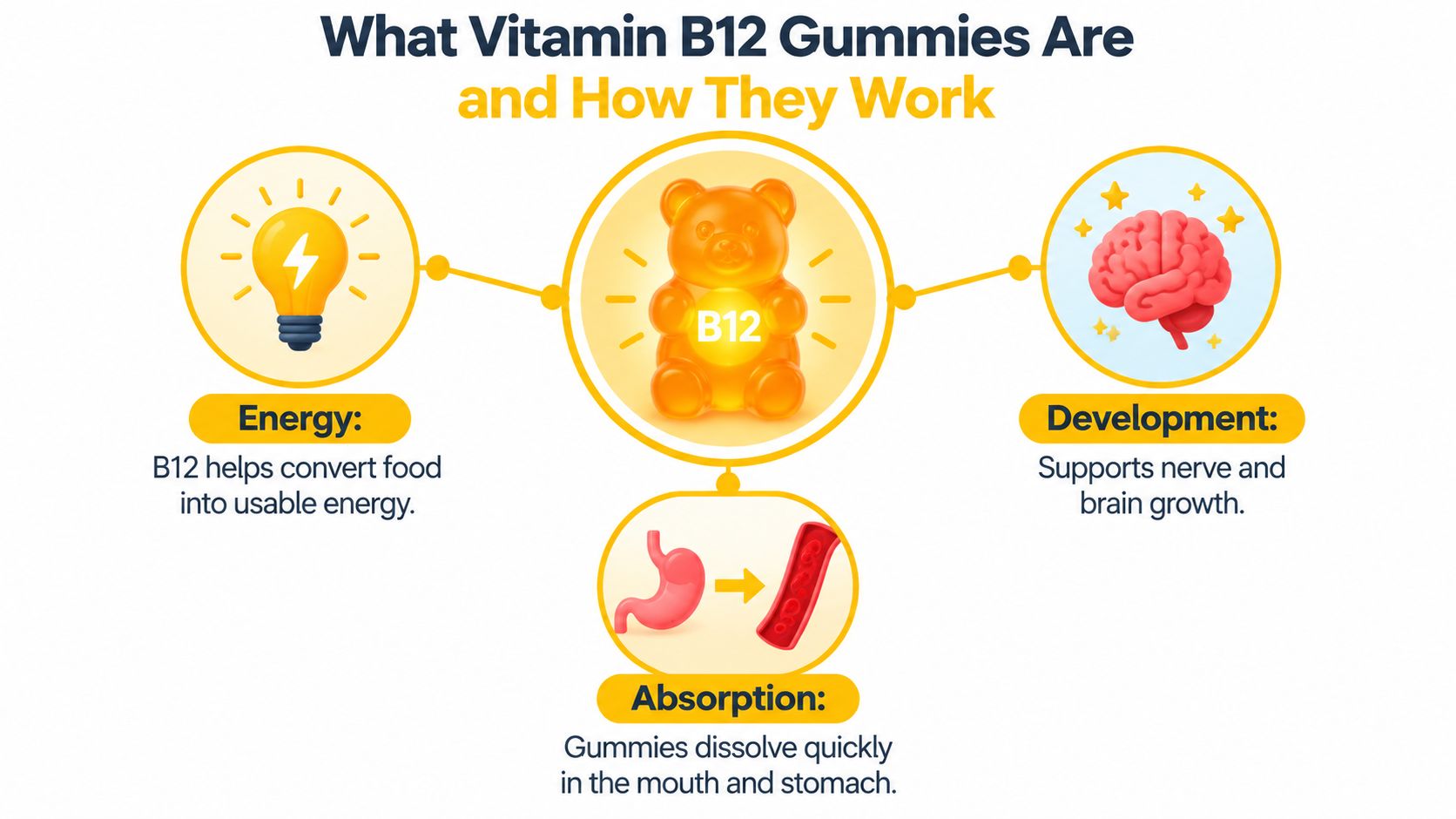
Think of vitamin B12 as part of the body's maintenance crew. It helps with processes involved in making red blood cells, supporting nerves and handling normal development. It doesn't act like a battery that gives a child extra energy on demand. Instead, adequate B12 helps the body carry out essential work, while a child who already has enough usually won't become more energetic by taking more.
A gummy is the delivery vehicle. It holds a measured amount of B12 in a form a child can chew, swallow and associate with an established daily event, such as breakfast or brushing teeth. That makes the format behaviourally useful, but the gummy still has to meet requirements for composition, labelling and quality.
Absorption is where many labels become confusing. The body has regulated pathways for taking up B12, and oral absorption is limited. The Royal Children's Hospital guidance describes oral B12 forms as less well absorbed, approximately 0.5% to 4%, depending on the circumstances. Manufacturers may therefore use a large labelled amount even though the Australian dietary reference intake is small. A large number on the label doesn't automatically mean the product is intended to replace medical treatment.
Why gummies aren't just lollies
Gummies can contain moisture-sensitive vitamins, so the manufacturer needs to protect dose consistency across shelf life. In Australia, a B12 gummy that makes health claims is treated as a therapeutic good, not an ordinary lolly. An ARTG entry for a multinutrient B12 gummy shows how such a product can list several active ingredients, including cyanocobalamin and other B vitamins, under Australia's therapeutic-goods framework.
That classification affects the product's formulation, directions and sponsor responsibilities. Parents should still keep the bottle out of reach and follow the stated serving, because a child may interpret a sweet flavour as permission to keep eating.
Some products sit near the broader wellbeing category rather than providing B12 specifically. For example, Focus is described as a sugar-free, vegan children's gummy containing mushroom polysaccharides, vitamin D3, zinc, elderberry and prebiotics, so it shouldn't be assumed to be a B12 supplement unless the current label says so.
Understanding B12 Forms Found in Gummies
Australian labels commonly present B12 as cyanocobalamin or mecobalamin. Neither name, by itself, tells you whether a product is suitable for your child. The right choice depends on the product's directions, the child's circumstances and whether a clinician has recommended a specific form.
Cyanocobalamin is a widely used form in supplements and appears in Australian therapeutic-goods listings. Mecobalamin is another name families may see, particularly after Australia's labelling change. The Australian regulatory update reported by NutraIngredients states that, after the transition period ended on 30 April 2026, products containing B12 in this form must use only the name “mecobalamin” on the label from 1 May 2026.
That change is about precise naming, not a universal instruction that every child should switch products. Clear naming helps parents identify what they're buying and helps manufacturers keep labels consistent.
Cyanocobalamin versus mecobalamin in gummies
| Feature | Cyanocobalamin | Mecobalamin |
|---|---|---|
| What parents may notice | A familiar name on many supplement labels and ARTG entries | The required label name for this form after the Australian transition period |
| Practical interpretation | Often used for routine supplementation when the product is age-appropriate and professionally suitable | May be selected when a clinician or product formulation specifically uses this form |
| How to decide | Check the full ingredient panel and daily serve rather than judging by name alone | Treat the name as an identification detail, not proof that it's automatically better |
| When medical advice matters | Essential if deficiency, malabsorption or neurological symptoms are present | Essential for the same reasons, regardless of the form named |
A label that says “vitamin B12” without identifying the form gives you less information than one that names the ingredient. If your child has a diagnosed deficiency, neurological symptoms or a condition affecting absorption, don't choose between forms based only on marketing language. Ask the treating healthcare professional which form and route are appropriate.
Benefits of Vitamin B12 Gummies for Children
A child may push away a tablet but accept a soft, sweet gummy after breakfast. For families, the main benefit is reliable delivery. A chewable format can make a planned routine easier to follow, especially for children aged 4 to 12 who eat little animal-derived food, follow a vegan diet or accept only a narrow range of foods.
Vitamin B12 supports normal body functions, including red-blood-cell formation and nervous-system function. As noted earlier, ABS data indicates dietary inadequacy affects a meaningful minority, even though adequate B12 status is common at population level. The reported measurements describe groups, not a diagnosis for an individual child aged 4 to 12.
What a gummy can and can't promise
A child with adequate B12 should not be expected to become more focused, happier or more energetic because a gummy contains a high dose. Tiredness or attention difficulties may relate to sleep, illness, emotional wellbeing, overall dietary intake, iron status, learning needs or another health issue. Treating a gummy like an “energy switch” can delay finding the cause.
A pleasant routine can improve consistency. It can't replace an assessment when symptoms point to a possible deficiency.
Confirmed deficiency changes the purpose of supplementation. Royal Children's Hospital clinical guidance notes that injections are preferred for infants and children with neurological involvement, while oral treatment may suit lower-risk older children and adolescents without malabsorption. Format and clinical context matter, so a gummy used for routine intake support is not automatically a treatment for deficiency.

A gummy may suit maintenance or intake support when its label matches the child's age and a healthcare professional has no concerns about its use. It is a poor choice for self-treating persistent tiredness, tingling, weakness, balance changes or other symptoms that need investigation. In those situations, the priority is assessment, not a sweeter delivery format.
Appropriate Dosing for Ages 4 to 12 and How to Read the Label
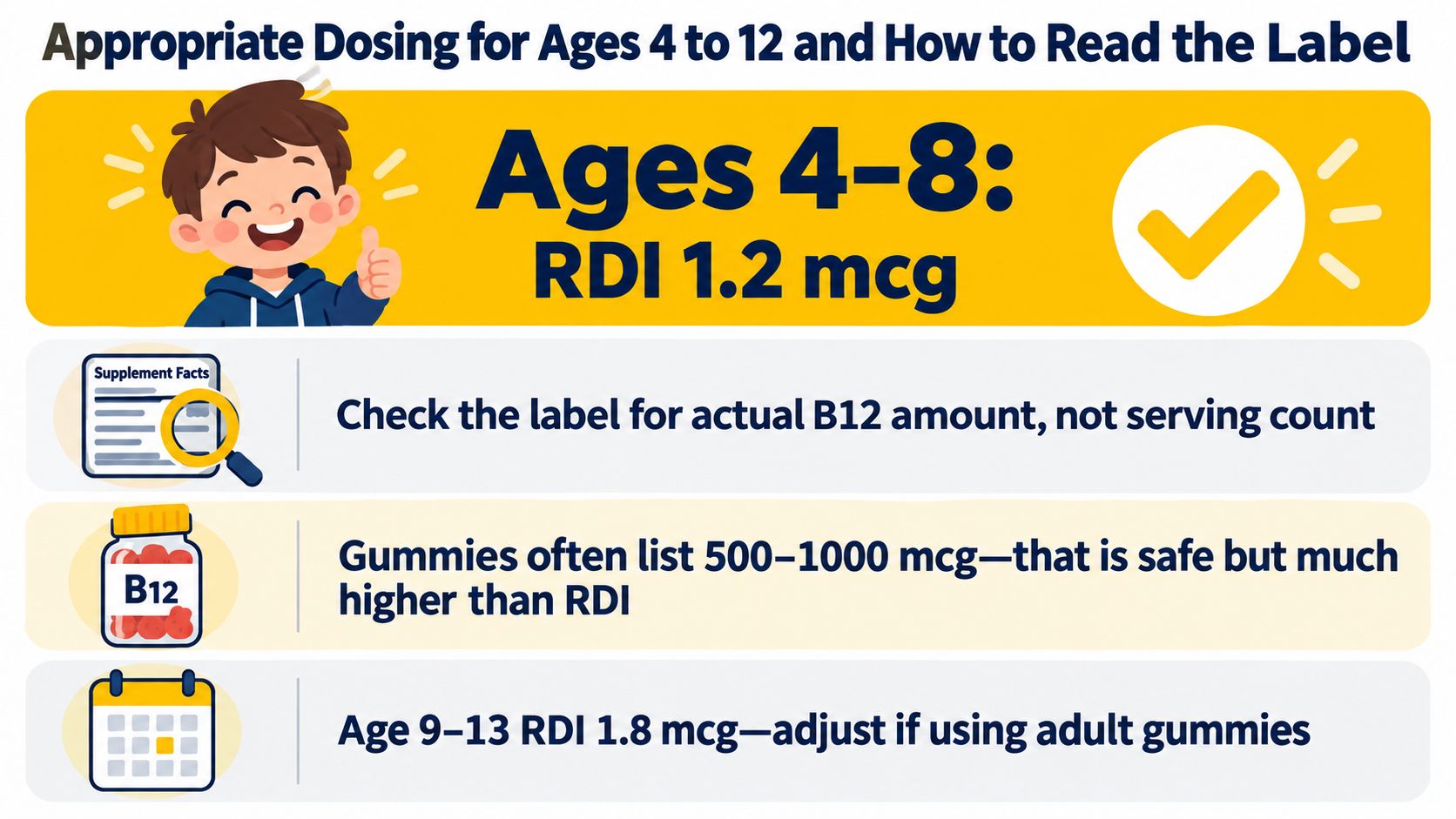
The Australian nutrient reference values help explain why B12 gummy labels can look startling. The RDI is 1.2 micrograms per day for children aged 4 to 8 and 1.8 micrograms per day for ages 9 to 13, according to the Australian Government nutrient reference values. These are dietary reference values, not instructions to divide a gummy into a matching number.
Many Australian gummy products use a much larger oral dose because B12 absorption is limited. One Australian therapeutic-goods listing gives 500 micrograms per pastille and 1,000 micrograms per daily adult serve, as shown in the TGA ARTG record. That label illustrates the difference between a child's daily nutritional requirement and the amount a manufacturer may place in an oral supplement.
Read the label in this order
- Start with age suitability. Check whether the product is designed for your child's age. Don't assume an adult product is appropriate because the gummy looks small.
- Find the daily serve. A bottle may state an amount per gummy and a different amount per serving. Work out the total B12 your child receives from the recommended daily serving, then follow the directions rather than improvising.
- Check every supplement in the routine. A children's multivitamin, a separate B12 product and fortified foods may all contribute to intake. Write down the products and show the list to your pharmacist or healthcare professional if you're uncertain.
- Identify the form. Look for cyanocobalamin or mecobalamin, not just a broad front-label phrase such as “B12 support”.
- Keep the product separate from treats. Store it according to the pack directions and supervise use.
The Australian reference values note that there are insufficient data to set a tolerable upper intake level for B12. That doesn't make unrestricted self-dosing sensible. A high-dose gummy may be designed around absorption, but children still need age-appropriate directions and a clear reason for taking it. For a fuller Australian overview of supplement considerations, see this guide to vitamin B12 supplements in Australia.
Vegan Diets Picky Eating and Building a Consistent Routine
A vegan child can eat a varied, nourishing diet and still need a dependable B12 plan. Plants don't naturally provide a reliable source of B12, so families generally need fortified foods, a supplement or guidance from a dietitian or healthcare professional. A picky eater may face a different version of the same problem, especially when accepted foods exclude most fortified products and animal-derived sources.
The practical challenge is rarely understanding that B12 matters. It's remembering the supplement, getting the child to accept it and avoiding a routine that turns breakfast into a daily argument. A gummy can help because it gives the habit a visible cue, a consistent texture and a predictable moment in the day.

Build the habit around an existing event
Choose one repeatable anchor, such as after breakfast, and keep the bottle in a safe, dry place nearby. Let your child help place a sticker on a calendar or choose whether the routine happens before or after packing the school bag. The aim isn't to make the gummy a reward. It's to make taking the planned serve as ordinary as washing hands before eating.
A sugar-free, vegan gummy may fit families looking for an option that aligns with dietary preferences, but “vegan” doesn't confirm that the product contains B12. Read the active ingredient panel every time, especially when comparing a B12-only supplement with a broader children's multivitamin. The vitamins for fussy eaters guide can also help families think about supplement routines alongside food acceptance.
The same principle applies to products aimed at concentration or wellbeing. A child who needs B12 shouldn't be given a non-B12 gummy as a substitute, and a child with attention concerns shouldn't be assumed to have a vitamin problem. Keep the product's purpose clear in your own mind and in the language you use with your child.
Seek professional advice when your child follows a strict vegan diet without a reliable B12 source, eats an extremely limited range of foods, has ongoing symptoms or has a condition that may affect absorption. A routine can support consistency, but it shouldn't hide a nutritional gap that needs assessment.
Choosing Safe Quality Gummies and Next Steps for Parents
Use the label as a decision tool rather than judging the product by its flavour or the size of the gummy. Australian families can work through this short checklist before buying:
- Confirm the active ingredient. Make sure the product contains vitamin B12 and names its form, such as cyanocobalamin or mecobalamin.
- Check the daily serve. Compare the amount per gummy with the amount per recommended serving, then check the child's age directions.
- Look for complete disclosure. The pack should identify active ingredients and provide clear instructions. If the information is vague, ask a pharmacist before purchase.
- Check the regulatory status. Products making health claims may be therapeutic goods, so look for the relevant Australian regulatory information and ARTG details supplied by the sponsor.
- Review the whole routine. Add up B12 from other supplements rather than layering products casually.
- Consider the household fit. Vegan ingredients, no added sugar and an accepted flavour may help a child follow the routine, but these features don't determine whether B12 is medically needed.
- Store it responsibly. Follow the storage instructions, supervise each serve and keep gummies away from children when they aren't being used.
The TGA regulatory information for complementary medicines can help you understand why label wording and sponsor responsibilities matter. For broader guidance on selecting children's gummy supplements, see this Australian resource on kids' vitamin gummies.
Contact a GP, paediatrician, dietitian or pharmacist if you're worried about persistent fatigue, weakness, tingling, balance changes, restricted eating or a diagnosed deficiency. A professional can decide whether testing is needed and whether an oral gummy, another supplement form or medical treatment is appropriate.
Daily Powers offers children's gummy supplements designed around everyday routines, including vegan, sugar-free formulations with no artificial colours or flavours. Visit Daily Powers to review the ingredient lists and age guidance, then discuss any B12 or deficiency concern with your healthcare professional before starting a product.