

You're standing in an Australian pharmacy aisle, or scrolling through an online shop after the school run, comparing B12 labels that all seem to promise the same thing. One bottle lists a small daily amount, another displays a much larger number, and a third is a children's gummy with a long ingredient list. The question sounds simple, but it isn't: does your child need vitamin B12, and how much will their body absorb?
For families eating vegan or mostly plant-based diets, children with restricted food choices, or households managing a diagnosed deficiency, the answer depends on more than the number printed on the front of a bottle. This guide explains how B12 works, why label doses can mislead, when testing matters, and how to build a safe routine around vitamin B12 supplements in Australia.
Table of Contents
- Why Vitamin B12 Matters for Australian Families
- The Absorption Gap That Makes Label Doses Misleading
- Recognising B12 Deficiency Signs in Children
- Choosing the Right B12 Formulation for Your Family
- Buying B12 Supplements Safely Online in Australia
- Building a Consistent Daily Supplement Routine
- Key Takeaways for Confident B12 Supplementation
Why Vitamin B12 Matters for Australian Families
Before school, a child may eat toast, fruit and a fortified plant drink, then leave for the day. Their parent may remember that vitamin B12 supports energy, yet still wonder whether a supplement is needed when the child appears healthy and active. That question is easier to answer by looking at diet, health history and the child's B12 source together.
B12 supports nerve function, healthy red blood cell formation and energy metabolism. It works like a maintenance component for the body's nerve wiring, oxygen-carrying system and cellular processes that convert food into usable energy. B12 is not a stimulant, so a supplement should not be used as a general treatment for tiredness when a child already has adequate B12 status.
Australian nutrient reference values give healthy adults a recommended intake of 2.4 micrograms per day, rising to 2.6 micrograms during pregnancy and 2.8 micrograms during lactation, as described in an Australian review of B12 supplementation adequacy. Children have age-specific requirements. Applying an adult target automatically can therefore give parents a misleading starting point, particularly when choosing a product for a younger child.

Why diet deserves attention
Vitamin B12 occurs naturally mainly in animal-derived foods. Plant foods are not reliable sources unless fortified, so a child who avoids meat, fish, eggs and dairy needs a dependable plan using fortified foods, a supplement, or both. Australian guidance recommends that people following vegan diets include a B12 supplement, according to the Australian dietary survey published in Nutrients.
A high-dose product is not automatically the right family choice. Parents should consider the child's dietary pattern, fortified-food intake, medical history, symptoms and how consistently the chosen product can be used. Questions about B12 may arise alongside information about immune support supplements, but B12 needs separate consideration because intake and absorption differ between people.
Practical rule: A carefully planned diet can still require a reliable B12 source when it does not regularly provide absorbable B12.
Evidence from Australian adults also shows why diet alone may not reveal someone's B12 status. In a Tasmanian residential aged-care study, 18 of 130 residents were deficient, a prevalence of 14% using a serum B12 cut-off below 150 pmol/L. A further 47 residents, or 36%, were in the equivocal 150 to 250 pmol/L range, as reported in the Australian clinical guidance on vitamin B12 deficiency. These figures concern older adults, not children. They still show why a person's food choices do not always describe their B12 status fully.
The Absorption Gap That Makes Label Doses Misleading
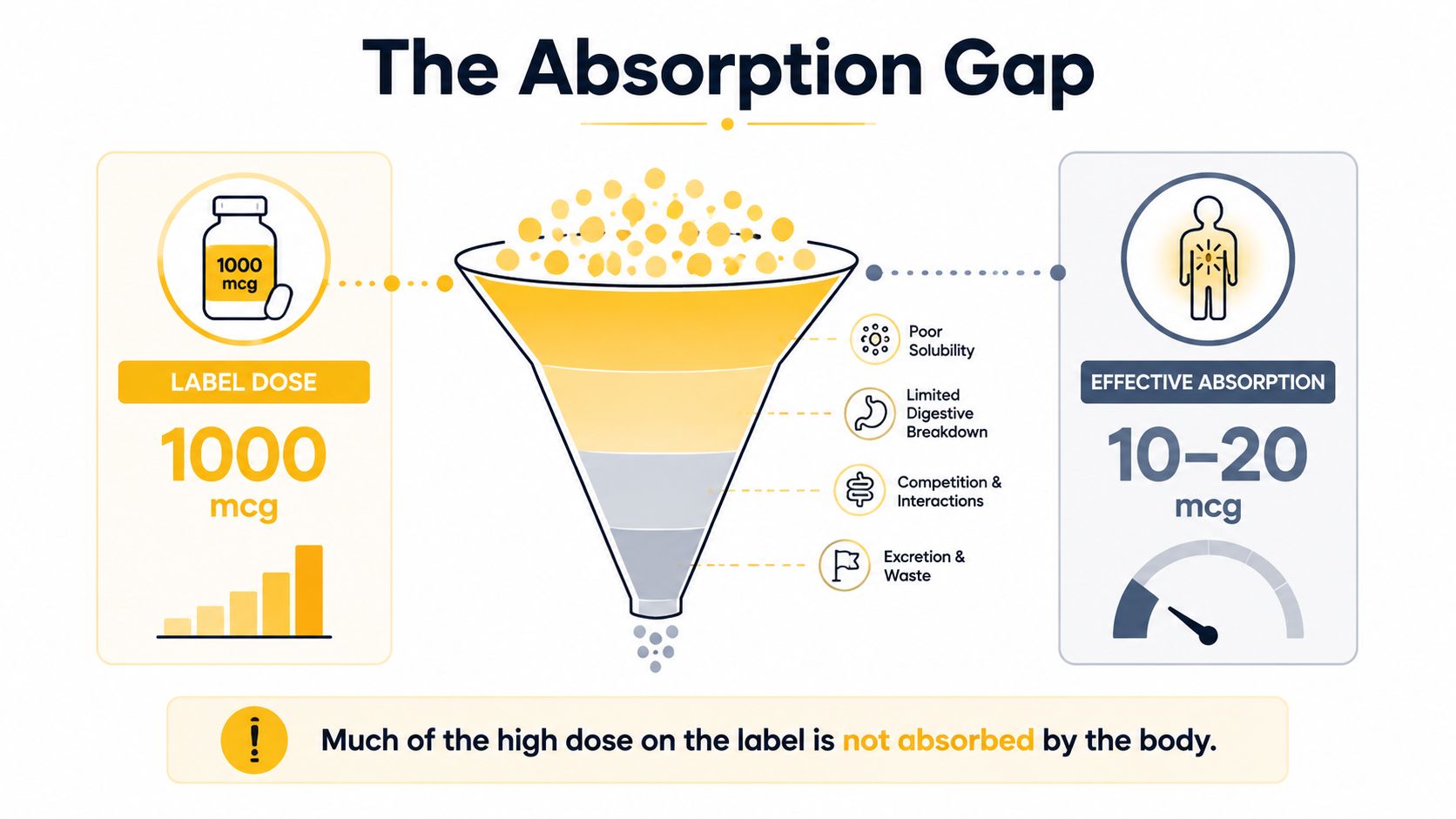
A parent may compare two B12 products and choose the one with the larger microgram figure. The label shows how much B12 is in the tablet or gummy, though not necessarily how much reaches the bloodstream. This absorption gap is one of the easiest parts of vitamin B12 supplements in Australia to miss.
B12 in food usually depends on stomach acid and intrinsic factor, a protein that carries B12 through the small intestine. Supplements can also enter the body through passive diffusion. That route does not rely entirely on intrinsic factor, but only a small proportion of a large oral dose is absorbed. A high-dose product can therefore contain much more B12 than the body ultimately takes up.
Australian evidence in vegan adults describes passive absorption as roughly 1% of a 1000 microgram oral dose, as detailed in a 2024 review of B12 supplementation and malabsorption. The absorbed amount varies with biology, the product, timing and the reason for low B12. The practical message is straightforward: 1000 micrograms on the label doesn't mean 1000 micrograms enters the bloodstream.
Why the Australian survey matters
A 2022 survey of Australian women following vegan diets showed why absorbed intake can give a different picture from ordinary intake. Thirty-nine per cent had B12 intake below RDI equivalency when researchers calculated absorbed amount, compared with 26% using mean daily intake alone, according to the Australian Nutrients study.
For families, this changes how products should be compared. A large number on the front of a pack does not automatically mean better coverage. Parents can ask:
- What form is used? Australian best-practice discussion identifies cyanocobalamin as the preferred form for general supplementation.
- Is the dose appropriate for the child? Adult and clinical-treatment doses should not be copied into a child's routine without professional advice.
- Can the child take it consistently? A suitable product has little practical value if the child regularly refuses it.
- Could absorption be affected? A GP may suggest a different dose or treatment plan when malabsorption or clinically significant deficiency is suspected.
The review estimated that about 5 micrograms per day might theoretically match the adult RDI through one daily oral dose in people with normal absorption. It also described a weekly 1000 microgram dose on an empty stomach as a theoretical way to meet adult needs. These adult examples explain the absorption gap, not a child's dosing instructions. Families should follow the product directions and seek advice from a GP or paediatric dietitian.
A product such as Focus contains vitamin D3, zinc, elderberry, mushroom polysaccharides and prebiotics, but it isn't a B12 supplement. This distinction matters when parents compare children's products. A pleasant gummy routine may make daily use easier, while the label still needs checking for the specific nutrient the child requires.
Recognising B12 Deficiency Signs in Children
B12 deficiency can be difficult for parents to identify because many possible signs overlap with ordinary childhood experiences. A tired child may have had poor sleep. A student who struggles to concentrate may be anxious, distracted or finding schoolwork difficult. A toddler with a small appetite may be selective. These possibilities don't rule out B12 deficiency, but they do mean symptoms shouldn't be used to diagnose it at home.
Signs worth discussing with a clinician
The pattern matters more than one isolated symptom. Pay closer attention when a concern persists, appears alongside a restrictive diet, or involves development, movement or neurological function.
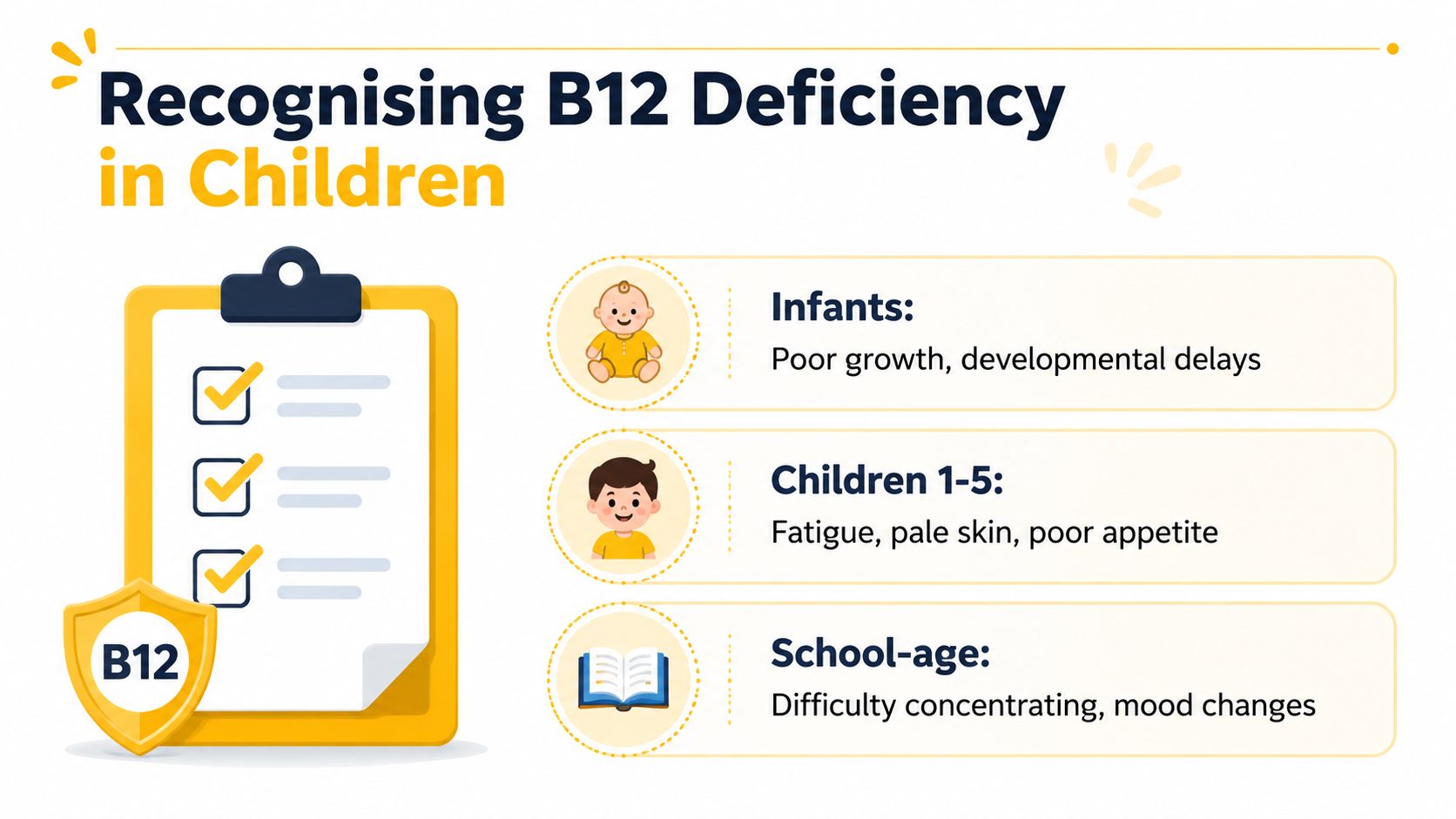
- Infants: Poor growth or developmental delay warrants prompt medical assessment, particularly when the diet is highly restricted or the breastfeeding parent has a known B12 risk.
- Young children: Fatigue, pale skin, poor appetite, weakness or changes in development deserve a GP conversation rather than an assumption that the child is fussy or tired.
- School-age children: Difficulty concentrating, unusual mood changes, persistent tiredness, tingling, numbness, balance difficulties or a noticeable decline in usual function should be assessed.
A blood result below 150 pmol/L is the clinically significant deficiency threshold used in the guidance cited for Australian practice. Results between 150 and 250 pmol/L are considered equivocal, so the number needs to be interpreted alongside symptoms, diet and medical history. The same guidance uses these ranges to distinguish clear deficiency from a result that may need further clinical consideration.
Testing or supplementing first
The right next step depends on the child. Testing is particularly important when symptoms are concerning, the child has a medical condition that may affect absorption, a clinician suspects deficiency, or treatment needs to be monitored. A GP may also consider other blood tests because fatigue and concentration changes have many causes.
Australian clinical guidance notes that the Medicare Benefits Schedule was updated in July 2025 to clarify B12 testing pathways and limit unnecessary repeat testing to once every 11 months for total B12, active B12, methylmalonic acid and homocysteine, as described by Healthdirect's vitamin B information. This isn't a reason to avoid testing. It's a reminder that repeat tests should have a clinical purpose.
Seek prompt medical care if suspected low B12 occurs with neurological symptoms such as tingling, numbness, balance problems or marked developmental change.
A clinician can decide whether an empiric supplement is reasonable while assessing the cause, or whether a blood test should come first. Don't use a child's response to a supplement as proof that B12 was the cause of a symptom.
Choosing the Right B12 Formulation for Your Family
Once a family decides that supplementation needs consideration, the product format becomes a practical decision. The “best” option is usually the one that matches the child's clinical needs, can be measured accurately, and will be taken reliably under adult supervision.
Australian guidance favours cyanocobalamin as the preferred form for general supplementation. Mecobalamin, also called methylcobalamin, is another form used in registered products and clinical settings. A GP or pharmacist can help determine whether a particular form is appropriate, especially when a child has confirmed deficiency, neurological symptoms or malabsorption.
A practical comparison
| Formulation type | Best for | Key considerations |
|---|---|---|
| Cyanocobalamin | General supplementation when advised by a clinician | Preferred in the Australian review for best practice; check the child's age guidance and dose |
| Mecobalamin | Families using a product that contains this registered form | Confirm the indication, formulation and dose with a health professional |
| Tablet or lozenge | Older children who can manage solid doses | Easy to store and measure by label, but taste and swallowing may reduce consistency |
| Liquid | Children who need flexible administration | Check measuring instructions carefully and store it as directed |
| Gummy | Children who resist tablets and can safely chew the product | Check sugar, allergens, serving size and whether it contains B12 rather than unrelated nutrients |
| Higher-dose oral product | Clinically advised treatment or situations involving limited absorption | High doses may be used because only a fraction is absorbed; don't choose treatment-level dosing independently |
| Lower-dose product | Routine supplementation where dietary intake and clinical advice support it | A smaller label number isn't automatically inadequate, but the full diet and absorption context matter |
A 2024 review states that people with malabsorption typically require 1000 to 1500 micrograms per day orally, while severe or clinically manifested deficiency may require 1000 to 2000 micrograms per day orally or 1000 micrograms intramuscularly on a loading or maintenance schedule, according to the clinical review on oral B12 treatment. Those are clinical figures, not a shopping recommendation for children.
Make the choice fit real life
Check whether the product is suitable for the child's age, vegan requirements, allergies, texture preferences and ability to take it safely. A parent should also compare the complete ingredient panel, not just the B12 amount. If you're weighing a gummy format against a tablet, the guide to choosing children's vitamins can help frame the broader questions around formulation and routine.
Buying B12 Supplements Safely Online in Australia
Online shopping can make it easy to compare products, but a polished product page doesn't prove that a supplement meets Australian requirements. In Australia, vitamin B12 products are regulated as medicines rather than general foods. The Therapeutic Goods Administration requires compliant products to be entered on the Australian Register of Therapeutic Goods, or ARTG, before supply.
The TGA records an oral B12 medicine with ARTG ID 371099 and mecobalamin as an ingredient. You can check the TGA ARTG entry for registered oral B12 medicine when evaluating what registration information should look like. Registration alone doesn't mean a product is right for your child, but it provides an important regulatory checkpoint.
Four checks before you buy
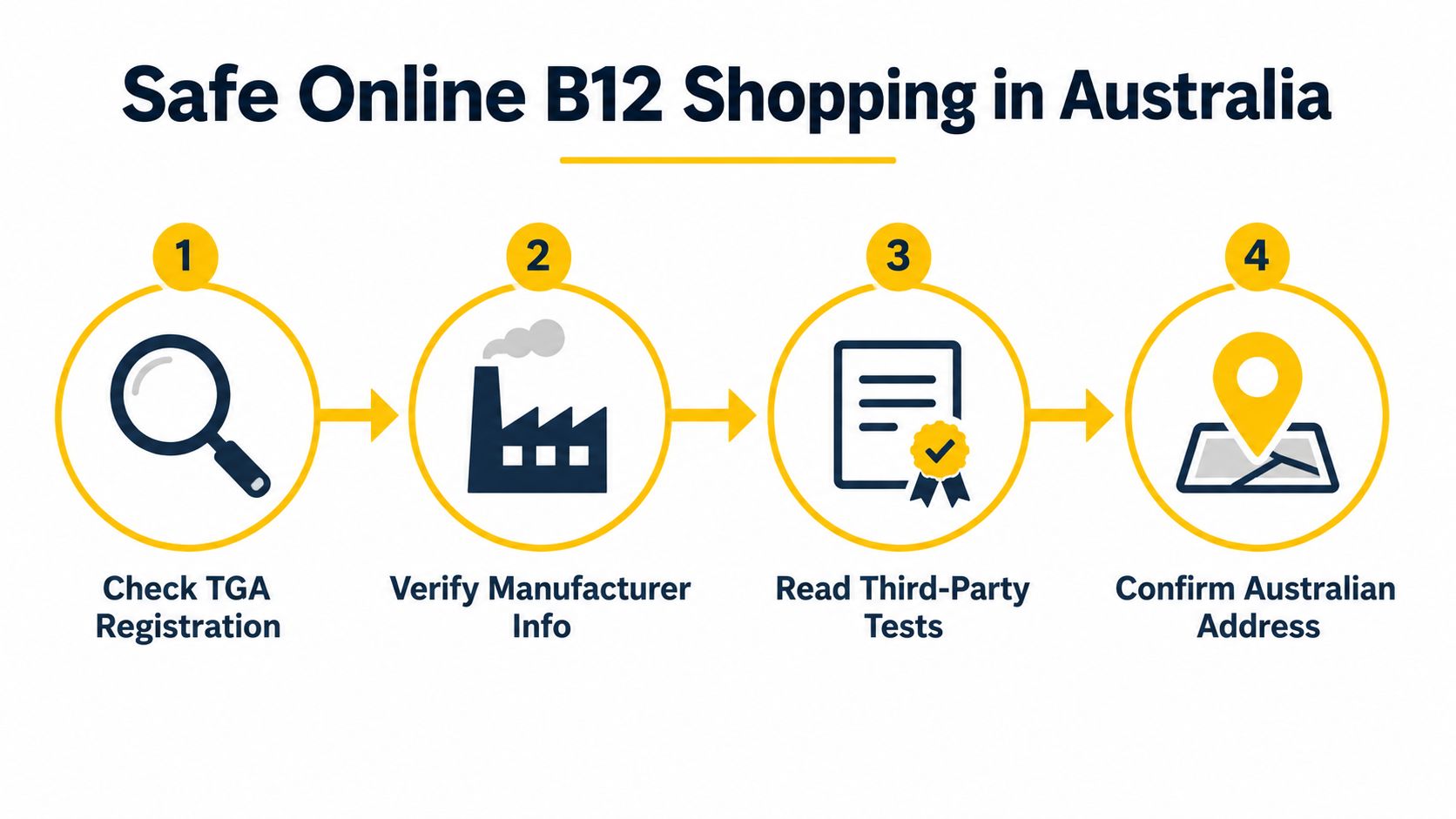
- Check the ARTG details. Look for an ARTG number and confirm that the product name, sponsor and active ingredient match the listing. Be cautious if the seller provides no clear Australian regulatory information.
- Read the complete label. Confirm the B12 form, amount per serving, recommended age, directions and other active ingredients. Transparent labelling helps you check allergens and avoid unintentionally combining overlapping supplements.
- Assess the seller. Look for an identifiable Australian business address, customer service contact and clear returns information. A marketplace listing with limited manufacturer details deserves extra scrutiny.
- Treat reviews as practical information. Reviews may help you understand taste, texture, packaging and whether children accept the product, but they can't establish that a product treats deficiency or is clinically suitable.
Subscription delivery can help prevent a household from running out, provided the service clearly explains its pause, skip and cancellation terms. Satisfaction guarantees may reduce the practical risk of trying a format, but they don't replace checking ingredients, age suitability or ARTG information.
Buying rule: Verify the product and the seller before you compare flavour or delivery convenience.
Building a Consistent Daily Supplement Routine
A supplement left in a cupboard can't support a child's routine. Families often miss doses because mornings are rushed, the product runs out, or the child dislikes the texture. The solution usually isn't a more complicated schedule. It's a visible cue attached to something that already happens every day.
Choose one reliable moment, such as breakfast or brushing teeth, and keep the product in a safe, supervised place. Don't leave gummies where young children can help themselves, and follow the serving directions rather than treating them like confectionery.
Let the routine feel predictable
Children often cooperate better when they understand what happens next. You might say, “After breakfast, it's supplement time,” then let the child choose whether to take it before putting on shoes or after packing the school bag. That choice gives the child ownership without handing over control of the dose.
A soft texture, acceptable flavour and sugar-free formulation may reduce resistance, but these features don't make a product suitable by themselves. The formulation still needs to contain the intended nutrient, match the child's age and fit the advice you've received. Daily Powers' children's gummy routine guide offers ideas for making supplement time more predictable.
Use a simple household check:
- Keep a visible reminder: Put a calendar or tick sheet near the routine, not beside the child's supplements if that creates an access risk.
- Plan for interruptions: Decide what happens on weekends, holidays and sleepover mornings.
- Reorder before the last serving: A subscription can reduce forgotten reorders, but review the delivery settings regularly.
- Avoid doubling up: If a dose is missed, follow the product directions or ask a pharmacist rather than automatically giving extra.
The aim is a calm, repeatable habit. If the routine creates daily conflict, speak with your pharmacist or dietitian about a different format.
Key Takeaways for Confident B12 Supplementation
Vitamin B12 decisions become clearer when you separate intake from absorption. A large label dose isn't the same as a large absorbed dose, and the Australian evidence shows that calculating absorbed intake can change whether a vegan diet appears to meet needs.
For general supplementation, Australian best-practice discussion favours cyanocobalamin, while higher oral doses may be used clinically when absorption is limited. Children shouldn't be given adult treatment schedules without advice from a GP, pharmacist or paediatric dietitian.
Persistent fatigue, pale skin, poor appetite, concentration changes, mood changes, developmental concerns, tingling or balance problems deserve proper assessment. A result below 150 pmol/L indicates deficiency in the cited guidance, while 150 to 250 pmol/L needs clinical interpretation.
Before buying online, verify the ARTG information, active ingredient, age directions, full ingredient list and seller details. Then choose one safe, manageable routine and supervise every dose.
Start today by checking your child's dietary pattern and current product label. If you're unsure whether testing or supplementation comes first, book a GP appointment and take the product packaging with you.
Daily Powers offers sugar-free, vegan children's gummy formulations with no artificial colours or flavours, designed to fit consistent family routines. Visit Daily Powers to explore the range and review each product's ingredients and directions before deciding what suits your household.