

The school morning is already noisy. One child says their tummy feels tight, another refuses breakfast, and you're searching for the best gut health supplements while packing lunch and looking for missing shoes. A brightly coloured probiotic gummy may seem like an easy answer, but a label full of strains and a large CFU number doesn't tell you whether it suits your child, their symptoms, or your family's routine.
Australian families have good reason to look for practical support. A CSIRO report on gut health found that at least 50% of Australian adults experience unpleasant gut symptoms each year, while 1 in 7 experience distressing symptoms. The same report gave high-fibre whole foods stronger support than many probiotic products, whose benefits can be limited to particular strains, health problems, and doses.
This guide won't promise a miracle product or suggest that every child needs a supplement. Instead, it will help you understand the gut ecosystem, compare prebiotics and probiotics, assess gummies, capsules and powders, read a child-focused label, and build a routine that can survive school days, holidays and picky eating. The right choice is the one that fits the evidence, the child and the household.
Table of Contents
- Introduction to Gut Health Supplements for Busy Families
- Understanding How the Gut Microbiome Works
- What Science Really Says About Probiotics and Prebiotics
- Comparing Supplement Formats and How to Choose for Kids
- Safety Dosing and Ingredient Checks for Children Aged 4 to 12
- Building a Daily Routine and Smart Buying Habits
- Your Next Steps to Choosing the Best Gut Health Supplements
Introduction to Gut Health Supplements for Busy Families
A parent may begin with, “Which probiotic should I buy?” A more useful starting point is the child's situation: what are you hoping to support, and what evidence fits that goal? Occasional constipation, recovery from a restricted diet, and ongoing abdominal pain are different concerns, even when each is described as a need for “gut health”.
The best choice also depends on the wider routine. The gut community responds to what moves through it, so fibre-rich foods, fluid, movement, sleep and regular meals help shape its conditions. A supplement may provide targeted support in some circumstances, but it cannot stand in for those foundations.
A calm starting point: “Best” means best fit, not the biggest tub, sweetest flavour or highest CFU count.
The CSIRO's gut health findings help families separate a product's broad wording from the evidence behind its formula. A label saying “supports digestion” may sound universal, while research can relate to a particular strain, dose, or health concern. Parents therefore need to assess the match, rather than treating a large CFU number as proof that a product is suitable.
Format matters just as much as ingredients. A powder mixed into yoghurt may suit one child, while another may accept a capsule or chewable product. If a child refuses the taste, forgets doses, or uses it only during a difficult week, the product is unlikely to become a consistent part of the routine.
That makes “best” a family-fit decision: start with food and habits, check the child's needs, then consider a targeted product with clear expectations.
For practical guidance on children's food, habits and digestion, read this guide to gut health for kids. It can help you decide whether food-first changes are enough, whether a cautious product trial is reasonable, or whether a healthcare professional should guide the next step.
Understanding How the Gut Microbiome Works
A child's gut is not an empty container waiting for a supplement. It is more like a garden, with microbes acting as the plants, the gut providing the soil, and food supplying much of the material that helps the garden grow. A varied garden can cope with changing conditions better than a single crop. In a similar way, a diverse microbial community may respond more flexibly to everyday changes.

Four terms parents often see on labels
Probiotics are the seeds. They are live microorganisms supplied in food or supplements. Some strains have evidence for particular outcomes, but results from one strain cannot automatically be applied to every probiotic blend.
Prebiotics are the fertiliser. They are substrates that selected gut microorganisms can use. Examples include fermentable fibres such as inulin, fructooligosaccharides and galactooligosaccharides. Instead of adding more organisms, a prebiotic helps feed microbes already present.
Postbiotics are the harvest. The term describes preparations made from inanimate microorganisms or their components, including compounds produced or released by microbes. They do not depend on live organisms in the same way probiotics do. Their evidence still depends on the specific preparation and intended benefit.
Synbiotics combine seed and fertiliser. A synbiotic pairs a probiotic with a prebiotic, ideally with a clear reason for combining them. The label alone does not show that the pairing has been tested for a particular outcome in children.
Why the soil matters
Seeds added to poor soil do not automatically produce a thriving garden. Likewise, a probiotic may pass through the digestive tract without creating a lasting change when the surrounding diet and gut conditions do not support it. Vegetables, fruit, legumes, oats and other fibre-containing foods therefore remain part of the foundation, even if a family also chooses a supplement.
A product such as Focus shows how a supplement may contain a prebiotic alongside other ingredients. Its listed daily serving contains prebiotic fructooligosaccharides, mushroom polysaccharides, vitamin D3, zinc and elderberry fruit powder. Parents should judge that combination by its intended purpose, child-appropriate directions and the evidence behind each claim, rather than by one appealing word on the front of the pack.
The practical model is straightforward: microbes need an environment. Regular meals, gradually increasing variety in plant foods and a product chosen for a child's needs all matter more than chasing a large CFU number. A supplement may fit some routines, but the best choice for an Australian family is the option that matches the child, the evidence and the family's ability to use it consistently.
What Science Really Says About Probiotics and Prebiotics
A parent comparing gut health supplements may see a long list of strains, a large CFU number and words such as “advanced blend.” The more useful question is what the product is designed to do, and whether that purpose matches the child. Australian evidence, summarised in the Australian review of probiotics and prebiotics, supports starting with prebiotic-first or targeted synbiotic approach in many everyday situations. Prebiotics provide material that gut microbes can use, although their effect still depends on the specific ingredient, amount and child.

Read the label from the bottom up
High-fibre whole foods form the broadest foundation. Vegetables, fruit, legumes and oats provide fibre together with water, vitamins, minerals and other plant compounds. A supplement can add a specific ingredient, but it cannot reproduce that complete food setting.
The next level is specific prebiotic fibre, such as FOS or GOS. A named fibre gives parents more information than a vague “microbiome blend,” because it identifies what the product is intended to provide. Tolerance matters too. A fibre that suits one child may cause discomfort for another, particularly if introduced too quickly.
Probiotics require closer examination. Australian guidance notes that the preparation and dosage form should match the evidence supporting the claim. Where strain detail matters, the label should identify the relevant strain or strains. A high CFU count does not, by itself, show that a product will produce the desired outcome.
Why strain specificity changes the question
“Probiotic” describes a category, not one standard treatment. Research involving one strain, health concern and outcome cannot automatically support an unnamed mixture for general wellness. Parents should check whether the product was studied for the child's age group, the symptom being considered and the result it claims to support.
Australian consumer information shows that the category is familiar, while product choice still needs care. Retail Pharmacy Magazine's Australian consumer research reported daily or almost-daily probiotic use among 48% of respondents, probiotic supplements used by 13% of Australians, and yoghurt as the preferred probiotic format for 43% of consumers. Familiarity does not establish that every product suits every family.
A separate Australia-focused study found that 58.9% of participants were probiotic users, while about 59% of non-users said they would try probiotics if a health professional recommended them. That supports a practical approach: match the ingredient to a clear need instead of treating a large number on the label as proof of quality.
For a plain-language explanation, read what probiotic means. The key questions are simple: which ingredient, for which outcome, in which child? Those answers matter more than choosing the product with the biggest CFU figure.
Comparing Supplement Formats and How to Choose for Kids
A product may look sensible on paper and still fail during a busy school morning. A child might refuse a capsule, notice the graininess of a powder, or accept a gummy because its texture feels familiar. For children aged 4 to 12, the most suitable format is the one a caregiver can provide accurately and the child can use safely and consistently.
| Format | Best For | Adherence Advantage | Watch Out For |
|---|---|---|---|
| Gummies | Children who resist tablets or powders | Familiar texture, portable and easy to pair with a daily habit | Check sugar, sweeteners, allergens and the exact serving size |
| Capsules | Older children who can swallow them comfortably | Precise, enclosed serving and little taste | They may be unsuitable for children who cannot swallow capsules or dislike tablets |
| Powders | Families wanting to mix fibre or prebiotics into food | Flexible use in yoghurt, porridge or a smoothie | Texture, flavour, clumping and measuring errors can affect acceptance and consistency |
Match the format to the friction
A format should reduce resistance, not create a new daily struggle. If your child refuses chalky textures, a capsule could lead to arguments, while a gummy may be easier to accept. It still requires a clearly stated serving and an ingredient list that fits your household. Since it may contain sweeteners or sugar, include it in the child's overall intake rather than treating it like a freely available sweet.
Powders suit children who already eat yoghurt, porridge or smoothies. They can also make a prebiotic or fibre ingredient easier for parents to identify. The trade-off is immediate sensory feedback: children may detect a changed texture or flavour, and a rounded spoonful can exceed the stated amount. Use the supplied measure and follow the product directions.
Capsules can suit a child who dislikes taste and can swallow confidently. They are less practical for children who cannot swallow them. Do not open, crush or mix a capsule unless the product instructions or a healthcare professional confirms that doing so is appropriate.
Family-fit test: Choose the format your child will accept on an ordinary Tuesday, not only on the day you buy it.
Routine matters as much as the format. A school-day option may need to stay in its original packaging and be given at a consistent time under adult supervision. An evening powder may fit a child whose routine already includes dinner and yoghurt. The strongest choice for an Australian family is therefore a suitable ingredient in a workable format, with fewer decisions for caregivers and a routine the child can maintain.
Safety Dosing and Ingredient Checks for Children Aged 4 to 12
A busy school morning is a useful safety test. Can you quickly find the active ingredients, amount per serving, directions, age guidance, allergens and storage instructions? If the label hides details inside a proprietary blend, comparing products becomes difficult. The best gut health supplement is therefore the one with information a parent can check, not the one with the largest promise or highest CFU count.
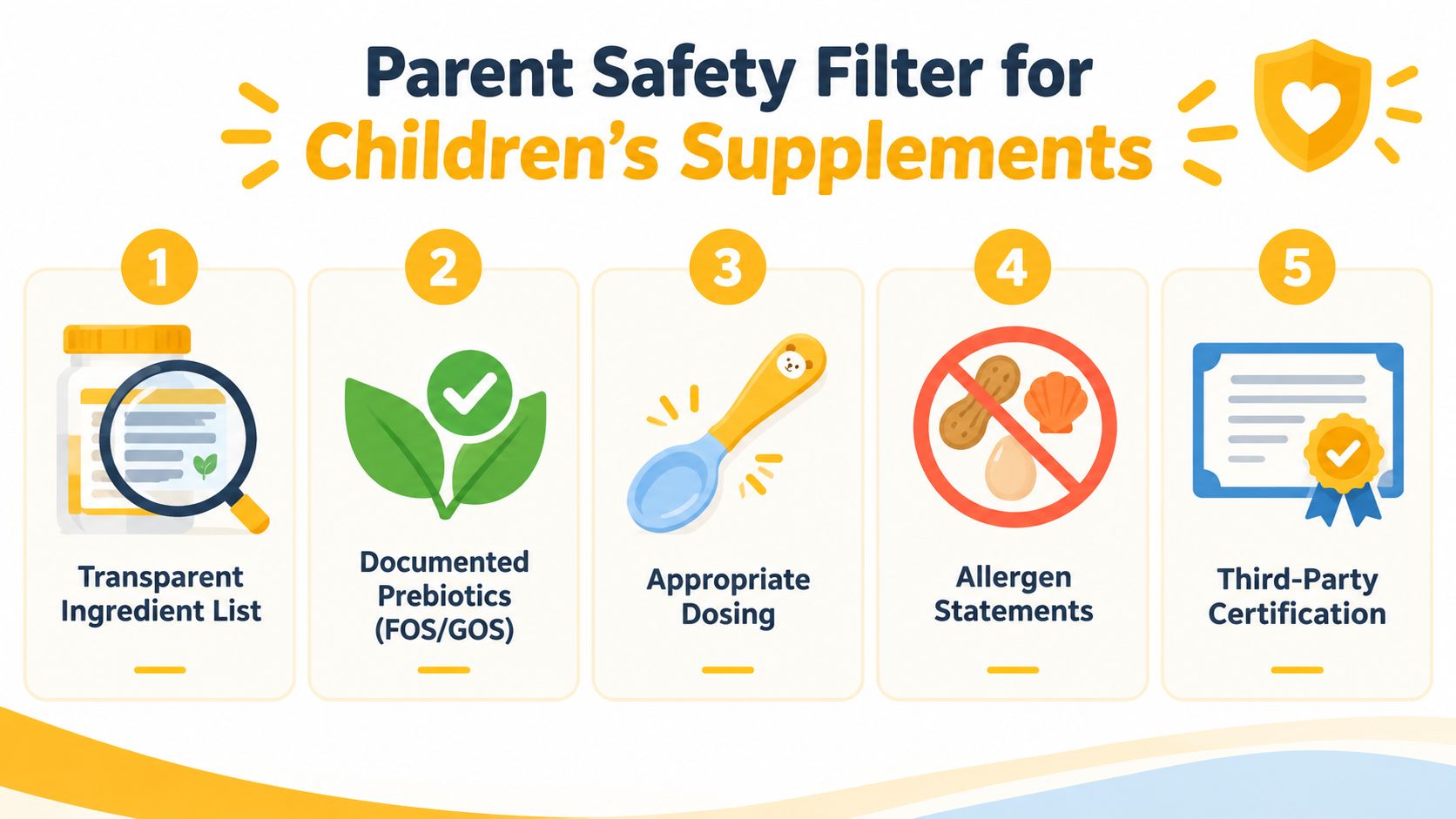
A practical parent safety filter
- Name the ingredient. Look for a full ingredient list rather than a broad phrase such as “advanced digestive complex”. If a probiotic supports the product's main claim, check whether its strain is identified.
- Find the prebiotic. A named fibre, such as FOS or GOS, gives more useful information than “fibre” alone. Introduce fermentable fibres cautiously if your child is sensitive, since gas or bloating can occur.
- Check the actual dose. Confirm whether the stated amount applies to one gummy, a daily serving or several capsules. A larger number on the front does not automatically mean a stronger or more suitable product.
- Review allergens and dietary needs. Check ingredients against allergies, intolerances and family preferences. Claims such as vegan, sugar-free or naturally flavoured do not replace an allergen statement.
- Check regulatory and quality information. The Australian evidence review explains why product claims, dosage forms and directions need careful assessment within the relevant medicine framework. Clear manufacturer details make that assessment easier. A prebiotic-first approach also helps keep the decision grounded in an identifiable ingredient rather than marketing language.
Magnesium needs a separate question
Magnesium is not interchangeable across forms. For constipation or bowel regularity, Australian guideline coverage discusses magnesium oxide or citrate, with magnesium oxide recommended at 0.5 to 1.5 grams per day for at least four weeks in the relevant adult guideline context, as reported by the Medical Journal of Australia. This information is not a self-prescription for a child.
Magnesium citrate can draw water into the bowel, so higher pharmacological doses may cause diarrhoea. A product chosen for relaxation is not automatically suitable for a child being assessed for constipation. Persistent pain, blood in the stool, repeated vomiting, unexplained weight changes, severe diarrhoea or ongoing constipation calls for medical advice instead of symptom-masking with a supplement.
Healthdirect notes common supplement-related effects including bloating, gas and diarrhoea. Use extra caution if a child is very unwell. Stop and ask a healthcare professional if symptoms worsen, your child takes medicines, or you are unsure whether the product suits their age or condition.
Building a Daily Routine and Smart Buying Habits
A routine works best when it joins something the family already does. Mix a prebiotic powder into a familiar breakfast, or give a chewable after toothbrushing while an adult checks the serving. The goal is a repeatable cue, not a perfect wellness ritual. Linking the supplement to an established action removes one more task from a busy morning.

Let the child help name the routine. “Time for your school-day supplement” is neutral and predictable. Language can connect the action with getting ready to learn, winding down or caring for the body, without promising that a supplement will fix concentration, emotions or digestion.
A kids routine chart makes the sequence visible. Keep it simple, store the product where an adult can supervise it, and treat a missed dose as a cue to restart rather than a failure. Calm repetition usually builds cooperation more effectively than pressure.
Buying logistics deserve the same attention as the ingredient label. A subscription is practical only if it has pause, skip and cancel controls, since plans may change during holidays, illness or professional review. Australia-wide shipping, clear delivery information, dosing directions and a satisfaction guarantee can also reduce the chance of keeping a product that does not suit the child.
Keep fibre-containing foods in the household routine and introduce changes gradually. Monitor comfort and willingness to take the product. Reliable delivery does not make a supplement a good fit if the child refuses it or develops digestive upset.
Watch the video below for another way to build a repeatable family habit.
Your Next Steps to Choosing the Best Gut Health Supplements
Start with the child, not the product category. Write down the specific concern, how often it occurs, what the child eats comfortably, and whether the issue is affecting sleep, school, appetite or daily life. If symptoms are persistent or worrying, arrange a healthcare review before trialling a supplement.
Use this short buying checklist:
- Begin with food foundations: Offer a varied, fibre-containing diet in ways your child accepts, alongside regular fluids and meals.
- Choose targeted support: Consider a documented prebiotic or carefully matched synbiotic when the intended outcome and evidence make sense.
- Interrogate probiotic claims: Look for strain information, an appropriate child age range and a claim that doesn't exceed the research.
- Prioritise the format your child accepts: Gummies, capsules and powders each have practical strengths, but adherence depends on real household behaviour.
- Read every dose: Check the serving size, active ingredient amount, allergens, storage instructions and directions.
- Monitor the response: Bloating, gas or diarrhoea are reasons to pause and seek advice if they persist or concern you.
A child-specific Australian study summarised by the University of Canberra reported that a daily multi-strain probiotic reduced gastrointestinal infection incidence by 62% in children aged 2 to 5. That finding supports a possible prevention angle, but it doesn't justify routine probiotics for every healthy child aged 4 to 12. Evidence has boundaries, and good decisions respect them.
Choose one manageable change, connect it to an existing routine, and review how your child tolerates it. That approach is more likely to support everyday wellbeing than repeatedly switching between products because a label promises more.
Daily Powers offers child-focused gummy options designed around simple daily routines, including prebiotic-containing formulations and clear serving guidance. Visit Daily Powers to review the ingredient lists and choose a format that fits your family's food-first approach and daily habits.