

Your child has pushed the salmon to the edge of the plate again. You're standing at the kitchen bench, trying to work out whether a DHA supplement is useful or just another brightly packaged promise about a sharper, more focused child.
The practical answer is less dramatic. DHA is an important omega-3 fat, but it isn't a guaranteed brain booster. Its value depends largely on what your child already eats, their baseline omega-3 status, their age, and the reason you're considering supplementation. Australian intake data also suggest that many children consume very little DHA through food, especially when seafood rarely appears on the menu.
Table of Contents
- What DHA Is and Why It Matters for Children
- The Evidence on Brain, Learning, and Attention
- How Much DHA Kids Need by Age
- Food Sources, Fish Oil, and Algal DHA Compared
- Safety, Upper Limits, and Allergy Awareness
- Choosing a Kid-Friendly DHA Product
- Putting It All Together for Your Family
What DHA Is and Why It Matters for Children
DHA, or docosahexaenoic acid, is a long-chain omega-3 fatty acid. It forms part of the membranes surrounding cells, including cells in the brain and retina. That structural role matters because children's nervous systems are developing, organising and refining connections throughout early life.
A useful way to think about DHA is as a building material. During pregnancy, infancy and childhood, the brain is continually constructing and adjusting its network. DHA isn't the architect, the teacher or the fuel for doing homework. It's one of the materials used to make flexible cell membranes, particularly in tissues where rapid communication matters.
Your body can make some DHA from ALA, or alpha-linolenic acid, which comes from foods such as chia, flaxseed and walnuts. The conversion is limited, however, so eating an ALA-rich food doesn't provide the same thing as eating DHA directly. Fish, seafood, fish oil and algal oil supply DHA in a form the body can use without relying on that conversion step.
DHA and EPA aren't interchangeable
DHA and EPA are both omega-3 fats, but they have different biological roles. DHA is more strongly associated with the structure of brain and eye tissue, while EPA is often discussed in relation to inflammatory signalling and cell communication.
That distinction matters on a supplement label. A product might list a large amount of “fish oil”, yet contain a smaller amount of actual DHA and EPA. Parents should look for the individual milligram amounts rather than assuming the total oil weight tells the whole story.
Australian nutrient guidance sets age-specific adequate intakes for combined long-chain omega-3s, including EPA, DHA and DPA. The benchmark is 40 mg per day for children aged 1 to 3, 55 mg per day for ages 4 to 8, 70 mg per day for boys aged 9 to 13, 85 mg per day for girls aged 14 to 18, and 125 mg per day for boys aged 14 to 18, according to an Australian explanation of the NHMRC omega-3 reference values.
The kitchen-bench translation: DHA supports the materials used in developing brain and eye tissue. It won't replace sleep, learning support, a balanced diet or an assessment for attention difficulties.
The Evidence on Brain, Learning, and Attention
DHA research becomes confusing when different groups of children are discussed as though they're the same. Premature infants, healthy full-term children and children with ADHD symptoms aren't interchangeable populations, and a result in one group can't automatically be applied to another.
Evidence is more convincing for DHA's role in visual and early neurological development than for a broad claim that supplementation makes healthy children smarter. In school-age children, trials have produced mixed findings. Some children with low omega-3 status may show improvements in specific areas such as attention or working memory, while children who already have adequate intake may show little measurable change.

Why baseline status changes the question
Australian research involving children aged 7 to 12 with ADHD symptoms found that increased red-blood-cell EPA and DHA was associated with improved spelling and attention, alongside reductions in oppositional behaviour, hyperactivity and cognitive problems. A separate Australian intervention in children aged 7 to 12 provided 750 mg of DHA and 60 mg of GLA daily for 20 school weeks and reported improved scholastic performance, as described in this Australian review of omega-3s and ADHD.
Those findings are relevant, but they don't mean every child needs a high-dose product. Recent reviews describe small and inconsistent effects on executive function, attention, working memory and processing speed, with stronger signals generally appearing in children whose omega-3 status is low and whose intake exceeds roughly 450 mg of combined EPA and DHA per day. The review also notes that Australia and New Zealand don't have a government-recommended dietary intake specifically for DHA or omega-3 fatty acids, which leaves families needing to interpret general adequacy guidance rather than follow a single universal supplement target. The broader context is outlined in this review of omega-3 supplementation and children's cognition.
Reading ability, IQ and “superbrain” claims go beyond what the evidence can confidently support. A more honest description is gap-filling. If a child eats almost no seafood and has low omega-3 exposure, improving intake may be worthwhile. If their diet already supplies enough, extra DHA isn't a guaranteed cognitive upgrade.
For families comparing DHA with other focus routines, Focus is a separate sugar-free, vegan gummy containing mushroom polysaccharides, vitamin D3, zinc, elderberry and prebiotics. It does not contain DHA, so it shouldn't be treated as an omega-3 substitute. Parents can also read this practical guide to focus supplements for kids when separating nutrition support from claims about attention.
How Much DHA Kids Need by Age
Australian guidance gives parents a useful starting point, but one detail is easy to miss. The NHMRC figures are for combined long-chain omega-3s, EPA plus DHA plus DPA, not DHA alone. That means a product label showing DHA should be considered alongside the child's total food and supplement intake.
| Age Group | AI of EPA+DHA (mg/day) | Estimated Median Intake (mg/day) |
|---|---|---|
| 1 to 3 years | 40 | 3.9 mg DHA |
| 4 to 8 years | 55 | 5.1 mg DHA |
| Boys 9 to 13 years | 70 | 6.8 mg DHA |
| Girls 14 to 18 years | 85 | 7.8 mg DHA |
| Boys 14 to 18 years | 125 | Not reported in the cited intake summary |
The median DHA intakes in the table come from an Australian national analysis of children aged 2 to 16. The reported medians were 3.9 mg per day for ages 2 to 3, 5.1 mg for ages 4 to 8, 6.8 mg for ages 9 to 13, and 7.8 mg for ages 14 to 16, as reported in the Australian children's omega-3 intake analysis. These figures aren't a diagnosis of deficiency, but they show why seafood refusal can create a meaningful dietary gap.
Turning the figures into meals
Australian guidance notes that one small 100 g serve of fish plus two small cans of tuna per week can provide adequate omega-3 for children up to age 14. That's a practical food milestone, not a compulsory menu. Some children eat that pattern comfortably, while others refuse fish, avoid animal foods or manage only occasional bites.
Start with low-pressure exposure. Try finely flaked salmon in potato cakes, sardines mixed into tomato sauce, or a small amount of tuna in a familiar sandwich. If seafood remains absent, a GP or paediatric dietitian can help you interpret the label and choose an age-appropriate option. The paediatric dosing guidance can support that conversation, but it shouldn't replace individual medical advice.
A product such as Calm serves a different nutritional purpose. It contains magnesium citrate, vitamin B6, zinc and prebiotics, and isn't a DHA supplement, so adding it doesn't solve an omega-3 shortfall.
Food Sources, Fish Oil, and Algal DHA Compared
There are three realistic ways to provide DHA to a child: whole seafood, refined fish oil or algal DHA. None is automatically right for every family. The best route is the one that fits the child's diet, allergies, preferences and ability to take the product consistently.
| Source | Typical DHA per Serve | Allergens | Vegan-Friendly | Sustainability | Best For |
|---|---|---|---|---|---|
| Oily fish | Varies by species and serve size | Fish | No | Depends on species and fishing method | Children who enjoy seafood |
| Refined fish oil | Check the DHA amount on the label | Fish may be relevant, plus formulation ingredients | No | Depends on source and processing | Children needing a concentrated non-vegan option |
| Algal DHA | Check the DHA amount on the label | Depends on the carrier and facility | Yes | Cultivated microalgae can avoid direct fish harvesting | Vegan, vegetarian or seafood-avoiding families |
Whole food comes with more than DHA
Salmon, sardines and other oily fish provide protein and other nutrients alongside omega-3 fats. Fish also gives children practice with a varied diet, textures and family meals. For a child who eats fish regularly, food may be all that's needed.
The trade-off is predictability. DHA content varies between fish species, serving sizes and recipes, and a child who eats one mouthful of salmon may receive far less than a child who finishes a portion. Large predatory fish can also carry greater mercury concerns than smaller oily fish, so variety and Australian food-safety advice matter.
Supplements solve consistency, not every nutrition problem
Refined fish oil concentrates omega-3 into a small liquid, capsule or chewable format. Proper refining can reduce contaminants, but parents still need to check the product's actual DHA and EPA amounts, storage instructions and allergen statements. Fish oil may also produce fishy burps or be refused because of taste.
Algal DHA comes from microalgae and can suit vegan families or children who don't eat seafood. It usually provides DHA without necessarily providing EPA, so the label matters. It can appear as an oil, powder, chewable or capsule, and acceptance often depends more on flavour and texture than on the source.
A useful decision rule: If seafood is a dependable part of your child's diet, start with food. If it isn't, choose a supplement format your child can take safely and regularly.
Safety, Upper Limits, and Allergy Awareness
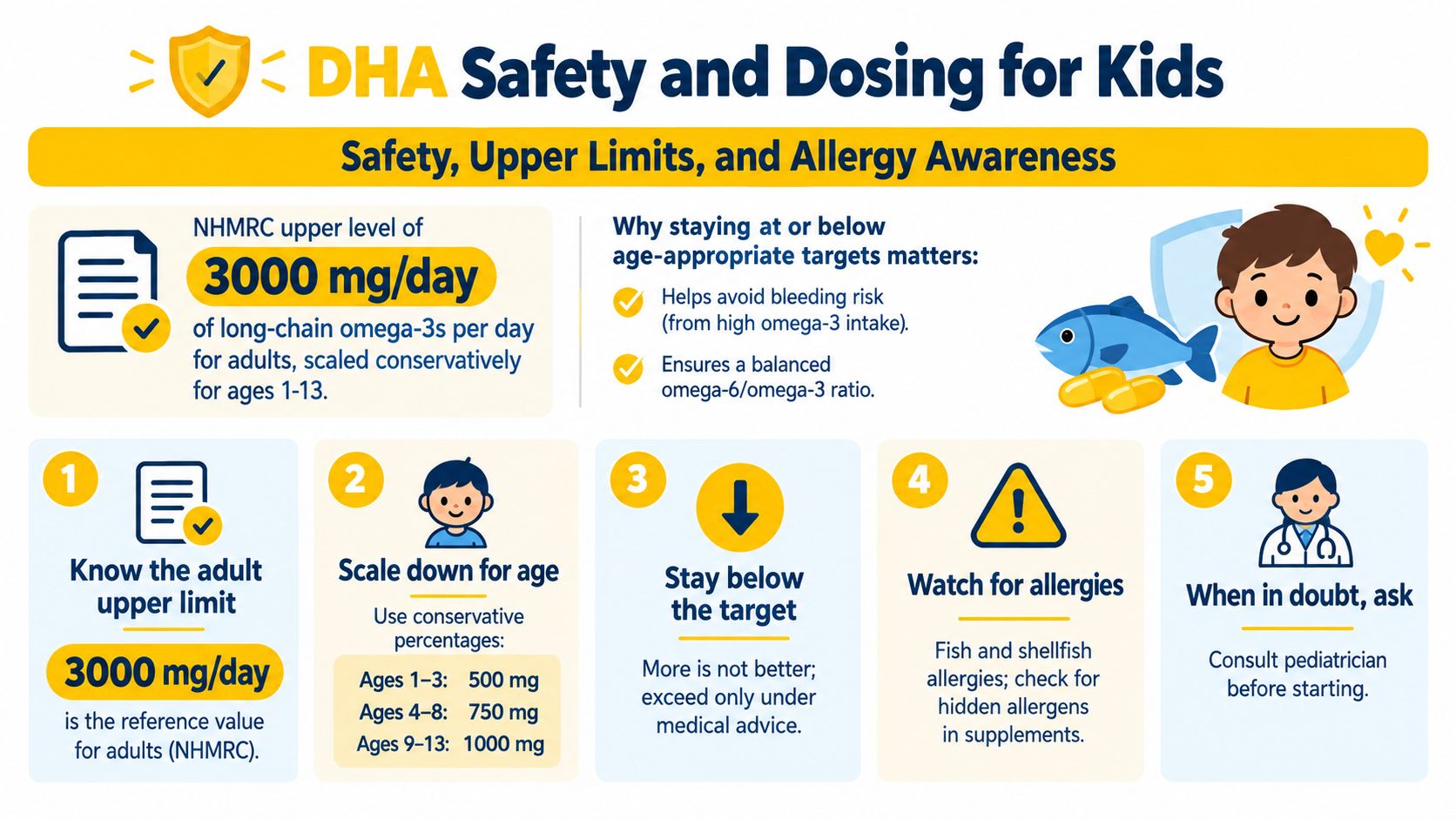
Safety starts with the total amount of long-chain omega-3 your child receives from food and supplements. The Australian and New Zealand reference framework states that an upper limit couldn't be determined for infants, while a 3 g per day upper limit from foods and supplements applies to other age groups, as outlined in this overview of international omega-3 recommendations.
That upper limit isn't a routine target. Children don't need to approach it for ordinary nutrition, and higher doses shouldn't be started casually. Large amounts may cause gastrointestinal symptoms, fishy aftertaste or bleeding concerns, particularly when a child takes medicines that affect clotting.
Check allergies and the physical format
A child with a confirmed fish or shellfish allergy needs individual advice before using an omega-3 product. Highly refined fish oil may contain very little fish protein, but “very little” isn't the same as an automatic guarantee for every allergic child. An allergist or GP can help assess the specific product and the child's reaction history.
Capsules can be a choking risk for young children, especially when they can't chew or swallow them reliably. Never give a child a product in a form that doesn't match their developmental ability, and follow the label's age instructions.
Oxidation affects oil quality. A fresh product, a sealed container, sensible storage and a clear use-by date matter more than a dramatic front-of-pack promise. Keep oils as directed, often in a cool place or the fridge after opening, and stop using a product if the smell or taste changes noticeably.
Safety rule: Treat DHA as a supplement to a varied diet, not as permission to ignore fish safety, allergy advice or the rest of your child's nutrition.
Choosing a Kid-Friendly DHA Product
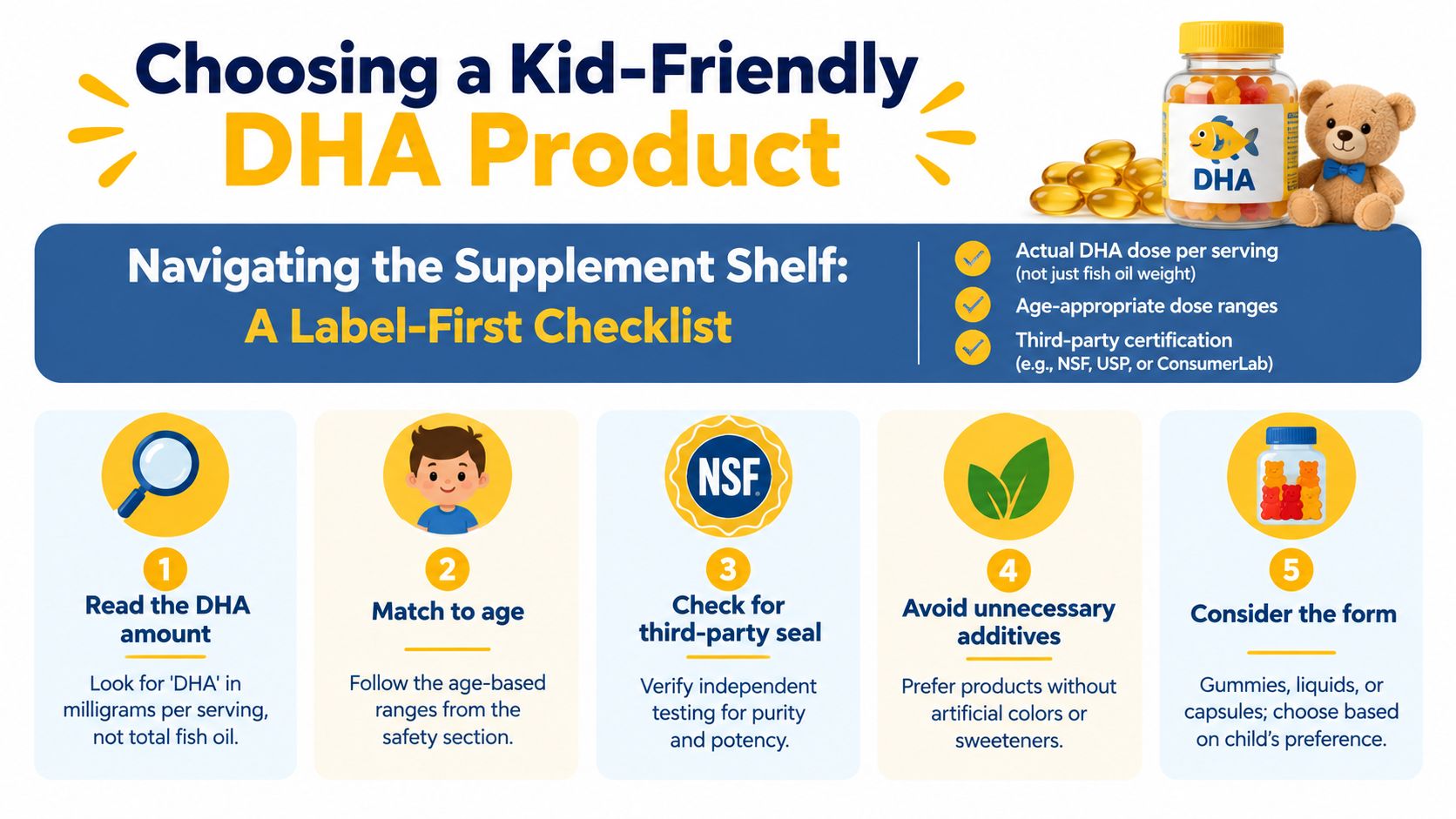
A DHA label should answer one question quickly: how much DHA does my child receive in one age-appropriate serving? “Fish oil”, “omega-3” or “marine oil” alone doesn't tell you the DHA dose. Look for DHA and EPA listed separately, then compare the serving size with the directions for your child's age.
The ingredient list should be short enough to understand. A child-friendly product may be a liquid, capsule, powder or gummy, but the format must be safe and acceptable to the child who will take it. Sugar-free and vegan choices can suit families with specific preferences, although those features don't prove that a product contains an effective DHA amount.
Five label questions for the shopping aisle
- Is the DHA amount stated clearly? Reject labels that list only total oil or hide omega-3 content inside a proprietary blend.
- Does the age guidance match your child? A product designed for older children shouldn't be casually adapted for a toddler.
- Can the manufacturer show quality testing? Look for credible independent testing or Australian regulatory information, and check what the seal verifies.
- Are the ingredients suitable for your family? Review fish, shellfish, soy and other allergen statements rather than relying on “clean” or “natural” language.
- Will your child take it consistently? A theoretically suitable product is of little use if the taste, texture or swallowing method creates a daily battle.
Triglyceride-form fish oil is often preferred over ethyl ester form when the product offers that choice, but parents should still prioritise the actual DHA amount, purity information and suitability for the child. Added antioxidants such as vitamin E or rosemary extract may help protect an oil from oxidation, but they don't compensate for poor storage.
Be cautious with omega-3-6-9 blends. Children eating a typical Australian diet generally obtain plenty of omega-6 fats, while the label may make it harder to see how much DHA is present. Marketing phrases such as “superbrain” and “IQ boost” should not influence your decision.
For more practical guidance on formats and labels, see this guide to gummy omega-3 products.
Putting It All Together for Your Family
Your child probably falls into one of two broad groups.
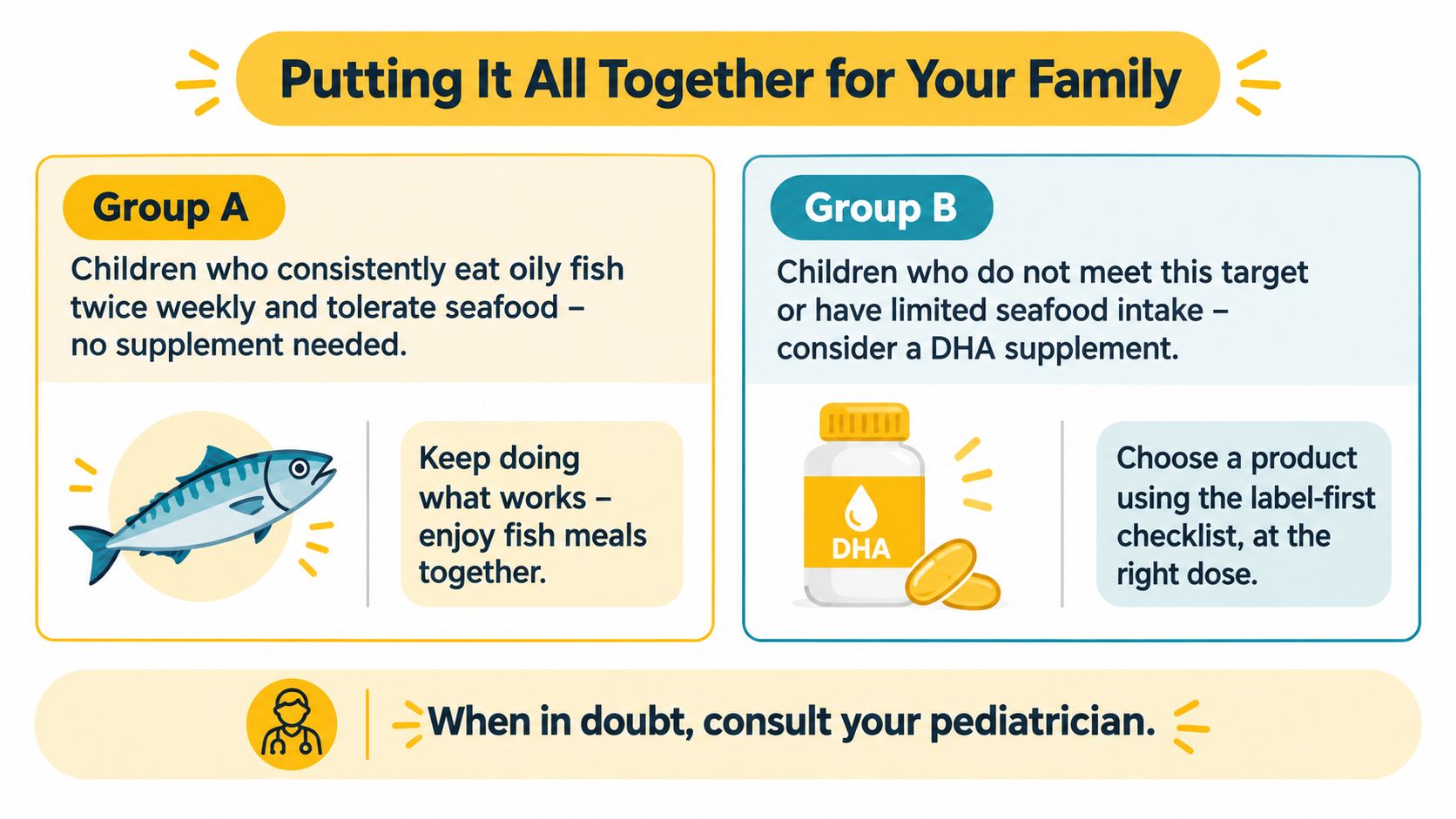
Group A includes children who regularly eat oily fish and tolerate seafood. Their diet may already provide the omega-3 exposure they need, particularly when fish meals are part of a varied pattern. Keep offering familiar foods, introduce different fish when practical and avoid turning every meal into a test of nutritional adequacy.
Group B includes children who rarely eat seafood, refuse fish, follow a vegan diet or avoid fish because of allergy. They have a clearer reason to discuss algal DHA or refined fish oil with a health professional. A supplement may also be reasonable for a child with a neurodevelopmental condition, but the evidence supports an individualised trial rather than a guaranteed outcome.
Australian population monitoring provides a wider reminder that nutrition is one part of children's development. In 2024, 53% of Australian children were developmentally on track across all five AEDC domains, compared with 55% in 2021 and 51% in 2009, according to the Australian Bureau of Statistics childhood-development indicators. DHA can't explain or fix those population-level results, but adequate nutrition belongs within the larger routine of sleep, learning, relationships, healthcare and play.
Reassess your child's diet when their eating pattern changes. If they take several supplements, use medicines, have a chronic condition, were born prematurely or have significant allergies, ask a GP or paediatric dietitian to help choose the dose and format.
Daily Powers offers children's supplements in practical gummy formats, including Focus for growing-mind routines and Calm for relaxation support, with transparent ingredient information and sugar-free, vegan formulations. Visit Daily Powers to compare the range, then speak with your GP or paediatric dietitian if you're specifically trying to close a DHA gap.