

The most popular advice about focus supplements for kids is also the least useful: find a gummy with a long ingredient list and hope it makes concentration easier. That reverses the order of decision-making. A supplement can correct a nutritional gap, but it can't compensate for chronic sleep disruption, an unrecognised learning difficulty, poor diet quality, hearing or vision problems, or an environment that makes sustained attention unnecessarily hard.
Australian families already use supplements widely. The latest Australian Bureau of Statistics survey found that 20.3% of children aged 5–11 used a dietary supplement in 2023, compared with 16.0% in 2011–12, while 15.0% of children aged 12–17 used one in 2023. Across Australians aged two and over, 33.6% used a dietary supplement, with vitamin and mineral products the most common type at 29.7%. (Australian Bureau of Statistics dietary supplements data)
That popularity doesn't prove that a child needs a focus product. It means parents deserve a more careful answer than a shopping list.
Table of Contents
- Why Most Parents Are Asking the Wrong Question
- What Focus Supplements for Kids Actually Are
- The Evidence Behind Common Focus Ingredients
- Is Your Child an Actual Candidate for One?
- Non-Supplement Strategies That Support Attention
- How to Read Australian Product Claims Honestly
- What to Look for on a Children's Focus Label
- A Safe Way to Trial, Track, and Decide
Why Most Parents Are Asking the Wrong Question
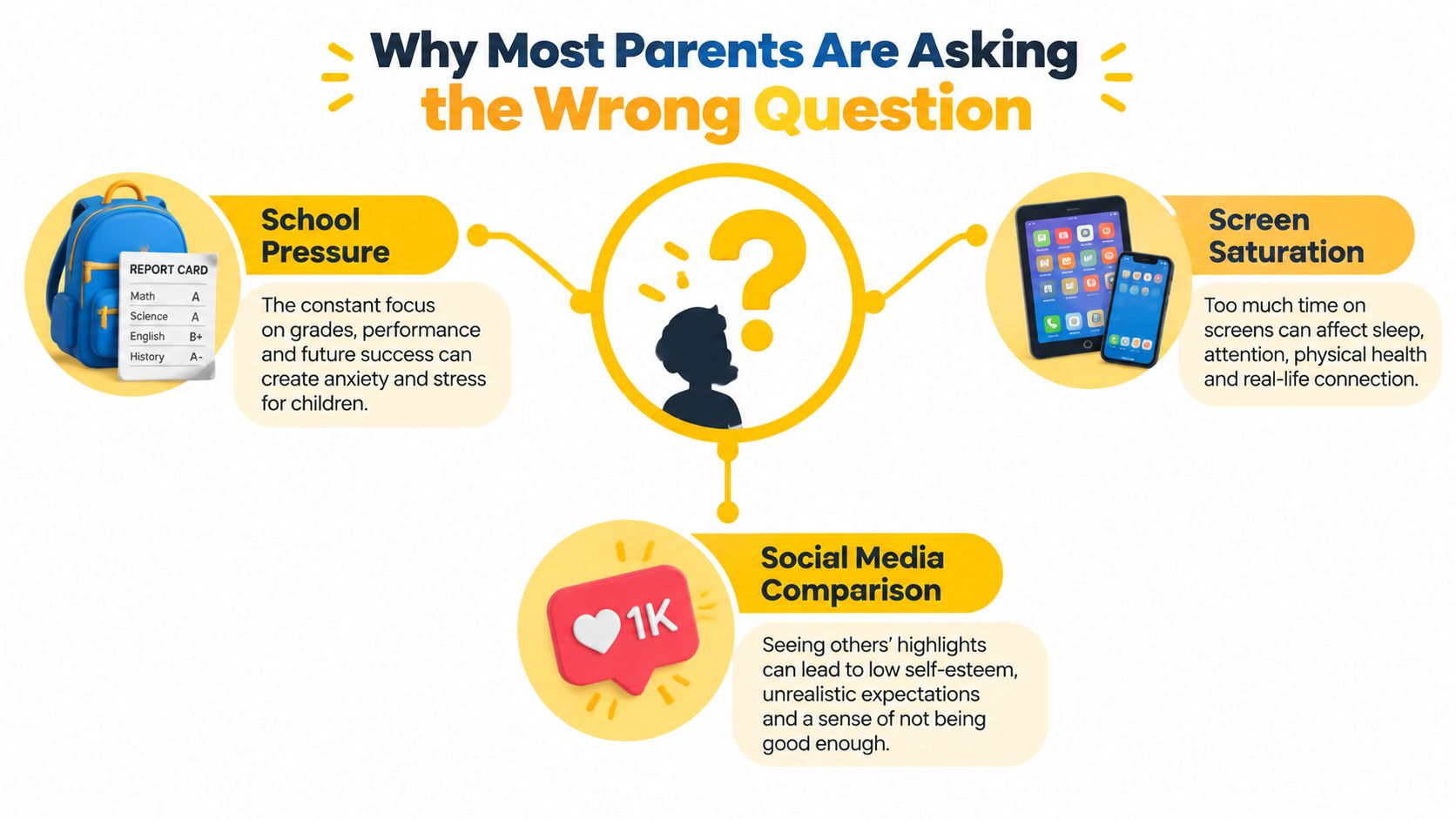
A child who loses focus during homework creates an immediate, understandable worry. School expectations are high, screens compete for attention, and social media exposes children to a constant stream of comparison and stimulation. A brightly packaged supplement appears to offer a manageable solution, especially when the label promises support for concentration, learning, or growing minds.
But “Which focus supplement works?” skips the first question: what is making concentration difficult for this child?
A supplement is most defensible when it fills a specific gap. That might mean a restricted diet, a confirmed deficiency, or low intake of a nutrient that matters for general health. It isn't a general-purpose “shiny child” button, and ordinary childhood distraction isn't a nutritional diagnosis.
Australian child-health research reflects both the demand and the need for better triage. Around half of Australian children had been given vitamins or supplements in the previous year, with primary school-aged children reported as the most frequent users at 50%. Parents most often cited immune support and supplementing the diet as reasons, and the estimated national spend on vitamins and supplements for children under 15 was $74 million per year. (Australian Child Health Poll research)
The question that leads to a better decision
Ask: “What gap am I trying to fill, and how will I know whether it has been filled?”
If the answer is unclear, skip the product for now. Review sleep, food, movement, learning demands, mood, and the pattern of the difficulty across home and school. If the concern persists or affects daily functioning, speak with a GP, paediatrician, teacher, or allied-health professional rather than using a supplement as an informal assessment tool.
The honest position is simple. Some children may benefit from targeted nutritional support. Many healthy children with a balanced diet won't gain a proven concentration benefit from taking more nutrients.
What Focus Supplements for Kids Actually Are
A focus supplement is a nutritional tool, not an attention treatment. It may provide a nutrient involved in normal nervous-system function, but listing that ingredient does not show that the finished product improves a child's concentration. Start by identifying the gap it is meant to fill.
Common product categories include:
- Omega-3 and phospholipid products, containing EPA, DHA, or phosphatidylserine, and usually marketed for brain or nervous-system support.
- Multivitamin and mineral blends, with ingredients such as iron, zinc, iodine, vitamin D, B vitamins, and magnesium. These are most defensible when a child's diet is insufficient, not when they duplicate an already adequate intake.
- Herbal and traditional blends, which may contain Bacopa monnieri or ginkgo. Evidence and safety information specific to children are often limited.
- Amino-acid and protein powders, promoted for energy, recovery, or mental performance. A child who eats enough protein has no obvious nutritional reason to use them.
- Emerging nootropic stacks, which combine several ingredients under one focus label. Each added ingredient raises questions about dose, interactions, and which component could be responsible for any observed change.
Australian law does not use a separate category called “dietary supplement”. Products are regulated as food or medicine, based on their ingredients, presentation, claims, and other features. The product format and its marketing therefore matter, not just the ingredient list.
A therapeutic product may display an AUST L or AUST R number. A food-format product is regulated under food law and is not listed in the same way. The same nutrient can appear in products with different strengths, labels, claims, and prices. None of those differences proves that one product will improve attention more than another.
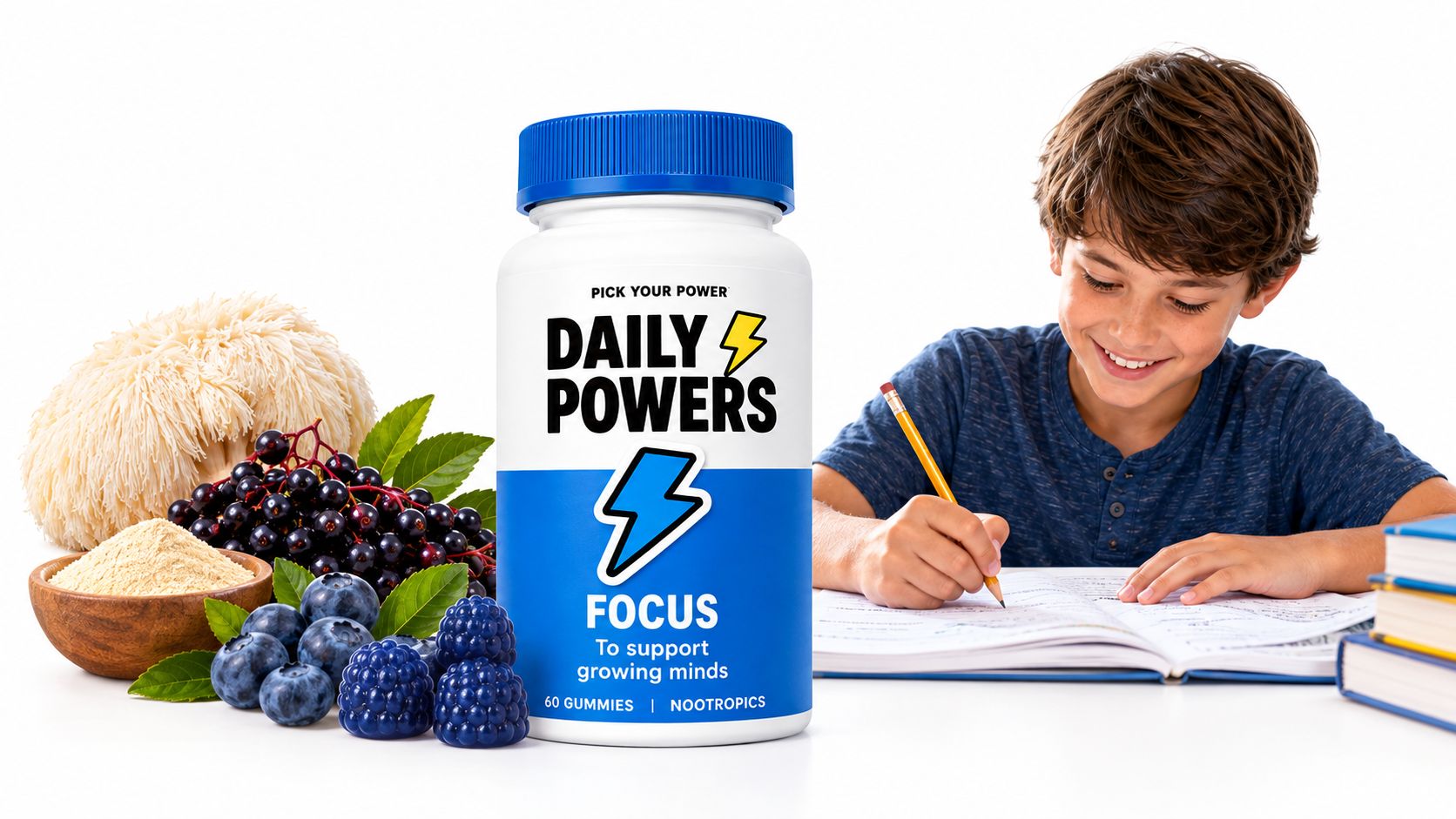
For example, Focus is described as a blueberry-flavoured gummy containing mushroom polysaccharides, vitamin D3, zinc, elderberry fruit powder, and prebiotics. Its listed daily serving provides mushroom polysaccharides, vitamin D3, zinc gluconate, elderberry fruit powder, and fructooligosaccharides, with directions to take two gummies daily or as directed by a healthcare professional.
That label identifies the contents. It does not establish a clinically meaningful focus effect for your child. If you cannot state which dietary gap the product addresses, probably skip it.
The Evidence Behind Common Focus Ingredients
The central question is not which ingredient sounds most promising. It is whether your child has a dietary gap that needs correcting. Australian evidence gives omega-3 the clearest nutrient-related discussion, but the expected effect on attention remains modest and inconsistent. The Australian ADHD clinical practice guideline reports only low- to very-low-certainty improvements in parent-rated inattention and hyperactivity. A Cochrane review also found little evidence that polyunsaturated fatty acids meaningfully improve ADHD symptoms overall.
DHA needs a careful reading of the evidence. FSANZ found no assessable evidence that DHA maintains normal brain function in healthy children aged 10–12, including studies using 400 mg to 1000 mg DHA doses. (FSANZ DHA systematic review) Discuss omega-3 intake with a clinician when fish intake is low or deficiency risk exists. Treating omega-3 as a general cognitive enhancer is not supported.
Iron, zinc, iodine, vitamin D, and B vitamins support normal biological functions. Correcting a genuine deficiency can therefore matter. Giving these nutrients to a child who already has adequate intake is a different situation. Iron should not be started casually without clinical advice.
Magnesium has a plausible role in nervous-system function, but that does not show that a magnesium gummy improves classroom attention. Bacopa, ginkgo, phosphatidylserine, and citicoline have limited, mixed, or preliminary child-specific evidence. Product claims may rely on adult research, small trials, or ingredient combinations that have not been independently replicated.
| Ingredient | Evidence strength in children | Key safety notes |
|---|---|---|
| Omega-3, including DHA and EPA | Best-supported nutrient-adjacent option, but modest and inconsistent | Check the actual EPA and DHA amounts. Discuss use with a clinician if the child takes medication or has a medical condition |
| Iron | Most relevant when deficiency is confirmed or strongly suspected clinically | Don't self-prescribe. Keep iron away from children because overdose can be dangerous |
| Zinc | Potentially useful when intake or status is low | Excessive or prolonged intake can create problems, so avoid stacking products |
| Iodine | Important for normal thyroid function when intake is inadequate | Don't add it casually if the child already receives iodine elsewhere |
| Vitamin D | Correct deficiency for health, not as a guaranteed focus treatment | Use age-appropriate guidance and avoid duplicate dosing |
| B vitamins | Useful for nutritional adequacy, with no general nootropic guarantee | Check the full label across multivitamins and fortified foods |
| Magnesium | May support general nervous-system and muscle function | Forms and doses differ. Gastrointestinal effects can occur |
| Bacopa or ginkgo | Limited, mixed child-specific evidence | Herbal safety, interactions, and product quality need careful review |
| Phosphatidylserine or citicoline | Preliminary or insufficient evidence for routine use | Avoid assuming adult research transfers directly to children |
Calm provides magnesium citrate, elemental magnesium, vitamin B6, zinc, and prebiotics in a berry-flavoured gummy. Its ingredient disclosure is easy to inspect. It still does not establish magnesium as a proven treatment for attention problems. If no clear dietary gap is being addressed, probably skip it.
Is Your Child an Actual Candidate for One?
Start with four checkpoints, not a bottle.
Check the diet before the marketing
Look at the child's usual pattern over several days. Is there regular access to iron-rich foods? Does the diet include sources of omega-3? Does breakfast provide enough food to sustain the morning, or does the child arrive at school hungry and irritable?
A very restricted diet, persistent fussy eating, dairy-free or vegan eating without careful planning, or poor appetite can justify a conversation with a clinician. The supplement should target the suspected gap, not become a substitute for understanding the diet.
Look for a consistent pattern
One difficult homework session doesn't establish an attention disorder. Notice whether the problem appears at school and home, during preferred and non-preferred tasks, and across different times of day. Ask the teacher for specific observations, such as losing instructions, abandoning tasks, or needing repeated prompts.
Sleep deserves its own review. Check bedtime consistency, night waking, morning mood, and whether the child seems tired during the day. A supplement can't repair an attention problem driven by inadequate or disrupted sleep.
Bring medical context into the decision
Get professional advice first for children under four, children taking prescription medication, children with restricted diets, or children with a known family history of ADHD or learning differences. Also check whether hearing and vision screening is current, and mention any diagnosed deficiency, medical condition, or recent medication change.
The Australian Child Health Poll states that healthy children with a regular healthy diet and no demonstrated nutritional deficiency have no indication for supplement use and should generally obtain nutrients from food. It also notes that micronutrient research in children with ADHD has shown modest and mixed effects, with possible benefits more apparent in broader functioning than in pure focus outcomes. (Australian Child Health Poll detailed report)
Decision rule: A supplement can address a nutritional gap. It can't diagnose the reason a child is struggling.
Non-Supplement Strategies That Support Attention
Attention works better when the basic conditions are right. Put the supports in this order: sleep, nutrition, movement, environment, then skill-building. A supplement, if it has a role, sits inside that foundation rather than above it.
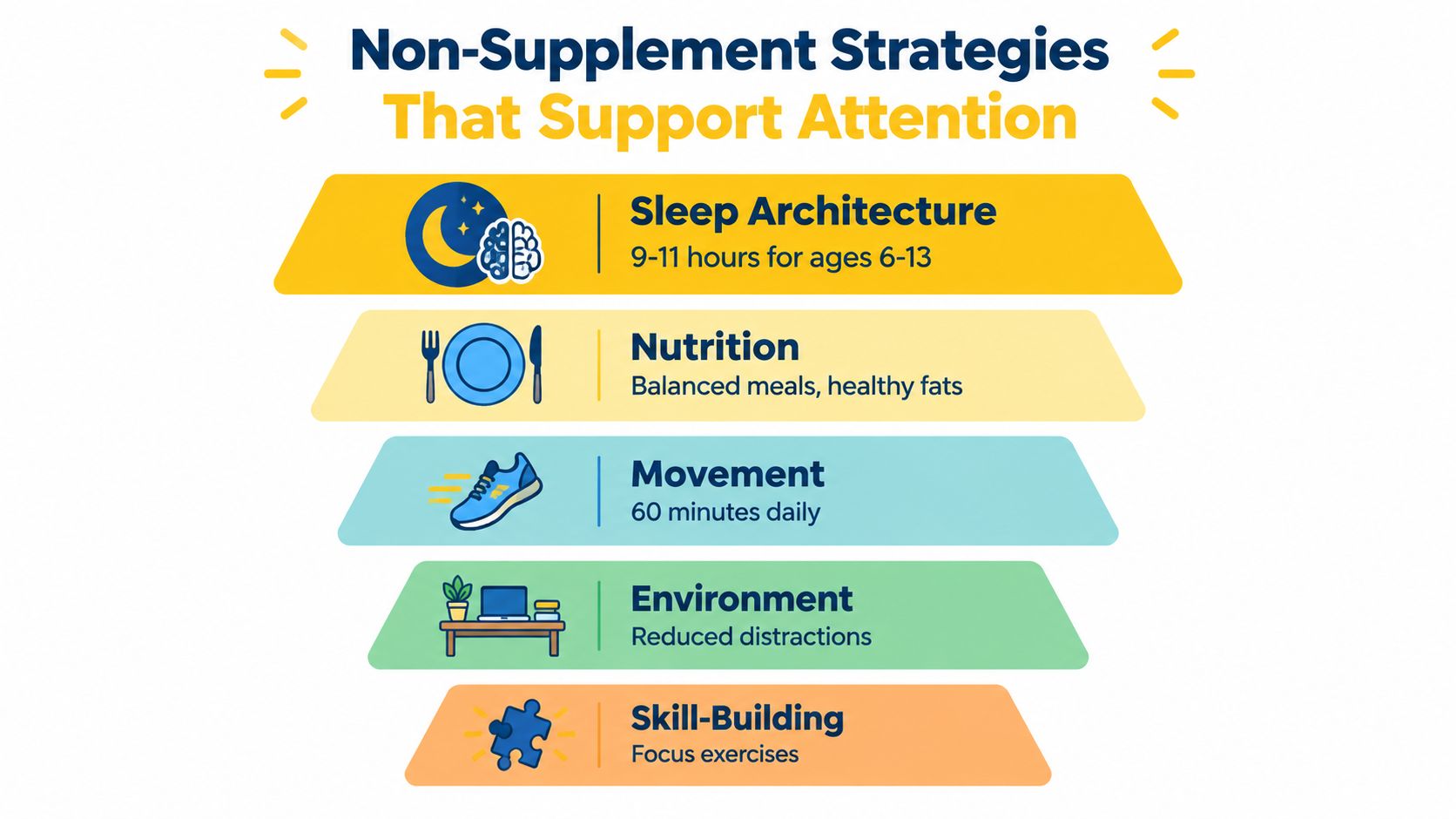
Start with sleep
Use a predictable wind-down sequence, a regular wake time, and a bedroom that supports sleep rather than entertainment. The Daily Powers guide to helping kids sleep can help families turn bedtime into a repeatable routine.
Don't treat sleep as a background detail. A tired child may look inattentive, restless, emotional, or oppositional, and those behaviours can easily be mistaken for a need for a focus product.
Build meals around adequacy
Use the Australian Dietary Guidelines as the reference point. Offer a varied pattern of vegetables and fruit, grain foods, protein-rich foods, and dairy or suitable alternatives, with healthy fats included through ordinary meals. Keep the focus on what the child eats consistently, not on making every meal perfect.
Make movement routine
Children need regular physical activity and time to move during the day. Outdoor play, walking, cycling, sport, active transport, and short movement breaks can all make sitting for a task more manageable.
Then reduce friction around work:
- Create a defined homework nook: A clear desk with only the materials needed is easier to manage than a noisy, open-plan space.
- Chunk the task: Give the child a short, visible starting point instead of presenting an entire worksheet as one demand.
- Use visual schedules: A simple sequence reduces the working-memory burden of remembering what comes next.
- Make screens single-task tools: Turn off notifications and avoid switching between entertainment, messages, and schoolwork.
- Protect unstructured play: Children practise planning, flexibility, and self-regulation when they play without every step being directed.
A well-rested, adequately nourished child with a suitable environment rarely needs extra input to become more attentive. If a specific gap exists, these strategies also give the supplement a sensible context.
How to Read Australian Product Claims Honestly
Read the label as a legal and commercial document, not as a research paper. Its wording may be permitted without showing that the product improves your child's concentration.
Australian complementary medicines generally carry an AUST L number for listed medicines or an AUST R number for registered medicines. Listed medicines are lower-risk products that may use only permitted indications. Registered medicines undergo a higher level of pre-market assessment. That distinction matters, but neither number guarantees better focus or confirms that the product suits your child.
The TGA's guidance on marketing complementary medicines in soft-gel capsules for children explains obligations around child-directed presentation and advertising. It also reflects Australia's separate treatment of foods and medicines, rather than treating every product as one generic supplement category.
Separate support language from treatment language
"Supports concentration" is a permitted support-style claim. "Treats ADHD" is a therapeutic claim and is not an acceptable way to market a listed medicine. A product can use lawful wording while having little evidence for the result parents want.
Translate common label language carefully:
| Claim on label | What it sounds like | What it actually means |
|---|---|---|
| “Clinically studied” | The product is proven for children | An ingredient, formula, or related product has been studied. Check the design, dose, age group, and outcome |
| “Natural” | The product is safe | Natural substances can still cause side effects, interactions, contamination, or dosing problems |
| “Supports concentration” | Your child will focus better | The wording describes a permitted support claim, not a promised measurable change |
| “Doctor-formulated” | Paediatric specialists endorse it | Check the names, qualifications, roles, and evidence behind the statement |
| “Recommended by paediatricians” | Clinical guidance supports the product | It may refer to an advisory relationship or marketing panel, not a professional guideline |
A worked label example
A hypothetical bottle might claim “clinically proven focus formula” while listing a proprietary blend of herbs, minerals, and omega-3 ingredients without individual amounts. The correct conclusion is simple: you cannot yet assess the active dose, whether the study used that exact formula, or whether its participants matched your child's age and circumstances.
Before buying, search for the product in the TGA's public Australian Register of Therapeutic Goods. Confirm what type of product it is, whether its claims match its regulatory status, and whether the label provides enough information for a clinician to assess its relevance and safety. If those details are missing, skip the product rather than filling the gaps with marketing language.
What to Look for on a Children's Focus Label
A good label makes the decision easier. A weak label makes you decode a promise.
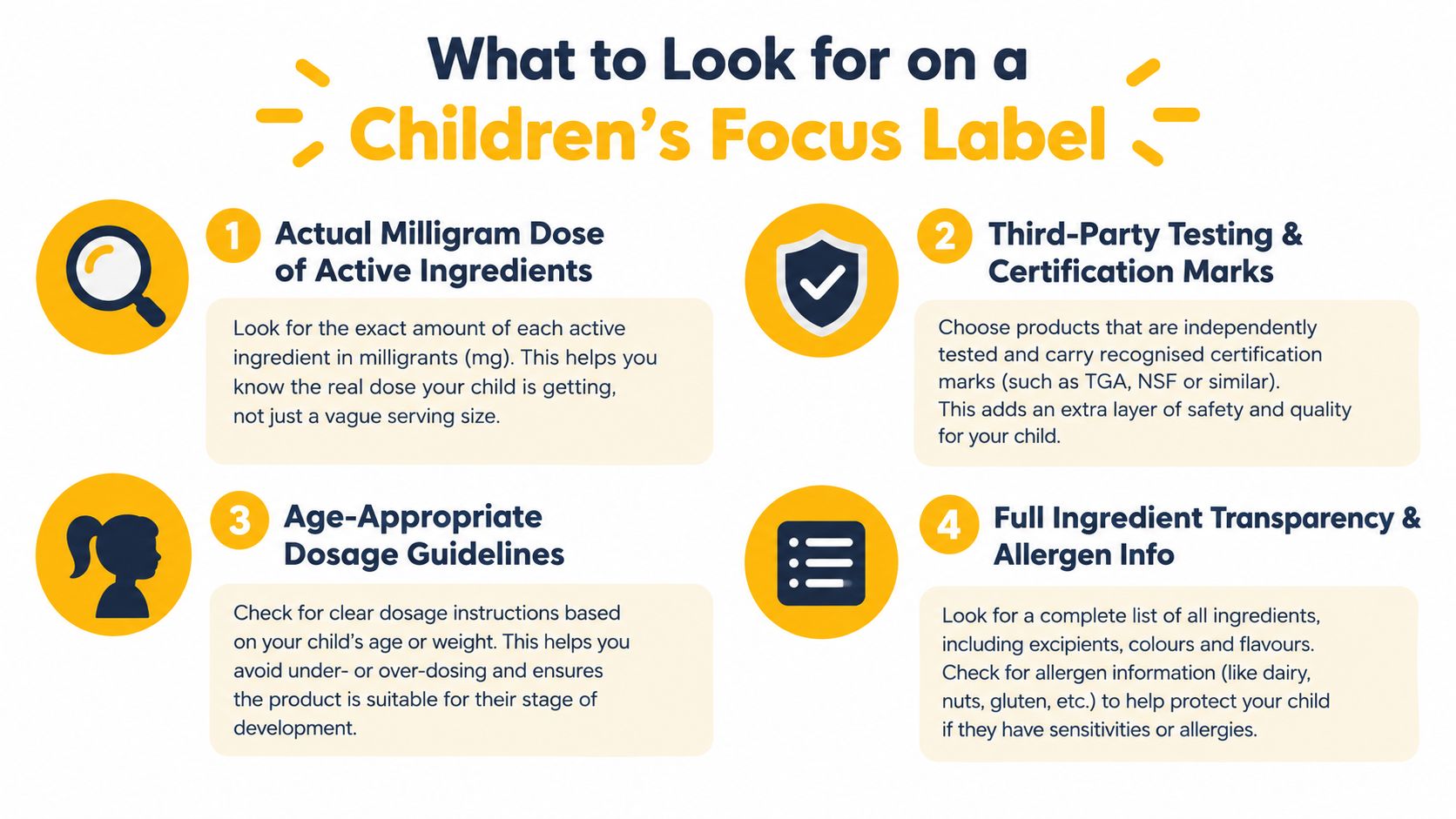
Use this checklist:
- Find the actual dose. The label should state the amount of each active ingredient, not only the total weight of a proprietary blend. For omega-3, look for EPA and DHA amounts rather than treating total fish oil as the meaningful figure.
- Compare the dose with relevant evidence. A study using a defined dose in a particular age group doesn't validate a product containing a fraction of that dose or a different ingredient combination.
- Inspect the entire formulation. Check sweeteners, flavouring agents, allergens, prebiotics, and other additions. A child-friendly format can help adherence, but it still needs to fit the child's diet and health profile.
- Confirm age suitability. Follow the product's age statement and directions. Don't adjust an adult product by guesswork, and don't combine multiple children's products without checking overlapping ingredients.
An ARTG listing is useful for regulatory verification, but it isn't a complete quality verdict or proof of effectiveness. Look for transparent manufacturing information and credible third-party testing where available, such as recognised certification marks or a TGA-licensed manufacturer.
Be sceptical of “clinically proven formula” without a cited study, “doctor-formulated” without named credentials, and proprietary blends that hide sub-therapeutic doses. A short, legible label is often more useful than a crowded one.
A Safe Way to Trial, Track, and Decide
Don't start three products on the same day. You won't know which ingredient caused a benefit, a side effect, or no change.
Establish a baseline
For two weeks, keep the child's usual routine and record four areas each day: attention, mood, sleep, and appetite. Use a simple 1-to-5 scale, where the same parent records the same behaviours at roughly the same time. Add a brief note for unusual events, such as illness, a major school assessment, or a disrupted night.
This isn't a clinical diagnosis. It's a way to reduce memory bias. Parents naturally remember the difficult days and may interpret normal variation as a supplement effect.
Introduce one change
Choose one product only, use the label dose, and set a defined trial window of four to six weeks. Record the same four markers and add any new symptoms. If the child takes prescribed medication, share the full product label with the GP or paediatrician before starting.
The paediatric dosing guidance from Daily Powers can help you identify the information that needs checking, but it doesn't replace individual medical advice. Don't increase the dose because the first week produces no obvious change.
Decide using the record
A small, consistent improvement in one meaningful area, without sleep, appetite, mood, or physical problems, may justify discussing continuation with the child's clinician. No meaningful change, worsening symptoms, or a new problem is a reason to stop rather than add another product.
Stop the trial and seek medical advice for stomach pain, headaches, sleep disturbance, mood changes, rashes, or unusual behaviour changes, particularly if they appear soon after starting. Keep products stored safely, and take the packaging to a clinician if there's any concern about an adverse reaction.
The right outcome may be continuation, replacement with a targeted nutrient, or no supplement at all. The decision should follow the child's needs, not the product's name.
Daily Powers offers children's gummy products designed around specific routines, including Focus with mushroom polysaccharides, vitamin D3, zinc, elderberry fruit powder, and prebiotics, and Calm with magnesium citrate, vitamin B6, zinc, and prebiotics. If you're considering a routine-friendly option after checking your child's needs and the label, visit Daily Powers to review the ingredient details and directions.