

You're in the aisle with a child who's tired, fussy, and done with anything that smells like fish. The gummy bottle feels like the easy win, because it's chewable, portable, and much less of a battle than a capsule or spoonful of oil. That's exactly why gummy omega 3 has become such a tempting choice for Australian parents, and why it deserves a closer look before it slips into the weekly routine.
The decision isn't really, “Should I buy a gummy?” It's, “What kind of omega-3 delivery format suits my child, and what trade-offs am I accepting?” That's a better question, because gummies can solve one problem while creating others, like multi-gummy servings, allergen checks, and oxidation control. If you've ever scanned a label in a hurry and assumed “omega-3” meant the same thing across brands, this guide will help you slow that decision down.
Table of Contents
- Why Gummy Omega 3 Feels So Easy and What That Hides
- DHA, EPA, and the Long-Chain Omega-3 Basics
- Where the Omega-3 in Gummies Actually Comes From
- The One-a-Day Promise and What the Serving Size Really Delivers
- Quality Markers That Matter on an Australian Label
- Safe Dosing, Supervision, and Building a Routine That Sticks
- Gummies Compared With Capsules, Liquids, and Fortified Foods
- A Short Caregiver Checklist Before You Buy
Why Gummy Omega 3 Feels So Easy and What That Hides
A parent stands in the pharmacy aisle with two omega-3 gummies side by side. One says “one-a-day” in large type, the other lists a serving that asks for several pieces. That small difference matters more than the front of pack makes it seem, because gummy omega 3 is really a delivery-format decision, not a simple yes-or-no habit.
The format has clearly gained ground in Australia. A 2024 IndexBox market analysis estimated the Australian omega-3 gummy category at about AUD 180 to 220 million. That helps explain why these products keep appearing in pharmacy aisles and in family conversations, especially when children resist capsules or liquid fish oil.
Convenience is real, but it changes the whole decision
Gummies solve the swallowing problem. For a child who refuses a capsule, that can be the difference between a supplement used regularly and one left in the cupboard.
The trade-off is that the label can look simpler than the product is. A child may need several gummies to reach the listed amount, so the serve size matters just as much as the front-of-pack promise. If you are also checking sugar, sweeteners, fish ingredients, plant sources, or other allergens, the label asks for more attention than a quick glance.
Oxidation is another detail that can hide behind the “easy” message. Omega-3 fats are sensitive, so quality control matters, especially when the product is soft, sweet, and designed to sit on a shelf. Parents do not need a chemistry lesson, but they do need to know that a pleasant chew does not tell them whether the oil inside has been well protected.
That is why the question is not only whether a child will take the gummy. It is also what dose the child gets, what the active omega-3 source is, and what else comes with it.
For families already sorting through gummy-style supplements, Daily Powers' kids vitamin gummies guide is a useful way to see how these products are usually presented before you narrow the choice to omega-3.
Practical rule: if the front of pack says “easy,” “fun,” or “one-a-day,” check the serving panel before you believe it.
DHA, EPA, and the Long-Chain Omega-3 Basics
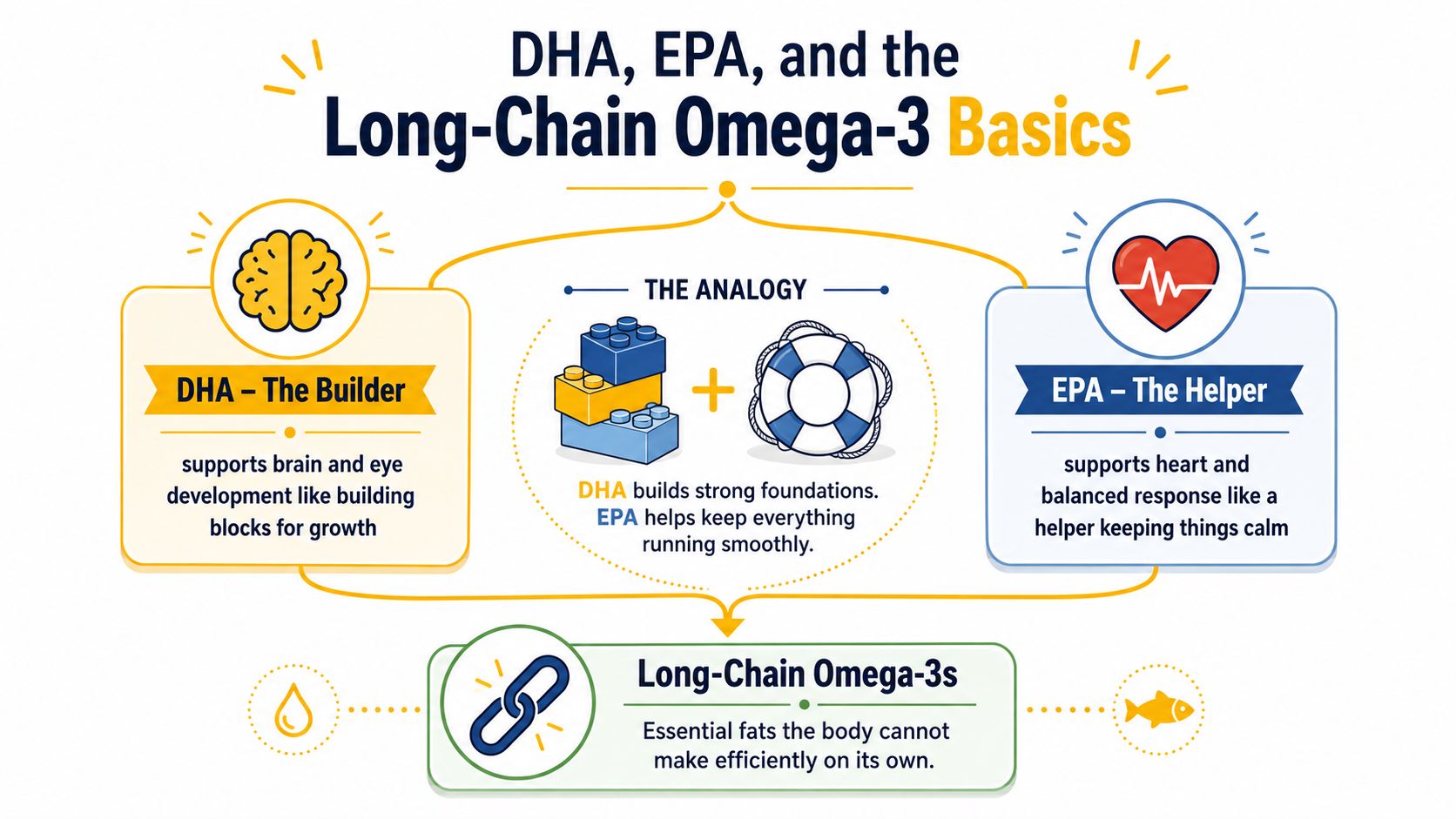
DHA and EPA are the long-chain omega-3 fats most parents are trying to buy. The body doesn't make them efficiently, so they need to come from food or supplements. If you want a simple memory hook, think of them like two different keys. DHA fits more into brain and eye development, while EPA is often discussed in relation to heart health and balanced inflammatory processes.
Why source matters more than the front label
A front label that says “omega-3” doesn't tell you whether the product contains meaningful DHA, EPA, or just a small amount of a precursor fat. That's where ALA comes in. ALA from foods like flax or chia is a shorter-chain omega-3, but the body converts it only modestly, so it can't always do the same job as DHA and EPA.
That's why parents get tripped up by terminology. “Total omega-3” on a label can sound reassuring, but what matters in practice is how much DHA plus EPA your child gets per serve. Once you know that, the rest of the label starts making more sense.
For healthy children, omega-3 is usually discussed in relation to visual development and learning, but the benefit depends on the dose and the child's overall diet. It's not a magic lever, and it's not a substitute for food, sleep, or a balanced routine. It's better to think of it as a nutrient gap-filler, not a universal fix.
A quick way to read the label
If you see DHA and EPA listed separately, that's a good sign the brand is being specific. If you only see “fish oil” or “omega-3 blend,” keep reading until you find the actual active amounts. That's the number that helps you compare one gummy to another, or a gummy to a capsule.
A child doesn't eat “omega-3”, they get a serving of DHA and EPA, or they don't.
Where the Omega-3 in Gummies Actually Comes From
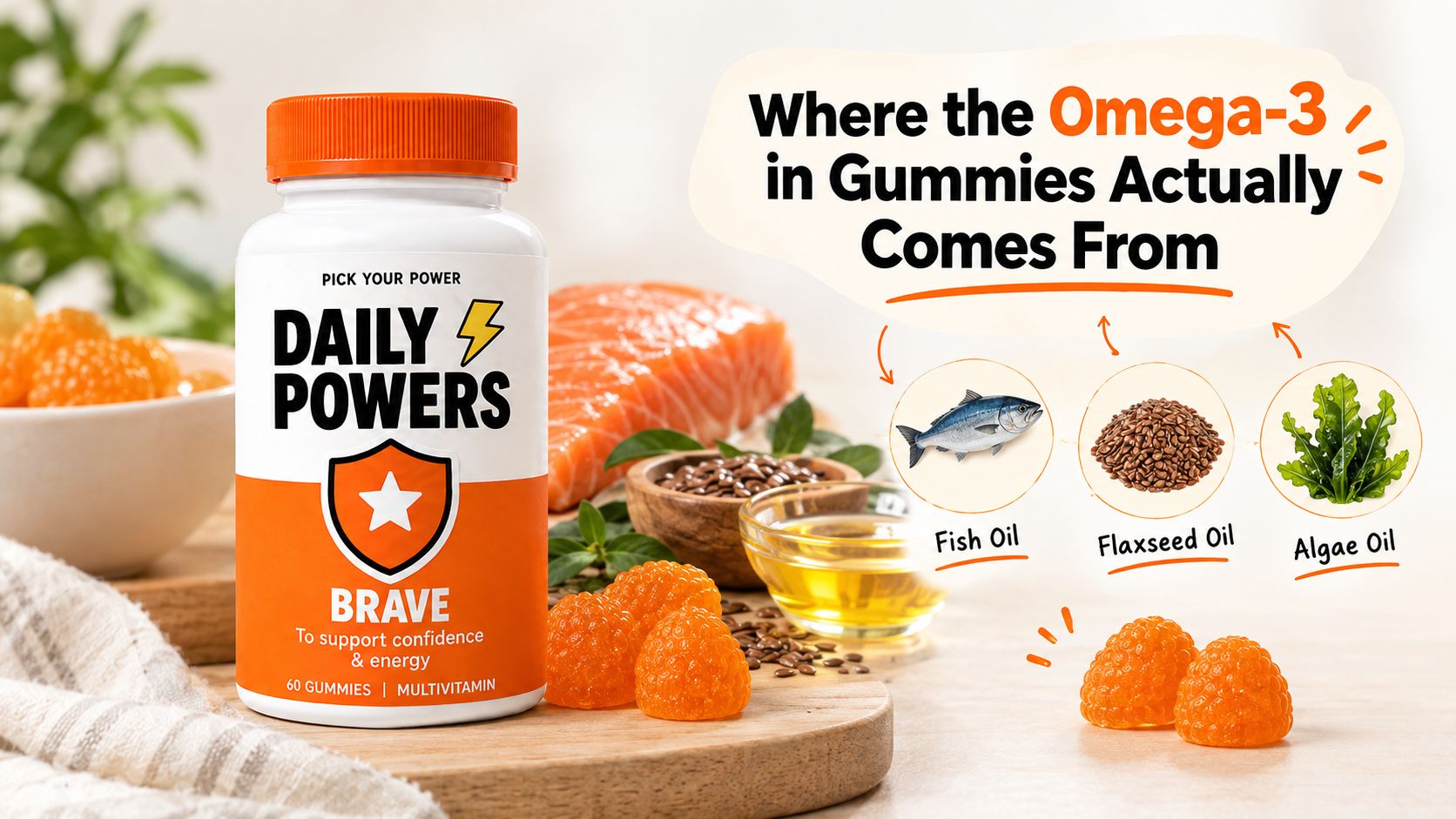
Australian kids' gummies don't all come from the same source. Some use fish oil, some use algal oil, some use krill oil, and some lean on fortification with ALA or microalgal DHA. That source question matters because it affects whether the product suits a fish-allergic child, a vegan household, or a parent who wants to avoid certain marine ingredients.
The source changes the trade-off
Fish oil is the most familiar option, and it usually gives the most straightforward DHA and EPA story. It does, however, raise fish-allergy questions, and it may not suit households that prefer plant-based products. Algal oil avoids fish entirely and is usually the natural fit for vegan products, though parents still need to check exactly which omega-3s are present.
Krill oil sits in a different place again. It's marine-derived, so it isn't vegan, and it still needs the same kind of label scrutiny as fish oil. Fortified gummies can look appealing on the front of pack, but if the actual long-chain omega-3 content is modest, they may not deliver the same practical value as a product built around DHA and EPA from the start.
For parents comparing ingredient styles beyond omega-3, it can help to look at other gummy categories too, like Daily Powers' calm magnesium ingredients guide, because the same label-reading habits apply across supplements.
Brave Gummies, a Daily Powers product, sits in a different category because it's a multivitamin gummy rather than an omega-3 product, but it's a useful reminder that gummy supplements are often designed around routine and texture as much as around nutrients.
The basic rule is simple. If your family needs vegan suitability, look first at algal sources. If fish allergy is a concern, read beyond the front label. If you're using the product mainly for convenience, the active omega-3 source still matters, because that's what determines whether the gummy is just pleasant or actually useful.
| Common omega-3 sources used in kids' gummies | Vegan suitable | Typical DHA+EPA per serve | Sustainability notes | Common in gummies? |
|---|---|---|---|---|
| Fish oil | No | Varies by brand | Depends on fisheries and processing | Yes |
| Algal oil | Yes | Usually DHA-focused, EPA may vary | Plant-based source, often preferred by vegan households | Yes |
| Krill oil | No | Varies by brand | Marine source, needs careful sourcing checks | Less common |
| Fortified ALA or microalgal DHA | Sometimes | Often lower or more limited in EPA | Depends on the exact formulation | Sometimes |
The One-a-Day Promise and What the Serving Size Really Delivers
A pack can look like a one-a-day choice and still ask for several gummies to reach the listed omega-3 dose. That gap matters, because parents are not just buying a flavour or a texture, they are buying a serving pattern their child has to repeat.
In Australian retail examples, kids' products commonly ask for 3 pastilles daily or 4 gummies daily. One listed product provides 34 mg DHA and 6.2 mg EPA per pastille and directs children aged 2+ to take 3 pastilles daily, while another lists 30 mg DHA and 5.5 mg EPA per gummy and instructs children aged 2+ to take 4 gummies daily. Those figures show why the front label can be misleading if you only notice the word “gummy” and not the number of pieces in a serve. Woolworths product listing
A child who takes half the serve is not getting the dose on the pack. That sounds obvious, but it is where gummies become tricky in real homes. Some children will take one piece happily, then lose interest in the second or third. Others will treat them like a treat and want them at the wrong time of day, which makes the routine harder to keep steady.
Serving size also changes how the product fits into family life. A true one-piece habit is simpler than asking for a handful of gummies before breakfast. More pieces mean more chances for refusal, more chances for missed doses, and more chances to finish the bottle faster than expected.
What parents should check is plain and practical. Look for the amount of DHA plus EPA per serve, then check how many gummies make up that serve. If the pack only talks about oil weight, ask the brand for the DHA+EPA figure per gummy before you buy. If the dose is hard to find on the label, the product is relying on convenience to do too much work.
A useful label should answer three questions without guesswork. How many pieces are in a serve? How much DHA plus EPA does that serve deliver? Does that serving pattern still make sense for your child on an ordinary school day? If the answer to any of those is unclear, keep looking.
Quality Markers That Matter on an Australian Label
Not all omega-3 products are stable just because they're sold as supplements. In Australia, a study of 26 fish-oil supplements found 38% exceeded the recommended limit for primary oxidation, 25% exceeded the limit for secondary oxidation, and 33% exceeded the limit for total oxidation. That doesn't mean every product is poor, but it does mean oxidation control is a real formulation and packaging issue for lipid-based omega-3 delivery. PubMed study
Oxidation, packaging, and why gummies can be tricky
Chewable formats need protection from air, heat, and time. A 2022 study found chewable fish-oil gels had much lower oxidation when individually packaged, while syrup forms oxidised fastest because they were more exposed to atmospheric oxygen. Capsule forms were more protected overall. PMC study
For a parent, the practical takeaway is simple. Individually protected packaging is better than an open bottle sitting warm in a cupboard. If a gummy product makes no effort to explain antioxidant protection, batch testing, or storage instructions, that's a reason to slow down.
What to look for before you trust the pack
- Oxidation information: Ask whether the brand can provide a certificate of analysis showing peroxide, anisidine, or TOTOX results.
- Allergen declarations: Check for fish, shellfish, soy lecithin, gelatin, and any “may contain” statements that matter to your family.
- Australian regulatory status: The listing of an adult omega-3 gummy on the TGA's ARTG in June 2025 shows the format is being formally expanded in the regulated Australian supplement market. Natonic product page
- Storage language: If the pack doesn't clearly tell you how to store it, assume heat and humidity may matter more than the marketing suggests.
The other label issue is transparency. A credible product page should make it easy to see where the oil comes from, how it's tested, and how it should be stored. If you have to dig through vague wording to find those basics, that's a signal in itself.
Safe Dosing, Supervision, and Building a Routine That Sticks
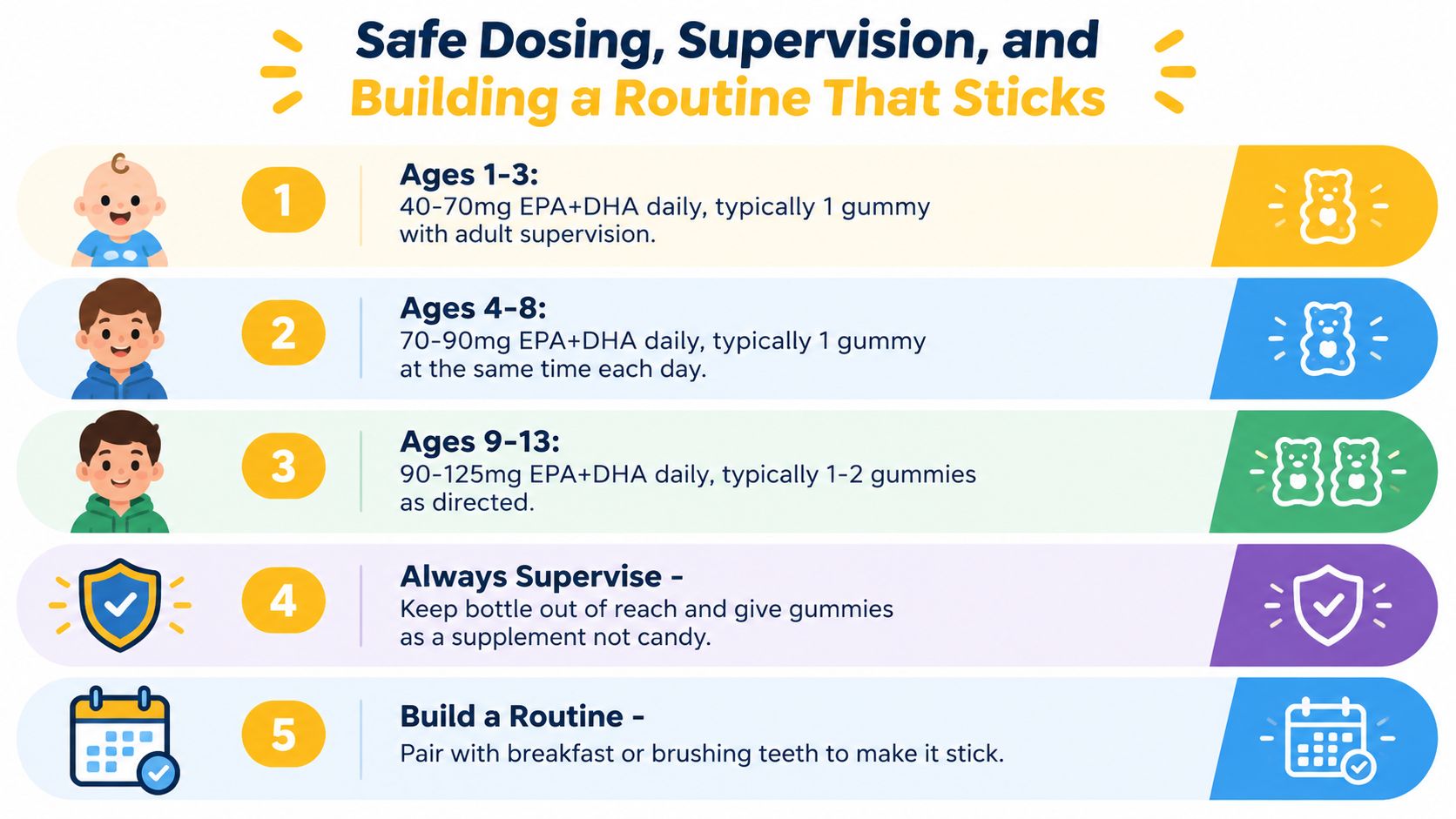
Start with the label, not the slogan. For gummy omega-3, the useful questions are your child's age, the amount of DHA plus EPA per serve, and whether the product fits the age guidance you trust. The NHMRC lists adequate intakes for DHA plus EPA for children, which gives parents a better reference point than a retail promise alone. For that reason, a gummy should be judged as a delivery format, not as a guaranteed daily habit. NHMRC Australian dietary guidelines
How to make the habit safe
Supervision matters most with younger children. Gummies are chewy, sticky, and easy to rush, so a child who gulps food or pockets pieces in the cheek needs closer watching. If the chew is too soft, or the serve needs several pieces, the format may be doing less of the work than the marketing suggests.
The routine often works best with an existing meal. Breakfast, lunch, or another regular family moment gives the gummy a place to sit, like a toothbrush beside the sink. That is usually easier than building a brand-new reminder from scratch.
A few small checks help the habit stick.
- Keep the bottle out of reach: Gummies can look like lollies if they sit on the bench.
- Link it to one anchor habit: Use breakfast, toothbrushing, or schoolbag packing.
- Notice what the child resists: Taste, chew size, or timing may be the issue, not omega-3 itself.
If you like a visual routine, a simple chart can help turn a vague “remember later” into a repeatable step. A practical option is Daily Powers' kids routine chart article, which can help families map the same sequence each day.
If a child does not chew it well, the issue may be the format, not the child.
Gummies Compared With Capsules, Liquids, and Fortified Foods
Gummies are great at one thing, making omega-3 feel acceptable to a child who hates swallowing. That matters. But they're not the strongest option for every goal, and they're often not the most efficient way to deliver a meaningful long-chain omega-3 dose. If your child can manage a capsule, a liquid, or a fortified food, those formats can sometimes deliver more omega-3 with fewer pieces to remember.
Matching the format to the goal
A gummy often wins on palatability and routine. It loses when the active dose is low, when the child needs several pieces daily, or when the family wants a more direct route to DHA and EPA. Liquids can be useful when a parent wants precise dosing or wants to mix the omega-3 into food. Capsules can be efficient, though they're usually less child-friendly if swallowing is an issue.
Fortified foods sit in a different category again. They can be easier to accept as part of normal eating, but they don't always provide a reliable daily amount unless the serving is carefully tracked. That's why gummies work best as a bridge, not as a universal solution.
| Omega-3 Delivery Formats Compared | Typical DHA+EPA per serve (mg) | Cost per 100 mg DHA+EPA (AUD) | Kid-friendly administration | Best suited for |
|---|---|---|---|---|
| Gummies | Varies, often spread across several pieces | Varies by brand | High, if the child likes chewing | Fussy eaters, routine building |
| Capsules | Often higher per serve | Varies by brand | Lower for young children | Older kids who can swallow pills |
| Liquids | Adjustable by teaspoon or dropper | Varies by brand | Medium, depends on flavour | Flexible dosing, food mixing |
| Fortified foods | Often lower or variable | Hard to compare | High if the food is already accepted | Households using food-based habits |
The clearest case for gummies is this, your child won't take another format, but you still want a regular omega-3 routine. The clearest case against them is when the child is old enough for a capsule or accepts a liquid easily. In those cases, the format can be more direct and less repetitive.
A Short Caregiver Checklist Before You Buy
Start with the active amount, not the marketing. Check the label for DHA plus EPA per serving, then ask whether that serve matches your child's age and your reason for buying it. If the pack only tells you the oil weight, you still don't know what your child is getting.
Then scan the ingredient panel. Look for added sugars, sugar alcohols, or sweeteners, and check for fish, shellfish, gelatin, or soy lecithin if your family has allergy concerns. If your child has a known milk, fish, or other sensitivity, this step matters more than flavour claims.
Before you commit, ask whether the brand can show real quality checks, especially for oxidation and storage. Make sure there's an Australian contact line, an expiry date you can read easily, and instructions that make sense for where you keep the product at home.
Try the gummy for a short period before buying in bulk. Watch whether your child accepts the texture, whether sugar-free versions cause tummy changes, and whether there are any skin or behaviour changes that you want to discuss with a professional. A GP or an accredited practising dietitian can help you decide whether the product fits your child's diet, or whether another format would make more sense.
Daily Powers builds children's supplements around routine, taste, and simple daily habits, which is useful if you're comparing formats rather than chasing a quick fix. If you're weighing gummy omega-3 against other options for your child, visit Daily Powers to explore how a practical supplement routine can fit into family life and where a gummy format does, or doesn't, make sense.