

You're halfway through school pick-up when your child says their tummy hurts. By dinner, they're bloated, cranky and pushing vegetables around the plate. You're left wondering whether it's a passing stomach bug, constipation, picky eating or something you should take more seriously.
Gut health for kids doesn't require a perfect menu or a cupboard full of supplements. It starts with understanding how the gut works, noticing patterns rather than isolated symptoms, and building ordinary habits around fibre-rich foods, water, sleep and regular meals. Supplements can have a place, but they sit alongside food and shouldn't replace professional advice when symptoms persist.
Table of Contents
- What This Guide Covers for Busy Parents
- Understanding the Child Gut Microbiome
- Signs of Imbalance and Why Australian Kids Are at Risk
- Food and Habits That Build a Healthy Gut
- Prebiotics and Probiotics for Children
- Building a Daily Routine That Actually Sticks
- Common Myths Parents Should Drop
- A Parent Checklist and When to See a GP
What This Guide Covers for Busy Parents
Gut health is the everyday condition of the digestive system and the community of microorganisms living inside it. Those microorganisms help process parts of food that the body can't digest alone, interact with the gut lining and contribute to normal immune function. For a primary-school-aged child, this can show up in very practical ways, from comfortable bowel movements to having enough energy for school and homework.
The gut isn't separate from the rest of a child's wellbeing. Discomfort can disturb sleep, poor sleep can affect concentration and mood, and a limited diet can make it harder to provide the fibre that beneficial gut bacteria use. That doesn't mean every sore tummy points to a microbiome problem. It means repeated patterns deserve calm attention.
This guide will help you work through:
- What the microbiome is: A simple explanation of the gut's microbial community and why fibre matters.
- What to watch at home: Bloating, irregular stools, tummy pain and other signs that may justify a closer look.
- What Australian children are eating: Local data showing why fibre and plant variety are important priorities.
- What to put on the plate: Kid-friendly prebiotic foods, realistic meal ideas and routines that fit busy weekdays.
- Prebiotics compared with probiotics: The difference between feeding existing beneficial bacteria and adding live bacterial strains.
- When supplements may matter: A food-first decision framework rather than an automatic “more is better” approach.
- When to call the GP: Clear warning signs that shouldn't be managed only at home.
The useful aim: You're not trying to create a flawless gut. You're creating a steady environment where healthy eating, regular movement, sleep and medical care can work together.
Understanding the Child Gut Microbiome
Think of the gut as an inner garden. The microbes are the living plants, and fibre-rich foods provide the rain and sunlight that help the garden thrive. A varied diet gives different microbes different materials to use, while disruptions such as illness, antibiotics, major dietary changes or a highly limited menu can alter the garden's balance.
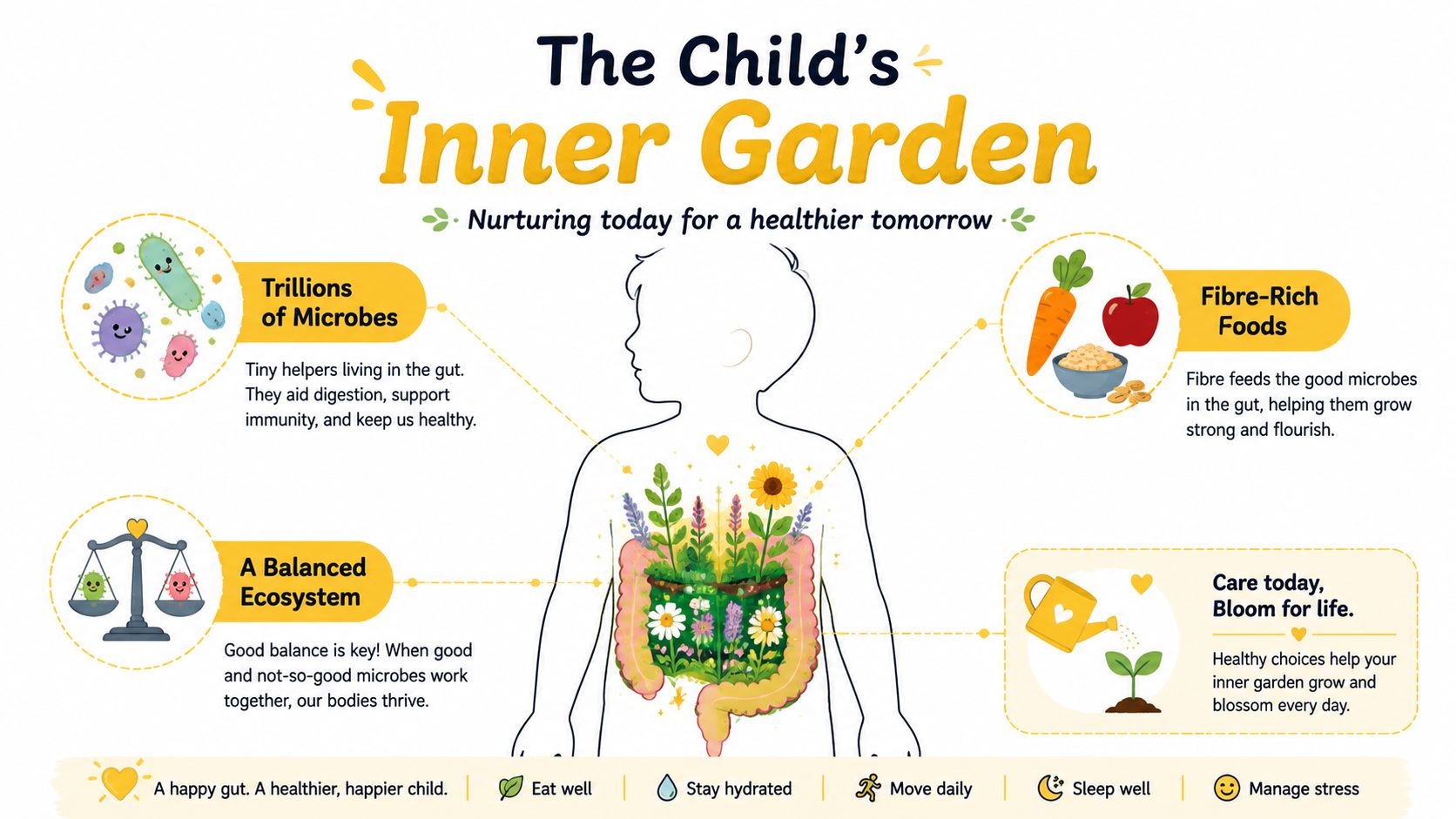
Digestion starts with the garden
Gut microbes ferment some of the fibre that reaches the large intestine. That process produces compounds that support the gut environment and contributes to stool bulk and movement. In daily life, a child with a well-supported digestive routine may pass stools more comfortably and regularly, although bowel patterns still vary between children.
For example, oats at breakfast, fruit in the lunchbox and legumes at dinner give the gut different types of fibre across the day. A sudden jump in fibre without enough fluid can instead cause extra gas, so changes should be gradual.
Immunity has a gut connection
The gut lining is one of the body's major points of contact with the outside world. Microbes and the compounds they produce interact with that lining and with immune processes. This is one reason a varied diet and a healthy intestinal barrier matter for normal immune function, rather than because a supplement can guarantee that a child won't get sick.
A child who attends school or childcare will still encounter ordinary infections. Gut-supporting habits are part of general health, not a substitute for vaccination, hand hygiene or appropriate medical care.
Mood, sleep and concentration
The gut-brain axis describes two-way communication between the digestive system and the nervous system. Signals from the gut can influence how a child experiences discomfort, appetite and stress, while stress can affect digestion and bowel habits.
A child with abdominal discomfort may become irritable after school or struggle to settle at bedtime. The immediate answer might be a calmer evening and help with constipation, not a promise that changing the microbiome will solve every emotional or learning concern.
In plain language, a helpful summary is: feed the gut garden with a variety of plant foods, support it with water and sleep, and investigate ongoing symptoms instead of guessing.
Signs of Imbalance and Why Australian Kids Are at Risk
Parents usually notice gut problems through patterns at home. These might include hard or infrequent stools, loose stools, bloating, repeated tummy pain, straining, changes in appetite or discomfort after meals. Mood changes and disrupted sleep can accompany digestive discomfort, but they aren't proof of a microbiome imbalance on their own.
Frequent colds or eczema flare-ups also shouldn't automatically be labelled as gut symptoms. They're signals to discuss in context, particularly if they occur alongside bowel changes, poor growth, restricted eating or ongoing abdominal pain.
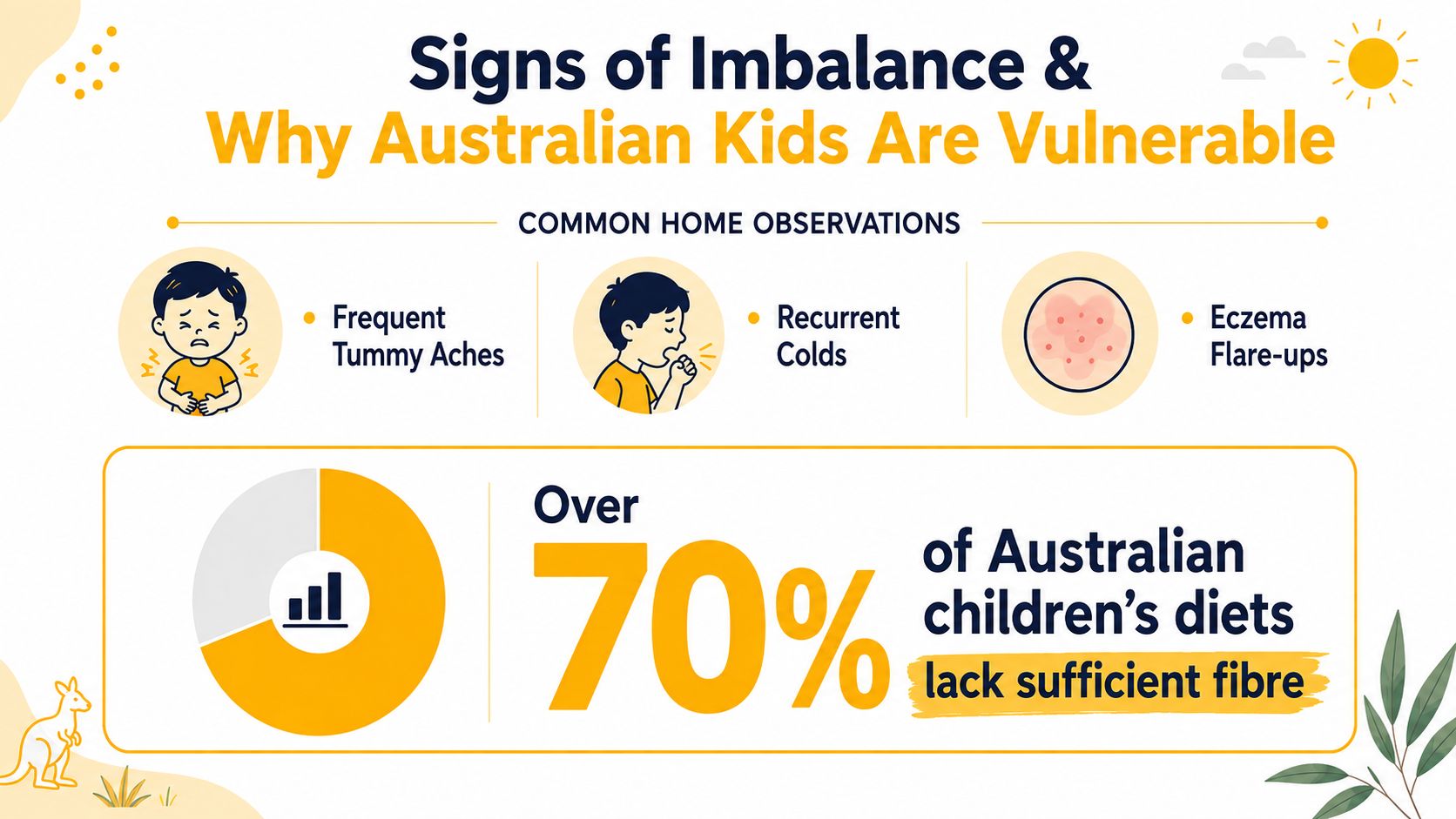
The Australian fibre gap
In 2022, 96% of Australian children and adolescents aged 2–17 didn't meet the recommended serves of vegetables, while 36% didn't meet the recommended serves of fruit, according to the Australian Institute of Health and Welfare data reported in the paediatric literature. The same source indicates that 96% missed the combined fruit-and-vegetable target.
That matters because plant foods provide fibre, and fibre is a major everyday fuel for beneficial gut bacteria. The gap becomes especially pronounced with age. Among children aged 14–17, 54% didn't meet fruit targets and 96% didn't meet vegetable targets, compared with 3.2% and 81% respectively among children aged 2–3. These figures don't diagnose an individual child, but they show why families need simple routines that keep working as children become more independent.
Use the age target as a guide
Australian recommendations provide a practical reference point:
| Age | Recommended fibre (g/day) | Typical Australian intake (g/day) |
|---|---|---|
| 2–3 years | 14 | 14–20 |
| 4–8 years | 18 | 14–20 |
| 9–13 years, boys | 24 | 14–20 |
| 9–13 years, girls | 20 | 14–20 |
The recommendations and reported intake range are summarised in this paediatric review of dietary fibre and gastrointestinal health. Treat the table as a direction, not a scorecard. A child's intake can vary from day to day, and increasing fibre works best when you add foods gradually and offer water regularly.
A simple home check is to ask:
- Bowel pattern: Has your child's usual stool pattern changed or become uncomfortable?
- Plant variety: Are fruit, vegetables, whole grains, legumes, nuts or seeds appearing across the week?
- Fluids: Is water available throughout the day, especially when fibre intake rises?
- Persistence: Does the issue keep returning rather than resolving after a brief change?
- Impact: Is pain affecting sleep, school attendance, appetite or normal activity?
Food and Habits That Build a Healthy Gut
At the kitchen bench, a healthy gut routine can start with familiar foods. Offer variety across the week rather than expecting one meal to provide everything. Different colours, textures and forms count, including roasted vegetables, mashed legumes, wholegrain toast, fruit, oats and soups. The Australian healthdirect guide to prebiotics and probiotics explains that prebiotics are high-fibre foods that feed gut microorganisms.
Start with familiar foods
Small changes are easier to accept than a sudden switch to unfamiliar meals:
- Fruit: Serve bananas, apples, pears or berries whole, sliced, or mixed into yoghurt.
- Breakfast grains: Use oats or wholegrain cereal as a simple fibre base.
- Legumes: Add lentils, chickpeas or beans to pasta sauce, dips, soups and patties.
- Wholegrain breads: Keep the usual sandwich filling while changing the bread gradually.
- Cooked and cooled starches: Potatoes or pasta that are cooked, cooled and then eaten offer a different fibre environment. Follow your child's tolerance.
- Vegetables: Carrot, corn, peas, pumpkin and sweet potato may be gentler starting points than strongly flavoured greens.
A budget-friendly swap can be as simple as oats instead of packaged breakfast foods, dried or canned legumes instead of more expensive meat in some meals, and seasonal or frozen vegetables instead of out-of-season produce. Choose canned legumes with less added salt when available, and rinse them before use.
Place a small serve beside a food your child already accepts. Repeated, low-pressure exposure gives children room to become familiar with new tastes without turning the table into a negotiation.
A realistic day at the kitchen bench
Breakfast might be oats with banana and berries. A lunchbox could contain a wholegrain sandwich, cucumber or carrot sticks and fruit. After school, offer yoghurt with berries or a small oat-based snack. Dinner might combine pasta with lentil-rich sauce, vegetables and a side your child already enjoys.
A short weekly preparation routine can make these choices easier. Cook a batch of oats or grains, wash fruit, portion vegetables, and prepare one legume-based sauce or dip. Keep some items visible and ready to serve. The aim is a dependable pattern, not a perfect menu.
Regular meal and snack times help children notice hunger and fullness. Water is the default drink, and slower eating gives them more time to chew and recognise discomfort. A consistent evening wind-down can also help, since overstimulation may make digestive complaints feel more intense the following day.
Families exploring links between nutrients, routines and children's concentration can read this guide to magnesium supplements for kids, while keeping the broader food-first approach in view.
Prebiotics and Probiotics for Children
Prebiotics and probiotics aren't interchangeable. A prebiotic is a non-digestible fibre that beneficial gut bacteria can use. A probiotic is a live microorganism provided in a food or supplement. One feeds the garden already there, while the other introduces selected living strains.
FOS, or fructooligosaccharides, is a commonly used prebiotic. It's related to fibres found naturally in foods such as bananas, onions, garlic and asparagus. Prebiotic fibres may support regular bowel movements, stool softness and the production of short-chain fatty acids, compounds associated with the intestinal lining and gut function. A review of fibre and prebiotic effects reports that fermentation products can support calcium and magnesium absorption, while increased bacterial biomass can benefit bowel movements, as described in this NIH-hosted review.
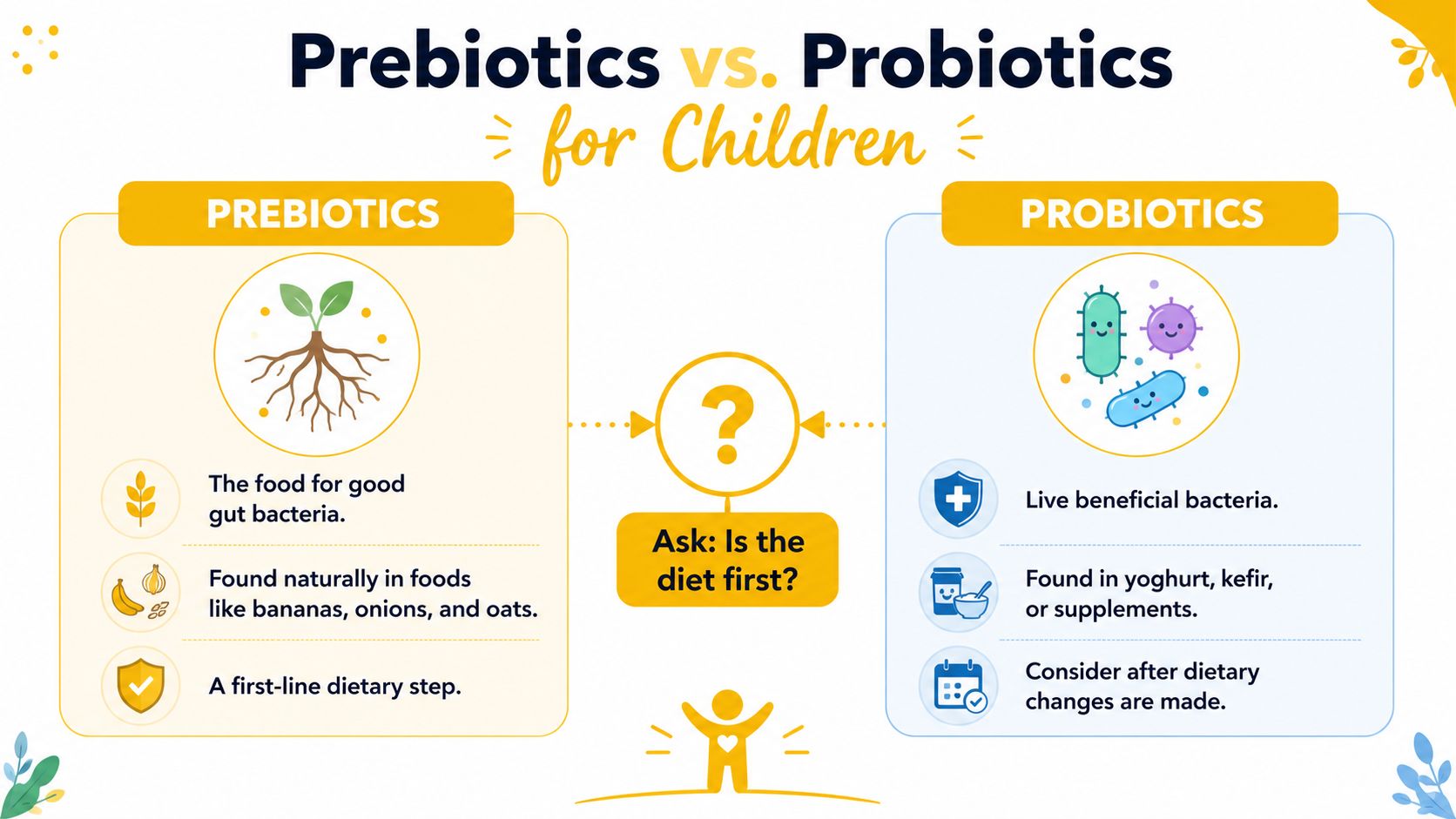
What the evidence says about adding fibre
An Australian cohort analysis from the Melbourne InFANT Program linked early-childhood fibre intake with gut barrier function and later immune and inflammation pathways. Broader paediatric review evidence reports that prebiotic fibres such as inulin and galacto-oligosaccharides can increase beneficial Bifidobacterium populations by 1–2 log units within 2–4 weeks, as described in this review of prebiotics and children's gastrointestinal health.
That doesn't mean every child needs a concentrated fibre product. It means the type of fibre matters, the response can vary, and gradual introduction is sensible because some children experience gas or bloating when their intake changes quickly.
Where probiotics may fit
Probiotics have strain-specific effects, so “probiotic” isn't a single treatment. Evidence is strongest in particular situations, including some forms of acute diarrhoea, while everyday use for healthy children has mixed support.
A 2026 Australian randomised trial involving 118 children aged 2–5 in childcare or kindergarten found that a daily multi-strain probiotic was associated with a 62% reduction in gastrointestinal tract infections during the final 16 weeks, but the benefit took up to 8 weeks to emerge and didn't reduce respiratory infections, according to the Federation University Australia trial report. That's a targeted finding, not a reason to give every healthy child a probiotic indefinitely.
Daily Powers Focus is one example of a kid-friendly routine containing 100 mg of prebiotic FOS per daily serving, alongside mushroom polysaccharides, vitamin D3, zinc and elderberry fruit powder. Its product information states that children take two gummies daily, or as directed by a healthcare professional. A product like this should complement varied meals, not stand in for them.
A sensible framework is straightforward:
- Food first: Build plant variety, water and regular meals.
- Define the reason: Consider a probiotic for a specific, time-limited situation rather than vague “boosting”.
- Check the child: Ask a GP or paediatric dietitian before supplementing a child with significant medical conditions, restricted eating, persistent symptoms or complex medication needs.
Building a Daily Routine That Actually Sticks
Children respond well to predictable cues. A routine becomes easier when the habit has a name, a place and an anchor, such as breakfast, the after-school snack or homework time. The cue shouldn't create pressure. It should remind everyone what happens next.
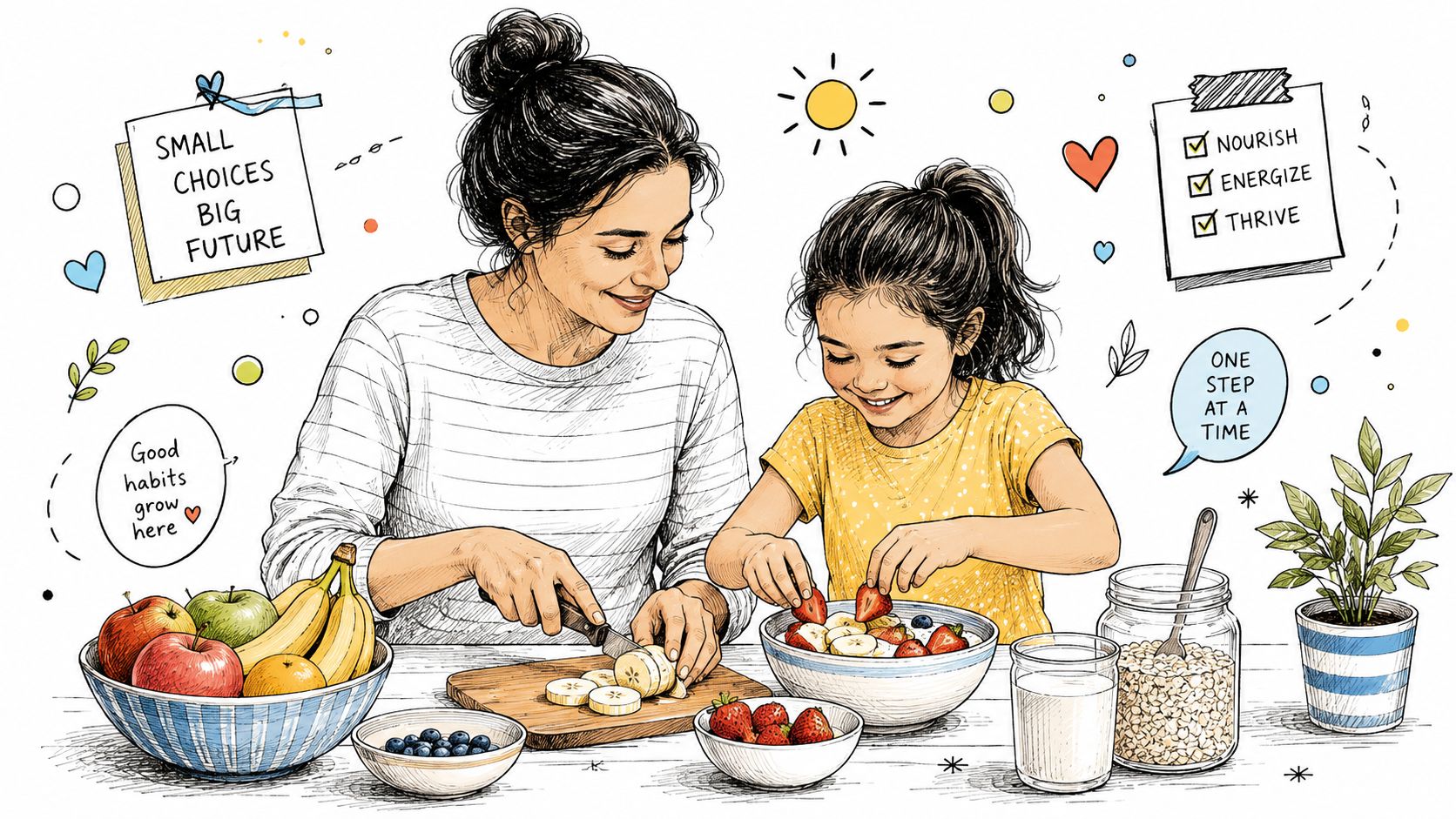
Make the week predictable, not rigid
A workable rhythm might look like this:
- School mornings: Serve a fibre-containing breakfast, such as oats, fruit or wholegrain toast, and offer water.
- Lunchboxes: Include one familiar food, one plant food and a filling option such as yoghurt, egg, cheese or legumes, according to the child's diet.
- After school: Use a prebiotic-rich snack before homework, such as banana with yoghurt, berries with oats or wholegrain crackers with hummus.
- Dinner: Add vegetables or legumes to a meal the family already eats instead of preparing a separate “health” dish.
- Evenings: Keep the wind-down consistent and reduce stimulating screen use before bed.
The routine is more important than making every meal impressive. If your child rejects the vegetable, the exposure still counts. Offer it again later without turning it into a test.
A useful cue: “Time for your focus habit” can signal homework, water, a snack and a short reset. The gummy, if you choose to use one, is only one part of that sequence.
For families who want a child-friendly format within a homework ritual, Daily Powers Focus can be paired with the start of study. Its product information describes a sugar-free, vegan gummy with no artificial colours or flavours, but the family should still follow the label and professional advice.
A separate positive routine can be built around Brave, a daily multivitamin gummy described by the product information as supporting general wellbeing through essential vitamins and a child-friendly habit. It doesn't replace the food, fluid and sleep foundations that support digestion.
Sleep deserves its own attention. A predictable bath, reading or quiet activity can help children shift out of the day's stimulation. Parents looking for practical ideas can use this guide to helping kids get to sleep.
Common Myths Parents Should Drop
Myth one, more probiotics is always better
Australian families are already familiar with probiotic products. One Australian study found that 47.4% of healthy preschool-aged children had ever taken probiotics, while 14.9% had taken them during the previous month, as reported in the Journal of Paediatrics and Child Health study.
That doesn't prove probiotics are harmful or unnecessary. It shows why parents need to ask what they're trying to achieve. A specific strain may be useful in a specific setting, but a higher dose or longer course isn't automatically better, and evidence for routine use in healthy children remains mixed.
Myth two, gut health is only about food
Food supplies the fibre, but the gut also responds to the wider routine. Poor sleep, stress, low movement, illness and antibiotic exposure can affect appetite, bowel habits and how a child experiences discomfort. Screen time matters indirectly when it replaces active play, regular meals or a calm bedtime.
The practical answer isn't to control every variable. Keep meals predictable, encourage movement, offer water and protect sleep where you can.
Myth three, kids will simply grow out of it
Early microbial development matters. Australian research found distinct faecal microbiota profiles associated with dairy foods and plant-based foods in children aged 2–3. More recent Australian research comparing 50 Indigenous Australian infants living remotely with age- and sex-matched non-Indigenous infants in urban Australia found differences in 114 species and 38 genera, with greater alpha diversity and dominant Bifidobacteria species in the Indigenous group; the infants were a median age of less than one year, according to the Nature Communications study.
Those findings don't prescribe one “perfect” microbiome. They show that environment, food exposure and lifestyle shape the gut early, so supportive habits are worth building before problems become entrenched.
A Parent Checklist and When to See a GP
Keep the daily plan small enough to repeat:
- Fibre variety: Offer fruit, vegetables, whole grains and legumes across the week.
- Fluids and pace: Make water the default drink and give children time to eat slowly.
- Sleep: Use a consistent wind-down and bedtime routine.
- Prebiotic habit: If appropriate, pair a prebiotic-rich food or professionally selected supplement with an existing daily cue.
- Observation: Track patterns in stools, pain, bloating, appetite, sleep and school participation.
Speak with a GP if constipation or diarrhoea persists for more than two weeks, if there's blood in the stool, unexplained weight loss, recurring severe abdominal pain, frequent infections alongside gut symptoms or a sudden change after antibiotics. A GP can decide whether your child needs assessment, testing or referral to a paediatric dietitian. For broader nutrition questions, this guide to vitamins and the immune system can provide general context, but it isn't a substitute for individual medical advice.
The aim is a steady, low-friction routine, not a perfect menu or a spotless symptom record. Small choices repeated across school days, weekends and holidays can give your child's gut a more reliable supply of fibre, fluid, rest and care.
Daily Powers offers children's gummy routines designed around everyday needs, including Focus with prebiotic FOS for families pairing gut support with homework and concentration habits. Visit Daily Powers to review the ingredient information and choose whether a simple, food-first routine could suit your family.