

You're not dealing with a child who “just won't sleep.” You're dealing with a tired body, an overstimulated brain, and a bedtime pattern that's probably been leaking energy all evening. If you're in Australia, staring down another late-night stall, the useful question isn't whether your child is difficult, it's whether the routine is giving them enough sleep opportunity for their age, and enough cues to settle.
Table of Contents
- Why Bedtime Battles Happen and What Australian Data Reveals
- Building a Resilient Bedtime Routine That Sticks
- Calming Nutrition and the Power of a Mental Sleep Cue
- Age-Specific Sleep Schedules for Children Aged 4 to 12
- When Bedtime Resistance Is About More Than Routine
- Troubleshooting Common Sleep Problems and When to Seek Help
Why Bedtime Battles Happen and What Australian Data Reveals
A mum tells me her eight-year-old is “in bed by 7.30” but still not asleep until after 9. There's water, a toilet trip, one more story, a louder protest, then the familiar call from the hallway. That pattern feels personal in the moment, but the wider Australian picture is clear, sleep is a measurable developmental need, not a vague personality trait.
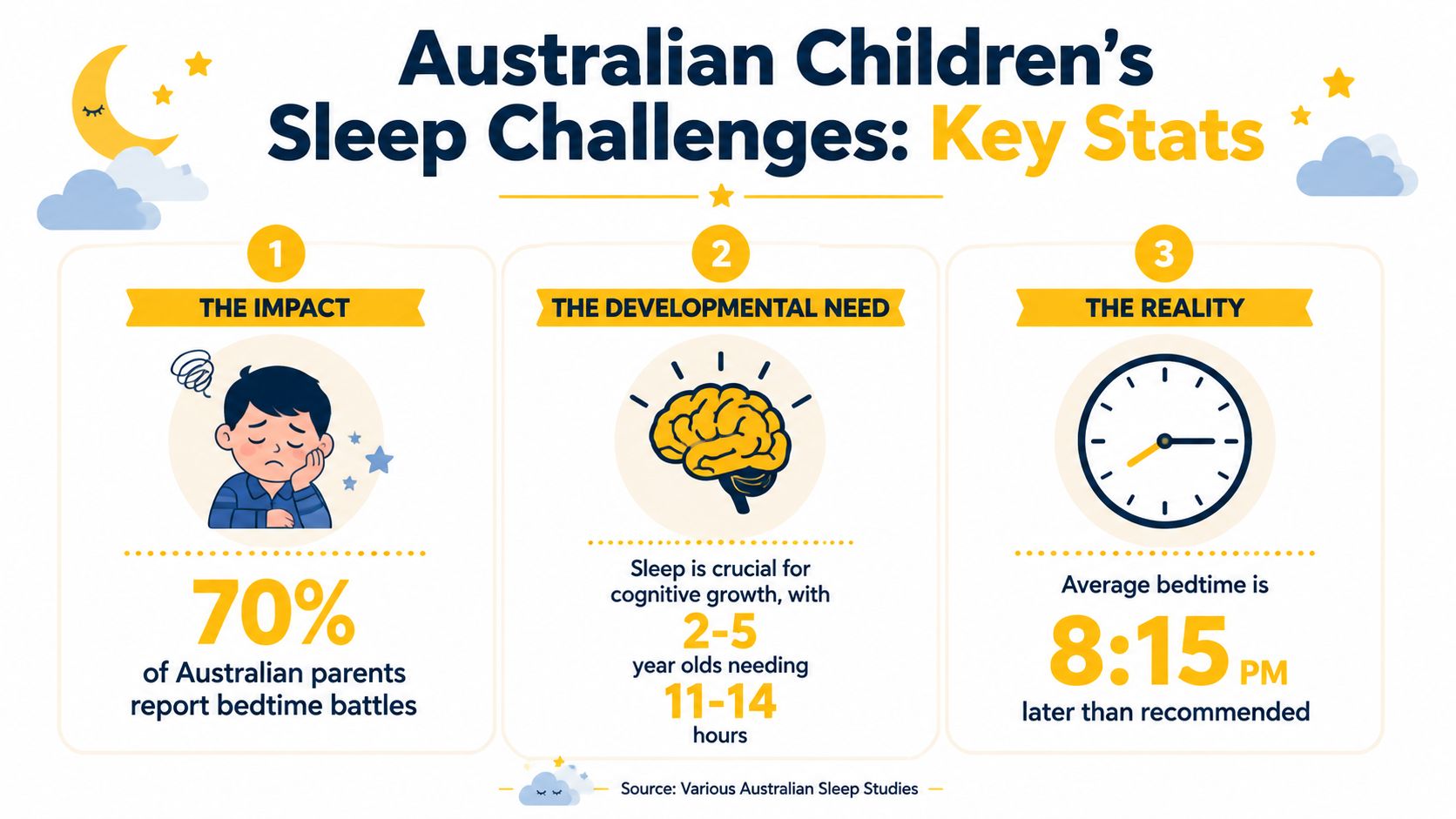
The Australasian Sleep Association recommends 10 to 13 hours for children aged 3 to 5 years, 9 to 11 hours for 5 to 13 years, and 8 to 10 hours for 13 to 18 years. The national sleep-health guidance also says children should get enough sleep for optimal functioning, and that up to half of Australian children may not be meeting recommended sleep needs. That means a child who wakes after only 7 to 8 hours is short on sleep even if bedtime looks “early enough” on paper. See the age-based targets in the Australian guidance on children's sleep needs and bedtime routines.
What the Australian pattern really looks like
The 2019 National Children's Nutrition and Physical Activity Survey found 17% of children aged 2 to 17 years had short sleep duration, defined against the Australian guideline, and the problem was more common in older children and adolescents. Australian monitoring has also shown weekday and school-night sleep differ from non-school nights, which is how sleep debt builds across the week. For parents, the takeaway is blunt, bedtime battles are often the visible edge of a routine problem, not a rare sleep disorder. The survey data is summarised in Australian children and sleep patterns.
Practical rule: If your child is still getting out of bed for fresh negotiations, the routine is teaching them that bedtime is flexible.
Sleep hygiene matters, but it's only part of the answer. Australian guidance also emphasises regular sleep timing, independent settling, and limiting evening stimulation. The issue usually isn't that a child can't sleep, it's that family schedules, screens, late energy, and inconsistent responses compress the sleep window until sleep becomes a fight instead of a cue-based habit.
Building a Resilient Bedtime Routine That Sticks
A bedtime routine falls apart quickly when it depends on how tired or patient a parent feels at 7.15 pm. It holds when a child learns the same sequence every night, and learns that asking for more does not change the order. That is behavioural conditioning, not willpower, and it is why some routines settle in while others unravel after a few nights.
Start with timing. A wind-down routine should begin about 30 minutes before the usual sleep time, then move through three to five quiet activities over roughly 20 to 45 minutes. The order matters more than novelty. When bath, pyjamas, teeth, story, bed happen in the same order, the brain starts reading those steps as sleep cues. The APA's guidance on a predictable routine matches this structure in sleep-friendly bedtime habits.
The sequence that helps bedtime settle
Keep the same rhythm most nights, and keep bedtime itself within a narrow window.
- Start the wind-down on time. The phone goes away, the noise drops, and the room starts to feel slower before the child is already overtired.
- Repeat the same short actions. Teeth, bathroom, pyjamas, story, lights out. The point is predictability, not perfection.
- Put the child down drowsy but awake. If they fall asleep only after you leave the room, they learn that your presence is the final sleep cue.
- Respond the same way each time they call out. Brief, boring, and consistent works better than changing the response every night.
If you change the plan halfway through the week, the child does not learn sleep. They learn persistence.
That is where many families get stuck. One night there is an extra cuddle, the next night there is not, then a drink is added, then a parent sits on the floor for twenty minutes. Intermittent rescue responses can reinforce repeated wake-ups, because the child keeps testing for the version that worked last time. Behavioural sleep programs tend to work best when adults stay steady, and the UK Department for Education parent-training trial reported a 92% post-intervention response in the data provided in the brief.
A simple support tool can sit inside that structure if it is used as a cue, not as a bribe. Brave is a daily multivitamin gummy designed as a repeatable “pick your power” ritual for kids, which fits the wider idea that a bedtime habit works best when children can predict what happens next. Used that way, the value is not magic. It is routine, repetition, and the same calm finish every night. For parents weighing whether a supplement belongs in the evening routine, this guide to the best vitamins for kids can help you sort out what fits a family's needs and what does not.
Calming Nutrition and the Power of a Mental Sleep Cue
The best wind-down rituals do two jobs at once. They relax the body, and they tell the brain, “We do this now because sleep is next.” That second part matters more than most parents realise. Children don't just need to feel tired, they need a mental cue that bedtime is arriving.
A magnesium-based gummy can fit that pattern when it's used consistently and early enough in the evening. Parents who use Calm often describe it less as a fast fix and more as a signal that the day is closing down. Its snapshot includes magnesium citrate, vitamin B6, zinc and prebiotics, with 0 sugar, vegan ingredients, and no artificial colours or flavours. The practical value is that a child starts associating the same words, the same taste, and the same time of night with settling down, which can reduce friction before the lights are even off.
The timing matters. The most useful window is 30 minutes to 1 hour before bed, because that gives the ritual enough runway to feel like a transition rather than a last-minute scramble. One mother's bedtime pattern captures the idea well, she gives her daughter a “sleepy gummy” every night, and the child now understands that it means bedtime is coming. That's behavioural training, not just supplementation. It turns the gummy into a consistent cue that helps her feel mentally ready for bed.
The other reason this can work is that the ritual itself is simple. No bargaining. No long negotiations. No screens. Just a repeated action that marks the end of the day and gives the child one stable thing to expect. If you want a practical read on how families layer supplements into broader routines, the article on which vitamins parents usually compare for kids sits in the same routine-first mindset.
Useful lens: the gummy is doing better work when it becomes part of the bedtime story, not the main event.
That's the trade-off. A supplement can support a calm evening, but it won't rescue a chaotic night by itself. The value is in the predictability, the association, and the fact that children often respond to identity cues, especially when the cue is repeated in the same way every night.
Age-Specific Sleep Schedules for Children Aged 4 to 12
A lot of bedtime friction eases when parents stop asking, “What time should my child be in bed?” and start asking, “What sleep window does this age need?” The answer changes as children grow, and school start times push families to be more deliberate than they used to be. The strongest bedtime routines don't depend on your mood at 7.15 pm. They work because the child learns a repeatable sequence, and that sequence becomes the cue for sleep rather than a source of debate.
The practical job is fitting the right sleep target around a 7 am wake-up. A child who needs 10 to 13 hours cannot usually function well on a bedtime that keeps sliding later, especially once school nights begin to stack up. The same applies to older primary-school children who need less than preschoolers, but still need more sleep than a rushed routine usually leaves room for.
Recommended sleep schedules by age group
| Age Group | Recommended Sleep | Example Bedtime, 7 am Wake | Wind-Down Start |
|---|---|---|---|
| 4 to 5 years | 10 to 13 hours | around 6.00 to 8.00 pm | around 5.30 to 7.30 pm |
| 6 to 8 years | 9 to 11 hours | around 8.00 to 10.00 pm | around 7.30 to 9.30 pm |
| 9 to 12 years | 9 to 11 hours | around 8.00 to 10.00 pm | around 7.30 to 9.30 pm |
For families who are currently well off target, the shift should be gradual. The NHS recommends starting the winding-down routine about 30 minutes before the usual sleep time, then moving bedtime earlier by 5 to 10 minutes each week, or 15 minutes if the child has been going to bed very late. That slower change is easier on children than a sudden reset, and it usually creates less evening pushback. The relevant NHS guidance is sleep timing for young children.
If your child treats bedtime like a negotiation, a structured cue can help the whole house settle faster. Focus is a daily blueberry-flavoured gummy designed around a repeatable routine for school days and homework, and the relevance here is behavioural, not magical. Children often settle better when the same ritual shows up at the same time each day, because the brain starts linking that routine with the next expectation.
Keep the school-week bedtime steady even when weekends tempt you to drift. That helps families reduce the Monday-night reset.
Consistency across the week is the key. If bedtime slides later on two nights and snaps earlier on three, the child spends more energy adapting than sleeping. A stable bedtime, even if it is not perfect, usually beats a flashy plan that falls apart by Thursday.
The sequence that works
Most families do better with the same order every night. Dinner, bath or shower, dimmer lights, pyjamas, toilet, teeth, then the same sleep cue and the same phrase. The point is not perfection. The point is that the child can predict what comes next without having to test the boundary each night.
A mental sleep cue helps here because it gives the child something concrete to attach to the routine. Some families use a short story, a quiet chat about tomorrow, a magnesium-based wind-down ritual, or a small daily product like Focus as the final step in a repeatable pattern. What matters is that the cue stays familiar, low-key, and linked to sleep, not to excitement or bargaining.
Older children often resist less when they feel some control inside the routine. Let them choose the book, the pyjamas, or which hand gets the final cuddle. That is a real trade-off many parents miss, because a child who feels boxed in will often fight harder even when they are tired.
The sequence should stay boring in the best way. Short, repeated, and calm. That is what teaches the body and the mind that bedtime is coming, and that sleep is the next job.
When Bedtime Resistance Is About More Than Routine
Some children aren't resisting sleep because the routine is weak. They're resisting because bedtime feels unsafe, lonely, overstimulating, or hard to regulate. That shows up as fear of the dark, repeated reassurance-seeking, intense separation distress, or a child who escalates the moment you leave the room.
Australian caregiver survey data in 2024 found 38% of parents of children aged 4 to 18 said their child worries about sleep, and 33% said sleep problems cause family strain. That's why generic advice like “just stay consistent” can feel insulting when your child is panicking, not stalling. The better response is to match the strategy to the cause. The survey data is referenced in this Mayo Clinic discussion of children's sleep worries.
What to do when fear is driving the bedtime fight
If the issue is separation difficulty, don't disappear abruptly and don't keep extending your stay. Use graduated reassurance. Stay close at first, then reduce your presence in small steps over several nights so the child experiences safety without learning that sleep only happens when you're in the room.
If the issue is sensory sensitivity, adjust the environment. A dim nightlight low to the ground, a quieter room, and fewer visual distractions can matter more than another story. For some children, a steady non-stimulating sound also helps the brain ignore small noises outside the room.
If the issue is emotional overload, keep the language simple. The bedtime script should be short enough that the child can repeat it back. Long explanations often make anxious children more alert, not less.
A child who worries at bedtime needs reassurance with boundaries, not more negotiations.
That's where a predictable cue can still help. The “sleepy gummy” or another repeated wind-down marker gives the child one small anchor in a night that otherwise feels uncertain. It won't solve anxiety on its own, but it can lower the emotional temperature before the final separation happens.
If the strain keeps building, it's worth naming the family impact plainly. Parents often end up exhausted, resentful, and stuck in a nightly loop that gets louder instead of calmer. The goal isn't to win the bedtime argument. It's to make bedtime feel emotionally safe enough that sleep can happen.
Troubleshooting Common Sleep Problems and When to Seek Help
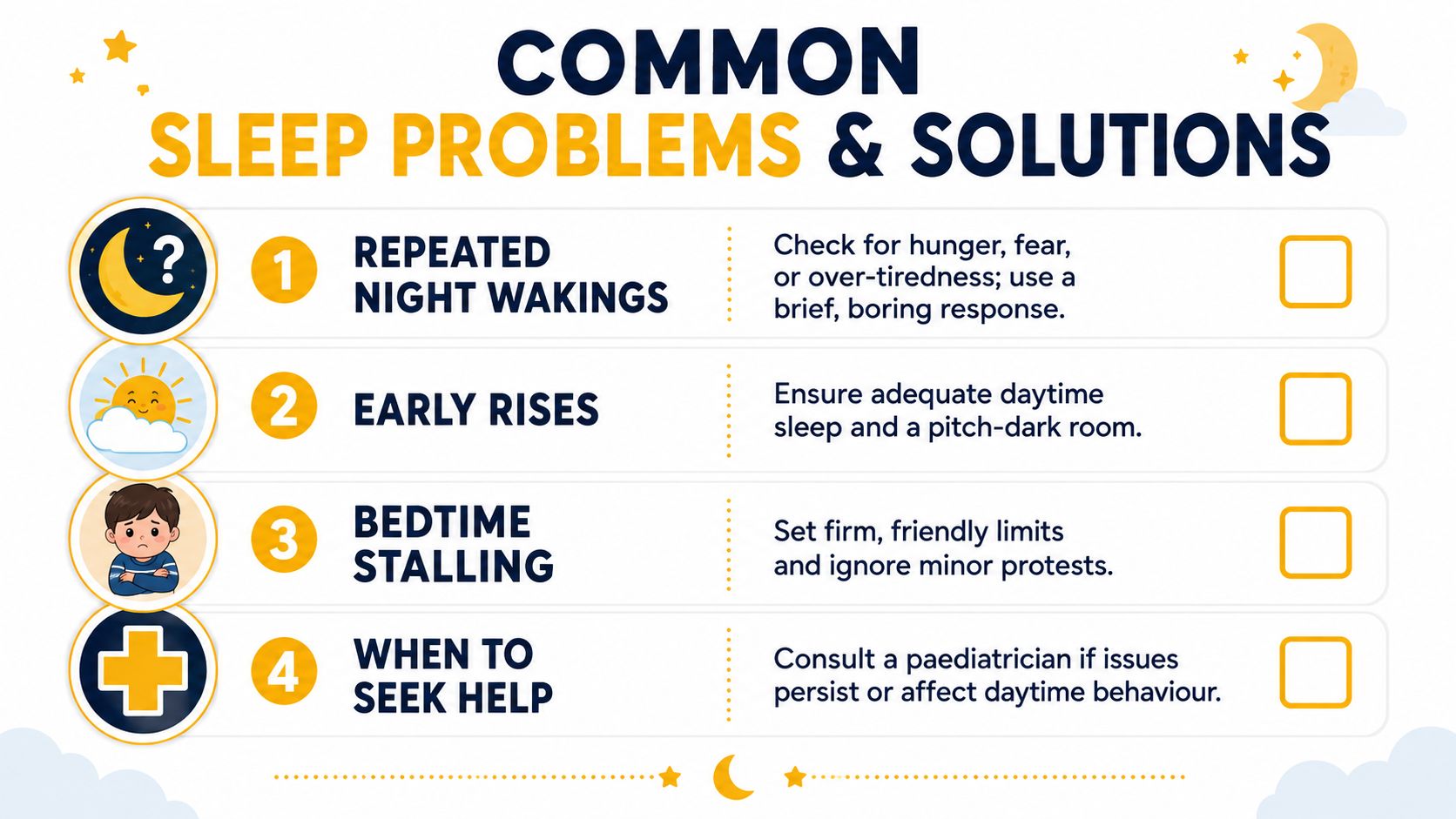
The most common sleep problems tend to cluster in a few predictable ways. Repeated night wakings, early morning rises, bedtime stalling, and sibling disruption all look different on the surface, but the response usually comes down to the same principle, keep it brief, boring, and consistent. That's how you avoid accidentally rewarding the very behaviour you're trying to reduce.
The behavioral methods with the strongest practical results are graduated extinction and structured fading. In the evidence summary provided, they typically improve sleep within about 1 week, often within 7 to 10 days, while more permissive parental-presence approaches usually take longer and are less successful from the parent's point of view. The mistake that slows everything down is changing the plan mid-week, especially by adding screens, long negotiations, or variable check-ins. The trial and review data is summarised in the UK Department for Education report on parent-led behavioural sleep strategies.
Use the right response for the problem
- Repeated night wakings: Check for hunger, fear, or overtiredness, then give a brief, boring response and leave the room again.
- Early rises: Make sure the room is pitch-dark and that daytime sleep isn't pushing bedtime too late.
- Bedtime stalling: Set firm, friendly limits and ignore minor protests that don't signal real distress.
- When to seek help: Book a paediatrician if the problem keeps going or starts affecting daytime behaviour.
Persistent snoring, night terrors, or sleep problems that don't improve after two weeks of consistent routine work deserve medical attention. So do nights where the child seems chronically unwell, or where the whole family is still struggling despite following the same plan properly. The point is not to wait forever and hope the child grows out of it.
If the problem is mostly behavioural, the fastest path is usually to simplify. One clear bedtime, one repeated routine, one response after lights out. If the problem is deeper, the routine still matters, but you'll want a paediatrician or sleep specialist to help sort out what else is going on.
If you're ready to make bedtime calmer, Daily Powers offers sugar-free, vegan kids' gummies built around repeatable daily rituals, including options that support wind-down, focus, and confidence. Visit Daily Powers if you want a routine-first approach that fits real family life and gives your child a predictable cue each evening.