

You're standing in the supermarket aisle, one child wants the colourful gummies, another is reaching for snacks, and you are trying to work out whether immune system vitamins are worth buying or just another label promise. That confusion is normal. The better question is not “which vitamin boosts immunity?”, it is “is my child missing a nutrient the immune system needs to do its job?”
For Australian families, that shift matters. The NHMRC Nutrient Reference Values set the benchmarks, not overseas wellness slogans, and Australian survey data show that some children do not meet the intake levels expected for key nutrients such as vitamin D, especially in cooler southern latitudes and in winter. A review of Australian vitamin D data also discusses this pattern in children and adolescents (PMC review of Australian vitamin D data). If a child is already under-consuming a key nutrient, a sensible daily routine can help close the gap. If they are not, megadoses usually add noise, not benefit.
Table of Contents
- The Question Parents Should Be Asking
- How Vitamins Support the Immune System
- The Six Core Nutrients for Children's Immunity
- Why a Daily Routine Beats a Seasonal Fix
- The Megadose Myth and Safe Upper Limits
- Building a Safe Daily Routine Your Child Will Follow
- A Simple Checklist Parents Can Come Back To
The Question Parents Should Be Asking
A parent standing in the supplement aisle is usually not short on concern. The hard part is sorting concern from need. The shelves call out “immune support” from every direction, but the better question is whether the child is under-consuming the nutrients that matter most.
That question matters in Australia because the pattern is often a deficiency-first one, not a megadose one. The Australian Health Survey 2011–12, as discussed in the Australian nutrition and immune support review, reported that vitamin D intake from food was very low in the general population. The same review also notes that deficiency is common enough to be a public health concern, especially in winter and for children with limited sun exposure. For parents, that points to a practical check, look for a real gap in the diet before reaching for a bottle.
Practical rule: start with the child's usual week, not the marketing claim on the front of the packet.
A lunchbox built around fruit, yoghurt, wholegrains, eggs, and vegetables already covers a lot of ground. A child who avoids those foods most days may have a different nutrient picture, and that is when immune system vitamins become more relevant. The aim is plain, food first, fill the gap, don't overdo it.
Daily Powers expert advice fits that approach because it treats daily routines as part of family habit, not a cure-all. That distinction matters. Parents do not need a louder promise, they need a clearer way to decide whether a supplement is doing useful work or just adding expense.
How Vitamins Support the Immune System
A child's immune system works like a house with several jobs happening at once. The outer walls keep germs out, the alarms notice trouble, and the repair crew helps the body settle back down after a challenge. Vitamins and minerals do not switch that system into overdrive. They help each part do its own job properly.
The barrier and defence layers
Vitamin A helps maintain the body's protective barriers, including skin and mucous membranes, which are the first line between your child and the outside world. Vitamin C supports innate immune cell function and antioxidant defence, so the cells doing frontline work are less likely to be strained. Vitamin D has a different role again, helping regulate immune responses so they do not tip too far toward inflammation.
The key point is simple. Different nutrients support different steps in the immune response, and a child can run short on one without needing a huge amount of everything else.
That is why parents get better results from asking, “What might my child be under-consuming?” than from asking, “Which vitamin is the strongest?” A lunchbox can look full and still miss a nutrient that matters, especially if the same few foods show up every day and the rest of the week is light on variety. The goal is to spot the gap, then fill it with food first whenever possible.
The signalling and repair side
Zinc supports immune-cell development and function, and it sits alongside vitamins C and D in the group of nutrients most often discussed in immune guidance. If a child is low in one of these, the whole system can have a harder time doing routine maintenance, just as a school photocopier struggles when paper, toner, and power are not all there at once.
That is where a multi-nutrient product makes more sense than chasing one “hero” ingredient. The body does not run on a single switch. It runs on linked processes, and those processes need steady input from the diet or, where appropriate, a supplement that fits the child's routine.

If you are comparing kid supplements, Brave is a daily multivitamin gummy for children that is designed around a simple routine rather than a one-off rescue strategy. That format matters because the immune system responds better to regular coverage than to occasional big promises.
The Six Core Nutrients for Children's Immunity
A parent can stand in the supplement aisle, read “immune support” on the front, and still not know whether the product matches what a child needs. The clearer way to judge a kids' immunity formula is nutrient by nutrient, because the label on the front often hides a mix of ingredients that each do different jobs.
| Nutrient | Primary Immune Role | NHMRC Target (Kids 4–12) |
|---|---|---|
| Vitamin C | Supports normal immune function and helps protect cells from oxidative stress | 25 mg/day for ages 4–8, 35 mg/day for ages 9–13 (consumer fact sheet) |
| Vitamin D | Helps regulate immune responses and immune-cell activity | 600 IU (15 µg)/day for ages 1–18 (NIH immune function fact sheet citing Australian guidance) |
| Zinc | Supports immune-cell development and function | Age-specific Australian intake benchmarks apply, with expert reviews highlighting zinc as a core immune nutrient |
| Vitamin A | Supports immune function and protective barriers | Australian age-appropriate intake guidance is used for dietary planning, and children need intake from food or supplements when advised |
| Vitamin E | Antioxidant support for immune cells | Useful supporting nutrient, especially in a balanced diet, not a stand-alone immunity fix |
| Vitamin B6 | Supports normal immune function and cell production | Supportive, but not the main nutrient parents usually need to prioritise first |
The strongest immune-support case is vitamin C, vitamin D, and zinc. These are the nutrients most often highlighted in immune guidance because they map more directly onto everyday immune functions and, in some children, a real intake gap. For a parent shopping after work, that means a formula containing those three usually deserves more attention than one built around flashier extras.
The other nutrients still matter. Vitamin A, vitamin E, and vitamin B6 are better understood as supporting players than headline acts. If a child's diet is thin, a broader formula can make sense, but the label should still be judged by whether it fills a likely gap rather than by whether it sounds impressive.
A deficiency-first approach helps here. Some children get enough from food, while others fall short because their diets repeat the same small set of foods and miss a wider range of nutrients. That is why the question is not just which vitamin “boosts” immunity, but which nutrient is under-consumed for that child. The best vitamins for kids guide is useful only if it is read through that lens.
A quick check on the age range can also help parents avoid guesswork. Vitamin C is a good example because the recommended intake rises from 25 mg/day for ages 4–8 to 35 mg/day for ages 9–13 (consumer fact sheet). Small differences like that matter when you are comparing a label with your child's age, because they show why a one-size-fits-all approach can miss the mark.
Parents do not need a shelf full of bottles. They need a short list of nutrients, a sense of which ones are most likely to be low, and a product that fits the child's routine well enough to be taken.
Why a Daily Routine Beats a Seasonal Fix
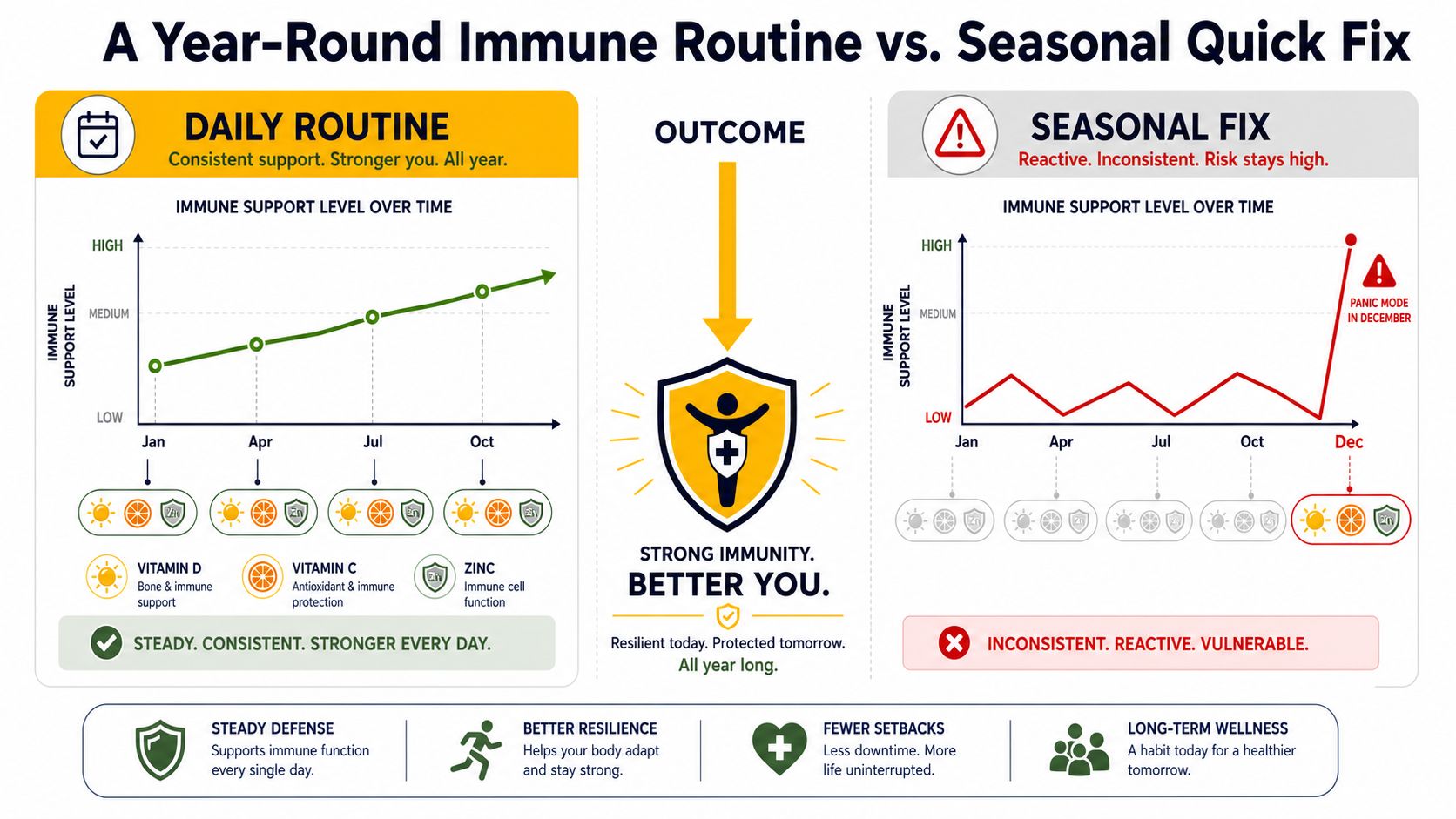
A seasonal supplement habit sounds tidy. Flu season arrives, the shopping list gets longer, and parents reach for the strongest-looking bottle. The problem is that immune nutrition doesn't work like a last-minute revision session.
Steady intake matters more than panic buying
Water-soluble nutrients such as vitamin C are used and cleared regularly, so a steady intake pattern makes more sense than an occasional big push. Fat-soluble nutrients such as vitamin D behave differently, because the body can store them, but that still doesn't make random loading a good idea. The safer pattern is consistent intake that matches age-appropriate needs, not bursts that hope to compensate for months of inconsistency (Mount Sinai nutrition guidance).
A daily habit beats a heroic weekend effort because the immune system works every day, not just in June.
The habit has to be easy enough to repeat
Parents often think they're choosing between “good supplements” and “bad supplements”. The more useful choice is between something a child will reliably take and something that ends up in a drawer. A gummy, liquid, or chewable can help because adherence matters. If the child refuses the format, the nutrient never gets to do its job.
The consumer note that families use these products all year round matches what daily nutrition looks like. School terms, sports, colds, travel, and picky eating don't run on a neat seasonal schedule. A repeatable cue, like breakfast or brushing teeth, gives the family a rhythm that's more realistic than an immune panic plan.
The Megadose Myth and Safe Upper Limits
A parent standing in the supplement aisle can feel pulled toward the biggest bottle or the strongest claim. The clearer question is simpler. Which nutrients is a child under-consuming, and which product fits age-appropriate needs without pushing past what the body can use?
The hardest message for many parents is also the most useful. More is not better. Harvard Health says there's no evidence that megadoses improve immunity, and the NIH Office of Dietary Supplements places the immune value of vitamins and minerals in the context of deficiency correction, not pushing intake above requirements (Harvard Health, NIH immune function fact sheet).
Why “just in case” can be the wrong approach
Fat-soluble vitamins such as A and D can accumulate, so piling on extra isn't harmless. Water-soluble vitamin C is less likely to build up in the same way, but that still doesn't make high-dose tablets a shortcut for immunity. Zinc is useful too, but the NIH guidance warns that high doses can become counterproductive and can interfere with other nutrient absorption over time (NIH immune function fact sheet).
The deficiency-first frame helps. If a child's eating pattern leaves a gap, the goal is to fill that gap, not to aim for the largest possible dose and hope it does extra work.
What safe thinking looks like
Safe thinking starts with age-appropriate intake, not with the biggest number on the shelf. For children, the aim is to correct gaps and then stop. That is different from trying to “supercharge” the immune system, because immune function depends on balance, not overdrive.
The practical test is simple. If a child is eating reasonably well and using a sensible daily supplement only when needed, that is usually more useful than repeated high-dose products with no clear reason. The parent job is not to chase the boldest promise. It is to match the product to the child's actual intake pattern and keep it within safe upper limits.
Building a Safe Daily Routine Your Child Will Follow
The easiest routine is the one that fits into a morning that is already busy. Put the supplement where the day already has a rhythm, beside breakfast, after the school uniform goes on, or as part of the toothbrush routine. Children do not need a lecture in that moment. They need the same cue, in the same place, day after day.
A good routine also starts with the child in front of you, not with the biggest promise on the packet. If the goal is to fill a likely gap, the question is whether the product fits the child's pattern of eating and the family's routine. That is a more useful way to think about immune system vitamins than hunting for a product that sounds strong.
Make the routine match the nutrient
Some nutrients are easier to absorb with food. If a product contains vitamin D, taking it with a meal that includes some healthy fat can help absorption, which is one reason breakfast or lunch often works well. If the formula includes zinc or iron, read the label carefully and follow any spacing instructions, especially if the product guidance says to avoid taking it with calcium-heavy meals.
That kind of label reading matters more than a broad immunity claim. A supplement only helps when the routine matches the nutrient, the dose, and the child's eating pattern.
Product format matters too. Soft chewables and gummies are often easier for picky eaters to accept than chalky tablets, and flavour can be the difference between a habit that stays in place and one that gets dropped. That does not make a gummy magical. It just makes it practical enough to use.
Read the label like a parent, not a marketer
Start with three questions.
- What nutrients are included? If vitamin C, vitamin D, and zinc are present, the formula is closer to the core immune support profile families usually look for.
- Does the dose fit a child, not an adult? Children aged 4 to 12 need age-appropriate amounts, not a smaller version of an adult label.
- Does it fit the diet already in your house? A child who eats fruit, dairy, eggs, legumes, and vegetables may need less supplementation than a child with narrow food choices.
If you want a simple daily multivitamin format to compare, Daily Powers' family collection gives parents a place to look at options built around repeatable use, transparent ingredients, and child-friendly formats. That still does not replace label checking. It just gives you a concrete starting point for judging a product in context.
A Simple Checklist Parents Can Come Back To
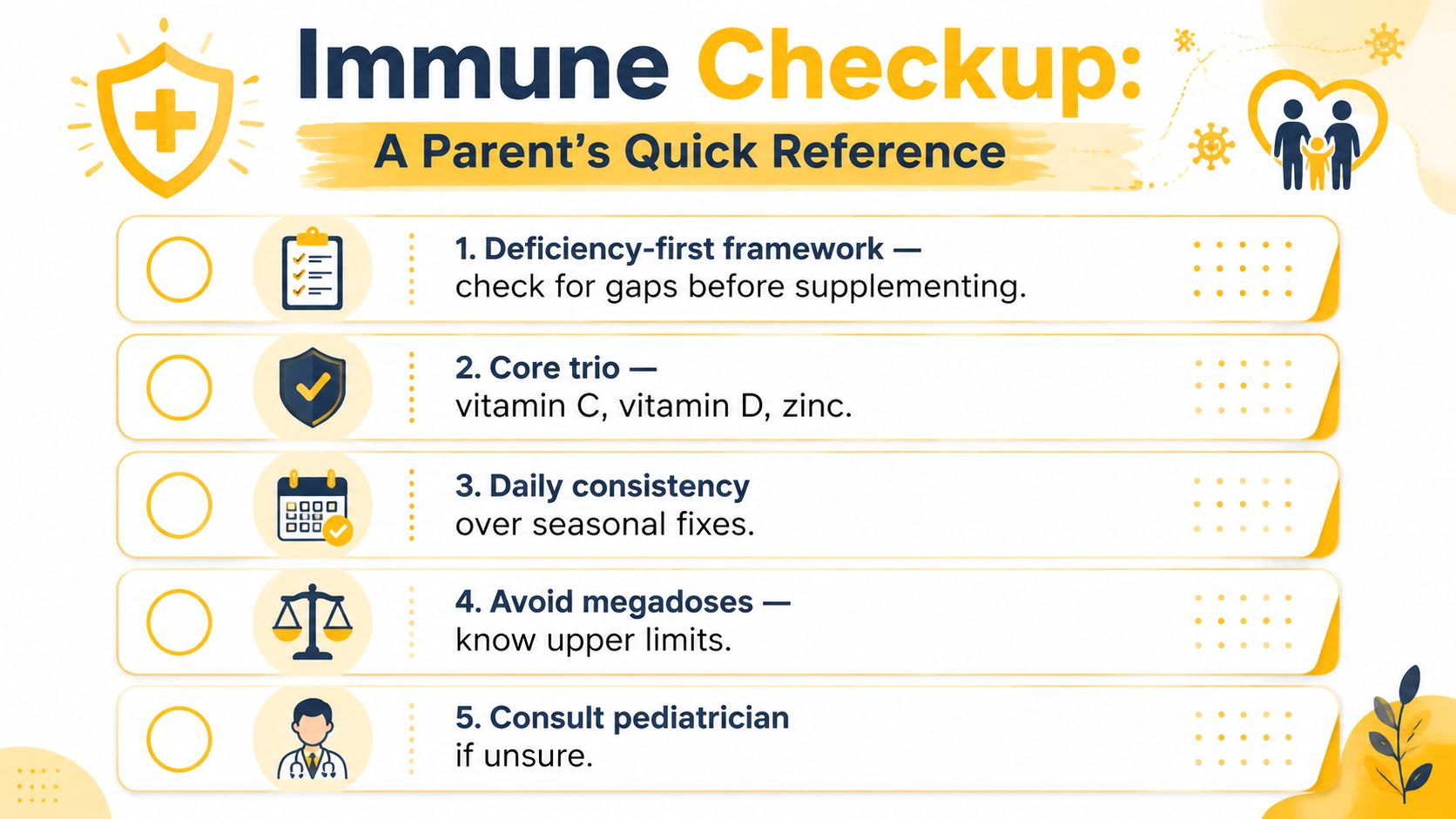
The easiest way to think about immune system vitamins is to keep the framework small. Start with diet gaps, because that's where the problem usually is. Prioritise vitamin C, vitamin D, and zinc, because those are the core nutrients with the clearest immune role.
If you're stuck between products, ask whether the dose fits your child's age, whether the routine will happen, and whether the formula is trying to do too much. Avoid megadose thinking. More isn't the goal, balance is.
Parent shortcut: if the supplement feels like a rescue mission, pause and check whether it's really filling a gap.
For most families, a varied diet plus a sensible daily supplement when there's a known shortfall is enough. You don't need a perfect immune protocol, and the science doesn't ask for one.
Daily Powers makes child-friendly gummy supplements that fit into a simple routine, which is often the missing piece when parents are trying to support nutrition consistently. If you want to compare options for a daily family habit, visit Daily Powers and look at how the products are structured around repeatable use, transparent ingredients, and kid-friendly formats.