

Immunity is your child's learned defence system against germs, and Australia's 2025 fully immunised coverage was 90.5% at 12 months, 88.4% at 24 months, and 92.5% at 60 months. It's also a balanced, regulated response, not something a parent can “boost” with one food, vitamin, or gummy.
Your child has a runny nose again. Perhaps it's the third cold in a few weeks, and you're wiping their face while wondering whether their immune system is working properly. If they're vaccinated but still catching coughs, colds, or stomach bugs, the word immunity can feel confusing.
In plain language, immunity means the body's ability to recognise and respond to threats such as bacteria, viruses, and fungi. Australian health guidance describes the immune system as a coordinated network of cells, chemicals, tissues, and organs that protects the body from infection, rather than a single substance that can be increased at will. (Australian Government immunisation guidance)
The useful question isn't “How do I make my child's immunity stronger?” It's “How does my child's defence system work, what protection does vaccination provide, and which everyday habits help it function normally?” This distinction can make winter illnesses feel less alarming and supplement decisions more practical.
Table of Contents
- What Immunity Actually Means for Your Child
- The Two Arms of Your Child's Immune System
- How Immunity Builds From Babyhood to the Primary Years
- The Biggest Myth About Kids' Immunity
- Everyday Habits That Genuinely Support Immune Health
- Where Supplements Fit and Where They Don't
- When to See a Doctor Instead of Reaching for a Gummy
- A Simple Framework for Supporting Your Child's Immunity
What Immunity Actually Means for Your Child
The simplest immunity meaning for a parent is this: immunity is the body's learned ability to recognise and respond to germs it has encountered before. The immune system can remember a threat and respond more quickly if it meets that threat again. Australian Government guidance explains that immunisation is the process of becoming immune after vaccination, while immunity itself means the body can fight infection. (Australian Government immunisation guidance)
That doesn't mean your child becomes protected from every illness moving through childcare or school. A vaccine targets particular diseases, and the immune system responds specifically to the threats it has learned to recognise. A vaccinated child can still catch an ordinary cold caused by a different virus, just as a child with a balanced diet can still have a blocked nose after sharing toys with classmates.
Practical rule: A cold doesn't automatically mean your child's immune system is weak, and vaccination doesn't promise a childhood without sniffles.
The word “boost” can also lead parents in the wrong direction. A well-functioning immune system needs regulation. If it's underactive, the body may struggle with infection. If it overreacts or attacks the body's own tissues, problems can include allergies or autoimmune conditions. Healthdirect describes immunity as part of a body-wide system that defends against infection and abnormal cells while protecting healthy tissues. (Healthdirect explanation of the immune system)
So, supporting immunity means helping the system operate normally through adequate sleep, nourishing food, hydration, hygiene, and evidence-based immunisation. It doesn't mean forcing the immune response higher with a single supplement. That balanced view helps parents interpret frequent childhood illness without assuming that every cough signals failure.
The Two Arms of Your Child's Immune System
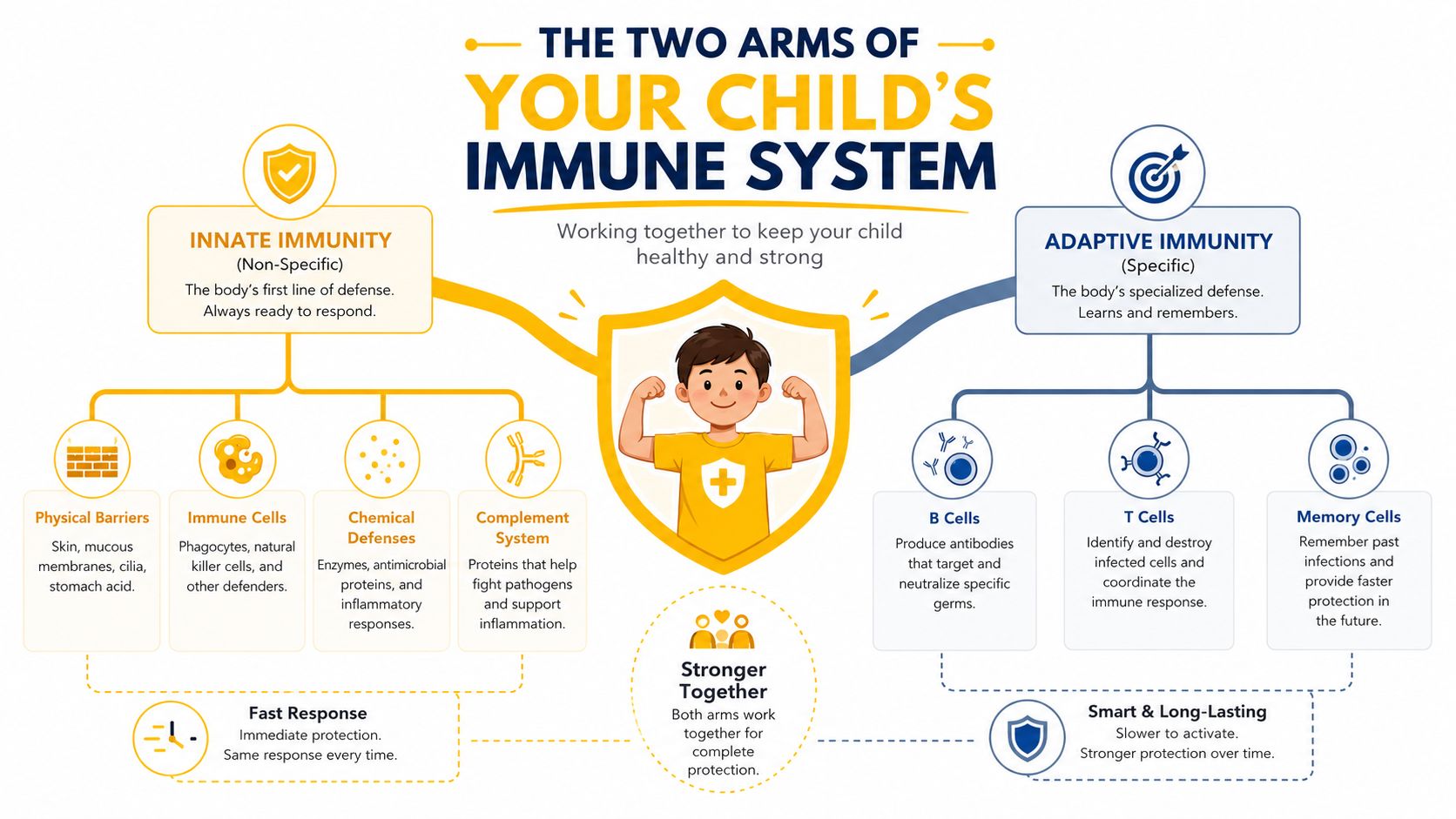
Think of your child's immune system as two connected teams. The first is an always-on security guard at the body's boundaries. The second is a specialist group that studies unfamiliar intruders and remembers them.
The first team is called innate immunity. It includes physical barriers such as skin and mucus, along with fast inflammatory responses, fever, and natural killer cells. It reacts broadly and quickly when something may be harmful. It doesn't need a previous introduction to begin working.
The second team is adaptive immunity. B cells can produce antibodies, while T cells help coordinate the response and identify infected or abnormal cells. This branch takes more targeted action and develops memory. If it meets a familiar threat again, it can respond more efficiently.
These arms don't work as two isolated steps. Innate immunity helps alert and direct adaptive immunity, while adaptive responses add precision and memory to the initial defence.
Active and passive protection
Australian health resources also distinguish between active immunity and passive immunity. Active immunity develops when your child's own immune system makes protective antibodies and immune memory after infection or vaccination. It tends to last longer because the child's body has done the learning itself. (NSW Health glossary on immunity)
Passive immunity is borrowed protection. A baby receives antibodies from the mother across the placenta, and breastmilk can provide additional immune support. This protection is temporary, while the baby's own immune system develops its responses.
Both forms matter in early life. Passive antibodies offer early help, while vaccination and normal exposure allow the child's adaptive system to build its own memory.
How Immunity Builds From Babyhood to the Primary Years
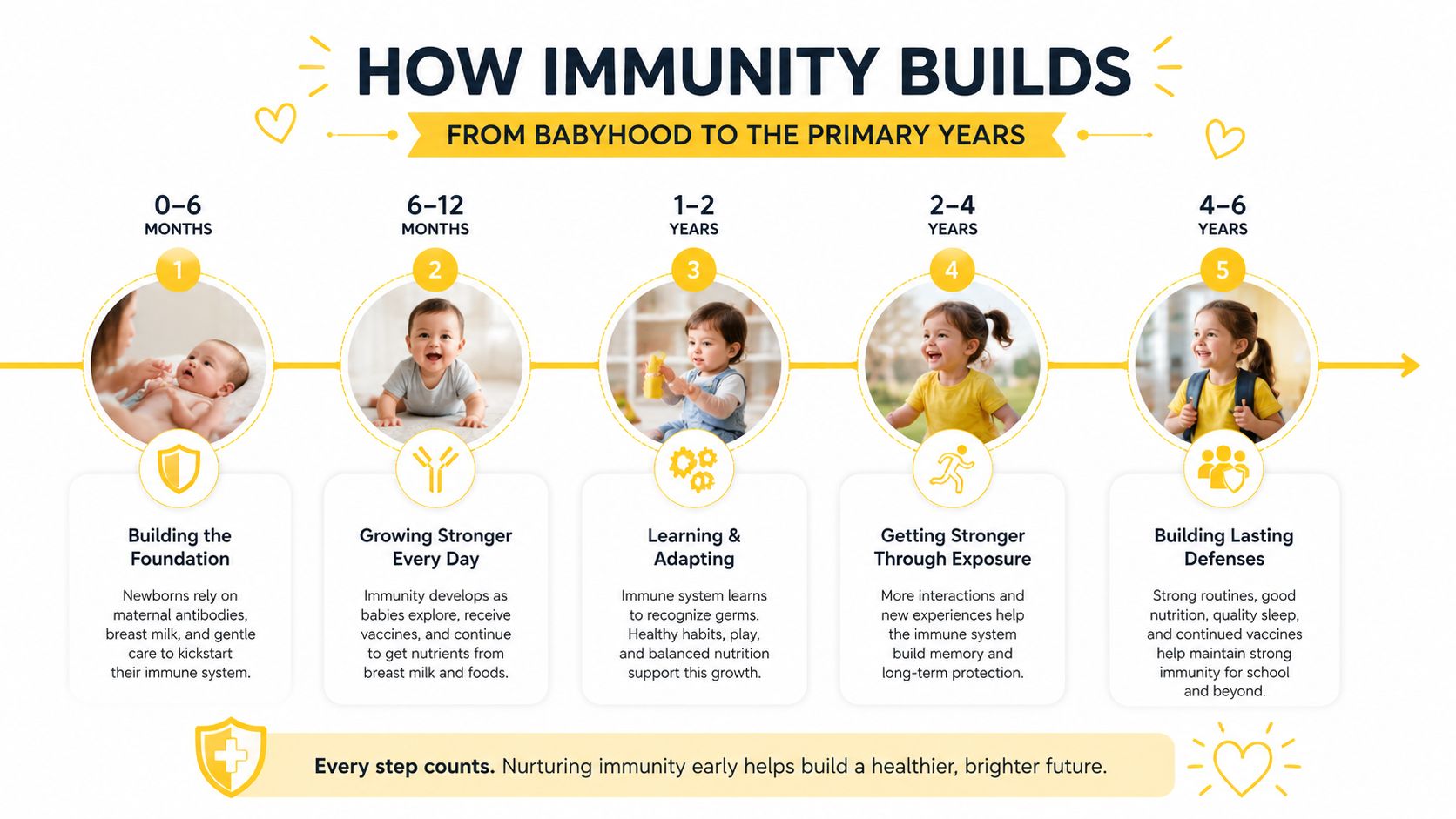
A newborn enters the world with innate defences and borrowed protection from their mother. Those maternal antibodies offer an early layer of help, but they gradually wane around six months. The child's own immune responses then become increasingly important as they encounter everyday microbes and receive scheduled vaccinations.
For a parent preparing a baby for a first winter in childcare, the early months can feel relentless. New environments bring close contact with other children, shared surfaces, and unfamiliar viruses. Each encounter gives the immune system information, although a cold caused by one virus doesn't create protection against every other virus waiting in the next room.
The first childcare years often bring frequent mild illnesses because exposure is high while immune memory is still developing. That pattern can be exhausting, but it isn't automatically evidence of a broken immune system. A child who recovers between infections, grows as expected, and returns to their usual energy may be moving through a busy period of immune learning.
The National Immunisation Program supports that learning by giving the immune system a controlled preview of serious diseases, without requiring the child to experience the disease itself. Australian guidance defines immunity as protection that can arise after vaccination or after infection and recovery. (Australian Academy of Science and Australian immunisation guidance)
Some families also explore gut health alongside general nutrition. A plain-language explanation of this topic is available in the guide to probiotic meaning, but probiotics shouldn't replace medical advice or scheduled immunisations.
A predictable routine can help families manage the broader demands of childhood health. For example, Calm contains Magnesium Citrate, Vitamin B6, Zinc, and prebiotics, and is described as a berry-flavoured, sugar-free, vegan gummy with no artificial colours or flavours. Its stated directions are two gummies daily, or as directed by a healthcare professional.
The Biggest Myth About Kids' Immunity
The biggest misconception is that vitamins and supplements can fix a child's immunity on their own. They can't replace sleep, varied food, hydration, hygiene, movement, or vaccination. The immune system depends on many connected processes, so a single gummy can't turn a poorly rested child into one who never catches an infection.
Marketing terms such as “immune support” can sound more specific than they are. They don't tell you whether a product prevents colds, reduces symptoms, or corrects a confirmed deficiency. In a well-nourished child, adding more of a nutrient doesn't automatically create more disease-specific immunity.
Most childhood colds also come from viruses the child hasn't met before. That's why a child with an excellent diet and an up-to-date vaccination history may still catch several different illnesses across the childcare and school years. The immune system may be responding normally, learning from each encounter, and protecting against serious disease without preventing every minor infection.
A better starting point is an inventory:
- Food: Is your child eating a reasonably varied pattern across the week?
- Sleep: Do they have a consistent wind-down routine and enough rest for their age?
- Vaccination: Are scheduled immunisations current?
- Health history: Is there a diagnosed deficiency or medical reason for supplementation?
- Daily function: Do they recover between illnesses and return to their usual behaviour?
Don't ask only, “What can I give my child?” Ask, “What foundation is already in place, and where is the genuine gap?”
This approach keeps supplements in proportion. They may be useful for a specific nutritional need, but they're not a substitute for a functioning routine or an assessment when symptoms are persistent.
Everyday Habits That Genuinely Support Immune Health
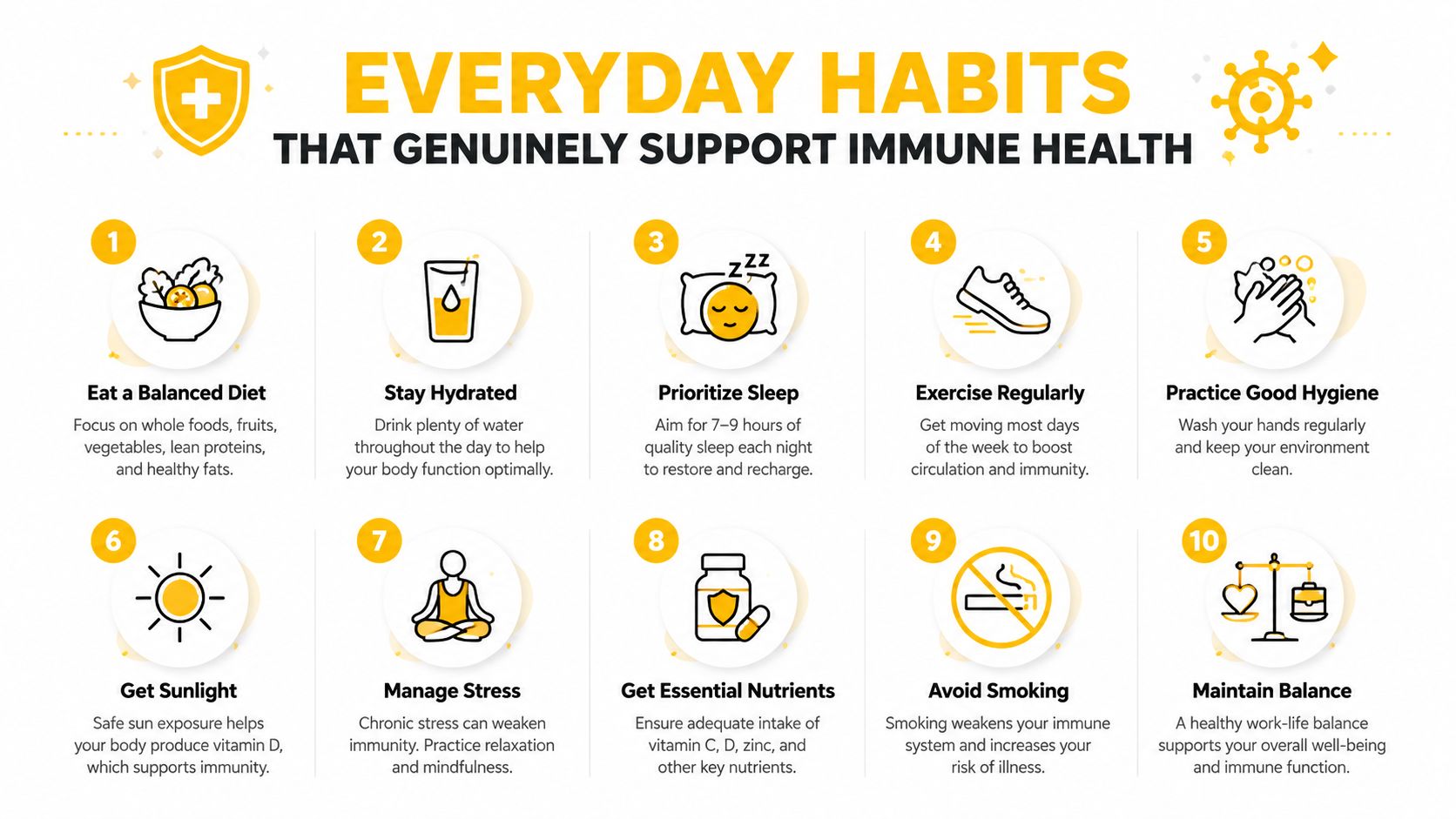
Australian family guidance presents immune health as a combination of well-balanced nutrients, gut health, hygienic environments, rest, and hydration. Life Ed Australia also recommends that children get at least 8 hours of sleep each night, supported by a consistent bedtime routine and reduced noise, light, and screens in the bedroom. (Life Ed Australia immune health guidance)
Build the foundation at home
Food doesn't need to be perfect. A colourful plate across the week can include fruit, vegetables, wholegrain foods, protein-rich options, and dairy or suitable alternatives. Citrus fruit and capsicum provide vitamin C, while meat, legumes, and other varied foods contribute nutrients involved in normal body function.
Sleep deserves practical attention. A screen-free wind-down, a familiar sequence such as bath, book, and bed, and a darker, quieter bedroom can make rest easier to protect. If your child has ongoing snoring, restless sleep, or daytime exhaustion, discuss it with a health professional rather than trying to solve it with supplements.
Outdoor movement supports general health and gives children a chance to play actively. It doesn't need to be formal exercise. Walking to the park, climbing, riding, dancing, or active games can all form part of a family routine.
Reduce transmission and protect against serious disease
Hand hygiene matters most at key moments, such as before eating, after using the toilet, after coughing or blowing the nose, and after returning from shared spaces. Teach children to clean all hand surfaces with soap and running water, then dry them properly.
Vaccination is the most targeted way to train adaptive immunity against specific serious diseases. Australia's national coverage data shows that fully immunised coverage in 2025 was 90.5% at 12 months, 88.4% at 24 months, and 92.5% at 60 months, with around 80,000 children not fully vaccinated at those milestones. (Australian Institute of Health and Welfare immunisation overview)
For a family-friendly discussion of digestion and routines, see gut health for kids. “Superfoods” can be enjoyable, but no single ingredient matters more than the overall pattern.
Where Supplements Fit and Where They Don't
Supplements make the most sense when they fill a known dietary gap or address a clinician-identified need. They don't replace meals, sleep, or vaccination, and they shouldn't be used to keep giving a child more nutrients because they catch ordinary colds.
A product such as Brave is described by its maker as a children's multivitamin containing vitamin C, vitamin D, zinc, and vitamin A to support everyday energy and immunity. Those nutrients have roles in normal body function, but the product's presence in a routine doesn't prove that it will prevent every infection. Parents can read more about the topic in this guide to immune system vitamins.
Whole foods also offer fibre and other naturally occurring compounds alongside nutrients. Vitamin C is found in citrus fruit and capsicum, vitamin D can come from safe sun exposure and fortified dairy, zinc from meat and legumes, and iron from red meat and leafy greens. Food and supplements aren't interchangeable in every situation, particularly where a child has a restricted diet, a diagnosed deficiency, or a condition affecting absorption.
| Nutrient | Whole-Food Sources | Supplement Form | When Supplementation Is Indicated |
|---|---|---|---|
| Vitamin C | Citrus fruit, capsicum, varied fruit and vegetables | Tablet, powder, or gummy | When advised for a specific dietary or clinical need |
| Vitamin D | Safe sun exposure and fortified dairy | Drops, liquid, or chewable supplement | When testing or clinical assessment identifies low status, including children with darker skin or limited sun exposure |
| Zinc | Meat, legumes, and varied foods | Tablet, liquid, or gummy | When intake is inadequate or a clinician recommends it |
| Vitamin A | Varied vegetables and other nutrient-rich foods | Multivitamin or targeted supplement | When a health professional identifies a need |
| Iron | Red meat, leafy greens, and other iron-containing foods | Liquid or tablet | When a GP confirms deficiency |
Vitamin D status needs careful interpretation. The Royal Children's Hospital defines sufficiency as at least 50 nmol/L, mild deficiency as 30–49 nmol/L, moderate deficiency as 12.5–29 nmol/L, and severe deficiency as less than 12.5 nmol/L. (Royal Children's Hospital vitamin D guidance)
Eat for Health notes that a 25-hydroxyvitamin D level below 27.5 nmol/L is consistent with deficiency in infants, neonates, and young children. (Eat for Health vitamin D guidance) The ABS uses closely related national categories, including total deficiency below 50 nmol/L. (Australian Bureau of Statistics vitamin D reporting)
Don't combine multiple products without checking the labels. Fat-soluble vitamins can accumulate, and a child under five should only start a supplement after discussing the product and dose with a GP or pharmacist.
When to See a Doctor Instead of Reaching for a Gummy
A gummy is not the right response to every symptom. Seek urgent medical care if your child has breathing difficulty, is unusually difficult to wake, appears severely dehydrated, has a seizure, or seems seriously unwell. If you're worried that your child “isn't themselves”, trust that observation and seek assessment.
Any fever in a baby under three months needs medical review. For children under two years, ask a GP about prolonged or recurrent fever rather than repeatedly treating the symptom at home. A pharmacist can advise about some minor illnesses and medicines, but they can't investigate poor growth, recurrent infections, anaemia, food allergies, or unexplained ongoing symptoms.
Signs that need prompt review
Arrange same-day medical advice for:
- Dehydration: Fewer wet nappies or toilet trips, a dry mouth, no tears, or unusual weakness.
- Breathing changes: Fast or laboured breathing, chest pulling in, persistent wheezing, or blue lips.
- Reduced alertness: Marked lethargy, unusual drowsiness, confusion, or difficulty waking.
- Ongoing vomiting: Repeated vomiting, especially when your child can't keep fluids down.
- Fever and rash: A rash with fever, particularly if the rash doesn't fade when pressed.
- Persistent illness: Symptoms lasting beyond 10 days without a clear period of improvement.
These signs don't tell you that your child has an immune disorder. They tell you that a clinician should assess the child rather than guess at a nutritional cause. A GP may need to examine hydration, breathing, growth, blood results, allergies, or infection patterns before recommending any supplement.
A supplement can't diagnose the reason a child is unwell. Assessment comes first, targeted treatment follows.
A Simple Framework for Supporting Your Child's Immunity
Use five ordinary pillars as a weekly check-in: sleep, food, movement, hygiene, and vaccines. They work as a layered defence, with each habit supporting normal health rather than promising a childhood without illness.
- Sleep: Keep the bedtime sequence predictable. A screen-free wind-down and a calm bedroom can help protect the rest your child needs.
- Food: Aim for variety over perfection. Add a colourful fruit or vegetable, a protein food, and a nourishing carbohydrate to meals when possible.
- Movement: Make active play part of the day. Outdoor games, walking, climbing, and dancing count.
- Hygiene: Practise handwashing before meals, after toilet use, after nose wiping, and when returning from childcare or school.
- Vaccines: Check the immunisation calendar and arrange catch-up advice if your child isn't up to date.
A supplement can sit on top of these foundations when a GP or pharmacist identifies a genuine gap. It shouldn't be used to compensate for consistently poor sleep, a very limited diet, missed immunisations, or symptoms that need investigation.
Your child will still catch illnesses. A runny nose isn't proof that immunity has failed, especially when the infection is caused by a new virus. The practical goal is resilience over time, supported by routines that help the immune system function normally and vaccinations that create targeted protection.
Daily Powers offers children's gummy supplements designed around everyday routines, including Brave for energy and immunity, Focus for concentration and on-task behaviour, and Calm for relaxation and wind-down. Review the ingredient lists and dosing guidance, discuss suitability with your child's GP or pharmacist, and visit Daily Powers to explore the range.