

At 7:45 pm, dinner plates are still on the bench, one child is asking for another snack, the other is negotiating for one more video, and you're trying to answer tomorrow's school email without losing your temper. Bedtime feels like a battle because everyone is tired, overstimulated and working from a different timetable.
A reliable kids bedtime routine fixes the coordination problem before it becomes a behaviour problem. For Australian families, the practical foundation is clear: a consistent start, a low-stimulation home, a short moment of connection and one repeatable cue that tells the body sleep is next. This approach suits children from 4 to 12, including the older primary-school years that often get less useful advice than the toddler stage.
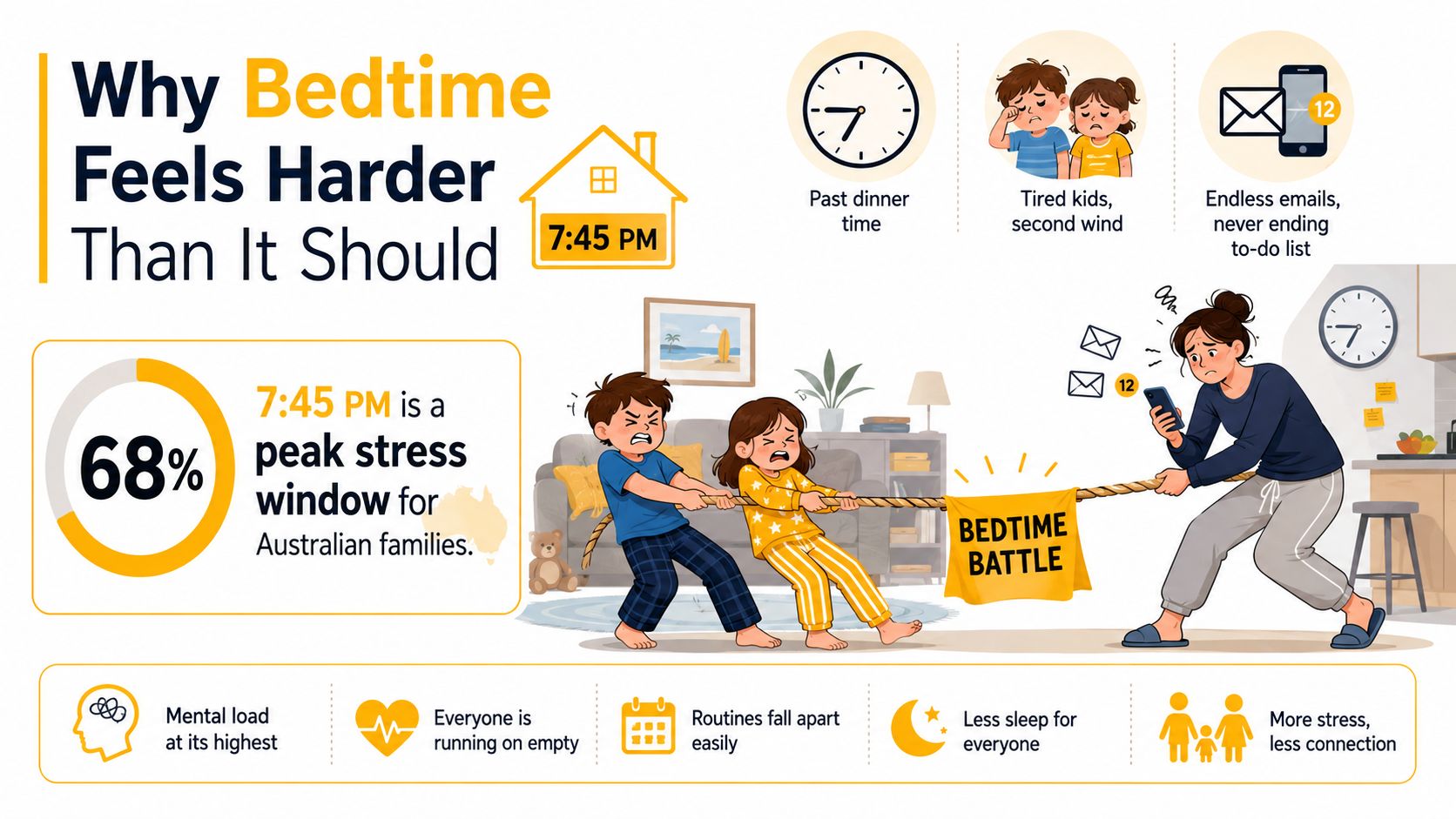
Table of Contents
- Why Bedtime Feels Harder Than It Should
- The Three Pillars of a Reliable Kids Bedtime Routine
- Building Your Evening Wind-Down Step by Step
- Sample Routines for Ages 4 to 6, 7 to 9, and 10 to 12
- Adding a Calm Wind-Down Cue Without Overcomplicating It
- Troubleshooting the Sticking Points That Derail the Routine
- Your 14-Day Roll-Out, Quick Checklist, and Common Questions
Why Bedtime Feels Harder Than It Should
Australian families aren't dealing with a niche issue. The Royal Children's Hospital National Child Health Poll reports that 19% of Australian children don't have a regular bedtime, 26% have difficulty getting to sleep, and sleep problems affect 45% of primary school-aged children. Those figures describe the household you're in, not a parenting failure.
The cost shows up everywhere. Dinner gets pushed later because the bedtime clock has already slipped. Screens become a bargaining chip. A child who's overtired may look wired rather than sleepy, while the parent who has spent the evening repeating instructions starts the next day already depleted.
The fix isn't a stricter lecture at the bedroom door. It's a sequence that removes decisions when everyone has run out of patience.
Build the evening around four signals
- Timing: Choose a dependable wind-down window and protect it most nights.
- Environment: Lower light, noise and screen stimulation before the child enters bed.
- Connection: Give each child a brief, undivided moment so they don't use bedtime to chase attention.
- Wind-down cue: Finish with the same small action, such as a story ending, breathing pattern, phrase or suitable supplement routine.
The exact clock time will vary with age, school start time, sport and family life. The order matters more than creating a perfect schedule.
Practical rule: Don't wait until your child looks sleepy. Start the routine early enough that tiredness doesn't have to do all the work.
Weekend drift and fear of missing out are normal, especially for children who can hear the household continuing after they've gone to bed. You don't need to make Friday night identical to Monday night. You do need to stop the difference becoming so large that Sunday night feels like a time-zone change.
The Three Pillars of a Reliable Kids Bedtime Routine
A bedtime routine works best as a structured household event, not a nightly negotiation. The Australian evidence supports that position. A Sax Institute evidence check found that thirteen systematic reviews provide strong evidence that bedtime routines improve children's sleep and settling.
For children aged 4 to 12, three pillars make the routine sturdy enough for real life.
Consistency creates the frame
Keep the start and finish within a reasonably narrow window on most nights. The Australian study of children's sleep timing found that bedtimes moved later by about 17 minutes per year on school days and 16 minutes per year on non-school days. Children aged 9 to 10 went to bed around 8:45 pm on school nights and 9:00 pm on non-school nights, while 16 to 17-year-olds were closer to 10:30 pm and 11:00 pm.
Your 4 to 12-year-old sits in the period where parent-led structure still has a strong influence, but natural bedtime drift is already gathering speed. The same study found non-school nights shifted bedtime later by an average of 34 minutes, so keeping weekends broadly aligned protects the transition back to school nights.
A practical target is to count backwards from wake-up time. If a six-year-old needs to be up at 6:45 am, a 7:45 pm lights-out target gives the evening a clear endpoint. Treat that as a starting point, then adjust for your child's needs and how long they take to settle.
Association makes the sequence familiar
Children learn that sleep is approaching through repeated cues. Bathroom, pyjamas, teeth, reading and lights out become a chain. Once the chain is familiar, you don't need to explain the whole plan every night.
The NSW Government guidance on children's sleep recommends settling about 30 minutes before bed, keeping bedtime and wake time within about 30 minutes day to day, avoiding screens for at least one hour before sleep, and using quiet cues such as reading, bathing, dim lighting and reduced noise.
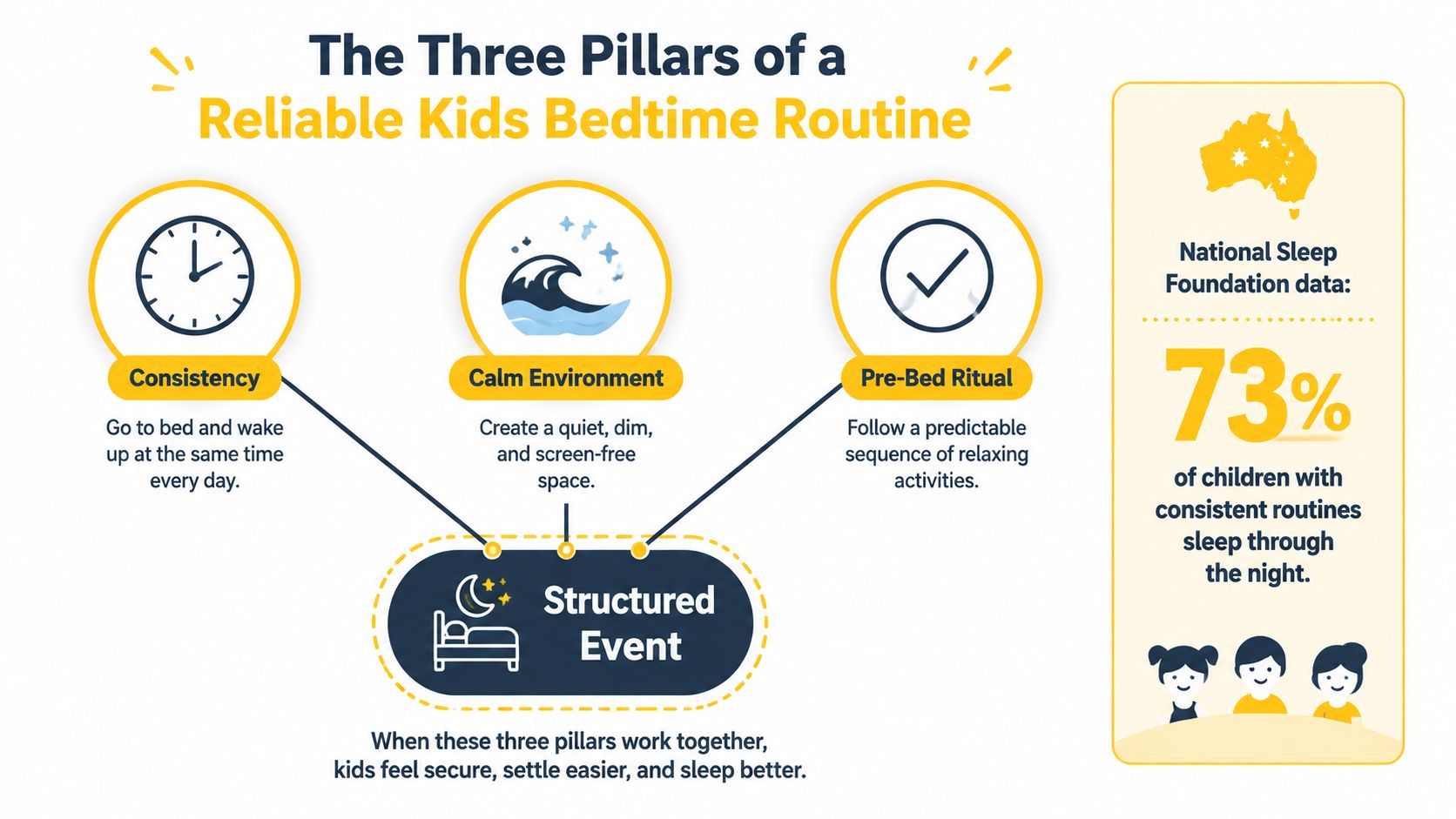
Wind-down lowers the evening temperature
Wind-down is not "be quiet". It means reducing the number of stimulating choices, conversations and bright signals your child has to process. A child can still play, read or chat, but the household should move from active mode towards rest.
A child's daily routine might include Brave as a separate, positive health habit for growing kids, but it shouldn't be confused with the sleep sequence. The bedtime ritual itself still needs timing, calm and connection.
Building Your Evening Wind-Down Step by Step
Use this as a printable 45-minute routine. The example finishes with lights out at 7:45 pm, but move the whole sequence earlier or later to match your child's needs. Keep the order stable even when the clock changes.
7:00 pm, anchor and announce
Say, “It's 7 pm. Bedtime starts now.” Don't say “in a minute” while finishing another task. Give your child a clear job, such as putting the remote on its charger, taking dirty clothes to the basket or choosing pyjamas.
This first step is about ending the open-ended part of the evening. If your child is finishing food, water or homework, make the boundary visible and calm. A short warning before the anchor can help, but the anchor itself must mean action.
7:10 pm, hygiene and pyjamas
Move to the bathroom for the practical work. Pyjamas, toilet, teeth and face washing belong here, before the child gets comfortable in bed.
Keep lights functional but not harsh. You don't need to turn the bathroom into a sleep laboratory. The aim is to stop hygiene becoming a late-stage interruption that sends everyone back into full alertness.
7:25 pm, quiet connection
Choose one low-energy activity. Read a picture book, build a small Lego model, complete a puzzle or play an audiobook. Avoid activities with winners, timers, loud sound effects or a clear reason to keep going.
Use the connection moment for conversation rather than commands. Ask, “What was the best bit of today?” or “Was there anything that felt tricky?” A short answer is enough. Your job isn't to solve every concern at 7:30 pm. It's to show that the day has been noticed.
For families wanting a visual version of the sequence, a kids routine chart can turn repeated verbal reminders into a set of steps your child can follow.
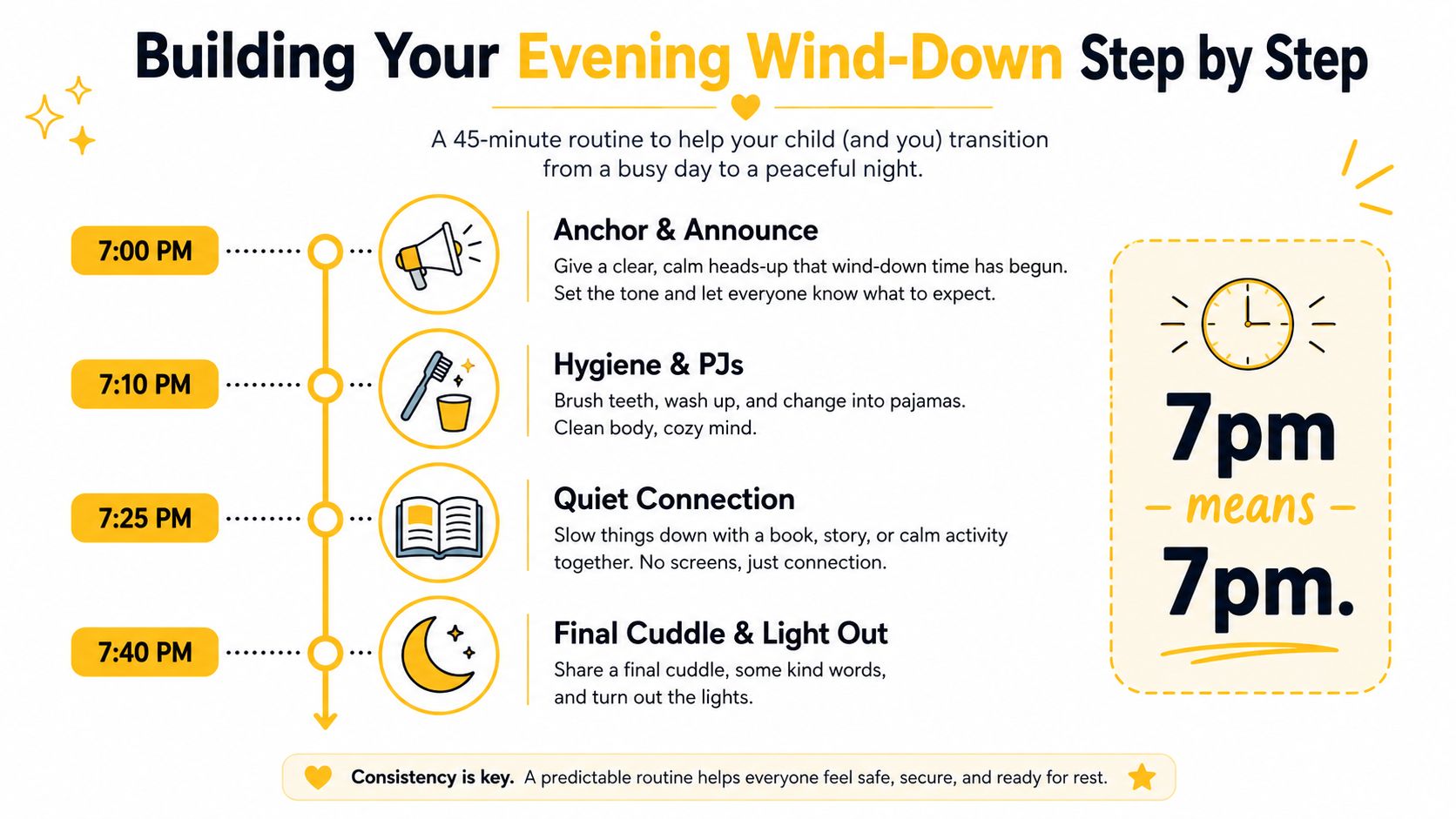
7:40 pm, final cuddle and lights out
Move into the bedroom for the final cue. It might be one short story, three slow breaths, a back rub or the same goodnight phrase each night. Keep the ending definite: “Your body is safe, the room is quiet and sleep is happening now.”
If your child asks for another activity, acknowledge the request without reopening the routine. “You'd like another story. Stories are finished for tonight. I'll see you in the morning.” Warmth and firmness work better together than either one alone.
Sample Routines for Ages 4 to 6, 7 to 9, and 10 to 12
Children don't need identical bedtimes across the primary years. They need the same underlying structure, adapted to their independence and the next morning's demands.
| Time | Ages 4–6 | Ages 7–9 | Ages 10–12 |
|---|---|---|---|
| 7:00 pm | Wind-down begins, pack away toys and choose pyjamas | ||
| 7:15 pm | Bath, toilet and teeth | ||
| 7:25 pm | Two picture books | ||
| 7:35 pm | One cuddle story and brief chat | ||
| 7:45 pm | Lights out | ||
| 7:30 pm | Wind-down begins, shower and pyjamas | ||
| 7:45 pm | Teeth, water and prepare school items | ||
| 7:55 pm | Chapter book with parent | ||
| 8:10 pm | Brief chat and final bathroom visit | ||
| 8:15 pm | Lights out | ||
| 8:30 pm | Wind-down begins, shower and devices parked outside the room | ||
| 8:45 pm | Independent reading | ||
| 9:05 pm | Five-minute check-in | ||
| 9:10 pm | Final cue and lights out | ||
| 9:15 pm | Lights out |
For ages 4 to 6, keep the parent-led portion long enough to prevent the child from stalling between tasks. Offer small choices, such as which pyjamas or which two books, but don't let the choices change the length of the routine.
For ages 7 to 9, hand over part of the sequence. Your child can shower, choose a chapter book and prepare their school bag, while you retain the final chat and lights-out boundary. This age group often benefits from knowing exactly how many pages or chapters are included.
Ages 10 to 12 need more ownership, not less structure. Let your child read independently and manage the first part of the routine, but keep devices out of the bedroom and preserve the five-minute check-in. Older children often use bedtime to raise worries they've held in all day, so that small conversation can prevent repeated returns after lights out.
Personalise without dismantling the framework:
- Swap one activity: Replace a bath with a shower, or a story with an audiobook, but keep the total wind-down length.
- Protect the final cue: Keep the same phrase, breathing pattern or lights-out action.
- Move in 15-minute bands: Sport and homework nights may need a later start, but avoid shifting every part of the sequence by random amounts.
- Plan for late nights: On activity nights, shorten the reading period rather than deleting the whole wind-down.
- Keep the hand-off clear: Parent-led activities should end before the child is expected to settle independently.
Adding a Calm Wind-Down Cue Without Overcomplicating It
A supplement can sit inside a bedtime routine, but it can't carry the routine. Treat it as a small, repeatable cue rather than a magic fix.
On a typical Tuesday, a child might take one Daily Powers Calm gummy with a small sip of water at the kitchen bench at 7:20 pm, after screens stop and before the bedroom phase begins. The bench becomes the hand-off point: active evening is finished, calm activities are next.

If you're considering magnesium support, check the label for age-appropriate dosing, clear ingredients and independent quality testing where available. Follow the product directions, ask a pharmacist or healthcare professional if your child has a medical condition or takes medicines, and keep gummies stored safely away from children.
The useful part of the cue is its predictability. Your child sees the same action happen in the same place, then moves into dimmer light, hygiene and reading. For background on magnesium and sleep, use this plain-language guide to what magnesium is good for sleep, but keep expectations realistic.
A calm gummy doesn't replace screens-off time, a darker room, adequate sleep opportunity or a reassuring relationship.
Add one new cue at a time and keep it in the same slot for 10 nights before deciding whether it suits your family. If the routine is already unstable, adding several products or rituals at once makes it impossible to know what helped and creates another source of negotiation.
Troubleshooting the Sticking Points That Derail the Routine
Screen pushback
Australian Bureau of Statistics data show that 60.0% of children aged 5 to 17 use screen-based devices in the 60 minutes before bed, while the figure is 29.5% for children aged 2 to 5. The same ABS release on children's physical activity, screen time and sleep reports an average of 9 hours 43 minutes of sleep on the night before interview for children aged 5 to 17.
Don't negotiate screen by screen. Set a visible 60-minute screens-off point, use a kitchen timer and charge phones or tablets in another room. If a device remains beside the bed, your child is still managing access to the next stimulation.
Fear of missing out
Children may resist because they're worried the family is continuing without them. Schedule a 10-minute one-on-one chat inside the routine, not after lights out. Tell your child what will happen after they go to bed, then keep the promise.
A short connection window is more effective than repeatedly returning for fragmented conversations. It gives the child attention without teaching them that calling out is the fastest way to extend the evening.
The second wind
A child who suddenly becomes silly, argumentative or frantic may be overtired. Bring bedtime forward by 15 minutes for several nights and add a dim bathroom reset, such as washing hands, brushing teeth and taking a quiet drink of water.
Don't answer a second wind with rough play or a late snack unless your child needs food. More stimulation usually prolongs the problem.
Weekend drift
Keep the weekend shift to about 30 minutes, then reset on Sunday morning with daylight and breakfast. The Australian sleep-timing evidence shows that non-school nights naturally move later, but a large gap makes the school-night return harder.
Use a three-night rule. If a change hasn't helped after three nights, adjust one variable only, such as the start time, screen cut-off or amount of evening activity. Changing five things at once leaves you with no useful information.
Your 14-Day Roll-Out, Quick Checklist, and Common Questions
Don't launch a complicated system on the most chaotic night of the week. Make the first week about timing and the second about refinement.
Days 1 to 7: Set the same wind-down start and lights-out window. Establish the screen cut-off, park devices outside bedrooms and lower household stimulation before the routine begins.
Days 8 to 14: Add the quiet activity, connection question and final cue. If you're using a calm gummy, introduce it as one consistent step rather than presenting it as the solution to every bedtime problem.
Quick checklist
- Time: Is the wind-down start clear and realistic?
- Environment: Are lights, noise and screens moving down together?
- Sequence: Does your child know what happens next?
- Connection: Has each child had a brief, focused check-in?
- Finish: Is the final cue the same most nights?
- Morning: Is wake-up time steady enough to support the evening?
If your child is wired at lights out, don't add more entertainment. Return to the quiet cue, keep your voice low and check whether the routine started too late.
If the weekend slips, restart at the next planned wind-down. Don't abandon the whole system because one night ran long. For morning structure that supports the evening cycle, use this morning routine for kids.
You may notice settling improve once the timing and sequence become predictable, but judge progress by the pattern across several nights rather than one bedtime. A calm gummy can move earlier if that makes the household flow better, provided you follow its label directions and keep the same place in the routine.
Daily Powers offers children's gummy supplements designed around everyday habits, including Calm for a magnesium-based relaxation and wind-down routine. Visit Daily Powers to review the ingredient information, dosing guidance and options for building a simple routine that fits your family's evenings.