

You're packing lunchboxes, hunting for the missing school hat, and there's a half-eaten gummy on the bench from yesterday's rushed breakfast. In the back of your mind is the same question a lot of Australian parents ask, especially when bugs keep moving through kinder, school or the whole house: does my child need kids immunity vitamins, or am I just buying hope in a bottle?
That question deserves a calmer answer than most marketing gives it. “Immune support” sounds simple, but it usually isn't. A child with a varied diet and normal growth is in a different situation from a child with a very restricted diet, limited sun exposure, darker skin, or a nutrient deficiency picked up on testing.
The helpful way to think about kids immunity vitamins isn't as one blanket yes-or-no decision. It's a nutrient-specific, age-specific decision. Australian data suggest most children are not broadly deficient across vitamins and minerals, but some groups do have genuine gaps. That's where the conversation starts.
Table of Contents
- Why Parents Are Asking About Kids Immunity Vitamins Right Now
- How a Child's Immune System Actually Works
- The Four Nutrients Most Immunity Products Rely On
- Safe Dosing and Upper Limits for Children Aged 4 to 12
- Choosing a Sugar-Free, Kid-Friendly Formulation
- When a Vitamin Is Not the Right Next Step
- A Practical One-Week Routine for Building the Habit
Why Parents Are Asking About Kids Immunity Vitamins Right Now
On an ordinary weekday, this often starts with a small moment. Your child has had a runny nose for the third time this term. They ate toast for breakfast, ignored the cucumber in their lunchbox yesterday, and now there's a brightly labelled “immune” gummy staring at you from the pantry.
That's not irrational parenting. It's a practical response to a practical problem. You want fewer sick days, less missed work, and less guessing.
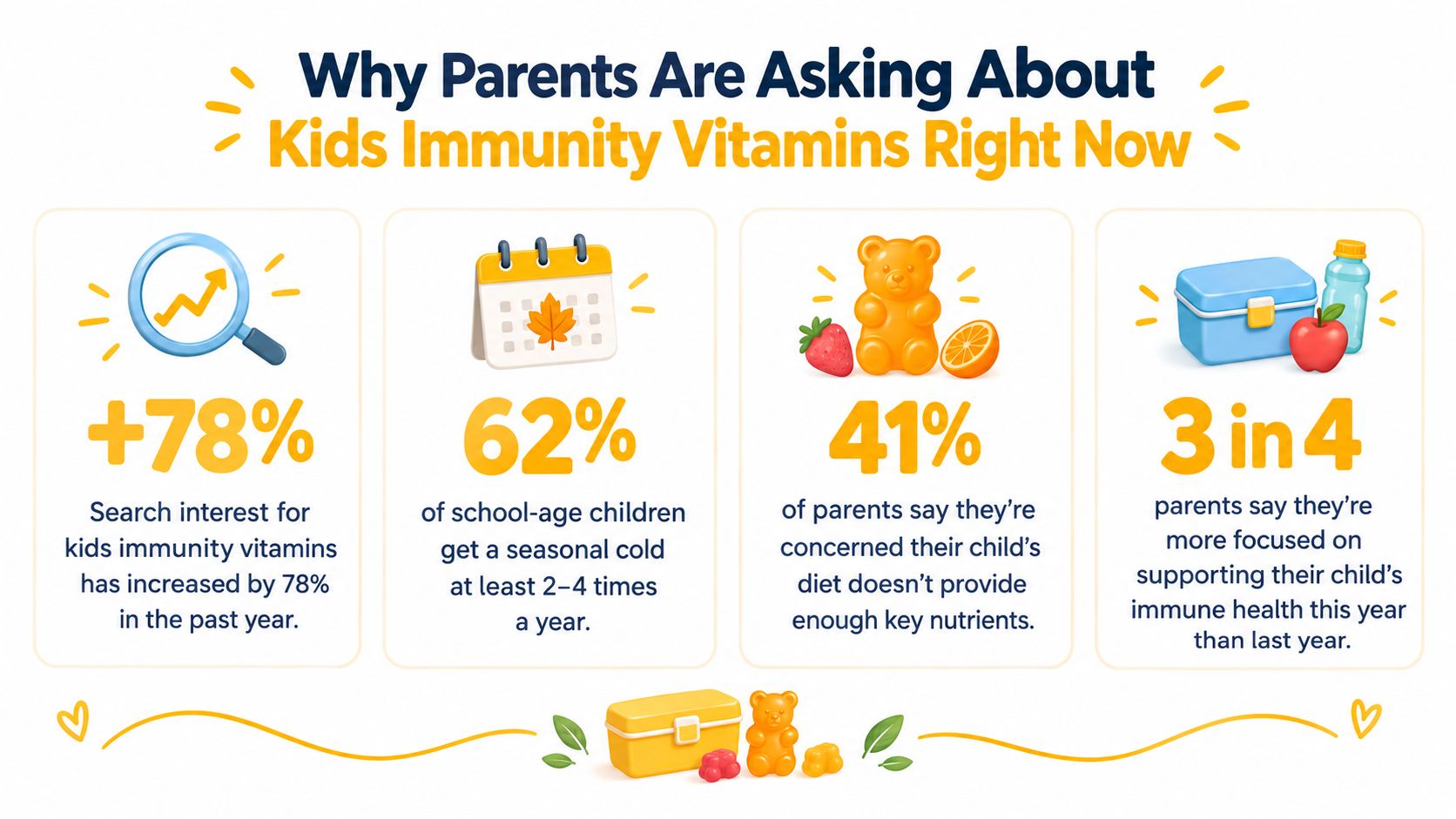
In Australia, supplement use is already part of family life. The Australian Bureau of Statistics reported that 29.7% of people used vitamin and/or mineral supplements, making them the most common supplement type reported nationally, while the same release noted that children aged 2 to 11 generally had adequate intakes of most vitamins and minerals, with calcium as the main exception (Australian Bureau of Statistics nutrition survey release).
What parents are really trying to solve
Most parents searching for kids immunity vitamins aren't asking a laboratory question. They're asking a household one.
- Fewer disruptions: Less school absence, fewer last-minute care changes, fewer sleepless nights.
- Peace of mind: A sense that they've covered a possible nutritional gap.
- A simple routine: One small daily action can feel easier than negotiating food variety every meal.
A major Australian child-health poll found that almost half of children had taken vitamins or supplements in the previous year, and 76% of parents said they gave them to boost their child's immune system. The same poll estimated $74 million per year was being spent on vitamins and supplements for children under 15, with primary-school-aged children the most frequent users at 50%, ahead of teenagers at 45% and pre-schoolers at 39% (Royal Children's Hospital National Child Health Poll detailed report).
The part that gets missed
Use is common. Need is more selective.
Practical rule: A supplement can help fill a real gap. It can't turn a normal child immune system into a force field.
Some children do deserve closer attention, especially those with very limited diets, ongoing feeding difficulties, little sun exposure, or other risk factors. But for a generally well child who eats a decent range of foods, a daily “immune” product may add much less than parents expect.
How a Child's Immune System Actually Works
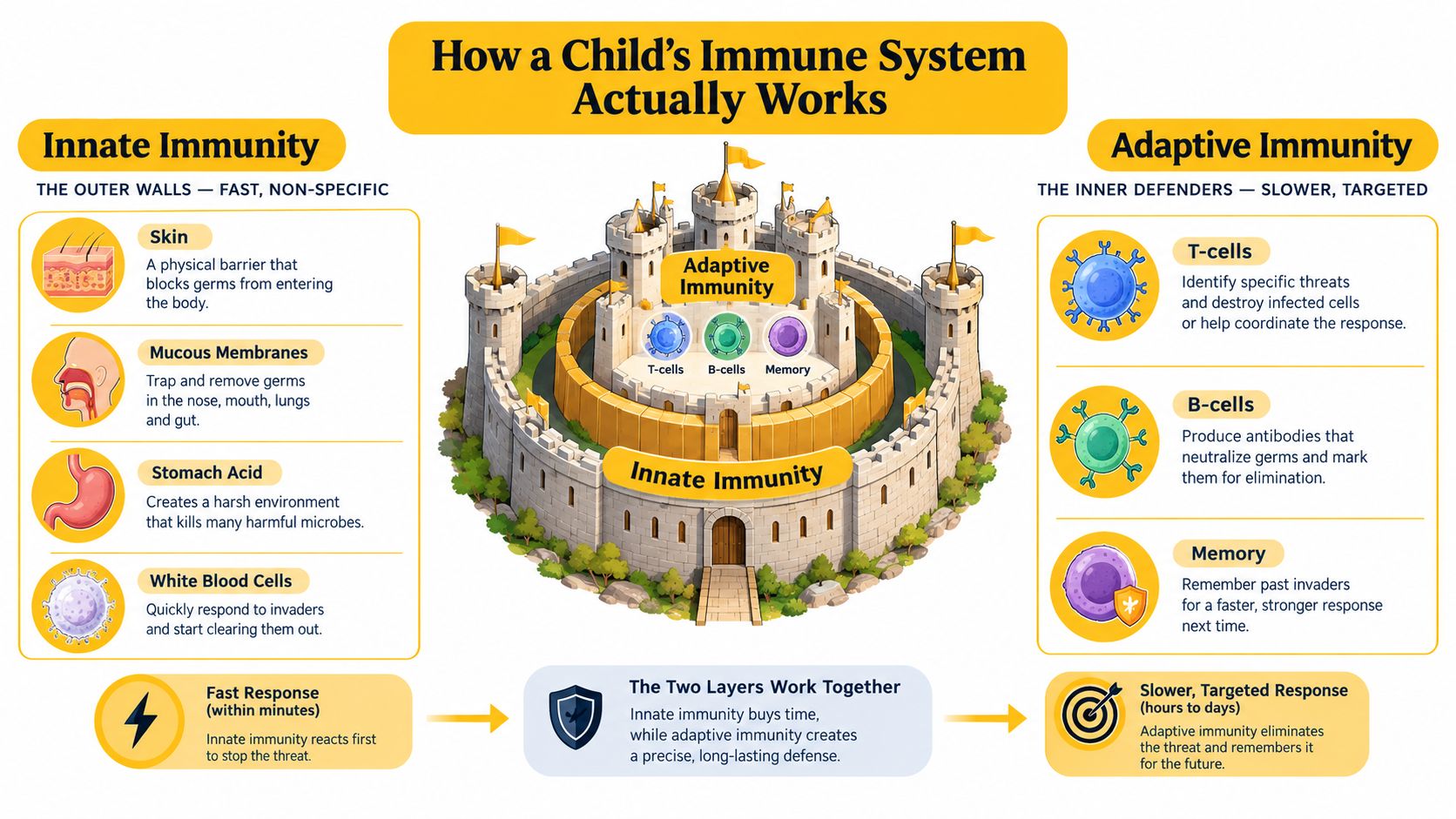
Parents often hear the phrase “boost immunity”, but that's not really how a child's immune system works. It helps to picture it as a castle with layered defences.
The outer walls are your child's fast defences. Skin keeps many germs out. The nose and airways trap particles in mucus. Stomach acid helps break down what shouldn't be there. Some white blood cells respond quickly when something unfamiliar shows up.
The fast team and the memory team
Inside the castle is the more specialised system. The body learns, remembers and responds better the next time.
- Innate immunity: Fast, broad defence. It reacts within minutes.
- Adaptive immunity: More targeted defence. It learns from previous exposure and vaccination.
- Immune memory: B-cells and T-cells help the body recognise certain threats again later.
Children aren't born with a fully trained adaptive immune system. They build it over time. That's one reason toddlers and younger school-aged kids seem to catch everything. It doesn't automatically mean something is wrong with their diet.
For a plain-language explainer on what immunity means in everyday health, this guide on immunity meaning is a useful companion.
Later in the section, this short visual overview can help make the “layers” idea easier to picture:
What vitamins can and can't do
Here's the key distinction. Vitamins don't usually supercharge immunity. They help the system run as it should.
If a child is low in an important nutrient, correcting that deficiency may support normal immune function. If a child already has enough of that nutrient, extra isn't the same as extra protection.
Supporting immunity is usually about removing a bottleneck, not adding horsepower.
That's why sleep, vaccination, hand hygiene, movement, food variety and managing specific deficiencies matter more than the word “immune” printed on a label.
The Four Nutrients Most Immunity Products Rely On
Walk down the supplement aisle and you'll see the same ingredients repeatedly. The label changes, the cartoon animals change, but the formula logic is often similar. Most kids immunity vitamins lean on vitamin C, vitamin D, zinc, or a multivitamin blend.
Vitamin C and zinc
Vitamin C gets top billing because parents recognise it. In practice, it makes the most sense when a child's diet is narrow and fruit and vegetable intake is patchy. If a child already eats a reasonable mix of produce, vitamin C is less likely to be the magic piece that changes their winter.
Zinc is a little more nuanced. It matters for immune function, but the question is whether a child needs extra zinc at all, and for how long. Australian evidence highlighted in the VITALITY trial summary notes that nutrient gaps can be very age-specific, with zinc inadequacy estimated at 20% in infants aged 6 to 11.9 months, while some infants under six months exceeded upper limits for vitamin A and zinc. The same summary also stresses that most children are not broadly deficient and that excess can be harmful (Murdoch Children's Research Institute VITALITY trial summary).
That matters because parents often hear “zinc supports immunity” and assume more must be better. It isn't.
Vitamin D and multivitamin blends
Vitamin D has the strongest Australian story in this category. The Royal Children's Hospital notes that low vitamin D is associated with impaired immunity and autoimmune disease, and the guideline gives practical dosing ranges used in care. The NHMRC Nutrient Reference Values set an adequate intake of 5.0 μg/day (200 IU/day) for children aged 1 to 8 years. The Royal Children's Hospital guideline uses 400 IU/day as a maintenance dose for children with ongoing risk factors, and 1,000 to 2,000 IU/day for treatment over 3 months depending on severity. The same guideline notes the upper limit for 1 to 3 year olds is 80 μg/day (3,200 IU/day) (Royal Children's Hospital vitamin D deficiency guideline).
A multivitamin blend can be a practical option for children with restricted diets, sensory food aversions, or family routines where one product is easier than several. For a child eating a varied diet, though, a blend may mostly be serving as reassurance.
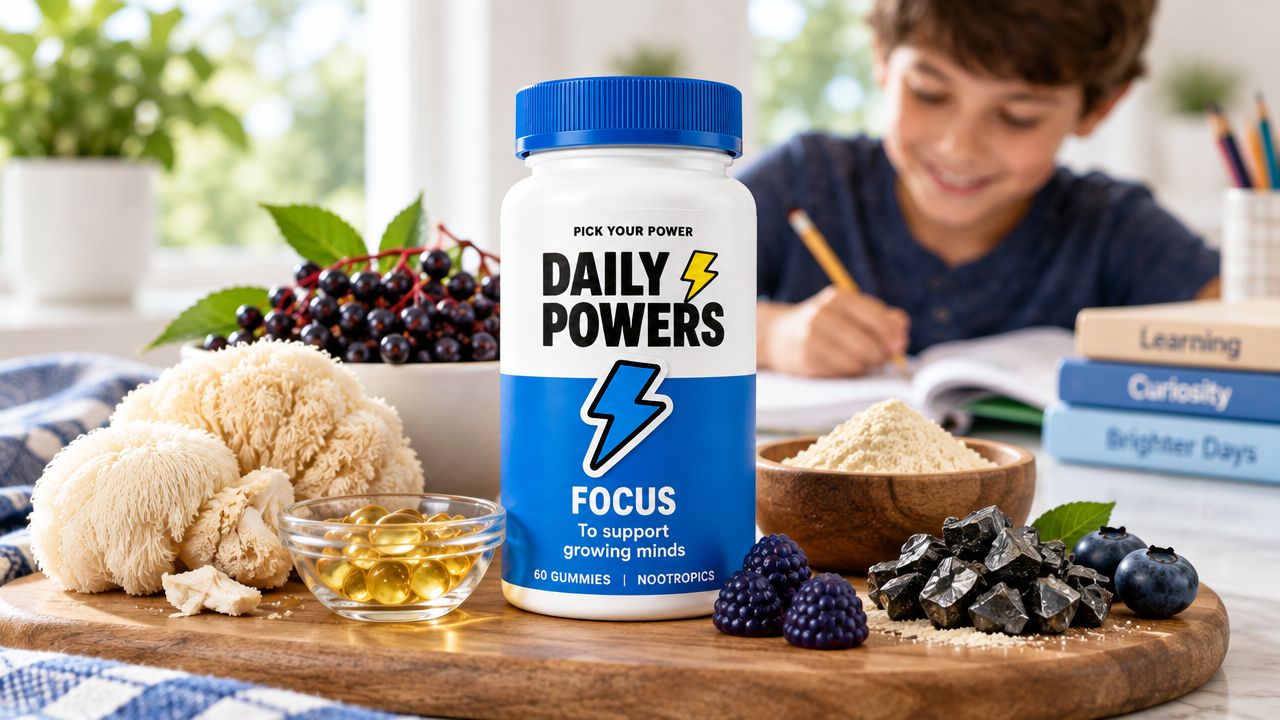
One example of a routine-focused option is Focus, which is a kids gummy that contains vitamin D3 and zinc along with mushroom polysaccharides, elderberry and prebiotics. Per the product snapshot, each daily serving contains Vitamin D3 4 μg and Zinc Gluconate 4 mg, and it's formulated as a sugar-free, vegan gummy for children.
For a broader look at ingredient categories and label reading, this article on immune support supplements adds useful context.
Immunity nutrients evidence summary for children
| Nutrient | Paediatric Evidence | Best-Suited For | Caveat |
|---|---|---|---|
| Vitamin C | Most relevant when intake from food is low | Fussy eaters or children with poor fruit and vegetable variety | Less likely to add much when diet already covers needs |
| Vitamin D | Strongest Australian case when deficiency risk is present | Children with low sun exposure or other risk factors | Higher treatment doses are a medical decision |
| Zinc | Useful nutrient, but need is very child-specific | Children with restricted diets or identified risk of low intake | Too much over time isn't harmless |
| Multivitamin blends | Convenience tool rather than universal need | Families needing simple routine support for a narrow diet | Can duplicate nutrients a child already gets |
Safe Dosing and Upper Limits for Children Aged 4 to 12
The biggest dosing mistake parents make is treating vitamins like a sliding scale. A little seems helpful, so more must be more protective. With children, that logic can get messy fast.
For most over-the-counter products, the safest starting point is simple. Treat the label dose as the ceiling unless your GP or paediatric dietitian has told you otherwise.
What the numbers mean in real life
Australian guidance is clearest for vitamin D in the evidence provided. For the other common “immune” nutrients, labels matter because products differ, and many children already get some of these nutrients from food.
A normal diet often supplies at least part of the daily intake picture. Citrus, berries, kiwi, tomato and capsicum contribute vitamin C. Meat, legumes, dairy, fortified foods and grains may contribute zinc and other vitamins. Vitamin D is trickier because food sources are limited and sun exposure patterns differ a lot between children.
Here's a plain-language dosing table using only values available in the verified evidence.
Daily targets and upper limits for key immunity nutrients, ages 4 to 12
| Nutrient | Adequate Intake / RDI (ages 4–8) | RDI (ages 9–12) | Upper Limit (ages 4–12) |
|---|---|---|---|
| Vitamin C | Check product label and seek professional advice if unsure | Check product label and seek professional advice if unsure | Follow product label unless clinician advises otherwise |
| Vitamin D | 5.0 μg/day (200 IU/day) is the NHMRC adequate intake for children aged 1–8 years | Check product label and seek professional advice if unsure | Therapeutic dosing should be clinician-led; the verified evidence provides an upper limit only for ages 1–3, not 4–12 |
| Zinc | Check product label and seek professional advice if unsure | Check product label and seek professional advice if unsure | Follow product label unless clinician advises otherwise |
| Baseline multivitamin | Depends on formula | Depends on formula | Depends on formula and total combined intake |
When higher dosing stops being a parent decision
If a child has a confirmed deficiency, especially vitamin D deficiency, the treatment dose can be much higher than a routine maintenance dose. That doesn't mean parents should adjust upward on their own.
If the goal is treatment rather than general cover, the right next step is medical advice, not dose tinkering.
Be especially cautious with products that contain iron. Iron can be important for some children, but it's not an “everyone should take it” nutrient, and accidental overuse matters more with iron than many parents realise.
Choosing a Sugar-Free, Kid-Friendly Formulation
The best supplement on paper is useless if your child won't take it by Thursday. Form matters almost as much as formula.
Parents usually compare products by brand name or cartoon packaging. A better way is to compare four practical criteria: adherence, sugar load, nutrient flexibility, and whether the product contains extras your child may not need.
Gummy, chewable or liquid
Gummies usually win on acceptance. They feel like a treat, which can make routine-building easier. The trade-off is that gummies can be harder to formulate for some nutrients and can blur the line between supplement and lolly if storage and rules aren't clear.
Chewables are often a middle ground. They can work well for school-aged children who don't mind the texture, but some children reject the chalky finish.
Liquids often make the most sense when dose flexibility matters, especially for younger children or selective eaters who need a more specific amount. They're less convenient on busy mornings, but they can be more practical when you're trying to match a clinician's advice.
Two label lines matter most
If you're comparing kids immunity vitamins on the shelf, start with these:
- Total sugars per dose: Parents often skip this line because the front-of-pack language sounds healthy.
- Sweetener type: “Naturally sweetened” doesn't tell you much on its own.
- Iron included or not: Helpful for some children, unnecessary for others.
- Age guidance: A child aged 4 has different needs from a child aged 12.
The reason sugar-free options appeal to many families isn't that sugar instantly “weakens immunity”. It's that daily products become habits, and habits are worth setting up cleanly where possible.
Daily Powers' Brave range is one worked example of the kind of formulation some families look for in this category: sugar-free, no artificial colours or flavours, and age-guided for children. If you want a deeper breakdown of what “sugar-free” means on a label, this guide to a sugar-free multivitamin is useful.
A quick shelf test
When you're standing in the aisle, ask four questions:
- Will my child take this daily?
- Does the formula match a likely gap, or just sound impressive?
- Am I comfortable with the sweetener and sugar content?
- Does it contain iron or higher-dose nutrients that should be checked first?
That short checklist is often more useful than the word “immune” in large print.
When a Vitamin Is Not the Right Next Step
Sometimes the most evidence-based choice is not starting a supplement today.
That can feel unsatisfying, especially when your child has been sick often and you want to do something concrete. But there are clear situations where a vitamin is the wrong next move, or at least not the first one.
The child who's already covering the basics
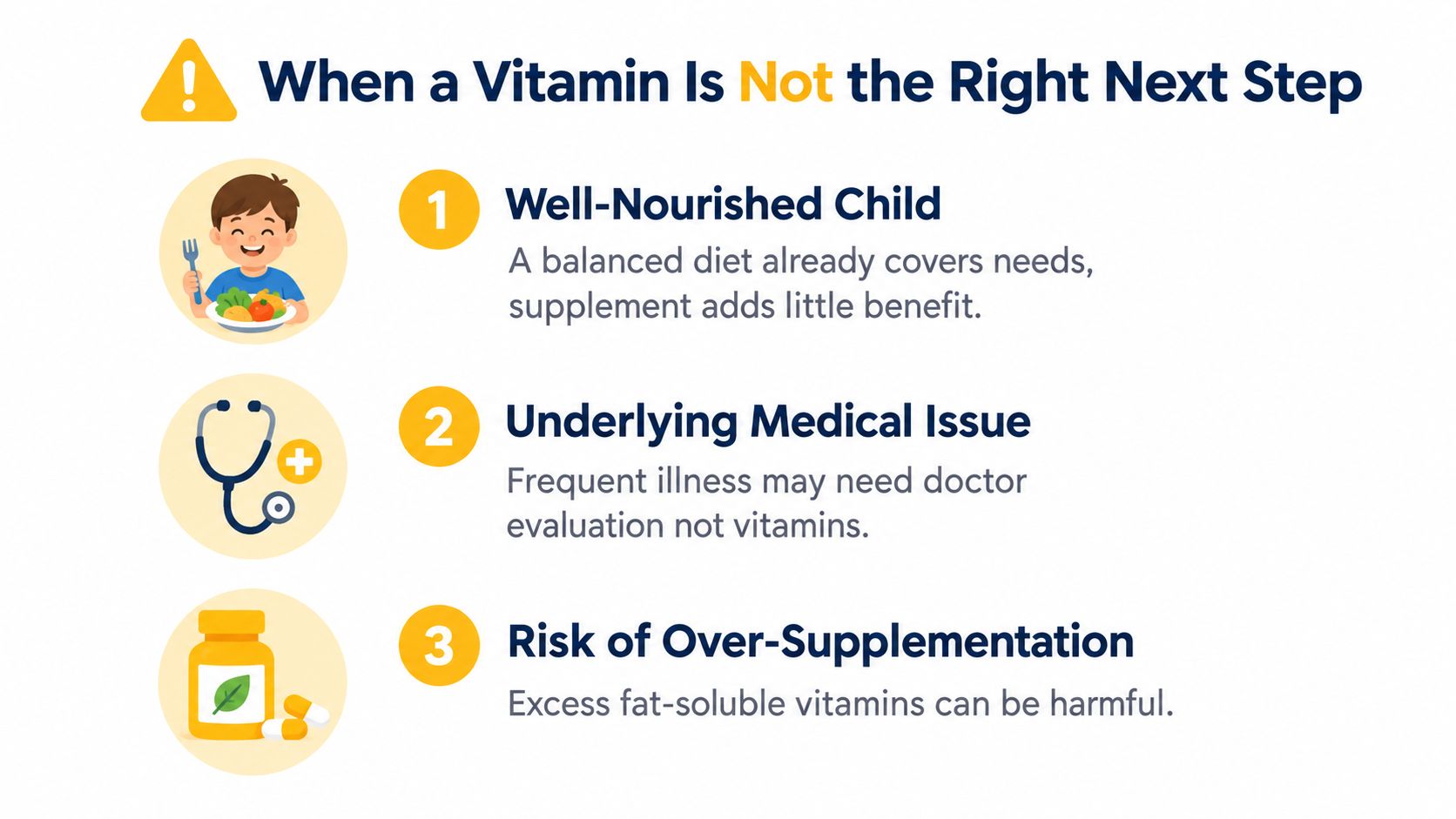
If your child is growing well, eating a decent spread of foods across the week, and doesn't have a known risk factor or deficiency, a daily “immune” product may add very little.
That point is easy to miss because supplement use is so normal. But normal use and clear need aren't the same thing.
The child who may need a clinical work-up
If a child has recurrent infections, persistent fatigue, poor growth, marked pallor, regular mouth ulcers, or a pattern that feels out of step with peers, the right question may not be “Which gummy?” It may be “What needs checking?”
Australian evidence helps here because it cuts through the blanket message. The ABS reported that children aged 2 to 11 generally had adequate intakes of most vitamins and minerals. At the same time, the ABS also reported that vitamin D deficiency in 12 to 17-year-olds was 15.4% in 2011–12, while only 0.6% of that age group were taking vitamin D supplements at the time. That suggests the issue can be a specific nutrient gap in a specific group, not a general need for all children to take daily immunity vitamins (Australian Bureau of Statistics nutrition survey release).
A child who seems unwell often may need assessment, not escalation.
The family trying to stretch the budget
For some households, the best value move is food first.
That might mean building the week around a few regular foods that cover common nutrient bases. Think yoghurt or fortified dairy alternatives, eggs, legumes, mince, tinned fish where appropriate for the family, fruit, and vegetables your child accepts. It might also mean checking sun habits and discussing vitamin D risk with your GP when it's relevant.
A supplement is a tool for a specific gap. It isn't automatically the smartest first spend.
A Practical One-Week Routine for Building the Habit
If you and your child have decided a supplement is appropriate, consistency matters more than enthusiasm. Most routines fail because they depend on memory alone.
The easiest systems use an anchor. That means attaching the vitamin to something your family already does every day.
Before day one
Pick one moment that already happens without debate.
- Breakfast anchor: Good for children who eat reliably in the morning.
- Teeth-brushing anchor: Helpful if mornings are chaotic but evenings are steady.
- School-bag anchor: Useful for older primary school children who like checklists.
Then choose the format your child is most likely to accept. Don't pick the “ideal” product if your child hates swallowing it. Store it somewhere visible to you but out of reach of younger children.
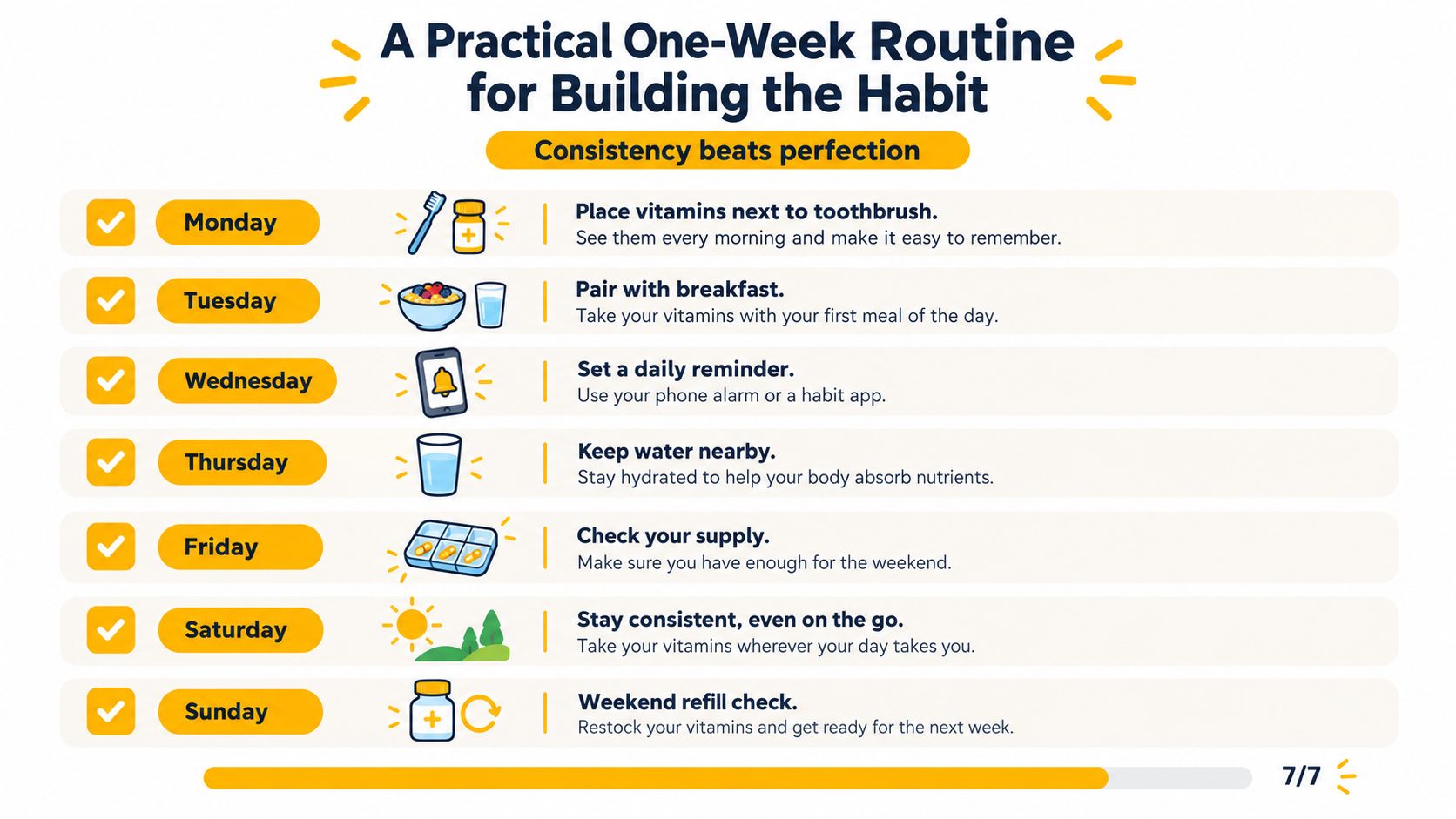
Days one to seven
A routine doesn't need to be elaborate. It just needs to survive real life.
- Day one: Trial the first dose when you're not rushing out the door. Check taste, texture and willingness.
- Day two: Repeat at the same anchor point. Keep the language simple and matter-of-fact.
- Day three: Notice whether your child has any digestive complaints or resistance.
- Day four: Tighten storage. Make sure younger siblings can't reach it.
- Day five: Pair it with a second cue, such as a sticker chart or a very short song.
- Day six: Ask yourself whether the timing still works. Some children do better at breakfast, others after school.
- Day seven: Review the week. If the routine was a fight every day, change the format or timing.
Four rules that prevent most problems
Keep it boring enough to last.
- Never double-dose: If you miss a dose, don't “catch up”.
- Keep it out of reach: Gummies can look like lollies to younger children.
- Check mixing instructions: If the label warns about pairing with certain foods or minerals, follow it.
- Tell other carers: Grandparents, schools and after-school carers need to know the child has already had it.
A vitamin only works if it's taken consistently and appropriately. The routine that lasts through a school term beats the perfect plan that fades by Wednesday.
Daily Powers offers Australian-made kids supplements designed around simple daily routines, including sugar-free gummy formats with clear ingredient lists and age guidance. If you're trying to make a supplement habit realistic without turning it into a battle, you can explore the range and label details at Daily Powers.