

Many Australian parents now reach for magnesium supplements for kids when bedtime becomes difficult. The popular message is simple, magnesium helps children sleep. The evidence is not. Australian paediatric coverage says magnesium isn't an evidence-based sleep aid for healthy children, and most children can meet their needs through a balanced diet. ABC News' coverage of magnesium sprays and children's sleep is a useful corrective to marketing that treats relaxation as sedation.
That doesn't make magnesium irrelevant. It's involved in nerve signalling, normal muscle function and calming pathways, including GABA-related signalling. The sensible question is not, “Will magnesium knock my child out?” It's, “Is there a genuine nutritional reason to consider it, and is the product appropriate for my child's age and needs?”
Table of Contents
- Why Magnesium Is Not a Magic Sleep Fix for Kids
- Understanding Australian Magnesium Dosing Guidelines for Children
- Comparing Magnesium Forms and Bioavailability
- Recognising When a Child Might Benefit from Magnesium
- Potential Side Effects and Safety Considerations
- The Role of Complementary Nutrients in Magnesium Formulations
- When to Consult a Clinician Before Starting Magnesium
Why Magnesium Is Not a Magic Sleep Fix for Kids
Magnesium isn't a sleeping tablet in gummy form. For healthy children, Australian paediatric experts say the evidence doesn't support oral magnesium as a routine sleep treatment, and magnesium oils or sprays don't have an evidence-based rationale for improving sleep. Most children can obtain enough magnesium from a varied diet, so a restless bedtime shouldn't automatically lead to a supplement.
Sleep problems can also reflect an inconsistent routine, anxiety, screen use, discomfort, breathing problems or another health issue. A gummy can become part of a predictable wind-down ritual, but it shouldn't replace attention to the causes of poor sleep. Practical bedtime strategies still matter, including the routine guidance in this Australian guide to helping kids get to sleep.
What magnesium may support
Magnesium has legitimate physiological roles. It helps regulate nerve signalling and contributes to normal muscle function, which can support a child's ability to relax physically after a busy day. It also interacts with neurotransmitter systems involved in calming neural activity, including GABA-related signalling.
Those roles describe nutritional support, not a guaranteed sleep effect. A child who has an inadequate intake might feel better when their overall nutrition improves, but that doesn't mean every child who takes magnesium will fall asleep faster or sleep through the night.
A useful distinction: supporting normal relaxation pathways isn't the same as producing sedation.
Parents sometimes report that a Calm gummy helps their child relax and wind down. In practice, the benefit may include the mental and physical cue created by a consistent evening routine. Saying, “Time for your Calm gummy,” can mark the transition from activity to quieter behaviour, especially when paired with dimmer lights, a story and a regular bedtime.
The strongest Australian message is therefore balanced. Don't use magnesium as a universal sleep fix. Consider it only when dietary intake, symptoms, clinical findings or professional advice give you a clear reason to do so.
Understanding Australian Magnesium Dosing Guidelines for Children
Children's magnesium needs aren't calculated by taking an adult dose and making it smaller. Australian nutrient reference values are age-specific, and they distinguish between magnesium obtained from food and magnesium supplied by supplements.
The Australian nutrient reference values for magnesium set the recommended dietary intake, or RDI, at 130 mg per day for children aged 4 to 8 and 240 mg per day for children aged 9 to 13. These amounts refer to total dietary intake, including food.
The supplement upper limit is much narrower. It is 110 mg per day for children aged 4 to 8 and 350 mg per day for children aged 9 to 13, with the upper limit applying to magnesium from supplements rather than ordinary food.

The numbers parents should separate
| Age Group | RDI (mg/day) | Supplement Upper Limit (mg/day) |
|---|---|---|
| 4–8 years | 130 | 110 |
| 9–13 years | 240 | 350 |
A child aged 4 to 8 can therefore meet their full RDI through food alone, while a supplement-only intake should remain below the relevant upper limit. Confusing the RDI with the supplement upper limit is one of the easiest ways to misread a label.
The Australian guidance also shows why age matters. For younger children, the Estimated Average Requirement uses a reference weight of 22 kg and sets the EAR at 110 mg per day. The RDI rises from 80 mg per day at ages 1 to 3 to 130 mg per day at ages 4 to 8, as explained in the Eat for Health magnesium fact sheet. Dosing should follow the child's age and the product's elemental magnesium amount, not a rough adult comparison.
For example, Calm lists magnesium citrate providing 30 mg of elemental magnesium per daily serving, alongside vitamin B6, zinc and prebiotic fructooligosaccharides. Parents should check whether the label describes the magnesium compound or the elemental magnesium, because those are not interchangeable figures.
Comparing Magnesium Forms and Bioavailability
The chemical form on a magnesium label affects how readily the compound dissolves and becomes available for absorption. Magnesium citrate and magnesium oxide are common examples, but the form is only one part of deciding whether a supplement suits a child. Parents interested in the sleep claims should first separate questions about a product's form from the evidence discussed in what magnesium is good for sleep.
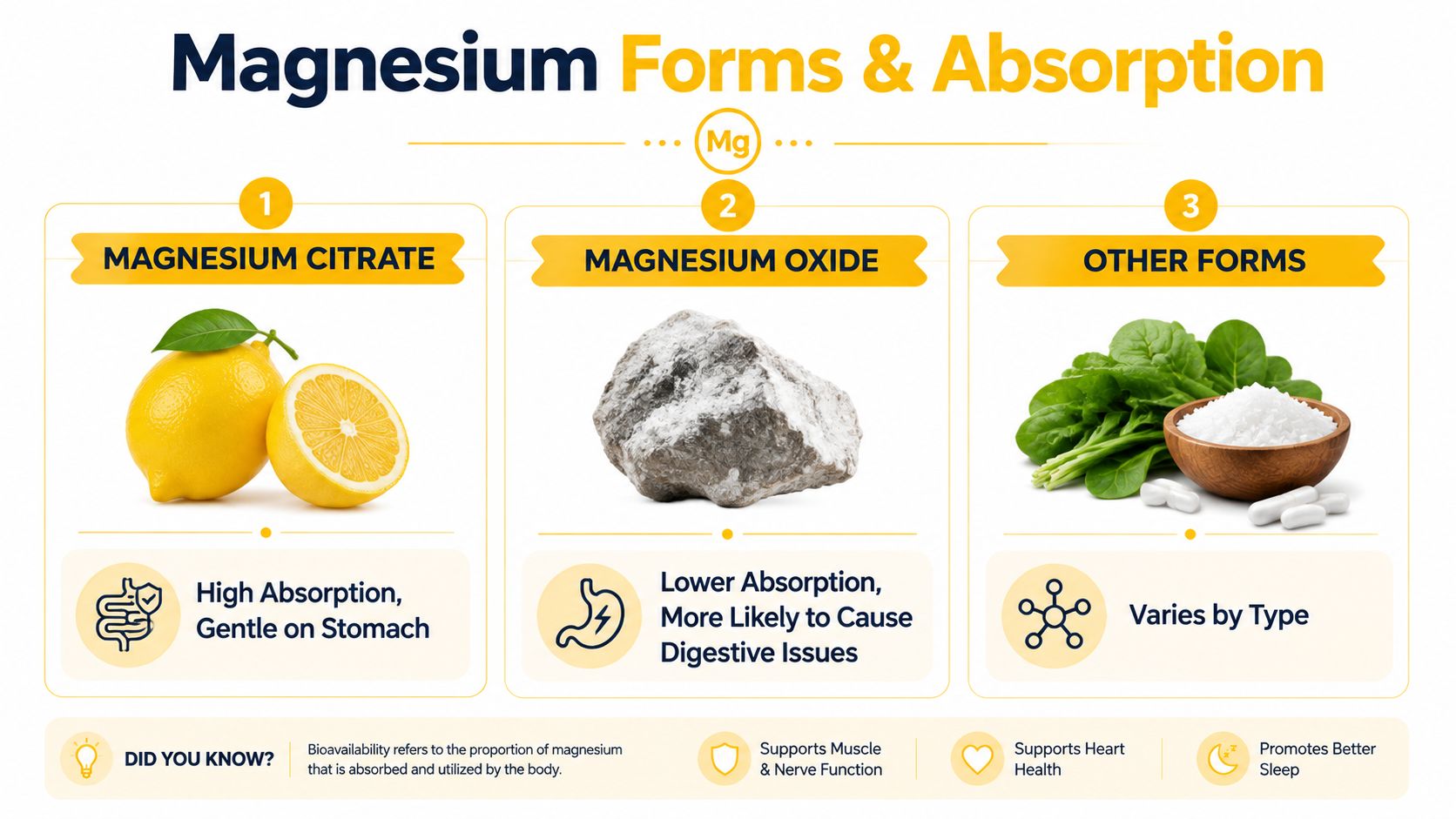
A controlled human study found that magnesium citrate was more soluble than magnesium oxide and produced a significantly larger rise in urinary magnesium after dosing. During the first four hours, the urinary increment was 0.22 versus 0.006 mg per milligram of creatinine. During the following two hours, it was 0.035 versus 0.008 mg per milligram of creatinine. The findings are reported in the controlled comparison of magnesium citrate and magnesium oxide.
A later randomised crossover study found the same broad pattern. Magnesium citrate produced significantly higher 24-hour urinary magnesium excretion, while plasma magnesium was also significantly higher at four and eight hours after a single dose than with magnesium oxide. The randomised crossover study of magnesium bioavailability provides the full findings.
What that means at the kitchen bench
Magnesium citrate generally offers better absorption than magnesium oxide. That finding does not make citrate automatically suitable for every child. The amount of elemental magnesium, age guidance, digestive tolerability and complete ingredient list also need checking.
Magnesium oxide may be less well absorbed and may cause digestive complaints for some children. Other forms differ by compound and formulation, so a larger compound weight does not necessarily mean a larger delivered amount of elemental magnesium.
Use the label as a practical checklist:
- Find elemental magnesium: Compare this amount with Australian guidance.
- Identify the form: Citrate and oxide do not behave identically in the gut.
- Review the serving size: A child may take more than one gummy or spoonful.
- Check tolerability: Bulky powders, sweeteners or unnecessary excipients can make regular use difficult.
Brave is a multivitamin gummy rather than a magnesium product, so it should not be treated as an alternative magnesium source.
Recognising When a Child Might Benefit from Magnesium
Most children don't need a magnesium supplement because they have a difficult night. The stronger reason to investigate intake is a persistent dietary gap, a medical finding or professional advice.
Australian national data show that magnesium inadequacy is a meaningful nutrition issue, particularly among older children and adolescents. The Australian Bureau of Statistics nutrient intake release reports that inadequacy across the population fell from 34.9% in 2011–12 to 31.3% in 2023. Among children aged 12 to 17, it fell from 44.5% to 26.8% for males and from 57.3% to 43.9% for females, so shortfalls remained substantial, especially for females.
Start with the diet
A child may warrant a closer look if their usual eating pattern contains very little variety, particularly when magnesium-containing foods are consistently absent. Consider the pattern rather than one meal:
- Limited plant foods: Legumes, whole grains, seeds, nuts and leafy vegetables contribute magnesium.
- Persistent selective eating: A narrow food range can make several nutrients harder to obtain.
- Changing adolescent habits: Older children may skip meals or rely more heavily on convenient foods.
- Clinical replacement: Perth Children's Hospital guidance supports oral magnesium replacement for asymptomatic children with mild hypomagnesaemia, while warning that oral magnesium can aggravate diarrhoea.
Symptoms such as muscle cramps, fatigue, irritability or poor sleep aren't proof of magnesium deficiency. They can arise from many causes, so parents shouldn't diagnose deficiency from a bedtime struggle or a single symptom.
Make the routine child-friendly
If a clinician or dietitian agrees that supplementation is appropriate, consistency matters more than dramatic dosing. Offer the product at the same point in the evening, explain that it supports the body rather than acting as a sedative, and let the child participate in the routine without turning it into a promise about sleep.
The aim is a calm transition. A gummy may provide a mental cue, while the surrounding habits do the larger practical work.
Potential Side Effects and Safety Considerations
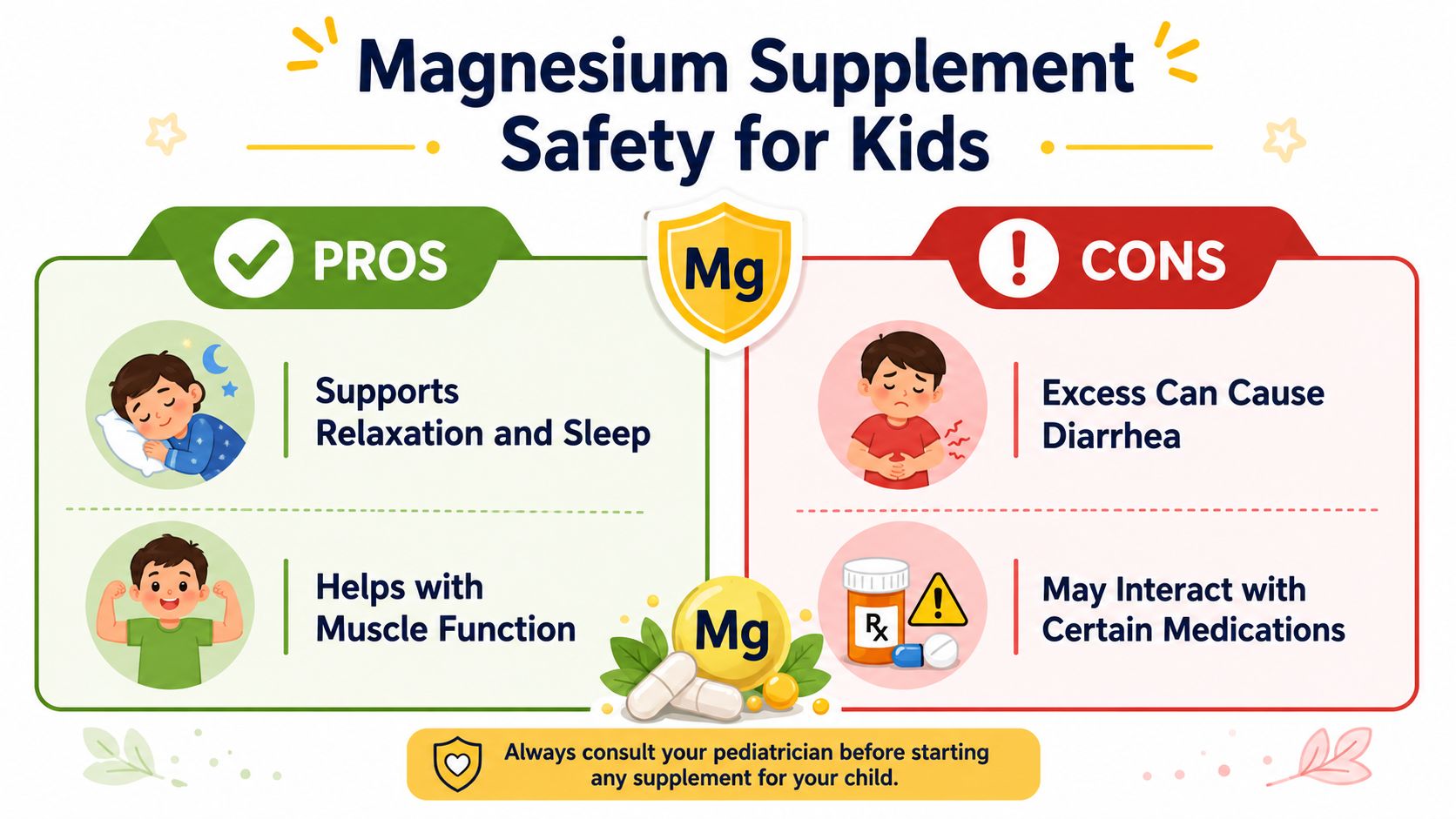
Magnesium supplements can cause side effects, especially when the dose is too high or a child's digestive system is already sensitive. Australian health guidance identifies diarrhoea, nausea and abdominal cramps as common problems from excess oral magnesium. Healthdirect's magnesium guidance also describes more serious cardiovascular effects, including hypotension and bradycardia, with severe toxicity potentially involving respiratory depression or cardiac arrest.
These severe outcomes aren't the expected result of an age-appropriate product used correctly, but they explain why “more” isn't a sensible strategy. Royal Children's Hospital guidance supports oral magnesium replacement for mild hypomagnesaemia while noting that it can worsen diarrhoea and requires caution in children with gastrointestinal obstruction or intolerance.
Practical safeguards
Check the elemental amount. Compare the label with the Australian supplement upper limit for your child's age. Don't add several magnesium-containing products without calculating the combined supplemental intake.
Watch the gut response. Loose stools, diarrhoea, cramping or nausea are reasons to stop and seek advice, particularly if symptoms persist or your child already has bowel problems.
Treat illness differently. A supplement isn't appropriate as a substitute for assessment when a child has ongoing vomiting, severe abdominal pain, marked weakness or symptoms suggesting a broader medical problem.
A low-bulk gummy can be easier to use than a large tablet or powder, but the delivery format doesn't remove the need for careful dosing. “Kid-friendly” describes acceptability, not automatic safety.
Safety rule: If a child develops diarrhoea after starting oral magnesium, don't increase the dose to chase a relaxation effect.
The Role of Complementary Nutrients in Magnesium Formulations
Magnesium is only one part of a child's nutritional picture. A broader formula can be designed around normal nervous-system function, everyday wellbeing and a practical routine, but each added ingredient still needs to be understood on its own terms.
Vitamin B6 is included in some children's formulas to support healthy nervous system function. Zinc contributes to everyday wellbeing, while prebiotics such as fructooligosaccharides are included to support gut health. These ingredients don't turn magnesium into a sleep medicine, and a longer ingredient list isn't automatically a better formula.

Read the complete label
A thoughtful label should show the form of magnesium, the elemental magnesium amount, the serving directions and the child age range. It should also identify complementary nutrients clearly, rather than hiding them behind broad language such as “calm blend”.
The formulation philosophy matters too. Gentle, everyday support is different from a high-dose approach intended to produce a noticeable sedative effect. For children, a consistent ritual that supports normal relaxation and muscle function is more appropriate than trying to “knock them out”.
The ingredient guide for Calm magnesium gummies provides an example of this broader approach. The listed daily serving contains magnesium citrate providing 30 mg elemental magnesium, 1 mg vitamin B6, 4 mg zinc and 160 mg prebiotic fructooligosaccharides.
Parents should still consider the child's entire diet and supplement routine. A product containing B6, zinc and prebiotics may be useful for a particular household routine, but it doesn't replace varied food, medical assessment or sensible sleep habits.
When to Consult a Clinician Before Starting Magnesium
Speak with a GP or paediatrician before starting magnesium if your child has a chronic health condition, takes regular medicines, has ongoing gastrointestinal symptoms or has signs that don't fit a simple dietary gap. Professional advice matters because a clinician can consider the child's history, diet, symptoms and, where appropriate, whether testing is needed.
Use this decision checklist:
- Existing health conditions: Ask before supplementing if your child has kidney, gastrointestinal or other chronic health concerns.
- Current medicines: Check for potential interactions rather than assuming a gummy is harmless because it's sold over the counter.
- Persistent symptoms: Poor sleep, cramps, fatigue or irritability can have several explanations and shouldn't be treated as proof of magnesium deficiency.
- Unclear dosing: Take the product label to the appointment if you're unsure whether the serving refers to compound weight or elemental magnesium.

A clinician's input is particularly important when diarrhoea is already present, because Australian hospital guidance warns that oral magnesium may worsen it. Stop the supplement and seek medical advice if your child develops concerning symptoms after taking it.
The goal isn't to make supplementation complicated. It's to make sure the decision matches the child, the dose matches the age and the product supports a genuine nutritional need rather than an exaggerated sleep promise.
Daily Powers offers child-focused gummy formulations, including Calm with magnesium citrate, vitamin B6, zinc and prebiotics, designed around a simple relaxation and wind-down routine. Review the ingredient details and age-appropriate directions, then visit Daily Powers to choose an option that fits your family's needs and discuss it with your healthcare professional if you're unsure.