

You're standing in the supplement aisle after school pickup, one child is hungry, another is tired, and the label in your hand says “multivitamin” even though you can't tell whether it contains minerals. That confusion is common, because parents are usually trying to solve a real-life problem, not study nutrient chemistry. In Australia, that search is hardly niche, 15.5% of people aged 2 years and over took a multivitamin or multimineral supplement in 2023, and 33.6% of the population, about 8.5 million people, used some form of dietary supplement ABS dietary supplements release.
A multivitamin with minerals sounds straightforward, but the label can hide a lot. Some products include a broad mineral panel, some include only one mineral, and some contain no minerals at all. For families, the question is simple, what is your child getting, and does it fit their diet, age, and routine?
Table of Contents
- Why Parents Are Searching for a Multivitamin With Minerals
- Understanding the Difference Between Vitamins and Minerals
- Why Most Kids Gummies Contain Few or No Minerals
- How to Read a Supplement Label Like an Expert
- When a Multivitamin With Minerals Helps Your Child
- Avoiding Nutrient Overlap and Staying Within Safe Limits
- Choosing the Right Multivitamin With Minerals for Your Family
Why Parents Are Searching for a Multivitamin With Minerals
Mornings tell the story. A child pushes away breakfast, the lunchbox comes home half-full, and by bedtime the same parent is wondering whether a gummy could help fill the gaps. That is usually the moment “vitamins” stops being an abstract idea and becomes a practical choice for a real child with a real routine.
The search is usually about reassurance, not perfection
Parents often reach for a supplement because of picky eating, frequent colds, school-day fatigue, or the general feeling that meals are not covering everything. Those worries make sense. Australian children do not all eat enough fruit and vegetables consistently, and the pattern is familiar in many homes, where parents can see that some days are better than others at the table.
That gap helps explain why so many families look for a multivitamin with minerals instead of a plain vitamin gummy. They are usually not shopping for a miracle. They want something that feels like a sensible backstop for days when meals are patchy, appetites are small, or school routines are hectic.
In Australian households, this is already part of normal behaviour. Vitamin or mineral supplements were the most common supplement type in 2023, used by 29.7% of Australians ABS dietary supplements release. That makes the conversation less about whether families are “doing supplements” and more about whether they are choosing one that matches the problem.
Practical rule: if the concern is a specific nutrient gap, read past the front-of-pack promise and check the ingredients panel first.
A useful example is a product like Focus, which combines zinc with vitamins and other ingredients in a daily gummy format. The point is not that every child needs that exact blend. The point is that parents are increasingly comparing formulas, not just flavours, because the details matter.
Understanding the Difference Between Vitamins and Minerals
A parent stands in the supplement aisle, comparing two labels that look similar at first glance. One promises “multivitamin” in large letters. The other lists a long row of nutrients. The tricky part is that the front of the bottle can sound fuller than what is inside.
Vitamins and minerals are separate nutrient groups, and a product can contain one without offering much of the other.
Start with the basic distinction
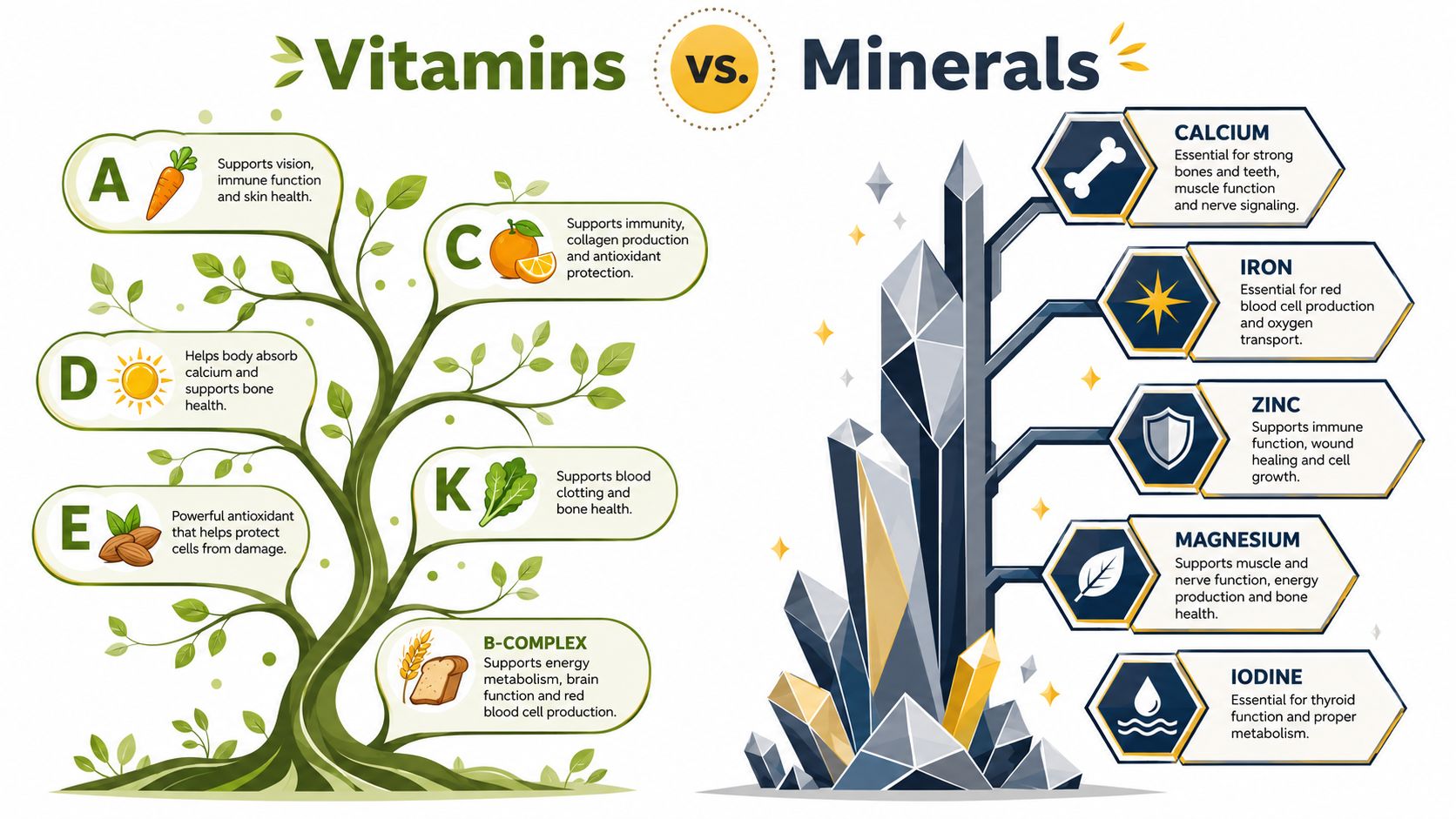
Vitamins are organic compounds. In simple terms, they are nutrients the body uses in small amounts for normal function, and some types can be stored for a while. Minerals are different. They are inorganic elements, and the body has to get them from food or supplements because it cannot make them.
That difference matters because a label that says “multivitamin” does not automatically mean it contains minerals. Families sometimes assume the two terms mean the same thing, then discover the product is really a vitamin-only gummy with a pleasant fruit flavour.
Zinc is a useful case study
Zinc shows why minerals deserve close attention. It supports immune cell development, normal cell growth and division, wound healing, cognitive and neurological function, and healthy skin. It is also an essential mineral, so the body cannot produce it and has to rely on diet or supplementation.
That is one reason zinc appears in children's products aimed at everyday wellbeing. It is not included just to fill space on the label. It reflects the fact that mineral coverage can matter when food intake is uneven or a child eats a restricted diet.
A useful way to picture the difference is that vitamins keep body processes running, while minerals provide the structural materials those processes depend on.
A product can only be a true multivitamin with minerals if it lists both groups in meaningful ways. In practice, that means checking for the specific minerals rather than relying on the marketing words on the front. Once parents start reading labels that way, it becomes clear that label length tells you less than ingredient quality.
Why Most Kids Gummies Contain Few or No Minerals
A parent can pick up a children's gummy and assume it offers broad nutritional cover, only to find the ingredient panel tells a narrower story. That gap between the front label and the active ingredients is common, and it is one reason minerals are often missing or included only in small amounts.
Minerals are harder to build into a gummy
Minerals such as zinc, iron, magnesium, and iodine can change taste, texture, and stability. Some bring a metallic note. Some interact with other ingredients during storage. Some make the gummy less pleasant to chew. If a formula is designed mainly for fruit flavour and a soft bite, the manufacturer may keep minerals low or leave them out completely.
That does not mean a vitamin-only gummy has no place. It does mean parents should not assume the word “multivitamin” on the front automatically means a full mineral profile inside. If minerals matter for your child, the active ingredients list is the part to read first.
Australian product listings show the kind of choices manufacturers make for stability and production. The TGA lists a registered multivitamin with minerals tablet that includes forms such as calcium carbonate, magnesium oxide, zinc oxide, ferrous fumarate, potassium iodide, folic acid, and retinol acetate TGA ARTG 292326. Those mineral forms are common in solid-dose products because they suit shelf stability and manufacturing needs.
Form matters as much as presence
A mineral can appear on a label and still be chosen in a form that suits production more than a child's everyday use. That is why oxide or salt forms are often seen in compliant Australian products. The label can still be legitimate, but the form tells you something about how the formula was built.
Zinc is a good example. One gummy may list zinc and another may not include any mineral at all, even though both use similar front-of-pack language. The product with zinc can support a different goal from a vitamin-only formula, but only if the zinc form and amount are included in the active panel. For a closer look at how parents can sort those details, this practical label guide from Daily Powers is a useful place to start.
Useful check: if a gummy says “multivitamin” but the active panel does not list any minerals, read it as a vitamin supplement, not a full multivitamin with minerals.
Ingredient transparency helps. A parent comparing two products may care more about whether zinc is present, what form it takes, and whether the product is sugar-free than about how many total ingredients are listed. If a child already likes the taste, the next question is whether the formula fills the gap you are trying to address.
How to Read a Supplement Label Like an Expert
A supplement label looks complicated until you know the order to read it in. Start with the active ingredients panel, then move to serving size, then check what's missing. That sequence cuts through a lot of marketing noise.
Use a simple label-reading checklist
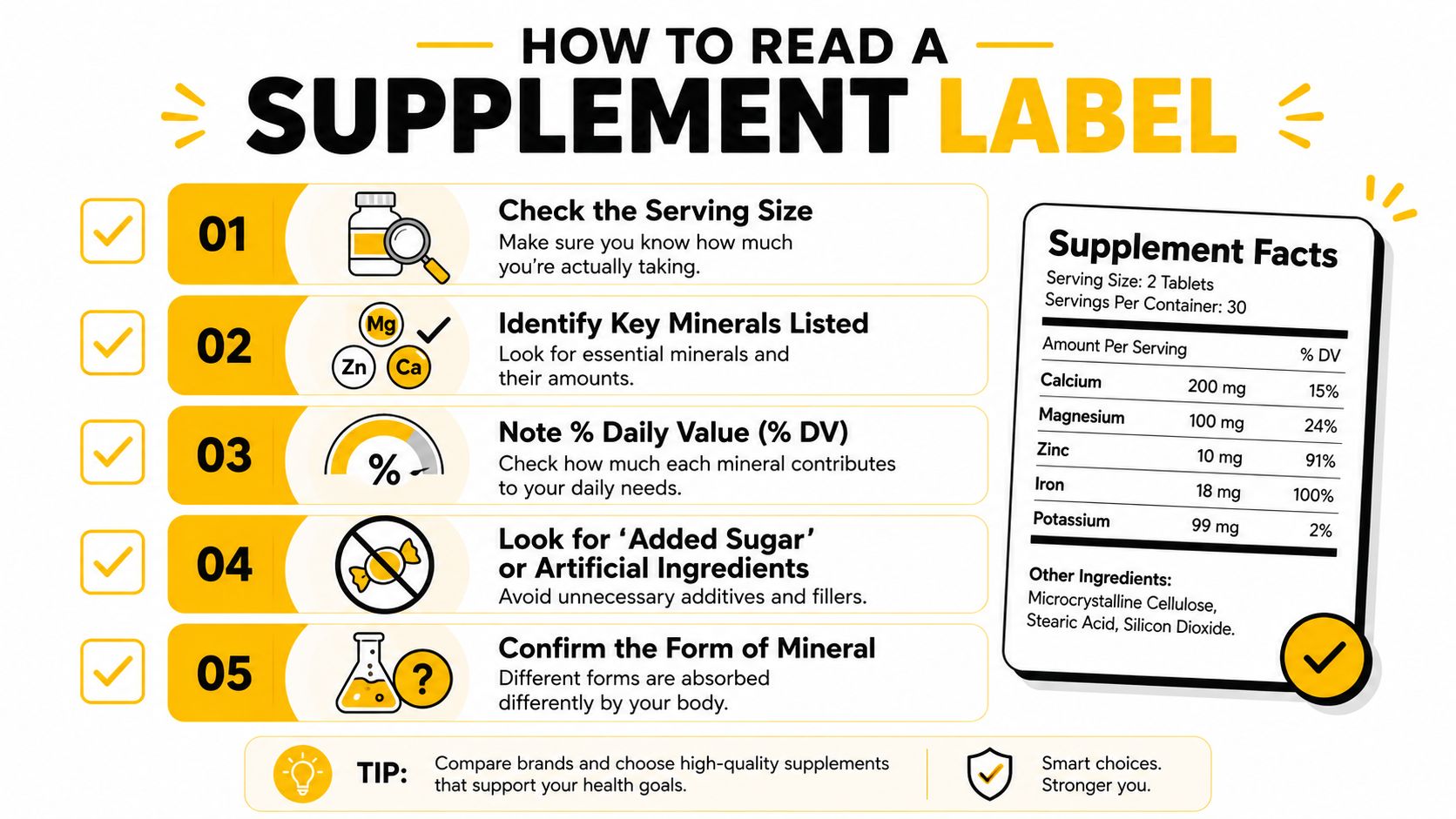
- Confirm the serving size. A product can look generous on the front, but the actual daily amount might be much smaller than you expect.
- Look for named minerals. If you want a multivitamin with minerals, check whether zinc, iron, iodine, magnesium, or calcium appears in the active panel.
- Check the form of each mineral. Zinc gluconate, zinc oxide, and other forms are not identical in formulation behaviour, so the form can tell you something about shelf stability and taste.
- Read the sugar and additive lines. For many families, sugar-free and no artificial colours or flavours are important practical filters.
- Match the product to your child's age and routine. A formula that works on paper still has to fit a child who needs to take it every day without a battle.
The main value of this process is clarity. It helps you tell the difference between a token ingredient list and a useful formula. It also keeps you from overvaluing a front label that promises everything but gives you very little in the mineral column.
One example worth noticing is that some children's formulas combine zinc with vitamins C, D, A, E, and B6, which can make sense if the goal is broader support rather than a single-nutrient fix. That kind of blend is easier to interpret once you stop reading “multivitamin” as a generic category and start reading it as a formula choice.
For a practical reference point, the guidance in Daily Powers' expert advice is useful because it puts ingredient reading into a family context instead of treating it like a chemistry exercise.
When a Multivitamin With Minerals Helps Your Child
A supplement helps most when it fills a real gap, not when it repeats what a child is already getting from food. That matters because a child with a restricted diet, a small appetite, or an uneven meal pattern may need a different kind of support than a child who eats a wide mix of foods on most days.
The best fit is usually a gap-filler
A multivitamin with minerals can be useful when a child's intake is low in a few specific nutrients, but the aim should still be coverage, not replacement. The main role of these products is to help fill small but important nutritional gaps, while food remains the foundation.
That is easy to miss when parents scan a front label. A long ingredient list can look impressive, yet what matters more is whether the formula covers the nutrients your child is most likely to miss, and whether those nutrients are present in forms the body can use well. Zinc is a good example. If a gummy contains zinc only as a token extra, it may sound reassuring without doing much. If the mineral form is chosen well and the dose is sensible, it can be more useful in a child whose diet is narrow or inconsistent.
A child who skips vegetables, accepts only a narrow food range, or resists many textures may have nutrient blind spots that are hard to close with food alone every day. In those cases, a targeted supplement can act as a backstop, especially when the rest of the diet is being worked on slowly and realistically.
Food-first still matters
The same logic also explains when a supplement may not change much. If a child already eats a broad diet and is growing well, the first move is usually to keep building meals, not to add more products. A supplement may be convenient, but it is not a shortcut around food habits.
Simple rule for parents: use supplements to support specific shortfalls, not to solve every nutrition worry at once.
That is why product fit matters. A child who needs a daily habit may do better with something simple, like Brave, if the family is looking for a routine-friendly formula that includes vitamins and a mineral component. The product still has to be judged on its label and dosing, but the broader idea is practical, not magical. A formula can only help where there is a genuine gap to fill.
The key takeaway is modest. If your child's diet is narrow, a supplement may help cover some of the gaps. If meals are already varied, the most useful “multivitamin” may be the one on the plate.
Avoiding Nutrient Overlap and Staying Within Safe Limits
This is the question parents ask because it sounds technical, yet it often comes down to a simple family routine. If your child eats fortified foods and takes more than one supplement, the total can build up faster than you expect.
Count the whole day, not each bottle
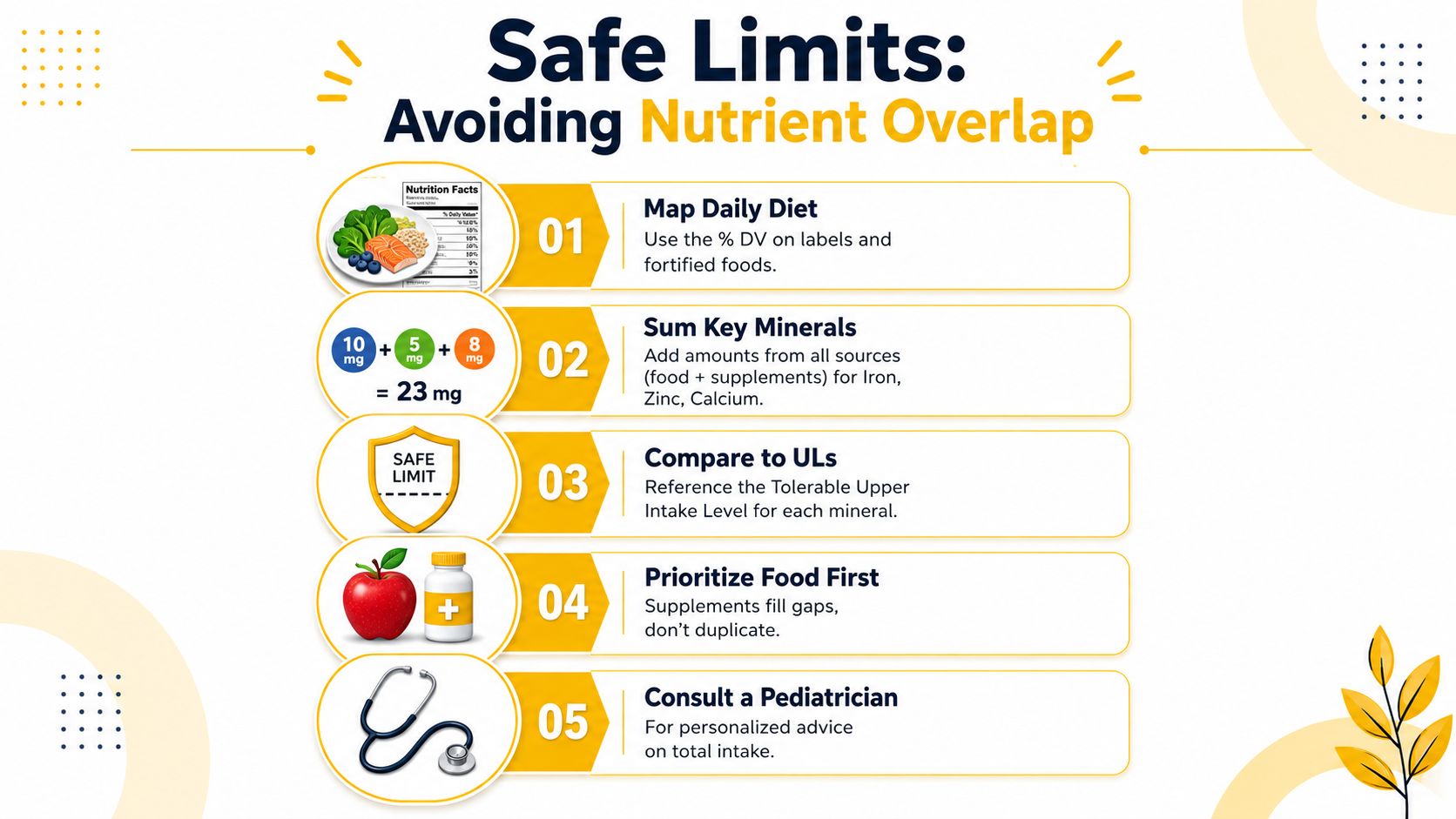
A child does not take nutrients by package. They take in a day's total from breakfast cereal, milk drinks, snacks, and supplements together. That is why two products that seem harmless on their own can become a problem when they contain the same nutrients.
A useful way to picture the difference is that vitamins help body processes run, while minerals provide the materials those processes depend on. Australian public-health guidance warns that supplements can push children over safe upper intake levels, especially when more than one product is used together PMC safety review. The concern is not abstract. Minerals such as iron, zinc, and iodine, along with vitamin A, can be helpful when intake is low but difficult to manage if they are repeated across fortified foods and multiple supplements. Zinc is a good example here. A child may need a little, but the form and amount matter, because the label may look reassuring even when the total across the day is too high.
A quick home audit helps
Before you add another product, do a simple check.
- List everything your child takes. Include gummies, tablets, powders, and any separate vitamin.
- Add in fortified foods. Breakfast cereals, milk drinks, and other packaged foods can contribute more than parents expect.
- Look at the key nutrients first. Focus on iron, zinc, iodine, and vitamin A if they appear in more than one place.
- Ask whether the child needs all of it. Sometimes the safer option is to remove duplication, not to add another product.
- Get personalised advice if the child has a medical issue or special diet. That matters more than any general rule.
Parents often expect a multivitamin with minerals to cover a long list of nutrients, but many kids' gummies are built for taste and convenience first. If you want a clearer sense of how formulas differ, this guide on vitamins for kids can help you compare products with a sharper eye. The bigger point is simple. Supplements can support a diet, but they should not stack on top of each other until the total becomes excessive. Families who do one careful audit often find they need fewer products than they expected.
Choosing the Right Multivitamin With Minerals for Your Family
The best choice is usually the one you can explain clearly to yourself. If you can't point to the minerals inside, the reason for the dose, and the way it fits your child's routine, the product probably isn't specific enough.
Choose for clarity, not just convenience
Look for a formula that clearly lists both vitamins and minerals, not a vague “daily support” blend. For many families, zinc is the mineral worth checking first because it has a real role in everyday development and repair, and it often appears in children's formulas alongside vitamins like C, D, A, E, and B6.
You should also check the practical details that affect daily use. Sugar-free formulations, no artificial colours or flavours, and a taste your child will accept matter because a supplement only works if it gets taken consistently. A child-friendly product that gets refused every second day is less useful than a simpler one that becomes part of the routine.
In Australia, multivitamin and mineral products are generally listed medicines with an AUST L number, which means they are permitted to make low-risk claims but are not individually pre-approved for efficacy like registered medicines Better Health Channel. That's an important reality check. A compliant listing is not proof that a product will solve a specific health problem.
For parents comparing options, Daily Powers' guide to the best vitamins for kids is useful because it keeps the focus on ingredient transparency, age-appropriate use, and the kind of daily habit children can maintain. That's the right lens for this category.
If you want a simpler way to choose a kids' supplement, Daily Powers builds sugar-free, vegan gummy formulas with clear ingredient lists and child-friendly routines in mind. Visit Daily Powers to compare options, check the ingredients, and choose a multivitamin with minerals that fits your child's day without turning supplementation into a guessing game.