

Your toddler is hot, tired and refusing to open their mouth. You have a bottle of medicine in one hand, a measuring spoon in the other, and a label full of numbers that seems to assume you already know what they mean. In that moment, paediatric dosing can feel like a quick household task, but the safest approach is more deliberate.
Australian paediatric dosing guidelines treat a child's dose as part of a documented safety system. Age, current weight, medical indication, allergies, dose amount, calculation method and treatment duration all matter. Administration matters too. A correctly calculated dose still won't help if a household spoon delivers the wrong volume or a child takes only part of the mixture.
This guide explains how the system works, where families commonly get confused, and when to stop and contact a pharmacist, GP or urgent safety service.
Table of Contents
- Why Paediatric Dosing Is a Safety System, Not a Number
- The Six Pillars Every Dose Must Record
- Weight-Based Calculations and Upper-Limit Rules
- Age and Weight Bands for Common Children's Products
- Australian Reference Tools Every Caregiver Should Know
- Administration Techniques That Improve Real-World Adherence
- Choosing the Right Dosage Form for Your Child
- When to Stop and Seek Professional Advice
- Quick-Reference Checklist for Daily Dosing
- Common Misconceptions About Growing Into Adult Doses
Why Paediatric Dosing Is a Safety System, Not a Number
At the end of a long day, a parent may reach for paracetamol because a child has a fever or seems uncomfortable. The safest question isn't, “How many millilitres?” It's, “Which product, for which child, for which symptom, at what concentration, and for how long?”
Australian prescribing guidance requires a child's prescription to record the age or date of birth, current accurate body weight, indication, dose in mass units, calculation basis and treatment duration. The guidance also recommends checking calculations and confirming administration instructions with parents and carers. That turns a dose into something another clinician or caregiver can review, rather than a number copied from memory. You can read the Australian paediatric prescribing position statement for the full safety framework.
Why children need their own rules
Children aren't smaller adults. Their bodies process medicines differently as they grow, and the appropriate dose may change with both development and body size. A label designed for adults can therefore be unsuitable even when a child looks physically large.
The Australian system uses several checks together:
- Medicine and indication: The product must match the reason it's being used.
- Age: Some medicines are restricted or adjusted by developmental stage.
- Weight: Many medicines use a calculation based on kilograms.
- Concentration: Two liquids with the same active ingredient may contain different amounts per millilitre.
- Maximum dose: A child's calculated dose must not exceed the applicable adult maximum.
- Duration: Repeated dosing over time creates a different safety question from one dose.
Practical rule: Treat every dose as a small medication review. Confirm the child, product, purpose, amount and timing before measuring.
The figure on a label is therefore a boundary within a set of conditions, not a recommendation to use in isolation. If the child's weight, age, symptoms or other medicines have changed, the old number may no longer be the right number.
The Six Pillars Every Dose Must Record
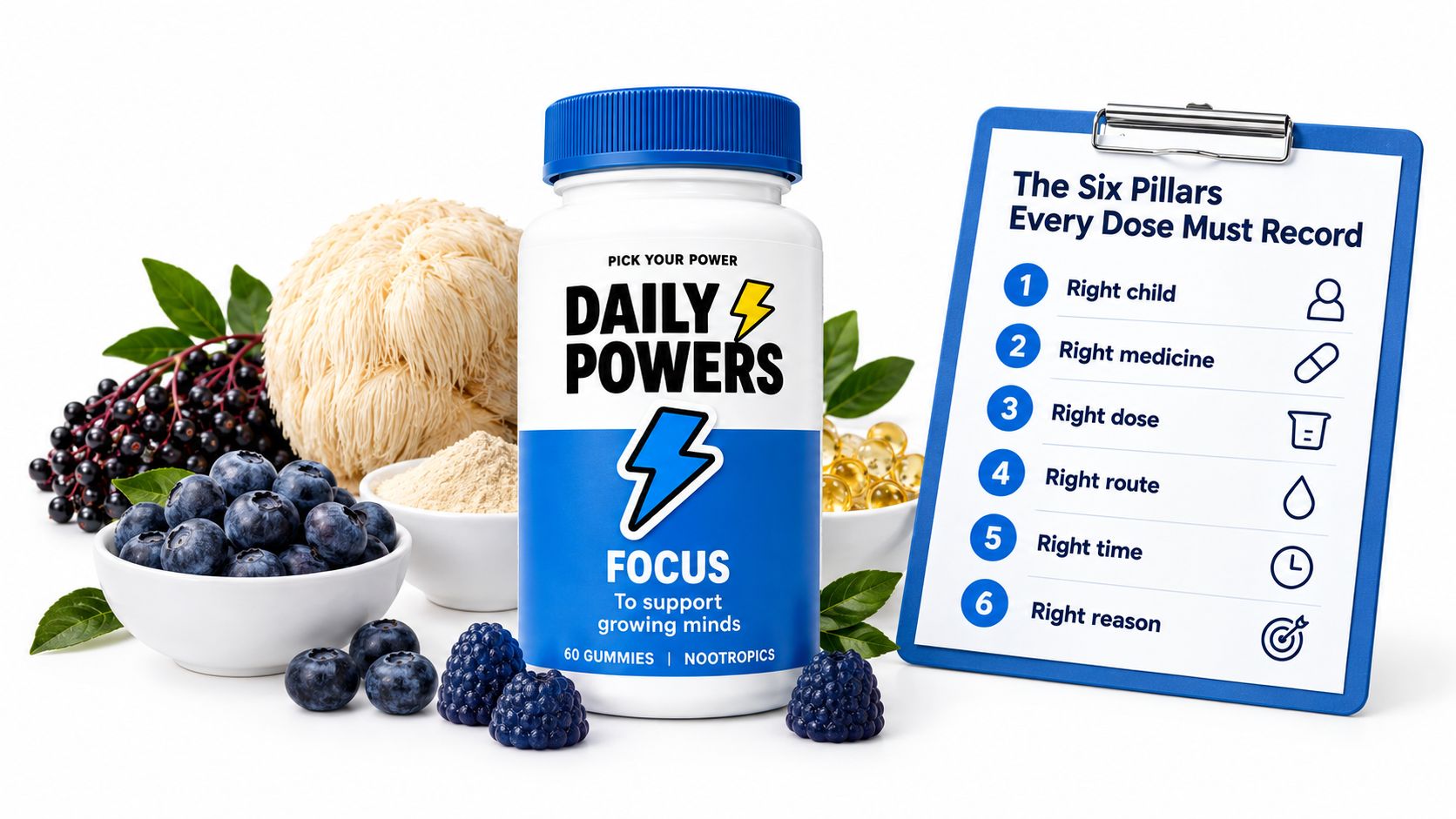
Australian paediatric prescribing standards identify six pieces of information that should travel with a child's medicine record: age or date of birth, current weight, indication, allergy status, dose, and calculation basis. Each one answers a different safety question.
| Pillar | What It Records | Caregiver Action |
|---|---|---|
| Age or date of birth | The child's developmental stage | Check the child's age against the product directions |
| Current weight | The body weight used for dosing | Use a recent weight in kilograms, not a guess |
| Indication | The symptom or condition being treated | Confirm the medicine is intended for that problem |
| Allergy status | Known medicine or ingredient sensitivities | Read the ingredient list and tell the pharmacist about reactions |
| Dose | The amount to administer | Record the amount in mg, mL, tablets or another stated unit |
| Calculation basis | How the dose was selected | Note whether it uses mg/kg, age band or a fixed dose |
How the pillars work together
Weight is not a formality. If an old weight is too low or too high, a weight-based calculation is affected from the start. Weigh the child in kilograms where possible and keep the result with the medicine notes.
Indication prevents product drift. A medicine used for fever, pain, allergy or dehydration may have different directions, and a product suitable for one symptom may not address another. Don't substitute a familiar product because the packaging looks similar.
Allergy status includes ingredients. The active medicine matters, but so can excipients such as flavours, colours or preservatives. A known reaction should be discussed with a pharmacist before giving the product.
Dose and basis make the instruction auditable. “Give some syrup” isn't a safe record. A useful note says what was given, in what unit, and whether the figure came from a weight calculation or an age range.
A simple home log can include the child's name, date of birth, current weight, medicine, reason for use, allergy information, dose, calculation basis, time given and intended duration. If you're considering a supplement routine such as Daily Powers Focus, record its label directions and ingredients separately from prescription or symptom-relief medicines.
Weight-Based Calculations and Upper-Limit Rules
A weight-based dose usually starts with the prescribed amount in milligrams per kilogram. Multiply that figure by the child's weight in kilograms, then convert the result into the volume shown on the product label.
For example, if a clinician directs 15 mg/kg for an 18 kg child:
15 mg × 18 kg = 270 mg
That gives the required amount of active medicine for the dose. To convert 270 mg into millilitres, you must read the product concentration, such as the number of milligrams contained in each millilitre. Without that concentration, it isn't safe to guess the volume.
The ceiling still applies
Australian guidance states that adult maximum doses should not be exceeded for paediatric patients, including children weighing more than 40 to 50 kg. A larger child doesn't automatically move into adult dosing. The calculation must still be checked against the product's maximum single dose and any maximum total amount over the stated period.
The difference matters because a single-dose limit and a cumulative daily limit answer different questions. A child may receive an amount that looks acceptable once, but repeated doses at short intervals can create an unsafe total. Keep a written record of the time and amount so another caregiver doesn't unknowingly repeat it.
| Child Profile | mg/kg Dose | Calculated Dose | Adult Ceiling | Final Dose |
|---|---|---|---|---|
| 18 kg child | 15 mg/kg | 270 mg | Must be checked against the product information | The lower applicable limit |
| Larger child over the relevant weight threshold | As prescribed | Weight calculation | Adult maximum must not be exceeded | The lower applicable limit |
The table demonstrates the method, not a universal paracetamol instruction. Product strength, indication, age, dosing interval and maximum daily amount must come from the current Australian label or a clinician.
Calculation check: Write the child's weight, prescribed mg/kg figure, multiplication, product concentration and final mL amount on paper. Ask a pharmacist to check the calculation if any part doesn't line up.
If you're reviewing a child's supplement routine, don't apply medicine-style calculations automatically. Product categories have their own directions and ingredient limits. A guide such as magnesium supplements for kids can help explain the category, but a child with medical conditions or regular medicines still needs individual advice.
Age and Weight Bands for Common Children's Products
Families often expect one master table covering every children's product. Australian labels don't work that way. The correct row depends on the specific product, concentration, active ingredient, indication and current child measurements.
The requested age bands below are useful for organising a conversation with a pharmacist, but they aren't a universal dosing chart. The verified Australian framework supports age and weight checks, not one set of invented figures for every brand. For that reason, the safest quick-lookup table shows what to verify rather than supplying unsupported dose amounts.
| Age Band | Weight Range (kg) | Paracetamol (mg) | Ibuprofen (mg) | Vitamin D (IU) | ORS Sachet Volume |
|---|---|---|---|---|---|
| Under 6 months | Check current weight | Use the product label and clinician advice | Check age restrictions before use | Follow the product directions | Prepare exactly as labelled |
| 6 to 12 months | Check current weight | Use the current concentration and label | Check age restrictions before use | Follow the product directions | Prepare exactly as labelled |
| 1 to 3 years | Check current weight | Use the current concentration and label | Use only the labelled age and weight row | Follow the product directions | Prepare exactly as labelled |
| 4 to 6 years | Check current weight | Use the current concentration and label | Use only the labelled age and weight row | Follow the product directions | Prepare exactly as labelled |
| 7 to 11 years | Check current weight | Use the current concentration and label | Use only the labelled age and weight row | Follow the product directions | Prepare exactly as labelled |
| 12 years and over | Check current weight | Check whether the product has adolescent directions | Check whether the product has adolescent directions | Follow the product directions | Prepare exactly as labelled |
Reading the row correctly
For liquids such as many analgesics, weight often drives the amount, while the bottle concentration determines the millilitres. Oral rehydration solution is different again. The sachet must be mixed with the exact volume of water stated on its packaging, because changing the water volume changes the solution's concentration.
Some products rely more heavily on age or developmental restrictions than weight. Iron products, cod liver oil and some herbal preparations shouldn't be treated as interchangeable with weight-based pain-relief liquids. Supplements also vary in ingredient strength, so compare the child's age with the exact label rather than borrowing directions from another brand.
The amount printed on a label may describe a single dose, while the permitted number of doses across a day appears elsewhere. Read both. If an age band and weight band point to different instructions, pause and ask a pharmacist rather than choosing the larger amount.
Australian Reference Tools Every Caregiver Should Know
Australian paediatric dosing is supported by national references rather than a single website or bottle label. The AMH Children's Dosing Companion is described as Australia's national independent guide for prescribing and administering medicines to children from birth to 18 years. It covers commonly used medicines in community and hospital practice, and its publisher states that it is updated annually and provides dosing by indication and age for more than 500 drugs in the current reference description, as shown by the AMH Children's Dosing Companion.
The Royal Children's Hospital identifies the AMH Children's Dosing Companion as its first reference for dose checking and states that paediatric medication doses are checked against a current Australian paediatric reference. This gives parents a useful question to ask: “Which Australian reference was used to check this dose?”
What each source contributes
- AMH Children's Dosing Companion: A structured professional reference covering medicines, indications and child age ranges.
- Royal Children's Hospital guidance: Practical clinical guidance for children and adolescents aged 0 to 18 years, including common presentations.
- TGA product information: The approved medicine information behind the product's directions, including formulation and dosing instructions.
- Poisons Information Centre: A real-time service for accidental exposures, including suspected overdose.
Overseas labels can be confusing because they may use different units, concentrations or age cut-offs. An imported bottle shouldn't be matched to an Australian dose by appearance alone. Show the package to a pharmacist and ask them to verify the active ingredient, strength and directions.
For families comparing everyday supplements, immune support supplements may provide general category context, but it doesn't replace the product label or individual clinical advice.
Administration Techniques That Improve Real-World Adherence
A dose can be mathematically correct and still fail at the kitchen bench. The child may swallow only part of it, the caregiver may use an unmarked spoon, or the medicine may be mixed into food that isn't finished.
Australian practical guidance recommends metric oral syringes or calibrated medicine cups and advises against household teaspoons. Household spoons vary in size, so they're unreliable for measuring medicine. Use the device supplied with the product, place it on a stable surface, and check the markings at eye level.
Make the dose easier to take
Give a liquid slowly into the inside of the cheek, not straight towards the back of the throat. Allow the child to swallow between small amounts. With an older child, supervised participation can help: they may hold the syringe while you control the dose and make sure the full amount is delivered.
Mixing requires care. A small amount of a suitable food or drink may be acceptable only if the child will finish the entire portion. Australian guidance warns against mixing medicine into a large volume or an essential food, because taste changes can create future refusal. Don't hide medicine in a full bottle or a favourite meal that the child needs regularly.
- Use one routine: Pair a daily supplement with a consistent meal or familiar household event.
- Keep language neutral: A short instruction is often easier than a long negotiation with a resistant toddler.
- Record the time: Write down who gave the dose, how much and when.
- Check storage: Follow the product instructions, especially where a liquid medicine or probiotic has specific storage requirements.
- Separate products: Keep medicine and supplements identifiable, with labels intact and lids secured.
A routine should make the right action easier to repeat. It shouldn't replace checking the label when the product or child changes.
If a child spits out or vomits a dose, don't automatically repeat it. You may not know how much was absorbed. Ask a pharmacist or clinician for product-specific advice.
Choosing the Right Dosage Form for Your Child
The best dosage form is the one that provides the required amount accurately and that the child can use safely. No form wins on every measure.
Oral liquids are usually the most flexible when a clinician has prescribed a weight-based amount, because a metric syringe can measure a specific millilitre volume. They require more attention to concentration, shaking instructions and storage.
Gummies can be easier for some children to accept, but each piece contains a fixed amount. That makes them less suitable when the dose needs fine adjustment by body weight. They also need secure storage because children may mistake them for lollies.
Chewable tablets may suit children who can chew reliably and tolerate the flavour or texture. Choking risk remains relevant, particularly when a child isn't developmentally ready to manage the tablet safely.
Standard tablets can offer a clear fixed strength for an older child who can swallow them. Don't split, crush or dissolve a tablet unless the label, pharmacist or prescriber confirms that the product allows it.
| Dosage Form | Dose Accuracy | Adherence | Best Age Band |
|---|---|---|---|
| Oral liquid | High when measured with a metric syringe and matched to concentration | Useful for children who can't swallow tablets, though taste may cause resistance | Often suitable for younger children, according to the label |
| Gummy | Fixed per-piece amount, so limited for weight titration | May be accepted as part of a supervised routine | Only when the product label permits it |
| Chewable tablet | Fixed strength, with accurate dosing if the prescribed amount matches | Can suit children who chew safely | Developmentally ready children |
| Standard tablet | Accurate fixed strength when swallowed whole | Suitable for children who can swallow reliably | Older children and adolescents, according to the label |
For a supplement decision, compare the ingredient list, per-unit strength, age directions and allergy information. A general discussion of vitamin D3 gummies can help explain the format, but it doesn't authorise changing the labelled serving or substituting it for a prescribed medicine.
Choose a liquid when the dose must be weight-titrated. Choose a chewable or tablet only when the child can use it safely and its per-unit strength matches the approved or advised amount.
When to Stop and Seek Professional Advice
Self-dosing should stop when the information no longer fits the child or the product. Contact a clinician when:
- A dosing error occurred: A double dose, wrong product, wrong child or wrong interval needs prompt advice. For suspected accidental overdose, contact the Poisons Information Centre on 13 11 26.
- Symptoms persist: If the child doesn't improve within the expected course, contact a GP. Don't keep extending treatment without review.
- New symptoms appear: Rash, unusual sleepiness, breathing changes, repeated vomiting or a clear deterioration warrants medical advice.
- An allergy is known: Ask a pharmacist to check active and inactive ingredients before giving the product.
- The child falls below the lowest band: Don't extrapolate a dose for a smaller child.
- The child is under 12 months: Speak with a GP or pharmacist before making a dosing decision.
- Information conflicts: If the bottle, leaflet and professional instruction disagree, pause and ask a pharmacist.
For triage and general health guidance, contact Healthdirect on 1800 022 222. Use a pharmacist for non-urgent product, measuring or ingredient questions, and a GP for ongoing symptoms, repeated treatment needs or a child with underlying health conditions.
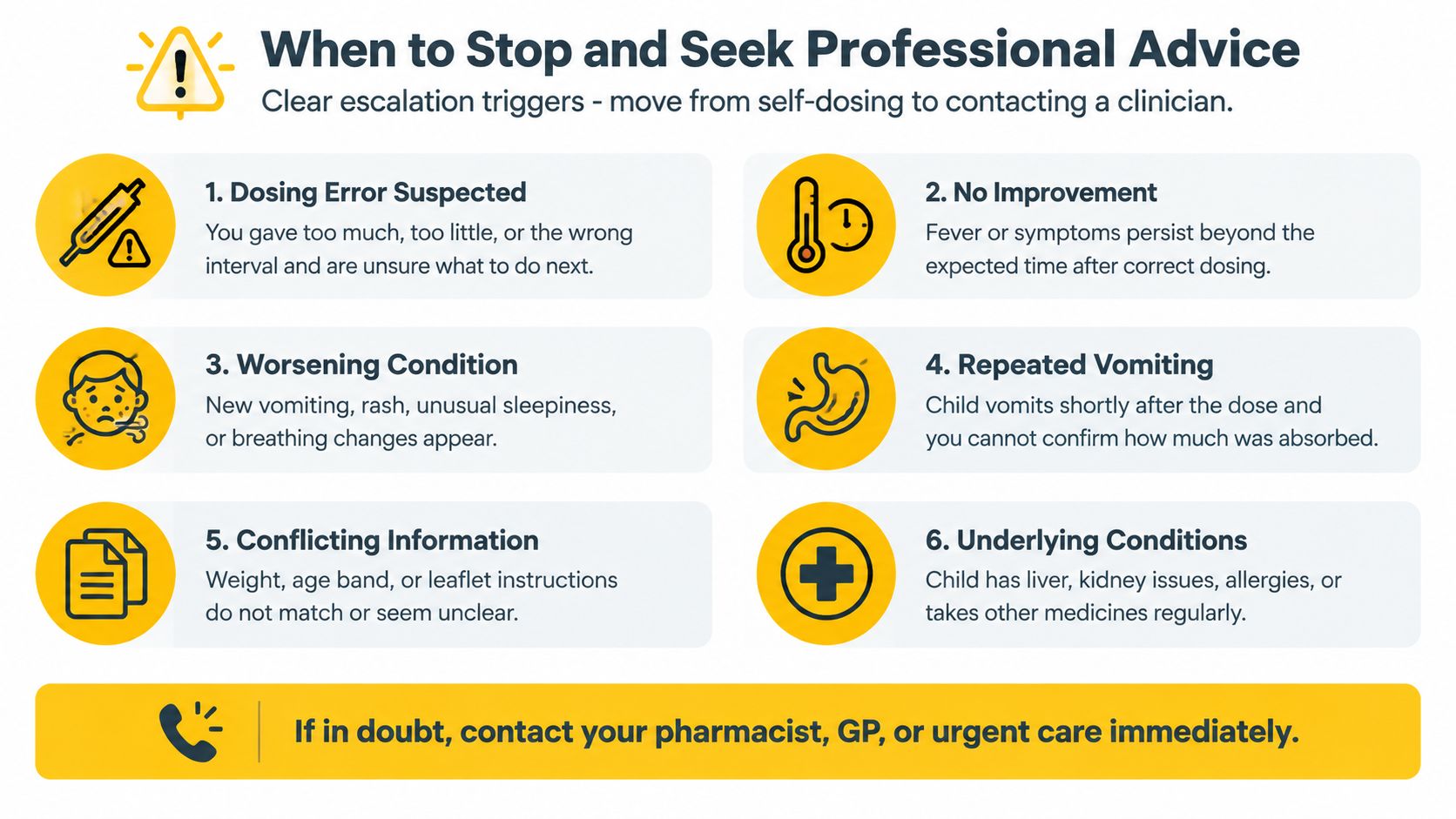
This list isn't exhaustive. If you're uncertain, a phone call is safer than guessing.
Quick-Reference Checklist for Daily Dosing
Keep this sequence with the medicine, not just in your memory:
- Confirm current weight: Record the child's weight in kilograms. Don't estimate from an old measurement.
- Check age band: Match the child's age with the exact product directions.
- Read concentration: Confirm the amount of active ingredient per millilitre, tablet or unit.
- Calculate the dose: Apply the prescribed basis and double-check the arithmetic.
- Check the ceiling: Make sure the final amount doesn't exceed the applicable maximum.
- Measure accurately: Use the supplied metric syringe or calibrated cup.
- Record and monitor: Write down the time and amount, observe the child, and seek advice if symptoms persist or new concerns appear.
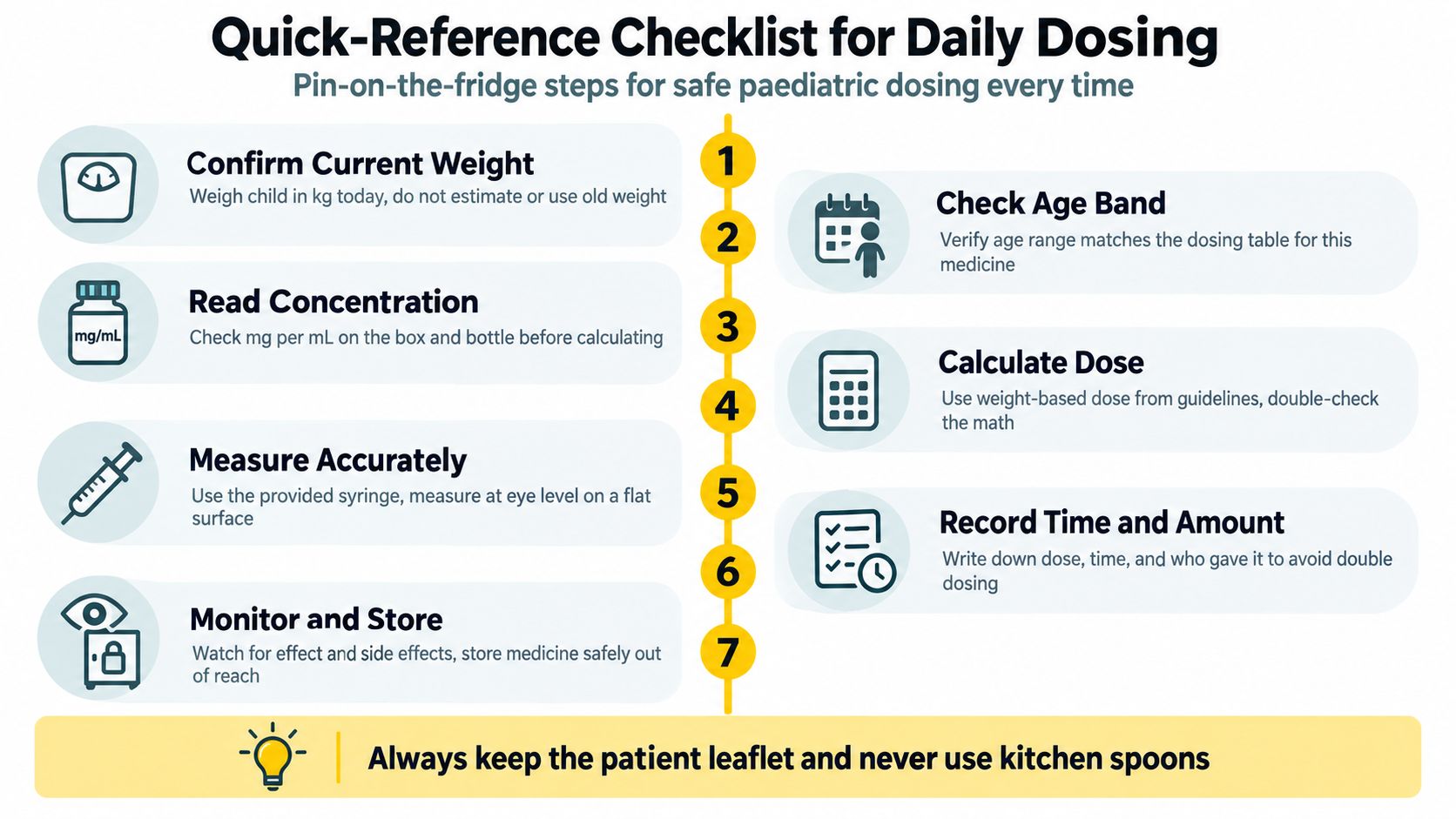
Keep the patient leaflet with the bottle and never use a kitchen spoon. A short record prevents two caregivers from assuming the other person gave the medicine.
Common Misconceptions About Growing Into Adult Doses
A child may be tall, heavy or close to adult height and still require paediatric dose checking. Australian guidance says adult maximum doses must not be exceeded for paediatric patients, including children above the weight range where families may assume adult treatment applies.
| Common Assumption | Documented Paediatric Rule | Safe Family Action |
|---|---|---|
| A tall child can take an adult tablet | Weight-based dosing still has an adult maximum and product-specific directions | Ask a pharmacist before using an adult product |
| A missed dose should be doubled | The correct response depends on the medicine, interval and time since the missed dose | Don't double unless a clinician specifically directs it |
| Natural supplements have no upper bound | Ingredients, strengths and age directions still matter | Follow the exact label and check interactions |
| A familiar label works for every brand | Concentrations and formulations can differ | Match the calculation to the current bottle |
Some over-the-counter information still relies heavily on age cut-offs, while professional references may include more detailed indication and age information. That difference is one reason a pharmacist is useful when a child approaches an adult-sized body mass.
A missed dose also isn't an invitation to compensate automatically. The medicine's half-life, intended interval and safety profile determine what to do, so seek product-specific advice.
Natural doesn't mean risk-free. A gummy, powder or liquid can contain active ingredients with their own age restrictions, interactions and maximum amounts. Treat supplements as products that need label checks, not as exceptions to medication safety.
Safe decision: When the child's size, age or product falls near a boundary, pause and ask a pharmacist or GP to verify the dose.
Daily Powers offers children's gummy supplements designed for daily routines, with product-specific ingredient lists and usage directions rather than medicine-style weight-based dosing. If you're building a consistent supplement habit for an eligible child, visit Daily Powers to review the available products and check the label information with your pharmacist when needed.