

30 billion CFU means a total of 30 billion colony-forming units, or viable microbes, per probiotic dose. For children, however, the strain names, age guidance and evidence behind the formulation matter far more than the headline number alone.
You're standing in an Australian pharmacy, comparing two brightly packaged probiotic products. One says “30 billion” in large lettering, while the other lists several long strain names in smaller print. It's natural to assume the larger number must be the better choice, especially when you're trying to help a child with digestive discomfort or support everyday wellbeing.
That assumption can be misleading. A high CFU count tells you how many viable microorganisms the product is intended to provide, but it doesn't tell you whether the strains suit your child, whether the count remains accurate through expiry, or whether the product is labelled for their age. Australian regulation adds another important layer, because probiotics may be sold as foods or as listed complementary medicines, with different expectations for information and quality control.
Table of Contents
- Understanding What 30 Billion CFU Actually Means
- Why Strain Selection Matters More Than the Total Count
- When 30 Billion Probiotics Are Suitable for Children
- How to Read Probiotic Labels Like an Informed Parent
- Storage, Shelf Life, and Viability Through Expiry
- Choosing Kid-Friendly Formats Without Compromising Quality
- Making a Confident Probiotic Choice for Your Family
Understanding What 30 Billion CFU Actually Means
CFU stands for colony-forming units. In plain language, it's an estimate of the live microorganisms capable of forming colonies under laboratory conditions. You can think of the number as a headcount of viable microbial units in a dose, rather than a measure of weight, potency in every child, or guaranteed health benefit.
A useful analogy is a city. A product labelled 30 billion CFU represents a very large population of intended live microbes, but knowing the population size doesn't tell you who lives there or how well each group performs. Two cities with the same population can have completely different services, environments and resources. Probiotic products can differ in much the same way because their strain mix, dosage form and stability may not match.

The number on the front is only a starting point
A prominent Australian example is Nature's Way Restore Probiotic 30 Billion. Its label states 30 billion CFU per capsule, divided among Lactobacillus rhamnosus GG at 25.5 billion CFU, Bifidobacterium lactis BI-04 at 2 billion CFU, and HOWARU Bifidobacterium lactis HN019 at 2.5 billion CFU, with 30 mg of inulin prebiotic fibre. The product is sold in 30-capsule and 90-capsule formats and is positioned for adults and children over 12 years. (Nature's Way Restore Probiotic 30 Billion)
That example shows why the headline needs context. The total count is a combined figure, not 30 billion of every strain. It also shows that a product with a high count can be packaged as a mainstream pharmacy-style supplement rather than a specialist product.
The practical question is not just, “How many bacteria are included?” It's also, “Which strains are included, how are they named, and how many remain viable when my family uses the product?” For a plain-language introduction to the broader concept, parents can read this guide to what probiotics mean.
Practical rule: Treat “30 billion” as the beginning of your label check, not the conclusion.
Why Strain Selection Matters More Than the Total Count
A probiotic strain is a more specific identity than a broad species name. Lactobacillus rhamnosus GG, for example, gives more information than saying “Lactobacillus rhamnosus”, because the strain designation identifies the particular line of microorganism included in the formulation.
That distinction matters because probiotic effects aren't automatically shared by every member of a species. A product containing one strain may be formulated for a different purpose from another product with the same total CFU but a different strain combination. The label should therefore help you understand not just the quantity, but the microbial “team” receiving that quantity.
Compare the whole formulation, not just the front panel
Imagine two products that both claim 30 billion CFU. Product A lists named strains with strain codes and explains how the count is measured. Product B gives a total number but only offers broad species names. The two products aren't automatically equivalent, even though their front-of-pack figures look identical.
A parent comparing them should ask:
- Strain identity: Does the label provide genus, species and a strain code where relevant?
- Purpose: Is the product intended for general digestive support, or is it associated with a particular symptom or use?
- Age guidance: Does the formulation specifically include your child's age group?
- Dosage form: Is it a capsule, powder, chewable or another format that your child can take correctly?
- Stability information: Does the company explain how viability is maintained through shelf life?
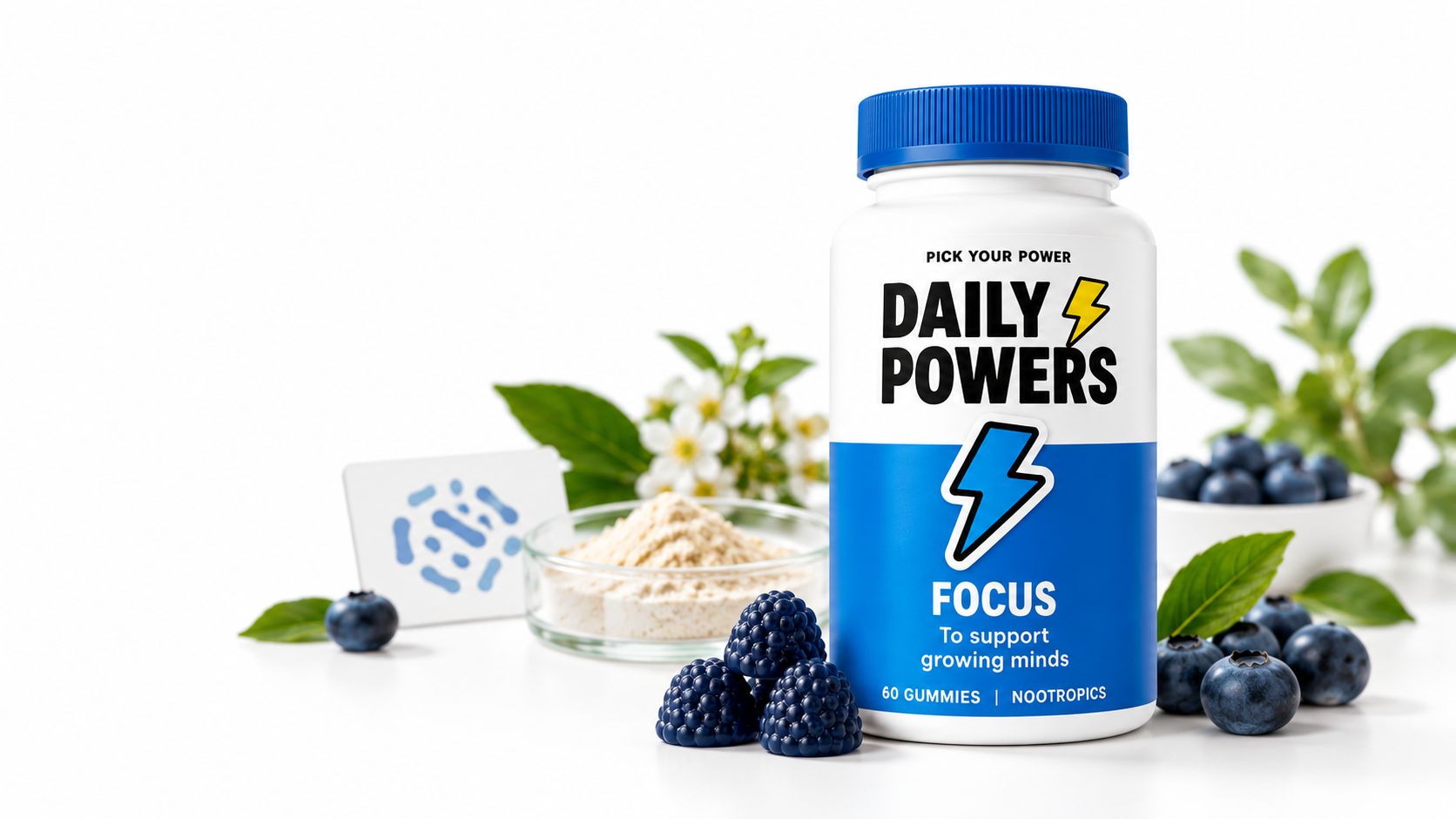
A higher count may sound impressive, but it can't compensate for a formulation that doesn't suit the intended user. In a children's supplement routine, consistency and age-appropriate directions are also practical considerations. A product such as Focus is not a probiotic 30 billion product. Its listed formulation uses mushroom polysaccharides, vitamin D3, zinc, elderberry fruit powder and prebiotic fructooligosaccharides for a child-focused daily routine. That distinction matters because a prebiotic is food for certain gut microbes, while a probiotic supplies live microorganisms.
The useful comparison is not “Which tub has the bigger number?” It's “Which product clearly identifies what it contains and why that formulation fits the intended use?”
CFU remains relevant, but it's one part of a larger assessment. A transparent label lets parents evaluate quantity alongside strain selection, directions and quality information instead of treating the total as a guarantee.
When 30 Billion Probiotics Are Suitable for Children
At the pharmacy counter, a parent may see “30 billion” in large type and assume the product is suitable for a child. The age direction on the label can tell a different story. Many Australian 30-billion probiotic products are labelled for adults and children over 12 years, reflecting the complete formulation, including capsule size, dose, strain combination and supporting evidence. Parents shouldn't reduce or share an adult product without professional guidance.

Australia's regulatory setting adds an important layer. Unlike foods, listed medicines must support the product's viability through expiry and disclose its CFU count accurately. Yet many product pages still make the headline number more prominent than the strain-specific evidence. A high count is therefore a starting point for questions, not a decision by itself.
The Nature's Way product listing at Dick Smith illustrates this type of formulation, presenting it for adults and children over 12 and describing digestive-support endpoints such as bloating, regularity and immune support. Those details still need to be considered alongside the child's age, symptoms and ability to take the stated dose.
For a younger child, begin with the reason for considering a probiotic. A healthy child without a specific digestive concern may not need a high-count product because the packaging gives that number prominence. Ongoing symptoms, medication-related concerns or a diagnosed condition call for individual advice from a doctor, pharmacist or paediatric health professional.
The wording also matters. General wellness language such as “supports gut health” is broad. A claim linked to bloating or irregularity relates to a more specific decision, where symptom pattern, duration and wider health history should be reviewed.
A pharmacist or doctor can help check whether a probiotic is appropriate, whether the product is labelled for the child's age, whether its dose and format can be used safely, and whether symptoms need medical assessment. They can also consider how it fits with the child's existing care plan.
A family routine may include products that are not probiotics. Brave is described as a daily multivitamin gummy for growing children, with essential vitamins, vegan-friendly ingredients and no artificial colours or flavours. Its child-friendly format does not establish that a high-CFU probiotic is suitable.
For practical family guidance, see this resource on gut health for kids. Age guidance and clinical context come before CFU count.
How to Read Probiotic Labels Like an Informed Parent
At the pharmacy counter, a parent may see “30 billion” printed in large type and assume it is the clearest measure of quality. Start further down the pack. The strain names, product category, expiry assurance and directions show what that number actually represents.
Australian probiotics can be sold as foods or as listed complementary medicines. The difference matters. A listed medicine must support the stated CFU amount through expiry and identify the product within the Therapeutic Goods Administration system. A food may provide less information about its bacterial count, making direct comparison harder.
An Australian Register of Therapeutic Goods example shows how a listed 30-billion product appears in the public register. The ARTG entry helps confirm the product's regulatory status, but it does not mean that every product with the same headline number contains the same strains or suits the same child.
Read the label in this order:
- Product status: Check whether the product is a listed medicine or a food. Listed medicines have regulatory requirements around their stated contents and quality evidence.
- CFU statement: Find the total count and check whether it is guaranteed at manufacture or through expiry. Those points are not equivalent. A count measured when the product was made may not describe what remains at the end of shelf life.
- Full strain names: Look for genus, species and strain codes. “Lactobacillus” or a species name alone gives less information than a complete strain designation.
- Age and dose: Confirm that the directions match your child's age and the intended daily use.
- Storage directions: Note the required temperature and handling instructions. Storage affects whether living microorganisms remain viable.
- Other ingredients: Review prebiotics, sweeteners, allergens and capsule or gummy ingredients.
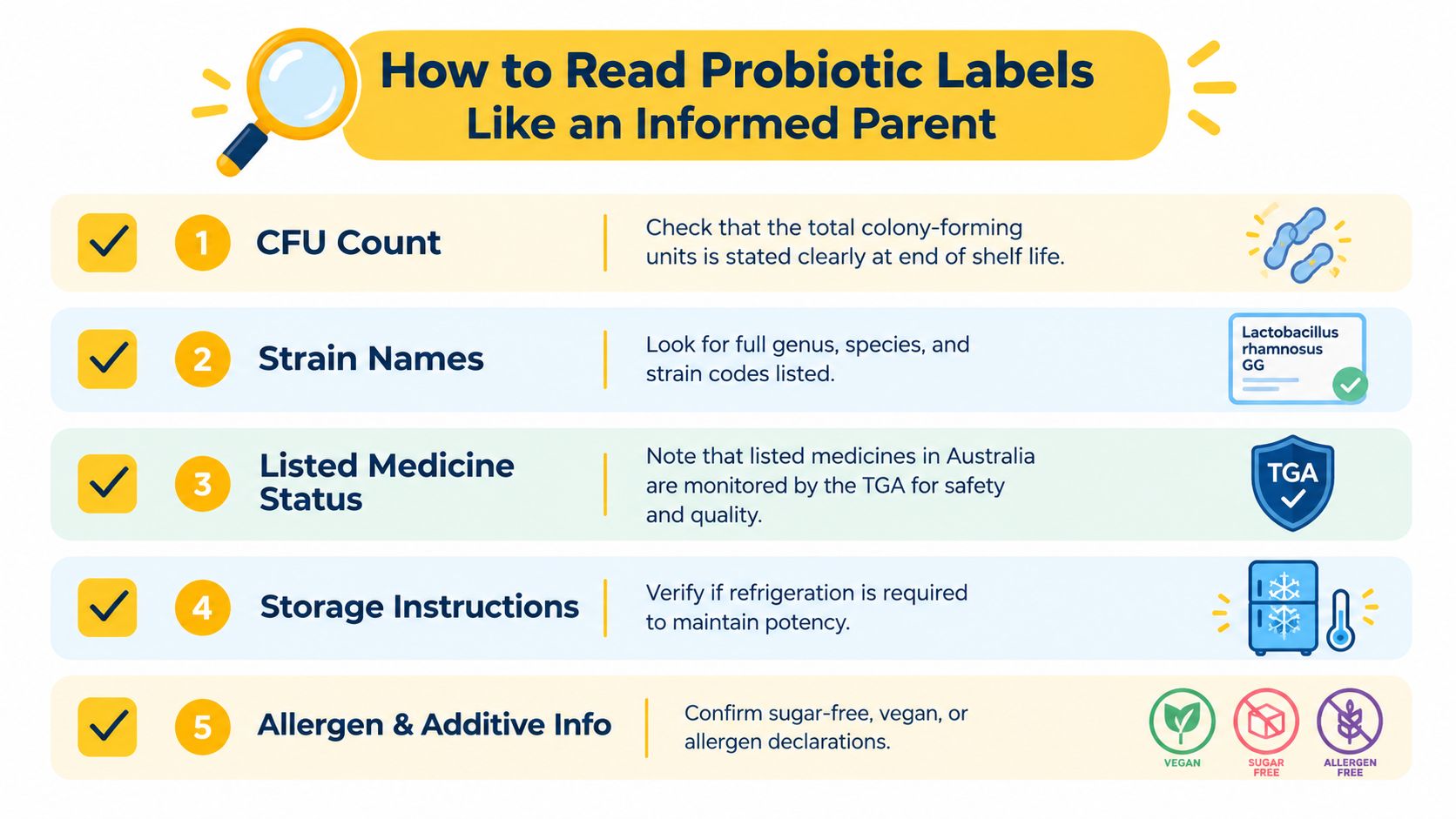
A front panel is the shop window. The strain list and CFU wording are the product's specification sheet. Two products can both state 30 billion CFU while containing different microbial communities, formats and expiry controls.
Calm provides another useful label-reading example. It is a children's magnesium gummy containing magnesium citrate, vitamin B6, zinc and prebiotic fructooligosaccharides. It is not a probiotic. Checking the ingredient list prevents parents from treating every product described with “gut health” language as interchangeable.
Storage, Shelf Life, and Viability Through Expiry
At the pharmacy, a parent may see “30 billion CFU” in large type, then notice a storage warning in much smaller print. The large number describes the product only if enough microorganisms remain alive under the stated conditions. Heat, moisture, oxygen and careless handling can reduce viability, so storage instructions are part of the quality information, not decoration.
A probiotic label works like a promise with a time limit. The relevant question is not how many CFU were present when the product was made, but how many are expected to remain through expiry.
Australia's regulatory position makes this distinction useful. Listed probiotic medicines face quality expectations that differ from those for foods. Sponsors must provide evidence that each batch contains at least the labelled quantity throughout its shelf life, while also addressing strain identity, viability and accurate labelling. The TGA quality guidance for listed probiotic medicines explains this focus. Product pages may still lead with the headline number, so parents should look beyond it.
At home, keep the container in its original packaging and follow its storage directions exactly. A product labelled for a cool, dry place should not be left in a hot car, beside a steaming kettle or open in a humid bathroom. Refrigerate it only when the label instructs you to do so.
Before buying or serving it, check the expiry date, seal and container for moisture damage. Read the dosing instructions rather than trying to compensate for poor storage by giving more. Unusual odour, discolouration or damaged capsules are reasons to ask a pharmacist before use.
A product close to expiry may offer less remaining time within its stated shelf-life conditions. Stability evidence supports the labelled CFU claim, but it does not promise a particular health outcome or show that the product suits every child. It gives parents a sound reason to judge viability and handling, rather than treating the largest number on the front panel as the whole quality assessment.
Choosing Kid-Friendly Formats Without Compromising Quality
A child may refuse a capsule, forget a powder mixed into food or accept a gummy more readily. Format affects whether a family can follow directions consistently, but it shouldn't override the basics of age guidance, strain transparency and storage requirements.
Consider a family routine. A parent might keep a correctly stored product with the morning medicines, check the label before serving and use the same daily cue. Another family may need a format that travels well, provided the product's storage instructions allow it. The most appealing format still needs clear dosing and ingredient information.
Child-friendly design can support habits, but “kid-friendly” doesn't automatically mean “probiotic”. Some children's gummies contain vitamins, minerals or prebiotics rather than live bacterial cultures. That's why the ingredient panel should confirm whether the product contains probiotic microorganisms and identify the relevant strains.
For a broader comparison of family supplement considerations, parents can read this guide to gut health supplements.
The video below offers another visual way to think about supplement formats and everyday use.
A simple routine is useful only when it remains accurate. Keep the product accessible to the responsible adult, away from children who might mistake supplements for ordinary sweets, and review the directions whenever the product changes.
Making a Confident Probiotic Choice for Your Family
A sensible probiotic decision doesn't require parents to become microbiologists. It requires a short sequence of checks that puts the child and the formulation ahead of the front-of-pack claim.
Start with the child's age and reason for use. If the label is intended for adults and children over 12, don't assume it's appropriate for a younger child. If symptoms are persistent, severe or unusual, speak with a healthcare professional instead of trying to solve the problem by selecting a larger CFU number.
Then inspect the formulation. Look for named strains, a clear total CFU statement, age-specific directions and storage information. Ask whether the count is supported through shelf life, particularly when comparing a listed medicine with a food product that may disclose less about bacterial quantity.
Use this quick decision filter:
- Appropriate age: The product directions match the child.
- Clear identity: The label names the strains, not only the total count.
- Relevant purpose: The intended use matches the family's reason for considering it.
- Reliable handling: The household can follow the storage and dosing instructions.
- Professional support: A pharmacist or doctor has advised when the child is young or has ongoing symptoms.
The phrase “probiotic 30 billion” describes quantity, not a universal recommendation. Thirty billion CFU isn't automatically better, safer or more suitable for children. In Australia, the stronger question is whether the product clearly explains its strains, age use, shelf-life viability and regulatory status.
Daily Powers offers children's gummy products organised around routines such as everyday multivitamin support, focus and calm. These products are not interchangeable with a probiotic 30 billion formula, so parents should compare their ingredient lists and intended uses carefully rather than grouping every children's supplement under the same category.
Choose the product you can identify, store and use correctly, and ask a qualified health professional when the label doesn't clearly fit your child.
Daily Powers creates children's gummy supplements for routines centred on everyday wellbeing, focus and calm, with transparent ingredient information and child-focused directions. Visit Daily Powers to compare the range and find a format that fits your family's routine.