

School mornings can feel like a small negotiation with a cereal bowl in one hand and a vitamin label in the other. You're trying to keep the routine simple, keep the sugar down, and avoid turning supplements into another battle before the bell goes. That's why sugar free multivitamin products have become so appealing to Australian parents, especially when the gummy format feels easier for kids to accept than tablets or chalky chewables.
The tricky part is that “sugar free” doesn't automatically mean better, gentler, or more suitable for every child. Parents still need to think about sweeteners, teeth, tummies, dose size, and whether a multivitamin is needed in the first place. A careful choice starts with the label, but it ends with the child who has to take it every day.
Table of Contents
- Why Parents Are Switching to Sugar Free Multivitamins
- What Sugar Free Actually Means on Supplement Labels
- Common Sugar Alternatives and Their Trade-Offs
- Does Your Child Actually Need a Multivitamin
- How to Choose a Safe Sugar Free Multivitamin for Kids
- Reading Supplement Labels Like an Expert
- Building a Daily Vitamin Routine Your Family Will Stick With
Why Parents Are Switching to Sugar Free Multivitamins
A parent at the kitchen bench is often making a fast decision with imperfect information. The child wants something fruity. The label promises “no sugar”. The parent wants fewer arguments, fewer sticky residues on teeth, and fewer afternoons shaped by a sugar crash. That's the world appeal of a sugar free multivitamin, it's not about chasing a trendy label, it's about making the morning routine easier to keep.
The appeal is practical, not just nutritional
Australian families are usually looking for a supplement that fits into the same rhythm as breakfast, backpacks, and school shoes. Sugar-free gummies suit that rhythm because they feel like a treat while still functioning as a daily supplement. That matters because routine is often the difference between a vitamin that sits in the cupboard and one that gets used.
There's also a dental reason parents pay attention to sugar in children's supplements. Australian dental guidance points out that frequent exposure to sugars drives tooth decay, and it also warns that sticky snacks and drinks, plus exposure frequency, matter for enamel risk. A gummy that contains no sugar may reduce one obvious risk factor, but it still needs to be used sensibly, because frequency and stickiness still matter.
Practical rule: sugar-free can lower one source of concern, but it doesn't cancel out poor timing, constant snacking, or an overly sticky supplement routine.
Sugar free also fits the way parents think about daily health habits
The strongest case for these products is usually adherence, not dramatic health claims. Evidence reviews around multivitamin use have become more cautious over time, which is why parents are often buying these products for convenience, taste, and consistency rather than broad prevention promises. The NIH Office of Dietary Supplements summarises a large review of 78 randomised controlled trials with 324,837 participants and six cohort studies with 390,689 participants, and that review found little or no benefit for preventing cancer, cardiovascular disease, and death. It also notes a long-term cohort of 390,124 healthy adults where daily multivitamin use was not linked with lower mortality, with a hazard ratio of 1.04 in one model. NIH Office of Dietary Supplements
For parents, that changes the question. The useful question isn't, “Will this gummy transform my child's long-term health?” It's, “Will my child take this consistently, and is it a sensible fit for our routine?” That's a much more grounded way to choose.
What Sugar Free Actually Means on Supplement Labels
The front of the packet can make a product look simple. The back usually tells a more interesting story. In Australia, “sugar free” has a legal meaning, and it's not the same thing as “no added sugar”. If you know that difference, you can stop guessing and start reading labels properly.
Start with the legal claim
Under the Food Standards Code, a food can be described as “sugar-free” only if it contains no more than 0.1 g of sugars per 100 g or 100 mL. A separate claim, “no added sugar”, means no monosaccharides, disaccharides, honey, syrups, or fruit juice concentrates have been added as ingredients. A product can be compliant with one claim and not the other. Australian Food Standards Code definition
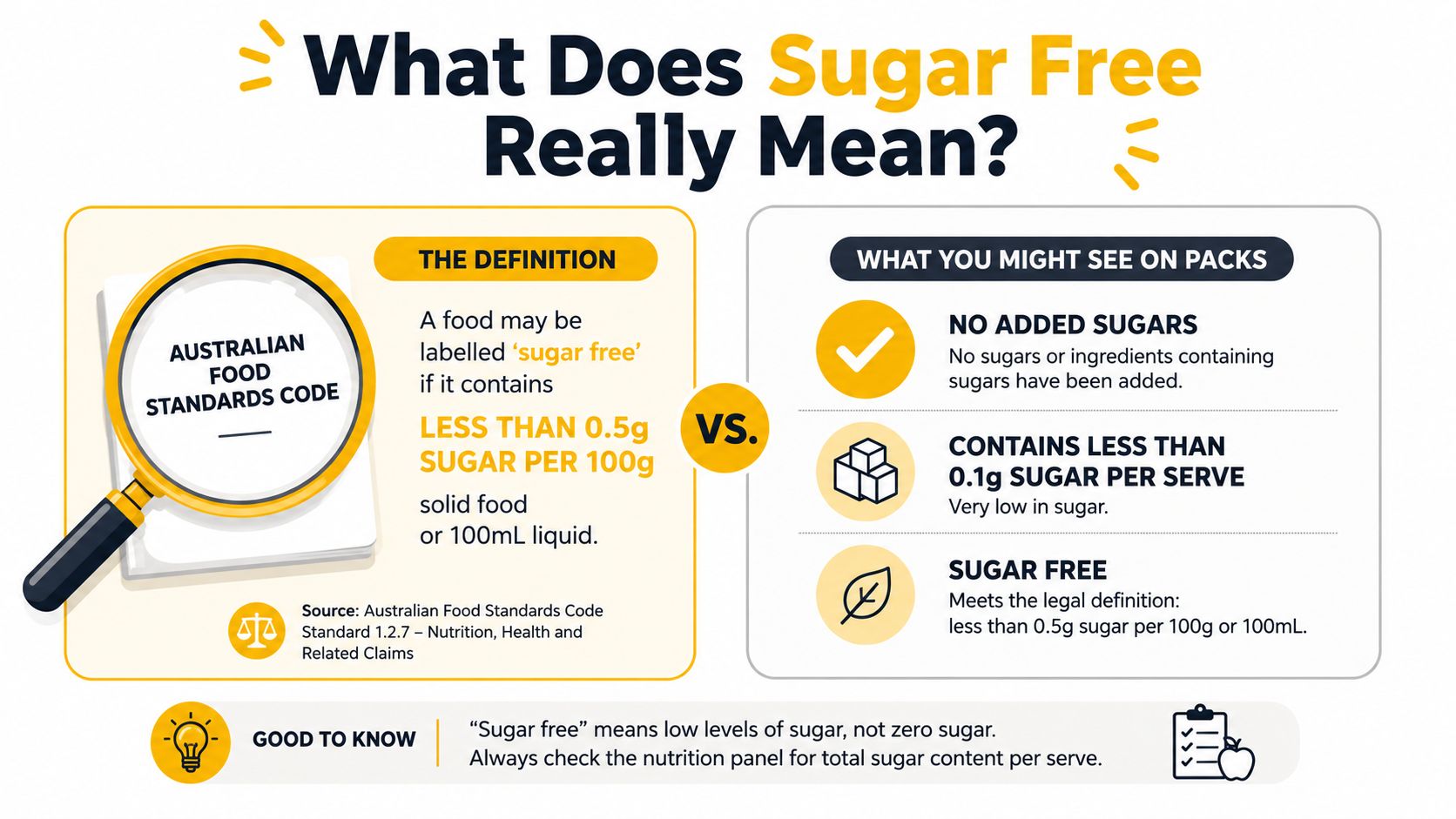
That distinction matters because gummies often rely on sweetening systems that aren't table sugar. A product can taste fruity, look child-friendly, and still stay within the legal sugar-free threshold. The label is telling you about the sugar content, not automatically about the sweetener type, the chewiness, or the dental impact.
Read the claim as one piece of information, not the whole answer
A sugar-free claim tells you there's very little sugar by legal definition. It doesn't tell you whether the formula uses sugar alcohols, plant-based sweeteners, or other ingredients that may affect a child's tummy or teeth differently. It also doesn't tell you how much of each vitamin or mineral you're getting.
A useful way to think about the label is this, sugar-free is a legal claim, not a full nutrition review. If the packet stops at the front-of-pack promise, keep reading. If the back panel shows the sweeteners, serving size, and ingredient list clearly, you're in better territory.
One example of a supermarket-style gummy label is Woolworths' 99% sugar-free adult multivitamin gummy, which shows that gummy multivitamins are usually a low-dose micronutrient delivery system rather than a high-potency mineral product. The label also demonstrates why you need to look past the front panel and check the actual nutrient amounts.
Common Sugar Alternatives and Their Trade-Offs
Parents usually ask the same follow-up question after they see sugar-free on a gummy. If there's no sugar, what's doing the sweetness work? The answer matters, because the replacement ingredient can change the experience for teeth, digestion, and daily compliance.
Sugar alcohols can be useful, but they're not invisible
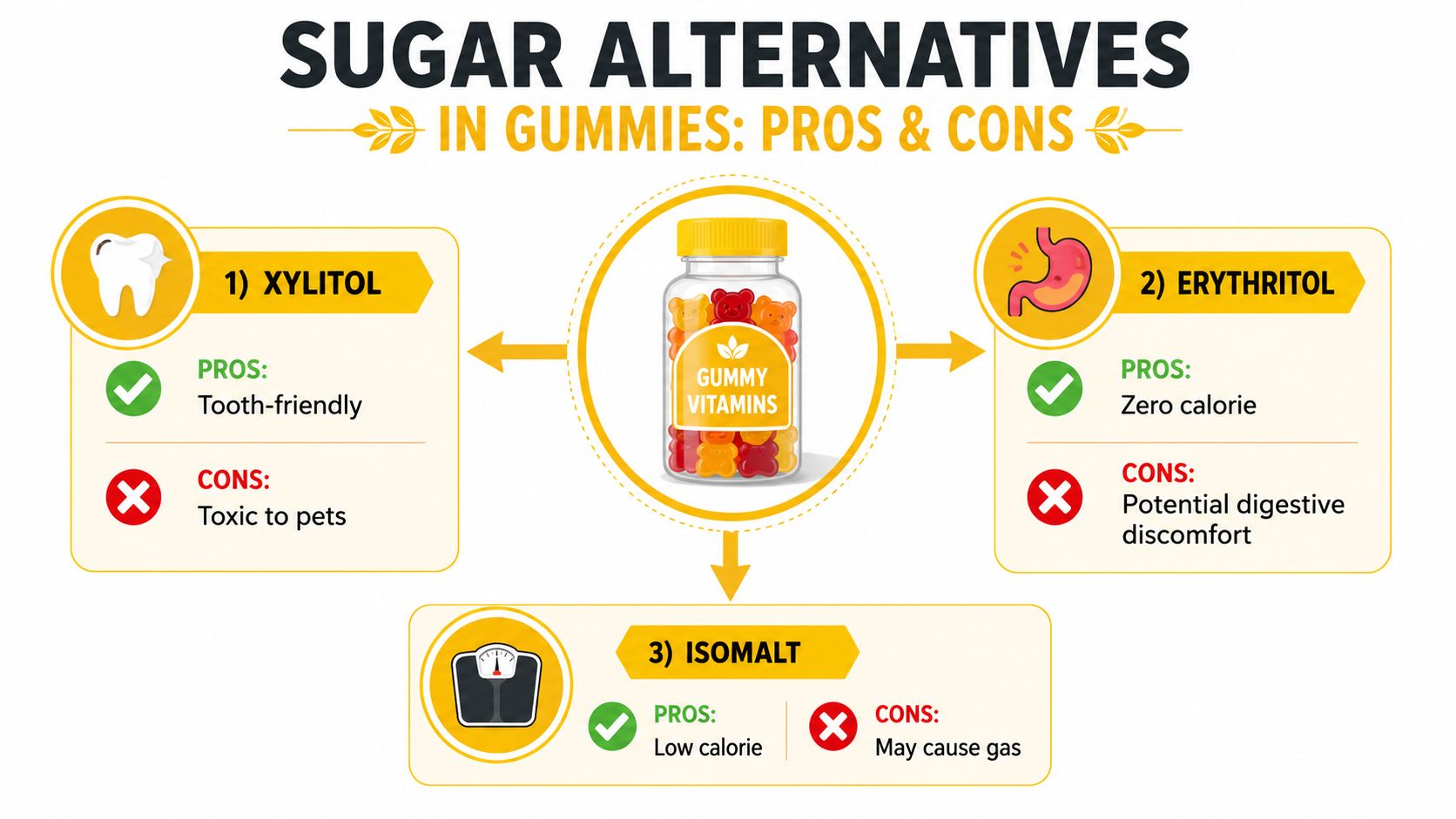
Sugar alcohols such as sorbitol and xylitol are common in sugar-free products. They can help create a sweet taste without using regular sugar, but they're not identical to sugar in the body. Australian health and dental sources warn that sugar alcohols can cause bloating or laxative effects in some people, which is exactly why some children tolerate them well and others don't. The practical lesson is simple, a child who gets a tummy upset from a gummy won't stick with it, no matter how healthy the front label sounds.
Sugar-free is a starting point, not a guarantee of comfort.
Parents also tend to assume that sugar-free means enamel-safe. That isn't automatic. Australian dental guidance stresses that acid exposure, sticky textures, and how often a child eats matter too. A gummy taken once a day with breakfast is a different situation from a chewy supplement offered between meals, after dinner, and again as a “reward”.
The sweetener choice changes the child's experience
Not every sugar-free formula is built the same way. Some products lean on sugar alcohols, some use natural sweeteners, and some use artificial sweeteners. Each approach has trade-offs.
- Xylitol is often discussed for dental reasons, but families still need to think about the overall formula and the child's tolerance.
- Erythritol may suit some products well, but a sensitive stomach can still react badly to any sweetening system.
- Isomalt can be useful for texture, yet it may still cause gas or digestive discomfort in some children.
The right question isn't which sweetener sounds most modern. It's which one your child can take consistently without complaints, tummy pain, or a nightly brushing battle.
One product example worth noting is Focus, which is presented with 0 sugar, vegan ingredients, and no artificial colours or flavours. That kind of formulation choice shows how brands are trying to solve both sweetness and acceptance, while still keeping the gummy child-friendly.
Does Your Child Actually Need a Multivitamin
A sugar-free gummy can be convenient, but convenience isn't the same as necessity. The more honest question is whether your child has a real nutritional gap, or whether you're trying to solve a routine problem with a supplement. Sometimes the answer is both. Sometimes it's neither.
Food first still matters
Australian dietary data show that many children and adolescents don't meet vegetable intake recommendations, and that poor dietary patterns are linked with micronutrient shortfalls even when energy intake is adequate. Recurring concern nutrients for children include iron, vitamin D, iodine, and folate, though the risk varies by age, sex, and diet pattern. That means a multivitamin may be useful for some children, but not as a blanket answer for everyone.
Families often reach for a gummy when meals are repetitive, vegetables are refused, or school mornings are chaotic. In that setting, a multivitamin may function as a bridge, not a cure. It can support a habit while you keep working on food variety, meal structure, and a less stressful breakfast routine.
Who might benefit most
A multivitamin makes more sense for some households than others. The children who often come up in practice are:
- Picky eaters, especially when the diet is narrow and repetitive.
- Vegetarian or vegan families, where some nutrients may need closer attention.
- Households with limited produce variety, where the overall pattern stays narrow for long periods.
- Children with inconsistent appetites, where some days are fine and some are not.
That list doesn't mean those children automatically need a supplement, but it does mean the question deserves a proper look. A sugar-free gummy can be a practical option when you're trying to build a dependable routine around a child who won't take tablets.
Practical rule: if the main problem is diet variety, focus there first. If the main problem is getting a child to take a sensible supplement consistently, a gummy may be the better format.
Multivitamin gummies are usually small-dose products, not therapeutic mineral formulas. That's why they're better thought of as routine support than as a fix for an identified deficiency. If you're worried about a specific nutrient, a targeted conversation with your GP, pharmacist, or paediatric dietitian is the cleaner path.
How to Choose a Safe Sugar Free Multivitamin for Kids
A child agrees to take a gummy, and the label says sugar free. That can feel like the decision is already made, yet the details still matter. The right choice is the one your child can take consistently, with ingredients you can read clearly and a sweetener profile that does not create new problems at the teeth or the tummy.
Compare the parts that affect daily use
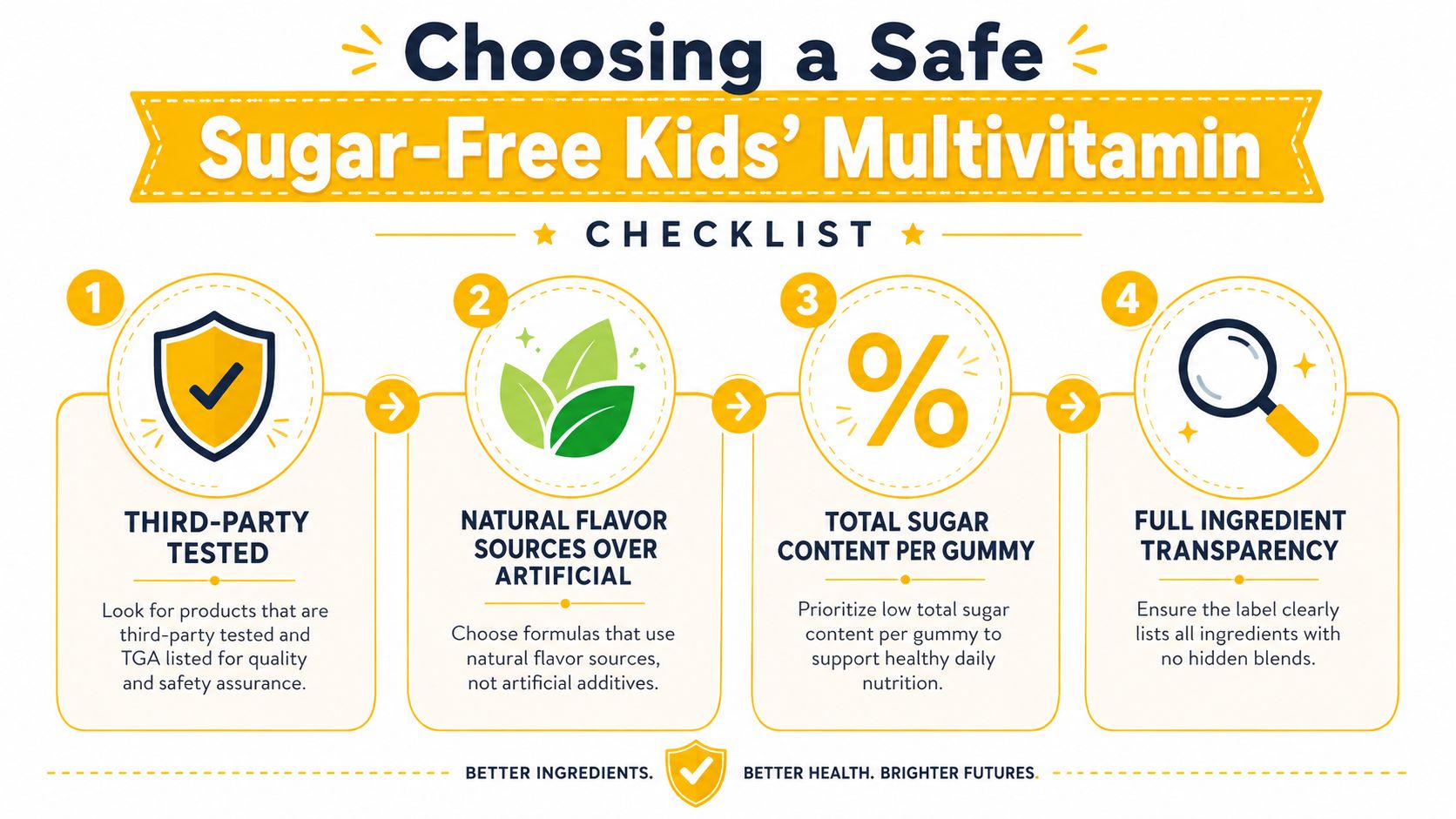
Start with the packet, because the packet usually tells you whether a product has been thought through for families. Look for full ingredient disclosure, clear serving directions, and guidance that fits your child's age and chewing ability. If a label hides behind vague “proprietary blend” language, that is a warning sign, because you cannot check what is included or how much of each ingredient is present.
The sweetener matters more than many product pages admit. A sugar-free gummy may be kinder to teeth than a sugary one, but some sweeteners can still be a poor fit for children with sensitive tummies, and a gummy that tastes too artificial may be refused after a few tries. Texture matters too. If a child dislikes the chew, the supplement becomes another half-used box in the cupboard, and the routine falls apart.
Brands also differ in how they handle flavour and colour. Some use stronger fruity flavours to improve acceptance, while others avoid artificial colours and flavours altogether. Daily Powers' Brave is one example of a children's gummy presented with no sugar and no artificial colours or flavours, which shows the direction many parents prefer when they are comparing options. If you want a broader starting point for age fit and ingredient checks, this guide to the best vitamins for kids is a useful companion read.
Use a simple decision filter
Standing in a shop aisle or scrolling online, it helps to slow the decision down and ask a few plain questions.
- Can I see exactly what is in it? Clear ingredient lists make comparison possible, and they make it easier to spot sweeteners, colours, and any extras you may want to avoid.
- Does the sweetener choice suit my child? Some children manage certain sweeteners well, while others get bloating or loose stools. If that has happened before, the ingredient list deserves extra attention.
- Is the routine realistic? A gummy that needs careful counting, complicated storage, or a hard-to-follow schedule is harder to keep going day after day.
- Does the product suit my child's age and chewing ability? A soft gummy still needs to be a sensible fit for the child who is taking it.
A product that passes those checks is easier to trust than one that leans on lifestyle language and leaves the rest vague. The label should help you decide without guesswork, because parents already have enough to juggle at breakfast time.
For families comparing children's supplements, Daily Powers expert advice is a useful place to start because it focuses on clear ingredient information and practical use at home.
Reading Supplement Labels Like an Expert
A supplement label is a bit like a note from school. The useful details are there, but they are not always where your eye lands first. Parents need to know which lines matter most, how to compare products properly, and which claims are doing the heavy lifting.
Start with the serving size and the nutrient panel
Begin with the serving size. A gummy can look small and still be dosed in a way that matters, and a product that asks for more than one gummy a day should be judged on the full daily amount, not just on a single piece. Then read the nutrient panel and the ingredient list together, because one shows the amounts and the other shows what the product is made from.
The clearest labels usually cause the least confusion. They show the dose, the sweetener, and the main active ingredients in a format that does not need guesswork. If the front says sugar free but the back is crowded with vague claims and tiny print, pause and read more carefully.
Look for consistency between the front and the back
The front of a packet may make a neat promise, but the back panel has the final word. If a product claims to be sugar free, that should match what appears in the nutrition panel and ingredient list. If there is a certification symbol, check what it means before you rely on it.
The embedded video below is useful if you want a visual walkthrough of label reading and ingredient checks.
A good label also tells you who the product is for, what age range it suits, and how to use it safely. That difference matters. A properly considered kids' supplement gives parents clear guidance, while a generic gummy in the children's aisle can leave too many questions unanswered.
For a closer look at how ingredient disclosure should be presented, the broader guidance at Daily Powers expert advice keeps the focus on transparency rather than marketing gloss.
Building a Daily Vitamin Routine Your Family Will Stick With
A daily vitamin routine can look simple on paper and still fall apart at home. A child may dislike the taste, forget the timing, or start resisting the moment a parent has to remind them again. Then the product sits in the cupboard, and the routine becomes another small battle in an already busy day. Habit design matters just as much as what is inside the bottle.
Make the routine easy to repeat
Choose one clear anchor point in the day and keep it steady. Breakfast works for many families because the cue is already there. Others do better after school or with dinner, especially when mornings feel rushed. Consistency matters more than perfection.
Children usually stick with a routine more easily when they have some ownership. Let them help choose the time, the place, or the cue that signals it is vitamin time. Keep the wording simple. “This is your vitamin time” is easier for a child to follow than a long explanation every morning.
Focus on consistency as the goal
If a product suits your child's taste, fits your family's timing, and feels comfortable in your hands as a parent, it has a better chance of becoming part of everyday life. That is where a sugar free multivitamin often earns its place. The benefit shows up in the routine itself, especially when a supplement keeps working through busy weeks, school holidays, and the odd morning when nothing goes to plan.
Practical rule: if the routine is too hard to remember, too hard to chew, or too hard to tolerate, it will not last.
The trade-offs matter here too. A gummy that uses sugar alternatives may help protect teeth compared with a sugary option, but some sweeteners can be harder on little tummies, especially if a child is sensitive to certain sugar alcohols. If the taste or texture causes complaints, adherence drops quickly, because children tend to notice discomfort long before adults do. Daily Powers' Brave fits into a repeatable routine by framing the gummy as part of a simple daily habit, which can help some families turn a supplement into something ordinary rather than a daily negotiation.
If you want a sugar-free kids' vitamin that fits into a calmer daily routine, explore the range at Daily Powers. The brand focuses on sugar-free, child-friendly gummies with clear ingredient information, which makes it easier to compare options with confidence. For parents who want a practical place to start, Daily Powers is worth a look.