

Australia's recommended daily vitamin C intake for children is modest, 35 mg for younger children and 40 mg for older children, not the megadoses suggested by some gummy marketing. That simple benchmark changes how parents should assess vitamin C gummies for kids: the useful question isn't whether a product promises “maximum immunity”, but whether it supplies an appropriate amount, fits the child's diet, and can be stored safely.
Gummies may help families create a predictable routine, particularly when a child is selective with food or struggles to swallow tablets. They're still supplements, not lollies, cold cures, or substitutes for fruit and vegetables. The safest choice starts with the Australian intake target, continues with careful label reading, and ends with secure storage and a clearly measured serving.
Table of Contents
- Why Vitamin C Matters for Australian Children
- What Vitamin C Actually Does in a Child's Body
- How Gummy Formulations Differ From Other Formats
- Dosing Made Simple for Kids Aged 4 to 12
- Can Kids Have Too Much Vitamin C
- Sugar-Free, Vegan, and Clean-Label Options Worth Knowing
- Safety Risks Specific to Gummy Vitamins
- Building a Daily Routine That Actually Sticks
Why Vitamin C Matters for Australian Children
The National Health and Medical Research Council's Nutrient Reference Values give parents a practical starting point. The recommended dietary intake is 35 mg of vitamin C each day for children aged 1 to 8 years, rising to 40 mg daily for children aged 9 to 18 years, according to the Australian vitamin C nutrient reference values. For families of children aged 4 to 12, that 35 to 40 mg range is the key number to keep in mind.
Vitamin C is water-soluble. The body doesn't store it in the same way it stores fat-soluble vitamins, so children need a regular supply through food and, where appropriate, supplementation. That doesn't mean a child needs a gummy every day regardless of what they eat. It means the family should consider the whole dietary pattern rather than treating one missed serving as a crisis.
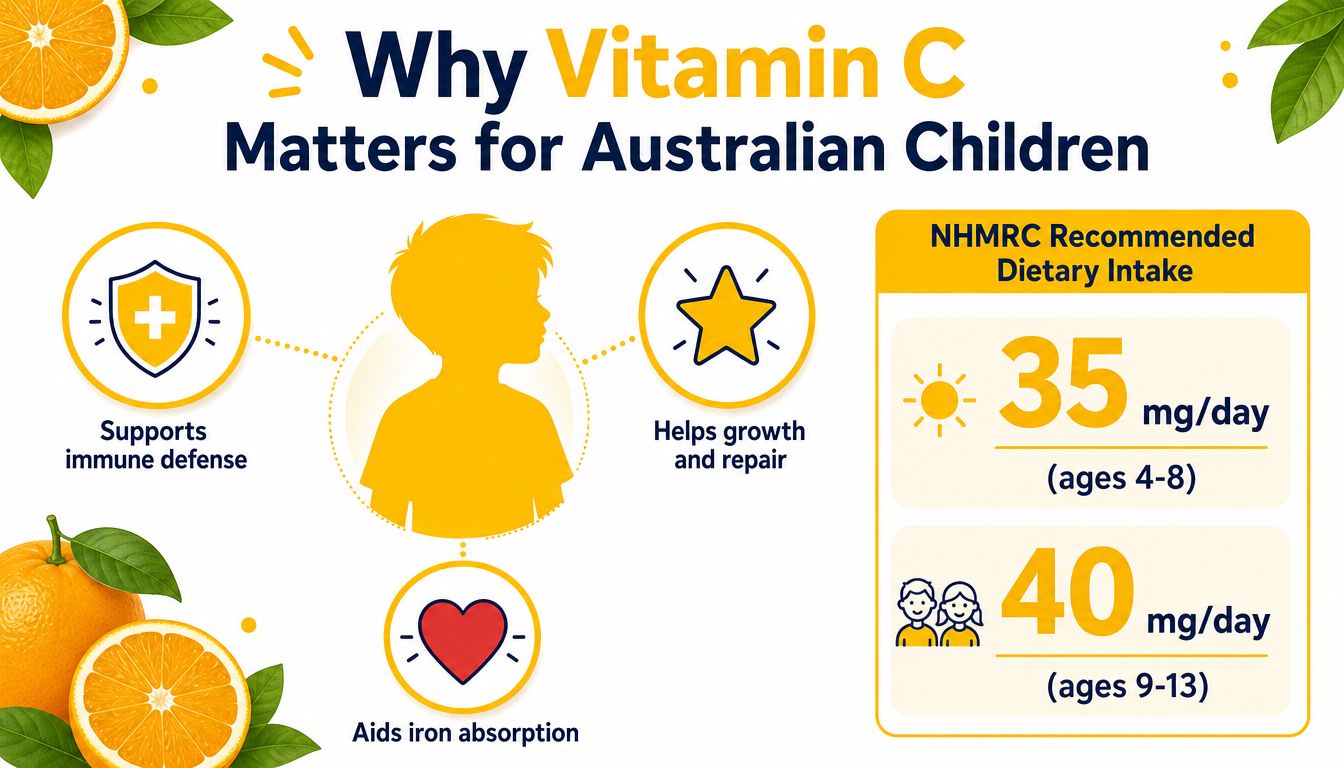
Enough is not the same as more
Australian national nutrition data suggest vitamin C deficiency isn't a major issue, but some children can still have inconsistent intake. The Australian Bureau of Statistics reports that 8.2% of Australians aged 2 years and over, about 2.0 million people, had an inadequate vitamin C intake from food and beverages in its 2023 Usual Nutrient Intakes release, as reported in the ABS national nutrient intake data.
The same release found that 46.7% of dietary vitamin C came from a relatively small group of foods and drinks, including fruit and vegetable juices, vegetable-based mixed dishes, and cereal-based mixed dishes. For a child who avoids fruit, vegetables, or mixed meals, intake may be less dependable even when there isn't a diagnosed deficiency.
Practical rule: Use 35 to 40 mg per day as the adequacy benchmark. Don't confuse that target with a reason to pursue the highest-strength gummy on the shelf.
Parents may find more context in this guide to vitamins that support the immune system, but the central point remains simple. A gummy should fill a plausible dietary gap, not turn ordinary nutrition into a high-dose supplement programme.
What Vitamin C Actually Does in a Child's Body
Vitamin C keeps several ordinary body processes working properly. It doesn't “supercharge” a healthy immune system, and it shouldn't be presented as a shield against every infection. A better description is permissive support, meaning the nutrient helps existing systems perform their normal roles.
Three useful biological roles
First, vitamin C contributes to immune function. It supports the activity of immune cells and helps maintain the skin and other tissues that form part of the body's first-line barrier. The benefit is about maintaining normal defence processes, not making a child immune to viruses.
Second, vitamin C is involved in collagen production. Collagen supports skin, gums, connective tissue, and wound repair, so vitamin C matters beyond the winter cold conversation. These functions are easy to overlook because marketing tends to focus on the word “immunity”.
Third, vitamin C improves the absorption of non-haem iron, the form found mainly in plant foods. Australian guidance for iron deficiency recommends serving vitamin C-containing foods alongside iron-rich foods, as explained in the child iron-deficiency dietary guidance. An Australian preschooler study also found that vitamin C from fruit and juice likely enhanced iron bioavailability, while estimated absorbable iron intake was 0.18 to 0.75 mg per day, according to the Australian preschool nutrition study.
What cold evidence can and can't tell you
The content owner's evidence summary reports that regular vitamin C supplementation may shorten cold duration by about 14% in children, compared with roughly 8% in adults, and may reduce symptom severity by about 15%. Those figures should be read as modest effects, not a promise that a child won't catch a cold or will recover immediately.
The practical interpretation is important. A gummy may support nutrient intake, particularly before a period when respiratory infections circulate, but it isn't a cure or reliable prevention for most winter colds. Australian consumer-facing guidance makes the same distinction, and this Australian product guidance on vitamin C gummies also reflects the need to avoid treating supplements as replacements for balanced food or medical care.
| Function | How It Works | Evidence Note |
|---|---|---|
| Immune cell function | Helps normal immune-cell activity and supports barrier tissues | Any cold benefit is modest rather than transformative |
| Collagen production | Supports skin, gums, connective tissue, and repair | Relevant to everyday tissue maintenance |
| Iron absorption | Improves absorption of non-haem iron from plant foods | Pairing vitamin C foods with iron-rich foods is practical |
Once body tissues have enough vitamin C, adding substantially more doesn't keep increasing the benefit. That saturation principle explains why a child-specific dose makes more sense than an adult-strength product.
How Gummy Formulations Differ From Other Formats
A gummy solves a practical problem first: many children can chew one more easily than they can swallow a tablet. That convenience can support a routine, but it also creates a safety problem because the texture and flavour may resemble confectionery.
The common formats each involve trade-offs. Gummies are palatable and portable, but parents need to check sugar, sweeteners, serving size, and storage instructions. Chewable tablets can carry a measured active dose without a gummy base, although their chalky texture may be unpopular. Syrups are useful for children who can't chew, but caregivers must measure liquid accurately. Effervescent tablets and powders can work for older children or families who prefer a drink, provided the child accepts the taste and format.
For this product approach, ascorbic acid is the chosen form because it is a well-established and practical form of vitamin C. A natural orange flavour complements the ingredient and gives the daily habit a familiar taste, without turning the supplement into a reason to increase the dose.
| Format | Typical Dose Per Unit | Sugar Content | Best For |
|---|---|---|---|
| Gummies | Varies by product and label | May contain sugar or sugar alcohols | Children who can chew but resist tablets |
| Chewable tablets | Varies by product and label | Often low or absent, depending on formulation | Children comfortable with a firmer texture |
| Syrups | Measured by volume | Varies by product | Children who can't chew tablets or gummies |
| Effervescent tablets | Dissolved serving | Usually depends on the product | Older children who prefer a drink |
| Powders | Mixed into food or liquid | Varies by product | Families needing flexible administration |
The useful comparison isn't “natural versus artificial”. It's whether the active amount is clear, the serving suits the child's age, and the child can take it without conflict. Families comparing children's supplements may also benefit from reading about vitamin D3 gummy formats, since the same questions about serving size, texture, and routine apply.
Dosing Made Simple for Kids Aged 4 to 12
Start with the diet, then read the label. The Australian benchmark is 35 mg per day for children aged 1 to 8 years and 40 mg per day for children aged 9 to 18 years, as set out in the NHMRC reference values. A gummy doesn't need to provide the entire daily amount if the child already gets vitamin C from food.
A simple age-band check
| Age Group | RDI (mg) | Typical Gummy Strength | Daily Servings |
|---|---|---|---|
| 4 to 6 years | 35 mg | Use the amount printed on the product label | Follow the child-specific label |
| 7 to 9 years | 35 to 40 mg | Use the amount printed on the product label | Follow the child-specific label |
| 10 to 12 years | 40 mg | Use the amount printed on the product label | Follow the child-specific label |
The phrase “typical gummy strength” can't replace a real label. Products differ, and one gummy may contain a different amount from another. Check the milligrams per gummy, not just the milligrams per serving, then confirm how many pieces the manufacturer recommends for the child's age.
A practical example is a child who eats fruit at breakfast and vegetables at dinner but has several selective-eating days each week. The gummy may be used as a routine support, but the serving should remain exactly as directed. Don't add a second serving just because the child has a cold.
A decision tree for caregivers
- Does the child regularly eat varied fruit and vegetables? If yes, discuss whether a supplement adds useful value or whether food already covers the target.
- Is the diet restricted, highly selective, or inconsistent? If yes, check the product's age guidance and consider discussing the choice with a GP or paediatric dietitian.
- Does the label provide a clear amount per gummy and a daily cap? If no, choose a product with clearer information.
- Is another vitamin C product already being used? If yes, calculate the combined amount before adding anything.
Pair the serving with an established habit such as breakfast or toothbrushing. The routine matters more than a perfect time of day, and caregivers should keep the bottle where an adult can see it but a child can't access it independently.
Can Kids Have Too Much Vitamin C
“More vitamin C” sounds harmless because the nutrient is water-soluble. Excess is generally excreted in urine rather than stored, but that doesn't make unlimited gummy consumption sensible. The body can reach a point where its cells are saturated, so additional vitamin C offers little extra value and leaves the body as waste.
Australian consumer health guidance says children and teenagers generally need about 35 to 40 mg per day and warns against exceeding 1,000 mg per day from vitamin C supplements, as explained by Healthdirect's vitamin C guidance. High supplemental amounts can also cause gastrointestinal symptoms such as nausea and diarrhoea.
The danger is often dose creep. A child who takes the recommended serving in the morning and then eats several extra gummies later has changed a measured supplement into an unmeasured snack. Combining a vitamin C gummy with a multivitamin, cold product, or another immune formula can create the same problem without anyone intending to give a high dose.
Dose ceiling: A product that supplies the daily target doesn't become more useful when a child takes multiple servings. Keep the serving cap visible and follow the label.
Routine mild overconsumption isn't likely to create serious harm in every instance, but it can cause stomach upset and provides no dependable additional immune benefit. If accidental ingestion has occurred, don't guess based on the number of gummies alone. Keep the container available and contact a poisons information service or seek urgent medical advice, particularly if the product also contains iron or other active ingredients.
Sugar-Free, Vegan, and Clean-Label Options Worth Knowing
A “clean label” only helps when it tells you something concrete. Parents should look past front-of-pack phrases and inspect the active ingredient, amount per serving, sweetener system, base, allergens, age directions, and storage guidance.
Sugar-free gummies may use sugar alcohols such as sorbitol or maltitol. These ingredients can reduce sugar content, but Australian retail guidance warns that larger amounts may have a laxative effect. A child with a sensitive stomach may tolerate a product better when the serving is conservative and the caregiver introduces it alongside food.
Stevia or monk fruit may provide sweetness without the same sugar-alcohol concern, although the complete ingredient list still matters. “Sugar-free” doesn't automatically mean taste-free, dental-risk-free, or suitable for every child.
What the base and label reveal
Pectin is a plant-based gelling agent and suits vegan formulations. Gelatin provides a different texture and may not suit families avoiding animal-derived ingredients. Neither base tells you whether the active vitamin C amount is appropriate, so read the nutrition panel separately.
Check for artificial colours and flavours, soy lecithin, gluten statements, and cross-contamination warnings where relevant to your household. Families with allergies or medically diagnosed intolerances should confirm details with the manufacturer or a clinician rather than relying on a broad “free from” claim.
| Feature | Standard Gummies | Sugar-Free | Vegan |
|---|---|---|---|
| Sweetener | May use sugar | May use sugar alcohols or plant sweeteners | Depends on the recipe |
| Base | May be gelatin or pectin | May be gelatin or pectin | Usually uses a plant-based base such as pectin |
| Main question | How much sugar and vitamin C? | Will the sweetener affect digestion? | Is the full formulation animal-free? |
| Parent check | Serving size and active amount | Laxative warnings and tolerance | Pectin, allergen, and manufacturing details |
Australian regulatory status also deserves attention. A TGA listing, where applicable, can provide a useful regulatory signal, while independent certifications such as NSF may offer additional quality information. Neither replaces label reading, and a claim such as “natural” or “clean” isn't evidence of dose accuracy on its own.
For a broader look at label priorities, see this guide to sugar-free multivitamins. The same framework applies here: transparency is more meaningful than attractive packaging.
Safety Risks Specific to Gummy Vitamins
Gummies look like lollies, and children may treat them that way if adults don't set a clear boundary. Queensland Poison Information Centre received 180 calls in 2023 about toddlers ingesting multivitamins with iron, with about 70% of those cases involving gummies or pastilles, according to reporting on Queensland Poison Information Centre calls.
That figure is especially relevant to households using a multivitamin that contains iron. A brightly flavoured gummy can hide the fact that it has an active ingredient requiring much more caution than a basic vitamin C product.
Three ways risk develops
Iron-containing companions: Families may use more than one children's supplement, and an iron-containing product needs particularly careful storage. Never assume a child understands that different bottles have different risks.
Dose creep: Children may sneak extra gummies, or a well-meaning adult may forget that another caregiver already gave the serving. A shared tick chart or written record prevents double dosing.
Sugar-alcohol effects: Sugar-free products may contain sorbitol or maltitol. Larger amounts can cause diarrhoea or other digestive discomfort, even when the vitamin itself isn't the immediate concern.
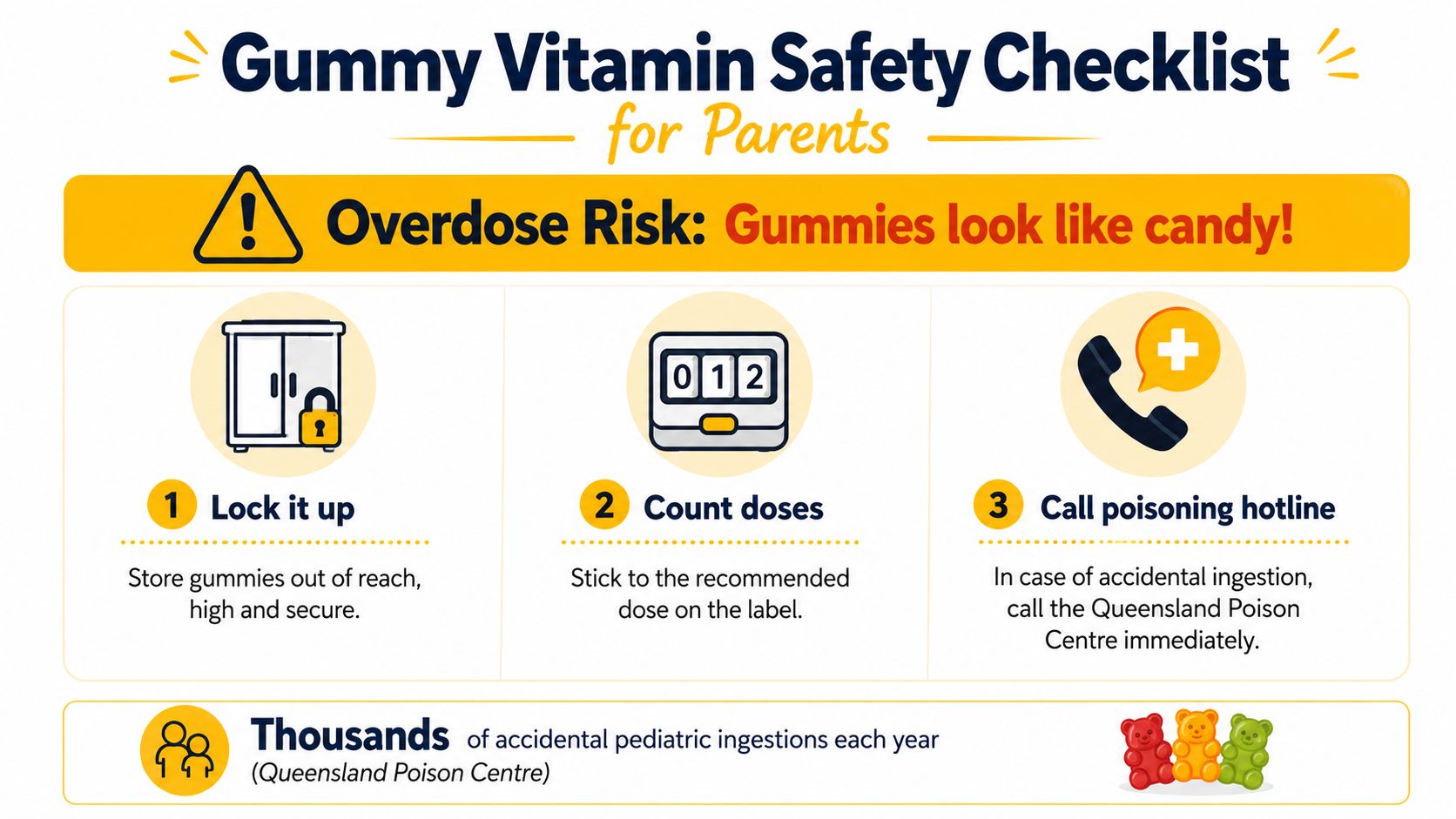
Use four household rules:
- Lock it up: Store gummies high, secure, and out of reach, ideally in a locked cupboard.
- Count doses: Put the measured serving into a small cup rather than handing over the bottle.
- Record the serving: Mark a visible chart so parents, grandparents, and older siblings know whether the dose has been given.
- Teach the distinction: Tell children that gummies are supplements, not snacks.
If accidental ingestion occurs, contact the relevant poisons information service promptly and keep the packaging nearby. For children already eating a varied diet, the more immediate household risk may be accidental over-supplementation rather than insufficient vitamin C.
Building a Daily Routine That Actually Sticks
A useful routine has three checks: meet the child's dietary need, stay realistic about the cold evidence, and keep the dose controlled. The Australian target remains the anchor, while the modest evidence for cold duration and severity means a gummy shouldn't become a source of pressure or false reassurance.
Make the habit visible to adults
Pair the gummy with a meal or an established action, such as breakfast or brushing teeth. Keep it in one consistent adult-controlled location, not beside the lolly jar, and use a simple tick chart when more than one caregiver shares responsibility.
A missed day isn't a reason to double the next serving. Vitamin C is water-soluble, and routine tolerance is generally forgiving, so steady habits matter more than rigid timing. If the child eats fruit and vegetables at the same meal as an iron-rich food, that food-based combination may already be doing useful nutritional work.
Review the routine when the diet changes, rather than automatically increasing it during every cold season. If the child's diet consistently meets the 35 to 40 mg daily target, reconsider whether the gummy is still filling a meaningful gap, especially after winter.
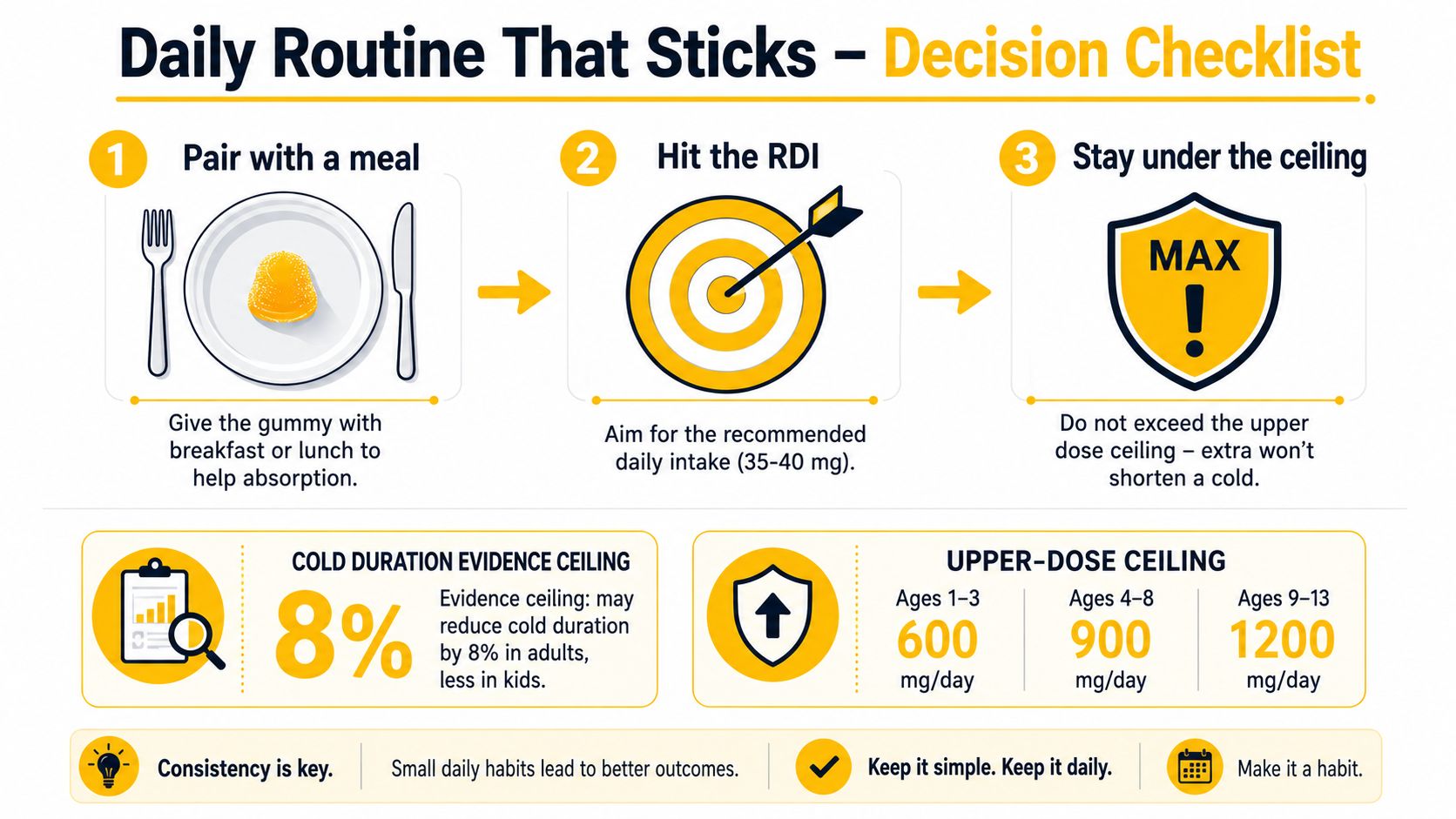
Use this quick checklist today:
- Check the food pattern. Note whether fruit, vegetables, juice, and mixed meals appear regularly.
- Read the label. Confirm vitamin C per gummy, the age band, serving size, and total amount from other supplements.
- Set the storage rule. An adult gives the serving, records it, and returns the container to a secure place.
- Reassess periodically. Review the diet and the reason for supplementation rather than continuing automatically.
The video below can offer another practical prompt for discussing supplement routines with your household.
Daily Powers offers Australian-made children's gummy supplements with transparent ingredient and dosing information, including sugar-free, vegan formulations without artificial colours or flavours. If you're comparing routine-friendly options for a child aged 4 to 12, visit Daily Powers to review the range and choose based on your child's actual nutritional needs.