

You're in the pharmacy aisle with a tired child, a basket of errands, and a shelf full of bright gummies that all seem to promise an easier morning. The key question isn't whether vitamin D3 gummies look appealing, it's whether your child needs one, and if so, how to choose a product that fits Australian guidance without overdoing it.
For many families, the appeal is obvious. Gummies are easy to hand over, easy to remember, and less of a struggle than drops or tablets. But the format itself doesn't tell you whether the supplement is needed, because vitamin D3 is a nutrient, while a gummy is only the delivery system.
Table of Contents
- Why Vitamin D3 Gummies Are on So Many Aussie Parents' Shopping Lists
- What Vitamin D3 Does in a Growing Body
- How Much Vitamin D3 Australian Children Need
- Gummy Form vs Drops, Sprays and Chewables
- Reading a Vitamin D3 Gummy Label the Right Way
- When a Daily D3 Gummy Helps and When It Doesn't
- Fitting a D3 Gummy Into Your Family's Daily Rhythm
Why Vitamin D3 Gummies Are on So Many Aussie Parents' Shopping Lists
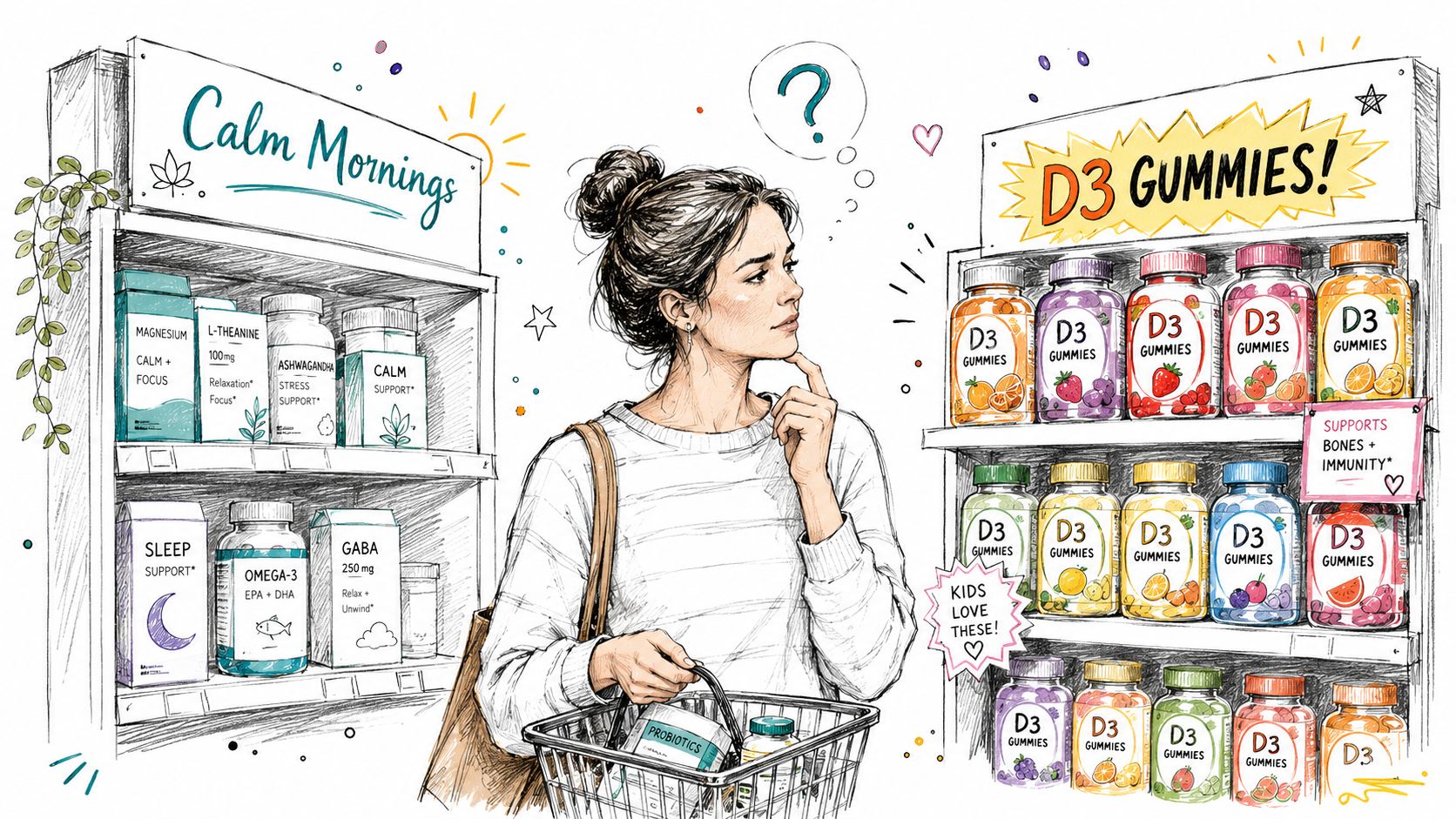
A parent often reaches this aisle because they want something simple. The child doesn't like drops, the morning routine is already crowded, and gummies feel like the least stressful option. That convenience matters, but it can also blur the line between a supplement that's useful and one that's just easy to give.
Vitamin D3, also called cholecalciferol, is the form the body makes in skin after UVB exposure and the form most supplements use. It's not the same thing as a healthy outdoor routine, and it isn't proof that every child needs extra vitamin D. A child might get some vitamin D from food, some from sunlight, or need extra support if intake or exposure is low.
The Australian context matters here. The Australian Bureau of Statistics reported that 20.6% of adults aged 18 years and over had a vitamin D deficiency in 2022–24, down from 23.8% in 2011–12, which shows improvement has been slow over time, not sudden or complete. The same release also found deficiency was 15.5% in summer versus 26.1% in winter, with higher winter burden in southern states including Tasmania at 45.7% and Western Australia at 33.3%. That seasonal pattern helps explain why parents think about supplements more in colder months, especially when sunlight alone may not be reliable in some regions. ABS vitamin D deficiency release
Practical rule: think of a gummy as a targeted habit, not a default daily vitamin.
That habit should be based on the child's age, diet, sun exposure, medical history, and any advice from a qualified health professional. It also needs a quick label check, because if another supplement already contains vitamin D, the gummy may add more than you intended.
What Vitamin D3 Does in a Growing Body
Vitamin D3 helps the body absorb calcium and phosphorus from food, so those minerals can be used where they matter most. The liver and kidneys then convert D3 into an active form that supports normal absorption and helps build and maintain bones and teeth.
Why this matters in childhood
Children grow fast, so their bones are being built while they are also being used. Low vitamin D status can matter more at this stage than many parents expect. The nutrient does not replace food, sleep, movement or outdoor play, but it does help the body use the minerals those habits help supply.
Vitamin D also supports normal immune function, which is why it comes up so often in winter discussions. That does not mean it prevents every sniffle or treats infections. It means it has a role in the body's usual defence systems, alongside sleep, nutrition and general health care. For a simple overview of how nutrients are discussed in this area, immune system vitamins can help put the idea in context.
Sunlight, food and supplements all feed the same pathway, but children do not use them in the same way. Some vitamin D comes from food such as oily fish, eggs, fortified milk and margarine. Some comes from UVB exposure when skin makes it. The chance of low status rises when children have limited sun exposure, darker skin, covered clothing, certain illnesses, or medicines that affect vitamin D metabolism. In those situations, a gummy is one option, not a universal answer.
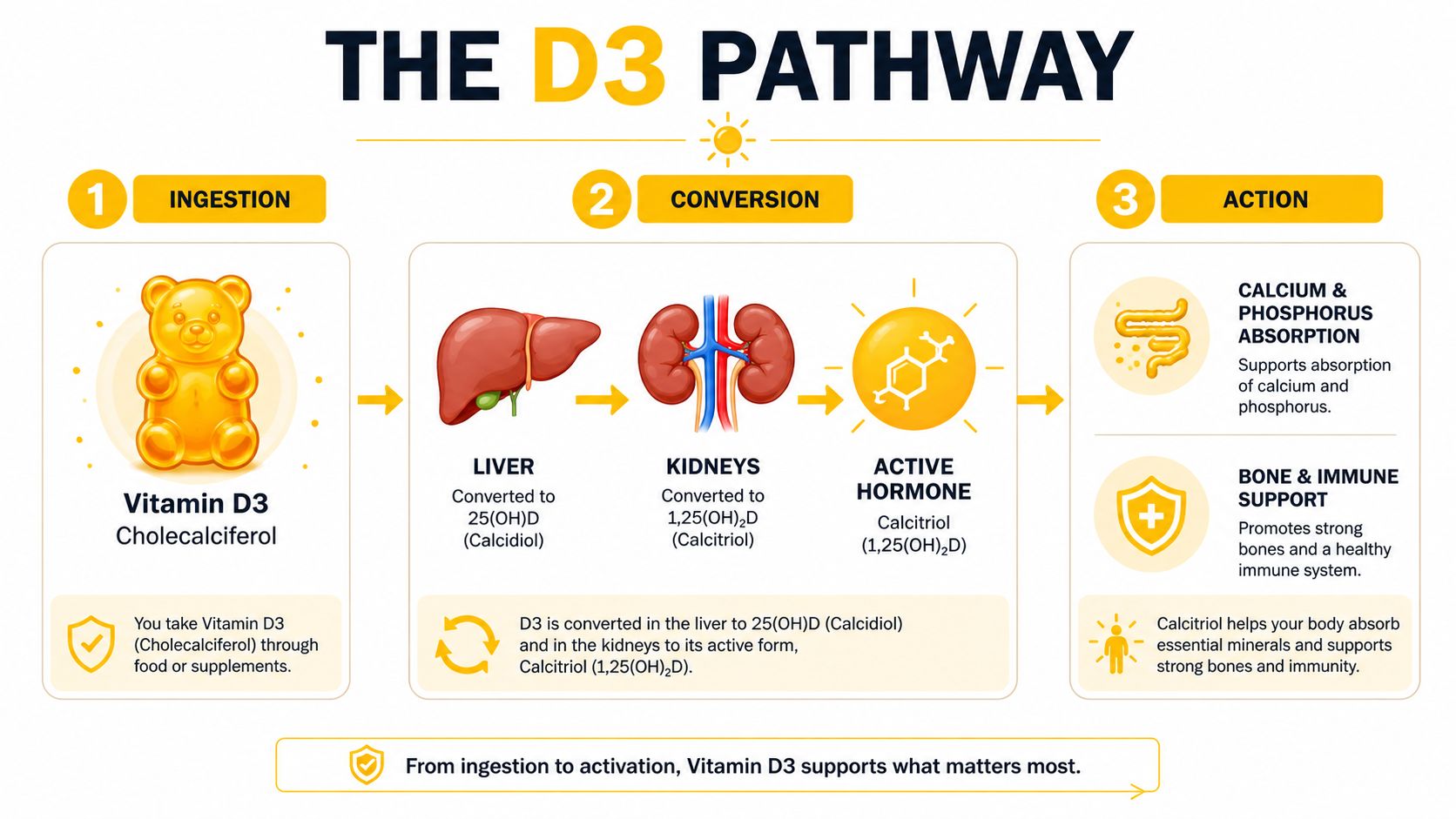
The practical takeaway is straightforward. A bright gummy changes how the child gets vitamin D, not what the nutrient does in the body. For caregivers, the primary question is whether the child's intake and risk profile justify supplementation.
How Much Vitamin D3 Australian Children Need
Australian reference values give parents a useful anchor, but they're not a one-size-fits-all answer. For children aged 4–8, the National Health and Medical Research Council sets the adequate intake for vitamin D at 5.0 µg/day, which equals 200 IU/day. The same 5.0 µg/day applies to children aged 9–13 and 14–18 years, so that figure is the standard reference point for older children and teens, not a high-dose target. Vitamin D nutrient reference values
Converting a gummy label without guesswork
The conversion is straightforward. 1 microgram equals 40 IU, so 5 micrograms equals 200 IU. If a gummy says 2.5 micrograms, that's 100 IU. If it says 12.5 micrograms, that's 500 IU. The label matters more than the flavour, because the child only gets what the serving provides.
That's where Australian guidance becomes practical. The Royal Children's Hospital uses a risk-based dosing model for children, with maintenance amounts commonly in the 400 to 600 IU/day range for those with ongoing risk factors, while deficiency treatment is usually much higher and should be clinician-led. For infants, the same guidance notes 400 IU/day for breastfed babies with risk factors, while formula-fed infants often don't need extra vitamin D. Royal Children's Hospital vitamin D deficiency guidance
A gummy should be checked against the serving size on the pack, not counted by eye. One gummy might deliver the dose. Two gummies might do it. Or the serving might be designed for older children and overshoot what a younger child needs.
Calm is a good example of why label reading matters even when a product is framed around everyday habits. It's a magnesium-based gummy with a fixed daily serving, which shows how clearly packaged products still need careful checking before they become part of a child's routine. I'm mentioning it here as a format example, not as a vitamin D product.
Check the dose first, then check the serving size, then check whether another supplement is already covering the same nutrient.
Parents should be especially cautious with babies, with children who already take multivitamins, or when a clinician has recommended a higher therapeutic amount. The bottle should stay in its original container, and the label should be followed exactly.
Gummy Form vs Drops, Sprays and Chewables
Different families need different formats, and the best one often comes down to age, routine and tolerance. Drops are the most precise option for infants and for families who want to mix a dose into milk or food. Sprays can work well for fussy toddlers who reject droppers. Chewables give a fixed dose without relying on a spoon or pipette, but younger children may struggle to chew them properly.
Gummies usually win on acceptance. They feel familiar, they're portable, and they're easier to remember because the routine feels less medical. That's a real advantage for families trying to stay consistent over months, not just days.
What the base ingredient changes
The base matters more than many parents expect. Some gummies use pectin, which is plant-based and often suits vegan households. Others use gelatine, which gives a different chew and may not fit all dietary preferences. Sugar-free and vegan versions exist in the Australian market, which helps address two common concerns, added sugar and animal-derived ingredients.
Once a product is opened, storage matters too. Heat and humidity can affect gummy stability faster than many parents realise, so a cool, dry cupboard usually makes more sense than a steamy bathroom shelf. That's especially important for fat-soluble vitamins, where the product has to hold its potency through the whole shelf life.
The dose split question is another practical divider. A child who needs a smaller amount may do better with drops or a product designed around a lower serving. A child who can safely take the labelled serving may be fine with a gummy, as long as the dose matches the goal.
| Format | Best fit | Main trade-off |
|---|---|---|
| Drops | Infants and precise dosing | Can be fiddly |
| Sprays | Toddlers who resist droppers | Less exact than drops |
| Chewables | Older children who can chew well | Harder for younger kids |
| Gummies | Families needing routine and acceptance | Easy to overuse if treated like lollies |
A quick shortcut helps. Choose drops for precision, sprays for convenience, chewables for fixed dosing, and gummies when adherence is the main problem and the child's age, diet and dose all line up.
Reading a Vitamin D3 Gummy Label the Right Way
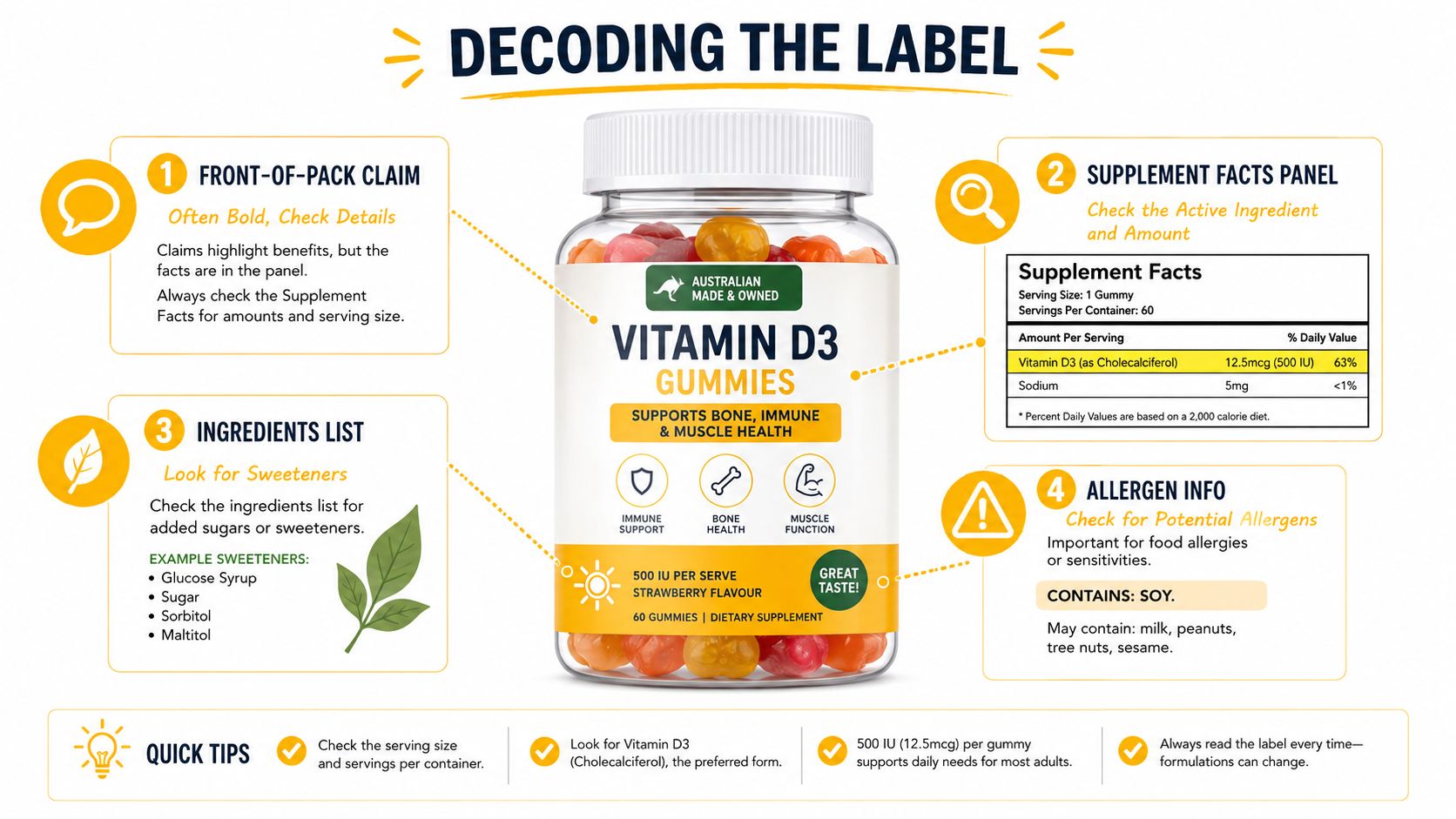
Vitamin D3 is converted by the liver and kidneys into an active form that supports bone and teeth development and normal immune function. On a gummy bottle, the front label can sound reassuring, but the details that matter sit in the supplement facts panel.
The four lines worth checking
Start with the vitamin D3 amount, listed in micrograms or IU. Then check the sugar content, because a gummy can still carry sweeteners or sugar even when it looks health-focused. After that, identify the source of D3, usually cholecalciferol, and see whether it comes from lanolin or lichen if your family wants a vegan option. Finally, check the gelling base, since pectin and gelatine affect dietary fit and texture.
Allergens matter too. Some gummies include sulphites, soy or added colours, and flavouring can be natural or artificial. That matters for children with food sensitivities and for families trying to keep additives low.
Back-panel details matter as well. A clear Australian listing, expiry date and storage instructions are basic signs that the product is set up for everyday use. Batch testing and certificate-of-analysis checks sit behind the scenes, because potency can drift if manufacturing controls are weak. TGA vitamin D supplement guidance PDF
For families comparing simpler formulas, this guide to sugar-free multivitamins offers a useful comparison point.
Put the bottle back if the dose is vague, the ingredient list is crowded, or the product doesn't say where the D3 comes from.
Three red flags stand out. Megadoses above 1000 IU without clinician guidance, added refined sugar listed near the top of the ingredients, and no clear D3 source on the pack. If any of those appear, the label deserves a second look before the product comes home.
When a Daily D3 Gummy Helps and When It Doesn't
The decision to supplement hinges on whether a child has identifiable risk factors, not on convenience or marketing appeal. A winter dip in vitamin D status can happen in Australian children, and a lower level in winter does not automatically mean a child is unwell. The key question is whether the child has a reason to need extra vitamin D3.
One Australian paediatric analysis found 61,809 vitamin D tests were done in 46,960 children over 15 years, with 36.2% low, 39.6% normal and 0.1% high results, while another analysis estimated nutritional rickets incidence at 4.9 per 100,000 children per year. Those figures show how often testing happens, but they do not mean every child needs a gummy. RACGP article on vitamin D tests for children
The children most likely to benefit
Daily supplementation makes the most sense for children with clear risk factors. That includes breastfed infants under 12 months when extra vitamin D has been advised, children with darker skin living in southern latitudes, kids wearing full covering for cultural reasons, those with limited sun exposure because of indoor routines or skin conditions, and children taking medicines that affect vitamin D status.
For those children, a low daily maintenance dose can be a sensible routine. It is easier than waiting for a problem to become obvious, and it fits the preventive approach Australian clinicians usually prefer. The goal is not to give more and more, it is to give a bounded amount where there is a real reason.
The child who eats fortified dairy, spends regular time outside, and has no known risk factors is a different case. In that setting, a gummy may add another daily habit without much measurable benefit. It can also create confusion if the family already uses a multivitamin or fortified foods.
Useful rule: if there is no documented risk factor, ask whether the gummy is solving a problem or adding another supplement habit.
That is why blood testing and clinical advice matter before using higher doses. Routine supplementation without a clear need can be a poor fit, while targeted use in at-risk children is a more sensible match to Australian guidance. The point is to match the supplement to the child.
Fitting a D3 Gummy Into Your Family's Daily Rhythm
A supplement works best when it sits inside a routine you can keep. Breakfast, toothbrushing or the school-bag check are all easier anchors than trying to remember a loose “sometime in the morning” plan. The more predictable the cue, the less likely the dose gets missed.
Storage deserves its own routine too. Gummies should stay out of reach and out of sight, because they can look and taste like lollies. Older children also need a simple message, that gummies are medicine or supplements, not food to graze on after school.
Keep the system simple
A note on the fridge or in a shared family app helps when more than one adult gives care. Write down the product name, the dose and the days it's been given. That small record can prevent accidental doubling when grandparents, partners or babysitters all help out.
If you're comparing routines for children who are picky about what they take, this practical guide to vitamins for fussy eaters can help you think through the habit side of supplementation too. The same principle applies here, good routines beat heroic intentions.
Three questions can guide a decision tonight:
- Does my child have a risk factor or documented need?
- Does the label show an age-appropriate D3 dose without extra ingredients we don't want?
- Can our household use this exactly as directed without duplication, choking risk or dental issues?
If the answer to any of those is unclear, it's worth asking a GP, paediatrician or pharmacist before you buy. Infants, children with medical conditions and children taking medicines that may interact need even more caution. Sugar-free, vegan and third-party-tested claims are useful, but only when they fit the child and the total daily intake.
Daily Powers offers children's gummies with zero sugar, vegan ingredients and clear serving guidance, including products designed around calm, focus and confidence. If you're building a simple daily habit for your family, visit Daily Powers and compare the options with your child's age, routine and nutritional needs.