

You've hidden powder in pancakes, offered smoothies in three different cups and tried the sticker chart. Still, your child clamps their mouth shut at the kitchen bench when a tablet, liquid or chalky chewable appears. By dinner, the question isn't only what they've eaten. It's whether you've got the energy for another negotiation.
For families searching for vitamins for fussy eaters, the practical answer starts before the supplement. A child may reject a product because of its texture, taste, packaging or the uncomfortable feeling that another adult-controlled task is being added to the day. The format and the routine have to work alongside the nutrient choice.
Table of Contents
- Why Fussy Eaters and Vitamins Need a Different Playbook
- Understanding the Nutrient Gaps in Picky Eaters
- Choosing a Format Your Fussy Eater Will Take
- How to Frame Supplements So Kids Stop Saying No
- Anchoring the Dose to a Daily Cue That Already Exists
- Reading the Label for Nutrient-Focused Formulations
- Your One-Week Starter Plan for Vitamins and Fussy Eaters
Why Fussy Eaters and Vitamins Need a Different Playbook
Fussy eating is common enough to make parents feel less alone, but stressful enough to make a supplement seem like the quickest fix. A 2022 HCF survey found that 69% of Australian parents said they had a child who was a fussy eater. Among those parents, 41% often prepared two or more extra meals at dinner, while 56% admitted to bribing children with screen time to get them to eat their main meal. HCF's survey findings capture the kitchen-table reality better than most generic feeding advice.
Australian children already take supplements often enough that the conversation isn't unusual. The Australian Bureau of Statistics dietary supplements release reports that 20.3% of children aged 5–11 years and 22.6% of children aged 2–4 years took a supplement. Across people aged 2 and over, vitamin and/or mineral supplement use was 29.7%, rising from 28.5% in 2011–12 to 33.6% in 2023. Children aged 2–17 also had similar supplement-taking rates overall by sex, so this isn't a habit limited to one type of household.
That doesn't mean every fussy eater needs a multivitamin. It means parents are already open to using a daily nutrition support product when food variety is inconsistent. The mistake is treating a closed mouth as a simple nutrient problem.
The three decisions that matter
Start with palatability. If a child dislikes the flavour or struggles with the texture, the formula won't become part of the day.
Next, use behavioural framing. A child is more likely to cooperate when the product feels like a positive ritual with an element of choice, not medicine being forced through a daily battle.
Finally, consider nutrient specificity. Persistent restriction can create particular gaps, but a broad product may not provide enough of the nutrient a clinician is concerned about. The Royal Children's Hospital guidance on vitamins and children makes the sensible distinction: ordinary fussy eating is common and often improves with repeated food exposure, while a very restricted diet may need closer assessment.
The useful question is not, “Which vitamin should I buy?” It's, “What can my child accept every day, what does their diet lack, and what cue will make the routine easy?”
Understanding the Nutrient Gaps in Picky Eaters
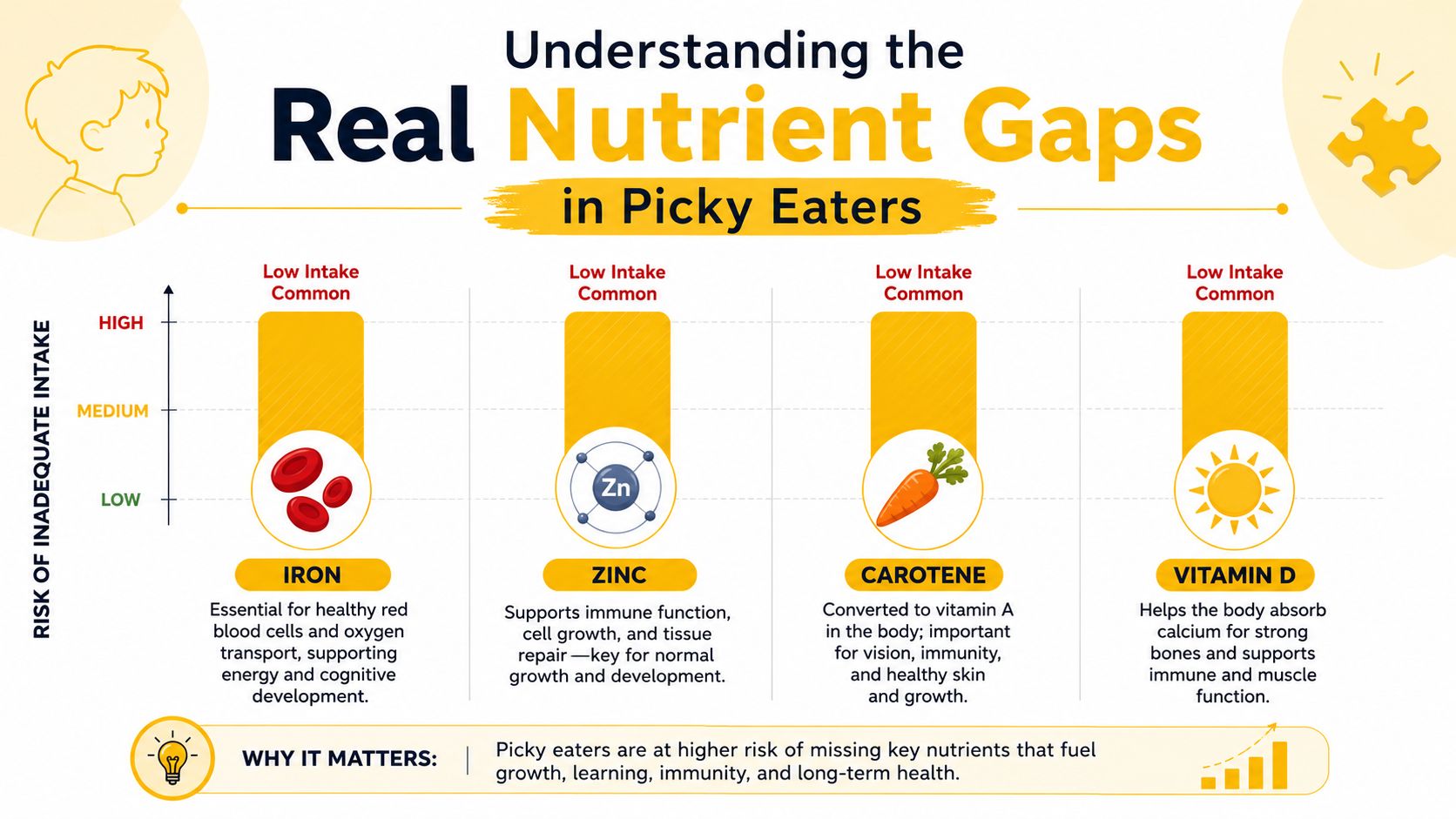
A narrow menu can narrow nutrient intake too. Children who repeatedly avoid meat, legumes, fortified cereals, fruit, vegetables, or vitamin D-containing foods have fewer chances to obtain iron, zinc, carotene, vitamin D and fibre. That pattern is a reason to prepare questions for a GP or dietitian, not proof that one child has a deficiency. Use the diet pattern to guide the conversation, then use professional advice to choose the response. For background on broader formulations, see this guide to multivitamins with minerals.
A peer-reviewed review of picky eating and nutrient intake found lower intakes of iron, zinc, carotene, vitamin D and fibre among persistent picky eaters. One longitudinal analysis reported carotene intakes about 25% lower, niacin and vitamin B6 about 8% lower, iron and zinc about 9% lower, and selenium about 12% lower than in non-picky eaters. These are group patterns, not a diagnosis. They show which nutrients deserve attention when a child's accepted foods stay limited.
A short clinical checklist
Iron deserves a closer look when meat, legumes, fortified cereals and other iron-containing foods rarely appear. Medicine Today describes iron deficiency as the most common childhood deficiency worldwide, including in developed countries, and notes that it can interact with appetite regulation. Its Australian review of fussy eating in toddlers and young children is more useful than guessing that a generic gummy will solve the problem.
Zinc can also become a concern when the accepted menu is extremely narrow. Ask whether assessment is appropriate before adding another product, particularly if appetite and food restriction appear connected.
Carotene and vitamin D matter when fruit and vegetable variety, vitamin D-containing foods, or relevant exposure are limited. Fibre belongs on the same checklist when a child mainly eats refined or highly predictable foods.
Target gaps instead of panic-buying
The Royal Children's Hospital's practical advice is appropriately cautious. Many Australian children, including many picky eaters, are not vitamin deficient, and repeated exposure to different foods often helps more than relying on pills. If the food range is severely restricted, growth raises concern, symptoms appear, or exclusion continues for a long time, involve a healthcare professional.
A broad multivitamin can support a routine in the right context, but it should not conceal a specific iron or zinc concern. Compare the label carefully. If you are considering a general product such as Brave, connect it to a calm daily cue and treat it as routine support, not a substitute for assessment or food exposure.
Practical rule: Let the diet pattern decide what to ask about, and let professional advice decide whether supplementation is needed.
Choosing a Format Your Fussy Eater Will Take
For a fussy eater, the best format is the one the child will take consistently and safely. A theoretically perfect supplement left untouched in a cupboard has no practical value. Treat format as a routine decision first, then match it to the child's age, chewing ability and sensory preferences.
Gummies often suit children because they are soft, chewable and easy to include in a calm daily ritual. That convenience has limits. A flavour can become tiring, a child may start treating the product like a lolly, and the ingredients may not suit your family's preferences. Young children still need age-appropriate supervision and clear directions, especially with chewable products.
Liquids allow flexible dosing and can suit children who cannot chew reliably, but strong taste can make them difficult to maintain. Powders may blend into yoghurt or another accepted food. If the child notices a new smell or texture, though, they may reject the entire meal. Chewable tablets suit children who already accept firmer, crunchy or tablet-like textures. Effervescent products and sprays depend heavily on flavour and willingness to try something unfamiliar.
| Format | Texture and taste control | Ease of acceptance | Watch-outs |
|---|---|---|---|
| Gummies | Soft texture with a defined flavour | Often easy to present as a food-like ritual | Check serving guidance, ingredients and choking suitability |
| Liquids | Taste can be strong, dosing can be flexible | Useful for some children, difficult for others | Mess, flavour rejection and measuring |
| Chewables | Firm texture, often chalkier than gummies | Suits children who accept tablets or crunchy foods | Texture fatigue and swallowing ability |
| Powders | Can blend into selected foods | Helpful only if the child doesn't detect them | May change taste, smell or texture of the whole meal |
| Effervescent tablets | Fizzy drink with noticeable flavour | Engaging for some children | Requires preparation and acceptance of the drink |
| Sprays | Minimal texture, direct flavour exposure | Convenient when tolerated | Taste, mouth sensitivity and age suitability |
A preschool picky-eating study reported 100% adherence to an oral nutritional supplement in its intervention group. Mean intake stayed above 80% of the prescribed dose over time, reaching 76.9% in the final month. The study was not Australian and used a specific product and protocol, so it does not promise the same result for every gummy. It does support a useful practical point: acceptance and palatability influence whether a child completes a supplement. Review the peer-reviewed preschool picky-eating adherence study for its specific context.
For a broader comparison, read this guide to kids' vitamin formats and multivitamins. For many families, the sensible shortlist is a soft gummy or familiar liquid, selected around the child's sensory preferences and ability to manage the format. The product only works as part of a predictable cue-based ritual built around calm, focus or brave participation.
How to Frame Supplements So Kids Stop Saying No
At the kitchen table, the word “vitamin” can be enough to start a refusal. A child who expects medicine, bitterness or a difficult swallow may reject the routine before tasting the product. Treat the first goal as cooperation and familiarity, not a lesson about nutrition.
Lead with the experience. If the gummy has appealing flavours and a soft texture, describe those features plainly: “This is the new berry gummy we're trying.” Save explanations about nutrients for another moment. Warnings about immunity, vegetables or what might happen without a supplement turn one small routine into a lecture.

Give control without creating a negotiation
Offer choices that both work for you. The child gets a say in the ritual, while the dose remains settled.
- “Brave or Calm today?” This gives the child ownership without asking whether the routine will happen.
- “Do you want it before you pack your bag or after?” The serving stays fixed, while the timing feels flexible.
- “You can choose the cup of water.” A small decision can lower resistance around the main task.
Skip rewards such as, “If you take this, you can have screen time.” The HCF survey found that 56% of parents had used screen time as a bribe, which shows how common the tactic is, but bargaining turns the gummy into a power exchange. The child learns to delay and demand a better reward.
Use identity cues, not pressure
Give the moment a clear role. Focus can accompany schoolwork or homework. Calm can fit the bedtime wind-down. Brave can support getting ready for school, meeting new people or trying a new activity.
This language connects the gummy with a familiar part of the day without promising that it creates a feeling on demand. “Time for your Focus gummy before homework” gives better direction than “You need your vitamins because you didn't eat enough vegetables.”
Siblings can follow one household rule without using identical words. Never compare one child's eating or cooperation with another's. Keep the gummy in its container, offer the agreed serving, and continue the routine without applause becoming another source of pressure.
“The successful kitchen-table test is simple: will a child enjoy the flavour enough to want the same routine tomorrow?”
Use that question to judge any product. Daily Powers describes its flavour development around this kitchen-table test, keeping acceptance at home central rather than relying on an impressive adult tasting note.
Anchoring the Dose to a Daily Cue That Already Exists
The gummy isn't usually the difficult part. Finding the moment that already happens every day is the essential work.
Australian Government guidance for fussy eaters recommends regular meal and snack routines, avoiding bribes and punishment, continuing to offer refused foods, and allowing repeated exposure to unfamiliar foods. It also recommends limiting meals to 20–30 minutes before removing uneaten food and waiting for the next planned meal or snack. These principles appear in the Australian Government guidance on variety and fussy eating, and they apply neatly to supplement routines: predictable timing beats repeated persuasion.
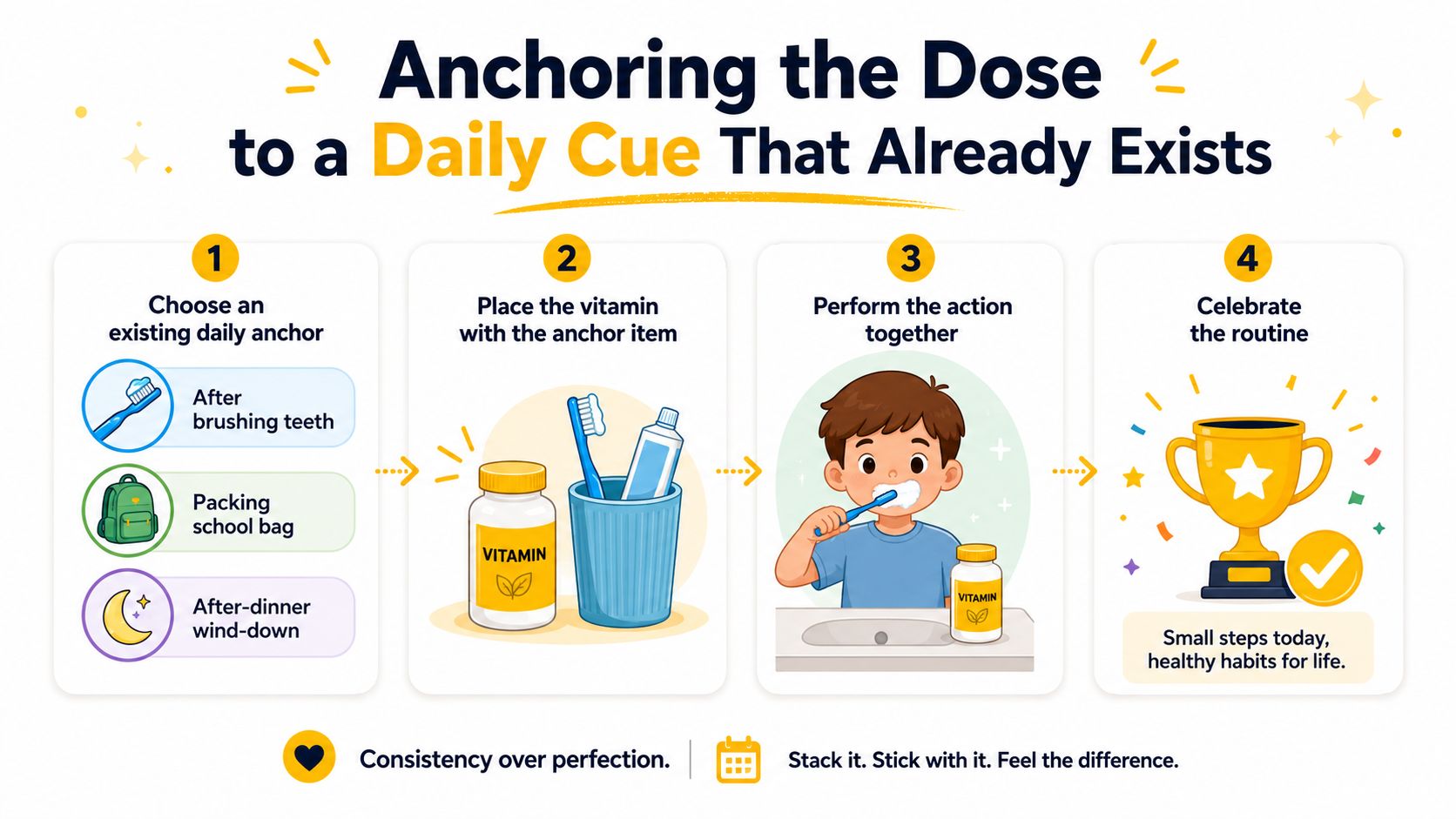
Build the cue in four moves
- Choose an existing anchor. Pick after brushing teeth, packing the school bag or the after-dinner wind-down. Don't choose a time that already feels chaotic.
- Place the product beside the anchor. Keep it with the school bag, in the bathroom routine area or near the supervised after-dinner setting, according to safe storage needs.
- Perform the actions together. Brush teeth, take the gummy and move to the next activity. Keep your words brief.
- Celebrate completion of the routine. A calm “You remembered your power routine” is enough. Don't turn it into a performance.
The best cue matches the product's identity. Use Focus before schoolwork, Calm during the evening wind-down and Brave before leaving for school or facing a new situation. The child begins to recognise the sequence, not just the taste.
Plan for imperfect days
Weekends, holidays and sick days will interrupt the pattern. Don't punish the missed dose and don't give extra to compensate unless a healthcare professional has specifically advised it. Return to the next normal cue and keep the language matter-of-fact.
If the child refuses, avoid restarting the entire routine with a new reward system. Check one variable at a time: taste, texture, timing, fatigue or whether the cue has become associated with pressure. The Australian Government's routine advice supports the broader principle, repeated predictable exposure works better than one-off persuasion.
A routine should feel boring in the best possible way. Put the product where the cue happens, offer it at the same general point in the day and keep moving.
Reading the Label for Nutrient-Focused Formulations
A colourful front label can't tell you whether a supplement matches your child's needs. Turn the pack over and start with the serving directions, active ingredients, age guidance and the full ingredients panel.
Broad multivitamins have a place when a family and healthcare professional want general coverage, but they're not automatically the right response to a restricted diet. If iron, zinc or vitamin D is the concern, check whether the product contains that nutrient and whether the amount is meaningful for the intended age group. A generic gummy may contain many ingredients while offering limited support for the one nutrient that needs attention.
Sugar-free and vegan claims can matter for families using a product daily, but they shouldn't replace ingredient scrutiny. Check for artificial colours and flavours, sweeteners, allergens and the texture-producing ingredients your child may react to. Transparent labelling makes it easier to compare products without relying on packaging language.
| Label item | Why it matters | What to look for |
|---|---|---|
| Serving size | Prevents accidental overuse | Clear daily directions for your child's age |
| Active nutrients | Shows what the product actually supplies | Nutrients relevant to the diet pattern or clinical advice |
| Age guidance | Supports safer use | A stated age range and child-appropriate instructions |
| Sweeteners and sugars | Affects everyday suitability and taste | Sugar-free information plus the complete ingredients list |
| Colours and flavours | Matters for family preferences and sensitivities | No artificial colours or flavours if that's your requirement |
| Allergens and formulation | Helps with household safety | Full disclosure, vegan status where relevant and allergen checks |
| Storage | Reduces unsupervised access | Secure, parent-controlled storage instructions |
The Daily Powers guide to sugar-free multivitamins can help you think through those label questions, but product selection still needs to match your child's age, diet and medical advice.
Nutricia's Australian nutrition guidance states that children shouldn't consume more than one serve of nutritional supplements per day unless a healthcare provider advises otherwise. See the one-serve guidance for fussy eaters and follow the product's own directions. Never stack several supplements casually, particularly when they contain overlapping vitamins or minerals.
Your One-Week Starter Plan for Vitamins and Fussy Eaters
Treat the first week as a routine trial, not a test your child can pass or fail. You're checking whether the format, flavour, language and cue fit your household.
- Day 1, observe: Write down what your child reliably accepts, when resistance is lowest and which daily activities already happen without argument.
- Day 2, choose and check: Select a suitable format, then read the serving directions, active ingredients, age guidance and ingredients panel.
- Day 3, choose the anchor: Pair the gummy with school preparation, homework, tooth brushing or the evening wind-down.
- Day 4, introduce positively: Don't announce a medical mission. Offer the delicious gummy, give a bounded choice and keep the interaction brief.
- Day 5, troubleshoot: If the child refuses, test one change only, such as a different cue or a quieter setting. Don't hide the product in a meal your child depends on.
- Day 6, reinforce: Repeat the same cue. If mornings are unreliable, add a second visual reminder, not a second serving.
- Day 7, review: Decide what worked, what caused resistance and whether the routine is sustainable. If the diet is highly restricted or you're worried about deficiency, take your notes to a GP or dietitian.
When a child asks for a second gummy, stick to the labelled serving and explain that the routine is finished for today. If the flavour becomes boring, change the context or review the formulation rather than turning the gummy into a reward. If refusal continues, stop the battle and seek advice about whether the product or the broader feeding concern needs reassessment.
Kitchen-table standard: Kids don't need a supplement that looks impressive to adults. They need a flavour and texture they'll accept as part of ordinary family life.
Daily Powers offers soft, sugar-free, vegan gummies framed around Brave, Focus and Calm, so you can match a child-friendly ritual with school preparation, learning or bedtime. Visit Daily Powers to review the range, ingredient information and dosing guidance, then choose a routine your child can realistically repeat.