

Your child refuses the breakfast you thought would help with school focus, then becomes anxious about the morning routine. You search for answers and find advice that conflicts at every turn. One page recommends a supplement, another says food is enough, while a well-meaning parent suggests something that worked for their child.
Evidence informed practice can help. It doesn't ask you to ignore research or dismiss your instincts. Instead, it gives you a calm, organised way to combine trustworthy evidence, professional knowledge and your child's actual needs.
Table of Contents
- Navigating Modern Parenting with Confidence
- Defining Evidence Informed Practice
- Evidence Based vs Evidence Informed
- The Five Steps to Implementation
- Real World Examples for Families
- Building Your Family Health Strategy
Navigating Modern Parenting with Confidence
Parenting often involves decisions that look small but feel significant. Should you change breakfast before a big school day? Is bedtime anxiety a phase, or does your child need extra support? Would a new routine help, or would it create another battle when your family is already tired?
Online advice can make these choices harder. A recommendation may sound authoritative while overlooking your child's appetite, sensory preferences, health history, culture or family routine. Even sensible advice can fail when it doesn't fit the child who has to follow it.

Take sleep as an example. A consistent wind-down routine may be useful, but your approach also needs to account for your child's temperament, worries, developmental stage and the practical limits of your household. Guidance about helping children get to sleep becomes more useful when you adapt it thoughtfully rather than treating it as a strict script.
A practical starting point: Ask what your child needs, what reliable evidence suggests, and what your family can realistically sustain.
Evidence informed practice brings those questions together. It doesn't promise a perfect answer before you begin. It helps you make a reasonable choice, observe what happens and adjust without blaming yourself or your child.
That distinction matters. A parent who notices that a child eats better at a certain time, becomes overwhelmed by strong flavours or settles with a predictable routine is contributing important information. Parental observation isn't a replacement for professional assessment, but it is part of understanding whether a plan fits real life.
Defining Evidence Informed Practice
A child may refuse a recommended food, struggle with a supplement routine or respond differently from the children described in a study. What is evidence informed practice in that situation? It is a way to combine reliable research, professional knowledge and the experiences of the child and family, rather than letting one source decide everything.
For families, these parts work like overlapping circles. Research provides direction, professional expertise helps interpret it, and family context shows whether a plan can work in daily life. The NDIS Quality and Safeguards Commission's evidence-informed practice guide describes this integration as part of sound decision-making.
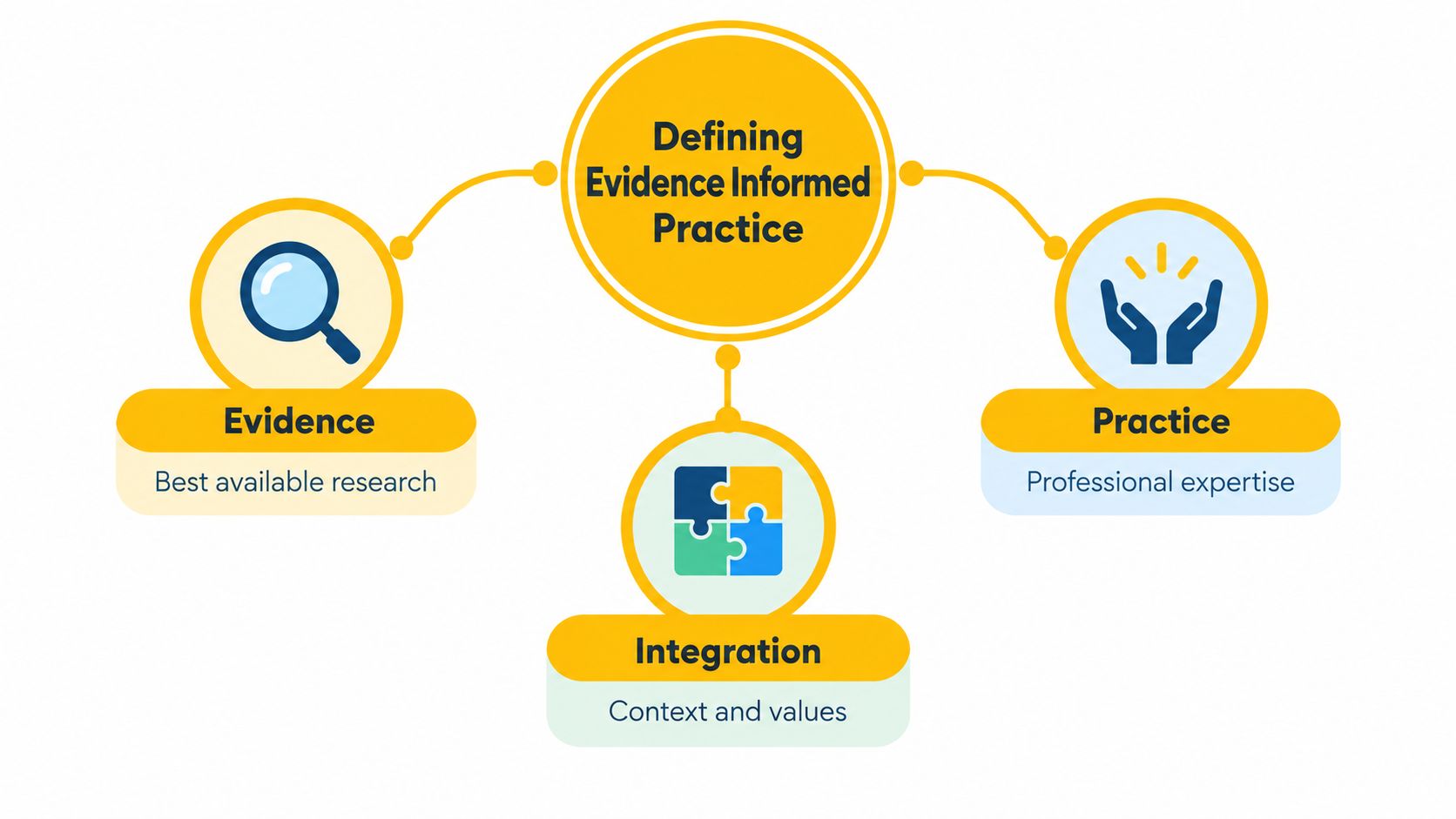
Research evidence
The first part is the best available contemporary research. Studies, clinical guidance and evidence reviews can show whether an approach is plausible, which outcomes have been observed and where uncertainty remains.
Research may not match your family exactly. A study might involve children with different needs, use another product or measure an outcome that is not your main concern. Applying evidence therefore requires careful interpretation. A promising headline is a starting point, not a complete answer.
Professional expertise
The second part is practitioner expertise. A paediatric dietitian, doctor, psychologist or other qualified professional can relate research to your child's health, development and circumstances.
That work may include deciding whether a concern needs assessment, checking possible interactions, considering nutritional adequacy and judging whether advice suits your child's age and needs. A good practitioner also explains when evidence is limited, so you can make a decision with a clear understanding of what is known and what remains uncertain.
Family context and values
The third part is the perspective of the person receiving care. For children, this includes the child's preferences and reactions, as well as the priorities of parents or carers. Food preferences, budget, culture, schedule, consent and the family's ability to maintain a routine all affect whether a plan is workable.
A daily supplement routine must be safe and appropriate, but it also needs to fit the child and household. Brave is one example of a child-focused daily multivitamin gummy designed for a repeatable routine. It contains essential vitamins, kid-friendly flavours and textures, no artificial colours or flavours, and a vegan-friendly formulation.
The decision belongs where these three areas meet. An approach may have interesting research behind it yet suit your child poorly. Another may be convenient but lack reliable support. Evidence informed practice brings the whole picture together, then encourages you to observe the result and adjust the plan responsibly.
Evidence Based vs Evidence Informed
The terms evidence based and evidence informed are related, but they can suggest different decision-making styles.
Evidence based language is often used when an intervention or protocol has been tested and supported by research. That evidence can be valuable, particularly when safety and effectiveness have been studied carefully. The confusion begins when people treat evidence as a universal instruction that must be followed unchanged.
Evidence informed practice keeps research central while recognising that children aren't identical. It includes professional judgement and the child and family's values, preferences and circumstances. Australian guidance increasingly presents this as shared decision-making rather than a rigid “what works” checklist, as described in the Centre for Community Child Health decision-making framework.
| Aspect | Evidence Based | Evidence Informed |
|---|---|---|
| Main emphasis | Applying approaches supported by research | Combining research with expertise and family context |
| View of the child | May focus on whether an intervention works for a studied group | Considers how the approach fits this child and situation |
| Professional role | Follows available guidance and evidence | Interprets evidence and adapts it responsibly |
| Family role | May be treated mainly as a recipient of advice | Participates in decisions and shares priorities |
| Response to uncertainty | Can encourage a search for a definitive answer | Makes uncertainty visible and uses monitoring to guide adjustment |
| Implementation | May emphasise the intervention itself | Considers delivery, consent, fit, feedback and sustainability |
This doesn't mean that parental intuition should replace clinical evidence. A strong feeling can identify a concern or reveal a useful pattern, but it may not explain the cause. A professional can help test that observation safely.
It also doesn't mean every choice is equally valid. Evidence informed practice still requires critical appraisal, appropriate safety checks and attention to the quality of information. “It worked for us” may be meaningful family experience, but it isn't enough on its own to establish that an approach will work for another child.
The family remains an active partner. You can ask why a recommendation has been chosen, what outcome to watch for, how long to try it and what would prompt a review.
The Five Steps to Implementation
A worried parent may begin with a simple question: “Could this help my child?” The answer rarely comes from choosing the intervention with the most impressive claim. It comes from asking a useful question, finding trustworthy information, checking how well it fits this child and family, then reviewing what happens. The Australian framework arranges this process as Ask, Acquire, Appraise, Apply and Assess, linking decisions with quality of life, inclusion and participation.
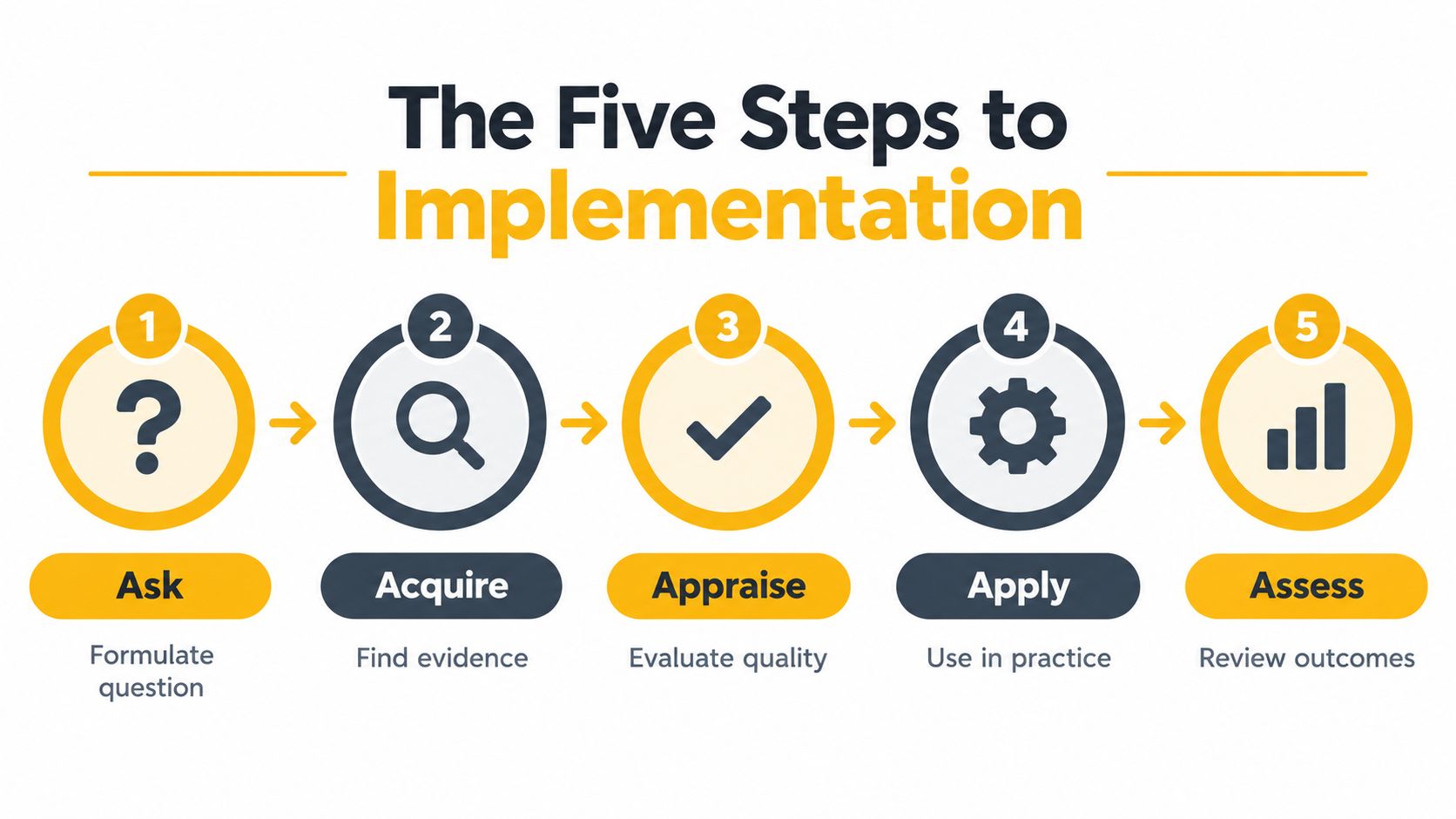
Ask
Begin with a question specific enough to guide a search. “How can I support my child?” is broad. “What might support a calmer bedtime routine, and what changes would show that it helps?” gives the family something practical to explore.
Include the concern, the child, the possible approach and the outcome that matters. For a supplement, ask what it is meant to support, whether it suits your child's age and whether a healthcare professional should review the choice.
Acquire
Look for information with clear authorship, transparent ingredients or methods, and a suitable professional or government context. Prefer guidance that explains limits and conditions instead of promising the same result for every child.
A doctor or paediatric dietitian can help locate information relevant to your child. For dosing questions, consult paediatric dosing information. An adult serving, or another child's routine, may not be appropriate.
Appraise
Pause before accepting a claim. Ask who produced it, what outcome was measured, whether the children studied resemble your child and whether the advice addresses safety and family circumstances.
Check the whole situation, not only the product. A child may seem to improve because of a predictable routine, encouragement or better sleep rather than one ingredient. That routine can still be useful. Describe the change accurately so the next decision is based on what happened.
Apply
Set up a manageable plan with your child and the relevant professionals. Agree on what will happen, when it will happen and how the family will remember it.
Start small. A child who dislikes a texture may reject the plan before you learn anything about its intended role. If the routine causes conflict, that response is useful information. Adjust the plan rather than treating resistance as a failure.
Assess
Review an outcome that you can observe. This might be a calmer bedtime routine, easier acceptance of breakfast or more comfortable participation in a daily activity.
Assessment does not require perfect measurement. A short diary, your child's comments and feedback from professionals can show whether the approach is useful, neutral or unsuitable. Concerning symptoms or no meaningful improvement should prompt advice, rather than automatic continuation.
Real World Examples for Families
A family is considering a daily supplement for a child who eats a narrow range of foods. The parent values a vegan formulation and wants to avoid sugar and artificial colours or flavours. The child refuses tablets but accepts soft, fruit-flavoured textures.
An evidence informed decision doesn't begin with “Which product is best?” It begins with a question about the child's nutritional situation, current diet, health history and the specific gap the family is trying to address. A healthcare professional can help determine whether supplementation is appropriate, while the parent and child can explain what the family can use consistently.

The routine matters
Suppose the family chooses a child-focused gummy with transparent ingredient information and age-appropriate directions. The decision still needs monitoring. Is the child taking it as intended? Does the routine fit breakfast or another reliable part of the day? Are there changes that need discussion with a healthcare professional?
The supplement isn't a substitute for varied food, assessment or treatment. Its place depends on the child's circumstances and the reason it was selected. A pleasant routine may improve consistency, but consistency alone doesn't prove that a product has changed a health outcome.
Tailoring support for a sensitive child
Now consider a child who becomes overwhelmed after school and finds the transition to bedtime difficult. The parent is interested in a magnesium-based gummy for relaxation, but the child has sensory sensitivities and the family wants a low-conflict routine.
Professional expertise should guide whether that option is suitable, including any relevant medical history or other products the child uses. The family can then decide whether the texture, flavour and timing fit the child's preferences, while tracking the outcome that matters to them, such as a smoother wind-down.
For broader questions about children's immune support, families should still consider sleep, nutrition, vaccinations, hygiene and medical advice as relevant. No single choice represents evidence informed practice by itself. The process is the combination of careful questions, reliable information, professional interpretation, family priorities and review.
Ask before adding: What problem are we trying to solve, and how will we know whether this particular choice is helping?
Building Your Family Health Strategy
Evidence informed practice gives parents a practical way to decide when advice conflicts, research is incomplete or a child responds differently than expected. It is less like following a winning rulebook and more like using a map: reliable evidence sets direction, while your child's needs determine the route.
Begin with the concern in plain language. Ask a qualified professional or consult trustworthy guidance, then check whether the information fits your child. Include your child's preferences in the plan. A routine that suits their comfort, communication and abilities is more likely to be used safely and consistently.
Australian government frameworks place this decision in context. Culture, family values, trauma history, sensory needs, consent and the practicalities of daily life may all shape a suitable strategy. For Aboriginal and Torres Strait Islander families and diverse communities, culturally safe practice and respectful handling of information belong at the centre of responsible decisions.
You do not need every answer at once. You need a process that helps you ask clearer questions, notice meaningful changes and seek support when home care is not enough.
Keep the decision connected to your child, rather than the loudest online claim. Research informs the choice, professional expertise interprets it, and family knowledge makes it workable.
Daily Powers offers children's gummy supplements for everyday needs such as bravery, focus and calm, with sugar-free, vegan formulations and no artificial colours or flavours. Explore the range at Daily Powers and discuss questions with your healthcare professional before starting a new routine.