

For most healthy Australian children aged 4–12, a low-dose supplement providing around 3–4 mg of elemental zinc can complement a mixed diet, provided total daily zinc stays below the 12 mg upper limit for ages 4–8 and 25 mg for ages 9–13. A form such as zinc gluconate can make sense for a children's product because it balances practical formulation needs with a meaningful zinc contribution.
You may be standing in the pharmacy aisle, comparing colourful gummies while your child asks whether they can have the one with the brightest label. Or perhaps you're packing lunch and wondering whether toast, fruit and a small yoghurt have covered enough nutrients for another busy school day. Zinc is often presented as an instant immune solution, but the useful question is more measured: does your child have a dietary gap, and does the product's dose fit their age?
This guide uses Australian nutrient reference values to explain what zinc does, where intake gaps are more likely, how zinc gluconate compares with other forms, and how to read the elemental zinc amount on a label.
Table of Contents
- Why Zinc Matters More Than the Aisle Suggests
- What Zinc Does in a Child's Body
- Zinc Gluconate Versus Zinc Oxide and Other Forms
- Age-Appropriate Dosing Using Australian Reference Values
- Where the Real Intake Gaps Sit in Australian Children
- Reading a Kids' Zinc Supplement Label the Right Way
- How Low-Dose, Sugar-Free Zinc Fits Into a Daily Routine
- Common Questions Parents Ask About Zinc Supplements for Kids
Why Zinc Matters More Than the Aisle Suggests
The supplement aisle makes zinc look like a seasonal product. Bright packaging often connects it with winter sniffles, while lozenges and children's gummies compete for attention with promises about immunity. For parents, that can turn a straightforward nutrition decision into a choice between marketing messages.
Zinc has a quieter role. It supports normal growth, immune function, appetite, taste and cell activity, so a child doesn't need to be visibly unwell for zinc intake to matter. The Australian nutrient reference material places children's needs in an age-related range, with an Adequate Intake of 2 mg a day for ages 1–3, 3 mg for ages 4–8, and 5 mg for boys and 4 mg for girls aged 9–13, as outlined by Australia's nutrient reference information for zinc.
Zinc also sits inside the machinery of the body rather than acting like a single-purpose medicine. It helps enzymes work, supports proteins involved in cell activity and contributes to normal development. The body uses it behind the scenes, which is why a child's overall eating pattern matters more than a product's loudest claim.
Practical perspective: Zinc is a nutrient to assess, not a shortcut to perfect health.
A child who eats meat, eggs, legumes, dairy and seeds across the week may already receive suitable zinc from food. Another child who avoids meat, eats a narrow range of foods or goes through a prolonged appetite slump may have a more relevant intake gap. Parents can also read our guide to immune system vitamins without treating every cough as evidence of deficiency.
The right product should therefore make the decision easier, not more dramatic. Look for an age-appropriate dose, a clearly stated elemental zinc amount and a form children can tolerate consistently.
What Zinc Does in a Child's Body
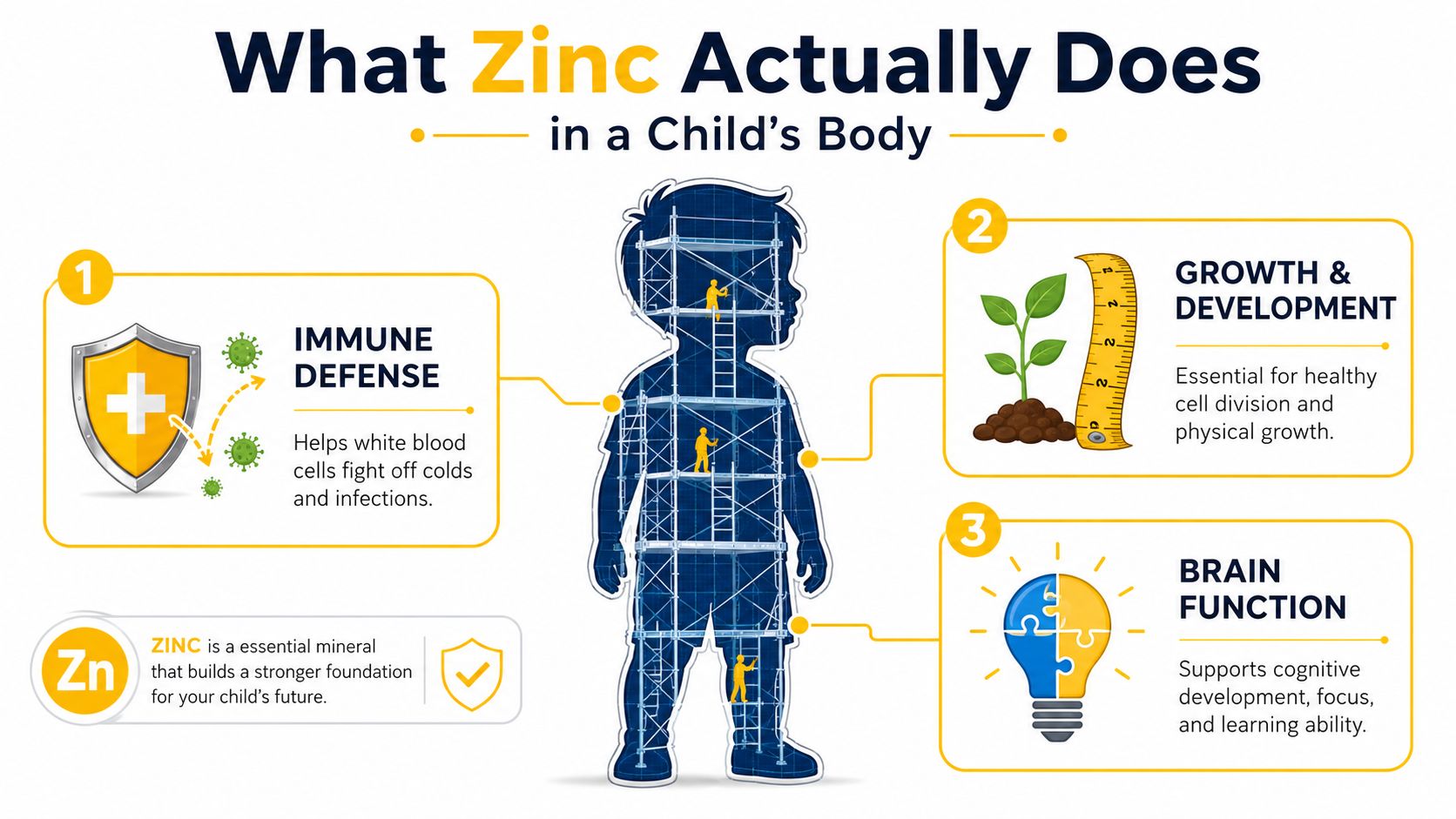
Zinc acts like scaffolding around a growing body. Food supplies the building materials, including protein, energy and other nutrients, while zinc helps enzymes, proteins and cell signals carry out their work.
Growth and everyday development
Children grow through repeated cell division, tissue formation and bone development. Zinc contributes to these processes, so an inadequate intake may matter more during periods of rapid growth. The Australian RDI is 4 mg a day for children aged 4–8, rising to 6 mg for boys and girls aged 9–13, according to the Australian zinc nutrient reference values.
Immune work without the hype
Zinc supports the development and normal function of immune cells. That makes it part of a child's general defences, not a promise of fewer colds. Children already receiving enough zinc from food are not automatically likely to gain extra protection from taking more.
Taste, appetite and brain-related functions
Zinc contributes to taste perception and appetite regulation. If zinc status is low, food may seem less appealing, although picky eating has many possible causes and zinc is not a universal solution. Zinc also participates in neurological function, but evidence that supplementation directly improves concentration in otherwise healthy children remains mixed.
The body does not keep a large zinc reserve for parents to rely on over long periods, so regular food intake matters. Useful sources include meat, legumes, dairy, eggs and seeds. Families considering a product that combines zinc with other ingredients may encounter Focus, which lists zinc gluconate alongside mushroom polysaccharides, vitamin D3, elderberry fruit powder and prebiotics. Parents can also review guidance on immune system vitamins without treating every cough as evidence of low zinc.
Zinc Gluconate Versus Zinc Oxide and Other Forms
A child may accept one zinc product and reject another, even when both provide zinc. The compound listed on the label affects more than the ingredient name. Parents should check the amount of elemental zinc, the form's suitability for an oral product, and whether the child will accept its taste and texture.
Zinc gluconate is commonly used in children's supplements because it offers a practical balance between formulation and use. It can provide a useful amount of elemental zinc while fitting into a gummy or chewable product. The reasoning is simple: a supplement only contributes when a child can take it regularly. Zinc's metallic taste can make that formulation work difficult.
Zinc oxide has a different role. It is familiar in topical preparations and appears in some oral products, but it may be less convenient for a children's gummy where flavour and texture matter. Zinc sulfate and zinc citrate are established oral forms. Picolinate and bisglycinate may also be chosen when a manufacturer is prioritising particular absorption or tolerability characteristics.
The form name does not provide a guaranteed absorption percentage. Absorption can change with the meal, the wider diet and the individual product. For parents, the useful comparison is how each form fits the product, rather than assuming one fixed result for every child.
A practical comparison
| Form | Approx. absorption fraction | Taste and tolerability | Best use for kids |
|---|---|---|---|
| Zinc gluconate | Product and meal dependent | Often workable for flavoured chewables | A practical oral option for gummies |
| Zinc sulfate | Product and meal dependent | May be harder for some children to tolerate | Oral supplements where formulation is suitable |
| Zinc citrate | Product and meal dependent | Can be suitable in chewable products | Oral products with a tolerability focus |
| Zinc oxide | Product and meal dependent | Can be challenging in oral formulations | More familiar in topical preparations than children's gummies |
Daily Powers selected zinc gluconate for Brave because it combines established oral use with practical formulation characteristics. It also allows the product to provide elemental zinc without making the gummy's flavour unacceptable. That choice does not make every gluconate product equivalent. The elemental zinc amount, serving directions and complete ingredient list still need checking.
A gummy providing 3.5 mg elemental zinc can sit alongside food rather than replace zinc-containing meals. The compound tells you how zinc is delivered. The elemental amount tells you what the child receives.
Age-Appropriate Dosing Using Australian Reference Values
A zinc label becomes much easier to judge when you place the daily serving between two figures: the recommended dietary intake and the upper level. The RDI describes the daily amount intended to meet the needs of a population group. The upper level applies to total zinc from food, water and supplements, not just the gummy.
For children aged 4–8, the Australian RDI is 4 mg a day, while the upper level is 12 mg a day. For ages 9–13, the RDI is 6 mg a day for boys and girls, while the upper level is 25 mg a day, according to the Australian and New Zealand nutrient reference material.
| Age group | RDI (mg/day) | Upper limit (mg/day) | Suggested supplement range |
|---|---|---|---|
| 1–3 years | 3 | 7 | Only with professional guidance |
| 4–8 years | 4 | 12 | Around 3–4 mg when a dietary gap exists |
| 9–13 years | 6 | 25 | Around 3–4 mg when a dietary gap exists |
A daily serving of 3.5 mg elemental zinc can complement food rather than attempt to provide the entire requirement. For a child aged 4–8, the parent should still count zinc from meals. A supplement isn't automatically “safe” just because its own dose is below the upper level if another zinc-containing multivitamin is taken at the same time.
Simple calculation: Estimate the zinc your child regularly receives from food, compare it with the RDI, then use a supplement only to address a reasonable gap.
Toddlers need extra caution because their RDI is 3 mg and their upper level is 7 mg, leaving less room for casual stacking. High-dose zinc products are particularly inappropriate without individual advice. Australia's zinc supplement-use research also notes that the TGA maximum recommended daily dose of 50 mg is well above the upper level for children and adults, so it shouldn't be used as a child dosing target. The Australian supplement-use paper explains this distinction.
Where the Real Intake Gaps Sit in Australian Children
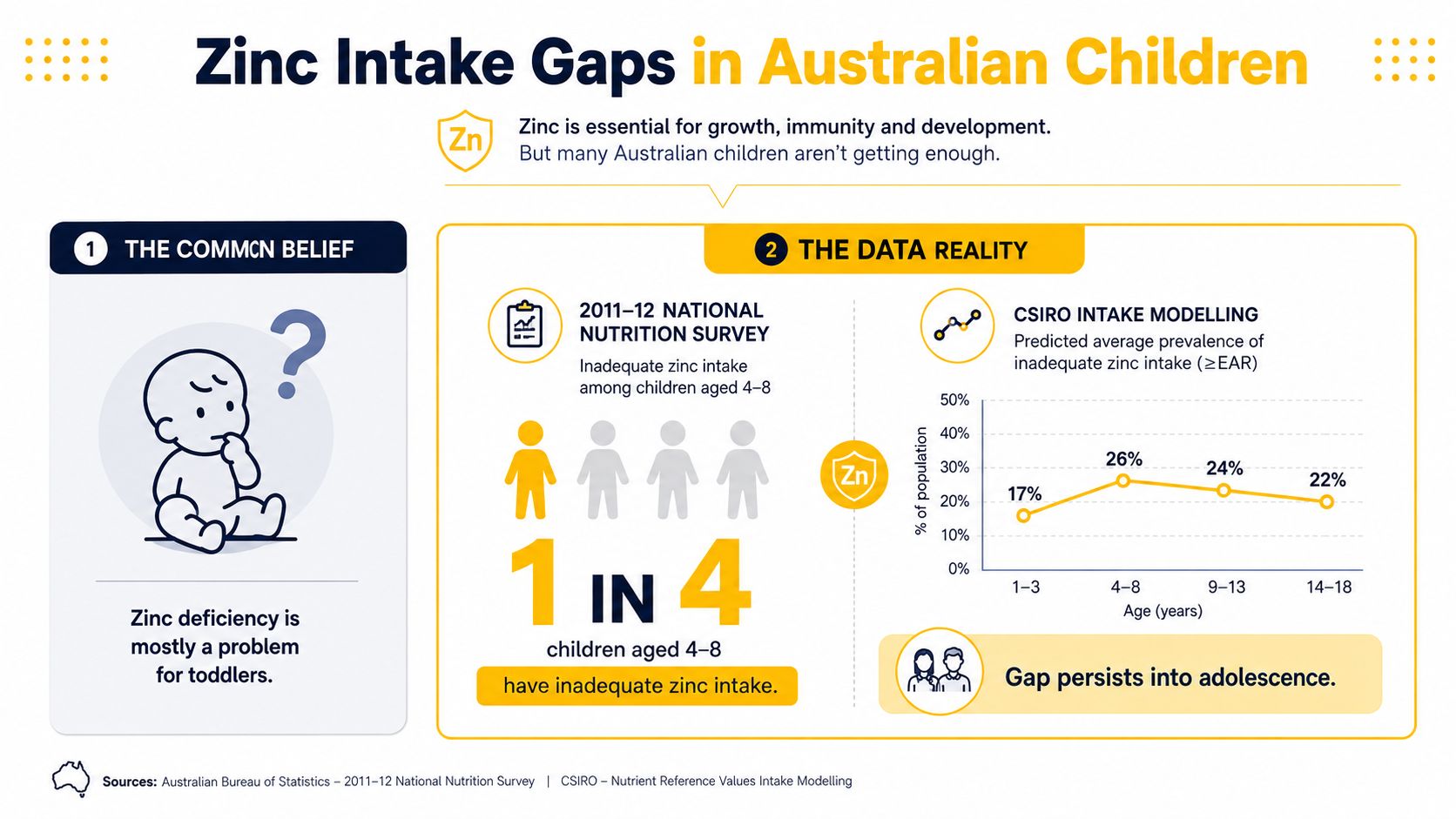
Many parents first hear about zinc when their toddler is unwell. Australian intake data point to a more nuanced pattern. The larger concern may appear during later childhood and adolescence, when food preferences, appetite and meal independence begin to change.
AIHW data reported that 13% of females aged 9–13 did not meet the EAR for zinc. Among 14–16-year-olds, 44% of males and 25% of females did not meet it, while among 17–18-year-olds the figures were 28% of males and 21% of females. An Australian dietary analysis found that nearly all children met the EAR except boys aged 14–16, where 29% failed to meet it. These figures are discussed in the Australian dietary analysis of zinc intake.
The pattern doesn't mean every adolescent needs a supplement. It does suggest that age, diet stage and risk subgroup deserve more attention than a blanket “zinc for immunity” message.
What may create a gap
An older child may eat fewer meat-based meals, rely heavily on cereal foods or replace a protein-rich lunch with discretionary snacks. Growth spurts can also affect appetite, although a single difficult week doesn't prove inadequate zinc intake.
Research from the Australian Feeding Infants and Toddlers Study estimated zinc inadequacy at about 20% among infants aged 6–11.9 months. In Australian children and adolescents, inadequacy rose during adolescence, reaching 19% for inadequate absorbable zinc intake and 29% for inadequate total zinc intake at age 15, as reported in the Australian zinc intake research indexed by PubMed.
Assess the whole week rather than one lunchbox. A child who regularly eats a narrow, low-protein pattern may be a more technically defensible candidate for low-dose supplementation than a preschooler with a varied diet.
Reading a Kids' Zinc Supplement Label the Right Way
The most important line on a zinc label is usually elemental zinc, not the total weight of the zinc compound. Zinc gluconate is the carrier compound. Elemental zinc is the amount your child's intake calculation needs.
For example, a product may list 25 mg of zinc gluconate and provide roughly 3.5 mg of elemental zinc. Those figures aren't interchangeable. If you compare products using the larger compound number, you can overestimate or misunderstand the actual zinc dose.
A label-reading sequence
- Find the serving size. Check whether the stated amount applies to one gummy, two gummies or another daily serving.
- Locate elemental zinc. Look for a line that clearly states zinc in milligrams, rather than relying on the compound weight.
- Add other sources. Check whether a multivitamin, mineral product or fortified food also contributes zinc.
- Scan the excipients. Look for added sugars, artificial colours, artificial flavours and unnecessary fillers, especially if the product is intended for daily use.
A sugar-free format can help avoid making a daily supplement another source of added sugar, but sugar-free doesn't automatically mean nutritionally necessary. Texture, flavour and dose transparency still matter. Families comparing children's products may also find our guide to sugar-free multivitamins useful when reviewing ingredient panels.
Calcium and iron may compete with zinc for absorption, so a large “mega” mineral combination isn't automatically better designed. Look for clear directions, an Australian Register of Therapeutic Goods listing where relevant, transparent ingredient information and evidence that the manufacturer manages quality and batch testing.
How Low-Dose, Sugar-Free Zinc Fits Into a Daily Routine
A child finishes breakfast, packs a school bag and heads out the door. That familiar sequence can make a low-dose zinc gummy easier to remember, provided it addresses a defined dietary gap rather than trying to compensate for a limited diet. Meat, legumes, eggs, dairy, seeds and other nutrient-rich foods remain the foundation.
Give the supplement after breakfast or with a small snack, away from a calcium-heavy moment such as a large glass of milk or yoghurt. Wholegrain toast and eggs provide a practical food anchor, while the gummy complements the meal instead of replacing it.
Make the routine easier to keep
- Use a consistent anchor. Brushing teeth, packing the school bag or sitting down for breakfast can prompt the daily serving.
- Check the elemental dose. A 3 to 4 mg serving is easier to place within Australian age-based limits than a high-dose product. The label, not the gummy's size or appearance, determines the zinc provided.
- Plan around other minerals. Families using iron or magnesium supplements should ask a healthcare professional how to schedule them. Some children may need doses separated by a couple of hours.
- Choose a tolerable format. A gummy may be more acceptable than a chalky tablet or liquid with a strong metallic taste, but it still needs secure storage and measured use.
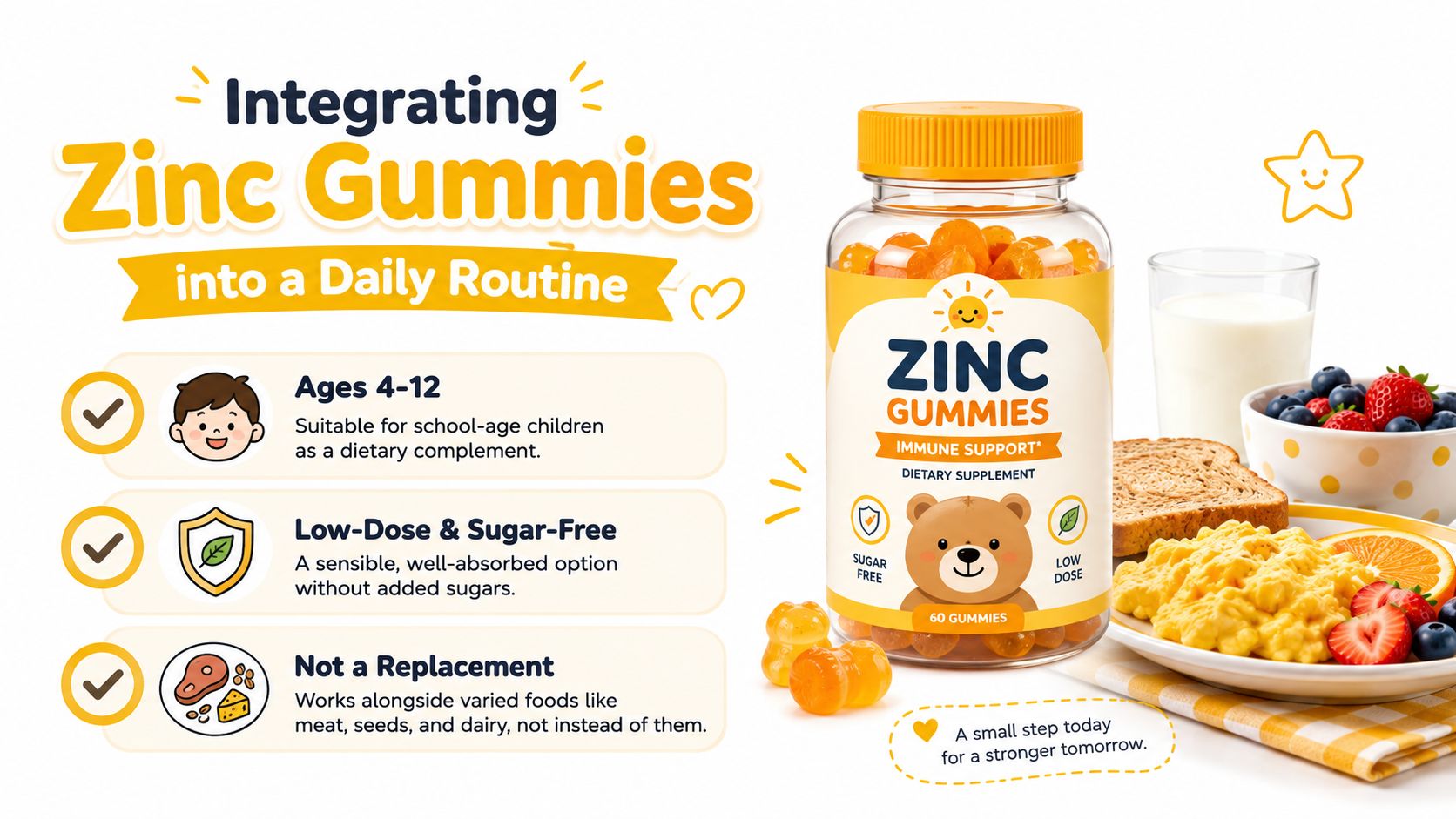
Daily Powers' kids' vitamin gummies guide can help families compare format, routine and ingredient information. The useful test is straightforward: can the child take the product as directed, and does the combined intake suit their age?
Sugar-free gummies avoid adding another source of sugar to a daily habit, although sugar-free does not by itself make supplementation necessary. A child who refuses tablets may accept a chewable gummy, but it is still a supplement, not lollies. Keep the routine connected to varied food, sleep and regular meals.
Common Questions Parents Ask About Zinc Supplements for Kids
Should zinc be taken with food?
A child may tolerate zinc better with a small meal or snack, particularly one containing protein. Avoid giving it at the same time as a large calcium-rich serving or an iron dose unless a health professional has advised that schedule.
Can zinc be taken with a multivitamin?
It can be appropriate when the combined amount remains within the child's age-based limits. Check every label before combining products, because several individually modest supplements can add up to an unnecessarily high total.
What might too much zinc look like?
Nausea, tummy discomfort, a metallic taste and reduced appetite can occur when zinc doesn't suit a child or the intake is excessive. Stop the supplement and seek advice if symptoms persist, recur or concern you.
Does zinc improve concentration or skin?
Zinc is involved in normal skin health, cell growth and neurological function, but no clinical study has been conducted on Brave to measure changes in children's skin or concentration. Evidence for direct concentration improvement in otherwise healthy children is mixed. A paediatric atopic dermatitis study found 55.6% of children had very low zinc levels and 22.2% had extremely low levels, but that finding relates to children with dermatitis and doesn't establish a before-and-after result for healthy children's skin or focus. The dermatitis study is available through DOAJ.
When should a professional assess my child?
Seek advice if your child has recurrent infections, slow growth, a very restricted diet, eating difficulties linked to developmental concerns or medicines that may interact with zinc. A paediatrician or dietitian can consider the full diet and clinical picture instead of treating one symptom as proof of deficiency.
Daily Powers offers children's gummy products designed around repeatable routines, including Brave and formulations such as Focus that provide zinc in a sugar-free, vegan format. Visit Daily Powers to review the ingredient lists and dosing directions, then discuss the most suitable option with your healthcare professional if your child has a restricted diet or ongoing health concerns.