

The popular advice to choose the children's multivitamin with the longest ingredient list gets the decision backwards. When your child brings home another cold and you're standing in the vitamin aisle, you don't need more promises about stronger immunity. You need to know whether there's a nutritional gap worth addressing, and whether the label gives you enough information to choose safely.
Table of Contents
- Does Your Child Really Need an Immune-Support Multivitamin
- Which Nutrients Actually Support Immune Function in Kids
- How to Compare Kids Multivitamins for Immune Support
- Kids Multivitamin Options Side by Side
- Which Multivitamin Suits Your Child's Situation
- Ordering and Subscription Considerations for Families
- Our Recommendation for Australian Families
Does Your Child Really Need an Immune-Support Multivitamin
Most healthy children don't automatically need an immune-support multivitamin. A varied diet remains the starting point, not something to work around with a gummy.
The Australian Bureau of Statistics' 2023 analysis found that children aged 2–11 generally obtained adequate amounts of most vitamins and minerals from food and beverages, with calcium the major exception; among children under 12, inadequacy remained below 10% for every assessed vitamin, according to the ABS national nutrition data. That's a good reason to question blanket advice that every schoolchild needs daily vitamins.
What immune support actually means
A nutrient can support normal immune function without a product being proven to prevent colds or infections. Those are different claims, and parents shouldn't have to decode the difference while comparing cheerful packaging.
My advice is to judge the nutritional purpose before the format:
| Your child's situation | My starting recommendation |
|---|---|
| Eats a varied diet without an identified concern | Don't assume a supplement is necessary |
| Regularly excludes whole food groups | Review the diet and consider targeted nutritional back-up |
| Has an inconsistent appetite or very limited variety | Discuss whether a multivitamin addresses likely gaps |
| Has symptoms or a medical condition affecting nutrition | Seek individual advice before choosing a product |
A picky eater may benefit from nutritional back-up, but picky eating alone doesn't identify which nutrients are missing. Likewise, a child with a diagnosed deficiency needs an appropriate treatment plan, not just a multivitamin that appears to cover many nutrients.
Choose well if you choose at all
Use children's immune-support guidance to organise your questions around diet, age and existing supplements. Start with what your child eats across their usual routine, rather than their worst dinner of the week.
Practical rule: Buy a multivitamin to address a plausible nutritional need, not to purchase reassurance about every illness.
There's no parenting failure in deciding not to buy one. There's also nothing wrong with using a carefully chosen supplement when dietary variety is difficult.
Which Nutrients Actually Support Immune Function in Kids
Vitamin A and zinc deserve particular attention when assessing immune-support claims. Vitamin C and iron also belong in the nutritional conversation, but their presence on a label doesn't establish that your child needs extra amounts.
Start with the distinction between a nutrient's normal role and the benefit of supplementing a child who already gets enough. Evidence that a nutrient matters isn't evidence that a larger dose produces a better outcome.
Vitamin A, vitamin C and iron
The historical Australian data provides useful context without turning every nutrient into a shopping requirement. The ABS identifies vitamin A as supporting normal immune function, while its 2011–12 analysis found that approximately 95% or more of children aged 4–8 met requirements for most nutrients, with calcium and iron notable exceptions, according to the ABS usual nutrient intake analysis.
For parents, I'd translate that into the following label-reading priorities:
- Vitamin A: Check the disclosed amount and age directions rather than treating its inclusion as proof of superior immune protection.
- Vitamin C: Don't let a prominent front-label claim outweigh the complete formulation or your child's dietary intake.
- Iron: Treat a suspected shortfall as a reason for dietary and professional assessment, not a reason to select the highest-potency multivitamin.
A broad nutrient overview can help organise the conversation, but it can't determine an individual child's requirements.
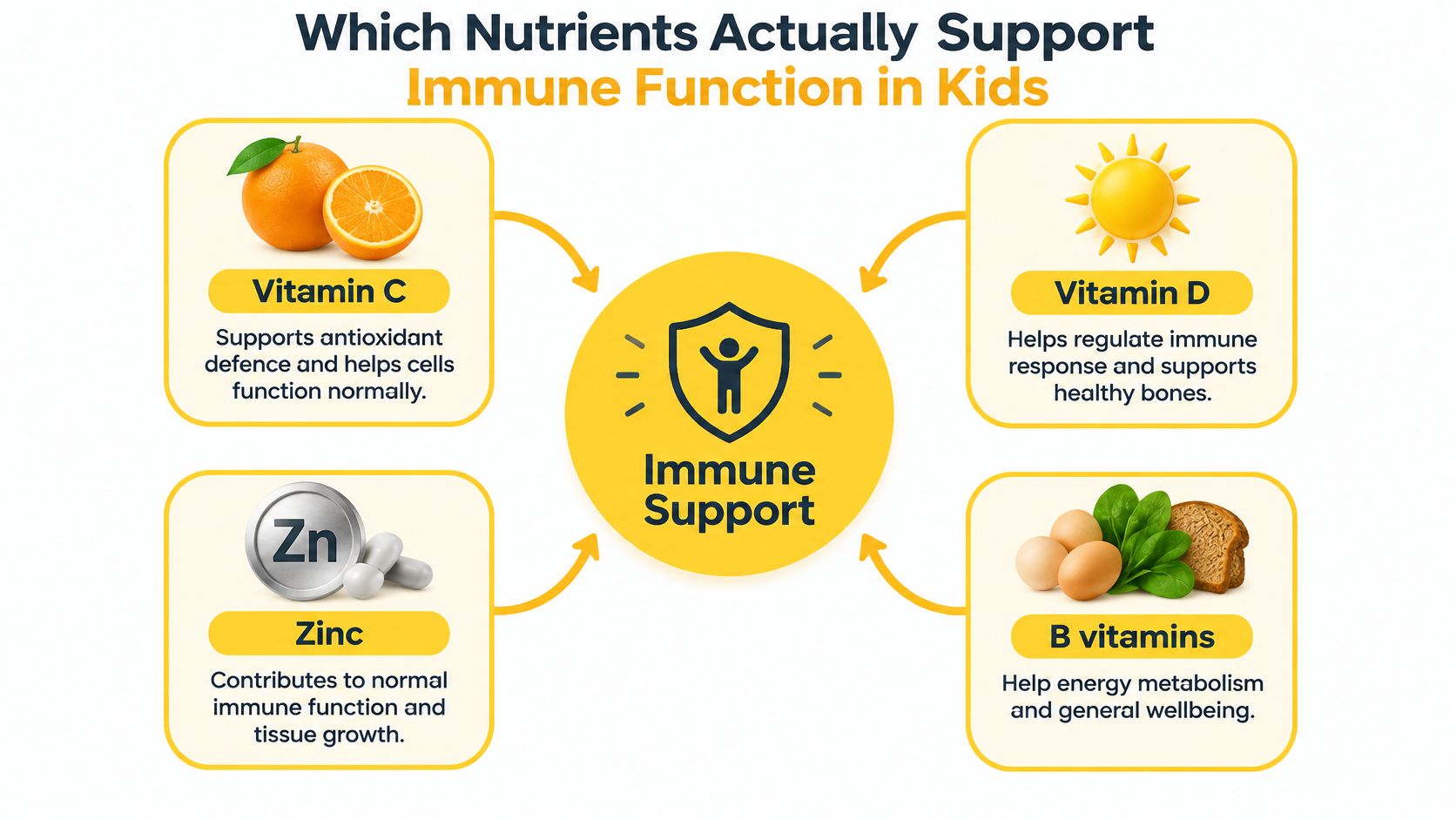
Zinc gives parents a useful benchmark
Australian reference values set zinc's estimated average requirement at 3 mg/day and recommended dietary intake at 4 mg/day for children aged 4–8, rising to an RDI of 6 mg/day for children aged 9–13; the government also notes that mild deficiency can impair immune responses in its zinc nutrient reference values.
An RDI is a total daily intake benchmark, not an instruction to supply that amount entirely through supplements. Food contributes too.
Look for elemental zinc per serving, not just the name of a zinc compound. If you can't tell how much zinc the child receives at the labelled dose, you can't make a meaningful comparison.
Use the guide to zinc supplements for kids to prepare specific questions about the label. More nutrients, or larger amounts, shouldn't receive extra credit unless they address an actual need.
How to Compare Kids Multivitamins for Immune Support
Turn the container around before reading the promises on the front. The active-ingredient panel should carry more weight than the marketing headline.
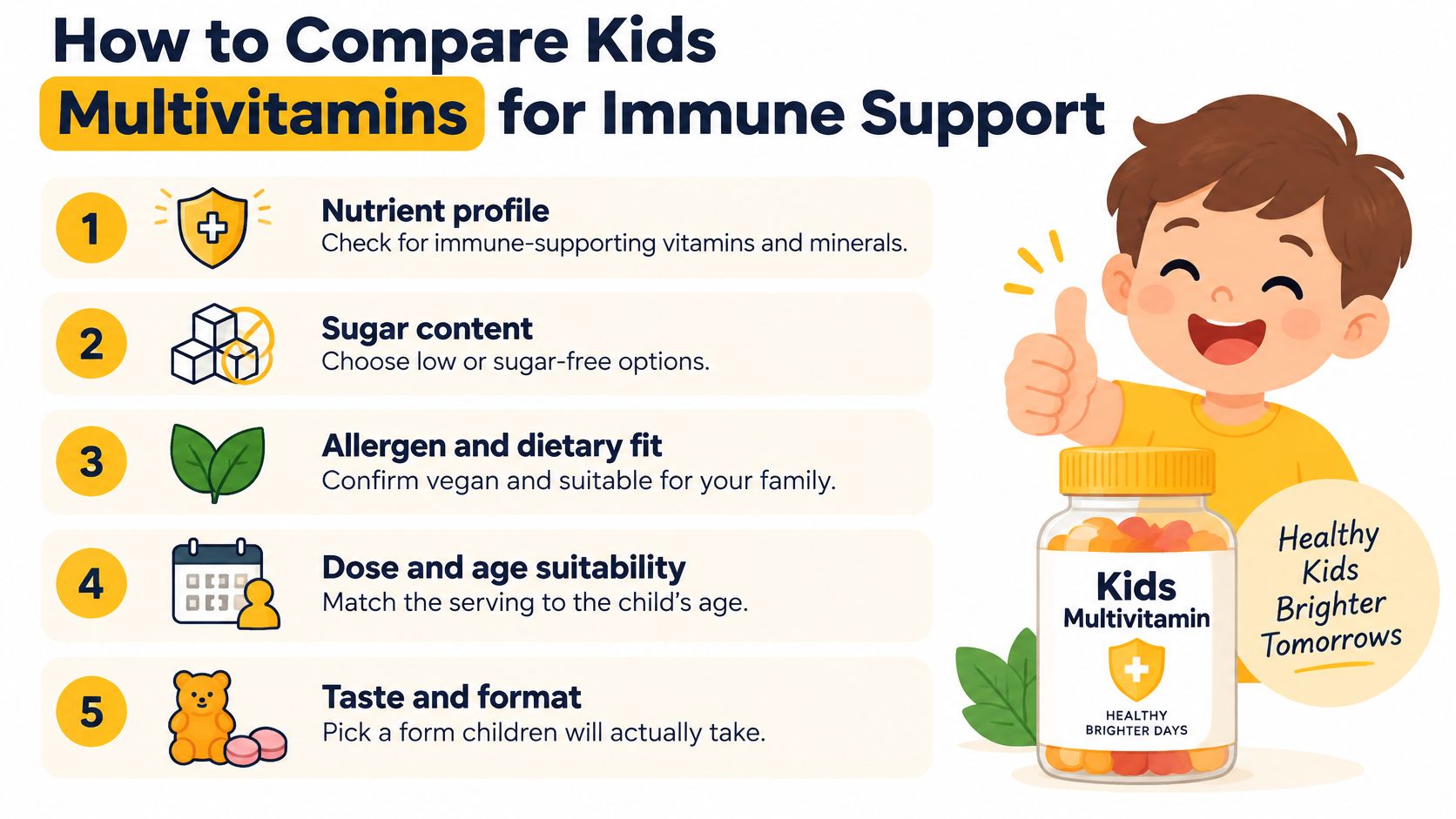
I'd assess products in this order: disclosed amounts, age-specific directions, dietary suitability, regulatory information and practical acceptance. Taste matters, but it shouldn't rescue a product whose dose you can't interpret.
Start with the non-negotiables
- Disclosed active amounts: Look for quantities at the recommended daily serving, with elemental mineral amounts clearly identified.
- Age-specific directions: The label should explicitly cover your child's age. Don't improvise a younger child's dose from an older child's instructions.
- Sugar and additives: Compare declared sugar content and check colours, flavours and other ingredients against your family's preferences.
- Dietary and allergen fit: Confirm vegan suitability separately from allergen declarations. Neither should be assumed from the product format.
- Regulatory identity: Find the Australian Register of Therapeutic Goods identifier where applicable, then understand what that status means.
This checklist is useful for narrowing the shelf, provided the full label remains your final reference.
Understand listed versus registered products
The Therapeutic Goods Administration explains that registered complementary medicines undergo pre-market evaluation of safety, quality and efficacy, while lower-risk listed products follow a different regulatory pathway and may carry lower-level claims, as outlined in its registered complementary medicines guidance.
Don't interpret an AUST number as proof that a product prevents infections. Similarly, a broad statement such as TGA approved shouldn't replace checking the actual identifier and claim wording.
For sugar and additives, be clear about what you're assessing. Choosing a sugar-free option may suit your household, but that choice doesn't demonstrate stronger immune benefits. An absence of artificial colours or flavours is also a formulation preference, not a substitute for appropriate nutrient amounts.
My ranking rule is simple: eliminate unclear dosing and unsuitable ingredients first. Only then compare flavour, format and convenience.
If essential information is missing online, ask the supplier for the complete label before ordering. Parents shouldn't have to buy a product to discover whether it suits their child.
Kids Multivitamin Options Side by Side
No format deserves an automatic win. A gummy, chewable tablet, liquid or powder must pass the same label checks, even if your child strongly prefers one.
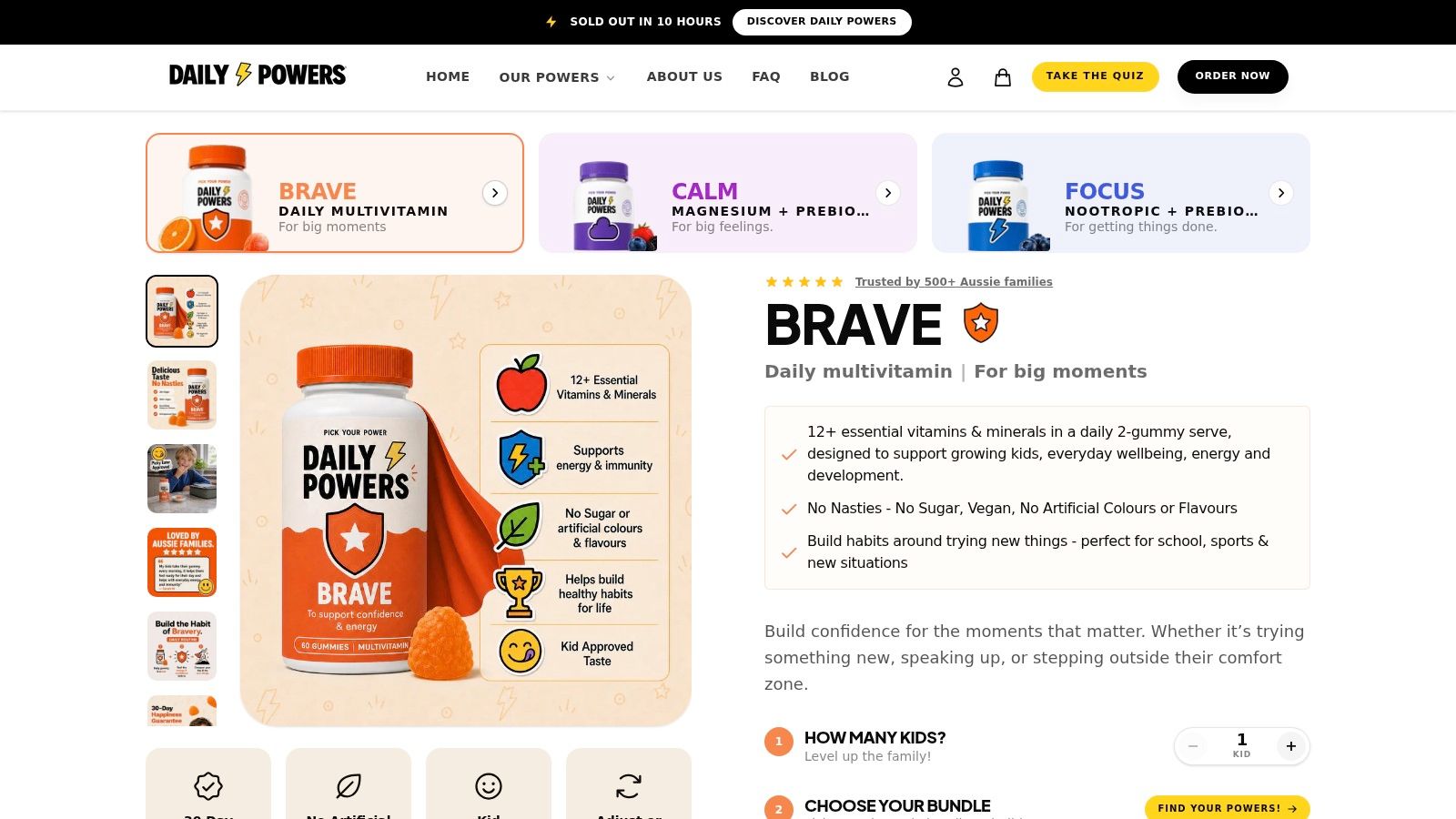
The product-page screenshot below illustrates the kind of online information parents should examine before purchasing.
Kids Multivitamin Formats Compared for Immune Support
| Format | Nutrient transparency | Sugar and additives | Age-appropriate dosing | Adherence and taste | Best suited to |
|---|---|---|---|---|---|
| Sugar-free vegan gummies | Require disclosed amounts just like other formats | Verify the sugar-free claim, sweeteners and complete ingredient list | Follow the labelled serving for the child's age | Consider whether your child accepts the flavour and texture | Families specifically seeking a sugar-free, vegan chew |
| Standard sweetened gummies | Don't infer completeness from appearance or flavour | Compare declared sugar and additives | Check directions rather than assuming all gummies use similar servings | Trial acceptance without presenting them as sweets | Families comfortable with the formulation after checking the label |
| Chewable tablets | Read the full panel rather than assuming higher potency is preferable | Check sweeteners, colours and flavouring ingredients | Confirm that the tablet and directions suit the child | Assess texture as well as flavour | Children who willingly take a chewable tablet |
| Liquid or powder multivitamins | Look for clear quantities at the stated serving | Check the full formulation, including flavouring ingredients | Use only the measurements and preparation directions provided | Consider taste and the practicality of preparation | Families who prefer a measured format and can follow its instructions consistently |
The comparison deliberately avoids awarding gummies an adherence advantage or tablets a nutrient-density advantage by default. Those are product-level questions, not conclusions you can safely draw from the category alone.
A liquid may offer different labelled serving sizes, but that doesn't give parents permission to adjust the dose freely. A powder mixed into food also needs clear preparation instructions, not guesswork.
Where a sugar-free vegan gummy fits
Brave is an orange-flavoured daily multivitamin gummy described by its supplier as vegan, sugar-free and made without artificial colours or flavours. Those are useful dietary and format details, but parents still need to inspect the current active amounts, age directions and regulatory identifier before deciding whether it fits.
Its positive daily ritual may appeal to families who want a predictable routine. That positioning shouldn't be interpreted as evidence that a vitamin creates confidence or prevents illness.
Disclosed doses beat long ingredient lists. A product you can assess is more useful than a product that simply sounds comprehensive.
The accompanying video offers another view of the product presentation. Use it for context, then return to the written label for the decision.
My preference is a format the child accepts after it meets the nutritional and safety criteria. If a child refuses the first option, reconsider the delivery format rather than increasing the dose, changing the directions or adding another product.
The best comparison isn't gummy versus tablet in the abstract. It's the complete label of the product you're considering versus your child's needs.
Which Multivitamin Suits Your Child's Situation
A family dealing with a narrow food repertoire needs a different conversation from a family seeking reassurance before school starts. Match the decision to the situation rather than buying the same product for every concern.
Picky eating and school transitions
For a child who repeatedly excludes food groups, write down the foods they reliably eat and bring that picture to a dietitian, GP or pharmacist. A multivitamin may provide nutritional back-up, but it shouldn't become a reason to stop working on dietary variety.
Verdict: Choose for the likely gap, not for the broadest list of benefits.
For a child starting school or childcare, separate the desire for a comforting routine from the nutritional decision. A new environment alone doesn't establish a need for extra vitamins, and an immune-support label isn't an infection-prevention plan.
Verdict: Keep the decision food-led unless there's a dietary concern to address.
For vegan or dairy-free households, formulation certainty comes first. Check the complete ingredients and relevant allergen statements rather than relying on a front-label dietary symbol.
Verdict: Confirm both nutritional suitability and dietary compatibility before comparing flavours.
When your child already takes other supplements
I'd slow the purchase down here. A product marketed for relaxation, energy or another purpose may still contain nutrients that overlap with a multivitamin.
For example, Calm lists vitamin B6 and zinc alongside magnesium and prebiotics. That makes the complete panel relevant when considering another supplement, regardless of the different product names.
- Collect every label: Include multivitamins, mineral gummies, cold remedies and relevant fortified foods.
- Record the actual daily serving: Don't confuse the amount per gummy with the amount per recommended serve.
- Match repeated nutrients: Ask a pharmacist to review the combined intake when ingredients overlap or mineral amounts are unclear.
The TGA warns that supplemental vitamin B6 can cause peripheral neuropathy, including at relatively low doses, with greater concern when people take multiple supplements; products providing more than 10 mg daily require a warning, but that threshold isn't a child-safe dosing target, as explained in the TGA vitamin B6 safety update.
If a child develops tingling, burning or numbness, stop the suspected supplement and seek medical advice. Don't dismiss those symptoms because the product is sold as a vitamin.
Verdict: Have the combined regimen checked before adding another product.
Ordering and Subscription Considerations for Families
Make the first order a suitability check, not a commitment to an indefinite routine. Before paying, save the current ingredient panel, directions and any advice you've received.
Check that the information you read applies to the exact product you're ordering. If the website displays only a benefits summary, request the missing details rather than assuming the packaging will resolve everything later.
Build a low-risk first order
- Read the full label online: Confirm that you can understand the serving instructions without relying on promotional copy.
- Check the trial conditions: Read any satisfaction guarantee, including the timeframe, eligibility and process for requesting help.
- Assess delivery arrangements: Check shipping information for your location and leave room for delivery variability.
- Keep an order record: Save the confirmation and current directions so another caregiver can follow the same plan.
Customer reviews can help you anticipate reactions to flavour or texture. They can't tell you whether a formulation meets your child's nutritional needs, and positive comments aren't evidence of immune protection.
A guarantee can reduce the financial risk of trying a flavour your child might reject. It doesn't reduce the need to assess safety and suitability before the trial.
Subscribe only after the product fits
A subscription is useful when you've already decided the product belongs in your child's routine. Look for pause, skip and cancel options, clear renewal information and an accessible customer account.
The supplement subscription guide is a useful place to organise those purchasing questions. Check the current terms rather than assuming flexibility from the word subscription.
Ordering advice: Don't let automated delivery become automated decision-making. Reassess the order when your child's diet, medicines or supplement routine changes.
I'd start with an order small enough to assess acceptance without unnecessary surplus. Set a reminder to review the routine before any renewal, and pause deliveries if the product is no longer needed.
Convenience should make an appropriate decision easier to maintain. It shouldn't make an unsuitable purchase harder to stop.
Our Recommendation for Australian Families
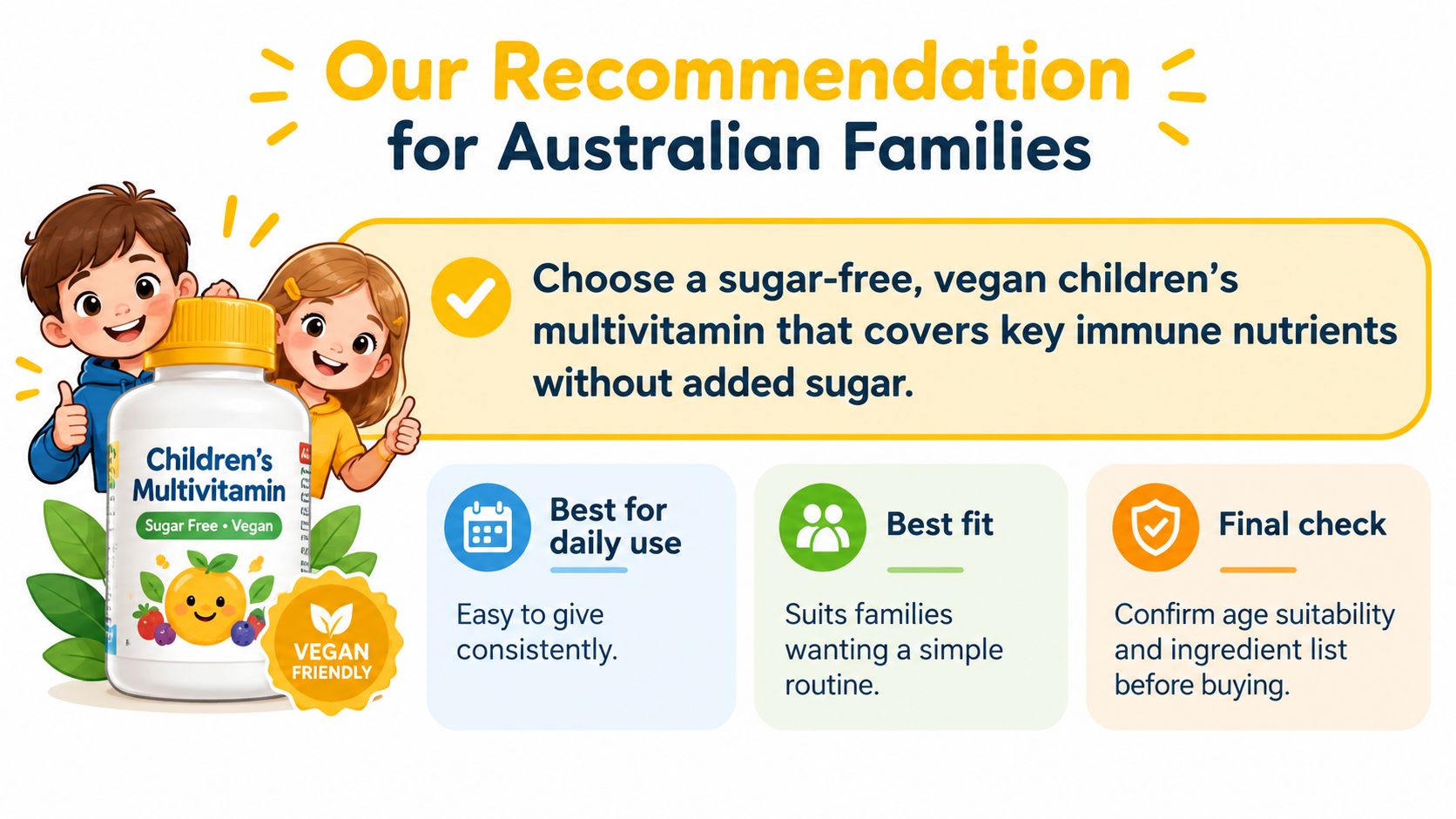
Choose the most transparent, age-appropriate formulation that addresses your child's actual dietary needs. For families specifically seeking a vegan, sugar-free option, that category is a sensible shortlist, provided the complete label passes the checks above.
I wouldn't declare a universal winner from flavour, format or an ingredient list alone. Without comparable active amounts, age directions and regulatory identifiers, a strongest-product claim would go further than the evidence allows.
What I would prioritise
- Nutritional purpose: You can explain what the supplement is intended to back up in your child's diet.
- Assessable formulation: You can identify the active amounts and follow directions that explicitly cover your child.
- Household suitability: The dietary declarations, texture and preparation requirements fit your family.
- A checked routine: You've considered other products rather than evaluating the multivitamin in isolation.
The summary below offers a purchasing prompt, not a recommendation that every child should take a daily supplement.
Know when to take the question to a professional
Book a GP review rather than relying on a general multivitamin when there's a suspected deficiency, persistent symptoms or a medical condition affecting nutrition. Seek a pharmacist's input when medicines or multiple supplements complicate the decision.
Bring the labels and a realistic account of your child's diet. Specific information gives the professional something useful to assess, rather than leaving you with another generic product suggestion.
If you're searching for the best multivitamin to support immune system health, the most useful answer isn't the highest potency or the longest panel. It's the product whose purpose, dose and suitability you can justify for your child, including the possibility that no supplement is needed.
My recommendation is to make one concrete move before buying: open the full ingredient panel and age directions, then compare them with the rest of your child's routine. If anything remains unclear, send the label to your pharmacist or discuss it with your GP before starting.
Daily Powers offers children's gummy supplements designed around simple daily routines, including a multivitamin option. Visit Daily Powers to review the full ingredients and dosing guidance, then check whether the formulation fits your child's diet and existing supplements before ordering.