

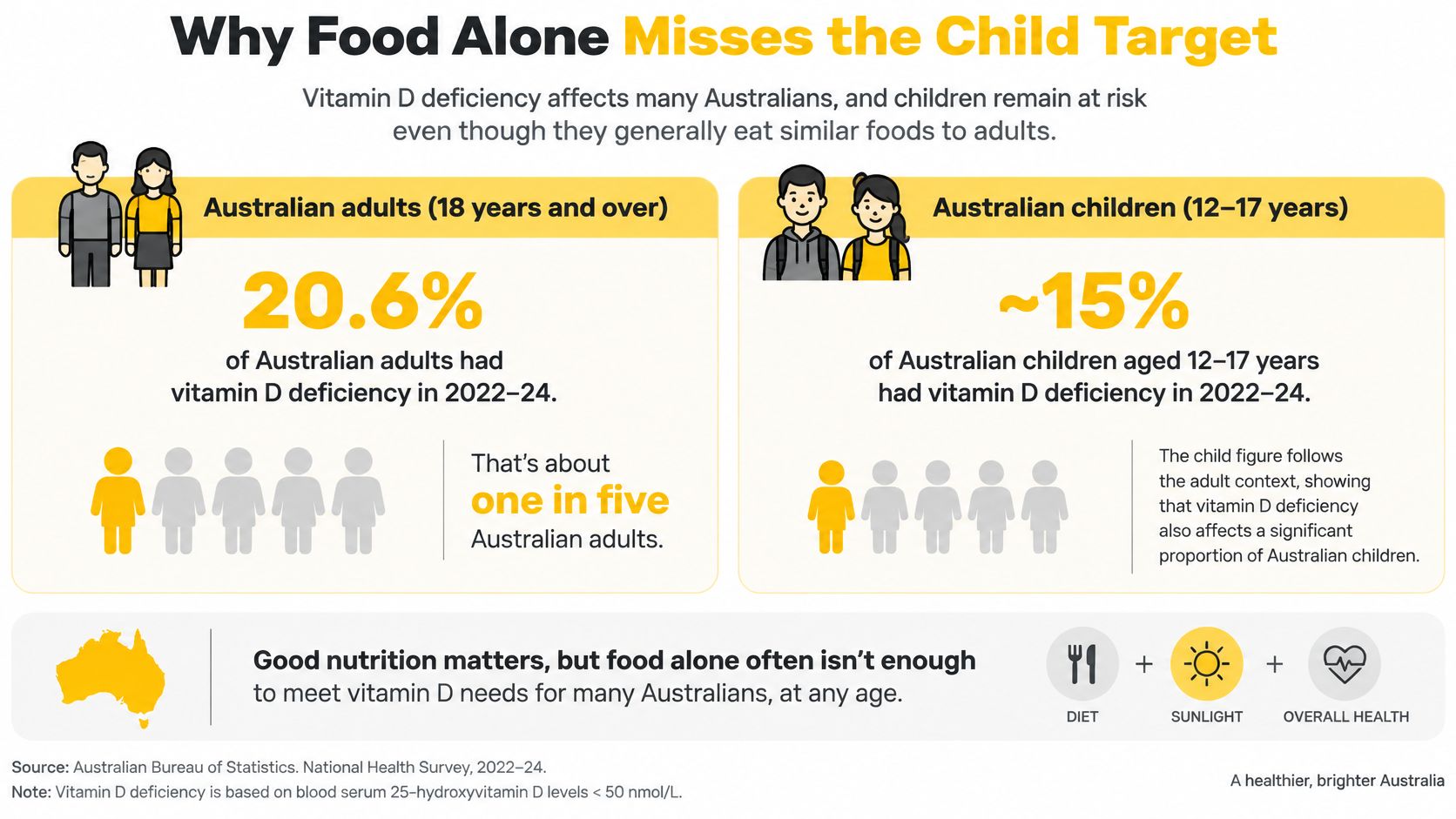
About one in five Australian adults is the figure that should change how you shop for a child. The Australian Bureau of Statistics reported that 20.6% of adults aged 18 years and over had vitamin D deficiency in the 2022–24 National Health Measures Survey. Earlier ABS data from 2011–12 found that around 15% of Australian children aged 12–17 were deficient, 15% of boys and 16% of girls. That earlier survey recorded 14% deficient in summer compared with 36% in winter, and 49% of people in Victoria and the Australian Capital Territory deficient in winter, compared with 16% and 13% in summer. The ABS also reported that 35.9% of dietary vitamin D in 2023 came from cereal-based mixed dishes, eggs, poultry and feathered game, and Australian authorities note there is no estimated average requirement for vitamin D from food and beverages because sunlight is the principal source.
A neat breakfast can still add almost no vitamin D. What to eat for vitamin D is a portion and a label question, not a superfood list, and food alone doesn't fix a deficiency.
Table of Contents
- Why Food Alone Misses the Child Target
- Foods That Actually Supply Vitamin D
- How to Read Fortified Food Labels
- Sunlight in Australia Beside the Plate
- Meals and Snacks Children Will Actually Eat
- Decide Whether Food Is Enough or Add a Supplement
Why Food Alone Misses the Child Target
That adult result, about one in five, is the backdrop. Teenagers aren't far from it, and winter pulls the rate up sharply in the southern states. A child who looks well fed in July can still sit in the group that tests low, because the meal and the season are doing different jobs.
Australian children and teenagers have a recommended dietary intake of 5 micrograms a day. Read that as a food target, not a promise the plate can hit it. There is no estimated average requirement from food and drink for a reason. Ultraviolet light on skin makes most of the vitamin D a body uses, so a diet score can't stand in for a blood result. Food is a contribution you can steer. It isn't a guarantee.
Ordinary dinners already do more of the work than a special ingredient. More than a third of the vitamin D Australians ate in 2023 came from cereal-based mixed dishes, eggs, poultry and feathered game. A pasta bake, an omelette or roast chicken leg is the pattern, not a rare fillet kept for guests.
Three situations need a clinician, not a bigger shopping list. Darker skin makes less vitamin D from the same time outside. Little time outdoors, long indoor days, or covering up for school and culture lowers the skin's output. Absorption problems, including some gut conditions, mean even a careful menu may not show up in the blood.
Practical rule: Treat the 5 microgram guide as a way to judge serves, then ask for individual medical advice if deficiency, limited sun, darker skin or poor absorption is already on your mind.
If you want a quick sense of the rest of the day's nutrients while you sort vitamin D, the kids' nutrient calculator is a calm place to start. Next, match foods your household already buys against that 5 microgram day.
Foods That Actually Supply Vitamin D
| Food | Vitamin D per 100 g | Against a 5 µg child day | Practical catch |
|---|---|---|---|
| UV-exposed mushrooms | 24.18 µg | About five times the guide | Must be the UV-exposed kind |
| Anchovies | 12.38 µg | More than double | Strong taste; small serves still count |
| Margarine | 12.09 µg | More than double at 100 g | Fortification is mandated; a spread is a thin serve |
| Chicken | 6.90 µg | Slightly over if 100 g is eaten | Not the same as lean breast |
| Salmon | 6.21 µg | Slightly over one day at 100 g | Best-known oily-fish option |
| Eggs | 5.78 µg | Near the guide only at 100 g | One egg is far less than 100 g |
| Dark chocolate | 3.20 µg | A partial extra | Not a children's staple |
Healthdirect sets the recommended dietary intake for Australian children and teenagers at 5 micrograms (µg) a day, and explains that getting enough from food alone is difficult because relatively few foods contain substantial amounts. The rows above are the short list that moves the number. Read every row against the weight in front of you, not against the 100 gram column.
Scale the column to the serve
UV-exposed mushrooms lead the table at 24.18 µg per 100 grams, about five times the child guide. Ordinary button mushrooms that never saw UV light are not this row. If your child eats 50 grams, take half the column, still a large share of the day.
Anchovies sit at 12.38 µg per 100 grams, more than double the guide at that weight. Few children eat 100 grams. A few fillets on toast still count, because the concentration is high. Offer them to older children who already like the taste.
Margarine is listed at 12.09 µg per 100 grams. In Australia, vitamin D fortification is mandated for all margarine, so a scrape is a predictable top-up. A scrape is not 100 grams. Check the label for the amount added, then judge the knife smear your child eats.
Chicken at 6.90 µg per 100 grams looks slightly over the guide only if that whole 100 grams is eaten. This is not a grilled breast. Vitamin D shows up in chicken leg and in some pork, beef and lamb, and not consistently in lean cuts such as chicken breast. Choose the leg or thigh if chicken is your vitamin D food.
Salmon at 6.21 µg per 100 grams is slightly over one child day at that full weight, which is why oily fish is the best-known option. A small child's piece is often closer to half of that. Halve the column, and you are looking at a useful serve, not a finished day.
Eggs at 5.78 µg per 100 grams match the guide only if someone ate the whole 100 gram reference. One egg is far less than 100 grams, so one boiled egg is a slice of the target, not the target.
Dark chocolate at 3.20 µg per 100 grams is only a partial extra, and it isn't a children's staple. Don't build the day around it.
Weigh the serve the child eats, divide by 100, and multiply by the table. A half serve is half the micrograms.
Portion size and cooking both change what lands on the plate. Sunlight remains the main natural source, so these foods are one part of the strategy. Circle two foods your household already eats, then score a real child's portion, not the 100 gram column.
How to Read Fortified Food Labels
Front-of-pack sunshine slogans don't tell you the dose. Four checks do, and they take less time than arguing over cereal in the aisle.
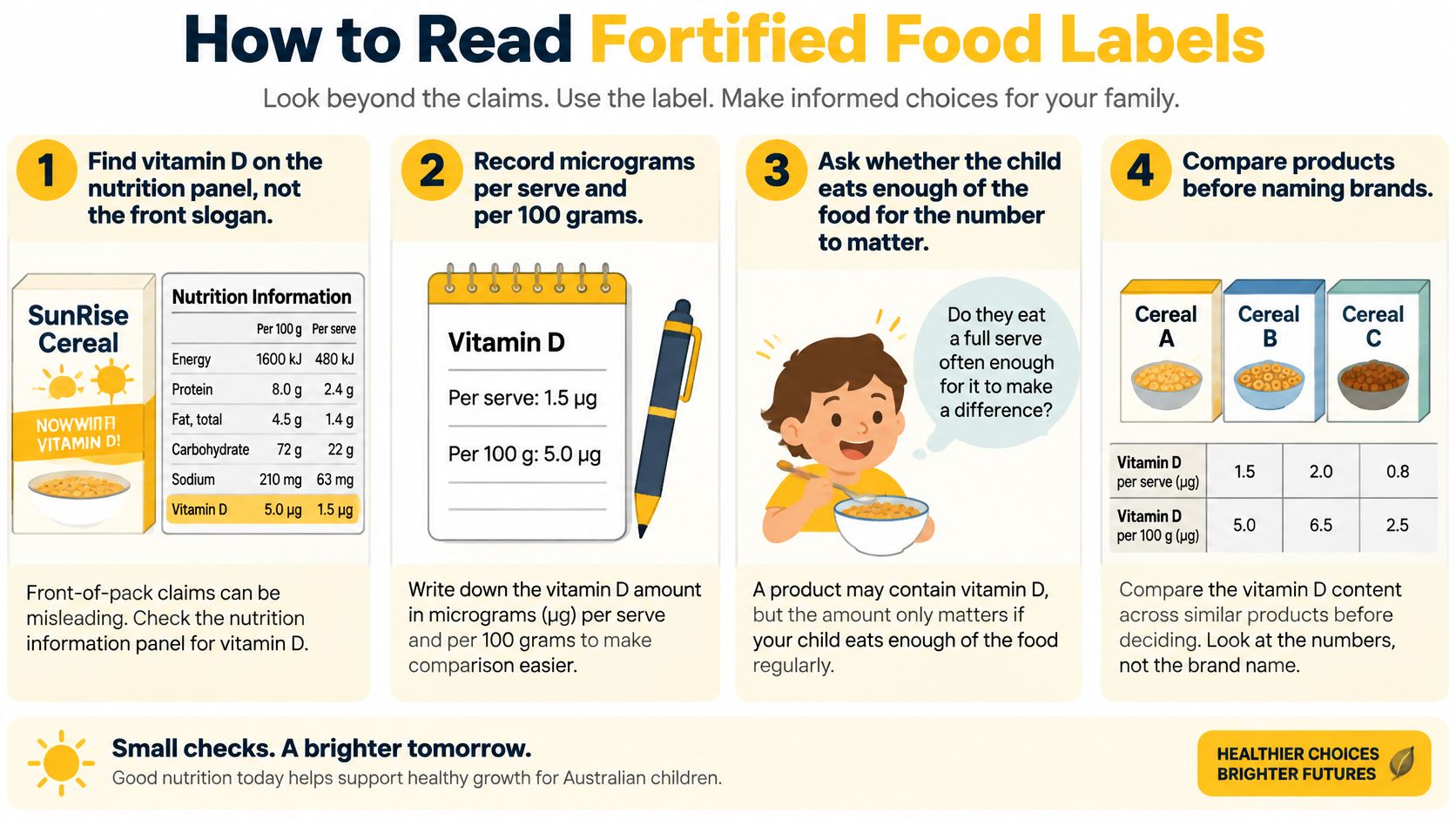
- Find the line, not the slogan. Look for vitamin D on the nutrition information panel. If the word isn't there, treat the food as adding none.
- Write down two numbers. Record micrograms per serve and per 100 grams. A per-100-gram figure looks generous when the serve is small.
- Ask what your child finishes. The maths only counts the amount that gets eaten. A half bowl is half the listed serve.
- Compare two products before you care about the brand name. Same shelf, same habit, different panel. Pick the one that lists vitamin D and still fits the rest of the diet.
FSANZ identifies a split you can use at the shelf. Vitamin D fortification is mandatory for edible oil spreads such as margarine, and generally voluntary for other foods. A plant-based milk, a yoghurt or a cereal should not be assumed to contain vitamin D unless the label lists it. Vitamin D2 is associated with fungi and yeast. Vitamin D3 is found in animal-derived foods and is the form made in skin. A vegan pattern therefore leans on UV-exposed mushrooms plus products that list vitamin D.
What the numbers on fortified foods mean
| Product | Vitamin D figure | Per what | How to use it |
|---|---|---|---|
| Vitamin-D-fortified ready-to-eat cereal | 12.03 µg | 100 g | A bowl is less than 100 g; read the serve |
| Fortified plant-based milk substitute | 1.74 µg | 100 g | Only if the panel lists vitamin D |
| Fortified children's dairy dessert or yoghurt | 1.1 µg | 100 g | A small top-up, not a day's worth |
| Proposed cereal claim maximum | 2.5 µg | One normal serve | 25% of the 10 µg regulatory RDI |
The Australian food-composition dataset reports about 12.03 micrograms of vitamin D equivalents per 100 g for vitamin-D-fortified ready-to-eat breakfast cereal, about 1.74 micrograms per 100 g for fortified plant-based milk substitutes, and 1.1 micrograms per 100 g for fortified children's dairy dessert or yoghurt. Among tested foods, canned salmon had the greatest measured concentration of vitamin D3, and eggs had the greatest concentration of 25-hydroxyvitamin D3. Cooking effects were inconsistent, so use the label and the Australian Food Composition Database rather than a raw-food guess.
A proposed maximum claim for breakfast cereal is 2.5 micrograms per normal serve, 25% of the 10 microgram regulatory RDI used for claims. That 10 microgram claim benchmark is not the 5 microgram intake guide for children. A bowl is a modest contributor. FSANZ modelling also found that brand loyalty and children's cereal choices could shrink the benefit of fortification across the population.
An unfortified "healthy" breakfast can add almost nothing. The same cereal and the same plant drink, once both panels list vitamin D, become the useful version of that breakfast. Swap the pair, not the routine.
This short clip walks through why the panel matters more than the front of the box.
Sunlight in Australia Beside the Plate
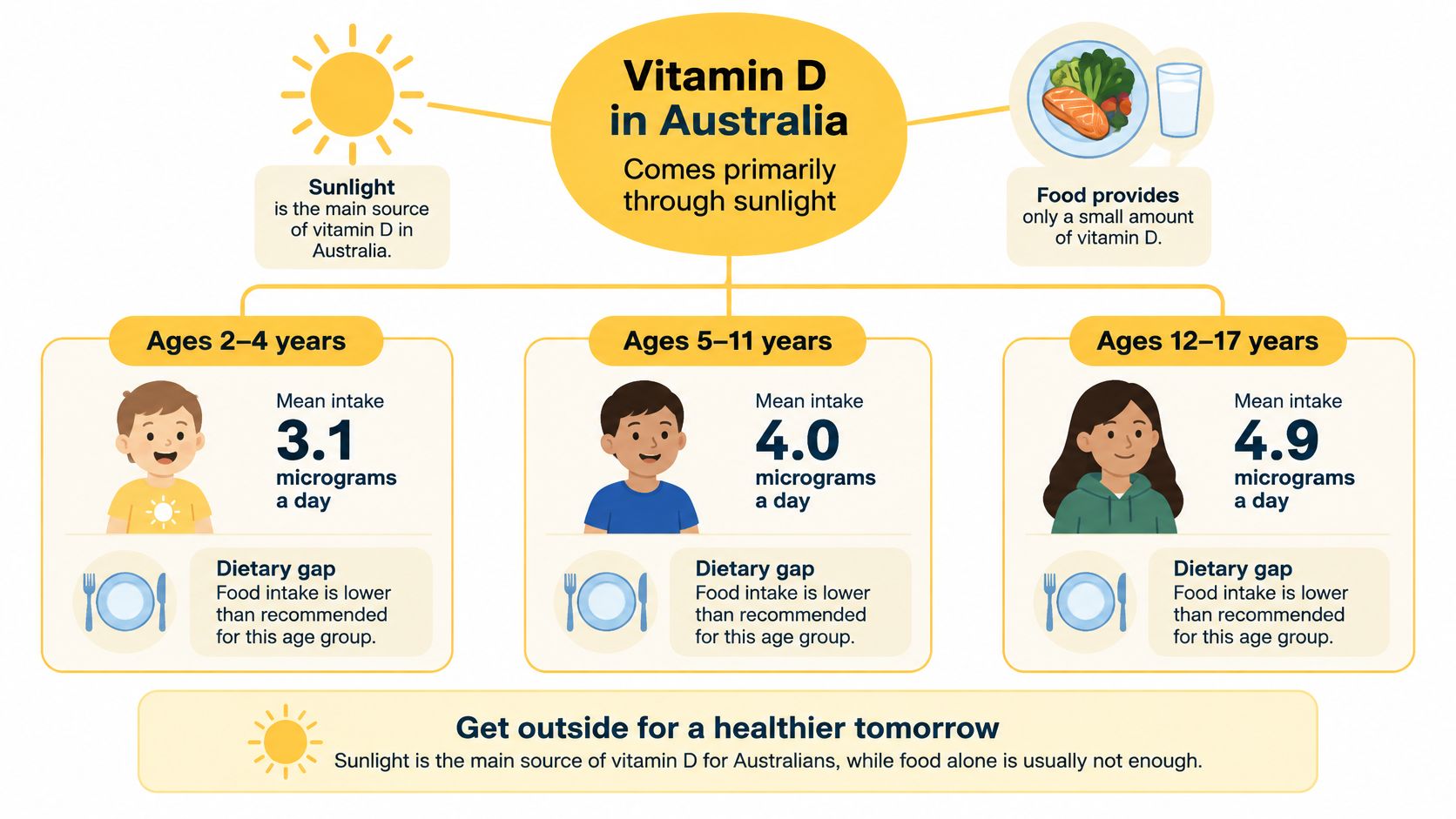
Think of skin as the solar panel and the plate as the spare battery. In Australia the panel does most of the charging. Food tops up the battery when cloud, clothing, winter or indoor days cover the panel. The spare battery is real. It is also small.
The Australian Bureau of Statistics food and nutrients release reported mean dietary vitamin D intakes of 3.1 micrograms a day for ages 2–4, 4.0 micrograms for ages 5–11, and 4.9 micrograms for ages 12–17. Each of those averages sits under a single day's intake guide. A colourful lunchbox is not proof of enough vitamin D.
When the panel produces less
Picture a Melbourne school week in July. Your child leaves in a hoodie, sits inside until recess, plays soccer in long sleeves, and comes home as the light drops. Southern winter, indoor sport and cultural or medical covering all cut what the skin can make. Darker skin can yield less vitamin D from the same outdoor time, so two children in the same playground aren't on the same clock.
Short everyday time outside still belongs with slip, slop, slap. Burning is not a vitamin plan, and this isn't a tanning timetable. You want ordinary daylight without a sunburn.
Nutrient reporting has no estimated average requirement from food because ultraviolet-B dominates. Stacking extra salmon doesn't replace a clinical check when something already looks wrong. Vitamin D3 and related metabolites from food do add to circulating status. They just can't be judged as if the child lived indoors in the dark.
On the plate, the best contributors are fatty fish, eggs and fortified foods. Pair a fish serve with a fortified food when you can, and keep food as one part of care.
Household check, three lines:
- Season: Are you in the months when deficiency climbs, especially in Victoria, Tasmania or the ACT?
- School-day outside time: Minutes in the open air, not time spent in a hall.
- This week's plate: Is there any high-vitamin-D food, or only an unfortified breakfast habit?
Meals and Snacks Children Will Actually Eat
Weeknights fail when the plan needs a new skill. These builds use foods you can already defend at the table, in amounts a child will finish.
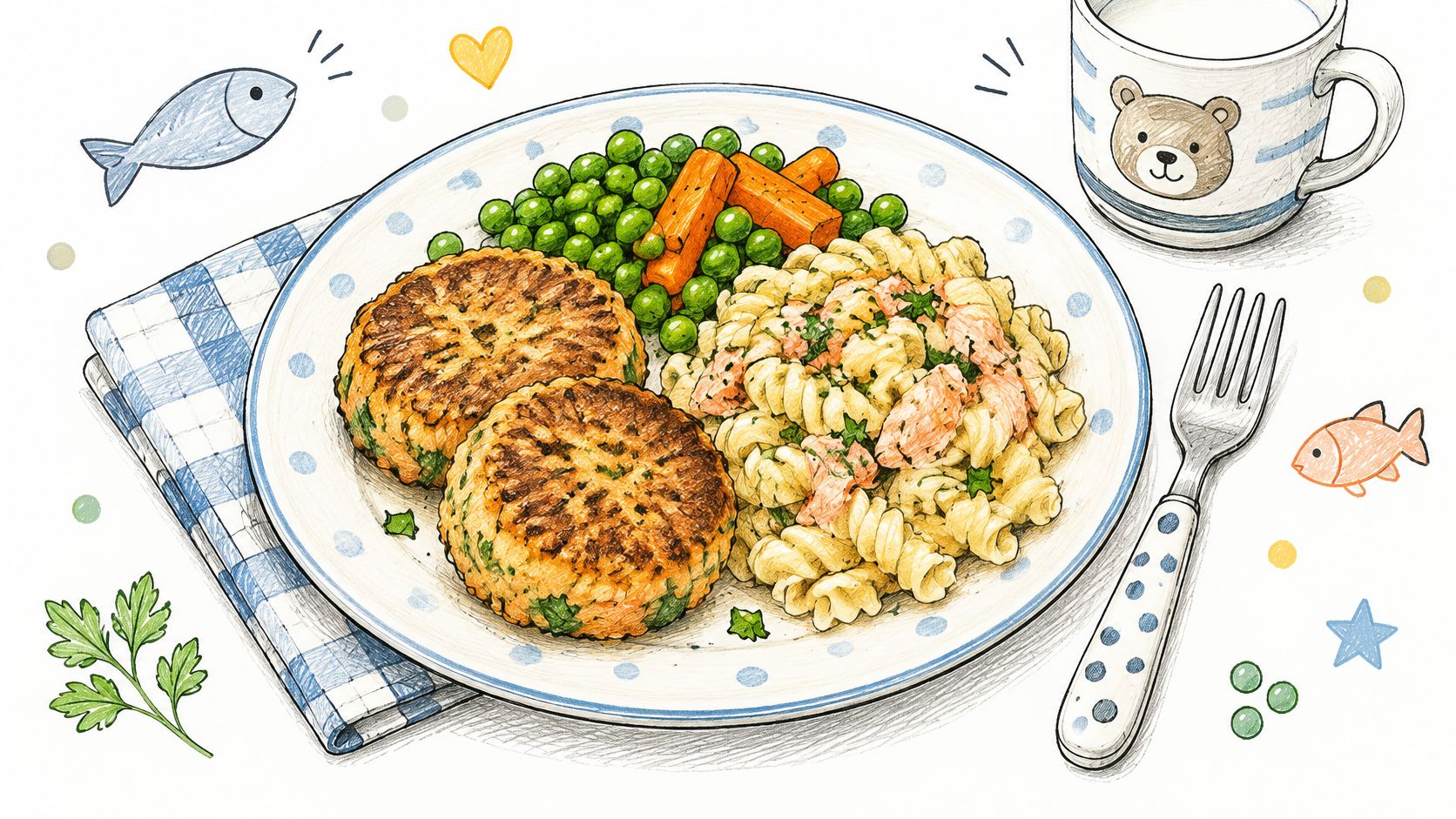
Salmon fishcakes, or salmon through pasta. Flake a small tin into mashed potato, or stir it through pasta with peas. Use a child portion of oily fish, not a 100 gram adult fillet. The point is a piece they recognise, twice in the week if they'll take it.
Egg muffins or egg soldiers. Bake beaten egg in a muffin tin with a little grated vegetable, or serve a boiled egg with toast strips. One egg is only a slice of the egg reference amount, so this is a regular contributor, not the whole day. It still counts because it gets eaten.
Mushrooms on toast. Fry UV-exposed mushrooms and add a scrape of fortified margarine. That plate also suits many dairy-free eaters. The mushrooms have to be the UV-treated kind. Check the punnet.
Cereal measured to the packet serve. Pour the serve written on the box, not a overflowing bowl you later call "one serve". Use cow's milk or a plant drink only when vitamin D is on that drink's panel. If it isn't listed, the drink isn't doing this job.
Snacks and the vegan swap
Anchovy spread on crackers works for older children who like the taste. A little goes further than a sweet biscuit that only looks like a treat.
Yoghurt or a children's dairy dessert counts only if the tub lists vitamin D. An unlabelled tub is a calcium habit, not a vitamin D habit.
For a vegan week, drop fish, eggs and dairy in one move. Keep the UV-exposed mushrooms, and pair them with a cereal and a plant drink that both list vitamin D. If either panel is blank, that breakfast has stepped out of the plan.
Cooking doesn't give you a tidy bonus you can guess. Trust the packet over a memory of the raw ingredient.
Rotate so one food isn't carrying Friday as well as Monday. Fish early in the week, eggs midweek, mushrooms before the weekend. The fussiest eater only needs one of these to stick.
If lunchboxes are the true challenge, these lunch ideas for picky eaters keep the same practical tone. Pick the single build the fussiest child will eat this week, and repeat it until it feels normal.
Decide Whether Food Is Enough or Add a Supplement
Start with a decision, not a bottle.
Count the vitamin D foods you genuinely circled. Note the season and the genuine minutes outside on a school day. Set that picture beside the intake guide for children and teenagers. You are asking whether the plate is doing steady work, not whether one impressive meal cancels a month indoors.
Keep the food pattern when meals regularly include oily fish or UV-exposed mushrooms, plus eggs or a fortified spread, and outdoor time is steady. Recheck when winter arrives, because the same menu meets a weaker sun.
Book a GP or a child health nurse when the plate is short, outdoor time is limited, or someone has already flagged low vitamin D. Don't guess a high dose from an adult product in the cupboard. High-dose courses belong with the clinician who ordered a test. Too much vitamin D is a supplement problem, not a salmon problem, because excess isn't something you cook your way into with ordinary serves.
The only conversion you need
1 microgram equals 40 IU, so 5 micrograms is 200 IU. Use that so a label in IU and a label in micrograms describe the same serve. Follow the age dose printed on a children's product. Don't split an adult capsule to "make it smaller". The 10 microgram figure used on some claim labels is a labelling benchmark, not a reason to double a child's food guide.
Take four questions to the appointment.
- What the child eats: Name the two vitamin D foods and the serves, including whether breakfast is fortified.
- Winter sun: Minutes outside on a school day, and whether clothing covers most of the skin.
- Whether a blood test helps: Let the GP decide. You don't order one to justify a product.
- Which labelled dose fits their age: Ask them to match a product to the child, especially if allergies, a medical condition or other medicines are in the picture.
We recommend speaking with a GP or healthcare professional before starting any new supplement, especially for children with allergies, a medical condition or on other medications. For ages 4 to 15, our serve guide is 2 gummies daily, or as a healthcare professional advises.
Only after that checkpoint, if the GP agrees a daily vitamin suits, Brave provides 5 micrograms (200 IU) of vitamin D3 in a 2-gummy serve alongside other vitamins. Check the label for the age range and the ingredient list. A wider look at how a children's multi fits beside food is in this guide to a multivitamin with vitamin D.
Today, write two vitamin D foods already in the trolley and one question for the GP. That list is the whole plan until someone who knows your child says otherwise.
Daily Powers makes vegan, sugar-free gummies for Australian children, with no artificial colours or flavours, so a daily habit can sit beside real food rather than replace it. If vitamin D is the gap you're weighing, start with the plate and a GP, then see how a simple routine fits your child. Visit Daily Powers to read the labels, the doses and the age guidance before you decide.