

The lunchbox is still open on the bench, the school run is twenty minutes away, and you're comparing three tabs. One is fish oil. One is a mushroom gummy that talks about homework. The third is an overseas sleep listing a relative forwarded after the teacher mentioned focus. That search is what most families mean by brain supplements Australia, and it is easy to treat every bottle as the same kind of help.
They aren't. A gummy can cover a named nutrient gap, or it can sit inside a daily habit. It can't stand in for meals, sleep, learning support, or a GP.
Table of Contents
- What Caregivers Mean by Brain Supplements
- Brain Supplement Types Parents Can Compare
- Diet Gaps Versus Real Nutrient Shortfalls
- How to Read Evidence and an AUST Number
- Safety Checks for Children and Imports
- Which Situation Fits Focus Calm or Food First
- Choose a Routine Then Confirm with Your GP
What Caregivers Mean by Brain Supplements
Say it's a Tuesday and the note from school is still on the fridge. Your child isn't "bad at learning". Mornings are rushed, vegetables come back untouched, and bedtime runs long. You want something legal to buy in Australia, sensible for a child, and worth a routine rather than a one-off try.
That decision sits in a crowded aisle. In 2023, 33.6% of Australians aged 2 years and over, about 8.5 million people, used a dietary supplement, according to Ken Research citing Australian Bureau of Statistics data. Vitamins are ordinary household items now. Ordinary doesn't mean every jar is right for a child, or that a focus claim and a deficiency claim are the same promise.
What belongs in the term
Keep the phrase tight.
- Vitamins, minerals and omega-3s: nutrients with a job you can name, such as iron when a test shows a shortfall, or EPA and DHA from fish oil.
- Listed complementary medicines: products on the Australian Register of Therapeutic Goods with an AUST number and claims the sponsor must be able to support.
- Not prescription ADHD treatment: a gummy is not a medicine plan for a diagnosed condition, and it doesn't replace classroom adjustments.
Hold three facts while you compare bottles: your child's age, any other medicines, and whether a clinician has already found a named deficiency. Sort the types first, then separate a vegetable gap from a real micronutrient shortfall, read the evidence and the AUST number, check child and import safety, match one situation, and only then choose a subscription or a single bottle.
Brain Supplement Types Parents Can Compare
| Type | Typical ingredients | Evidence for cognition | Usual TGA status | Child safety caution |
|---|---|---|---|---|
| Omega-3 | EPA and DHA from fish oil | Modest support in some low-intake or specific groups, not a universal booster | Often AUST L listed medicine | Match age dose; fish allergy; soft gels are a choking risk under five |
| Iron | Elemental iron | Helps thinking mainly when iron deficiency is confirmed | Listed or pharmacy medicine | Do not self-dose; excess is harmful |
| Iodine | Iodine | Supports thyroid-related development if intake is low | Listed mineral if claims are made | Excess risk; check overlap with multivitamins and fortified food |
| Children's multivitamin | B vitamins, zinc, vitamin D and other micronutrients | Replaces shortfalls; not proven as a nootropic when intake is already adequate | AUST L if listed; claims limited to deficiency support | Use the age-specific serve; a second multi on top is double dosing, not extra focus |
| Magnesium | Magnesium salts such as citrate or glycinate | Mixed evidence for relaxation; not a focus medicine | Listed mineral | Age-specific dose; high doses can cause diarrhoea |
| Herbal or mushroom nootropic | Bacopa, ginkgo or mushroom polysaccharides | Mostly adult studies; child evidence is thin | Sponsor must hold age-matched evidence | Avoid adult doses and stacks; check interactions |
| Imported melatonin or brain gummy | Melatonin or undisclosed blends | Not evaluated for general paediatric focus or sleep | Often not on the ARTG; personal import cannot be resold | Melatonin is prescription-only; do not use for ordinary bedtime trouble |
Mark one row. A stack of iron, herbs and a sleep gummy is how families overshoot a simple problem.
Three differences the label won't spell out
Iron is not a thinking booster for a child whose stores are already fine. It helps cognition mainly when deficiency is confirmed. Extra iron is harmful, so a tired afternoon is not a reason to pick a high-dose bottle off the shelf.
A children's multivitamin is nutrient insurance, not a focus drug. If intake of a vitamin is already adequate, adding more doesn't turn homework into a different subject. Compare the elemental mineral, the amount of iron or magnesium the body can use, not the heavier weight of the whole compound, and count how many gummies make one daily serve.
Melatonin is not a general kids' sleep gummy in Australia. Ordinary bedtime friction is a routine problem. A product that hides the amount per gummy, or that you found on an overseas site, doesn't belong in the same basket as a listed mineral. Soft gels are a choking risk under five, so supervise and follow the age cut-off. If you're weighing fish oil, read how DHA fits a child's diet before you treat a capsule as a grade-changer. Then take one candidate type into the next decision, not three bottles.
Diet Gaps Versus Real Nutrient Shortfalls
A child who won't eat vegetables is not automatically low in every brain vitamin. That mix-up sends families toward a focus blend when the true job is the plate.
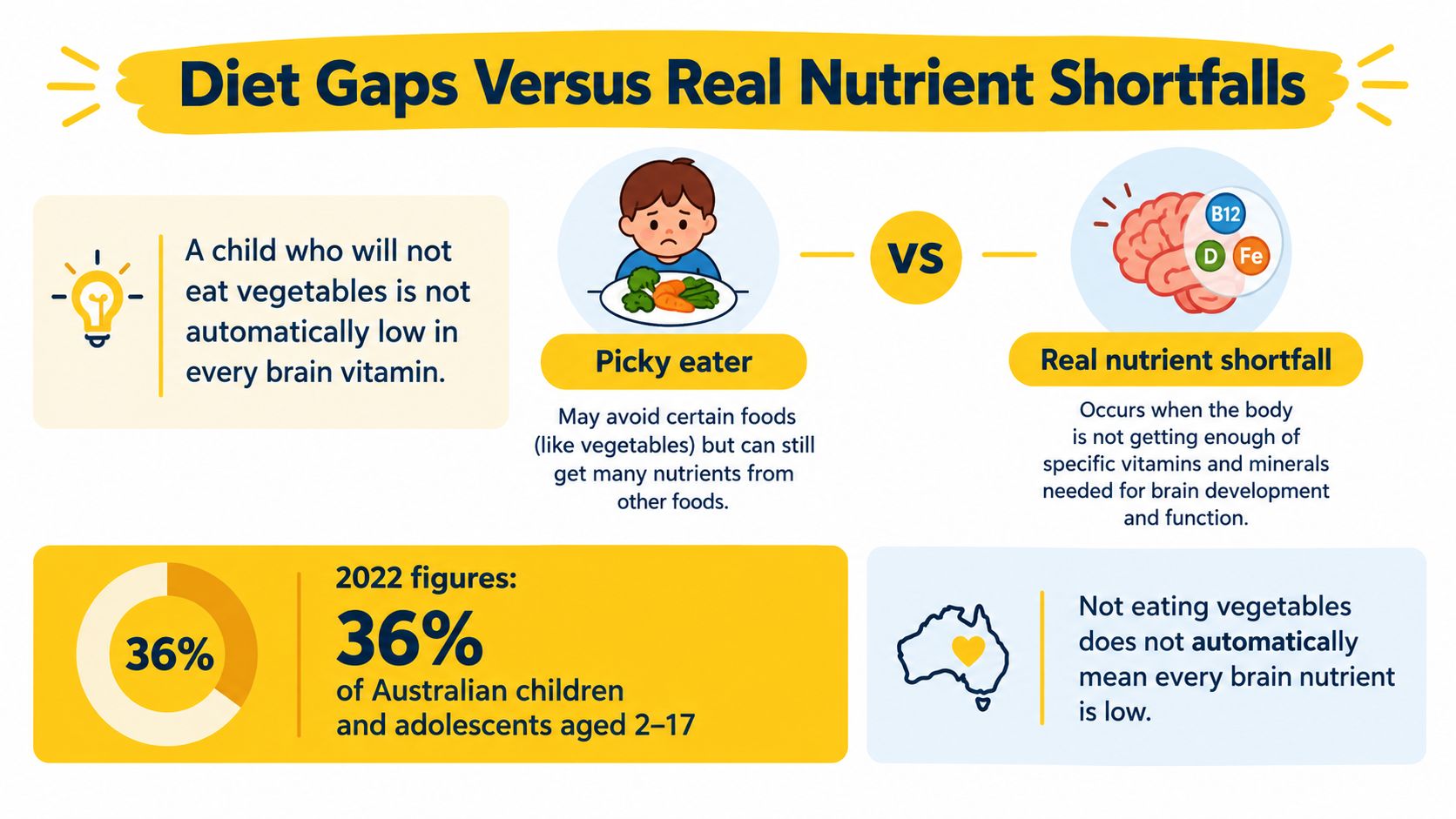
The Australian Institute of Health and Welfare reports that in 2022, 36% of Australian children and adolescents aged 2–17 did not meet the recommended daily serves of fruit, while 96% did not meet the recommended serves of vegetables. Overall, 96% failed to meet recommendations for both food groups. The same reporting found that 5.8% consumed no fruit and 4.5% consumed no vegetables.
The pattern is older than one survey year. In 2017–18, only 6.0% of children aged 2–17 met recommended serves for both fruit and vegetables. 73.0% met the fruit guideline, and only 6.3% met the vegetable guideline. Caregivers are managing a variety problem, especially around vegetables, not a simple lack of fruit.
Adequate intake is a different finding
The Australian Bureau of Statistics' 2023 National Nutrition and Physical Activity Survey indicates that children aged 2–11 generally had adequate usual intakes of most vitamins and minerals, with calcium the notable exception. Broad micronutrient intake is often adequate. Food-group quality is not.
What that means at the shops
A gummy cannot repair a vegetable gap. It doesn't deliver the fibre, the volume, or the habit of sitting with broccoli. Iron, iodine, vitamin D or zinc deserve a look only when diet, a blood test, or a clinician points at that nutrient. A child who avoids dairy has a calcium and food problem first. That is not a reason to buy a focus blend.
Practical filter: if meals are the issue, change food and routine. If a named deficiency exists, match one nutrient to that finding.
Build the plate with food that supports a healthy brain, then decide whether any single nutrient still has a job. Two problems, two different fixes.
How to Read Evidence and an AUST Number
Pick up the bottle in the order you see it. Front claim, then age band, then the amount in a daily serve, then the number on the label.
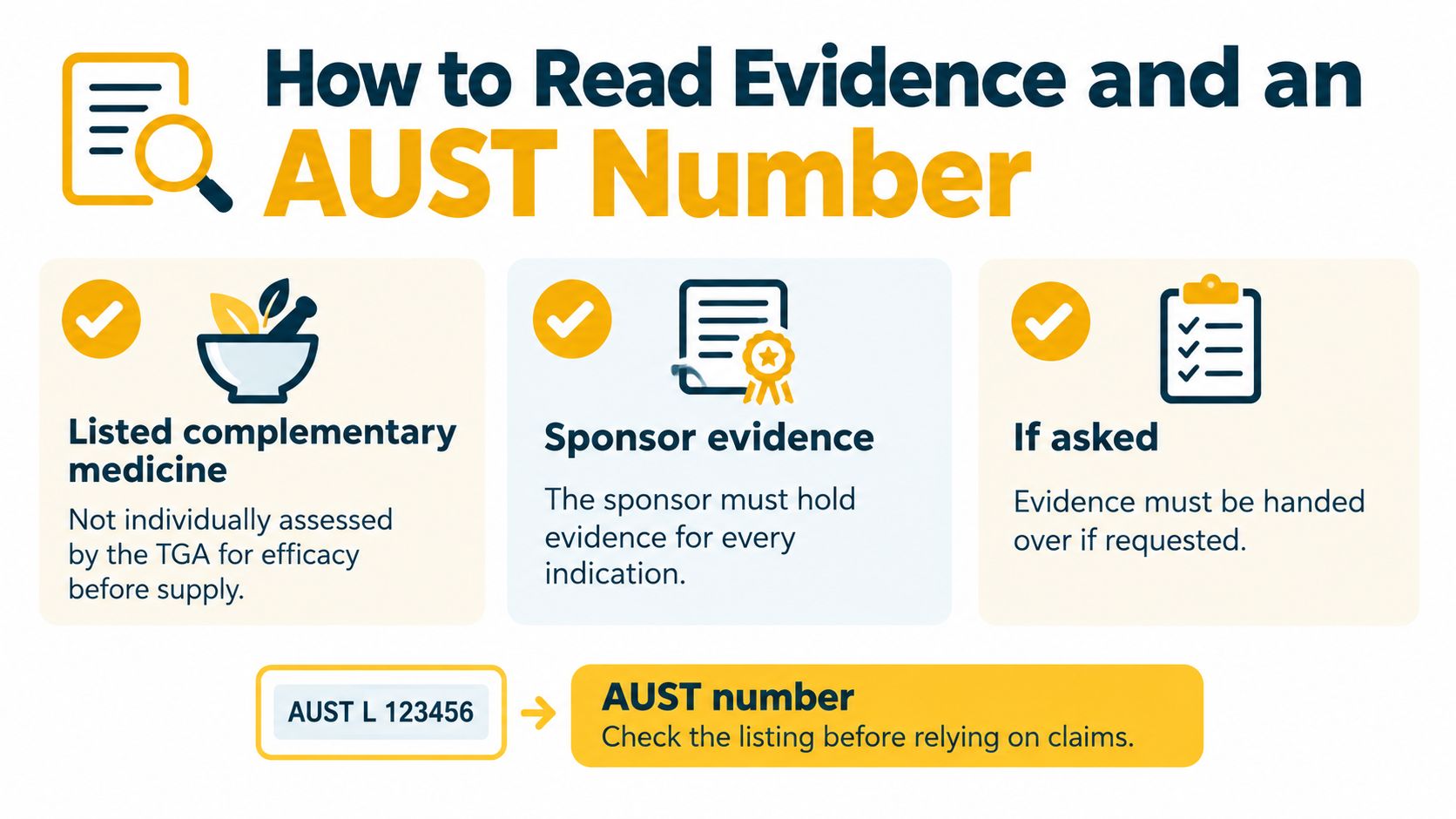
A listed complementary medicine is not individually assessed by the TGA for efficacy before supply. The TGA's overview of listed complementary medicines is clear that sponsors must still certify they hold evidence for every therapeutic indication and marketing claim, and must provide that evidence if asked. For a child's product, that evidence should match age, dose, ingredient form and the claimed result. An adult trial, or a story about how a mushroom "works in the brain", is not the same thing.
Maintenance claim or stronger promise
TGA guidance separates a low-level health-maintenance claim from a stronger scientific indication. Scientific indications need scientific evidence, such as clinical studies or systematic reviews. A label that says a vitamin helps prevent deficiency must also say supplements assist only when dietary intake is inadequate, and that they don't replace a balanced diet.
Our gummies are made in a GMP-certified facility. That is a quality check on how the product is made. It is not a guarantee that concentration, memory or school results will improve. How the TGA approval process works is worth reading before you treat any listing as a performance trial.
The 25% benchmark
For a named nutrient supplementation claim, a listed medicine generally must provide at least 25% of the relevant Recommended Dietary Intake, Adequate Intake, or Nutrient Reference Value in the labelled serving, in a form capable of absorption, under TGA guidance on supporting claims. Use the age-specific Australian or New Zealand value, not an adult figure. Record elemental mineral, serving size, and how many gummies make the daily dose. A product under that threshold may still contain the nutrient. It generally cannot use the same named supplementation claim.
An AUST L number means the product is on the ARTG with permitted low-level claims. It is not proof of better cognition. A registered medicine (AUST R) or an assessed listed medicine has evidence checked before supply.
- Find the AUST L or AUST R number and confirm it matches the pack in your hand.
- Read the age range and stop if your child sits outside it.
- Note the active amount per daily serve, in elemental units, and the gummy count.
- Ask whether the words promise concentration, attention or memory, or only help when dietary intake is inadequate.
Do that on any bottle tonight, before you subscribe.
Safety Checks for Children and Imports
An ordinary kids' sleep or focus gummy cannot be an unlisted import with a hidden blend. If it is supplied in Australia as a therapeutic good, it has to be legal to supply.
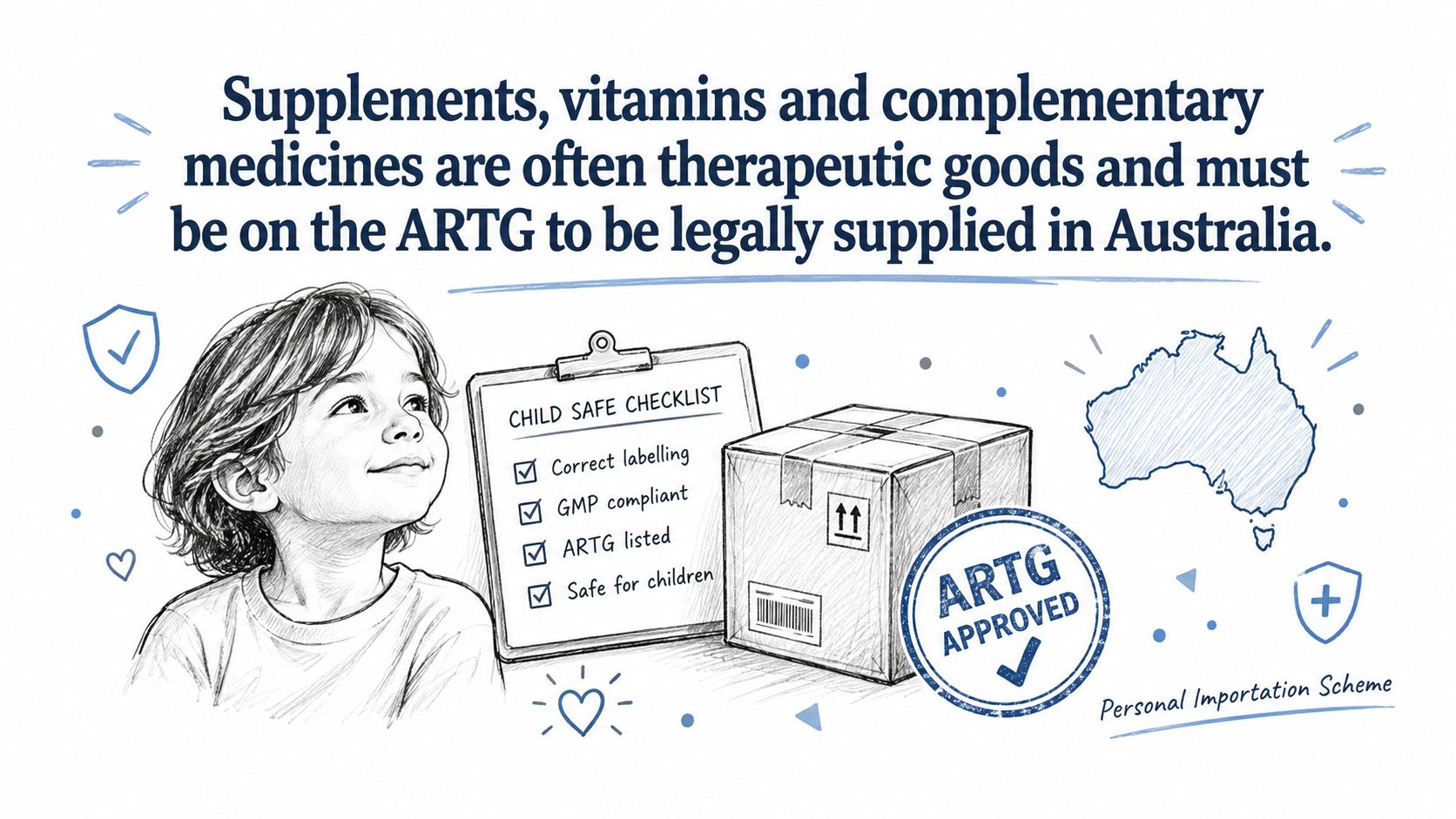
The TGA's guidance on checking a non-prescription health product states that supplements, vitamins and complementary medicines are often therapeutic goods. They must comply with TGA legislation and be entered on the ARTG to be legally supplied in Australia. The Personal Importation Scheme allows limited personal use. Those goods cannot be resold or supplied to others. Prescription-only goods need a valid Australian prescription, and quantities are restricted.
Melatonin is prescription-only in Australia. It is approved for children only in limited circumstances involving insomnia associated with autism spectrum disorder and/or Smith-Magenis syndrome. Broader paediatric safety and efficacy have not been evaluated. An online sleep gummy is the wrong tool for a child who fights lights-out.
TGA expert advice identified soft gels as a choking hazard, especially for children under five, and recommended supervision plus age-specific restrictions. A chewy, age-matched gummy is a different dose form from a capsule a younger sibling could grab.
Six checks before it enters the house
- Confirm AUST L or AUST R on the pack, not only on an advertisement.
- Read the full ingredient list and the elemental dose per daily serve.
- Match the age band to this child, not to a sibling.
- Prefer child-resistant storage, out of reach after the dose.
- List other medicines and allergies on a note you can show a pharmacist.
- Reject undisclosed proprietary blends and adult nootropic stacks.
We recommend speaking with a GP or healthcare professional before starting any new supplement, especially for children with allergies, a medical condition, or other medicines.
Stop signs are simple. Don't start iron without a test. Don't use melatonin that wasn't prescribed. Don't keep a product that won't name the amount in each gummy.
Which Situation Fits Focus Calm or Food First
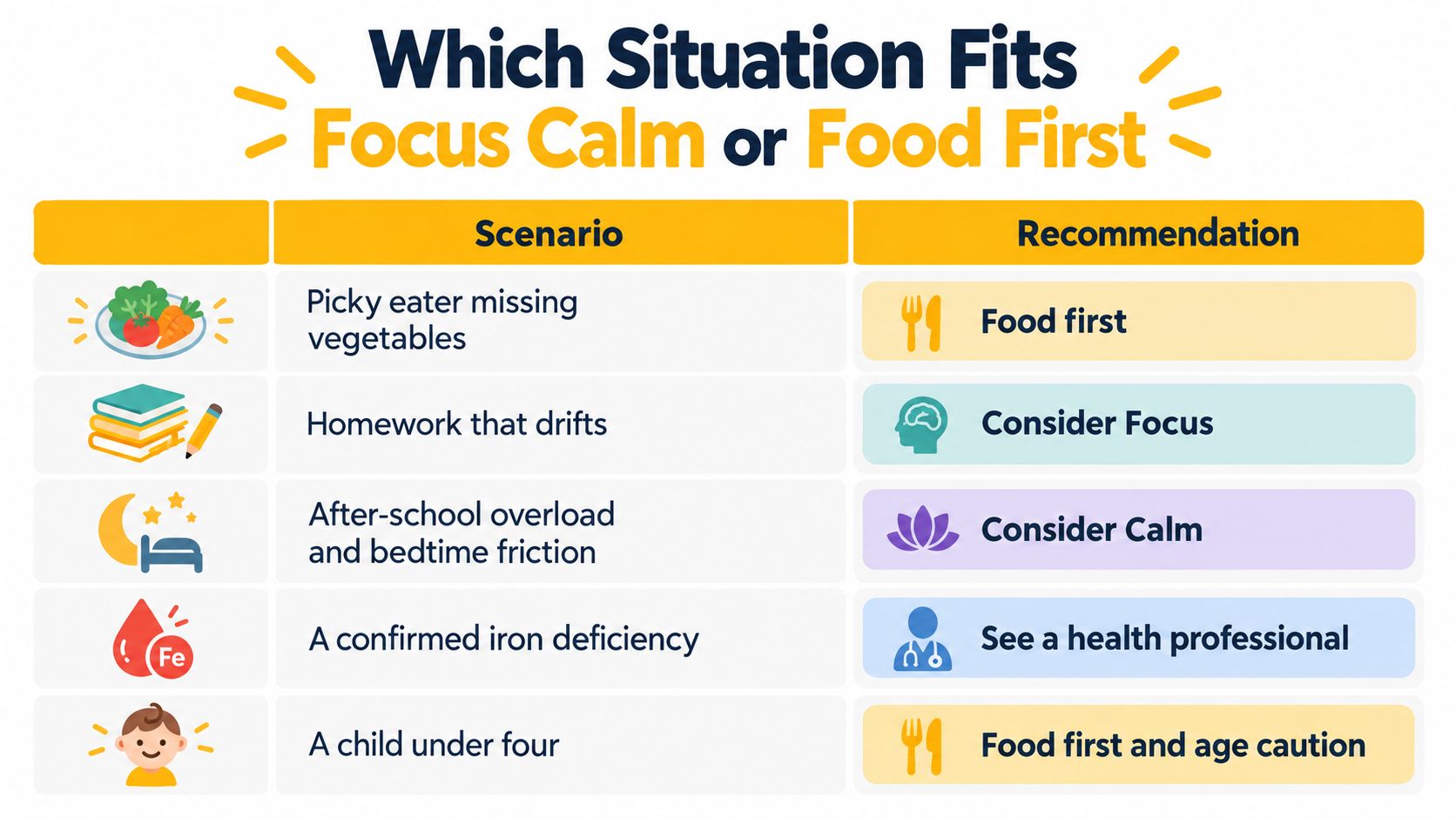
Use one row. The first column is the actual starting point. The product, if any, comes second.
| Situation | First step | Consider if still needed | Avoid |
|---|---|---|---|
| Picky eater, few vegetables | Improve food variety and routine | Age-banded multivitamin if diet review shows gaps | Adult herb blends sold as brain repair |
| Homework attention drifts | Sleep, breaks and a start-work cue | Child-dose nootropic gummy only as a habit aid | Caffeine and adult nootropic stacks |
| After-school overload, hard bedtime | Consistent wind-down | Child-dose magnesium | Online melatonin |
| Confirmed iron deficiency | GP plan and food sources | Iron only as advised | Self-selected high-dose iron |
| Under four or choking risk | Clinician advice | Supervised age-appropriate form | Unsupervised soft gels |
| Allergies, condition or other medicines | GP or pharmacist review | Only a checked single product | Any stack started at home |
Three households, three different jobs
A fussy eater aged 6 to 12 often needs repeated exposure to vegetables more than a high-dose herb. A sugar-free daily multivitamin can sit beside that food work as a short ritual, not as dinner. Brave is an orange daily multivitamin gummy built for that kind of routine, with no artificial colours or flavours. It doesn't replace the meal.
When sleep and the after-school rhythm are already decent, and homework still drifts, a child-labelled nootropic and prebiotic gummy can act as a cue to start work. It is not a promise of grades. Say the name, set a timer, and begin the first question. The gummy marks the start. It doesn't do the thinking.
Evening overload is different again. Big feelings after sport and a late bedtime fit a wind-down (same order, dimmer room, same endpoint) plus a child-dose magnesium gummy, not an imported sleep product.
Seeing the habit beside the food, rather than instead of it, is easier in a short walk-through.
Buy for one job, use it daily for at least a month, and stop stacking focus, iron and herbal blends.
Leave the table with one row, not three products in the cart.
Choose a Routine Then Confirm with Your GP
One situation, one product, then a way to judge it that isn't "two good mornings".
- Keep the single situation you already chose. Don't add a second job because the bundle looks tidy.
- Prefer an Australian-made, fully labelled product with an AUST number and a stated age range of about 4–16.
- Check sugar, artificial colours, flavours, allergens, and the exact daily gummy count before you rely on taste alone.
- Pick delivery on purpose. A subscription suits a household that forgets to reorder and can pause, skip or cancel. A one-off bottle suits a 30-day trial, or a child who may refuse the texture.
- Judge benefit only after consistent daily use for at least 30 days, alongside food and sleep. Two mornings isn't a trial.
- If a stop sign applies (unprescribed melatonin, untested iron, undisclosed blends, or a child on other medicines), book the GP or pharmacist before you start. Otherwise start one product and review it at day 30.
One local set that maps onto those three household jobs is the Daily Powers range, designed in Australia, vegan, with no sugar and no artificial colours or flavours. Brave is the daily multivitamin "for big moments", with 12 or more essential vitamins and minerals in two orange gummies, aimed at everyday energy rather than a nootropic effect. Focus is the nootropic and prebiotic gummy "for getting things done". Calm is the grape magnesium gummy for wind-down and big feelings. The Complete Trio is three bottles per child (daily multivitamin, magnesium and nootropic) at A$99.45, about A$3.32 a day, with 15% off and free shipping. Australia-wide shipping and a 30-day satisfaction guarantee let you trial one routine without locking the cupboard in for a year.
If none of the stop signs apply, start the single product that matches the row you chose, and put a note in the calendar for day 30.
Daily Powers makes sugar-free, vegan gummies for Australian children, framed around one job at a time: everyday nutrition, a start-work cue, or evening wind-down. If you're choosing brain supplements Australia and want a labelled routine instead of an imported stack, start with the product that matches a single situation and review it with your GP where medicines or allergies are in the picture. Visit Daily Powers to compare Brave, Focus and Calm and set up a delivery you can pause.