

You're standing in the kitchen before school, two tubs of children's gummies open on your phone, both using words like TGA approved. One promises focus, the other immunity, and you're left wondering what the regulator checked. Did someone test whether the product works, or did the brand complete the paperwork? That confusion is common, and it's exactly why the TGA approval process is worth understanding before you buy, formulate or launch anything.
Table of Contents
- Why Understanding the TGA Approval Process Matters
- The ARTG Gateway and the Two Product Categories
- Listed vs Registered Complementary Medicines Compared
- Inside the Registered Medicine Application Workflow
- Documentation Sponsors Must Assemble
- Fees, Timelines and Refund Triggers
- Post-Approval Obligations and Ongoing Compliance
- Common Questions About the TGA Approval Process
Why Understanding the TGA Approval Process Matters
A parent browsing a children's supplement site isn't usually asking for a law lecture. You're asking a practical question: can I trust what's on this label? The answer depends on which regulatory pathway the product took, not on the badge-style language on the pack.
In Australia, a therapeutic product that qualifies as a medicine and isn't exempt or excluded generally can't be legally supplied until it's included in the Australian Register of Therapeutic Goods, or ARTG. That's the legal gateway. If a product carrying therapeutic indications isn't on that register, the conversation about flavour, price or marketing doesn't matter, because lawful supply hasn't been established.
What Is at Stake for Parents
Parents often read approval language as proof of benefit. If a gummy mentions concentration, relaxation or immune support, it's natural to assume the Therapeutic Goods Administration, or TGA, tested that claim for that exact product. Sometimes the regulator has assessed efficacy before market entry. Sometimes the sponsor has self-certified compliance and holds the evidence itself.
That difference changes how you should read a label. It doesn't automatically make one product good and another bad, but it tells you where the evidence sits and what questions to ask next.
What Is at Stake for Brands
Sponsors face the mirror-image risk. If you finalise a formula, order packaging and write website copy before you map the pathway, you may discover that an ingredient or claim pushes you into a more demanding category. Reformulating late is expensive, and relabelling late is worse.
- Formula first is risky: Check whether each ingredient fits the intended pathway before you lock the recipe.
- Claims drive category: Wording that implies treatment can demand stronger evidence than general health support wording.
- Packaging isn't cosmetic: The label, the ARTG entry and your advertising need to tell the same story.
Practical rule: Don't ask whether a product is approved in the abstract. Ask which ARTG pathway it used, what was assessed, and what evidence the sponsor must hold.
Once you hold that mental model, timelines, fees and documentation stop looking like random bureaucracy. They become consequences of an earlier decision about risk, ingredients and claims.
The ARTG Gateway and the Two Product Categories
Think of the ARTG as a single front door. A therapeutic product carrying therapeutic indications generally must be entered in the register before it can be legally imported, manufactured, supplied or exported, as set out in the TGA guidance on understanding different types of complementary medicines. Entry is what authorises supply. It isn't a marketing endorsement, a quality award or a promise that every consumer claim has been clinically proven.
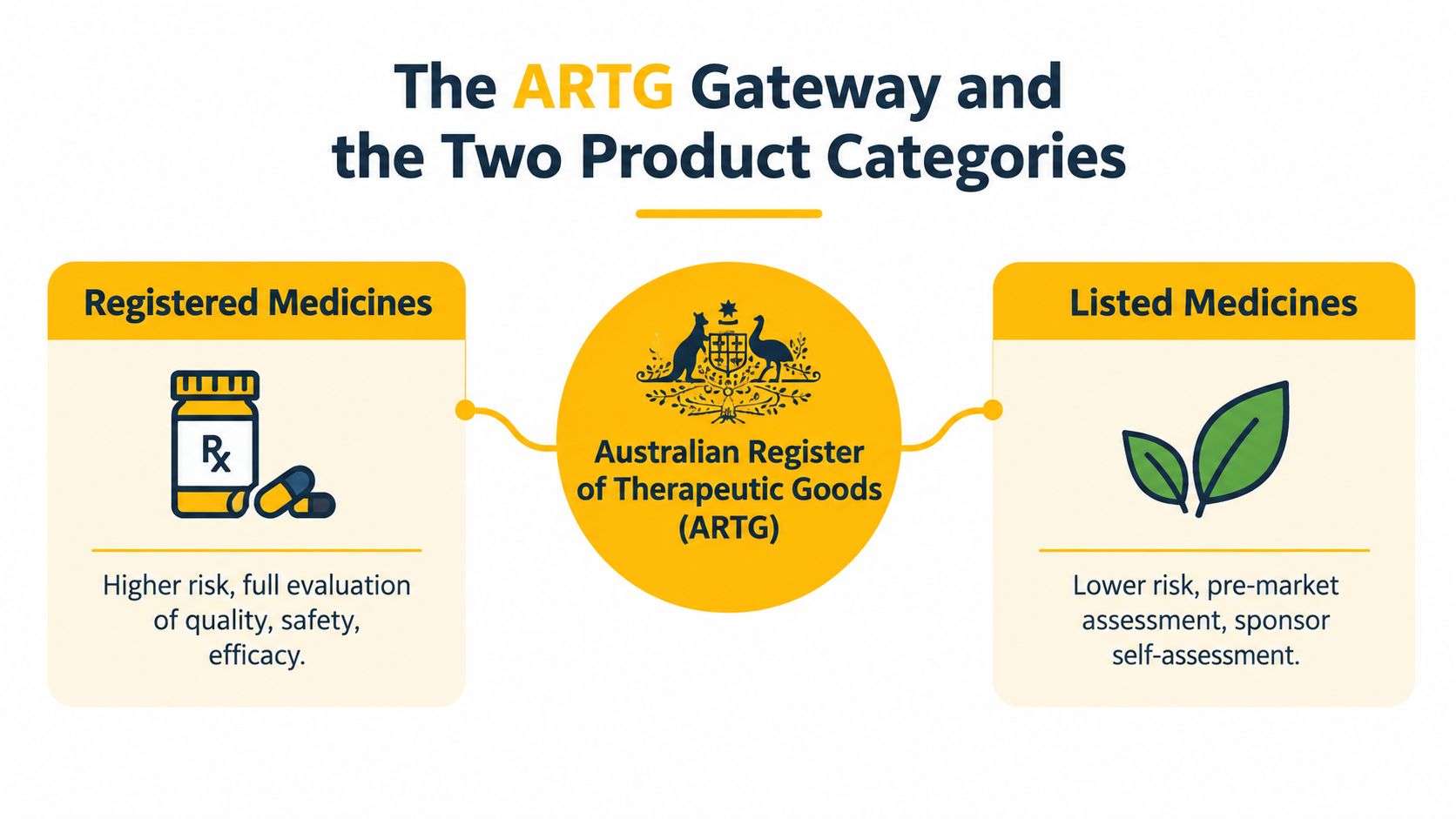
The diagram below shows the split that matters most for complementary medicines.
Listed Medicines and the AUST L Prefix
Listed medicines carry an AUST L number, or AUST L(A) for assessed listed medicines. They're generally the lower-risk route for complementary medicines that use permitted ingredients and permitted, lower-level indications. The sponsor certifies that the product meets the requirements and holds evidence to support its indications.
That doesn't mean anything goes. The indications used on labels or in advertising must appear in the ARTG entry and be supported by evidence the sponsor holds. If your website says more than your entry allows, you've created a compliance problem, even if the product itself is listed.
Registered Medicines and the AUST R Prefix
Registered medicines carry an AUST R number. This pathway applies where ingredients or indications sit outside the listed framework, or where the risk profile calls for pre-market evaluation. The TGA assesses quality, safety and efficacy before the product is entered.
A children's gummy can land in either bucket. A straightforward vitamin formulation using permitted ingredients and modest general-health wording may fit listing. Change an active ingredient, raise a dose beyond permitted limits, or claim an effect that sounds like treating a condition, and you may be pushed toward registration.
Lawful supply rests on ARTG inclusion, not on informal approval language.
The prefix on the label is therefore your first clue. AUST L, AUST L(A) and AUST R aren't serial numbers. They're signals about how much assessment happened before the product reached the shelf.
Listed vs Registered Complementary Medicines Compared
The pathway decision isn't a branding preference. It's driven by ingredient controls, risk profile and proposed indications. Sponsors should classify every active ingredient, check the Poisons Standard and permitted-ingredient requirements, and map each proposed indication to the intended ARTG category before finalising the formula or packaging.
The table below compresses the choice into the dimensions founders usually ask about first.
| Dimension | Listed (AUST L / AUST L(A)) | Registered (AUST R) |
|---|---|---|
| Risk profile | Lower-risk ingredients and indications | Higher-risk ingredients or higher-level indications |
| Pre-market assessment | Sponsor self-certifies for standard listing; assessed listed products receive pre-market efficacy assessment | TGA assesses quality, safety and efficacy before entry |
| Evidence position | Sponsor holds evidence and must support every indication used | Sponsor submits evidence for TGA evaluation |
| Claims available | Limited to permitted indications consistent with the entry | Indications approved through registration |
| Speed to market | Generally faster where the formula fits the framework | Generally slower because substantive evaluation occurs first |
Where Assessed Listed Fits
Assessed listed medicines sit between the two poles. The TGA assesses efficacy before market entry, while safety and quality evidence remains with the sponsor. For a founder who wants a specific, evidence-backed claim without full registration, that's a meaningful middle path. You can see similar distinctions matter when parents compare products in roundups such as a guide to the best magnesium supplement brand in Australia, because the same shelf can hold products assessed in different ways.
A concrete example helps. A product like Focus is described in its catalogue material as blueberry-flavoured gummies combining mushroom polysaccharides, vitamin D3, zinc, elderberry and prebiotics, with 0 sugar and no artificial colours or flavours. From a regulatory perspective, the useful question isn't whether that sounds appealing. It's whether each ingredient, amount and proposed indication fits listed-medicine requirements, and whether the evidence held matches the exact wording used with consumers.
That's the cause-and-effect chain sponsors miss. Marketing writes a stronger claim, the claim demands a different pathway, and the pathway changes evidence, timing and cost. Decide the language and the formula together, not in separate rooms.
Inside the Registered Medicine Application Workflow
Registration starts with the sponsor, the Australian entity legally responsible for the product. The sponsor logs into TGA Business Services, prepares the application and submits evidence addressing quality, safety and efficacy. From there, the process moves in two principal stages, and the video below gives a useful visual overview before you work through the detail.
Stage One Preliminary Assessment
Preliminary assessment is a screening step. The TGA checks whether the application is complete and suitable to proceed to substantive evaluation. Sponsors sometimes mistake passing this stage for approval, but it only means the application can move forward. The evaluation clock doesn't start at submission. It starts after acceptance for evaluation and payment of the required evaluation fee, and weekends and public holidays are excluded from working-day calculations.
The legislated milestones are specific. The TGA must notify the applicant within 40 working days whether the application has passed preliminary assessment, published evaluation periods run from 45 working days for RCM1 to 90 working days for RCM2 and 150 working days for RCM3, with longer periods for applications needing more extensive evidence, and a 25% refund of the prescribed evaluation fee applies if the Secretary doesn't make a recommendation within the applicable timeframe, all as described in the TGA guidance on submitting an application for a registered complementary medicine.
Stage Two Substantive Evaluation
The RCM categories reflect the amount and type of evidence required. An RCM1 application is identical to an already registered complementary medicine apart from limited presentation differences, so it needs the least new assessment. Higher categories involve progressively more evidence for assessors to work through, which is why the timeline stretches.
The flow from submission to decision is easier to plan when you see it laid out in sequence.
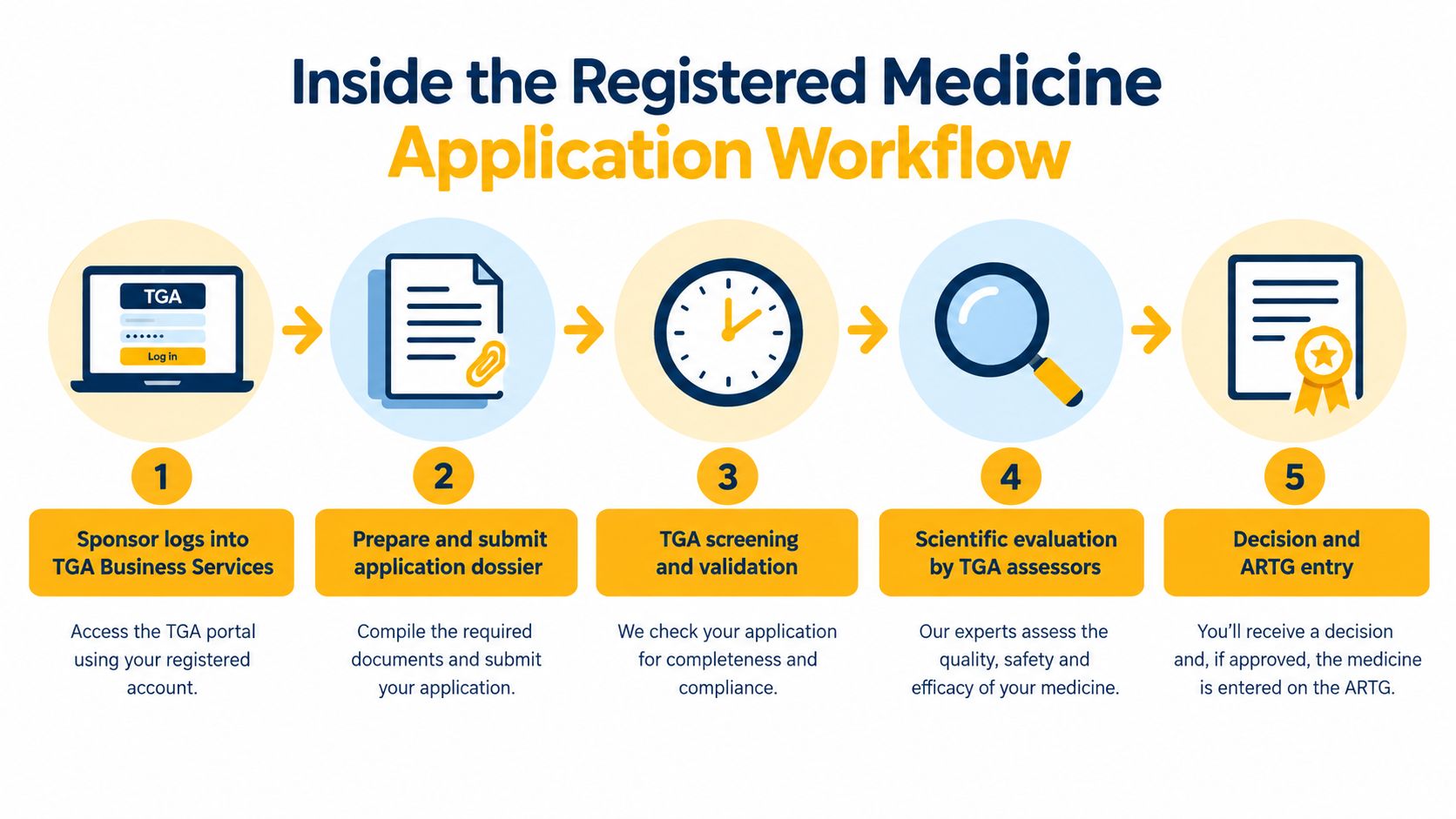
If evaluation succeeds, the product is entered in the ARTG and authorised for legal supply. For launch planning, count backward from that entry date, then add your own time for dossier preparation, manufacturing and packaging. The regulatory clock is only part of your calendar.
Documentation Sponsors Must Assemble
A strong dossier reads like an answer to three questions. Is the product made consistently, is it safe for its intended users, and does the evidence support what you want to say? Every document should serve one of those questions.
The binders in the image below reflect the way experienced sponsors organise their thinking from day one.

Quality and Manufacturing Evidence
Quality evidence covers what the product is and how it's made. Expect finished product specifications, ingredient details, manufacturing information and stability thinking that supports shelf life. For children's gummies, that includes practical questions about dosage form, uniformity and storage, not just a list of actives.
Good Manufacturing Practice, or GMP, evidence must cover each manufacturing step. Australian manufacturers generally require a TGA-issued GMP licence, and sponsors using overseas sites still need valid GMP evidence for those steps. Don't treat this as a certificate you collect at the end. If your manufacturer can't produce the right evidence, your application has a hole in it.
Safety and Efficacy Evidence
Safety documentation needs to address the intended population. A product for children can't rely on vague adult reasoning and hope nobody notices. Dose, duration, ingredient interactions and warnings all need to make sense for the age group on the label.
Efficacy evidence must match the indication, word for word in effect. Evidence for general nutritional support won't carry a treatment-style claim, and evidence for one ingredient at one dose won't automatically support a different blend. Ingredient questions parents ask, such as whether multivitamins are vegan, sit alongside these deeper questions about whether the source, form and amount match the evidence file.
Labels as Regulatory Documents
Label artwork belongs in the submission mindset from the start. The pack carries the ARTG number, indications, directions and warnings that consumers rely on, so artwork sign-off is a compliance task, not a graphic design afterthought. Build a final check that compares the label, the ARTG entry and the proposed advertising side by side. Most avoidable errors show up in that comparison.
Fees, Timelines and Refund Triggers
Founders usually budget for product development and then discover regulation as a separate cost centre. For registered complementary medicines, expect an application stage and a larger evaluation stage, with the evaluation fee required before substantive assessment begins. Until that fee is paid and the application is accepted, the evaluation clock hasn't started.
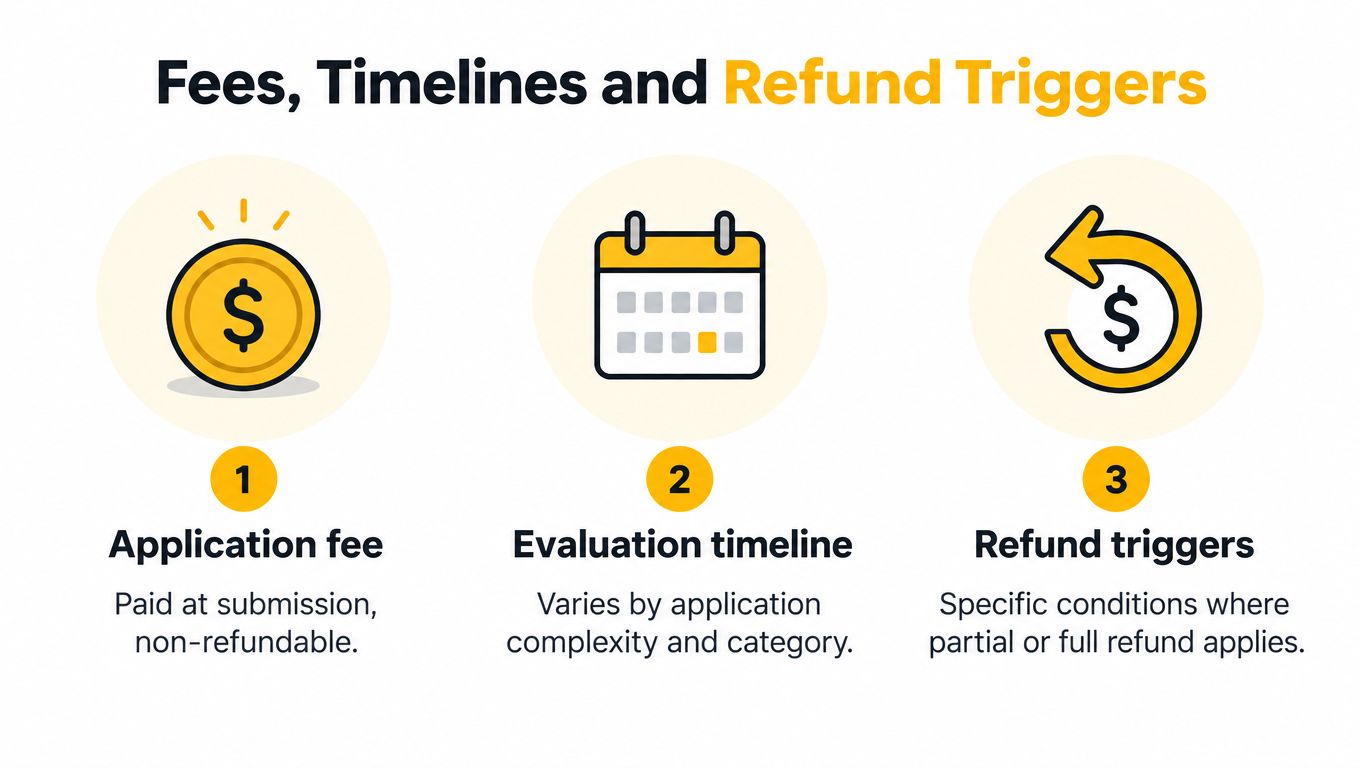
The graphic below separates the three money and time ideas sponsors most often blur together.
How Category Choice Changes the Budget
An application that mirrors an existing registered medicine asks assessors to do less new work than one presenting extensive fresh evidence. That difference flows through to both the legislated evaluation period and your preparation costs. Category selection is not a shortcut you choose for convenience, though. It must reflect the actual relationship between your product, its evidence and any comparable registered medicine.
Cash-flow planning also needs working days translated into calendar reality. Working-day periods exclude weekends and public holidays, and your own response time to regulator questions sits outside the tidy headline figure. Build buffer into launch commitments to retailers, manufacturers and marketing partners.
The Refund Trigger and Hidden Costs
If the Secretary doesn't make a recommendation within the applicable evaluation timeframe, part of the prescribed evaluation fee is refundable.
Treat that refund trigger as a safeguard, not a planning strategy. A partial fee refund won't recover a missed retail window or idle inventory. Your real protection is a complete dossier, realistic category selection and prompt responses during evaluation.
Budget beyond the headline fees as well:
- GMP work: Audits, licences and evidence gathering for every manufacturing step.
- Stability and testing: Laboratory work that supports specifications and shelf life.
- Evidence development: Literature reviews, expert reports or clinical material matched to your indications.
- Consultant time: Regulatory support for classification, dossier assembly and responses.
The cheapest pathway on paper can become the expensive one if the formula doesn't fit it. Pay for classification advice early, while changing direction is still cheap.
Post-Approval Obligations and Ongoing Compliance
ARTG entry lets you supply the product. It doesn't end the sponsor's job. From launch day onward, your advertising, labels and product records need to stay aligned with the entry that authorised supply in the first place.
Public advertising must be accurate, balanced and non-misleading, supported by evidence, and consistent with the product's approved indications or intended purpose, as explained in the TGA guidance on advertising considerations for therapeutic goods. That consistency test catches many children's brands, because social copy tends to drift further than pack copy.
How You Can Refer to the TGA
Don't describe a product as TGA approved or TGA registered as if the regulator has endorsed it. TGA inclusion isn't an endorsement. The ARTG number is the permitted identification mechanism, and TGA assessed wording is available only in specified circumstances for assessed listed or registered medicines.
This matters in everyday content decisions. If you're explaining a nutrient in an article about vitamin B12 supplements in Australia, educational copy still can't stretch a product beyond its entry. A blog post, an influencer brief and a product page all need the same discipline.
For a daily multivitamin such as Brave, described in catalogue material as vegan-friendly gummies with no artificial colours or flavours, ongoing compliance means every new claim about confidence, routine or wellbeing still needs checking against the entry and evidence. New campaign language doesn't get a free pass because the product is already on the market.
Changes Reports and Records
Assign a responsible person to recurring duties rather than relying on memory:
- Monitor complaints and adverse events: Record issues, assess them and report where required.
- Control changes: Treat formulation, site, label and indication changes as regulatory events that may need a variation.
- Review advertising regularly: Audit live pages and social content against the current ARTG entry.
- Maintain evidence: Keep the material supporting your indications accessible and current.
Small brands don't need a large department. They need a named owner, a review calendar and a rule that nobody publishes a new claim without checking it first.
Common Questions About the TGA Approval Process
Does TGA Approved Mean the TGA Proved It Works
No. Listed medicines are included after the sponsor self-certifies compliance, and the TGA does not individually evaluate them before market entry, while registered complementary medicines undergo pre-market assessment of safety, quality and efficacy and assessed listed medicines receive pre-market efficacy assessment, as explained in the TGA guidance on understanding listed and registered complementary medicine regulation. The consumer question should be what the TGA checked for this specific product, and what it didn't check.
How Can Caregivers Verify a Product
Find the AUST L, AUST L(A) or AUST R number on the label and check it against the ARTG entry rather than relying on approval slogans. Then compare the indications in the entry with the claims on the pack and website. If the marketing promises more than the entry supports, ask the brand to explain the gap.
Why Do Applications Get Delayed
Delays usually trace back to preventable mismatches. The formula doesn't fit the chosen pathway, GMP evidence doesn't cover a manufacturing step, the efficacy material doesn't match the indication, or label wording runs ahead of the evidence. None of these problems is mysterious. They're sequencing errors, and they're cheapest to fix before submission.
A Short Checklist for Parents and Sponsors
- Parents: Check the ARTG prefix, read the indications, and ask what was assessed before market entry.
- Sponsors: Classify ingredients and indications first, assemble evidence by quality, safety and efficacy, then write marketing copy last.
Transparent brands gain more trust by explaining those limits plainly than by implying every ARTG entry involved clinical efficacy review.
Daily Powers makes sugar-free, vegan children's gummies for everyday routines, with clear ingredient and dosing information published for caregivers to check. If you're comparing labels and ARTG details before you buy, visit Daily Powers to review the range and choose the product that fits your child's routine.