

The most popular advice about hair, skin and nail vitamins starts in the wrong place: choose biotin, add collagen, then look for a stronger dose. A better starting point is what's changed, and why? A supplement chosen for a brittle nail won't necessarily address the reason that nail became brittle.
For parents searching for great vitamins for hair skin and nails, the useful answer isn't a shopping list. It's a way to separate a possible nutritional gap from a symptom that needs assessment, then choose support that fits your child's diet and age.
Table of Contents
- Which Vitamins Really Matter for Hair, Skin and Nails
- When Symptoms Need a Check Instead of a Supplement
- Where to Find These Nutrients in Everyday Food
- How Much Children and Adults Need Each Day
- Judging Supplement Labels, Interactions and Warning Signs
- Choosing Child-Safe Options and Setting a Daily Routine
Which Vitamins Really Matter for Hair, Skin and Nails
| Nutrient | Role in hair, skin or nails | Strength of evidence |
|---|---|---|
| Biotin | Often included in hair and nail formulas | Don't assume its inclusion proves a benefit for someone with adequate intake |
| Vitamin A | Requires assessment within overall nutritional needs | Not a reason to choose a high-dose beauty formula without advice |
| Vitamin C | Needed for collagen formation and helps iron absorption | Supports nutritional adequacy; extra isn't a proven appearance booster |
| Vitamin E | Often included in skin-focused supplements | An ingredient claim alone doesn't establish a benefit from taking it |
| Zinc | Supports cell growth, tissue repair and skin integrity | Most relevant when intake is inadequate |
| Iron | Essential for normal tissue maintenance | Supplement decisions should follow assessment of intake and iron status |
| Omega-3 fatty acids | May be considered during a broader dietary review | Don't treat their presence in a formula as proof it will improve hair |
| Vitamin D | Requires consideration of individual nutritional needs | Hair changes alone aren't enough to select a dose |
| Collagen | A protein rather than a vitamin | Don't assume a collagen blend treats the cause of a visible change |
The important distinction is between a nutrient having a role in the body and a supplement improving appearance. Those aren't interchangeable claims. A long ingredient list can make a formula look thorough without showing that the person taking it needs those ingredients.
Zinc provides a useful example. It supports cell growth and division, tissue repair, immune function and skin integrity, and inadequate intake can contribute to skin changes, delayed wound healing and hair loss. That supports addressing inadequate intake, not assuming that more zinc produces better hair, according to Healthdirect's guidance on zinc deficiency.
Start with the nutritional question
Ask what problem the supplement is intended to solve. Is a clinician treating an identified deficiency, or is the family hoping that a broad formula will improve an unexplained symptom?
Those situations need different decisions. Targeted treatment has a defined purpose, while an open-ended beauty supplement can leave the original problem unexplored.
Practical rule: Choose a nutrient because there's a reason to address its intake, not simply because it appears on a hair, skin and nails label.
For caregivers considering a zinc-containing product, this guide to zinc supplements for kids can help frame questions about suitability. The key question remains whether the child needs additional zinc at all.
When Symptoms Need a Check Instead of a Supplement
Hair, skin and nail changes are clues, not diagnoses. A visible change may relate to inadequate nutrition, illness, medicines or normal variation, so choosing a supplement from appearance alone can send you in the wrong direction.
A plumbing diagram offers a useful reminder that the body's systems are connected. It shouldn't be read as a strict, word-for-word proof that hair, skin and nails always receive nutrients last, or that a change in them measures the severity of a deficiency.

Supplement use is common, but popularity doesn't tell you whether a product suits a symptom. In 2023, 33.6% of Australians aged 2 years and over took a dietary supplement, according to the Australian Bureau of Statistics dietary supplement findings.
Use symptoms to guide a conversation
The table below is a discussion aid, not a way to diagnose yourself or your child. A GP can decide whether a dietary review, examination or testing is appropriate.
| Symptom | Nutrient to check | Common non-nutrient cause | First action |
|---|---|---|---|
| Brittle, ridged or splitting nails | Review overall intake before selecting individual nutrients | Ask whether a local nail condition or another health issue needs assessment | Arrange a GP check before supplementing |
| Diffuse hair shedding | Discuss iron and zinc intake and whether testing is appropriate | Review recent illness, medicines and other health changes | Bring a symptom history to the GP |
| Dry, flaky skin | Review dietary variety rather than assuming a vitamin gap | Ask whether this is a skin condition rather than a nutrition problem | Seek assessment if persistent or troublesome |
| Cracked corners of the mouth with rash | Ask whether nutritional assessment is warranted | A local skin or mouth problem may need different care | Arrange a GP assessment |
| Slow-healing cuts or sores | Zinc intake may be relevant | A clinician should assess other health explanations | Seek prompt advice for persistent poor healing |
| Sudden patchy hair loss | Don't select a nutrient first | A scalp or other medical condition needs assessment | See a GP |
Notice what this table doesn't do: it doesn't assign a diagnosis to a symptom. It also doesn't prescribe the same blood tests to everyone.
A clinician may decide that testing is useful, but the choice should follow the person's history and examination. Buying a supplement first can make it harder to keep track of what changed and when.
Decide what needs attention first
Sudden, persistent or worsening changes deserve professional advice, especially when a child's growth, eating or general wellbeing is also concerning. Don't wait for a supplement trial to finish before raising those concerns.
For a child who eats a varied diet and is growing well, a cosmetic change doesn't automatically justify a beauty-focused product. If intake is restricted or a deficiency is identified, ask the clinician to specify the nutrient, dose, review date and reason for stopping or continuing.
Before considering gummies for hair growth, ask:
- Does the change persist? Record when it began and whether it's getting worse.
- Is there a plausible dietary gap? Note excluded foods, limited variety and recent appetite changes.
- Would another product duplicate something already taken? Include occasional products, not just daily ones.
Write down a typical week of eating, gather the supplement containers and photograph fortified-food labels. Bring those records to the GP, pharmacist or dietitian rather than trying to interpret the symptom alone.
Where to Find These Nutrients in Everyday Food
Start with foods your family already accepts, then look for practical additions. The aim isn't to create a special beauty diet, but to make everyday meals more varied.
This food map gives families a starting point for reviewing zinc and iron sources.
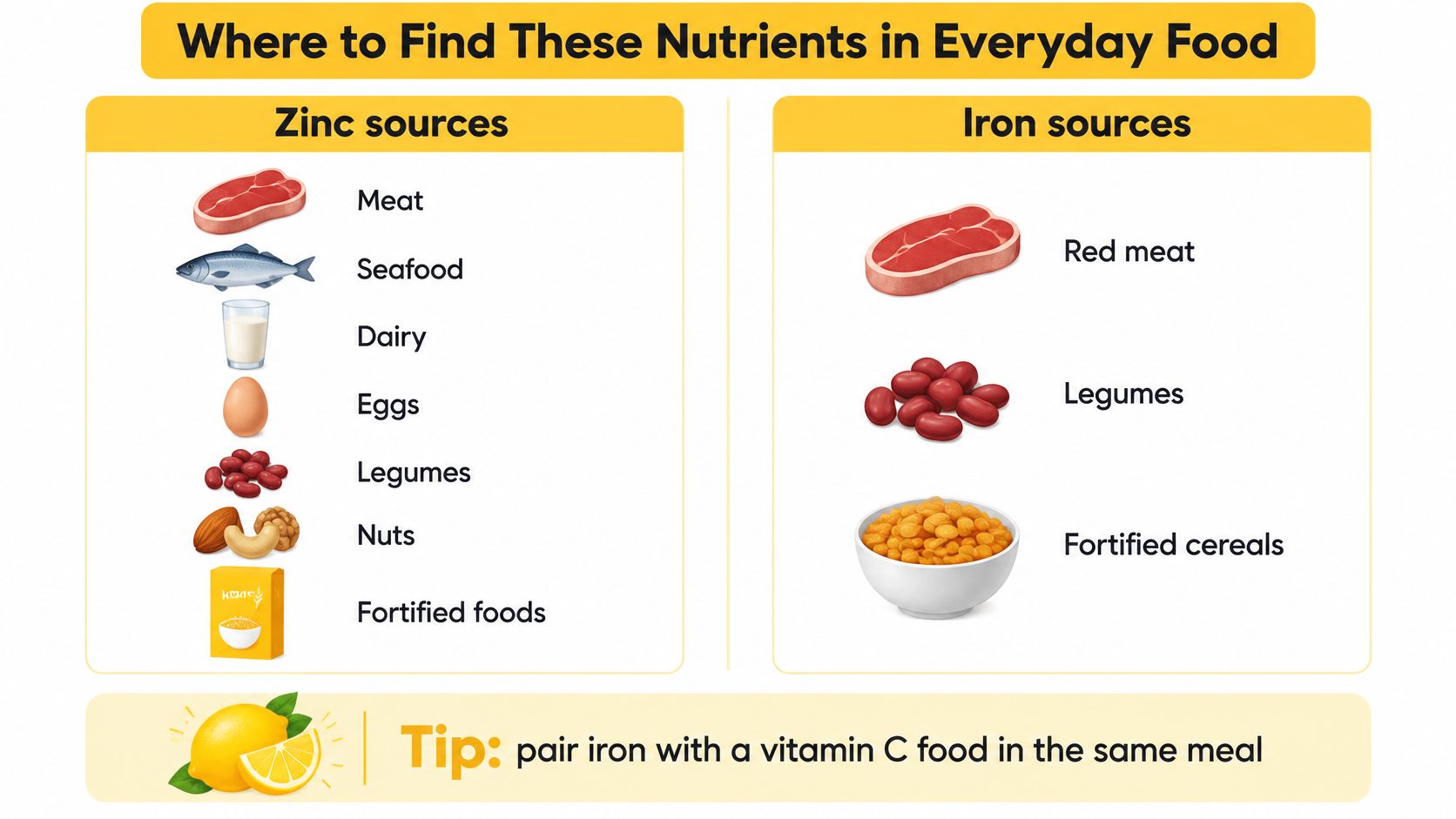
Vitamin C is particularly useful to understand. It's needed for collagen formation and improves absorption of non-haem iron, the form found in plant foods. Citrus, berries, capsicum, broccoli and kiwi are practical choices, consistent with the Australian nutrient reference guidance for vitamin C.
Build meals rather than isolated nutrient targets
Try a familiar meal with a small addition: capsicum alongside a legume-based lunch, berries with breakfast, or broccoli with dinner. These are meal ideas, not promises that a particular combination will change hair or nails.
For a lunchbox, yoghurt, capsicum strips and a suitable spread can offer variety without turning lunch into a supplement schedule. Choose foods and textures that suit the child's needs and follow school allergy requirements.
- Food's advantage: You can build variety into meals the family already eats, rather than adding another product to remember.
- Food's limitation: A very restricted diet may need individual assessment rather than repeated encouragement to eat differently.
- A supplement's advantage: Its label provides a measurable amount that can be recorded and reviewed.
- A supplement's limitation: That amount may overlap with other products or fortified foods.
The following video is an optional companion to the food discussion.
A supplement is most defensible when there's a clear purpose, such as restricted intake, an identified deficiency or a clinician's recommendation. It shouldn't become a substitute for working out why eating is difficult or why a symptom has appeared.
How Much Children and Adults Need Each Day
A child's hair, skin or nails can change while their overall diet still meets many nutrient needs. In the 2023 National Nutrition and Physical Activity Survey, children aged 2–11 years generally met requirements for most assessed vitamins and minerals. Calcium was the main concern.
Survey results describe groups, not an individual child. Use age-specific nutrient reference values to assess intake, and seek advice if symptoms or a restricted diet raise concerns.
Read daily amounts carefully
These reference amounts can help you review a child's diet. They are not automatic supplement doses. For zinc, Healthdirect lists the following daily amounts and advises against taking more than 40 mg a day unless directed by a doctor (Healthdirect zinc guidance). The 40 mg figure is not a safe dosing target for children.
| Nutrient | Age group | Daily amount | Caution |
|---|---|---|---|
| Zinc | 4–8 years | 4 mg/day (Healthdirect) | Count food and supplements together |
| Zinc | 9–13 years | 6 mg/day (Healthdirect) | Use the child's age band |
| Zinc, additional supplemental | General caution, not a child-specific limit | Healthdirect advises not exceeding 40 mg/day unless directed by a doctor (Healthdirect) | Excess can interfere with copper and iron absorption |
| Vitamin C | 1–3 years | 25 mg/day (NHMRC nutrient reference values) | Check age-specific needs |
| Vitamin C | 9–13 years | 28 mg/day (NHMRC nutrient reference values) | Extra vitamin C is not a proven appearance treatment |
| Calcium | Children | Consult age-specific nutrient reference values (NHMRC nutrient reference values) | Assess this separately from beauty claims |
| Biotin | Children | Consult age-specific nutrient reference values (NHMRC nutrient reference values) | Don't borrow an adult product's dose |
| Zinc | Adults | Consult age- and sex-specific nutrient reference values (NHMRC nutrient reference values) | Children's amounts don't apply |
| Vitamin C | Adults | Consult age- and sex-specific nutrient reference values (NHMRC nutrient reference values) | Check individual circumstances |
Add up total daily intake
A simple worksheet can show where each family member's nutrients come from. Use columns for food or product, amount consumed, nutrient per serving and daily contribution. Record each person separately, since serving sizes vary.
For example, a child's multivitamin may provide zinc, while fortified cereal and other foods add more. Include all of these sources when estimating the daily total. The same approach can help when reviewing vitamin B12 supplements in Australia.
If a food label doesn't list a nutrient, mark its contribution as unknown rather than zero. A dietitian can help estimate intake without implying more precision than the available information supports.
Use recommended intake values as a guide for assessing the whole diet, rather than relying on a supplement to meet a target.
Judging Supplement Labels, Interactions and Warning Signs
An official-looking number isn't proof that a supplement will improve hair, skin or nails. Australia's regulatory system distinguishes between listed and registered medicines, and consumers need to understand what that distinction means.
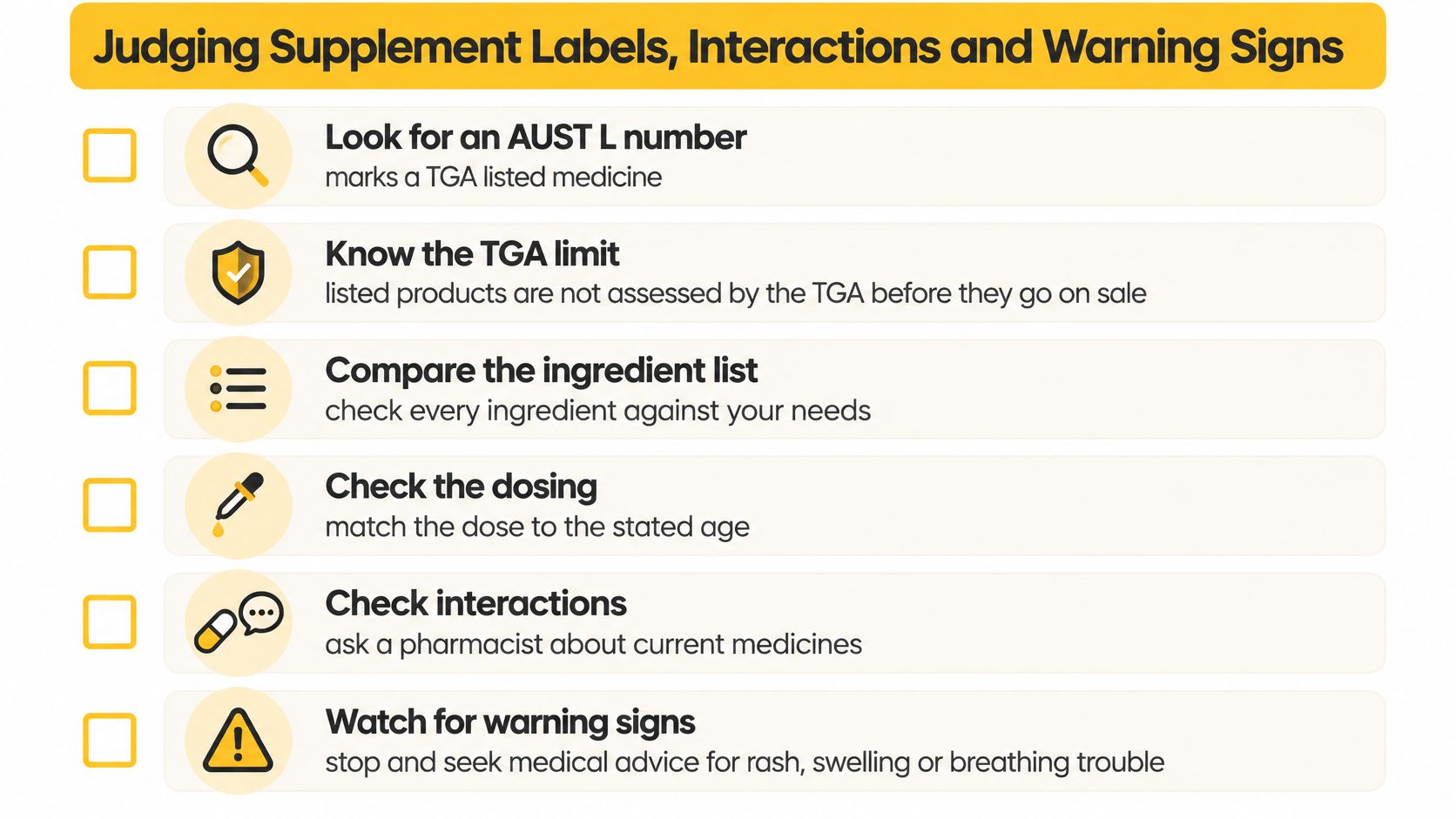
Most vitamins are listed medicines. Manufacturers must use permitted ingredients and meet manufacturing-quality requirements, but listed products generally aren't evaluated before market entry in the same way as registered medicines, as explained in the TGA's guide to vitamin regulation in Australia.
Use this checklist when comparing labels.
Check the full label, not just the promise
- Find the AUST number: Distinguish an AUST L listing from broader claims that a product is approved or proven.
- Confirm the intended age: An appealing flavour doesn't make an adult formula suitable for a child.
- Read the daily serving: Compare the amount taken according to directions, not just the amount in an individual gummy or capsule.
- Inspect every active ingredient: A collagen blend or relaxation product may also contain vitamins already present elsewhere.
- Review current medicines: Ask a pharmacist to check the actual combination rather than assuming vitamins can't interact.
- Check ingredient sources and allergens: Don't infer suitability from the product category or a familiar brand name.
The ingredient total matters beyond the product marketed for appearance. A family member might take a multivitamin, a separate mineral product and another blend without realising that their ingredients overlap.
Keep the original packaging available. A photograph of the front alone won't give a pharmacist enough information to review the dose, directions and warnings.
Don't overlook vitamin B6
The TGA guidance cited above also highlights stronger controls announced in November 2025 because long-term high-dose vitamin B6 exposure can contribute to nerve damage. This is a reason to check B6 across products, not only in a supplement labelled as a B vitamin.
Don't treat the absence of an immediate reaction as proof that indefinite use is appropriate. Agree on why a product is being taken and when its use should be reviewed.
Tell the clinician and testing service about all supplements before blood tests, including biotin-containing products. Ask whether any preparation or temporary interruption is needed rather than deciding yourself.
Tingling, burning or numbness means stop the product and seek medical advice. Don't respond by reducing the dose and continuing without a review, or by adding another supplement to address the new symptom.
Choosing Child-Safe Options and Setting a Daily Routine
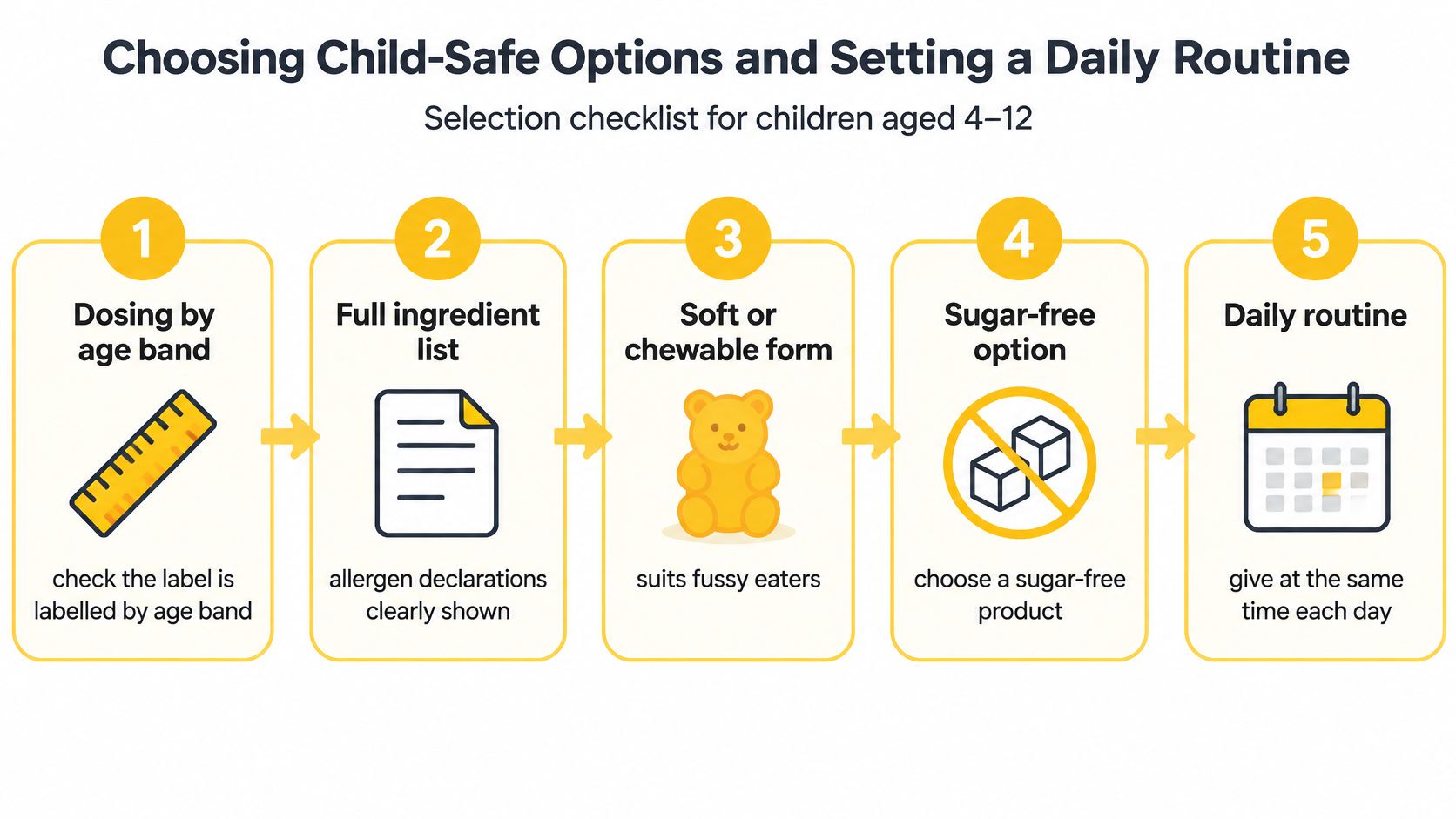
A supplement routine works best when it fits the child's age, needs and household schedule. Check the label for age-specific directions, ingredient amounts, allergens and a form the child can take safely.
Choose for the child, not the marketing category
- Age-specific directions: Check that the product is intended for your child's age.
- Clear ingredient amounts: Make sure you can see what each daily serving provides.
- Practical format: A chewable or soft texture may make a routine easier, but it does not make the product more nutritious.
- Dietary suitability: Read the allergen and formulation details.
- Simple household routine: Choose a product that caregivers can give as directed and store safely.
For example, Brave is described as a daily children's multivitamin gummy with a vegan-friendly formulation and no artificial colours or flavours. These details can help you assess whether the product suits your household.
Before buying, be able to name the nutritional need the product is intended to address. Hair, skin or nail claims alone are not a reason to start a supplement.
Make the routine easy to review
Use the symptom guidance in Section 2 and the intake method in Section 4 as your starting points. Then agree on a simple routine with the child's clinician or pharmacist.
Choose a regular time that follows the label directions, such as breakfast if suitable. Keep one shared dosing record where caregivers can check it, and store the product out of children's reach. This helps prevent missed or duplicate doses.
Set a review date with the clinician based on why the supplement was recommended. A change in appearance does not, on its own, show that the supplement caused the change.
Keep the child's role simple: take part in a familiar routine rather than watching for changes in appearance. Adults remain responsible for dosing, storage and follow-up. Meals and everyday care still provide the foundation.
Daily Powers offers children's gummy supplements designed for a repeatable family routine, with product information for caregivers comparing options. Visit Daily Powers to review ingredients and usage guidance, then ask a pharmacist or dietitian about your child's needs and any overlapping nutrients before choosing.