

Walk down the children's supplement aisle and the gummies are easy to spot. Bright fruit on the front, the word "kids" in large letters, a promise about immunity or growth. So why does the back of so many of those bottles read "4 years and over", when the fussiest eaters in the house are usually two and three?
That mismatch is where most of the confusion around gummy vitamins for toddlers begins. The product looks like it was designed for a small child. The dose, the format and the safety instructions were often written for an older one. Parents fill the gap with guesswork, and guesswork is the wrong method with anything a child swallows.
This guide treats the gummy as a supplement decision rather than a flavour choice. It covers what Australian evidence says about how often young children take supplements, which children are likely to need one, how to read a label written for someone else's age group, and the storage habits that stop a sweet-looking vitamin from becoming an accidental overdose.
Table of Contents
- Are Gummy Vitamins Safe for Toddlers?
- Do Toddlers Need a Multivitamin and When to See a Paediatrician
- Ingredients to Avoid and What to Look For on the Label
- Gummy, Liquid and Chewable Options for Under-4s
- Choking, Poisoning and Storage Rules for Gummies
- How to Introduce Gummies Into a Toddler Routine
- Gummies for Children Aged 4 and Over
Are Gummy Vitamins Safe for Toddlers?
The verdict, up front: for most toddlers eating a varied diet, a gummy is not a routine need, and for any child it should only be given inside the label's stated age range and dose.
That isn't a rejection of the category. It's a question of placement. A gummy is a supplement that sits alongside food, not in place of it, so the first decision isn't flavour or brand. It's whether this particular child's diet has a real gap that a supplement would fill.
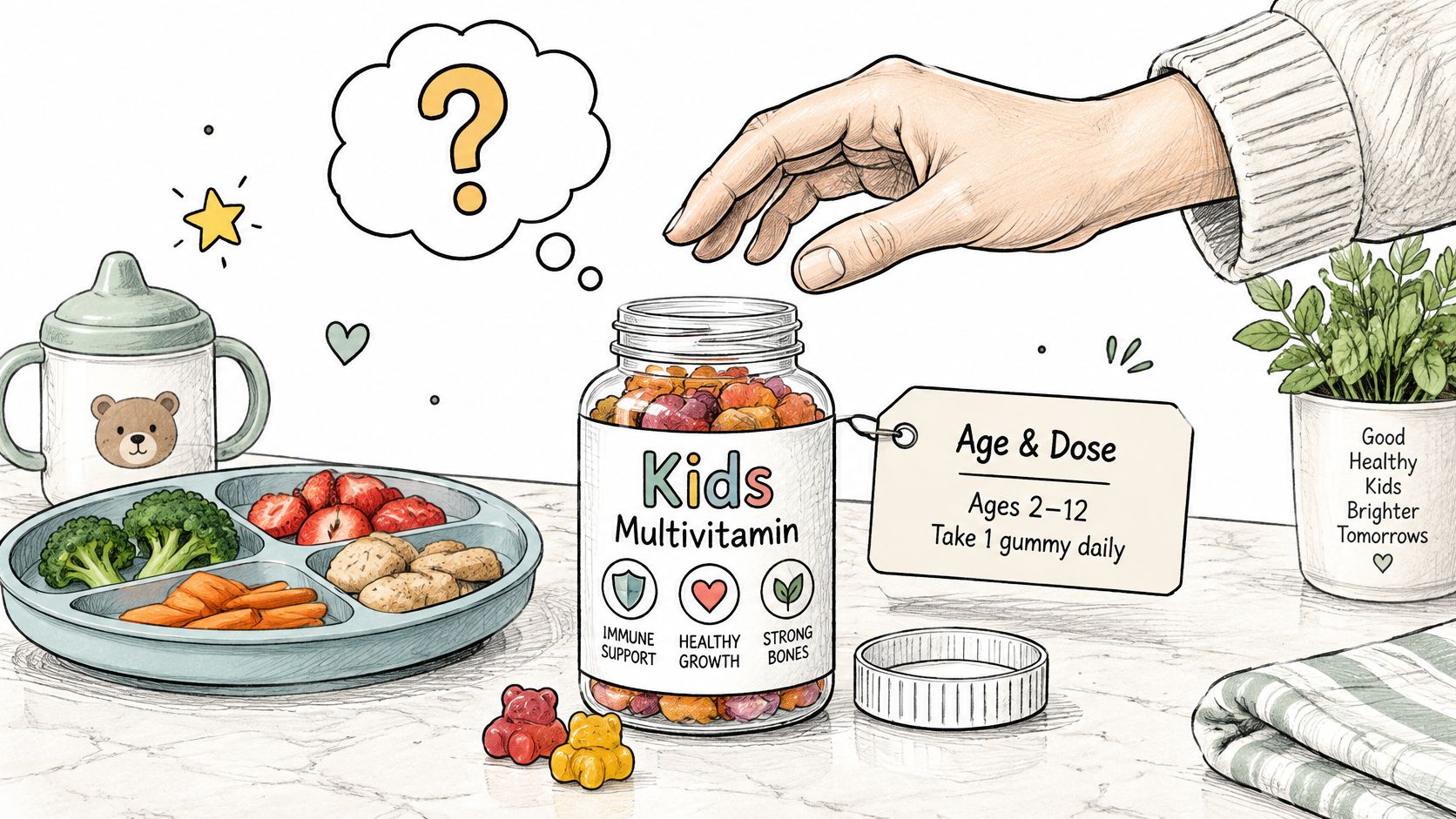
What supplement use in Australia actually looks like
Daily gummy use isn't an established household habit here. A national analysis of Australian children's usual nutrient intakes reported that only 6% of caregivers said their children used supplements, and fewer than 10% of children were given infant vitamin or mineral supplements, with vitamin D the main product reported (published analysis of Australian children's nutrient intakes).
Read that again. Supplement use is the exception, not the baseline. A parent doesn't need a reason to skip a gummy. They need a reason to start one.
The same analysis notes that Australian food standards govern how vitamins and minerals can be added and declared. Food Standards Australia New Zealand permits added vitamins and minerals only where the Food Standards Code allows it, requires added nutrients to be listed in the ingredient list, and sets minimum thresholds for claims and limits on permitted amounts in formulated supplementary foods for young children. In short, the products that do get used are meant to be clearly labelled and carefully dosed.
The three checks this article runs through
Diet gap. Does the child's everyday eating leave a genuine shortfall, or does the gummy just feel reassuring to buy?
Format and safety. Can this child physically take the product without choking, and does the household have a storage routine that keeps a lolly-shaped supplement out of reach?
Label fit. Does the minimum age on the pack match the child in front of you, or are you planning to halve an older child's serve without saying so?
If your child eats widely across the food groups and the label's minimum age sits above your child's age, a gummy isn't the right tool today. The next step is a conversation with your GP or paediatrician, not a smaller dose of something designed for someone else.
Do Toddlers Need a Multivitamin and When to See a Paediatrician
Most of this question resolves before you reach the shelf. Match your situation to a row, then read the reasoning below it.
| Situation | Likely need | Next step |
|---|---|---|
| Varied diet with dairy, fish, eggs, vegetables and fruit | Usually no supplement needed | Keep a food-first routine and raise concerns with the GP |
| Very restricted eater with few food groups | Possible gap in several nutrients | GP or dietitian reviews the diet before any product |
| Low dairy or calcium intake | Calcium gap; a multivitamin is not the fix | Dietitian reviews calcium-rich foods first |
| Diagnosed deficiency or medical condition | Dose set by a clinician | Follow the clinician's dose; do not add a product |
| Child taking an older sibling's gummies | Dose and age not matched to the child | Stop and ask a paediatrician or GP |
Why a multivitamin isn't the answer to every gap
National data point to a more specific picture than the shelf suggests: children aged 2 to 11 generally had adequate intakes of most vitamins and minerals, with calcium the notable exception (Australian Bureau of Statistics food and nutrition data). That single exception matters, because calcium isn't the nutrient most multivitamin gummies are built around.
So a child drinking little milk and eating few dairy alternatives may well have a calcium shortfall. A broad multivitamin won't reliably close it, and adding one can disguise the problem rather than solve it. The productive move is a dietitian reviewing calcium-rich foods, and a GP deciding whether anything else is needed.
For the restricted eater, the pattern is different again. When a child eats from only a handful of food groups for weeks, the review comes first and the product comes second, if at all.
A rule worth keeping: a gummy is never the treatment for a diagnosed deficiency. Once a clinician sets a dose, adding a second product on top is how children end up above the upper limit for a nutrient.
Signs that need a paediatrician, not a supplement
Book an appointment rather than a product if you're seeing poor growth, weeks of very restricted eating, frequent illness, a known allergy or an ongoing medication, or if your child has swallowed extra gummies by accident. Each of those changes the calculation in a way no label can.
Age is the other trap. "Toddler" usually means under four, while many children's products start at four. A reduced serve of an older child's gummy is not a safe assumption, which is why the paediatric dosing guidelines are worth reading before you decide on a serve size for a child under four.
What to bring to the appointment
Take the bottle, not a description of it. Your GP or paediatrician needs the product name, the ingredient panel from the label, and an honest account of how much is given and how often, including any fortified foods or other supplements in the house. That's a five-minute conversation that often ends with no product at all, which is a good outcome.
Ingredients to Avoid and What to Look For on the Label
A label written for a four-year-old tells you very little about a two-year-old. Read it for these six things before anything else.
- Nutrient form and amount per serve. Each vitamin and mineral named, with its chemical form and the elemental amount in the actual serve, not per 100g.
- Age-specific directions. A stated minimum age and a dose band that matches your child, not a single adult-style serve.
- A full ingredient declaration. Every added vitamin and mineral should appear in the ingredient list, as Australian labelling rules require.
- An allergen statement. Full disclosure of common allergens and processing warnings.
- Sugar and sweetener detail. "Sugar-free" is a starting point, not the whole picture.
- No artificial colours or flavours. Fewer unnecessary additives in something a small child takes daily.
Then question these:
- Broad claims with no numbers. "Supports calm" or "supports immunity" tells you nothing about dose.
- No minimum age anywhere on the pack. If the manufacturer won't name an age, you can't safely guess one.
- A dose expressed as a percentage of an adult daily value. That figure is close to meaningless for a toddler.
- Overlap with other products. Two supplements plus a fortified cereal can stack the same nutrient three ways.
Judging the dose against child reference values
Australian Government guidance is explicit that nutrient requirements vary by age and circumstance, and that the Australia–New Zealand Nutrient Reference Values set both recommended intakes and upper limits for vitamins and minerals (Australian Government consultation material on foods for infants and children). The upper limit applies to everything combined: food, fortified products and supplements.
Magnesium is the cleanest worked example. A pack front might shout "magnesium citrate" in large type, but that's the compound, not the dose. What matters is the elemental magnesium per serve, listed in the nutrition panel. Magnesium also arrives through dairy foods, whole grains, legumes, nuts, seeds and vegetables, and supplemental magnesium can add gastrointestinal risk when the dose is excessive or poorly tolerated. Food first, then a figure you can check.
Sugar-free deserves the same scrutiny, since removing sugar doesn't remove sweeteners, acids or flavourings. The guide to sugar-free gummies covers what those swaps mean in practice.
Dosing basics: give only the labelled serve for your child's age band, measure liquids with the dropper or spoon that came in the pack, and never double a dose to make up for a missed one. A skipped day costs nothing.
Gummy, Liquid and Chewable Options for Under-4s
Three formats, three different risk profiles. Compare them on the criteria that change the decision for a child under four.
| Format | Choking consideration | Dosing accuracy | Tooth and sugar note | Minimum age |
|---|---|---|---|---|
| Gummy | Soft; can be swallowed in large pieces | Hard to split; dose is fixed per gummy | Sticky; can cling to teeth; sugar-free is not tooth-safe | Check the label; many start at age 4 |
| Liquid drops | Lower solid-piece risk; spills and accidental drinking | Measured with a dropper or spoon | Check the label for sugar and acid content | Set by the label; no stated age means no toddler dose |
| Chewable tablet | Must be chewed well; crumbly pieces | Fixed tablet dose | Often less sticky; check the label | Set by the label; no stated age means no toddler dose |
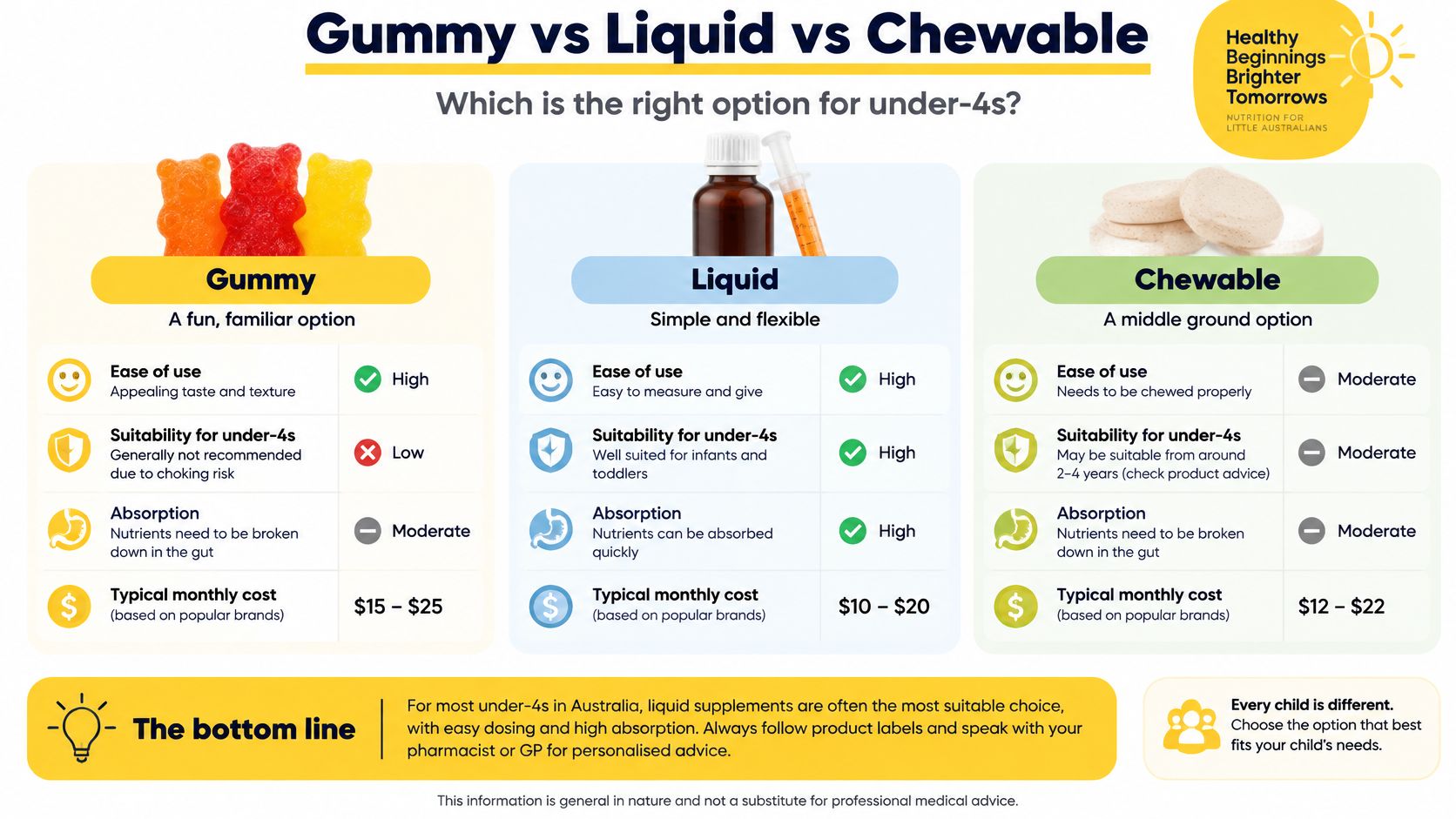
Gummies are popular for a reason that doubles as a warning: children accept them readily. That acceptance is exactly why they need supervision. Poison-centre research from New South Wales shows how quickly that goes wrong. In a study of reports to the NSW Poisons Information Centre between 1 July 2014 and 30 June 2019, children aged 1 to 4 accounted for 41.5% of vitamin and mineral supplement exposure cases, and the researchers singled out palatable gummies and chews because children mistake them for confectionery and many packs aren't child-resistant (British Journal of Nutrition study of Australian supplement exposures).
The dental trade-off nobody mentions
Swapping sucrose for a sweetener solves one problem and leaves another. Australian dental guidance warns that vitamin gummies may raise tooth-decay risk because the sticky format holds the product against teeth, and that frequent sugar exposure increases decay risk (SA Dental nutrition and oral health guidance). A swallowed tablet clears the mouth faster than a chewed gummy.
That means sticking to one consistent mealtime, skipping repeated treat-style dosing through the day, and keeping normal brushing and dental check-ups. A sugar-free gummy is a better choice than a sugary one, not a pass on oral care.
When a liquid or chewable fits better
Liquid drops suit a child who can't manage a solid piece, and the supplied dropper makes a labelled dose easier to hit than a split gummy ever will. Check the minimum age before you rely on that convenience, and store the bottle where a small child can't drink from it.
Chewable tablets demand genuine chewing, and crumbly or chalky versions are hard work for a toddler with a small number of teeth. If the label only covers ages four and up, don't use it under four without paediatrician advice. Choose the format the label was written for and your child can take without choking or a daily argument.
Choking, Poisoning and Storage Rules for Gummies
A gummy can look like a sweet, but a toddler may eat several before an adult notices. Australian poison-centre reports show that accidental access to vitamins and minerals is a real household risk, so storage matters as much as the product itself.
| Product type | Reported cases |
|---|---|
| Multivitamins | 3,610 |
| Vitamin D | 2,080 |
| Iron | 1,533 |
| Magnesium | 804 |
| All vitamin and mineral supplements | 10,946 |
Reported vitamin and mineral supplement exposure cases by product type, New South Wales Poisons Information Centre, 1 July 2014 to 30 June 2019 (study of calls to Australia's largest poisons information centre).
Multivitamins accounted for the most reported exposures in this table. Iron and magnesium exposures can also warrant medical assessment if a child takes too much. Most cases were accidental, and children often consumed more than the recommended amount. In the study, 77% of cases were managed at home, while 17.7% involved hospital assessment or referral.
Gummies can be mistaken for sweets, and their packaging may not be child-resistant. Treat the bottle like medicine, even if its contents look and taste like food.
The six-step storage routine
- Store the bottle high and shut. Keep it in a closed cupboard above bench height, not on a bedside table, in a handbag or on a bathroom shelf.
- Close it properly. If the pack has a child-resistant lid, twist it until it clicks after every use.
- Give each dose yourself. Hand the gummy to your child. Do not let children take gummies from the container, even if they seem sensible.
- Put the bottle away straight away. Return it to storage before your child finishes chewing.
- Call it a vitamin. Avoid calling it a lolly, treat or snack. Clear language helps children understand that it is not food to help themselves to.
- Act promptly after an extra dose. If your child takes more than the labelled dose, call the Poisons Information Centre on 13 11 26 and follow its advice.
Check the storage spot tonight: Could a two-year-old reach the bottle by climbing on a chair? If so, move it before the next dose.
How to Introduce Gummies Into a Toddler Routine
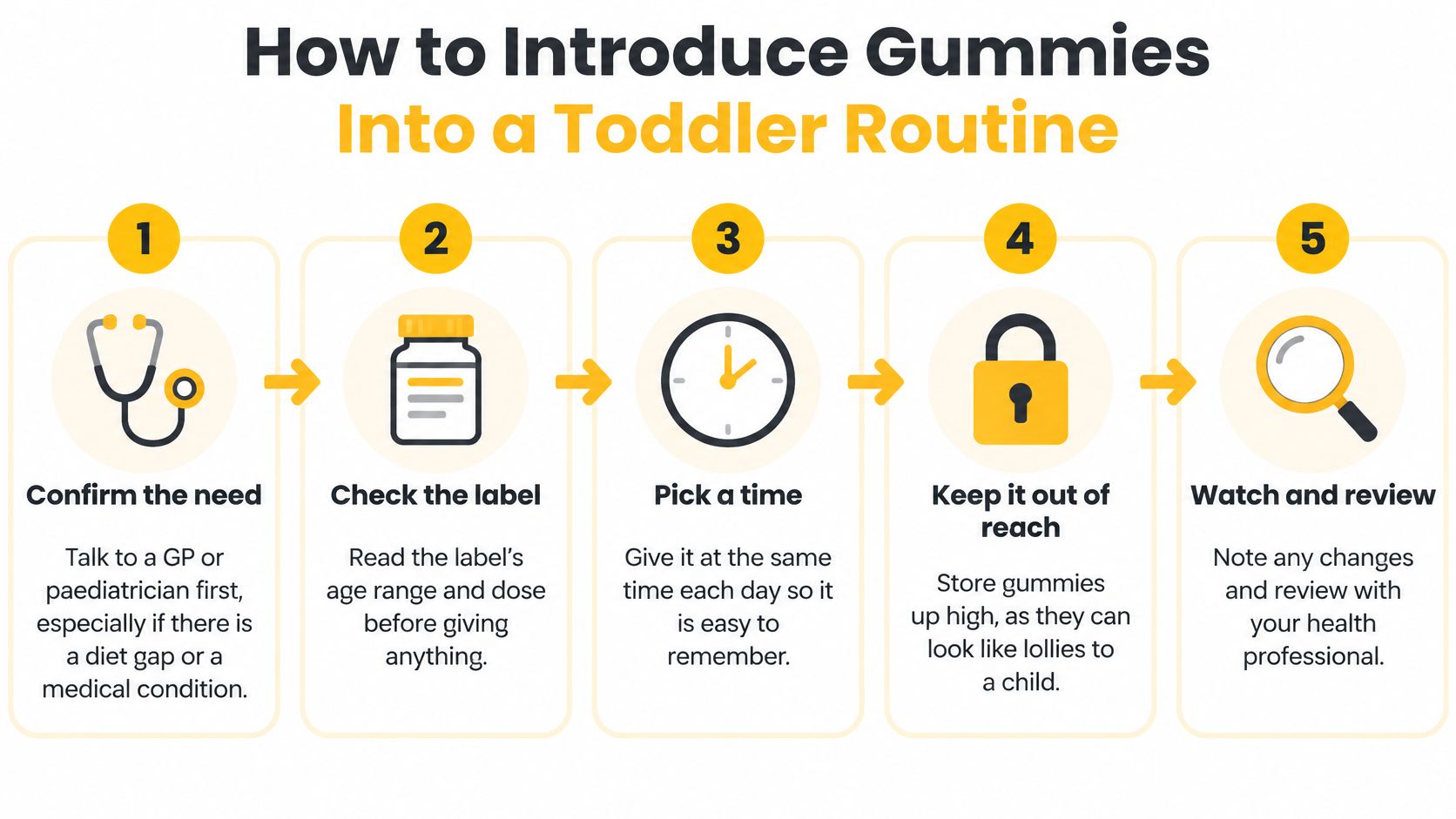
If a clinician recommends a supplement, plan how it will fit into the day before giving the first dose. A simple routine makes it easier to notice whether doses are being missed or the product is causing difficulty.
- Book the review before the first dose. Agree with your child's clinician when to check whether the supplement still fits the plan.
- Set up the routine in advance. Choose who will give the dose and where you'll record it, so other caregivers can follow the same plan.
- Choose a time you can repeat. Pair the dose with an established moment, such as breakfast, rather than relying on memory later.
- Keep a brief record. Note each dose and any problems, such as refusal or distress, so you have something concrete to discuss at the review.
- Include the review date. Around four weeks in, take your notes to the paediatrician or dietitian and ask whether to continue, change or stop.
- Adjust if the routine is not working. If doses are often missed or your child is distressed, contact the clinician rather than turning the supplement into a reward or negotiation.
For the first four weeks, a parent might mark each planned dose on a kids routine chart and note any missed doses or difficulties. That record can make the review more useful than relying on memory alone.
Keep the supplement in perspective: a gummy may help address a selected gap, but it does not replace the variety of foods recommended in the Australian Government's eating well guidance. Share supplements and fortified foods with your child's clinician, since the total amount from different sources matters.
Gummies for Children Aged 4 and Over
From age four the picture shifts. Many children's products are labelled from four upwards because that's the age band the dose was designed around, and a consistent daily routine becomes the main thing a caregiver is managing.
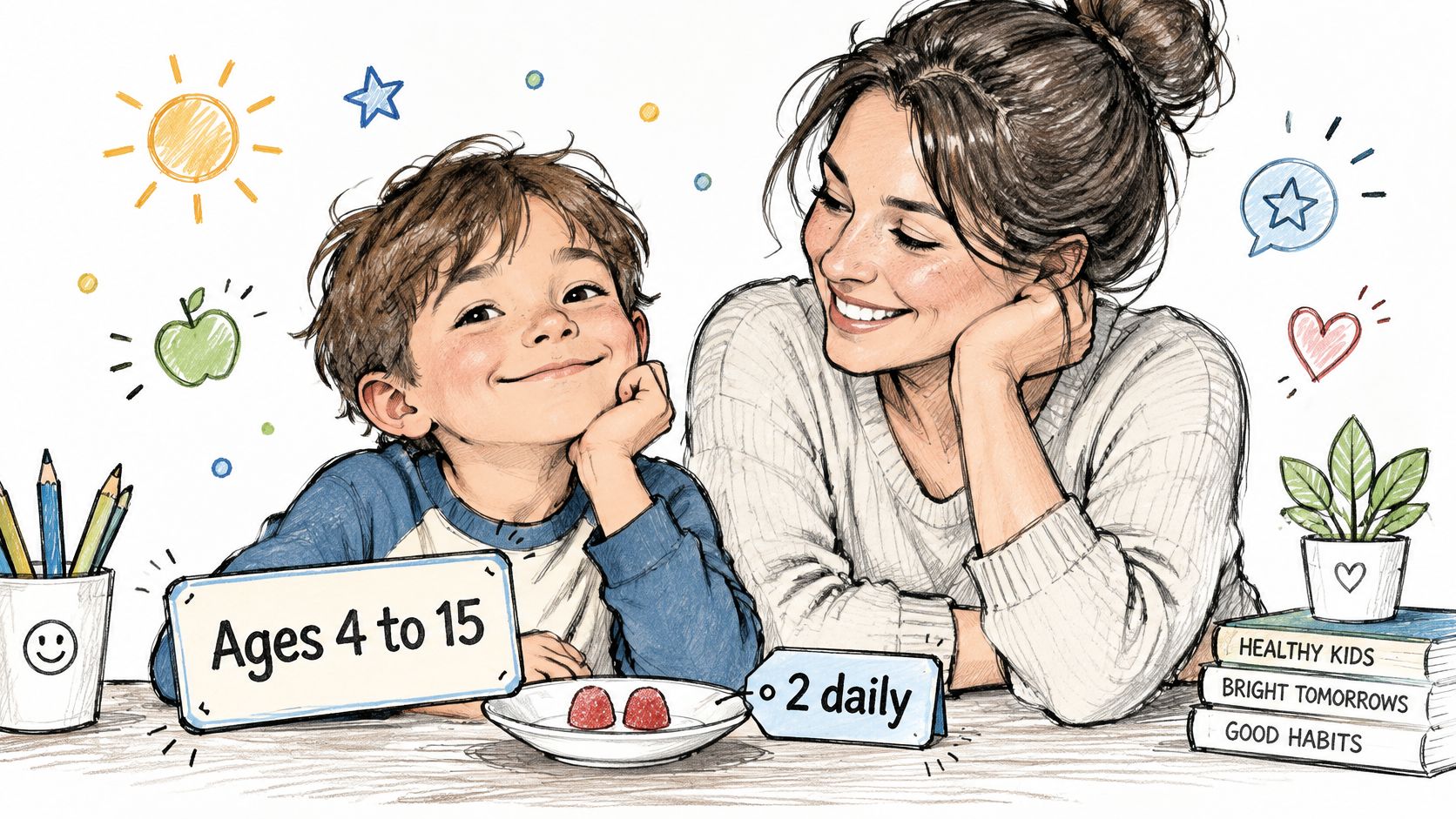
Our Brave daily multivitamin gummies are formulated for children aged 4 to 15, with 2 gummies daily, or as advised by a healthcare professional. Each serve delivers more than 12 essential vitamins and minerals in an orange flavour, with no sugar and no artificial colours or flavours.
Consistency is where most families come unstuck, so the delivery model matters more than people expect. A subscription with pause, skip and cancel options reduces the chance of running out mid-week and breaking the habit, and the 30 Day Guarantee means a family can trial a product and get their money back if the kids don't love it. Every Daily Powers gummy is developed with nutrition experts and to strict quality standards, which is the baseline any parent should expect before a child takes something daily.
None of that applies to children under four. For a toddler, the paediatrician's advice and dose come first, and a label showing a minimum age of four is a reason to wait, not a reason to start early with a smaller serve.
Write down three things before the appointment: what your child eats across a typical week, every supplement and fortified food currently in the house, and your questions. Then book the GP or dietitian visit before you buy anything.
If you're weighing up a daily multivitamin for a child aged four or over, Daily Powers makes sugar-free, vegan gummy supplements designed in Australia, with transparent ingredient lists and dosing guidance so you can check the details before you commit. Our range covers everyday multivitamins, focus support and magnesium for winding down, giving families one simple routine to build on. Visit Daily Powers to compare the range and see what fits your child's age.