

7.1% of Australian children aged 2–17 consumed sugar-sweetened drinks daily, according to the Australian Bureau of Statistics' 2017–18 National Health Survey. That puts sugar free gummies in perspective: choosing a supplement without sugar can be useful, but it's only one decision within a child's overall diet.
For parents, the bigger questions sit behind the front-of-pack claim. What provides the sweetness? Does the dose suit your child? What does an AUST number establish, and can your child chew the product safely? A sensible choice considers all of these, not just the absence of sugar.
Table of Contents
- Sweeteners Used in Sugar Free Gummies Compared
- Pros and Cons of Sugar Free Gummies
- How Sugar Free Gummies Fit a Lower-Sugar Routine
- Dental and Digestive Limits Parents Should Know
- How to Read an Australian Gummy Label
- Checking Dosage Against Age and RDI Benchmarks
- Choking Risk and Safe Daily Use for Children
- Test Two or Three Gummies Before You Commit
Sweeteners Used in Sugar Free Gummies Compared
A sugar free gummy still contains a sweetener, so check which one. Manufacturers draw from two families, and the choice shapes texture, dental exposure and how much a child can comfortably eat in a day.
| Sweetener | Type | Dental note | Digestive note |
|---|---|---|---|
| Maltitol | Polyol, also called a sugar alcohol | Replacing sugar can reduce decay risk; added acids still matter | Larger amounts can have a laxative effect |
| Sorbitol | Polyol | Non-cariogenic, but not protection against acid erosion | Larger amounts can have a laxative effect |
| Xylitol | Polyol | Non-cariogenic; assess the whole gummy | Can upset digestion; toxic to dogs, so keep away from pets |
| Erythritol | Polyol | Non-cariogenic; added acids remain relevant | Symptoms are possible with large amounts |
| Allulose | Rare sugar, not a polyol | Low cariogenic potential does not establish that a gummy is tooth-safe | Gas or digestive discomfort is possible |
| Stevia, or steviol glycosides | Intense sweetener | Non-cariogenic; check the other ingredients | Assess the bulk ingredient it is blended with |
| Monk fruit, or mogrosides | Intense sweetener | Non-cariogenic; the finished formulation matters | Often blended with ingredients that affect tolerance |
Bulk sweeteners and intense sweeteners do different jobs
Polyols provide sweetness and bulk. In gummy formulations they can replace some of the physical body that sugar would otherwise give. Polyols are also called sugar alcohols, a chemistry term for their structure.
Stevia and monk fruit supply intense sweetness with little physical bulk, so manufacturers blend them with a bulk ingredient to reach the intended texture and flavour. Seeing stevia on the front of a pack tells you nothing about what makes up the rest of the gummy.
A sweetener's energy contribution is not the same as the finished gummy's energy content. Use the product's energy declaration, where provided, instead of calculating calories from a sweetener name, because a single gummy can contain several sweeteners, fibres and other ingredients at once.
Not every sweetener in the table appears in every Australian children's product. Read the actual ingredient list, including the ingredients paired with a prominently advertised sweetener.
What parents should take away
- The ingredient list is more useful than a headline claim. Check the full blend rather than choosing a product solely because it contains a familiar plant extract.
- The dental notes describe the sweetener, not the finished product. Added acids and how often a child eats the gummy both shape decay risk.
- Tolerance differs between children. One child may take a polyol comfortably while another gets wind or looser stools, so begin with the labelled serve and watch what happens.
Keep xylitol-containing products securely away from dogs. Choose according to the complete formulation and directions, not a ranking of sweeteners from best to worst.
Pros and Cons of Sugar Free Gummies
| Potential advantages | Limitations to consider |
|---|---|
| A child's daily supplement can be delivered without adding sugar to the day | A sugar free claim answers one question; the panel still has to show nutrients your child actually needs |
| Individually moulded gummies make the labelled serve easy to count | Two gummies are easy to count, yet those two gummies may carry a nutrient load above your child's needs |
| A chewable format often suits a child who refuses tablets, so the serve gets taken | Chewing and swallowing still have to be reliable before you can depend on the format |
| Recipes without gelatine or dairy can fit some household dietary rules | Vegan and "natural" wording describes ingredients, not benefit, and not suitability for every child |
| A serve placed beside breakfast slots into a routine the household already keeps | The lolly-like look invites requests for extras, so the tub needs a home out of reach |
The strongest reason to choose sugar free gummies is straightforward: your child needs a specific supplement, and the family prefers a formulation without sugar. Let the nutrient decision set the format. Work out what your child's diet, a clinician or a blood test says is missing, confirm the product supplies it at an age-appropriate amount, then ask whether a gummy can deliver that amount reliably.
Convenience is the part parents get wrong most often. A flavour a child likes tells you the serve will be eaten. It tells you nothing about whether the active ingredients match the need. A bright pack also stays silent about the second supplement already sitting in the cupboard, which is how duplicated nutrients creep into a child's day. Read both labels side by side before you buy.
Decision rule: Choose the nutrient and dose first. Choose the gummy format only if your child can use it safely.
There is a practical trade-off too. Gummies simplify administration, but caregivers still count the serve, control access and watch for unwanted effects. Treat the tub like medicine, not like the fruit bowl.
The verdict is conditional: sugar free gummies suit families seeking a supplement without sugar when the indication, age range, dose, chewing ability and tolerance all fit. If any one of those checks fails, a different formulation, or no supplement at all, may serve your child better.
How Sugar Free Gummies Fit a Lower-Sugar Routine
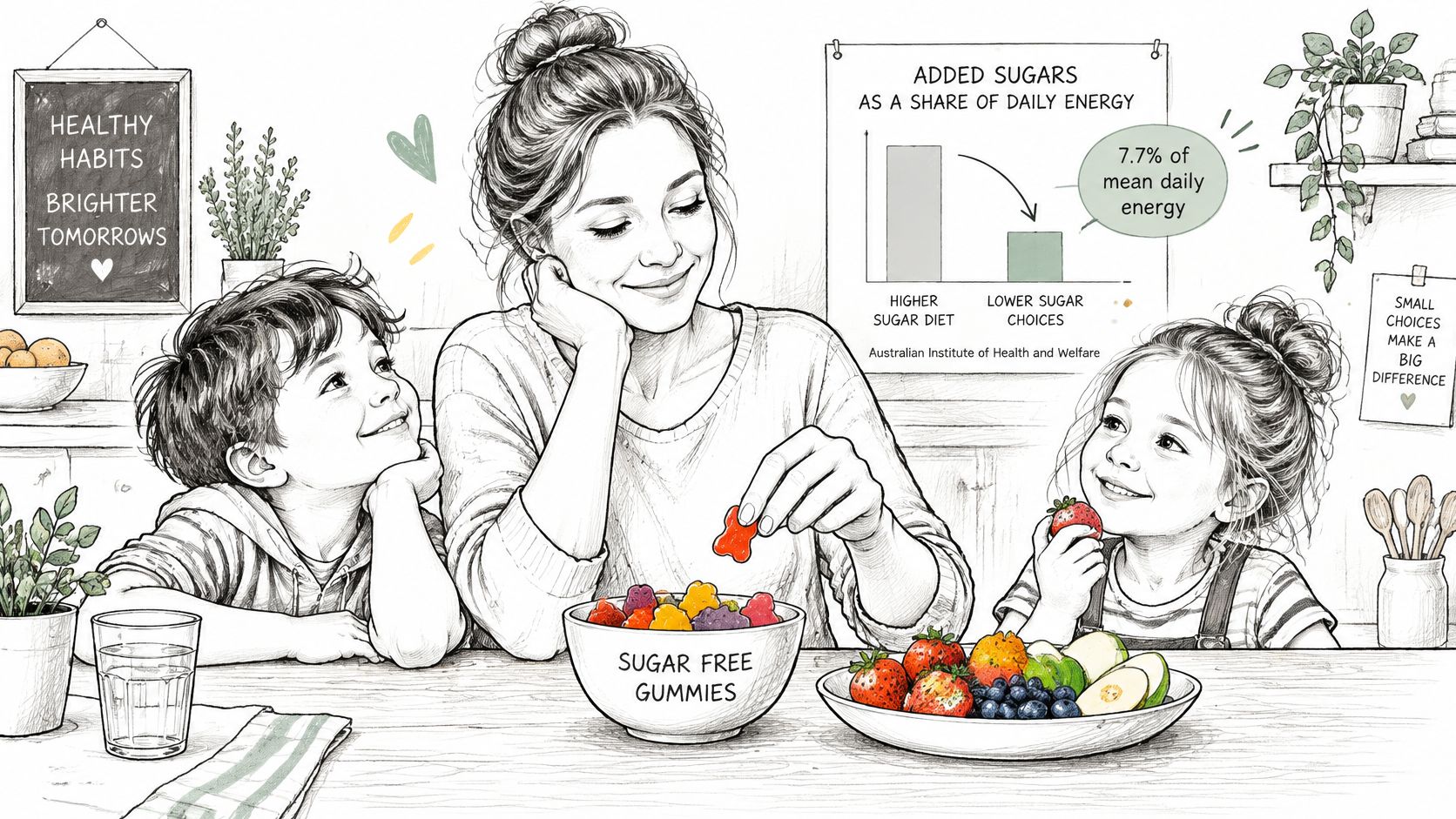
Added sugars contributed 7.7% of mean daily energy intake among Australian children aged 2–17 in the Australian Institute of Health and Welfare's 2023 analysis. The Australian Dietary Guidelines advise limiting foods and drinks containing added sugars, including confectionery, because they can add kilojoules without equivalent nutritional value.
A sugar free supplement can keep sugar out of that particular daily habit. It doesn't change the nutritional quality of everything else the child eats, and it shouldn't become permission for unrestricted sweet products.
Treat the gummy as a dose
A supplement gummy is a dose wearing lolly packaging. Its place in the household is closer to a measured medicine routine than a bowl of snacks.
Ask what changes when you introduce it. Does it replace a sugar-containing supplement, add another sweet-tasting occasion, or become a reward for finishing dinner? Those situations have different implications, even if the product is identical.
For a concrete example, Calm is a vegan, sugar-free gummy containing magnesium citrate, vitamin B6, zinc and prebiotics, without artificial colours, flavours or sweeteners. Those attributes describe the formulation; they don't decide whether an individual child needs it.
Make the routine predictable
- Choose an existing cue. Use a regular household event, such as breakfast, when consistent with the product directions.
- Separate supplements from treats. Don't offer extra gummies as a reward or negotiate the serving size.
- Make an adult responsible. One caregiver should know whether the daily serve has already been given.
Say a child receives a gummy with breakfast, then asks another caregiver for more after school. A simple tick on a shared checklist prevents uncertainty without making the child responsible for remembering the dose.
If sweet drinks and snacks are frequent, review those habits too. Removing sugar from a supplement is a narrow improvement, not a substitute for looking at the family's usual food and drink choices.
Dental and Digestive Limits Parents Should Know
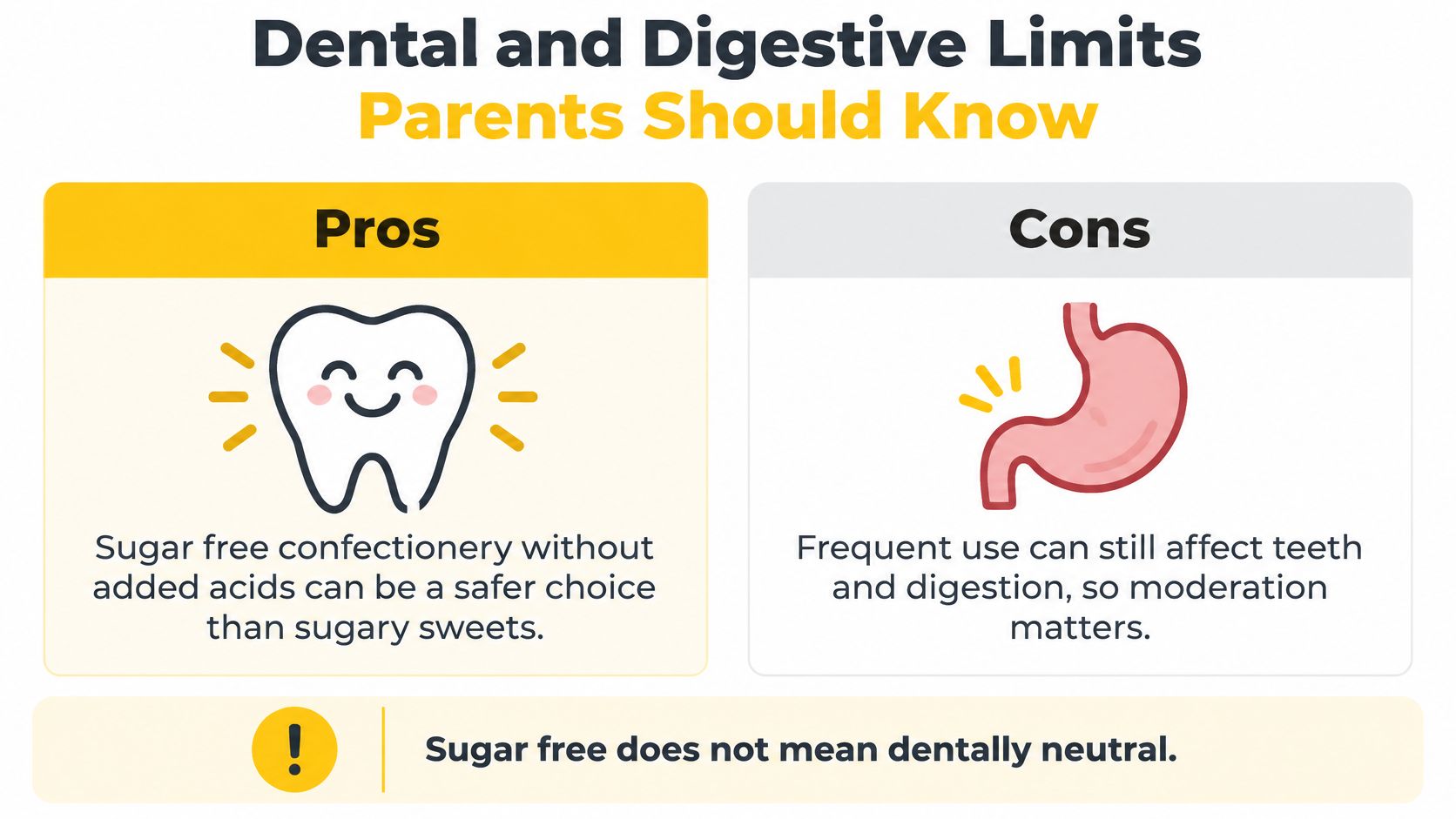
Sugar feeds the bacteria that cause decay, so removing it from a gummy lowers one risk. Enamel has a second weakness: acid. The Australian Dental Association's diet and nutrition policy treats sugar-free confectionery with no added acids as the safer swap, and asks parents to limit how often children's teeth meet acidic foods and drinks at all.
Fruit-flavoured gummies often carry citric acid or malic acid to sharpen the taste. Acid softens the outer enamel layer for a time, then saliva remineralises it. A child who eats gummies at one sitting gives teeth a single exposure; a child who nibbles them across an afternoon keeps restarting the softening before saliva finishes repairing it. Two mechanisms, then, and two separate questions to ask of any product: what sweetens it, and what acidifies it.
Check acids and eating patterns
The ingredient list names added acids, though it rarely gives a parent enough detail to calculate how erosive a particular gummy is. Taste is an unreliable guide here, because sourness and acid content do not rise and fall together consistently. Frequency is the part you can control. Keep gummies to the labelled serve at a planned sitting rather than letting them become a snack that reappears through the day.
A gummy never stands in for brushing with fluoride toothpaste or for regular dental visits.
Watch the child's digestive response
Prebiotic fibre in a formulation is worth flagging for a child with a sensitive gut, since tolerance varies from one child to the next. Introduce one new supplement at a time so that any change in symptoms can be traced to something specific, and remember that timing alone does not prove the gummy was the cause.
A workable routine looks like this:
- Give the labelled serve at a planned sitting rather than allowing grazing.
- Offer water afterwards.
- Maintain normal brushing with fluoride toothpaste.
- Check the ingredient list for added acids and sweetener blends.
- Pause the product and consult a health professional if stomach symptoms persist.
Resist the temptation to troubleshoot poor tolerance by adding serves, stacking products or improvising doses. If the routine above does not settle things, the formulation, the active ingredient or something unrelated to either may need a closer look, and that assessment belongs with a clinician rather than with another experiment at the breakfast table.
How to Read an Australian Gummy Label
- Find the AUST number if the gummy is sold as a therapeutic good. Check the exact entry in the Australian Register of Therapeutic Goods, or ARTG. A confectionery product isn't automatically a medicine just because it's a gummy.
- Identify whether the prefix is AUST L, AUST L(A) or AUST R. These categories don't mean the same thing.
- Compare the active ingredients and amounts on the pack with the product information. Check whether quantities refer to each gummy or the complete daily serve.
- Read beyond the actives. Find the sweeteners, added acids and other ingredients that may affect suitability.
- Read the directions for the intended age range, daily amount and warnings.
- Separate nutrient content from therapeutic claims. An amount of vitamin C is a composition statement; a claim about supporting immunity describes an intended benefit.
- Check allergens independently. A vegan claim doesn't establish that a product meets every allergy-related requirement.
What each AUST code tells you
The Therapeutic Goods Administration's explanation of complementary medicine regulation distinguishes sponsor-certified listed medicines from assessed listed and registered medicines. Most listed complementary medicines aren't individually evaluated by the TGA before sale.
| AUST code | Category | Pre-market check | What to do |
|---|---|---|---|
| AUST L | Listed medicine | Sponsor certifies compliance; the product isn't individually evaluated before sale | Confirm the ARTG entry and check the exact labelled dose |
| AUST L(A) | Assessed listed medicine | Efficacy evidence is evaluated before listing | Check that the assessed indication matches the benefit you're relying on |
| AUST R | Registered medicine | Full pre-market assessment of safety, quality and efficacy | Recognise the broader assessment, but still check age, dose and warnings |
An AUST number is useful regulatory information. It isn't a personal recommendation for your child, and AUST L doesn't mean the TGA independently tested the product's benefits before sale.
Apply the claims separately
Say a pack carries no-sugar and vegan claims alongside AUST L. These are separate pieces of information: the formulation claims describe product attributes, while the code identifies its regulatory category.
None establishes that the product will improve a particular child's symptoms. If that's your reason for buying, ask whether the evidence addresses the product's actual indication and dose, rather than a broadly similar ingredient.
Our explanation of what TGA-approved vitamins means can help you interpret that common marketing phrase. The practical aim is to replace a vague impression of approval with a clear understanding of what was, and wasn't, assessed.
Checking Dosage Against Age and RDI Benchmarks
The TGA's Australian regulatory guidelines for complementary medicines state that a vitamin or mineral supplementation indication generally requires at least 25% of the relevant Australian Recommended Dietary Intake, while naming a vitamin or mineral in an indication generally requires at least 10%, unless lower-dose evidence supports the claim.
These are claim-related benchmarks, not instructions to give every child that proportion as a supplement. The RDI is a dietary reference, and meeting a claim threshold doesn't establish a deficiency or individual need.
Calculate using the right reference
Use this calculation:
Amount in the recommended daily dose ÷ relevant RDI × 100 = percentage of RDI
First, establish the complete daily dose. If the label gives an amount per gummy, account for the full labelled serving before making the comparison. Then use the reference appropriate to the child's age and sex.
For a worked interpretation, if the daily dose contains exactly one-quarter of the relevant RDI, it meets the supplementation proportion described by the TGA. If an older child's RDI for that nutrient is higher, the identical dose represents a smaller share.
That age difference isn't universal across every nutrient. Check the actual reference rather than assuming that every younger child has a lower requirement.
TGA dose benchmarks for a sugar free gummy
| Label situation | TGA benchmark | What to do |
|---|---|---|
| Supplementation indication for a vitamin or mineral | The supplementation proportion described in the TGA guidance | Compare the complete daily dose with the relevant RDI |
| Vitamin or mineral named in an indication | The naming proportion described in the guidance, unless lower-dose evidence supports it | Check the dose and evidence supporting the indication |
| Upper intake levels | Nutrient-specific limits using the relevant age reference and intake definition | Add relevant sources before comparing with the limit |
| Children across different age bands | An identical serve can represent different proportions of requirements | Use the child's applicable reference and labelled directions |
Check the total, not just the gummy
An upper intake level isn't a target to reach. Also, the intake sources included in an upper-limit comparison can differ by nutrient, so don't assume every limit treats food and supplements identically.
Take a list of other supplements, fortified foods and relevant medicines to a pharmacist. Include breakfast cereals, multivitamins and single-nutrient products rather than checking each bottle in isolation.
Our paediatric dosing guidance provides additional context for reading age-specific directions. If your child takes medicines or has a medical condition, confirm the proposed dose with a pharmacist or GP before starting.
Choking Risk and Safe Daily Use for Children
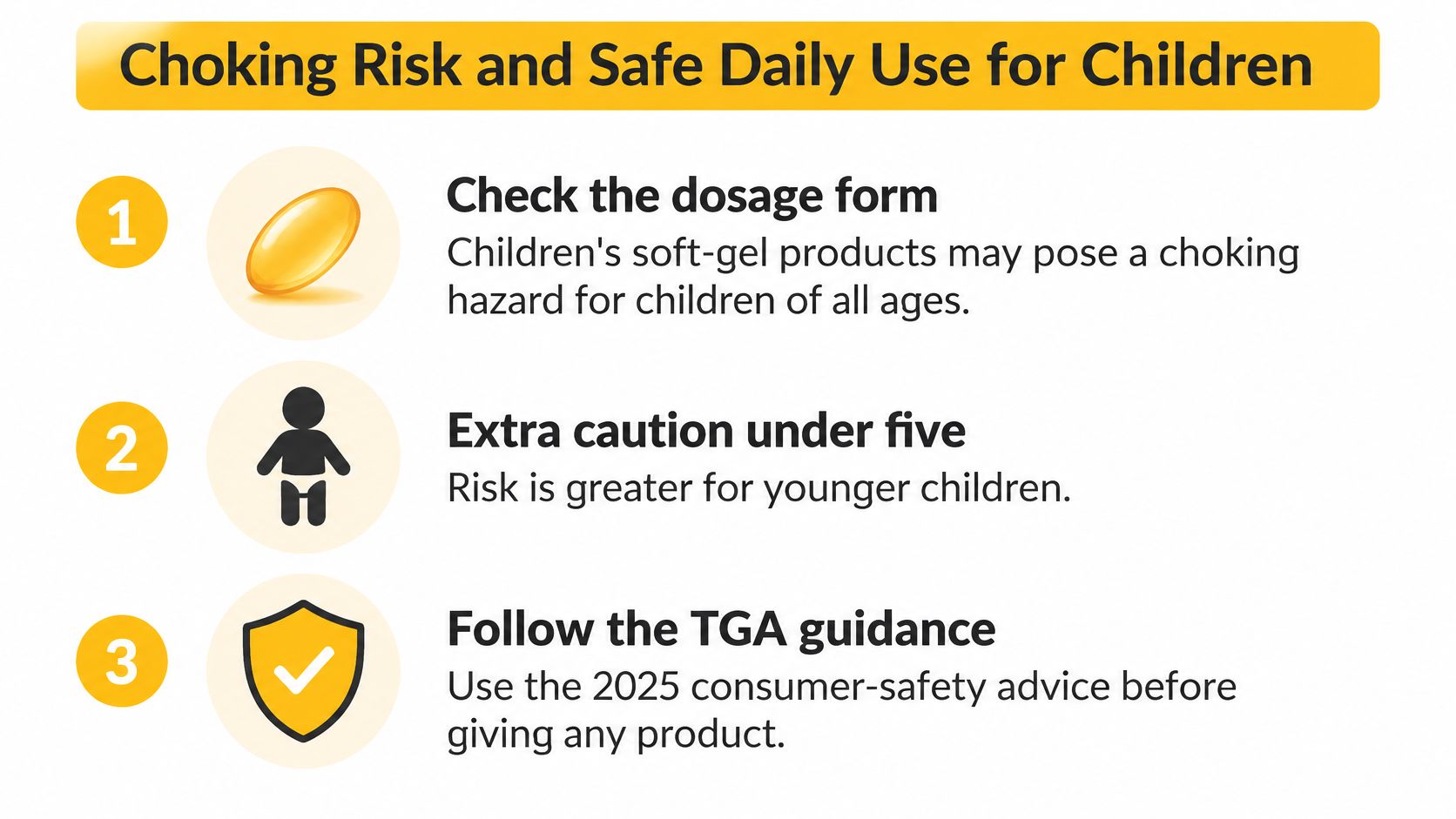
Younger children need particular caution with chewable dosage forms. The TGA's 2025 safety guidance on children's soft-gel complementary medicines warns that these products may pose a choking hazard for children of all ages, with greater concern for children under five, and recommends considering age restrictions, supervision and child-resistant packaging.
Gummies and soft-gel capsules carry different risks, so assess each product separately. A sugar-free claim describes the formulation. The physical form still needs a swallowing check. The useful question is whether this child can reliably manage this particular product, including its shape, size and chew.
Build safety around the child
A soft texture can still be hard to swallow. Children differ in chewing skills, attention and swallowing ability. A label's age range describes a product, while those skills vary from one child to the next.
Follow this administration routine:
- Check the exact age directions. For a preschool child, seek professional advice about developmental readiness rather than assuming that a child-oriented pack establishes suitability.
- Seat the child and stay within sight. Offer the product when they are sitting still. If they are running, playing or distracted while travelling, wait until the activity stops.
- Dispense the serve yourself. Keep the pack out of reach, and present the supplement as a supplement rather than an ordinary lolly.
- Store it securely in its original labelled packaging. Close any child-resistant closure properly and keep the pack out of children's reach.
- Seek advice before use if your child has swallowing difficulties, a relevant medical condition or takes other medicines.
What to do when chewing is difficult
Stop administration if your child pockets the gummy in their cheek, tries to swallow it whole or struggles to chew it. Hurrying a child through chewing adds risk, and cutting the product is not a reliable way to make it safe.
Ask a pharmacist about a more appropriate dosage form. Any change to form or mixing a product into food should follow product-specific advice rather than guesswork.
Our guide to chewable multivitamins for kids offers context for comparing formats.
A child's chewing and swallowing skills determine whether a chewable product is suitable.
For a child with swallowing concerns, get individual advice before offering a chewable supplement. A regulatory code and a soft texture both describe the product. Neither replaces an assessment of the child in front of you.
Test Two or Three Gummies Before You Commit
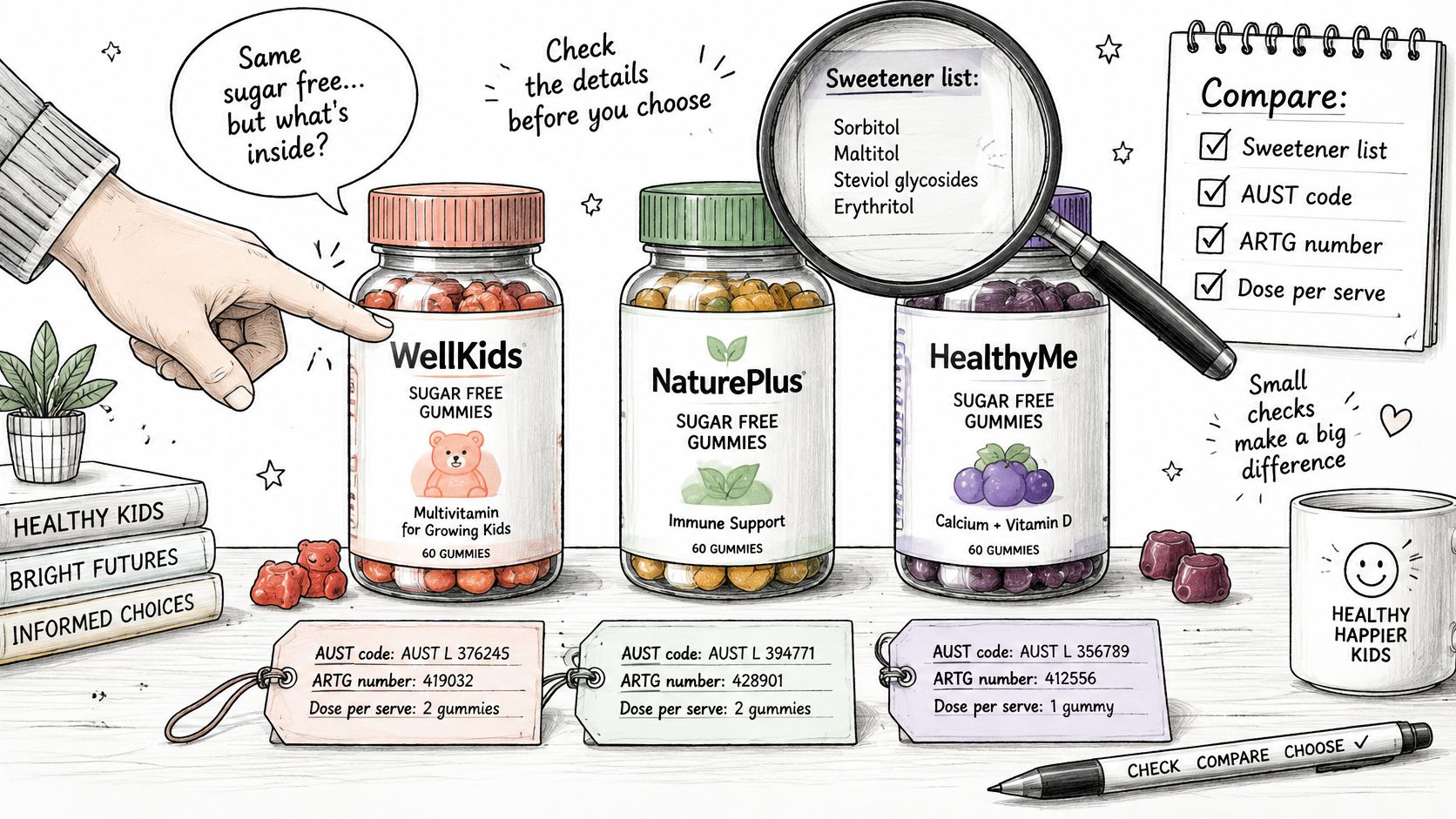
Compare products before testing them with your child. Put shortlisted packs side by side and apply the label checks: regulatory category where applicable, active ingredients, amount per daily serve, age directions, sweeteners, acids, allergens and warnings.
Set aside any product whose directions don't include your child's age or whose dose information is unclear. A comparison is only useful when you can establish what the child would receive.
Choose deliberately and observe
Before starting, confirm the choice with a pharmacist or GP if your child takes medicines, has a medical condition or has difficulty swallowing. Bring photographs of the full labels, not just the front panels.
Then introduce only the chosen product according to its directions. Don't trial several gummies together, because that makes both nutrient exposure and unwanted effects harder to interpret.
Keep a simple record:
- Administration: Note whether the correct serve was given and who supervised it.
- Tolerance: Record bloating, loose stools, discomfort or difficulty chewing.
- Purpose: Write down why the supplement was chosen and whether that reason still applies.
Review without assuming benefit
Good tolerance doesn't prove a supplement works. A child enjoying the taste, or a caregiver successfully maintaining the routine, answers a different question from whether the product provides the intended benefit.
Review ongoing use with the professional who recommended it when appropriate. Don't continue solely because you've finished a bottle, and don't wait for a planned review if concerning symptoms develop.
Sugar free gummies belong within a balanced routine, never in place of food, brushing or professional advice.
We offer sugar-free, vegan children's gummy supplements developed with nutrition experts, without artificial colours or flavours. Visit Daily Powers to compare our ingredient information and directions, then check the proposed choice against your child's age, needs and existing supplements.