

Could a colourful gummy really tell you whether your child needs a gut health supplement? These products may contain prebiotics, probiotics or synbiotics, but the ingredients do different jobs. In 2023, about one in three Australians aged 2 and over took a dietary supplement, according to the Australian Bureau of Statistics dietary supplement report.
For parents comparing gut health supplements in Australia, start by checking what's inside, what it's meant to do and whether your child has a reason to take it. The label is a little like a recipe: the ingredients matter more than the packaging.
Table of Contents
- What Gut Health Supplements Are and Why Parents Are Asking
- Prebiotics, Probiotics and Synbiotics Explained
- What the Evidence Shows for Children
- Safety and Regulatory Checks for Australian Children's Supplements
- Choosing Sugar-Free and Vegan Gut Health Supplements
- Dosing, Age Guidance and When to Seek Medical Advice
- Building a Daily Routine and Your Next Step
What Gut Health Supplements Are and Why Parents Are Asking
You're standing in the pharmacy aisle, holding a powder in one hand and a bottle of gummies in the other. Both mention gut health, but one contains bacteria and the other contains fibre. Your child's lunchbox is waiting to be packed, and neither label makes the decision especially clear.
That confusion is understandable. Gut health supplement is an umbrella term, not a single ingredient or a promise of a particular result.
Some products supply substances that feed microbes already living in the bowel. Others supply live microorganisms. Some combine these approaches, while mixed vitamin gummies may include a prebiotic alongside ingredients intended for other purposes.
Popularity isn't proof of benefit
The Australian Bureau of Statistics dietary supplement report puts supplement use at 33.6% in 2023, compared with 28.5% in 2011–12. Its classifications include probiotics and fibre products, so these belong within an established supplement category.
Those figures describe what Australians take. They don't establish that a particular ingredient improves children's digestion, or that a healthy child needs a daily product.
A more useful decision starts with the child rather than the shelf:
- If your child is well: Ask what problem you're trying to solve before adding anything.
- If eating is restricted: Consider the overall food pattern, not just whether a gummy contains a gut-health ingredient.
- If symptoms keep returning: Seek an explanation rather than repeatedly changing supplements.
Give the product a clear job
Try finishing this sentence before you buy: I'm considering this product because…
“Because everyone seems to take one” isn't a strong reason. “Because our dietitian has identified a specific need” gives you something concrete to assess.
A practical guide to gut health for kids can help organise those initial questions. The aim isn't to find the most impressive collection of ingredients. It's to decide whether a supplement has a useful, clearly defined place in your child's care.
Prebiotics, Probiotics and Synbiotics Explained
The gut works like a garden: some products feed microbes already there, some add live microbes, and others combine both approaches. This comparison separates products that manufacturers often group together.
Prebiotics are like fertiliser for selected plants already growing in the garden. Probiotics are like adding particular seedlings. Synbiotics bring the two approaches together.
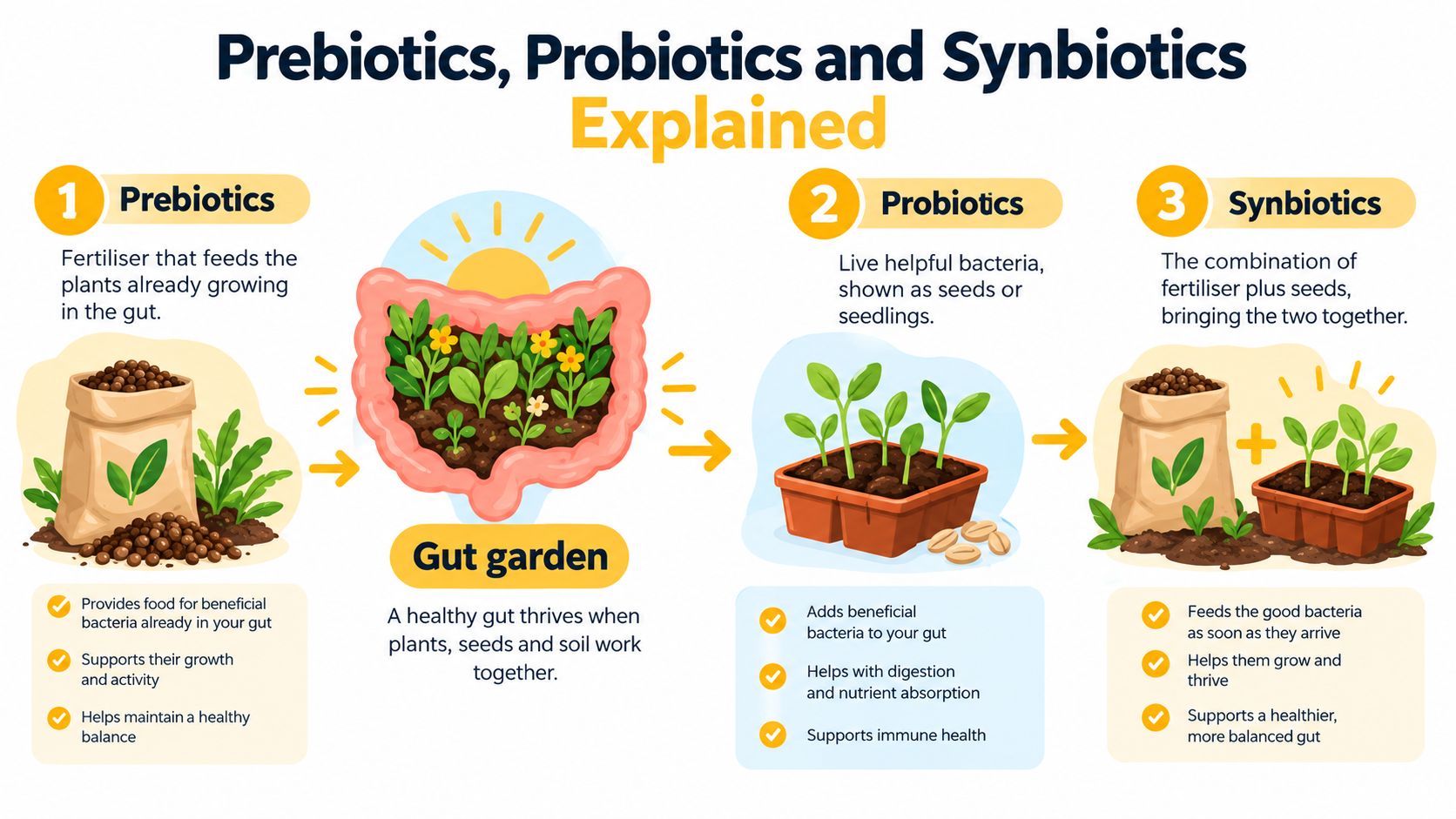
Read the garden picture as a checklist: is the product feeding existing microbes, adding new ones, or doing both?
Prebiotics feed rather than add
Prebiotic ingredients are typically fermentable fibres. Some fibre reaches the large bowel, where resident microbes can ferment it into short-chain fatty acids, as explained in this guide to what prebiotics do. Other fibre fractions contribute more through stool bulk and water retention.
Fibre and prebiotic aren't interchangeable labels. A fibre product should be assessed by its actual ingredients and purpose, rather than assumed to work like every other fibre-containing product.
Probiotics need a specific identity
Probiotics supply live microorganisms. Their effects depend on the particular strain and how it's used, so a result associated with one product can't automatically be transferred to another.
The Victorian public-health guidance on gut health advises that healthy people generally don't need probiotics for routine gut health. If a probiotic is being considered for a condition, the product needs to match that purpose, ideally with advice from a GP or accredited practising dietitian.
A bottle saying “contains probiotics” leaves important questions unanswered: which strain does it contain, what outcome was studied, and does that situation resemble your child's?
Practical rule: Name the ingredient first, then ask what it's meant to do.
A synbiotic combines prebiotic and probiotic components. Putting the two together doesn't by itself show that a product is effective. Assess its components and the reason for using it.
Fermented foods belong in the food conversation. A yoghurt or sauerkraut won't necessarily deliver the same strain or quantity as a labelled probiotic capsule. Check what the product provides rather than assuming foods and supplements have the same effect.
What the Evidence Shows for Children
Does a particular ingredient, used in a particular way, have support for the outcome your child needs? That narrower question is more helpful than asking whether gut supplements work as a whole category.

Possible benefits aren't universal recommendations
A systematic review of probiotics in children found that results varied by condition, so the evidence does not identify one probiotic strain, dose and timing that works for every child. A finding for one group or product is a bit like a recipe: changing the ingredients or the people it is for can change the result.
Trials in children have examined probiotics for antibiotic-associated diarrhoea and some irritable bowel syndrome symptoms. These are specific clinical questions, not evidence that every well child should take a daily probiotic.
Prevention and treatment are different questions. Evidence that an ingredient may reduce the chance of a problem does not automatically show how to manage it once symptoms begin.
A useful evidence check asks:
- Who was studied? Adult findings should not be assumed to apply to children.
- What was measured? A change in gut bacteria is not the same as less pain or easier bowel motions.
- What exactly was used? The ingredient, formulation and directions matter.
Food remains the foundation
The Australian Dietary Guidelines recommend grain foods mainly as wholegrain or high-fibre varieties, alongside vegetables, fruit and legumes. They also recognise fibre and adequate fluid intake as important in managing constipation.
Start with ordinary meals. Wholegrain cereal, fruit, vegetables and legumes can contribute to a child's food pattern, with choices adapted to what they can manage.
A gummy may make a routine easier for a reluctant child. That is a practical convenience, not proof of a digestive benefit. Its contribution still depends on the amount and identity of the prebiotic it supplies.
The video illustrates how everyday foods can support healthy eating. Supplements and food habits are separate parts of the conversation.
You do not need to rule out supplements altogether. Keep convenience, biological plausibility and demonstrated benefit in separate boxes, and match any product to the outcome you are considering.
Safety and Regulatory Checks for Australian Children's Supplements
Turn the pack around before making a decision. The front describes the product's appeal; the ingredient panel and directions give you information you can compare.
In Australia, food-health claims and therapeutic claims sit within different regulatory requirements. A statement about supporting a normal function shouldn't be read as permission to use a product to diagnose, prevent or treat a child's digestive condition.
Start with what the claim actually says
Under the Australian food-health claim framework, businesses making self-substantiated general-level health claims must notify Food Standards Australia New Zealand and certify that the food-health relationship has been established through systematic review.
The important practical point is specificity. Evidence for a particular prebiotic blend doesn't automatically support a different blend, a different serving size or every product that uses the same broad category name.
Nor does a change in the microbiome necessarily establish that a child will feel better. Parents should check whether the claimed endpoint is a laboratory measure, a bowel symptom or another outcome.
Label checks before buying a children's gut health supplement
| Label element | What to check |
|---|---|
| Precise ingredient identity | Look for the named prebiotic or the full probiotic strain identification, rather than only a category description. |
| Quantity per serve | Check the actual amount supplied by the recommended serving, including fibre or prebiotic quantities. |
| Age directions | Confirm the product is intended for your child's age. Don't estimate a child's dose from an adult label. |
| Evidence population | Ask whether the supporting evidence relates to children and a relevant age group. |
| Claimed endpoint | Distinguish changes in bacteria from improvements in symptoms or everyday functioning. |
| Claim wording | Ask whether the marketing wording matches the specific relationship supported by the evidence. |
| Other ingredients | Review the full formulation, including ingredients unrelated to gut health and any relevant allergen information. |
Treat regulatory language carefully
An approval statement shouldn't replace checking the actual pack, its directions and the precise scope of any claims. If a manufacturer describes a product as approved, ask what that means for that particular product rather than assuming it establishes every advertised benefit.
The explanation of the TGA approval process provides a starting point for questions about regulatory terminology. A pharmacist can also help you interpret unfamiliar wording.
A transparent label helps you assess a product. It doesn't remove the need to ask whether your child needs it.
If the ingredient quantity or age guidance isn't clear, pause the purchase. Asking the manufacturer for a written answer is more useful than guessing from a reassuring phrase on the front.
Choosing Sugar-Free and Vegan Gut Health Supplements
Could a product suit your family's preferences and still be the wrong choice for your child? Sugar-free, vegan and free from artificial colours or flavours can help narrow the options, but these features don't show whether a supplement will improve digestion.
Keep preference checks separate from questions about ingredients and purpose. It makes labels easier to compare.
Compare preferences alongside the full formulation
| Family preference | Useful check | What it doesn't establish |
|---|---|---|
| Sugar-free | Read the claim alongside the full ingredient list, including sweeteners and carriers. | That the product suits every child. |
| Vegan | Check the product's declared suitability and full formulation, not only its headline ingredient. | That it has stronger evidence for gut health. |
| No artificial colours or flavours | Check the manufacturer's statement against the remaining ingredients. | That every ingredient is needed or well tolerated. |
| Gummy or chewable | Consider whether your child can manage the format and follow the pack directions. | That the format provides a useful amount of an ingredient. |
“Sugar-free” and “no added sugar” are different label claims, and neither replaces a look at the ingredient list. Check for fruit powders, flavouring ingredients and sweeteners.
You don't need to turn shopping into a chemistry exam. If an unfamiliar ingredient matters to your child, ask a pharmacist or the manufacturer what it does in the formulation.
Compare purpose and labels, not just product names
Daily Powers offers children's gummies including Focus and Calm. The range describes Focus as a nootropic and prebiotic formulation, and Calm as magnesium-based. Two products from the same range can have different intended uses, so compare each label rather than assuming they are interchangeable.
Check the sugar-free, vegan and no-artificial-colour statements on each product page against the full ingredient list. Then read the amount of prebiotic per serve on the label and compare it with the directions for your child's age. If either detail is unclear, ask a pharmacist or the manufacturer instead of guessing.
These are mixed-ingredient formulations, so the prebiotic is only one part of the comparison. Consider the stated purpose and full formulation together. An ingredient amount on a label, by itself, doesn't show that a product will change your child's bowel habits.
Let acceptance be a practical factor
A chewable may be easier to fit into family life if your child dislikes powders or chalky tablets. That practical benefit matters, provided your child can use the format safely and the product otherwise suits them.
Choose based on the formulation and intended use first. Then consider whether your child will accept the format.
Before combining products, show their full ingredient lists to a pharmacist or dietitian. This can help you spot overlapping ingredients in mixed formulations.
Dosing, Age Guidance and When to Seek Medical Advice
Use the product's age-based directions, not an adult dose adjusted by guesswork. If the pack doesn't clearly cover your child's age, ask a pharmacist or their usual clinician before starting.
For the gummy examples above, check the current age guidance on the packaging and product listing. Don't assume that every item from a children's brand has identical directions or that a sibling's routine suits another child.
Make changes carefully
Rapid increases in fermentable carbohydrates can cause gas, bloating or abdominal discomfort. If you're considering a fibre or prebiotic supplement, ask how to introduce it gradually while staying within the product's instructions.
Keep the rest of the routine reasonably steady so you can describe what changed. Follow any fluid directions, and don't increase the serving because an effect isn't immediately obvious.
Useful notes for a clinician include:
- What changed: Record the product, serving and when it was introduced.
- What your child experienced: Describe discomfort or bowel changes in ordinary language.
- What else was happening: Mention illness, antibiotics, other supplements or changes in eating.
New discomfort isn't proof that a product is “working”. Pause and seek advice if symptoms appear or worsen rather than pushing through them.
Match the next step to the situation
The Australian Institute of Health and Welfare's gastrointestinal conditions material identifies these conditions as a chronic-condition group affecting 1.7% of Australians. That broad population figure isn't a diagnosis for your child, but it reinforces why digestive complaints deserve proper assessment.
| Your child's situation | Appropriate next step |
|---|---|
| Well, without digestive symptoms | Review the reason for supplementation rather than assuming a daily product is necessary. |
| Bloating or discomfort after starting a supplement | Pause and discuss the formulation and introduction plan with a health professional. |
| Persistent, severe or unexplained symptoms | Seek medical assessment rather than trying successive gut-health products. |
| Currently unwell or taking antibiotics | Check with the treating clinician before adding a supplement. |
| Diagnosed health condition | Include supplements in the existing care plan rather than managing them separately. |
| Immunocompromised | Don't start probiotics without medical guidance. |
Children with severe symptoms need prompt assessment. A supplement purchase shouldn't delay care while you wait to see whether a different ingredient helps.
The same applies when symptoms repeatedly return. Bring the label and your observations to a GP or child-and-family health professional so the conversation starts with the child's experience, not a product recommendation.
Building a Daily Routine and Your Next Step
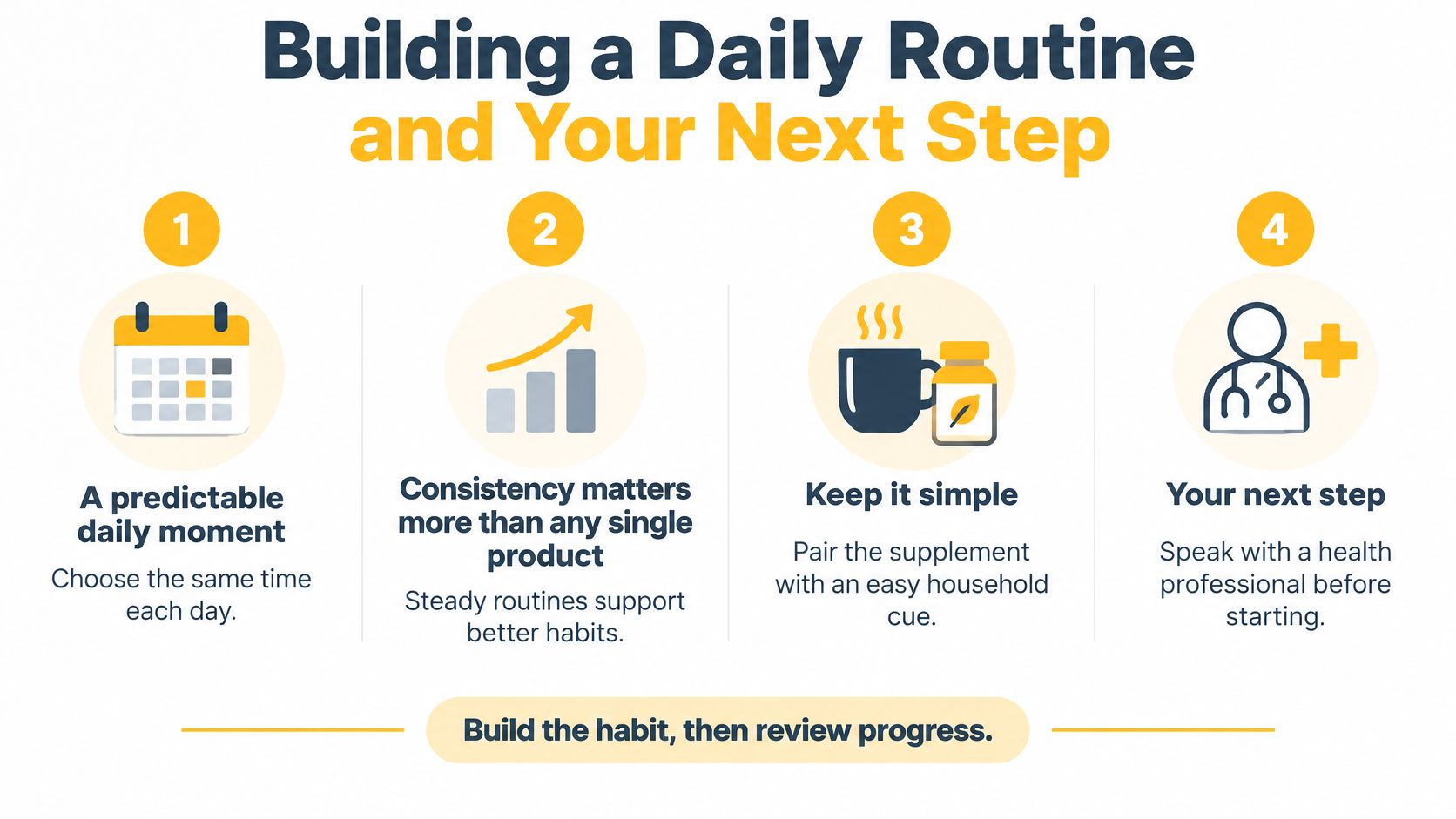
Once you've established that a supplement is appropriate, keep the routine uncomplicated. Pairing the dose with breakfast or the school-bag check is a practical way to give the adult a reliable reminder.
The aim is consistent use as directed, not perfect streaks or pressure on the child. Taking a supplement regularly also shouldn't distract from meals, fluids or follow-up care.
Make the routine easy to supervise
- Choose a familiar cue: Use an existing household moment rather than creating a complicated new task.
- Keep an adult in charge: Store the product according to its instructions, out of children's reach and separately from sweets. Put the reminder somewhere visible, not the gummies.
- Record the dose: A simple tick on a tracker can help caregivers avoid uncertainty about whether it has already been given.
- Plan a review: Ask the clinician when to reassess whether the product still has a useful role.
A small ritual can give your child a way to participate. They might bring their water cup or tick the tracker after the supervised dose, without being responsible for accessing or measuring the supplement.
Keep the language neutral. Taking a gummy shouldn't become a test of whether a child is good, brave or trying hard enough.
Use this visual as a reminder to simplify the habit and keep professional advice part of the process.
Do one useful thing this week
Choose a product you're considering and photograph its ingredient panel and directions. Check the ingredient identity, serving information and age guidance before deciding whether to buy it.
If your child has persistent symptoms or a diagnosed condition, use that photograph to start a conversation with a GP or accredited practising dietitian. You don't need the perfect supplement shortlist before asking for help.
For sugar-free, vegan children's gummies with published ingredient lists and usage directions, visit Daily Powers. Compare the formulations using these label checks, and take any questions about suitability to your child's pharmacist, GP or dietitian before starting.