

In 2023, 93.2% of Australian girls aged 12–17 had usual calcium intakes below the Estimated Average Requirement. That finding from the Australian Bureau of Statistics' national nutrient estimates reframes “high in calcium” as more than a label claim: the useful question is how much calcium a child eats, and whether the total suits their age.
A food can contribute meaningfully without providing a whole day's calcium. Read the serve size, check the calcium amount, and compare it with your child's daily target. The same approach helps you choose among dairy foods, fortified alternatives, tofu, fish and other options, without assuming that a single “high-calcium” product guarantees adequate intake.
Table of Contents
- Daily Calcium Targets for Kids by Age
- High in Calcium Foods Ranked by Serve
- How to Tell If Your Child Is Getting Enough
- Snack and Meal Ideas for Picky Eaters
- Why Vitamin D and Movement Matter Too
- When a Supplement Fits and What to Do Next
Daily Calcium Targets for Kids by Age
A four-year-old and a teenager have different calcium needs. The NHMRC Nutrient Reference Values set these daily recommended intakes for children and adolescents:
| Age (years) | Daily calcium target (mg) | What changes |
|---|---|---|
| 4–8 | 700 | Early school years and steady growth |
| 9–11 | 1,000 | Growth rises through the middle years |
| 12–18 | 1,300 | Peak bone-building years |
These are whole-day targets. Add calcium from all foods and drinks across the day; one snack or meal does not need to provide the full amount. The higher target for teenagers reflects the demands of rapid skeletal growth and developing bone.
Turn the target into a food example
A child who has a 250 ml glass of milk and a 200 g pot of plain yoghurt in one day gets about 640 mg of calcium, using the approximate values in the food table below. That is close to the 700 mg target for ages 4–8 and a smaller share of the targets for older children.
Treat the total as an estimate. Calcium content varies by product, so check the nutrition information for a more precise count. Other meals and snacks add to the day's intake.
Targets are planning benchmarks. One day below target does not show a deficiency. Appetite and food choices vary from day to day, so consider the usual pattern, particularly if a child avoids whole food groups or eats few calcium-rich foods.
Age changes the share a serve contributes: the same amount of calcium makes up more of a younger child's daily target than a teenager's. Keep your child's age band in mind when comparing daily intake with the target.
High in Calcium Foods Ranked by Serve
A food's calcium value depends on the portion a child eats. The figures below are approximate amounts for the listed serves, drawn from the Australian Bureau of Statistics' food and nutrient guidance. Brand, ingredients and preparation can change the amount.
| Food | Serve | Approx. calcium (mg) | Check before relying on it |
|---|---|---|---|
| Calcium-set firm tofu | 100 g | about 350 | Check that a calcium salt is listed |
| Plain yoghurt | 200 g | about 340 | Amount varies by brand |
| Canned sardines with bones | 90 g drained | about 330 | Bones must be eaten |
| Full-cream milk | 250 ml | about 300 | Standard reference serve |
| Hard cheese, such as cheddar | 40 g | about 300 | Amount varies by type |
| Calcium-fortified soy drink | 250 ml | about 300 | Check the label per serve |
| Almonds | 30 g | about 75 | Adds to the total, rarely the whole day |
| Cooked broccoli | 75 g | about 35 | Adds to the total, but contributes less per serve |
The order helps compare the calcium in each listed portion. It does not mean every child will eat the full serve, or that the figures apply to every product.
Check what makes the food a source
Tofu shows why ingredients matter. Firm tofu can provide substantial calcium when it is set with calcium salts. Check the ingredient list rather than assuming all tofu contains a similar amount.
Fortified soy drinks need the same check. Use the calcium amount for the portion your child drinks, not just the figure per 100 ml. If the label gives calcium per 100 ml, multiply that number by 2.5 to estimate the amount in a 250 ml glass. A partly finished glass provides less.
A listed serve is a measuring cup, not a guarantee of what ends up in a child's diet. Milk, yoghurt, cheese, fortified alternatives and bony fish can contribute substantial calcium in one serve. Vegetables and nuts can add to the total, though their listed portions provide less.
How to Tell If Your Child Is Getting Enough
A food's calcium contribution depends on the amount your child really eats. Compare their usual portions with the age-based target, allowing for the difference between a full serving and a few bites.
Population estimates can show where intake may be a concern, but they cannot assess an individual child. The Australian Bureau of Statistics' 2023 usual nutrient intake estimates found that 25.3% of boys and 38.1% of girls aged 5–11 had usual calcium intakes below the Estimated Average Requirement (EAR). Among Australians aged 12–17, 64.8% of boys and 93.2% of girls were below an EAR of 1,050 mg per day. These figures describe groups, not diagnoses.
Keep targets and adequacy measures distinct
A recommended daily intake gives families a practical target for planning an individual diet. The EAR is used to assess whether intake is likely to meet the needs of a group. Because they serve different purposes, falling below the EAR in an estimate does not by itself mean a child has a deficiency.
The ABS estimates use usual-intake modelling to account for day-to-day variation. A single day can be unusually light or calcium-rich, so it may not represent a child's typical pattern.
Look for a pattern, not a perfect day
Consider what your child usually eats across meals and snacks. For example, yoghurt at breakfast and cheese in a sandwich contribute to the day's intake; calcium-set tofu or another calcium source at dinner may add more. Count the portion eaten, rather than the amount offered.
Repeated gaps deserve attention. Dairy avoidance, a vegan diet, highly selective eating or regularly skipping calcium-containing foods can make it harder to reach an age-based target. For a child who avoids dairy, check whether a reliable alternative, such as a labelled fortified drink or calcium-set tofu, is part of their usual diet.
One missed serving is not a reason to panic. If calcium sources are consistently limited, or your child has growth concerns, a fracture or a restrictive diet, discuss their usual eating pattern with a GP or accredited dietitian. A clinician can help assess whether the pattern needs further attention.
Snack and Meal Ideas for Picky Eaters
A child who refuses plain milk and most cheese may still accept calcium in a different texture or familiar meal. The aim isn't to disguise everything, but to offer practical choices and build a routine around foods the child is willing to eat.
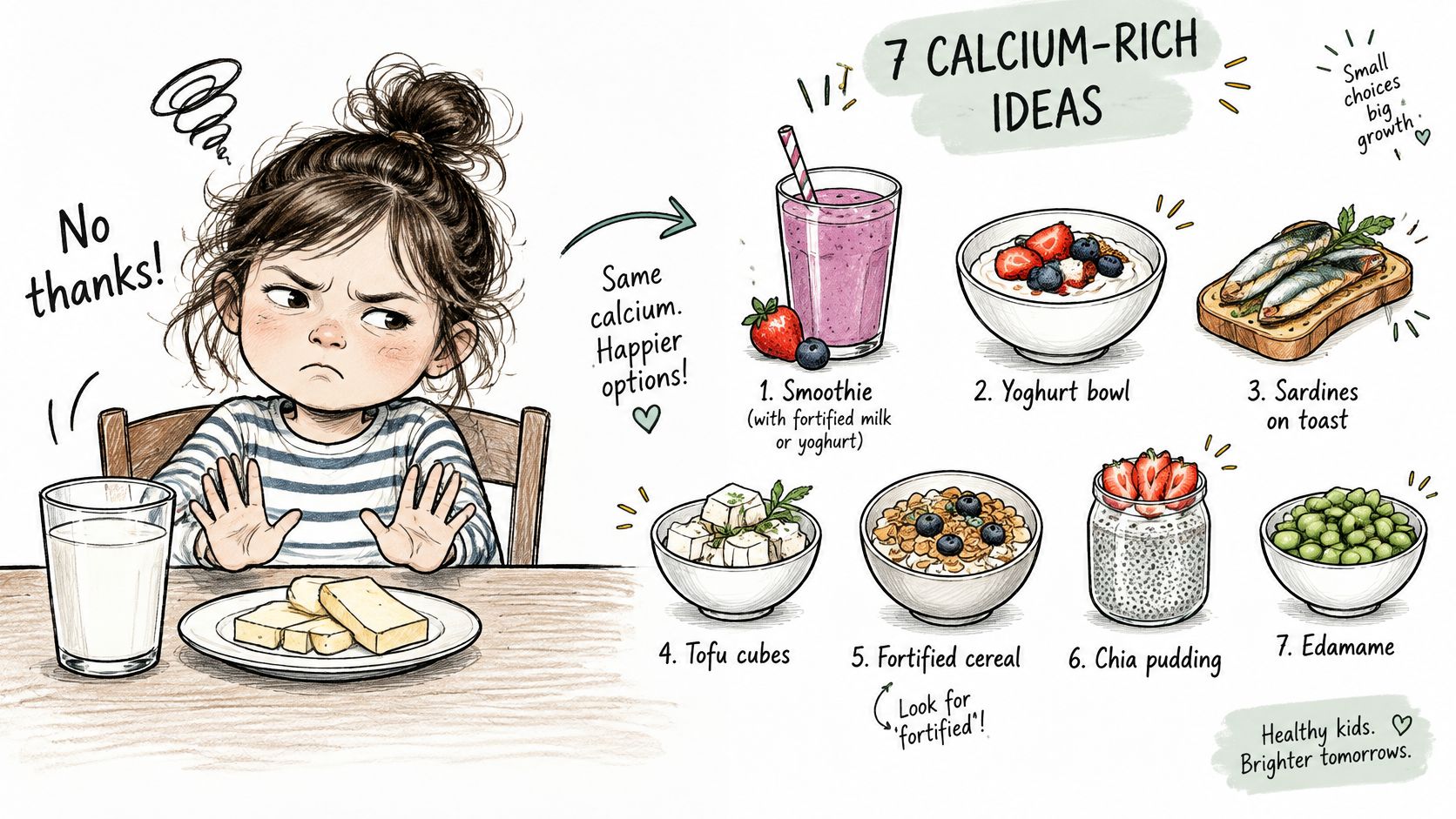
- Fortified soy drink: Blend a cold smoothie with fortified soy drink, banana and a spoon of yoghurt. Serve it with a straw if that makes the texture more appealing.
- Melted cheese: Make a cheese toastie with grated cheese melted through the filling, then cut it into easy-to-hold fingers.
- Yoghurt: Pair yoghurt with stewed apple and rolled oats, or offer a frozen yoghurt tube for a different texture.
- Milk in a familiar recipe: Make pikelets or pancakes with milk and let your child choose fruit for the topping.
- Fish with soft bones: For a child who accepts fish, mash the soft bones into sardine or salmon patties so they're part of the mixture.
- Calcium-set tofu: Crisp-fry cubes of firm tofu and offer a little soy sauce for dipping. Check that the tofu is set with a calcium salt.
- A planned lunchbox: Pack cheese cubes, a yoghurt pouch and another calcium-containing snack from the table, while following your school's nut policy.
If your child is old enough to understand, tell them what's in a dish and let them choose between two suitable options. Swapping texture or presentation is different from hiding ingredients, and giving children a choice can make a new food easier to approach. For more ways to organise a lunchbox around accepted foods, see these lunch ideas for picky eaters.
For a quick visual guide to the options, watch the video below.
Pick two snacks and one meal to rotate each week. That gives your child repeat opportunities without requiring a new recipe every day.
Why Vitamin D and Movement Matter Too
Vitamin D helps the gut absorb calcium, so eating calcium-rich foods is only part of supporting developing bones. Australian health guidance on vitamin D lists 5 micrograms of vitamin D a day from food for children and teenagers, while noting that individual needs can vary with factors including skin coverage, latitude, season and limited sun exposure.
Calcium, vitamin D, protein and movement work together. Improving one part alone may not address the whole picture.
Make room for everyday activity and protein
Weight-bearing play puts load through the skeleton. Running, jumping and ball games are practical examples of movement that help support bone strength, alongside a diet that supplies protein. Meat, eggs, legumes and dairy can all contribute protein, so consider the child's overall eating pattern rather than focusing on one nutrient in isolation.
Use these checks to decide whether to ask for guidance:
- Outdoor routine: Is your child outdoors most days?
- Coverage: Are they covered for most time spent outdoors?
- Active play: Do they regularly run, jump, play ball games or take part in other active play?
These questions don't diagnose vitamin D status, but they can highlight a pattern worth discussing. A restrictive diet or very limited sun exposure is a reason to seek advice, not to guess at a dose or stack fortified foods and supplements.
Families who want practical food ideas can also explore what to eat for vitamin D. If you're considering a vitamin D product, check how much your child already gets from fortified foods and any other supplements, and ask a health professional where needs are uncertain.
When a Supplement Fits and What to Do Next
Whether a child needs a calcium supplement depends on their usual intake, age and individual health needs. A GP or accredited dietitian can help identify a gap and advise whether a supplement is appropriate.
| Situation | What to do first | When to seek advice |
|---|---|---|
| Child eats dairy or fortified foods most days | Compare their usual serves with the age-based target | Ask a professional if intake seems consistently low |
| Dairy-free or vegan diet | Include suitable fortified drinks, calcium-set tofu and legumes | Ask a dietitian to review the plan |
| Very selective eater with few food groups | Offer accepted calcium-rich foods in snacks and meals | Discuss persistent restrictions with a GP or dietitian |
| Fracture, growth concern or suspected deficiency | Arrange a clinical assessment | Seek advice promptly |
Check the full intake before adding a product
Include calcium from foods, fortified drinks and cereals, and any supplements or gummies already in the routine. Considering each product separately can make it harder to see how much calcium a child gets overall.
If a health professional recommends a calcium product, check its elemental calcium per serve, age range and recommended daily dose. The weight of a calcium compound is not the same as the amount of elemental calcium. Check whether the product also contains nutrients your child already takes.
Daily Powers' Brave is a daily multivitamin gummy, not a calcium supplement. Each two-gummy serve contains 5 μg (200 IU) of vitamin D3. Include this amount when discussing your child's supplement routine with a health professional.
Bring a simple record to the appointment
For a useful appointment, bring a brief record of three typical days of food and drink, including portions offered and eaten. Add any supplements and fortified products, then use the food table and your child's age-based target to help estimate calcium intake.
If your child has a restricted diet, regularly accepts very few calcium-rich foods, or has a growth concern or fracture, arrange professional advice. For more background, read this guide to vitamin D and calcium gummies.
A supplement should fill a defined gap that a professional has identified. Daily Powers' gummies are formulated with input from nutrition experts, but a multivitamin is not a calcium supplement. Review Daily Powers' product ingredients and serving information, and discuss any supplement choice with your child's GP or accredited dietitian.