

There's no fixed number of days for how long vitamins take to work, because a corrected deficiency usually takes weeks to months to show in symptoms or blood tests, and a child who's already getting enough may notice no change at all. That isn't a hedge. It's the answer most product pages skip when they promise you'll see a difference in a week or two.
Parents usually ask one question, but they're really asking two. How long until a real shortfall is corrected? And how long until a well-fed child feels something? The first sometimes has a timeline. The second often doesn't, because there's nothing missing to replace.
Table of Contents
- Expected Timelines for Each Vitamin at a Glance
- Why Most Children Feel No Change on Day One
- Water-Soluble and Fat-Soluble Vitamins Compared
- Why Iron and Vitamin D Take Months to Settle
- How to Track a Routine Week by Week
- Confirm the Plan With a GP Before Changing the Dose
Expected Timelines for Each Vitamin at a Glance
You can't assign one countdown to every nutrient. Timing depends on your child's starting point, whether the body stores that nutrient, how well it's absorbed, and whether you're watching symptoms or a blood result.
The starting point matters most. A child who is low in a nutrient may improve as intake rises. A child already eating enough has no gap to close, so extra intake creates no new level of energy, focus or calm you could date on a calendar.
How to Read This Table
Each row pairs a nutrient with a situation, because the same vitamin behaves differently in a child who is deficient and a child who isn't. The second column shows whether the body keeps a store. The last two separate an early change from the point where levels are steady enough to judge or retest.
Stored nutrients buy time. The body can draw on reserves of vitamin A or B12 for months or years, while vitamin C passes through quickly and a genuine gap shows sooner. That difference is why two children on the same product can have completely different timelines.
| Nutrient | How the body handles it | First change to expect | Stable effect or retest point |
|---|---|---|---|
| Vitamin C (deficiency) | Water-soluble, little stored | Days to weeks after intake rises | Scurvy risk builds after weeks of very low intake |
| Vitamin A (adequate intake) | Fat-soluble, stored in liver and fat | No noticeable change expected | Weeks to months to draw on stores |
| Vitamin D (deficiency) | Fat-soluble, stored | A prescribed loading course over several weeks | Levels rechecked months into treatment |
| Iron (anaemia) | Mineral, used to make haemoglobin | A measurable haemoglobin rise within weeks | Treatment continues for months to rebuild stores |
| Vitamin B12 | Water-soluble, stored in liver | No immediate change expected without deficiency | Stores can last for years before deficiency signs appear |
| Multivitamin (child already eating enough) | Mixed | No measurable change expected | Not applicable without a shortfall |
| Magnesium or zinc (well-fed child) | Mineral | No measurable change expected | No set retest point without a diagnosed shortfall |
Notice the pattern. Deficiency rows carry timeframes because clinicians can measure something that was too low and watch it recover. The well-fed rows have none, because no reliable research timeline tells you when a child with adequate intake should feel different.
A timeline only exists once a shortfall is known.
That rule protects you from two mistakes. You won't stop a needed treatment after three days because nothing happened, and you won't keep adding products to a healthy diet while waiting for an effect that was never defined. If you're asking how long vitamins take to work, first ask what exact problem they're meant to correct.
Why Most Children Feel No Change on Day One
Day one in a vitamin log usually reads like this: "7:10 am, two gummies with breakfast, normal school day." Day fourteen tends to read the same. That sameness surprises parents, yet it follows from how nutrients work. They support normal body processes rather than switching on like pain relief, and even when a child is genuinely low, the body needs time to absorb the nutrient, put it to use and rebuild whatever was running short.

It helps to split "how long" into two questions. The first is how long it takes to correct a measured shortfall, and that one has answers clinicians can test. The second is how long until a well-fed child would notice anything new, and that question often has no honest answer at all.
Symptoms and Blood Tests Move at Different Speeds
According to Healthdirect's guidance on dietary supplements, clinicians may confirm deficiency with blood tests and advise continuing supplementation until nutrient levels return to the normal range, rather than working to a fixed number of days. Those two clocks rarely run together. A child can feel brighter before stores are replenished, and blood results can improve weeks before anything looks different at the breakfast table.
Shortfalls are real, and they cluster by age. The 2021 OzFITS study found 90% of infants and 25% of young children fell short of the estimated average requirement for iron, while 20% of infants missed the mark for zinc. Figures like these argue for checking intake by age and nutrient. They do not argue that every school-aged child eating a varied diet is deficient.
What If You See a Change Straight Away
Record a quick change as a feeling, then check it against the log. A new routine often arrives alongside earlier bedtimes, more attention at breakfast, better sleep after a busy week, or plain hope that this will help. Any of those can brighten a morning before the vitamin has had time to do anything.
You'll also come across reports like the one from James L., a verified buyer, who describes feeling more alert and productive throughout the day. That is one person's account. It says nothing about their starting nutrient status, diet or sleep, so it cannot set a timeline for your child.
Practical test: A sensation on day one isn't proof a vitamin is working, and no sensation on day seven isn't proof it isn't.
A simple log kept over a defined period tells you far more than a single good morning. If a shortfall is suspected or symptoms persist, a GP or Accredited Practising Dietitian can assess diet, growth and blood tests before any change in dose.
Water-Soluble and Fat-Soluble Vitamins Compared
Two questions hide inside "how long do vitamins take to work." The first is how long until a real shortfall is corrected. The second is how long until a well-fed child would notice anything. Storage behaviour explains why those questions get different answers, and why the second often has none.
| Water-soluble | Fat-soluble | |
|---|---|---|
| Vitamins | Vitamin C and the B-group | Vitamins A, D, E and K |
| Storage | Held in small amounts; vitamin B12 is the exception, with the liver holding stores for a long period | Stored in the liver and body fat |
| Extra intake | Excess is removed in urine | Excess can accumulate |
| Timing effect | Regular intake matters; deficiency signs can appear within weeks of very low intake | Short gaps in intake are buffered; building or draining stores takes longer |
That storage difference shapes both timing and safety. It also explains why asking how long vitamins take to work without naming the vitamin rarely gets you a useful answer.
Water-Soluble Vitamins
This group includes vitamin C and the B-group vitamins. Most aren't stored in large amounts. Vitamin B12 is the main exception, because the liver can hold stores for a long period before deficiency signs appear.
Vitamin C gives the clearest short-term example, and it is specifically about deficiency. Healthdirect's vitamin C deficiency guidance explains that scurvy can develop after about 1 month of very low intake, less than approximately 10 mg per day, that increasing vitamin C through food or supplements usually leads to noticeable improvement within days to weeks, and that follow-up may occur after 3 months to assess whether treatment has worked.
Read that carefully. It is a treatment timeline for a child who was getting far too little. A child who already eats fruit and vegetables regularly shouldn't expect the same visible shift from extra vitamin C.
Mild deficiency is usually treated by adding vitamin-C-rich fruits and vegetables, such as oranges, kiwifruit, capsicum and broccoli. Large doses aren't necessary because excess vitamin C is removed in urine, and excessive intake may increase kidney-stone risk.
- Reserve check: If intake stops, does the body have much held back? For vitamin C, not for long.
- Food first: Mild low intake is usually a diet problem before it is a high-dose supplement problem.
- Symptoms still matter: Persistent fatigue, poor concentration or recurrent illness needs medical assessment rather than a bigger dose.
Fat-Soluble Vitamins
Vitamins A, D, E and K dissolve in fat and can be stored in the liver and body fat. That storage buffers short gaps in intake, and it also means excess can accumulate.
Healthdirect's vitamin A deficiency guidance explains that vitamin A is fat-soluble and stored in the liver and body fat, and the body can take weeks or months to use these stores. A daily vitamin A supplement isn't expected to produce an immediate, noticeable effect when intake is already adequate.
Correcting a confirmed deficiency follows a different path. Timing depends on severity, absorption, dose and the symptom being monitored. Supplements should generally be used for a defined period, and clinicians may confirm effectiveness with blood testing before deciding whether supplementation should continue.
This short video is a useful visual reset before you compare products by how fast they claim to act.
Routine supplementation provides nutritional support at a measured pace. Visible benefits are most plausible when supplementation corrects an actual dietary shortfall. Follow Australian age-appropriate dosing directions and seek professional advice before giving fat-soluble vitamins, because excess vitamin A can accumulate rather than being eliminated.
Is my child short of this nutrient, or is this supplement a precaution?
Ask that before you start, and again before you buy a second product. If it is a precaution for a child eating well, judge it as a routine and a safety decision. Whether Tuesday felt different from Monday tells you nothing about nutrient status.
Why Iron and Vitamin D Take Months to Settle
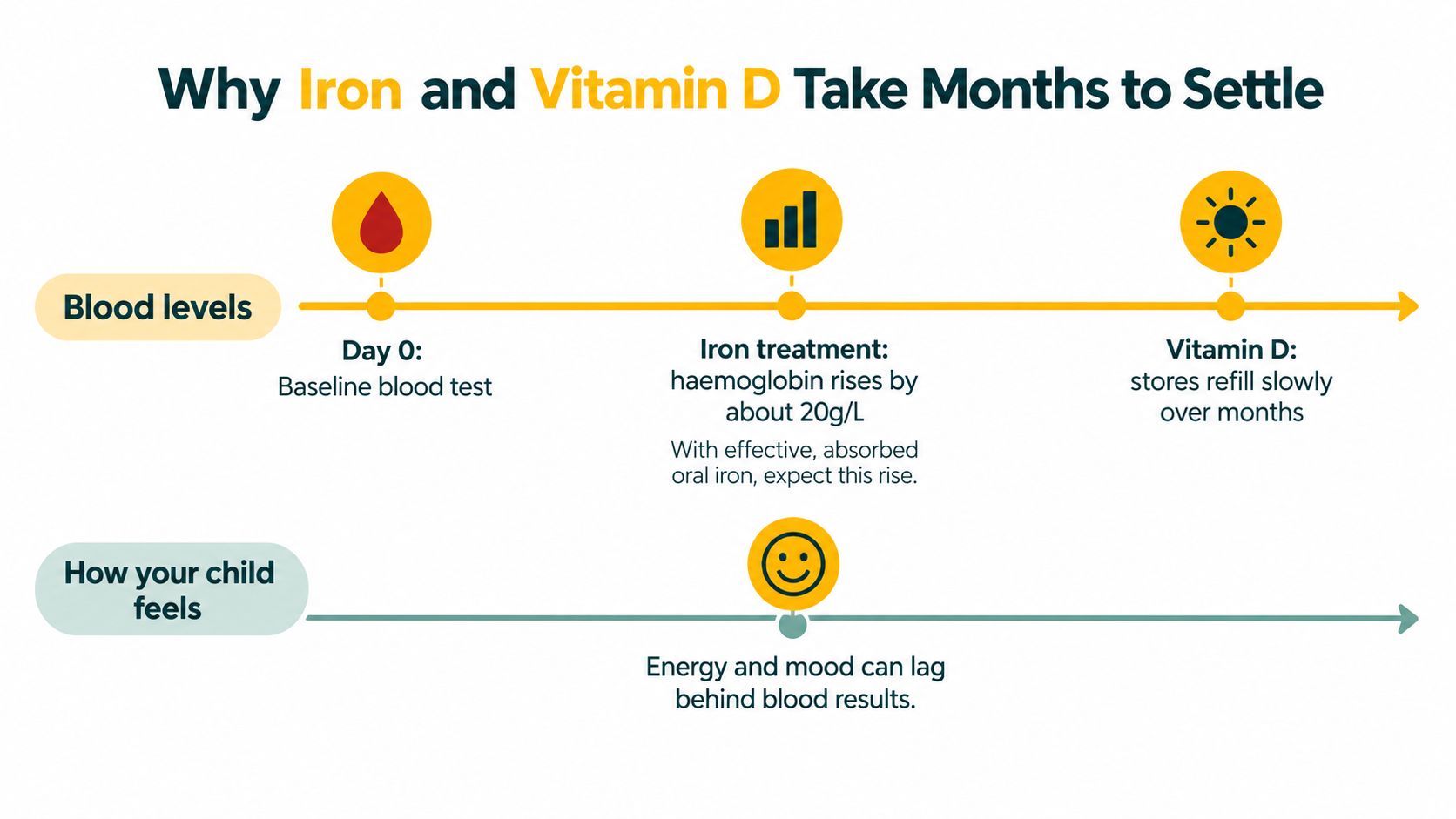
Iron and vitamin D frustrate parents because blood levels and how a child feels don't move together. A test can improve while energy still lags. A child can also seem brighter while stores remain low.
Iron Rebuilds in Two Stages
For iron-deficiency anaemia, Barts Health haematology advice and guidance sets an expected haemoglobin increase of approximately 20 g/L within 3 to 4 weeks on an effective, absorbed oral regimen. That's the first measurable sign treatment is working. It isn't the finish line.
Guidance recommends continuing treatment for at least three months after an effective response, with blood-count and ferritin monitoring used to confirm recovery. Ferritin reflects iron stores, so stopping when your child looks less tired can leave the tank only partly refilled.
Don't give high-dose iron unless it's prescribed. Iron overdose can be dangerous, and unexplained fatigue, pallor or reduced concentration needs assessment because poor absorption, ongoing blood loss, inflammation or another diagnosis can block the expected response.
Vitamin D Needs a Loading Phase, Then Time
A Central East clinical vitamin D deficiency protocol describes a loading course over roughly 6 to 10 weeks, then maintenance, with serum vitamin D requiring approximately 3 to 6 months to reach a steady state before retesting. Vitamin D dosing should be clinician-guided because age, baseline concentration, sun exposure, diet and medical conditions all affect the plan. Our guide to calcium and vitamin D3 explains how those nutrients are usually discussed together.
In 2023, the Royal Australian College of General Practitioners advice summarised by Clinical Labs said vitamin D levels should not be retested within 3 months of beginning replacement, because blood levels may take several months to stabilise. Retesting too early can make a sound plan look ineffective.
Put the sequence in order and it becomes easier to follow.
- Weeks 0 to 4: Look for the early haemoglobin response if iron treatment was prescribed.
- Weeks 6 to 10: Complete a vitamin D loading course if a clinician has set one.
- Month 3 onwards: Iron stores are still rebuilding, and vitamin D can be considered for retesting.
- Months 3 to 6: Vitamin D reaches a steadier level for evaluation.
When parents ask how long vitamins take to work for these nutrients, the honest answer is that the blood test decides, not a single good afternoon.
How to Track a Routine Week by Week
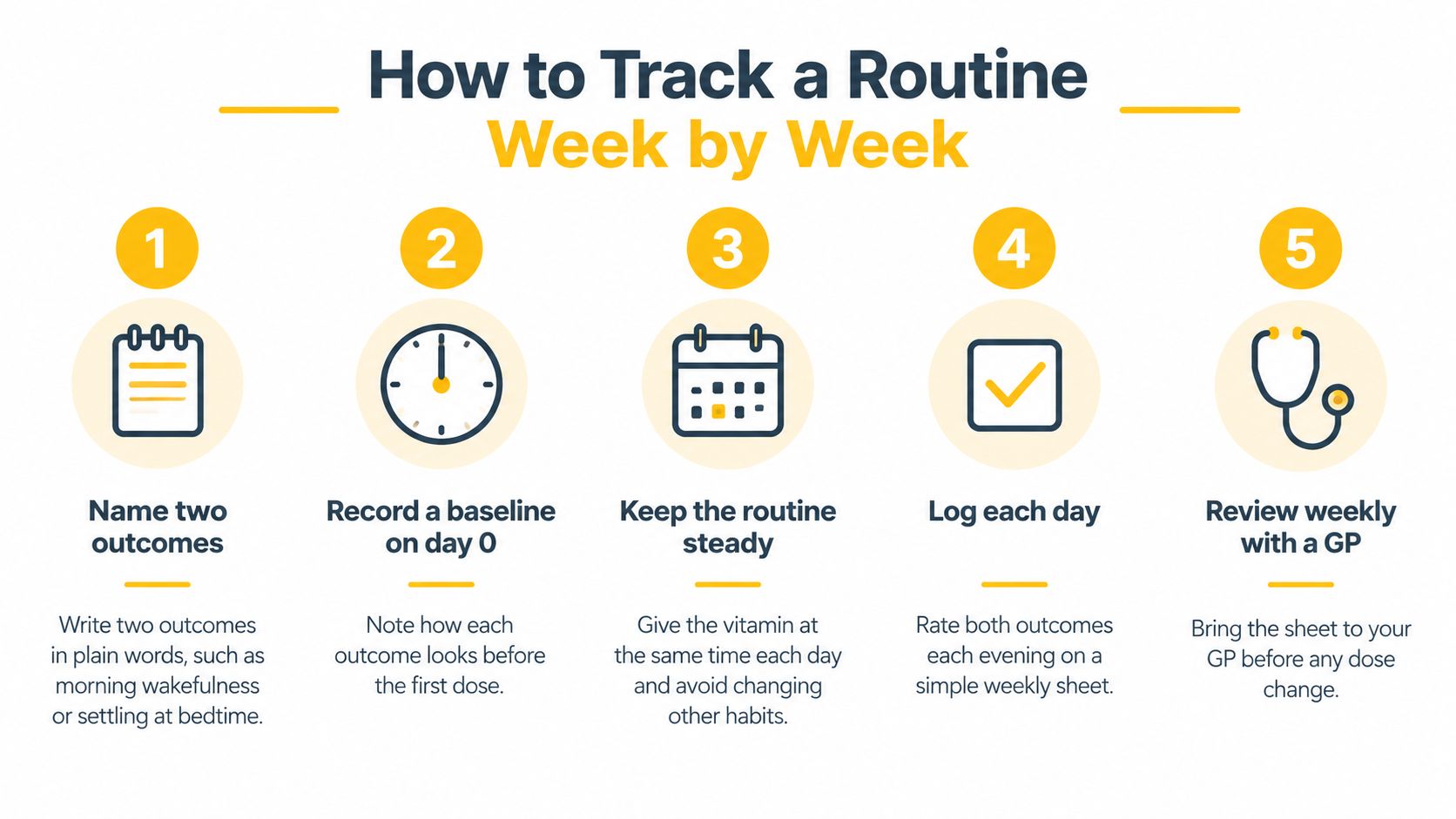
A vague hope like “more energy” is hard to judge after a busy school week. Turn it into two named outcomes you can observe, and you'll know whether you're seeing a trend or just remembering the best morning.
Seven Steps That Keep You Honest
- Name two outcomes: Write them in plain words, such as “wakes without repeated prompts” or “settles at bedtime within our usual routine.” Two is enough to stay consistent.
- Record a baseline on day 0: Note how each outcome looks before the first dose, plus appetite and sleep. Without a baseline, week four has nothing to compare with.
- Tick each dose: Use a simple calendar so missed days are visible. A product taken four days out of seven hasn't had the routine you're trying to assess. A printable kids routine chart can keep ticks in one place.
- Rate weekly from 1 to 5: Score both outcomes at the same time each week, perhaps Sunday evening. The number turns “maybe better” into a comparison across weeks.
- Look for repetition: Count improvement only when it appears on most days, not after one excellent sleep or a quiet weekend.
- Review at set points: Check the pattern at weeks 2, 4 and 8, then around month three if a blood test is planned.
- Bring the log to appointments: Give your GP or dietitian dates, doses, missed days and scores. That evidence supports a better decision than “I think it helped a bit.”
Keep the rest of life as steady as you reasonably can. If you start a vitamin, move bedtime earlier, change breakfast and begin a new sport in the same week, you won't know which change mattered. You don't need a laboratory at home. You do need fewer moving parts.
| Timeframe | What to record | Meaningful change | Next step |
|---|---|---|---|
| Days 1 to 7 | Doses taken, appetite, sleep | Routine established; no change expected | Keep the labelled dose |
| Weeks 2 to 4 | Named outcomes rated 1 to 5 | Repeated improvement on most days | Keep logging |
| Weeks 4 to 8 | Same ratings, plus any blood test results | Clear trend rather than one good day | Review with GP or dietitian |
| Month 3 onwards | Blood tests if ordered | Levels stable; retest timing set by clinician | Confirm whether to continue or stop |
A routine can be well established long before any measurable change appears. That's not failure. It means adherence is one outcome, and nutrient status is another.
What counts: The same outcome, rated the same way, moving in the same direction across several weeks.
If scores don't move, don't extend the trial indefinitely. Use the review date you set at the start and decide whether the original reason still stands.
Confirm the Plan With a GP Before Changing the Dose
Feeling nothing is no reason to give more. That rule matters most with children, because a supplement may be preventing or correcting a shortfall without producing a visible change in energy, concentration or mood.

Children who eat a varied diet can generally obtain the vitamins and minerals they need from food. Some nutrients can also accumulate or cause harm when taken in excess, particularly fat-soluble vitamins and iron. If you're unsure whether a dose suits your child's age, check our paediatric dosing guidelines and confirm the plan with a clinician.
Match the Situation to the Next Step
| Situation | Sensible next step |
|---|---|
| Child eats a varied diet and has no symptoms | Continue the labelled dose; expect a routine, not a measurable boost |
| Nothing noticeable after one week | Keep the dose and keep logging; one week is too early to judge, so follow the review schedule |
| Persistent tiredness, pale colour or poor concentration | Book a GP assessment before adding more supplements |
| Confirmed deficiency or low blood levels | Follow the clinician's dose and retest date |
| Two products contain the same nutrient | Check labels for duplicate ingredients and keep only one source |
| Allergies, a medical condition or other medication | Speak with a GP before starting any new supplement |
Start with the product already in your cupboard. Read the active ingredients per serve, not just the front label, and compare it with any other gummy, powder or fortified drink your child uses. Duplicated vitamin A, vitamin D, iron or zinc is easy to miss when products carry different flavours and promises, and two serves from different brands can unknowingly double a daily total.
We recommend speaking with a GP or healthcare professional before starting any new supplement, especially for children with allergies, a medical condition or on other medications. For kids aged 4 to 15, we recommend 2 gummies daily, or as advised by a healthcare professional. We also recommend consistent daily use for at least 30 days to see the full benefits of the vitamins, while recognising that a settled routine and a corrected deficiency are two different outcomes.
If a daily multivitamin fits a clinician-supported plan, Brave is a daily multivitamin gummy for kids that supports everyday energy and immunity, in a vegan-friendly formulation with no sugar and no artificial colours or flavours. Count it as one labelled source in the overall diet, and skip separate products that supply the same nutrients.
Supplements should not mask symptoms that could reflect poor sleep, illness, restricted eating or another medical issue. A child who is persistently tired, pale, losing appetite, struggling to concentrate or not growing as expected needs assessment. Adding a second supplement only delays the answer.
Your next action is simple. Write down the intended outcome, confirm the dose against the label or your clinician's advice, log it through the review period you set, and book a GP review if symptoms persist or nothing changes by that date. When someone asks how long vitamins take to work, you will have records and, where needed, blood results instead of guesswork.
If you're building a steady daily routine while you assess what your child needs, Daily Powers offers Australian-designed, vegan kids' gummies with no sugar and no artificial colours or flavours, with clear ingredient and dosing information for parents. Visit us to explore the range, read the labels in full, and choose a routine you can track calmly and consistently.