

Only 10% of Australian children aged 5 to 14 met both the physical activity and screen time recommendations on the same day in the 2011 to 12 National Nutrition and Physical Activity Survey reported by the Australian Institute of Health and Welfare page on children's physical activity. That single figure changes how to help kids focus. A child who can't settle to homework may not need more pressure. They may need a day that's organised so attention has a chance.
Treat focus as a whole day routine, not one skill you switch on at the kitchen table. Sleep, screen timing, movement, food and emotional load all shape what happens in a ten minute homework block. Change one of those at a time, watch what follows, and you'll learn more than you will from stacking new rules.
Table of Contents
- Daily Focus Targets for School Aged Kids
- How to Run a Short Focus Block
- Sleep and Screen Gaps That Blur Attention
- Movement Breaks Before You Add More Work
- When Worry Rather Than Effort Is the Problem
- Review the Week and Choose Your Next Step
Daily Focus Targets for School Aged Kids
A child who can't settle is often short on sleep or long on screens, not short on effort. The Australian Bureau of Statistics article on children's physical activity, screen time and sleep found children aged 5 to 17 spent an average of 2 hours 51 minutes per day in sedentary screen activity, while 60.0% used a screen within the hour before bed and 57.7% had a device in their bedroom. Australian guidance in that article recommends 9 to 11 hours of sleep for children aged 5 to 13, no more than two hours of recreational sedentary screen time, consistent bed and wake times, and avoiding screens for one hour before sleep.
Those averages aren't a judgement on your household. They're a starting point for a check. Before you lengthen schoolwork or buy a focus product, log one ordinary week and see which foundation is missing.
Seven Day Focus Foundations Audit
Keep the log simple enough to finish on a tired night. A notebook on the fridge works. So does a note on your phone.
| Foundation | Target to aim for | What to log each day |
|---|---|---|
| Sleep, ages 5 to 13 | 9 to 11 hours with steady bed and wake times | Bedtime, wake time and total hours |
| Screens before sleep | None in the hour before bed | Yes or no, plus minutes in the last hour |
| Bedroom device | No screen device in the bedroom | Yes or no |
| Recreational screen time | No more than 2 hours of sedentary recreation | Daily minutes against the 2 hour 51 minute average |
| Movement | At least 60 minutes across the day | Active minutes and whether play came before homework |
| Hunger | A proper breakfast and no long gap before hard work | What was eaten and whether focus dropped when hungry |
| Task and setting | One short block, noted by subject and time of day | Planned task, minutes, finished or abandoned |
Food belongs in the same audit because a long hungry stretch can look exactly like poor concentration. If breakfast is the weak row, our guide to food that's healthy for the brain gives practical options to test without overhauling family meals.
How to Read the Week
Read the rows in order, from sleep down. Don't start with the task row, even though that's where the frustration shows up.
- Sleep first: If total hours fall short or bedtime drifts, that's your first change for the next seven days. Leave everything else alone.
- Late screens second: If sleep looks fine but screens run into the last hour, move the off time earlier and watch the next afternoon.
- Movement and hunger next: Note whether unfinished tasks cluster on low movement days or before dinner. Patterns matter more than one bad day.
- Task last: Only judge task length once the rows above it are mostly in range.
One row rule: Change only the first missed target for a week. If you change bedtime, screens and homework rules together, you won't know which one helped.
There's a trade off here. A week of logging feels slower than a new timer app. It also stops you fixing the wrong problem for a month. If sleep, screens, movement and hunger are already solid and attention still fails at home and at school, don't stack more rules. Move to the worry and assessment check later in this article, because persistent difficulty across settings needs a different conversation.
How to Run a Short Focus Block
A short focus block works when your child doesn't have to guess what counts as started, finished or good enough. The sequence below follows the structured, low distraction approach in the Royal Children's Hospital fact sheet on ways to help children at school and home, which recommends gaining attention first, giving one clear instruction, breaking work into short concrete steps, checking understanding, and using positive reinforcement. It also recommends seating away from busy areas and alternating demanding work with brief movement breaks.
Run it the same way each school day. Predictability does part of the work.
The four core moves in the sequence are shown below.
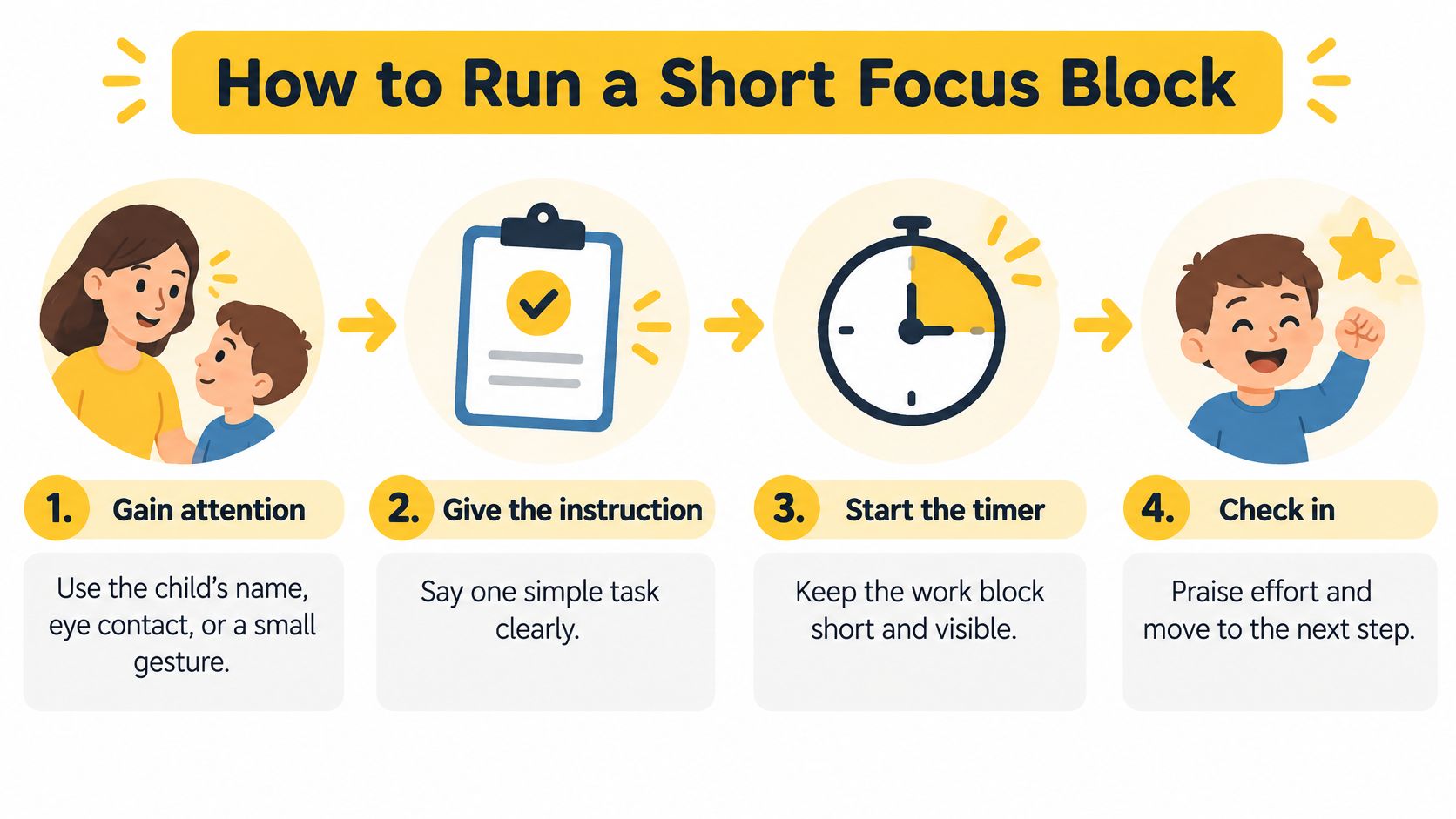
The Seven Moves in Order
- Gain attention first: Say your child's name, get eye contact, or use a small gesture. Don't call instructions from another room and hope they've landed.
- Give one instruction: Say one job, not a chain. "Open your maths book to page twelve" beats a list of five things to remember.
- Make the step concrete: Complete five maths questions is a target your child can see. "Do your homework" isn't.
- Ask for a repeat: Your child says the first step back to you. If they can't, the instruction didn't land, and that's useful information, not defiance.
- Clear the setting: Remove competing screens and seat your child away from doors, windows and busy walkways. Add a visual cue, such as the written target on a sticky note, if reading or remembering the instruction is the hard part.
- Set a short interval: Use a visible timer and stay nearby without hovering over every line. Nearby means available. It doesn't mean correcting as they write.
- Praise and review: Give immediate specific praise for the finished step. Name what happened, such as "You did all five and checked the last one." Then review the result before any block gets longer.
The Slips That Undo It
Most blocks fail in predictable places. A five part direction overloads step two before work begins. Reprimanding every glance away turns step six into a surveillance exercise, and your child spends the block watching you instead of the page.
Stretching the timer because the first block went well is the quietest slip. You feel encouraged, so you add five more questions. Your child learns that finishing earns extra work, and tomorrow's start gets slower.
Keep the same observable target until it's completed on most tries. Then add a small amount of work, not a new reward system.
Say a child completes five maths questions on four of five afternoons. The next step is six or seven questions, at the same time, in the same seat. It's not a longer timer plus a new chart plus a different room.
This is general concentration support for everyday homework friction. It isn't a substitute for assessment when inattention is severe, persistent or getting in the way of learning. That distinction matters, because running a tighter block on a child who needs professional support just adds pressure to the wrong place.
Sleep and Screen Gaps That Blur Attention
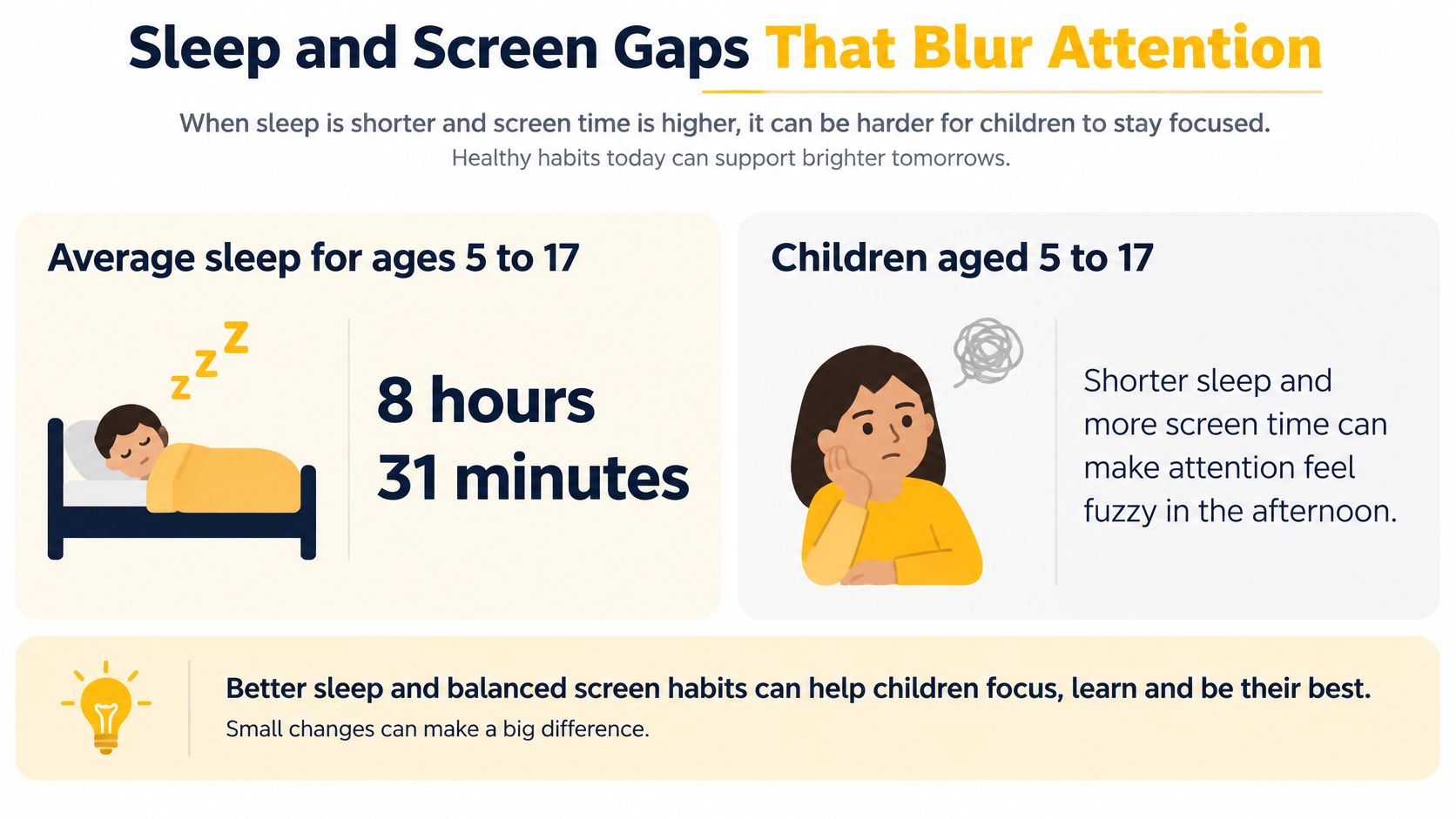
A shortfall of twenty minutes each night adds up quickly. Measured Australian activity and sleep data for children aged 5 to 17 found an average of 8 hours 31 minutes of sleep per night. For children aged 5 to 11, those with a screen-based device in their bedroom slept 8 hours 49 minutes, compared with 9 hours 9 minutes for those without one. The measured activity and sleep data also show that nearly all 6 to 7 year olds met the minimum sleep requirement on school days, compared with 50% of 16 to 17 year olds.
The Longitudinal Study of Australian Children annual statistical report from the Australian Institute of Family Studies reports links between missing minimum sleep guidelines and poorer mental health symptoms, lateness or absence from school, and spending more than five hours a week on homework. These patterns can feed into one another: a tired child may take longer to finish homework, leaving less time for sleep and making the next day harder.
The figures are a reminder to check the whole routine before adding more work or pressure. Sleep, bedroom screens and emotional load can all shape how much attention a child has available.
Turn Each Target Into One Household Change
Start with the bedroom device. Charge it in the kitchen or lounge room overnight, then observe whether sleep or mornings change. One practical adjustment is easier to assess than changing several household rules at once.
Next, aim for the same bed and wake times on school days, and switch screens off for the hour before bed. Keep that hour predictable: a shower, pyjamas, a book and a dim room can replace the pull of one more video. If bedtime is difficult, this guide to how to get kids to sleep offers more ideas for a wind-down routine. Once the routine is set, note sleep and morning wake-ups across the week.
What Not to Trade Away
Avoid trading sleep for extra study. An unfinished worksheet can be raised with the teacher; a short night affects the child's next day as a whole. A device-free bedroom may also mean negotiating a new charging spot, so make that single change first and watch what happens.
For ages 5 to 13, the recommended sleep band is 9 to 11 hours. A gap of twenty minutes can leave a child just below that range, so record bedtimes and wake times for a week rather than relying on memory. The first few nights after moving a device may bring objections. Judge the change by the pattern across the week, not by one difficult evening.
Movement Breaks Before You Add More Work
A child's focus is shaped by the whole day, including sleep, screen habits, movement and emotional load. Before adding another worksheet or a supplement, check whether the routine leaves room for activity. The Sydney Children's Hospitals Network movement guidelines say attention can improve after exercise. Movement is one practical way to prepare for homework, although the effect will vary with sleep, the activity and the child's needs.
A short burst of play before the first focus block is an easy place to begin.
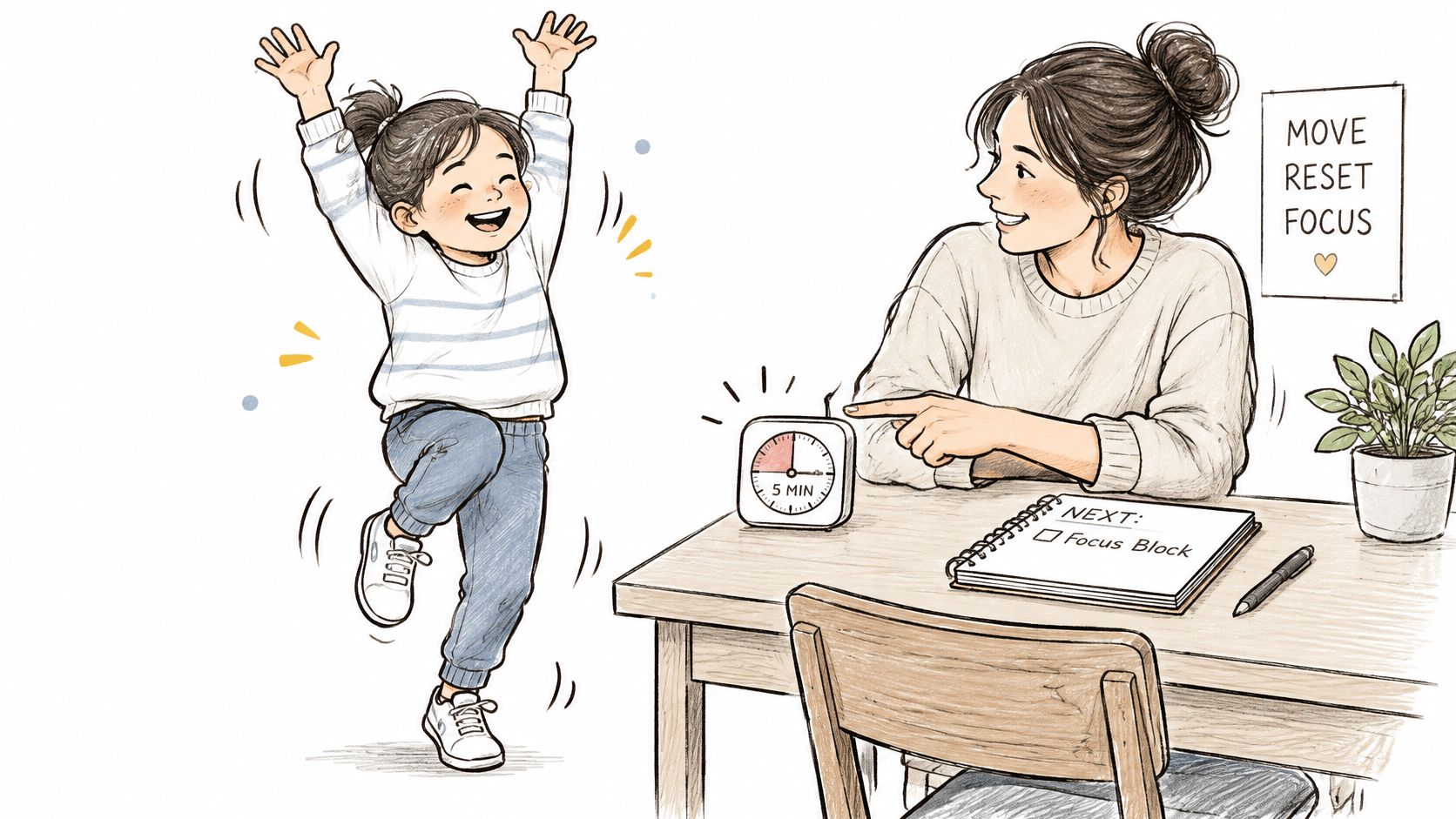
A Before Homework Sequence You Can Test
Start with active play after school, before opening books. Try time outside, a scooter ride, kicking a ball or a lounge-room game. Then use the same short focus block as usual and note whether your child begins the first task more readily. Changing one thing makes it easier to see what helped.
Between blocks, offer a brief movement break away from screens. A drink of water and a lap of the yard give the child a clear pause, without the extra transition from a phone back to homework. Keep the break short and away from the work table, so returning to the task is straightforward.
| Time | Activity | Check |
|---|---|---|
| After school | Active play before any homework | Movement logged in the audit |
| Homework time | One short focus block using the seven steps | Target written where the child can see it |
| Between blocks | Brief movement break away from screens | Break kept short and off the work table |
| Evening | Calm, low-conflict wind down | No high-energy games close to bed |
| One hour before bed | Screens off and devices out of the bedroom | Matches the bedroom device and screen rows |
| Bedtime and wake time | Same times each school day | Total hours logged against 9 to 11 for ages 5 to 13 |
Build towards 60 minutes across the day gradually. Walking to school, playground time and afternoon play can all contribute. A single exhausting session may be harder to repeat, while small amounts of movement are easier to fit around school and homework. For everyday ideas that do not depend on a formal sport commitment, see this guide to a boost for kids. Choose one idea and track it alongside the homework routine.
The video below demonstrates a simple movement break to use between focus blocks.
Two Pitfalls to Name Clearly
Exercise can support attention, but it does not guarantee better marks. The response may depend on the activity, sleep, learning needs and classroom conditions. For two weeks, record active minutes, tasks completed and observed on-task behaviour. This gives you a clearer picture than judging the change from one afternoon.
Timing matters too. Hard play late in the evening may make it harder to wind down, especially if it pushes bedtime later. Choose movement that fits the day, then keep the evening calm enough for sleep. The aim is to support attention without trading away rest.
When Worry Rather Than Effort Is the Problem
A child who seems distracted may be carrying worry or feeling overwhelmed. In the national educator benchmark reported in the State of Mental Health in Education report on Be You.pdf), 816 education professionals identified mental health as the leading health issue affecting children and young people, ahead of excessive screen time and bullying.
At the homework table, attention can be affected by emotional load, tiredness, task difficulty or the setting itself. A longer timer cannot tell you which factor is at play. Before asking for more effort, look for a pattern: when does concentration dip, and what tends to happen just beforehand?
Read the Pattern Before You Add Pressure
For two weeks, note whether concentration changes by subject, setting, time of day, peer environment or emotional state. Add observations beside your existing audit, rather than starting another record. Then compare them with the classroom teacher's view. They see how your child manages a different setting and different tasks.
| Pattern over two weeks | More likely driver | Next step |
|---|---|---|
| Worse in one subject only | Task difficulty or a learning gap | Ask the teacher what that subject looks like in class |
| Fine in one place and poor in another | Setting, noise or peers | Compare home and classroom notes before changing the child |
| Drops when upset, rushed or corrected | Emotional load or felt threat | Shorten the task and lower the conflict, then watch mood |
| Paired with late nights, lateness or absence | Insufficient sleep | Fix bedtime and bedroom screens before adding work |
| Present at home and school and learning is suffering | Possible attention, learning or mental health need | Book a GP and involve the teacher or a psychologist |
| Severe from about age four or five and not easing | Anxiety, distress or behavioural difficulty | Seek professional assessment rather than adding a reward chart |
Start with the narrowest pattern. A difficulty in one subject may point to the task or a learning gap. If concentration is difficult across settings and learning is suffering, discuss the pattern with a GP and the teacher. The table is a guide for deciding what to ask about, not a diagnosis.
Lowering Threat Is a Real Intervention
Shortening a task for a distressed child removes the threat long enough to see whether attention returns when the child feels safer. If concentration improves, that response helps distinguish emotional load from difficulty sustaining attention. A reward chart may not reveal the same information.
The fastest route to better focus is sometimes less pressure and a more predictable day, not a longer work block.
Predictable, low conflict routines can reduce the number of changes a child has to manage. Keep the start time, seat and first step consistent, then notice whether beginning the task becomes easier. Treat this as a small adjustment, not a reason to press on when your child remains distressed.
A steady pattern can help a child feel more secure, but it cannot answer every question about persistent difficulties. Seek professional assessment when problems continue, affect learning or appear across settings. In Australia, a GP is a practical first point of contact and can coordinate referrals. Bring your two weeks of dated observations, including when concentration was easier as well as harder. That record gives the conversation concrete examples to work from.
Review the Week and Choose Your Next Step
On day eight, review the log rather than relying on memory. A difficult afternoon can overshadow the rest of the week, while dated notes show whether sleep, screens, movement or hunger repeatedly fell short.
Choose the row that missed its target and change only that row for the next seven days. Keep the same short focus block at the same time each day. This gives you a clearer way to judge whether the adjustment helped.
Make the Day Eight Decision Explicit
- Foundations in range and focus improving: Keep the routine and review again in two weeks. Avoid adding another habit yet.
- Foundations in range but distraction persists at home and school: Use the pattern table to decide whether to speak with a GP or psychologist, and bring the log.
- Clear distress or sustained sleep loss in the audit: Seek professional advice before making other changes. Address your child's wellbeing before optimising the routine.
When sleep, screens, movement and hunger are in range, add at most one new repeatable habit, such as a fixed homework start time on school days. If you've discussed a routine product with a GP or pharmacist, Focus is a nootropic and prebiotic gummy designed to help children stay on task. For kids aged 4 to 15, the recommended serving is 2 gummies daily, or as advised by a healthcare professional.
Judge the next fortnight by visible signs: a first step completed with less conflict, a calmer homework start, or a teacher saying your child seems more settled. Real signs are more useful than promises of instant focus.
If you're unsure which product may suit your child, take the 2 minute quiz to find the right Daily Powers product. The quiz helps parents choose a power for their child. Keep routines and assessment first, with any product as one part of the routine, not a substitute for it.
Daily Powers is an Australian children's nutrition brand offering gummies for focus, calm and everyday wellbeing. Start with your seven day audit, adjust one foundation at a time, and add a daily habit only when the basics are in range.