

If a supplement says magnesium glycinate on the front, have you learnt how much magnesium your child will receive, or only the name of the ingredient carrying it?
That gap matters more than the usual debate about which form is best. For Australian caregivers comparing magnesium glycinate vs magnesium, the useful question isn't which name sounds more advanced. It's whether a clearly labelled dose fits the child's age, nutritional needs, tolerance and everyday routine.
Table of Contents
- Why the Label Comparison Matters for Kids
- Elemental Magnesium and Chemical Forms
- Comparing Absorption and Bioavailability
- Tolerability, Dosing, and Side Effects
- How to Compare Doses for Children
- Choosing by Everyday Family Scenarios
- A Practical Recommendation for Kids' Magnesium
Why the Label Comparison Matters for Kids
Consider a caregiver comparing bottles at the pharmacy. One highlights magnesium glycinate; another says magnesium. Neither front label, by itself, gives enough information to choose a children's supplement.
The apparent comparison is misleading because magnesium is the nutrient, while magnesium glycinate is a particular supplemental form, with magnesium bound to the amino acid glycine. Australian nutrient reference values concern elemental magnesium rather than a particular salt or chelate, as set out in the Australian and New Zealand Nutrient Reference Values.
What the comparison asks
| Label term | What it means | What to check |
|---|---|---|
| Magnesium | The nutrient category, not a complete ingredient description | The chemical form listed in the ingredients |
| Magnesium glycinate | A specific form supplying magnesium | The elemental magnesium delivered |
| Elemental magnesium | The magnesium amount used for nutritional comparison | Whether the amount is per gummy or daily serving |
| Children's magnesium | A product description, not an individual recommendation | Age directions, serving size and warnings |
The question behind the purchase
A parent seeking an easier evening routine may focus on a calming claim. Another may be replacing a tablet their child won't take. These are different practical problems, and neither can be resolved by the word glycinate alone.
A useful label comparison asks what the ingredient contains, how much elemental magnesium the serving delivers, what evidence supports its intended use, and whether the child can realistically take it as directed.
Use the following visual as a prompt to examine the full label, not as a dosing recommendation.
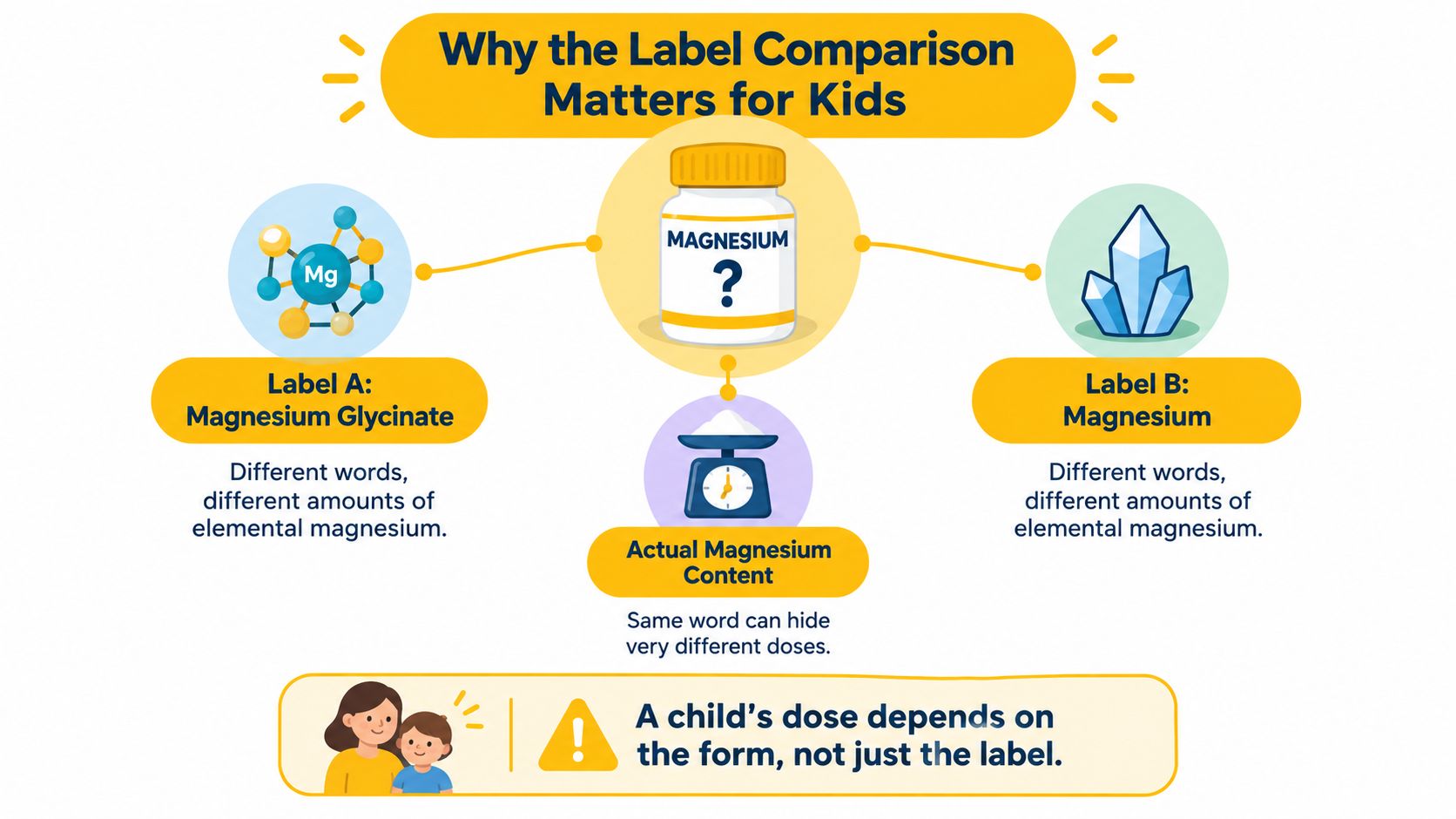
The wording in the visual needs qualification: a child's dose depends on elemental amount and individual suitability, not chemical form alone.
Practical rule: Compare the ingredient panel and directions before comparing the claims on the front.
Keep nutritional intake separate from supplemental exposure. The former asks how much magnesium the child receives overall; the latter is necessary for checking supplement-specific limits. A sensible label-reading method records both rather than treating a supplement as the child's entire magnesium intake.
Elemental Magnesium and Chemical Forms
Compound weight isn't the same as magnesium dose. A magnesium compound includes magnesium and the material associated with it. Only part of that compound's weight represents elemental magnesium.
Glycinate describes a chelated form associated with glycine. Citrate, oxide and other names identify different chemical forms. Those names matter, but they don't remove the need to find the elemental declaration.
A commercial magnesium glycinate specification illustrates the distinction: 850 mg magnesium glycinate provides approximately 170 mg elemental magnesium, about 20% by weight in that particular specification. That's a label-reading example, not a children's dosing recommendation or a conversion factor to apply to every glycinate product.
Compound weight versus elemental magnesium
| Quantity | Example label wording | How to use it |
|---|---|---|
| Compound weight | Magnesium glycinate | Identifies the ingredient quantity, not necessarily the nutritional dose |
| Elemental amount | Equivalent magnesium | Use for comparison with nutrient reference values |
| Per-unit amount | Each gummy contains | Establish whether the daily serving includes multiple units |
| Daily serving | Recommended daily dose | Check the total delivered under the directions |
Read the label in the right order
Start with the ingredient name, then find wording such as equivalent magnesium or elemental magnesium. Next, establish whether that declaration applies to an individual gummy, tablet or complete serving.
Don't assume the largest printed number is the most nutritionally meaningful. A large compound quantity may supply less elemental magnesium than a smaller headline quantity on a differently labelled product.
- Identify the form: Look beyond a generic magnesium claim.
- Locate the elemental declaration: Don't estimate it from the compound name.
- Match the serving basis: Compare daily servings with daily servings.
- Check the age directions: An understandable label still needs to be appropriate for the intended child.
If a label lists only magnesium glycinate without clearly stating its elemental contribution, ask the manufacturer or pharmacist for clarification. Guessing from another product's specification introduces avoidable uncertainty.
The analytical distinction is simple: the chemical name tells you what carries the magnesium; the elemental declaration tells you how much magnesium is supplied. Neither, on its own, establishes whether supplementation is needed or whether the product will improve the outcome a caregiver has in mind.
Comparing Absorption and Bioavailability
Absorption is relevant, but it isn't a child outcome. Even if a formulation changes a biochemical measurement, that doesn't automatically establish better sleep, concentration or emotional regulation.
An evidence summary on magnesium glycinate describes limitations in human comparisons and doesn't establish that glycinate consistently outperforms other well-absorbed forms. Its discussion includes mixed comparative findings, making a universal superiority claim difficult to justify.
The following graphic should be read cautiously. Its implication of a fixed absorption advantage over generic magnesium isn't established by the evidence discussed here, and generic magnesium isn't a single chemical comparator.
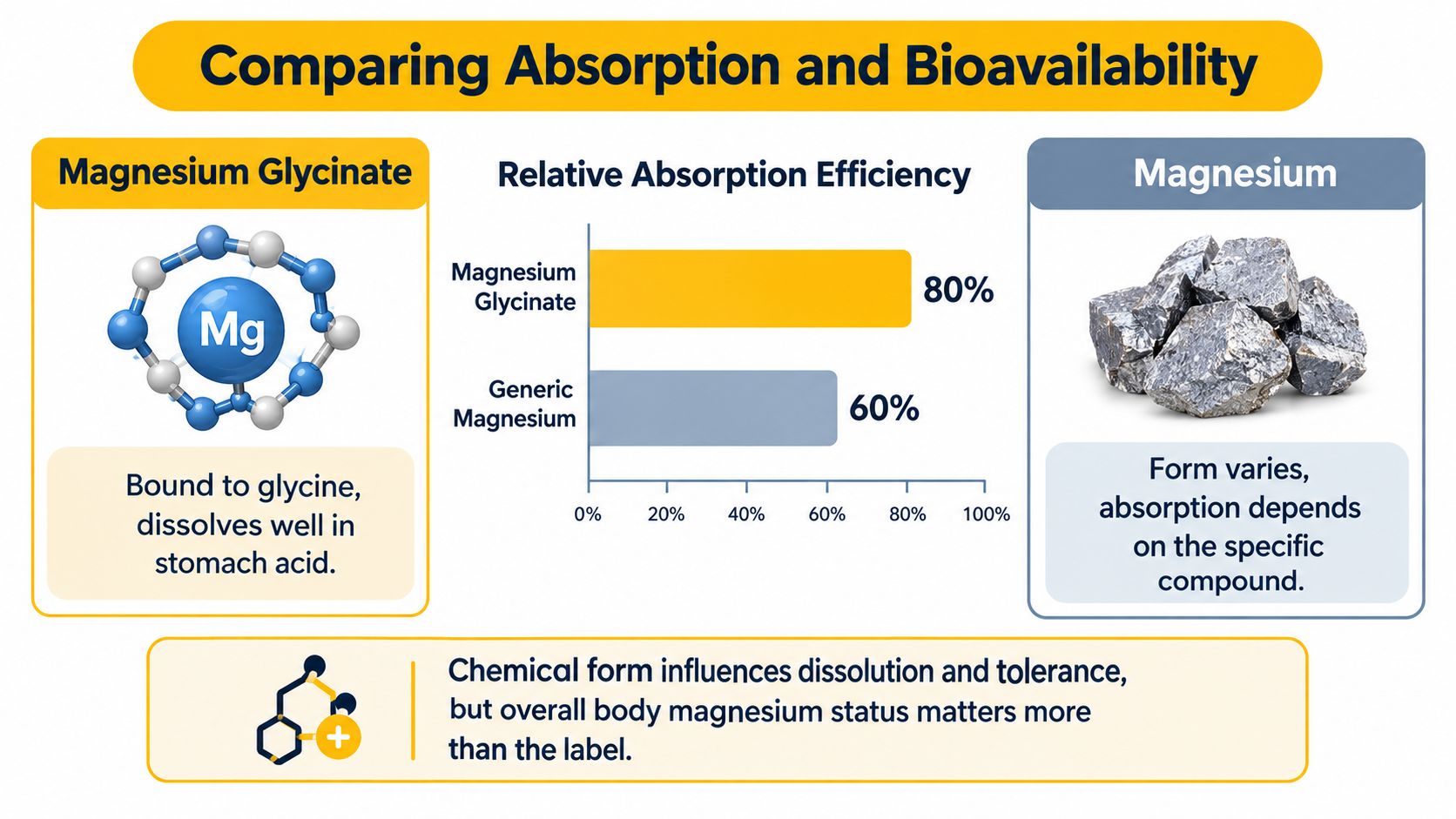
Compare evidence, not categories
For glycinate versus citrate, the useful question is whether an appropriate human comparison demonstrates a meaningful advantage at comparable elemental doses. For glycinate versus oxide, a formulation rationale still needs to be separated from evidence about the intended child outcome.
A comparison with unspecified magnesium is weaker again: without an ingredient identity, the caregiver can't know what was compared.
What can be inferred about absorption
| Comparison question | What the supplied evidence supports | What it does not prove |
|---|---|---|
| Glycinate versus citrate | Comparative human findings require careful interpretation | Glycinate always performs better |
| Glycinate versus oxide | Chemical form is relevant to formulation assessment | A universal paediatric outcome advantage |
| Glycinate versus generic magnesium | The comparator must be identified | A fixed absorption ranking |
| Adult versus child findings | Adult findings can inform further questions | Improved sleep or behaviour in children |
A head-to-head human study is more informative than an assertion that an organic form must absorb better. Even then, its population, dose, comparator and measured outcome determine how useful it is for a particular child.
Plasma magnesium, gastrointestinal tolerance and meaningful improvement are separate endpoints. A blood measurement concerns a biochemical response; stool tolerance concerns acceptability; a sleep or behavioural outcome concerns whether the intervention helped the problem that prompted its use.
For terminology around chelated forms, the guide to magnesium chelate benefits provides related reading. Treat any benefits discussion as a starting point for checking evidence, not a substitute for child-specific assessment.
This accompanying video is optional background rather than proof of comparative effectiveness.
For a purchase decision, favour information you can verify: ingredient disclosure, elemental dose, age suitability and clear directions. Don't pay for an absorption promise unless you understand what was measured and why it matters to your child.
Tolerability, Dosing, and Side Effects
Calling a product gentle doesn't establish that every child will tolerate it. Dose and the child's response remain important, even when a formulation uses a chelated ingredient.
Australian regulatory material addresses dose-related laxative effects and safety conditions rather than treating magnesium as a single, uniformly tolerated ingredient. The TGA consultation on magnesium ingredient requirements provides context for those concerns.
That makes tolerability a practical assessment, not a permanent ranking of glycinate, citrate and oxide.
The graphic below summarises common comparisons, but its categorical claims about gentleness, price and relative gastrointestinal effects shouldn't be treated as established conclusions for children.
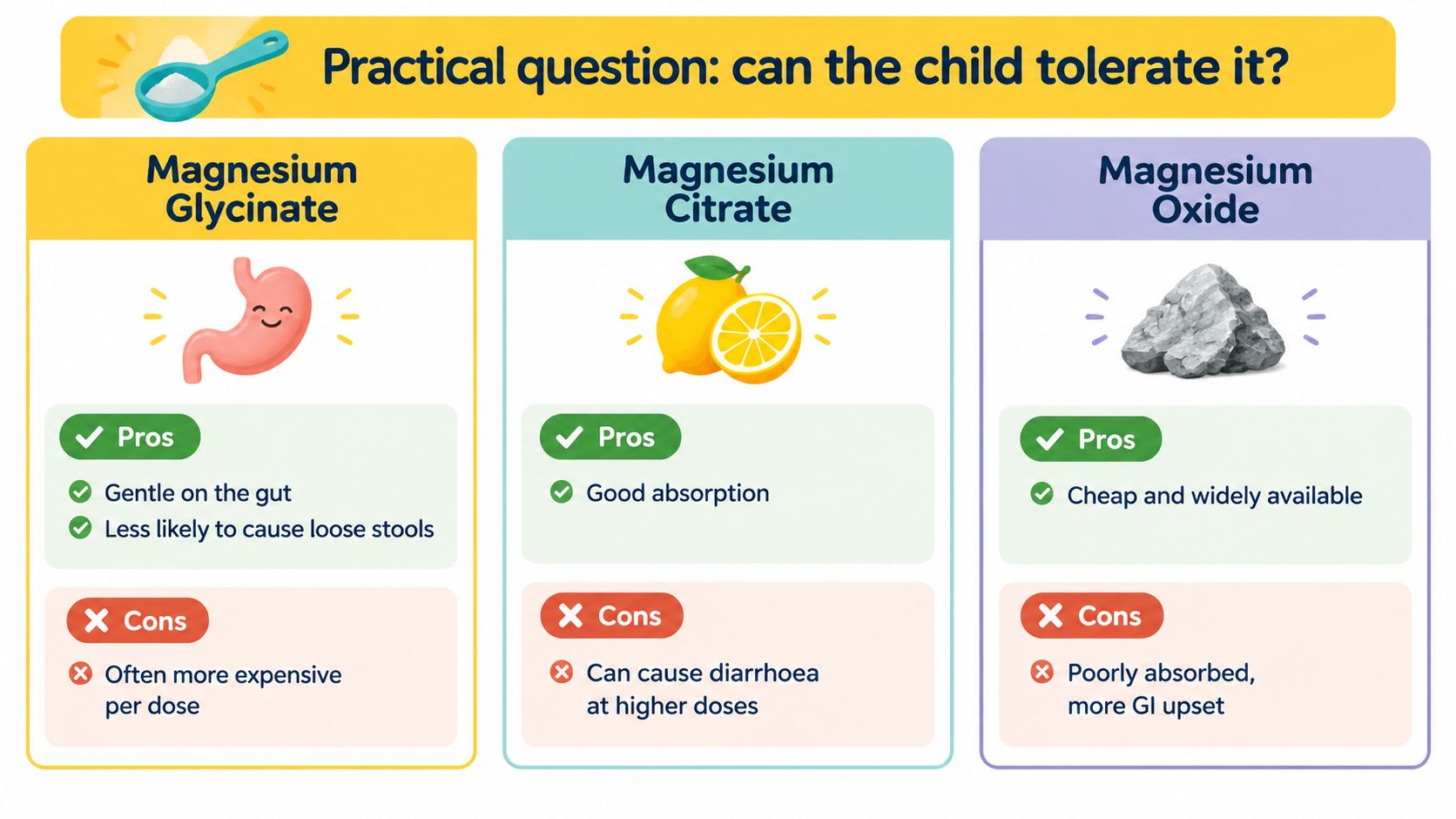
Evaluate the complete routine
A glycinate product can be considered as a formulation choice intended to support tolerability. That's different from claiming it cannot cause gastrointestinal problems or is safer than every alternative.
Similarly, a child's experience with citrate or oxide shouldn't be predicted solely from a comparison chart. For a fair assessment, caregivers and clinicians need to know the elemental dose, serving directions and other magnesium sources.
Tolerability variables
| Variable | Why it matters | Caregiver check |
|---|---|---|
| Elemental daily amount | A form name doesn't describe total exposure | Record the amount taken under the directions |
| Other products | Magnesium may appear in several parts of a routine | Review multivitamins, supplements and medicines |
| Gastrointestinal response | Acceptability must be assessed in the individual child | Note stool changes and discomfort |
| Formulation and format | A product must be usable as well as appropriate | Check ingredients and whether the child accepts it |
Australian guidance identifies diarrhoea, nausea and abdominal cramping as concerns with excessive supplemental magnesium. Don't interpret these effects as evidence that a product is working, or assume that switching to glycinate will resolve them without reviewing the dose and routine.
A tolerable product is one the individual child can use appropriately, not one described as gentle on the packaging.
Bring the full product list to a pharmacist or healthcare professional, including any magnesium-containing laxative. Record fortified foods separately so they can be considered without automatically treating them as ordinary food magnesium or as supplements.
The overview of magnesium gummy side effects can help caregivers prepare questions. Persistent symptoms or an apparent reaction warrant professional advice rather than repeated experimentation with different forms.
How to Compare Doses for Children
Australian guidance separates recommended intake from all sources from the upper limit for supplemental or other non-food magnesium. These figures answer different questions: nutritional adequacy and the boundary used for assessing non-food exposure.
The following age bands and amounts come from the Australian nutrient reference intake tables.
Age-based magnesium comparison
| Age group | RDI from all sources | Supplemental upper limit |
|---|---|---|
| Children aged 4–8 | 130 mg/day | 110 mg/day |
| Children aged 9–13 | 240 mg/day | 350 mg/day |
The cited Australian tables establish these age-specific values; the upper limits don't include magnesium naturally occurring in food. An upper limit isn't a target dose, and an RDI isn't an instruction to supply the full amount through a supplement.
Build separate intake records
Use the elemental declaration to calculate the intended daily serving:
Elemental magnesium per unit × units taken daily = elemental magnesium from that product each day.
Then add the elemental contributions from other supplements and magnesium-containing medicines. Keep a parallel record of dietary intake, including fortified products, and ask a professional how added magnesium should be classified when the source or label is unclear.
- Record the label basis: Note whether the declaration is per gummy or complete serving.
- Use the child's age band: Don't apply an older child's limit to a younger sibling.
- Include overlapping products: A multivitamin or medicine may change the assessment.
- Check the directions: Don't increase the serving just because the total appears below a limit.
As an illustration, a 50 mg elemental magnesium serving supplies approximately 38% of the RDI for a child aged 4–8, using the Australian reference values cited above. That calculation describes its nutritional contribution; it doesn't establish a need for supplementation or individual suitability.
For an older child, use the corresponding age band rather than carrying that percentage across. The serving's elemental amount stays the same, but its relationship to the child's reference intake changes.
Interpret the calculation cautiously
A tally below the supplemental upper limit is only part of the decision. The child's diet, reason for supplementation, other products and tolerance still require consideration.
The paediatric dosing guidelines discussion offers related context for caregiver questions. Product directions and individual healthcare advice should guide the routine, rather than a home calculation being used to justify dose escalation.
Choosing by Everyday Family Scenarios
The practical choice can change when the household problem changes. A caregiver comparing ingredients for nutritional support is making a different decision from a caregiver hoping a gummy will resolve persistent bedtime distress.
For an evening routine, distinguish making a habit easier from demonstrating a therapeutic benefit. A child accepting a product consistently tells you something about usability, not whether magnesium was needed or caused an improvement.
Scenario-based comparison
| Caregiver scenario | What to prioritise | Key limitation |
|---|---|---|
| The evening routine is difficult | A manageable routine and a clearly defined goal | Ease of use doesn't prove a calming effect |
| The child rejects chalky tablets | An acceptable, age-appropriate format | Acceptance doesn't establish nutritional need |
| The family is comparing glycinate and citrate gummies | Elemental dose, directions and tolerance | The form name alone can't settle the choice |
| The child already takes a multivitamin | A complete ingredient and dose review | Product overlap can be missed |
| Sleep or behavioural concerns persist | Individual professional assessment | A supplement-only approach may miss the underlying issue |
A catalogue example without a superiority claim
Daily Powers Calm illustrates why the elemental declaration matters: its catalogue lists magnesium citrate, not glycinate, with a daily serving providing 200 mg magnesium citrate containing 30 mg elemental magnesium. Those are different descriptions of the same ingredient contribution, not amounts to add together.
The catalogue directs 2 gummies daily, or as directed by a healthcare professional, and lists vitamin B6, zinc and prebiotics alongside magnesium. These details describe the formulation and directions; they don't establish superiority, equivalence to glycinate or suitability for every child.
A family comparing that formulation with a glycinate product should apply the same checks to each. Neither the gummy format nor the chemical name should bypass the intake review.
Match the decision to the actual difficulty
If the obstacle is tablet refusal, ask about an appropriate alternative format. If the concern is gastrointestinal discomfort, review exposure and symptoms before changing products.
If the child already follows a supplement routine, checking for duplication may be more useful than adding another ingredient. And if the concern is ongoing anxiety, sleep disruption or behaviour, make assessment the priority rather than choosing the product with the strongest calming language.
A Practical Recommendation for Kids' Magnesium
There's no evidence-based reason to declare glycinate universally best for children. A more defensible recommendation starts with whether supplementation is appropriate, then considers how a specific product fits that child.
Begin with age, usual diet, other supplements and medicines, the reason magnesium is being considered, and any previous product reactions. A clinician can help distinguish a nutritional question from a persistent symptom that needs a different assessment.
Australian regulation also deserves careful interpretation. The TGA guidance on supporting claims and indications for listed medicines addresses the conditions for nutrient supplementation claims, including an absorbable nutrient form. That shouldn't be read as proof that a particular magnesium product improves a child's sleep or behaviour.
Make the recommendation conditional
Glycinate may be considered when its formulation, elemental dose and directions fit the child and a healthcare professional agrees it's appropriate. Citrate or another form shouldn't be rejected just because it lacks the glycinate name.
Use the checklist below to organise the discussion rather than as permission to start supplementation independently.
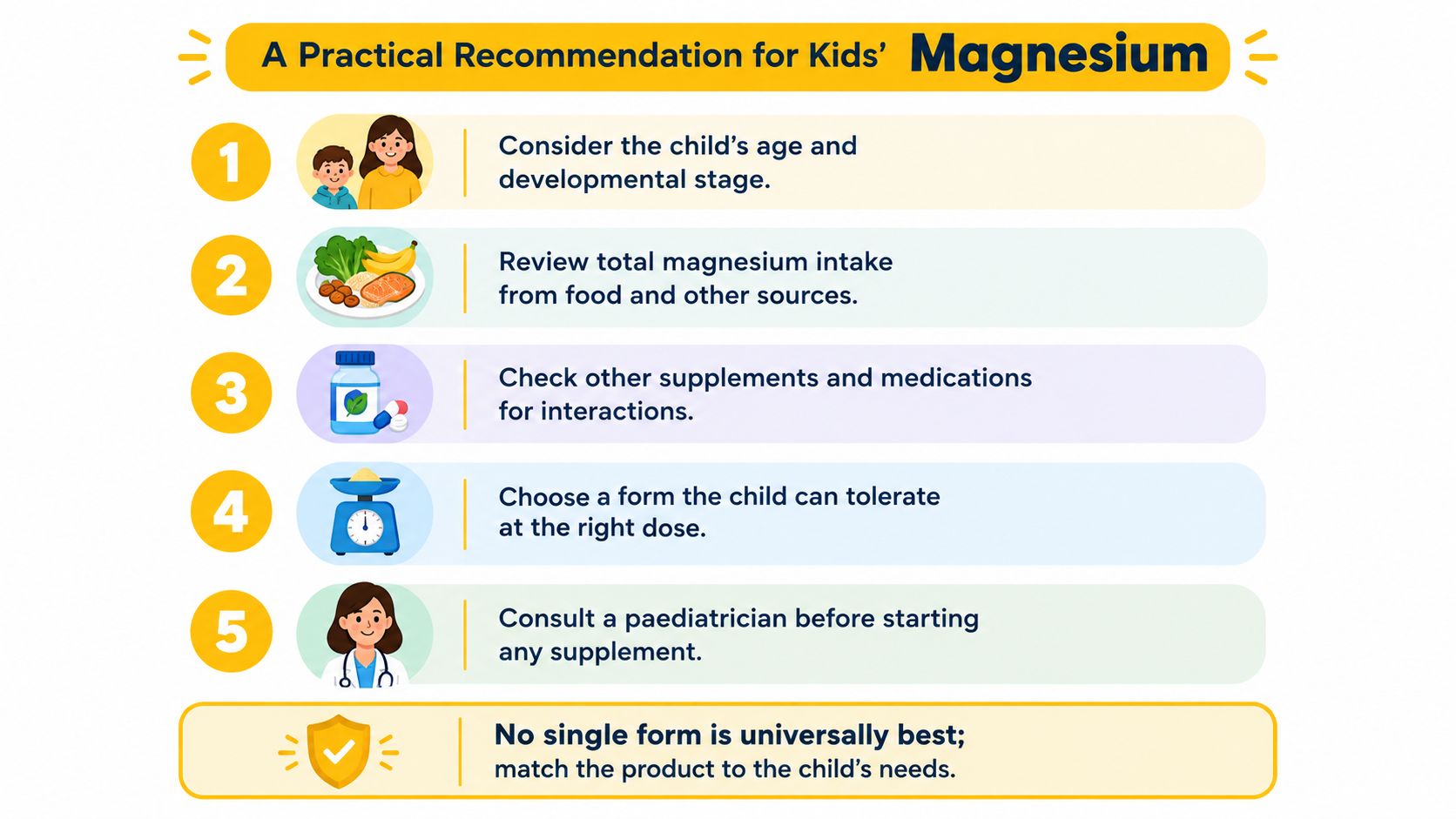
Decision standard: Choose a transparent, appropriate and tolerable formulation for a defined need, not a chemical name with the strongest promise.
If a professional recommends a trial, agree on what you're trying to achieve and what would count as a reason to stop. Avoid changing several parts of the child's routine at once, because that makes any apparent response harder to interpret.
Document and review
Keep a simple record that makes the follow-up conversation useful:
- Starting routine: Product, elemental amount, serving and timing.
- Tolerance: Stool changes, nausea, abdominal discomfort or other concerns.
- Adherence: Whether the child took the directed serving.
- Intended outcome: The specific difficulty you hoped would improve.
- Review decision: Whether professional advice supports continuing, changing or stopping.
Stop the product and seek advice if adverse effects occur. If the original concern persists, don't keep increasing magnesium or switching forms in the hope of finding an answer.
The strongest conclusion from magnesium glycinate vs magnesium is therefore a change in the decision itself: choose by demonstrated need and a verifiable dose, not by category confusion or an absorption slogan. Children with persistent sleep, anxiety, behavioural or gastrointestinal concerns need individual guidance, not a supplement-only solution.
Daily Powers offers children's gummy supplements with published ingredient information and serving directions, allowing caregivers to examine the formulation rather than rely on the product name. Visit Daily Powers to review the labels, then discuss the elemental magnesium amount and your child's existing routine with a pharmacist or healthcare professional before adding a supplement.