

Most shopping advice tells you to look for TGA approved vitamins and stop checking there. That's the mistake. The phrase sounds like a guarantee that the Therapeutic Goods Administration tested a product, proved it works, and endorsed the result on the pack. For most children's vitamins in Australia, it doesn't mean that at all.
You're not being careless if you've read it that way. Retailers, ads and even well-meaning friends use the shorthand because it's short and reassuring. The safer habit is slower and more useful. Find the AUST number, check it on the register, then read every claim against that exact entry.
Table of Contents
- What TGA Approved Really Means for Vitamins
- Listed, Assessed and Registered Vitamins Compared
- How to Verify a Vitamin on the ARTG
- Reading the Label on a Children's Vitamin
- Which Vitamin Claims Are Safe to Trust
- Checking Total Daily Intake Across Products
- When a Child Needs Advice Before Starting
- Confirm the Listing Before You Buy
What TGA Approved Really Means for Vitamins
In Australia, vitamins aren't regulated as foods. They're generally complementary medicines under the Therapeutic Goods Act 1989, and most need an entry on the Australian Register of Therapeutic Goods, called the ARTG, before they can legally be supplied.
That register entry is what people usually mean by TGA approved vitamins. It doesn't automatically mean the TGA tested that bottle in your hand and endorsed the outcome in the advertisement. For a typical listed vitamin, it means the sponsor has put the product on the register using permitted ingredients and permitted indications, and must meet manufacturing and labelling rules.
Plenty of households face this decision. In 2023, 33.6% of Australians took a dietary supplement, according to the Australian Bureau of Statistics food and nutrition data. With use that common, a vague trust signal isn't enough, especially when you're buying for a child.
A listing confirms regulatory eligibility and compliance. It doesn't confirm that your child needs the product, or that your child will benefit from it.
Three questions replace the shorthand. What regulatory status does this exact product hold? Can you find that status on the ARTG using the number on the pack? Do the label, website and ads stay inside the wording that entry allows?
If you can answer those three, you can shop with your eyes open. You'll know where the AUST number sits, how to search it, and how to spot a claim that's wandered beyond the listing.
Listed, Assessed and Registered Vitamins Compared
Start with the number on the pack, because it tells you which pathway the product used.
TGA vitamin statuses, identifiers and what they confirm
| Status | Label identifier | What the TGA checks | What it does not confirm |
|---|---|---|---|
| Listed medicine | AUST L number | Permissible ingredients, permissible indications and manufacturing standards; sponsor holds supporting evidence | Individual efficacy assessed before supply |
| Assessed listed medicine | AUST L number | Quality, safety and evidence reviewed before listing | Claims beyond the approved listed wording |
| Registered medicine | AUST R number | Safety, efficacy, performance and quality assessed before registration | Individual response or suitability for a specific child |
The Listed Pathway Most Vitamins Use
Most everyday children's vitamins sit in the listed medicine pathway because they're considered lower risk. The TGA guidance on the legislative framework for listed medicines explains that listed medicines aren't routinely subject to full pre-market TGA assessment of safety, quality and efficacy, ingredients must comply with the Therapeutic Goods (Permissible Ingredients) Determination, and label indications must be selected from the Therapeutic Goods (Permissible Indications) Determination.
In plain language, the sponsor, not the TGA, does the upfront checking. The sponsor must verify every active ingredient and excipient against the permissible ingredients rules. That includes the permitted age, route, dose and warning conditions for that formulation.
The sponsor must also hold evidence supporting each claimed benefit. Holding evidence and having the TGA assess that evidence before sale aren't the same thing. That gap is where parents get caught.
For a children's gummy, the sponsor should be able to show why each ingredient is allowed, why the dose suits the stated age range, and which permitted indication supports each claim. If a website says a product supports energy or concentration, there should be a matching listed indication behind those words.
How Assessed and Registered Products Differ
An assessed listed medicine also carries an AUST L number, but the TGA reviews quality, safety and evidence before listing. A registered medicine carries an AUST R number and goes through a higher level of pre-market evaluation covering safety, efficacy, performance and quality.
Neither status promises that a particular child will respond in a particular way. Registration is a stronger pre-market check, not a personal suitability test. Suitability still depends on your child's diet, health, medicines and total intake from other products.
Reading rule: AUST R means a higher-level assessment took place before registration. AUST L means you should check every claim against the listed indication yourself.
Match the number on your pack to one row in the table before you read any marketing. If it's AUST L, don't treat listing as proof of efficacy. If there's no AUST number at all on a product making therapeutic claims, you don't yet have a verified Australian listing to rely on.
How to Verify a Vitamin on the ARTG
A label saying “TGA approved” is not the verification. The useful check is whether the product's AUST number leads to an ARTG entry that matches the pack and supports the claims being made.
Look for the AUST number in the image: it should appear on the product packaging, not only in an online listing or advertisement.
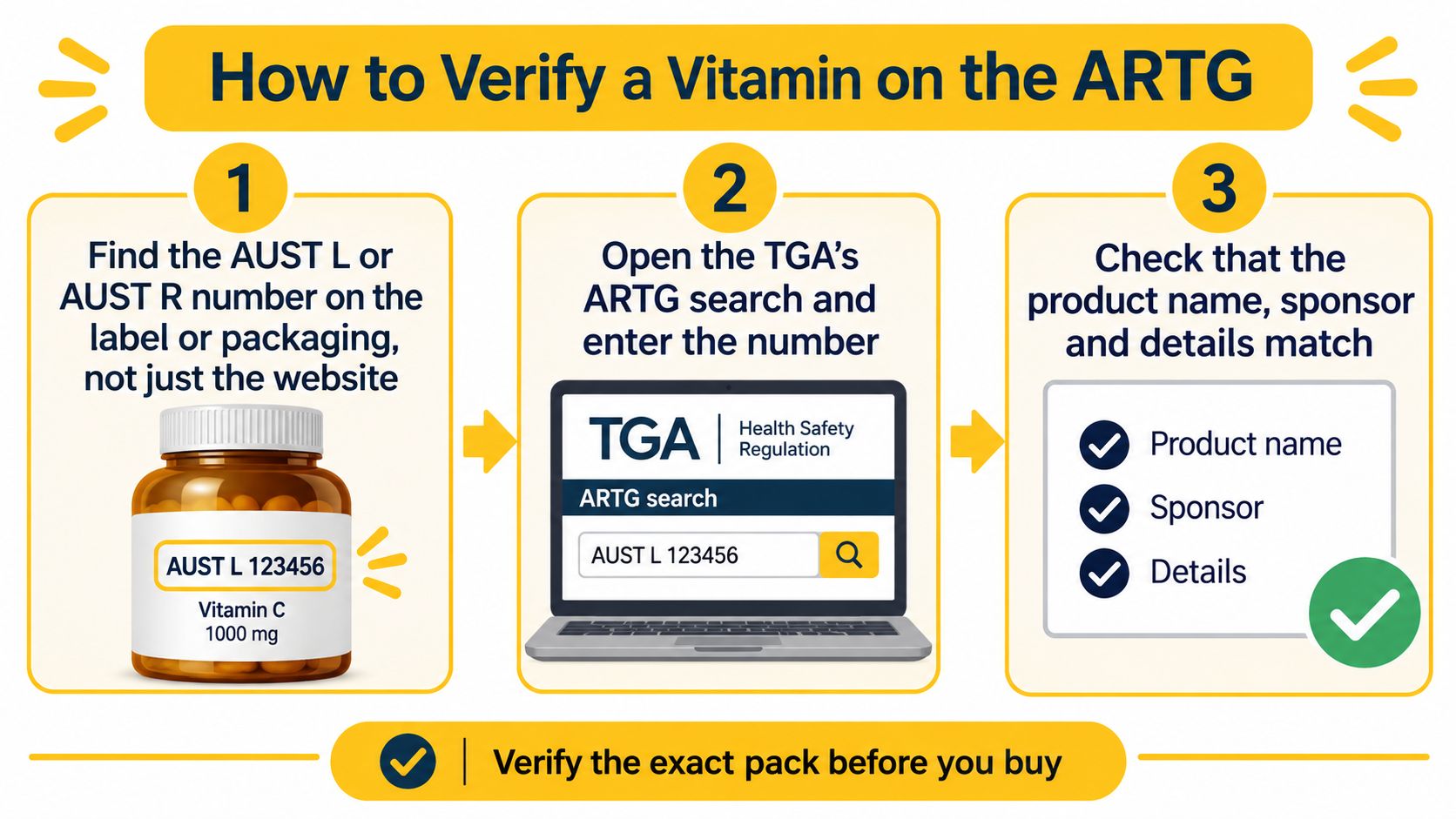
- Find the number on the physical pack. Look for AUST L or AUST R followed by digits. An online listing may show a different variant, an old pack image or a similar product, so use the number on the pack you are considering.
- Search the ARTG by number. Open the TGA's ARTG search and enter the exact number. Searching by brand name can return several products, flavours or formulations. The number is the more precise route to the relevant entry.
- Match the product name and sponsor. Check that the name and sponsor in the entry correspond to the pack. A different sponsor or product name may indicate that you are looking at a different entry, so pause before treating it as a match.
Compare Claims, Ingredients and Warnings
- Compare the listed indications with the claims. Check claims about energy, concentration, relaxation or immunity against the ARTG entry. The wording need not be identical, but the marketing should not promise more than the listed indication supports.
- Check ingredients and warnings against the entry. Review the label's ingredients, directions and warnings alongside the ARTG information. Pay particular attention to age limits, maximum daily dose and warnings about medicines or allergies.
- Stop if the entry does not match. If the number returns no result, or the entry belongs to another product, you have not verified the claim for that pack. Ask the sponsor for an explanation in writing or choose another product.
Retailer badges, screenshots and influencer posts cannot substitute for the ARTG entry for the product in your hand.
For example, a checkout page may call a gummy TGA approved while the carton has no AUST number. Without that number, you cannot check the product against the register. The appealing flavour or price does not fill that gap.
A successful check gives you a matching ARTG entry and a way to compare its indications with the product's claims. A mismatch tells you what remains unverified.
Reading the Label on a Children's Vitamin
Use this table with the pack in one hand and the ARTG entry open on your phone.
Label checks for a children's vitamin
| Label item | What to confirm | Red flag |
|---|---|---|
| AUST L or AUST R number | Matches an ARTG entry for the same product name and sponsor | Missing number, or 'TGA approved' with no ARTG entry |
| Product name and sponsor | Same as the ARTG record | Name differs from the register or sponsor is unknown |
| Ingredient list | Every active and excipient listed, with amounts per serve | Vague 'proprietary blend' or missing amounts |
| Age range and directions | Age range and number of gummies or tablets per daily serve | No age range or dose stated for a child |
| Warnings | Medicines, allergies, pregnancy and maximum daily use | No warnings on a product for children |
| Website and packaging | Claims match the label and the ARTG indication | Claims on the website that do not appear on the label |
Where Caregivers Most Often Miss a Problem
The ingredient list deserves slow reading. You need amounts per serve, not just ingredient names, because amounts let you add up intake across a multivitamin, fortified cereal and any second supplement. If you're also checking whether a formulation suits your family's dietary choices, our guide on whether multivitamins are vegan shows which label words to look for.
Directions are the second trap. A pack should state the age range and exactly how many gummies or tablets make the daily serve. Two gummies for a six-year-old is a different instruction from two gummies for a teenager, and the label should remove that guesswork.
Gummies need one extra check that tablets don't. Because they resemble confectionery, children can treat them as a snack and help themselves. Read the storage instruction, keep the container out of reach, and treat the stated maximum as a limit, not a suggestion.
Which Vitamin Claims Are Safe to Trust
A claim is safer to trust when you can find the same idea in the product's permitted indications. Friendly wording doesn't change that test.
The image below contrasts acceptable support language with claims that promise too much.
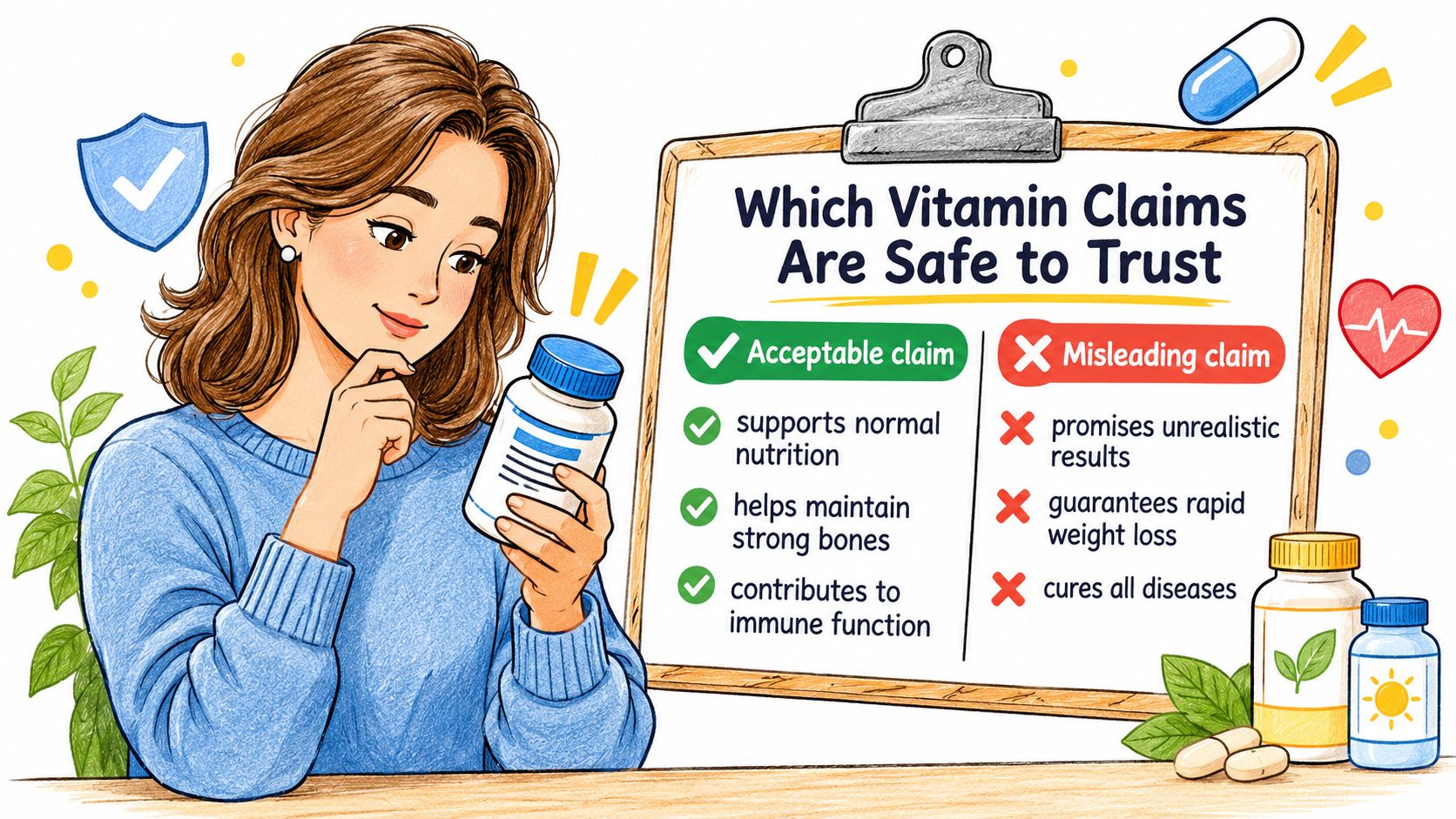
Acceptable if listed: "Supports normal daytime energy as part of a varied diet," and similar support wording for concentration or relaxation. Red flags: improving school performance, treating anxiety, preventing illness, or "Stops tiredness at school." Those name outcomes or conditions a listed vitamin shouldn't promise.
Websites, packaging, reviews and testimonials are all marketing, so they must stay consistent with the label and entry. Our explainer on what evidence-informed practice means helps you separate a supported indication from a testimonial. A daily multivitamin such as Brave, described as daily multivitamin gummies for kids with a vegan-friendly formulation and no artificial colours or flavours, still needs its claims checked against its own entry.
This short video is a useful pause before you apply the test to a live product page.
Ask three questions of any claim. Does it name a result? Does it name a condition? Does it promise a specific child's outcome? If you answer yes to any, match the wording to the ARTG indication closely or treat the claim with caution. For nutrient-specific claims, also check current TGA notices for that nutrient before you trust the wording.
Checking Total Daily Intake Across Products
A listed product can still duplicate nutrients from other sources. One bottle may look reasonable by itself, while the combined amount from supplements and fortified foods is higher than expected.
Healthdirect's guidance on dietary supplements explains that supplements can cause side effects or interact with medicines, and that higher intake is not automatically better. It recommends discussing supplements with a doctor, nurse or pharmacist.
Check the whole day, not just the supplement label.
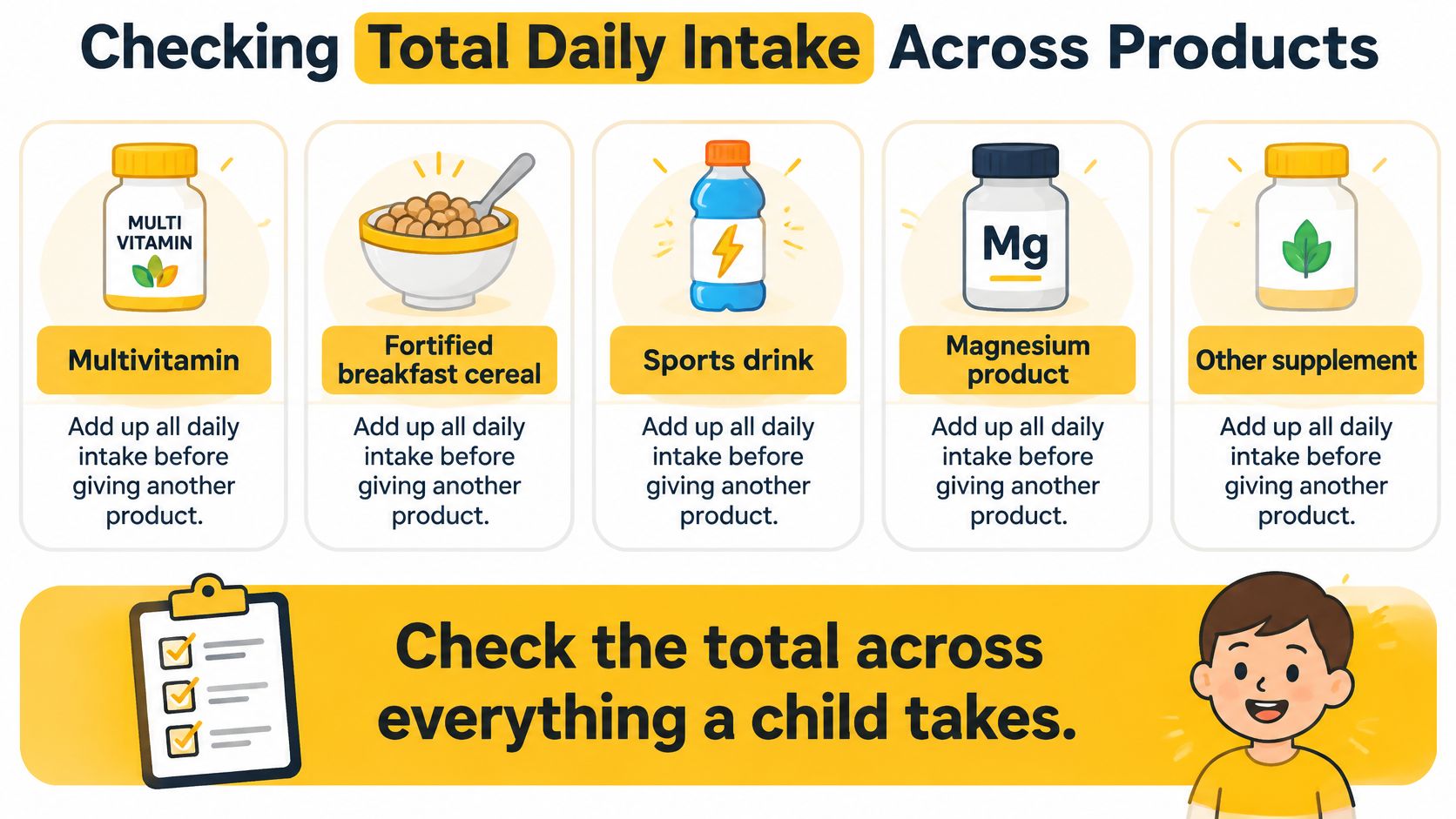
A Five-Part Stacking Checklist
- List everything for a typical day: Include the multivitamin, fortified breakfast cereal, sports drink, magnesium product and any other supplement. Check school and weekend routines too, since they may differ.
- Compare duplicated nutrients: Look for vitamin D, zinc, vitamin C and magnesium across product labels. Ingredients can also appear under different names, so ask a pharmacist if you are unsure whether two names refer to the same ingredient.
- Check each age range: A product labelled for adults or teens may not suit a child, even at a smaller serve. Age-specific directions help distinguish products formulated for different users. See these paediatric dosing guidelines for help reading those directions.
- Add amounts across products: Note the amount of each repeated nutrient from every supplement and fortified food. Keep the units consistent, such as micrograms (μg), before adding.
- Keep a written tally: Record the products and amounts together. A simple list makes duplication easier to spot and easier to discuss with a healthcare professional.
One Worked Example
If one product provides 5 μg of vitamin D per serve and another provides 5 μg, the total from supplements is 10 μg before counting food. Add the amounts only after checking that both figures refer to a daily serve.
A sugar-free, vegan label can make a product more suitable for some families, but it does not change the nutrient total. Store gummies out of reach to prevent an unsupervised extra serve. Bring your tally when discussing whether the products can be combined.
When a Child Needs Advice Before Starting
Some children shouldn't start a new vitamin on the strength of a listing alone. The ARTG entry addresses regulatory eligibility. It doesn't assess your child's individual nutritional need.
Seek advice first if your child has a diagnosed deficiency, a chronic condition, a restricted or unusual diet, a known allergy or intolerance, or takes any regular medicine. Add unexplained symptoms to that list too. Tiredness, poor appetite or trouble concentrating can have causes a vitamin isn't designed to address, and a supplement can delay the right check.
We recommend speaking with a GP or healthcare professional before starting any new supplement, especially for children with allergies, a medical condition or on other medications. That's not a disclaimer to scroll past. It's the step that connects a general product to one child's history.
Who to Ask and What to Bring
- GP: Best for medical questions, diagnosed deficiencies, symptoms and chronic conditions.
- Pharmacist: Best for medicine interactions, duplicate ingredients, dose timing and maximum daily use.
- Dietitian: Best where food intake is restricted, selective or unusual, and you need a dietary picture first.
Bring a photo of the front and back of the label, the AUST number, and your full list of foods, supplements and medicines. Note the daily dose you plan to give, the time of day, and why you're considering the product. If your child has tried it before, write down any reaction and when it happened.
That preparation turns a vague conversation into a decision. The clinician can check interactions, judge whether testing is needed, and tell you what change to watch for and over what period.
If a child takes more than the label directions, or shows an unexpected reaction, seek medical advice promptly rather than waiting to see if it passes.
You don't need to be alarmed to act quickly. Note what was taken, how much, and when, then call for advice with that information ready.
Confirm the Listing Before You Buy
At the point of purchase, the question is whether this product fits your child's needs and can be used as directed. If anything on the pack or product page is unclear, pause and resolve it before checkout.
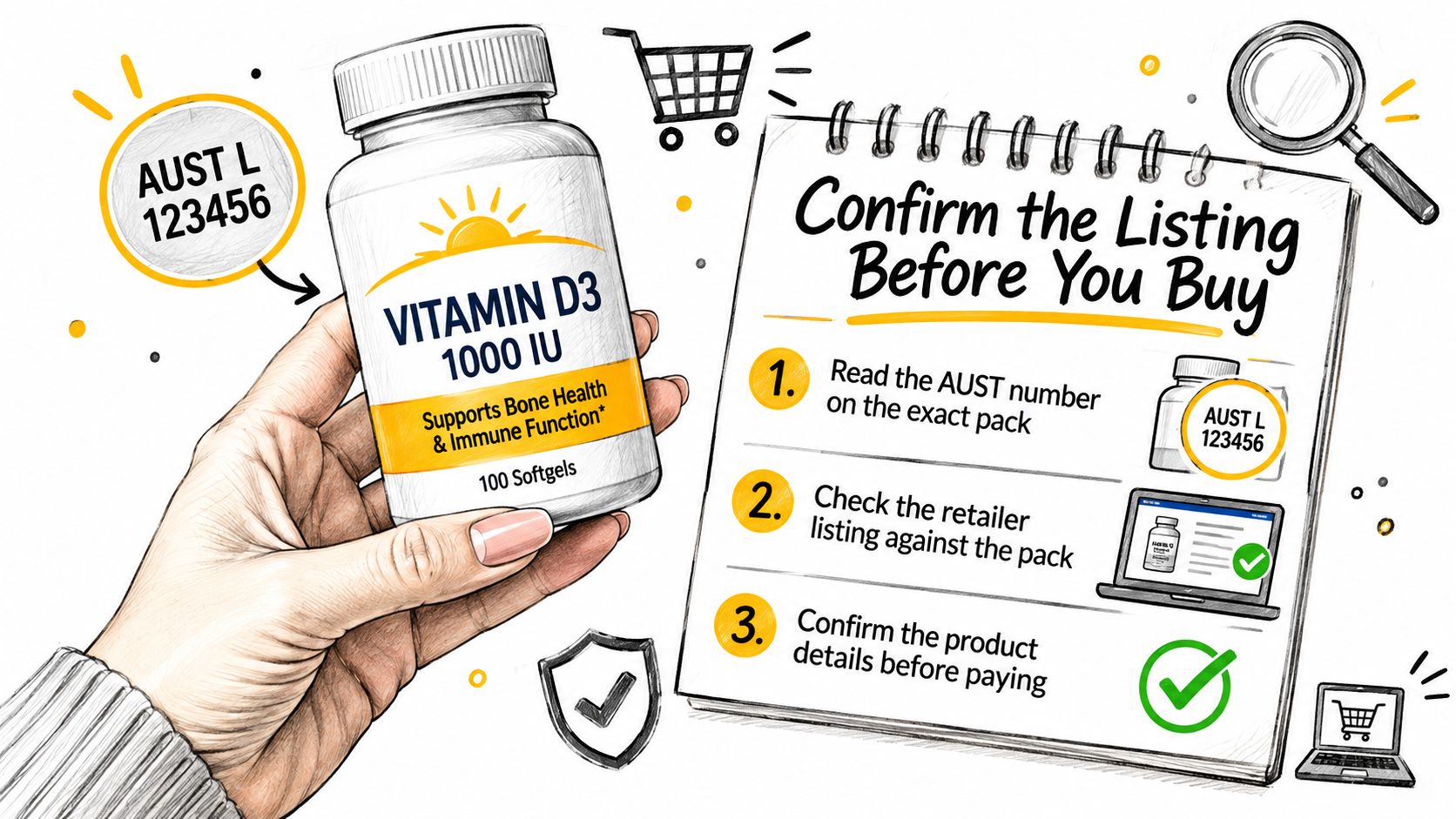
For the ARTG lookup steps, return to section 3. At purchase, make sure the product you choose is the one you checked, and that its directions suit your child's age and circumstances. Keep the label available so you can refer to the listed serving when using it.
If you start a vitamin, allow time to assess the routine. Daily Powers recommends consistent daily use for at least 30 days to see the full benefits of its vitamins. A brief daily note on energy, sleep, appetite or any reaction can help you track changes over that period. For children aged 4 to 15, Daily Powers recommends 2 gummies daily, or as advised by a healthcare professional.
At Daily Powers, you'll find vegan, sugar-free gummies with no artificial colours or flavours, and ingredient lists and dosing guidance to help you make an informed choice.